• 검색 결과가 없습니다.

Fabrication of Plasma Electrolytic Oxidation Coatings on Magnesium AZ91D Casting Alloys

N/A
N/A
Protected

Academic year: 2021

Share "Fabrication of Plasma Electrolytic Oxidation Coatings on Magnesium AZ91D Casting Alloys"

Copied!
7
0
0

로드 중.... (전체 텍스트 보기)

전체 글

(1)

한국표면공학회지 J. Korean Inst. Surf. Eng.

Vol. 50, No. 6, 2017.

https://doi.org/10.5695/JKISE.2017.50.6.432

<연구논문>

ISSN 1225-8024(Print) ISSN 2288-8403(Online)

Fabrication of Plasma Electrolytic Oxidation Coatings on Magnesium AZ91D Casting Alloys

Sung-Hyung Lee

a,b,*

, Hitoshi Yashiro

b

, and Song-Zhu Kure-Chu

c

a

GEO Nation Co. Ltd., Tokyo, Japan

b

Department of Chemistry and Bioengineering, Iwate University, Morioka, Iwate, Japan

c
Materials Function and Design, Nagoya Institute of Technology, Nagoya, Aichi, Japan

(Received November 24, 2017 ; revised December 21, 2017 ; accepted December 28, 2017)

Abstract

AZ91D casting alloy requires an advanced plasma anodizing processing because large amount of defects are liable to generate during anodization. In this study, plasma electrolytic oxidation (PEO) of AZ91D Mg alloy was conducted by the application of either constant voltage or current using a pulse mode and its effects on pore formation, surface roughness and corrosion resistance were investigated. The PEO films showed a three-layer structure. The PEO film thickness was found to increase linearly with voltage. The surface roughness, Ra, ranged between 0.2 µm and 0.3 µm. The corrosion resistance increased from RN 3.5 to 9.5 by the PEO treatment when evaluated according to the 72 hour salt spray test. The PEO-treated surface exhibited higher pitting potential than the raw material

Keywords: AZ91D magnesium alloy, Unipolar pulse, Anodic oxidation, Plasma, Ceramic coatings, Corrosion resistance, Surface roughness

1. Introduction

In recent years, there has been an exponential growth in demand for light materials such as Mg for use of mobile electronic devices, as well as lightweight automobiles and industrial applications.

Accordingly, interest in the surface treatment of Mg and its alloys has also increased.

Mg is lightweight and has excellent specific strength, thermal conductivity, electrical conductivity, and electromagnetic interference shielding ability.

However, because these materials are highly reactive, they corrode easily when used without pre-treating the surface, which limits their use.

Various types of existing anodizing methods can form a porous oxide film on Mg surface, but the

formed film does not possess sufficient thickness, hardness, or corrosion resistance [1-6]. Plasma anodizing is a type of surface treatment that forms oxide films electrochemically with generation of plasma in an aqueous solution. This method uses a low concentration neutral/alkaline electrolyte without harmful substances such as sulfuric acid or chromic acid.

Plasma anodizing consists of complex processes including simultaneous formation of oxidation layer, dielectric breakdown, dissolution of the formed oxidation layer, and gas generation [7,8]. When the voltage applied during the treatment is higher than the dielectric breakdown voltage, the oxide film layer that had formed breaks down and plasma is generated. In addition, the metal ions produced by the electrolysis of substrate react with hydroxide ions supplied to the surface to form a very strong oxide film [9].

The objective of this study is to establish an optimal system that can form a stable oxide film during the plasma anodizing process. Either voltage control or current control in a unipolar pulse mode

* Corresponding Author:Sung-Hyung Lee

Department of Chemistry and Bioengineering, Iwate University

Tel: +82-19-621-6330 ; Fax: +82-19-621-6330

E-mail: [email protected]

(2)

were applied to investigate the effect of the power mode on the oxide film. Moreover, the study also optimized temperature and time and investigated chemical composition of the formed oxidation layer.

2. Experimental Methods

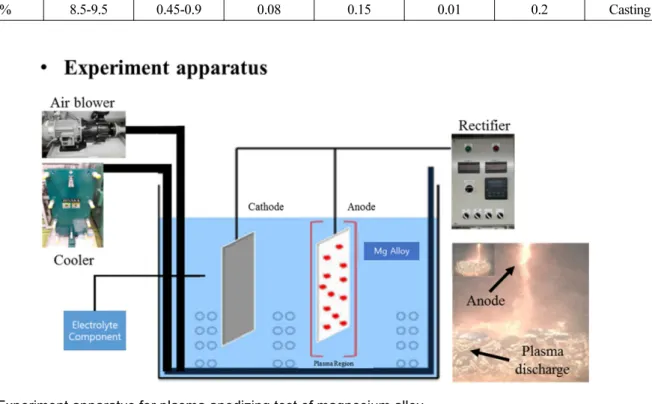
The plasma anodizing system is comprised of the electrolytic component, a high-voltage, high-current, 50 HZ pulse-reverse rectifier (NF, BP4650), a cooler (Lab Companion, RW-1025G), stainless steel (type 316) heat exchanger, and an air bubble system.

Figure 1 shows the schematic of this plasma anodizing system.

Figure 2 shows a schematic of the pulsed unipolar output. There is a pause between pulses, and voltage is constant in the unipolar type. An insulated gate bipolar transistor (IGBT) type multimeter was used in this study to control the pulse width.

In the unipolar case, the pulse cycle has 500 ms of positive (+) time (“on-time) and 500 ms negative (-) time (“off-time”). If the positive (+) pulse width is too short, surface plasma does not sufficiently form because the energy applied during a single pulse does not provide enough energy to generate plasma, which greatly influences the formation rate of the oxide film.

When the micro-arc occurs on the surface of the specimen by the electric pulse, the surface material melts at a momentarily high temperature, and the molten molten material is then quenched by the surrounding water forming craters and then cooled [10].

Meanwhile, the graphite plates were used as a cathode. Since the current density varies depending on the interelectrode distance and their size, graphite plates having a size of 10 × 30 mm were placed in front and behind the specimen to form a uniform oxide film layer. The electrolyte solution basically consisted of 2 g / l of sodium aluminate, 5 g / l of Fig. 1. Experiment apparatus for plasma anodizing test of magnesium alloy.

Fig. 2. Schematic of the pulsed unipolar output of a

plasma anodizing power supply.

(3)

sodium hydroxide, and 10 g / l of sodium silicate.

A circulation system enables controlling the temperature of the electrolyte solution, as shown in Figure 1. During the plasma anodizing treatment, a significant amount of oxygen gas is generated on the anode. If oxygen gas adsorbs onto the surface, the oxide film layer does not form on that area. This may cause formation of a nonuniform porous film.

The system used in the present study eliminates oxygen gas using strong pump flow without any additional vortex equipment. The system was designed to align the direction of the cold electrolyte solution being supplied to the position of the specimen. By positioning the specimen parallel to the direction of the electrolyte supply, the oxygen gas adsorbed on the surface was eliminated by the force of the flow of the electrolyte solution, a stainless steel heat exchanger was used to control the temperature of the electrolyte.

The cross-section and composition of plasma- anodized samples were observed by field emission scanning electron microscopy (FESEM) with an attachment of elemental analysis(EDS). For this purpose, the specimens were cut, cold mounted, and polished with silicon carbide (SiC) paper.

In order to evaluate the corrosion resistance, anodic polarization and salt spray tests were carried out. The salt spray test followed the American Society for

Testing and Materials (ASTM) - B117 standard test using a 5 wt% NaCl solution maintained at 35

o

C for 72 h. Corrosion characteristics were quantified by assessing the samples by average rating numbers (RN).

Surface roughness was measured using surface roughness tester (MITUTOYO, SJ-400) and the roughness average ( Ra) was used. The measurement was made over the surface of 0.8 mm for 3 times for each specimen. The Ra represents an average surface roughness value from the measurement center line to the surface contour.

3. Results and Discussion

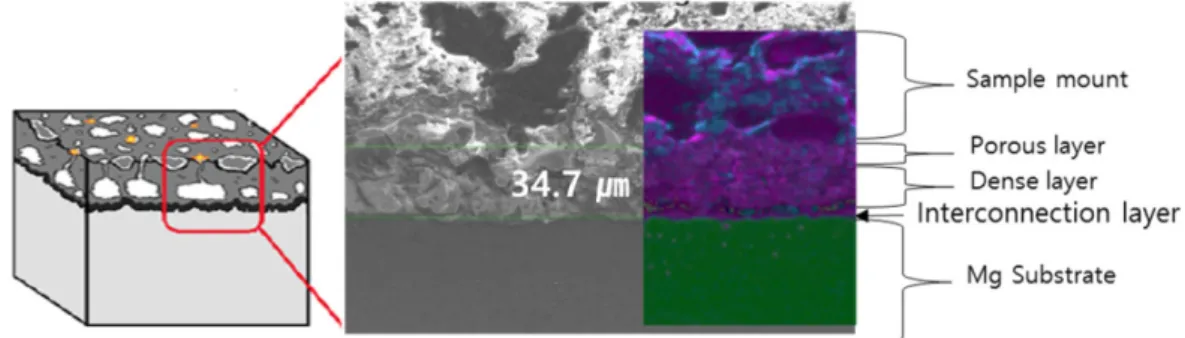
Figure 3 shows the three-layer structure oxide film of plasma anodizing. The porous structure of the outermost layer may be advantageous to additional painting to have excellent coating adhesion. The dense middle layer is superior in mechanical properties (abrasion resistance) and corrosion resistance, and the interconnection layer is a very thin layer through which electricity passes from the material to the oxide film [11].

Various types of oxide pore / crack structures can be generated in the plasma anodization process. The roughness due to porosity and pore size can affect the durability characteristics.

Fig. 3. Cross sectional view of AZ91D after plasma anodizing using pulse for at 150 V, 10 min.

Fig. 4. Surface morphologies of AZ91D before (a) and after pulse plasma anodizing for 30 min under (b) voltage

control of 150 V and (c) current control of 10 A/dm

2

.

(4)

Figure 4 shows FESEM images of raw material and that treated under 150 V voltage control and 10 A/dm

2

current control.

When the voltage was controlled, the pores of the oxidized surface showed a relatively constant size and only a small amount of the ejected material was detected. Also, the surface pore size was relatively uniform and no micro cracks or crater (sinkhole / pipe) were observed. When the current is controlled, the surface void becomes uneven, and a lot of fine cracks and crater holes are observed.

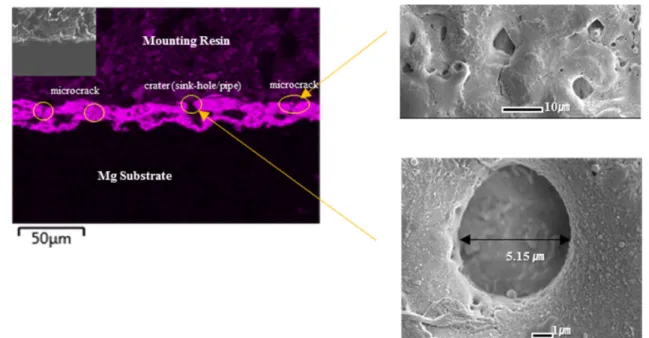
Figure 5 shows of the cross-sectional plasma oxidation oxide formed under 10 A/dm

2

current control.

A crater (sinkhole/pipe) is a pore created by the plasma at the material/oxide interface, and a sink- hole/pipe leads a porous coating with less durability.

The reason of microcrack generation is that the temperature of the material metal rises due to the heat generated in the plasma electrolytic oxide film process and the tensile stress becomes larger than the thermal expansion coefficient of the oxide film [12].

Figure 6 shows surface roughness of AZ91D material before and after the plasma anodizing treatment as indicated in Ra.

As a result of controlling the voltage, it was observed that the pores on the surface of the oxide film were relatively constant and the surface roughness was in the range of Ra 0.2 to 0.3 µm.

When the current was controlled, craters and micro

cracks were generated, and the surface roughness was 0.45 to Ra 0.6 µm. Therefore, it is more preferable to control the voltage than to control the current to obtain a uniform oxide film.

As the treatment voltage increases or the treatment time becomes longer, the oxide film grows thicker. In turn, as the oxide film becomes thicker, the electrical resistance increases, thus affecting generation of plasma [13]. Therefore, the current flowing on the specimen surface during the plasma anodizing treatment does not increase proportionately to the voltage level. Moreover, the higher applied voltage increases the strength of the plasma, thereby dissolving a greater amount of material from the surface. Thus, a strong micro-arc is sustained for a Fig. 5. The structure of oxide film formed on AZ91D by the pulse plasma anodizing for 10 min under current control of 10 A/dm

2

.

Fig. 6. Surface roughness of AZ91D after pulsed plasma

anodization for 10 min: (a) Raw material (b) Voltage

control 150 V (c) Current control 10 A/ dm

2

.

(5)

long time at the voltage level that exceeds the dielectric breakdown voltage.

Figure 7 shows the effect of pulse plasma anodizing on the anodic polarization behavior in 3.5 wt.% NaCl solution at 25

o

C. It was found that specimen after plasma anodizing treatment showed higher breakdown potential than the original material. The breakdown potential was highest when 150 V pulse voltage was applied, which means that the oxide layer formed under constant voltage was more protective.

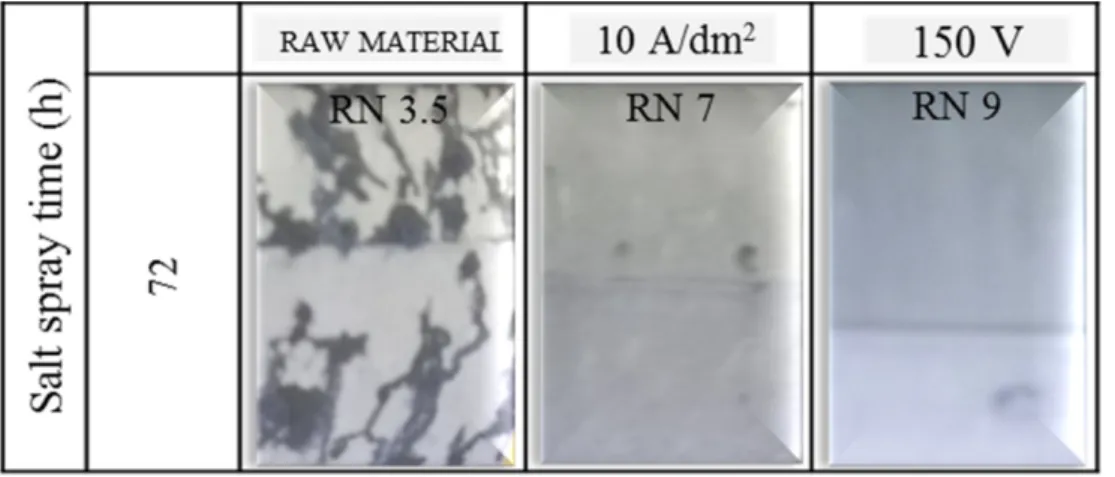
Figure 8 shows the results of salt spray test that was performed for 72 h in accordance with ASTM standards for assessing the corrosion characteristics of the Mg alloy specimens treated with plasma anodization. Untreated AZ91D material and that treated with 10 A/dm

2

showed RN values of 3.5 and 7, respectively, while the specimens treated with

150 V plasma anodizing showed RN values of 9.

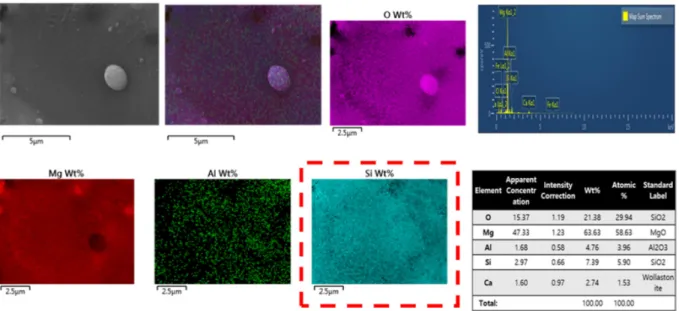
Figure 9 is the result of EDS element mapping showing the distribution of Mg, O and Si on the oxide film composition formed by plasma anodizing treatment of AZ91D material.

Experimental results were obtained for both Mg, O and Si as the main film forming elements. Si and O are uniformly distributed. Mg and O account for 88.6% of the total atomic%.

Chemical species that form such phases are generated by various phenomena such as specimen dissolution and electrolysis of the electrolyte solution, after which ceramic phases formed via various reactions. The chemical reactions by which each ceramic phase was formed are shown below.

The mechanism of MgO formation is similar to the existing Mg anodizing technique. As shown in the Fig. 7. Anodic polarization curves of AZ91D in a 3.5 wt.% NaCl solution at 25

o

C (a) raw material, (b) plasma anodized under current control of 10 A/dm

-2

, (c) plasma anodized under voltage control of 150 V.

Fig. 8. Surface images of specimens after 72 hours salt spray test.

(6)

reaction in Equation (1), Mg

2+

is transferred from the specimen to oxidation layer/electrolyte solution interface, and OH

-

is transferred from the electrolyte solution to the sample/oxidation layer interface.

Thus, MgO simultaneously forms at the oxidation layer/electrolyte solution interface and at the sample/

oxidation layer interface.

Mg

2+

+ 2OH

-

= MgO + H

2

O (1) Mg

2

SiO

4

may be formed by the reaction between the SiO

32-

anion and Mg

2+

. Sodium silicate in the electrolyte solution dissociates to produce SiO

32-

, which reacts with Mg

2+

to form Mg

2

SiO

4

.

Na

2

SiO

3

= 2Na

+

+ SiO

32-

(2) 2Mg

2+

+ SiO

32-

+ 2OH

-

= Mg

2

SiO

4

+ H

2

O (3) Moreover, MgAl

2

O

4

may also form through the reaction shown in Equation (4).

Mg

2+

+ 2AlO

2-

= MgAl

2

O

4

(4) Since AZ91D includes Al, MgAl

2

O

4

formed by the plasma anodizing treatment has a stable spinel structure and improves the corrosion resistance by strengthening the passivation phenomenon [14].

Conclusion

The present study demonstrated a plasma

anodizing system and applied a plasma anodizing treatment to the AZ91D Mg alloy under the conditions of controlled pulse voltage & pulse current. The plasma anodizing treatment resulted in the formation of a uniform oxide film layer on the surface of Mg alloy.

The defect which appeared when the pulse current of 10 A/dm

2

was employed did not form under the pulse voltage condition of 150 V and the number of pores was also smaller.

Corrosion resistance increased from RN 3.5 to 9 and it was confirmed that Mg, Al, O and Si were evenly distributed on the surface of the oxide film.

The optimum oxide film was obtained at 150V process pulse voltage.

Based on the results of this study, additional research is planned to develop applications of high- performance AZ91D parts and to clarify the formation mechanism, the effects of temperature, physical properties such as roughness and corrosion resistance due to the pulse electric field.

References

[1] Mordike, B. L., and Tü Ebert. Magnesium properties-applications-potential. Materials Science and Engineering A 302, no. 1 (2001) 37-45.

[2] Song, Guangling, Andrej Atrens, D. Stjohn, Jason Nairn, and Ying Li. The electrochemical corrosion of pure magnesium in 1 N NaCl. Corrosion Science 39, no. 5 (1997) 855-875.

[3] Ma, Y., X. Nie, D. O. Northwood, and H. Hu.

Fig. 9. EDX elemental maps of the PEO films formed on AZ91D Mg alloy at 150 V for 30 min.

(7)

Systematic study of the electrolytic plasma oxidation process on a Mg alloy for corrosion protection. Thin Solid Films 494, no. 1 (2006) 296-301.

[4] Gray, JEl, and Ben Luan. Protective coatings on magnesium and its alloys—a critical review.

Journal of alloys and compounds 336, no. 1-2 (2002) 88-113.

[5] Srinivasan, P. Bala, C. Blawert, and W. Dietzel.

Effect of plasma electrolytic oxidation treatment on the corrosion and stress corrosion cracking behaviour of AM50 magnesium alloy. Materials Science and Engineering A 494, no. 1 (2008) 401-406.

[6] Zhang, Yongjun, Chuanwei Yan, Fuhui Wang, Hanyi Lou, and Chunan Cao. Study on the environmentally friendly anodizing of AZ91D magnesium alloy. Surface and Coatings Technology 161, no. 1 (2002) 36-43.

[7] Duan, Hongping, Keqin Du, Chuanwei Yan, and Fuhui Wang. Electrochemical corrosion behavior of composite coatings of sealed MAO film on magnesium alloy AZ91D. Electrochimica Acta 51, no. 14 (2006) 2898-2908.

[8] Yerokhin, A. L., X. Nie, A. Leyland, A. Matthews, and S. J. Dowey. Plasma electrolysis for surface engineering. Surface and coatings technology 122, no. 2 (1999) 73-93.

[9] Wei, C. B., X. B. Tian, S. Q. Yang, X. B. Wang,

Ricky KY Fu, and Paul K. Chu. Anode current effects in plasma electrolytic oxidation. Surface and Coatings Technology 201, no. 9 (2007) 5021- 5024.

[10] Curran, J. A., and T. W. Clyne. Thermo-physical properties of plasma electrolytic oxide coatings on aluminium. Surface and Coatings Technology 199, no. 2 (2005) 168-176.

[11] Narayanan, TSN Sankara, Il Song Park, and Min Ho Lee. Strategies to improve the corrosion resistance of microarc oxidation (MAO) coated magnesium alloys for degradable implants Prospects and challenges. Progress in Materials Science 60 (2014) 1-71.

[12] Moon, Sungmo, and Yunkyung Nam. Anodic oxidation of Mg–Sn alloys in alkaline solutions.

Corrosion Science 65 (2012) 494-501.

[13] Hussein, R. O., D. O. Northwood, and X. Nie.

The effect of processing parameters and substrate composition on the corrosion resistance of plasma electrolytic oxidation (PEO) coated magnesium alloys. Surface and Coatings Technology 237 (2013) 357-368.

[14] Wang, Lingqian, Jiansong Zhou, Jun Liang, and

Jianmin Chen. Microstructure and corrosion

behavior of plasma electrolytic oxidation coated

magnesium alloy pre-treated by laser surface

melting. Surface and Coatings Technology 206,

no. 13 (2012) 3109-3115.

수치

Figure 1 shows the schematic of this plasma anodizing system.
Figure 3 shows the three-layer structure oxide film of plasma anodizing. The porous structure of the outermost layer may be advantageous to additional painting to have excellent coating adhesion
Figure 4 shows FESEM images of raw material and that treated under 150 V voltage control and 10 A/dm 2  current control.
Figure 8 shows the results of salt spray test that was performed for 72 h in accordance with ASTM standards for assessing the corrosion characteristics of the Mg alloy specimens treated with plasma anodization
+2

참조

관련 문서

Effect of Electrolyte on Mechanical and Corrosion Properties of AZ91 Cast Magnesium Alloy Coated by Plasma Electrolytic Oxidation Method.. Bo-Sik Kim, Du-Hyung Lee, and Si-Young

The characteristics of a titanium oxide layer prepared using a plasma electrolytic oxidation (PEO) process were investigated, using an extended gate ion sensitive

Vakili-Azghandi, A.Fattah-alhosseini, Effects of Duty Cycle, Current Frequency, and Current Density on Corrosion Behavior of the Plasma Electrolytic Oxidation Coatings on 6061

Keywords : Micropore, Ti-25Ta-xHf, Plasma electrolytic oxidation, Crystallite

The surface oxidation of magnesium was performed by Plasma electrolytic oxidation treatment method. And the optical reflectance spectra of the oxidation layers are studied. In

The stages of the corrosion process in artificial defects in the coating obtained by plasma electrolytic oxidation (PEO) at the surface of the MA8 magnesium

During PEO (plasma-electrolytic-oxidation) treatment of titanium, the relationship between the thickness of oxide film and the measured electrical information was investigated. A

이러한 마그네슘합금의 내식성을 향상시키고자 전 기화학적 플라즈마 전해 산화처리 (Plasma Electrolytic Oxidation)를 하게 되는데, 아노다이징, 화성피막처리 등