Publications of the Korean Astronomical Society pISSN 1225-1534
32: 083∼ 085, 2017 March eISSN 2287-6936
⃝2017. The Korean Astronomical Society. All rights reserved.c https://doi.org/10.5303/PKAS.2017.32.1.083
AKARI INFRARED CAMERA SURVEY OF THE LARGE MAGELLANIC CLOUD
T. Shimonishi1, D. Kato2, Y. Ita3, T. Onaka4, and AKARI /IRC LMC team
1Department of Earth and Planetary Sciences, Graduate School of Science, Kobe University, Kobe, 657-8501, Japan
2Center for Low Carbon Society Strategy, Japan Science and Technology Agency, Tokyo, 102-0076, Japan
3Astronomical Institute, Graduate School of Science, Tohoku University, Sendai, 980-8578, Japan
4Department of Astronomy, Graduate School of Science, The University of Tokyo, Tokyo 113-0033, Japan E-mail: [email protected]
(Received October 11, 2016; Revised Novemer 4, 2016; Accepted Novemer 4, 2016)
ABSTRACT
We conducted an unbiased near- to mid-infrared imaging and spectroscopic survey of the Large Magellanic Cloud (LMC) as a part of the AKARI Mission Program “Large-area Survey of the LMC”
(LSLMC, PI: T. Onaka). An area of about 10 square degrees of the LMC was observed by five photometric bands (3.2, 7, 11, 15, and 24 µm) and a low-resolution slitless prism (2 – 5 µm, R ∼20) equipped with AKARI /IRC. We constructed and publicly released photometric and spectroscopic catalogues of point sources in the LMC based on the survey data. The catalogues provide a large number of near-infrared spectral data, coupled with complementary broadband photometric data. Combined use of the present AKARI LSLMC catalogues with other infrared point source catalogues of the LMC possesses scientific potential that can be applied to various astronomical studies.
Key words: catalogs — infrared — Magellanic Clouds — surveys — techniques: spectroscopy
1. INTRODUCTION
The LMC is one of the closest external galaxies to the Earth and has been playing a central role in var- ious research fields of modern astronomy. Thanks to its proximity (∼50 kpc), individual stars can be iden- tified with favorable spatial resolution (1′′∼0.25 pc).
The nearly face-on geometry enables us to compare the distribution of stars and the ISM in two dimensions.
The low-metallicity environment of the LMC (about half of the solar neighborhood) allows us to study how the properties of circumstellar and interstellar materi- als are affected by the metallicity of the parent galaxy.
The present imaging and spectroscopic survey of the LMC with AKARI provides new dataset for the detailed study of infrared sources in the galaxy.
http://pkas.kas.org
2. THE AKARI /IRC LMC SURVEY
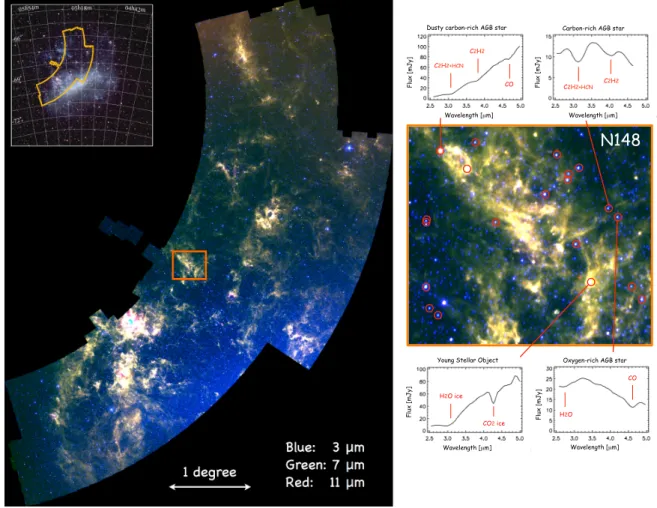
The survey was performed using five imaging filters (each centered at 3.2, 7, 11, 15, 24 µm) and low- resolution slitless spectroscopic prism (2 – 5 µm, R ∼ 20) equipped with the Infrared Camera (IRC, Onaka et al., 2007) on board AKARI. About 10 deg2regions of the LMC were observed in the cold and warm mission phase (Fig. 1). Detailed properties of the survey are summarized in Table 1 of Shimonishi et al. (2013) for the spectroscopic survey and Table 1 of Kato et al. (2012) for the imaging survey. The present survey plays a com- plementary role to other infrared surveys such as SAGE or HERITAGE (Meixner et al., 2006, 2013). Based on the data obtained in the survey during the cold mis- sion, we constructed the photometric and the spectro- scopic catalogues of point sources in the LMC. We also performed the survey in the warm mission phase and these data are currently under processing. The spec- troscopic catalogue includes 1,757 sources (Shimonishi et al., 2013). The photometric catalogue includes about 83
84 T. SHIMONISHI ET AL.
Blue: 3 µm Green: 7 µm Red: 11 µm 1 degree1 degree
Blue: 3 µm Green: 7 µm Red: 11 µm
H2O ice!
CO2 ice!
C2H2+HCN! C2H2! C2H2+HCN!
C2H2!
CO!
CO!
H2O !
Wavelength [µm]!
Young Stellar Object!
Wavelength [µm]!
Wavelength [µm]!
Flux [mJy]!
Flux [mJy]!Flux [mJy]! Flux [mJy]!
N148!
Wavelength [µm]!
Oxygen-rich AGB star!
Carbon-rich AGB star!
Dusty carbon-rich AGB star!
Figure 1. Left: Three color composite image of the LMC (blue: 3.2 µm, green: 7.0 µm, red: 11.0 µm). The blue color mainly traces the distribution of stars, while green and red colors trace the distribution of warm interstellar dust and PAHs. The survey area is shown by the yellow line on the optical image of the LMC in the upper left side. Right: Zoom-up image of a star-forming region N148, whose location is shown by the orange solid line in the left panel. Red circles indicate the positions of the objects whose near-infrared spectrum is obtained by the spectroscopic survey. Detected spectral features are labeled in the spectra. (A color version of this figure is available in the online journal)
650,000, 90,000, 49,000, 17,000, 7,000 sources at 3.2, 7, 11, 15, and 24 µm, respectively (Kato et al., 2012). Both catalogs are publicly released and available through the website “AKARI Observers Page1”.
2.1. Spectroscopic catalogue
The spectroscopic catalogue in 2 – 5 µm contains low- resolution spectra of 1,757 point sources. It provides us with an opportunity to study various infrared spec- tral features such as ice absorption bands (H2O, CO2, CO) toward embedded objects, molecular gas absorp- tion lines (C2H2, HCN, H2O, CO) toward late type stars, and emission lines due to ionized hydrogen or Polycyclic Aromatic Hydrocarbons (PAHs). The contin- uous coverage of this wavelength region is realized only by satellite observations. The present catalogue sig- nificantly improves our understanding of near-infrared
1http://www.ir.isas.jaxa.jp/AKARI/Observation/.
spectral features for various types of infrared sources in the LMC. In addition, temporal variations of spec- tra at one to two year intervals are also discussed in the catalogue paper. Detailed studies of near-infrared ice absorption bands toward YSOs based on the survey data are reported in Shimonishi et al. (2008, 2010).
2.2. Photometric catalogue
The photometric catalogue provides us opportunities to study the properties of a huge number of infrared point sources based on color-color and color-magnitude dia- grams. An example of the color-color diagram ([3.2 µm]
- [7.0 µm] vs [7.0 µm] - [11.0 µm]) is shown in Figure 9 of Kato et al. (2012). Compared with the Spitzer SAGE survey, our IRC survey has 7 and 11 µm bands, which are sensitive to the presence or absence of the silicate dust band at 9.7 µm. In addition, a shorter wavelength cutoff of the IRC 3.2 µm band (N3) is sensitive to the
AKARI INFRARED CAMERA SURVEY OF THE LARGE MAGELLANIC CLOUD 85
water ice absorption band at 3.05 µm. Thanks to these characteristics, the present catalogue enables accurate photometric classifications of YSOs embedded in cold dust.
ACKNOWLEDGMENTS
This research is based on observations with AKARI, a JAXA project with the participation of ESA. We thank all the members of the AKARI project for their con- tinuous help and support. This work was supported by Grants-in-Aid for Scientific Research from the Japan Society for the Promotion of Science (JSPS).
REFERENCES
Ita, Y., Onaka, T., Kato, D., et al. 2008, AKARI IRC Survey of the Large Magellanic Cloud: Outline of the Survey and Initial Results, PASJ, 60, 435
Kato, D., Ita, Y., Onaka, T., et al. 2012, AKARI Infrared Camera Survey of the Large Magellanic Cloud. I. Point- source Catalog, AJ, 144, 179
Meixner, M., Gordon, K. D., Indebetouw, R., et al. 2006, Spitzer Survey of the Large Magellanic Cloud: Surveying the Agents of a Galaxy’s Evolution (SAGE). I. Overview and Initial Results, AJ, 132, 2268
Meixner, M., Panuzzo, P., Roman-Duval, J., et al. 2013, The HERSCHEL Inventory of The Agents of Galaxy Evolution in the Magellanic Clouds, a Herschel Open Time Key Pro- gram, AJ, 146, 62
Onaka, T., Matsuhara, H., Wada, T., et al. 2007, The In- frared Camera (IRC) for AKARI – Design and Imaging Performance, PASJ, 59, 401
Shimonishi, T., Onaka, T., Kato, D., et al. 2008, AKARI Near-Infrared Spectroscopy: Detection of H2O and CO2
Ices toward Young Stellar Objects in the Large Magellanic Cloud, ApJ, 686, L99
Shimonishi T., et al., 2010, Spectroscopic observations of ices around embedded young stellar objects in the Large Magellanic Cloud with AKARI, A&A, 514, A12
Shimonishi T., et al., 2013, AKARI Infrared Camera Sur- vey of the Large Magellanic Cloud. II. The Near-infrared Spectroscopic Catalog, AJ, 145, 32