Effects of Feed Additive as an Alternative for Antibiotics on Growth Performance and
Feed Cost in Growing-finishing Pigs
1)
Kim, Jong-Duk*․Sherwin J. Abuel**․Shim, Keum-Seob*
항생제 대체제로서 첨가제가 육성 및 비육돈의 성장능력과 사료비에 미치는 영향
김종덕․셔윈 아부엘․심금섭
This experiment was conducted to evaluate two different types of feed additive as an alternative for antibiotics on growth performance and feed cost in growing and finishing pigs. One additive is an herb extract, with Fenugreek (Trigonella foenum
graecum) as the main component, while the other feed additive contains aminole-vulinic acid (ALA). In the first experiment, 128 grower pigs were allotted to 4 different treatment groups and replicated 4 times with 8 pigs per replicate; the trial lasted for 28 days. The positive control group (PC) which is the control group supplemented with antibiotics was significantly higher (p<0.05) in growth rate (580.6 g/d) followed by the ALA group (532.0 g/d), there was no significant differences in terms of feed intake and feed efficiency. There were marginal reduc- tions in feed costs measured as feed cost per head in ALA and HE added diet.
However, the feed cost per weight gain of ALA treatment was higher than the control group (PC) supplemented with antibiotics. In the second experiment, 80 finisher pigs were allotted to 4 treatment groups and replicated 4 times with 5 pigs per replicate; the trial lasted for 70 days. The treatment group supplemented with an herb extract (HE) had a significantly higher (p<0.05) feed intake (2,415.8 g/d) compared to the other treatment groups, but there was no significant differences in terms of growth rate and feed efficiency. Feed cost per head in HE and ALA treatments were higher than PC treatment, and feed cost per weight gain of HE was higher than PC treat (p<0.05). The results from these experiments suggests
* Corresponding Author : Dr. J. D. Kim, Division of Animal Husbandry, Cheonam Yonam College ([email protected])
** Industry Academic Cooperation Foundation, Cheonam Yonam College
that these two types of feed additives can both be used as an alternative for antibiotics without having a negative effect on the performance of the animals.
And aminolevulinic acid was good in performance and production cost of grower and finisher pigs.
Key words : antibiotics, herb extract, aminolevulinic acid, grower pig, finisher pig
Ⅰ. Introduction
In Korea, organic agriculture as well as environment-friendly agriculture is important for several reasons: for air purification, water quality and conservation, soil conservation and improvement, organic waste digestion, and biodiversity conservation. This is the reason why environment-friendly agriculture and organic farming increased in Korea, and now consumers are also interested in environment-friendly and organic products for human health and well-being.
Organic forage production system for organic animal production is one of the most important aspects in organic livestock system, because organic feed is the key in producing organic animals. But organic animals are also essential for producing manure to be used for organic farming. Therefore, both organic plants and organic animals are essential to maintain their cycle for organic agriculture system.
Swine is the primary livestock in Korea, and it is also important because of the increasing demand for pork. Main key in organic swine production system is feed without antibiotics.
Antibiotics are widely used as feed supplement in swine feeds basically to protect the animals against disease and to promote growth of the animals (Kiser, 1976; Corpet, 2000). Feeding swine with antibiotics has been documented to increase weight gain by 3.3-8.0% and improve feed efficiency by approximately 3% (Doyle, 2001). However, indiscriminate use of antibiotics led to an increasing number of antibiotic-resistant pathogens and the concern of cross-transfer to humans. As a result, the expanded use of antibiotics, in particular for growth promotion, has led to a partial or total ban of antibiotic application to feed in a number of European countries (Taylor, 1997; Barton, 2000; Kyriakis et al., 2003; Kim et al., 2005).
In Korea, consumers are getting more health conscious and do not want antibiotic residues in
meat products, which forces producers to look for alternatives to antibiotics. Many investigations
have focused on the alternative feed additives or supplements, such as probiotics, enzymes,
minerals, organic acids and herbs (Kim et al., 2005; Chen, 2005). Phytogenic feed additives
which are herbs or extracts from herbs can also improve digestion, but show also antioxidative,
fungicidal, antimicrobial and some physiological effects (Leibetseder, 2004).
The potential use of acidifiers (Henry et al., 1985; Jonson 1992; Kim et al., 2005) and various herbs (Bourne, 1998; Wenk, 2002) in swine diets have been recently discussed.
Acidifiers appear to be a possible alternative to feed antibiotics in order to improve perfor- mance of weaning pigs. It is generally known that dietary acidifiers lower gastric pH, resulting in increased activity of proteolytic enzymes, improved protein digestibility and inhibit the proliferation of pathogenic bacteria in gastric intestinal tract (Kim et al., 2005).
5-Aminolevulinic acid, a five-carbon amino acid, is the first committed metabolite in the biosynthesis pathway of tetrapyrroles such as heme, vitamin B
12and chlorophyll in living cells.
Two major pathways for the biosynthesis of 5-aminolevulinic acid have been described. The biosynthesis of 5-aminolevulinic acid in bacterial cells is tightly regulated by feedback inhibition at the level of 5-aminolevulinic acid formation, and 5-aminolevulinic acid formation is con- sidered to be the rate limiting step for tetrapyrrole biosynthesis (Dzelzkalns et al., 1982).
Since chemical synthesis of 5-aminolevulinic acid is complicated and results in low yields (Rebeiz et al., 1988), biological synthesis appears to be a good alternative. The microbiological production of low concentrations of 5-aminolevulinic acid has been reported in several instances (Nishikawa & Murooka, 2001). Another approach to improve production of 5-aminolevulinic acid is by expression regulation of the rate-limiting enzyme in the metabolic pathway. Therefore, an engineering approach to over-expressing the gene coding for 5-aminolevulinic acid synthase seemed more direct.
Recently, a few recombinants have been developed for mass production of 5-aminolevulinic acid. 5-Aminolevulinic acid synthase has been purified from several sources (Kiatpapan &
Murooka, 2001; Choi et al., 2004), of which 5-aminolevulinic acid synthase from Rhodobacter sphaeroides had the most favorable characteristics.
The objective of this experiment was to determine the effect of herb extract and aminol-
evulinic acid on growth performance and production cost of grower and finisher pigs, so that we
can evaluate the possibility of herb extract and aminolevulinic acid as an alternative of
antibiotics.
Ⅱ. Materials and Methods 1. Experimental Animals and Design
1) Grower pigs
A total 128 grower cross-bred pigs (Landrace × Yorkshire × Duroc) with average initial body weight of 21.74 kg at the time of starting the experiment were randomly assigned to four treatments for 4 wk. Each treatment had 4 replications of 8 pigs (4 gilts and 5 barrows) with a similar. The pigs were housed by treatment group 3 × 4 m pig pens with slot according to a randomized completed block design.
And pigs allotted to four dietary treatments that consisted of a negative control group without antibiotics (NC), a positive control group with antibiotics using Avilamycin 0.1% and Colistin 0.1% (PC), Herb extract group (HE, 0.06%), with Fenugreek (Trigonella foenum graecum) as the main component, and Aminolevulinic acid (ALA, 0.2%) group.
2) Finisher pigs
A total 80 finisher cross-bred pigs (Landrace × Yorkshire × Duroc) with average initial body weight of 49.85 kg at the time of starting the experiment were randomly assigned to four treatments for 10 wk. Each treatment had 4 replications of 5 pigs (2 gilts and 3 barrows) with a similar. The pigs were assigned to treatment according to a randomized completed block design.
And pigs allotted to four dietary treatments that consisted of a negative control group without antibiotics (NC), a positive control group with antibiotics using Flavomycin at 0.1% (PC), Herb extract groups (HE, 0.03%), with Fenugreek (Trigonella foenum graecum) as the main com- ponent, and Aminolevulinic acid (ALA, 0.1%) group.
2. Experimental Diet and Feeding
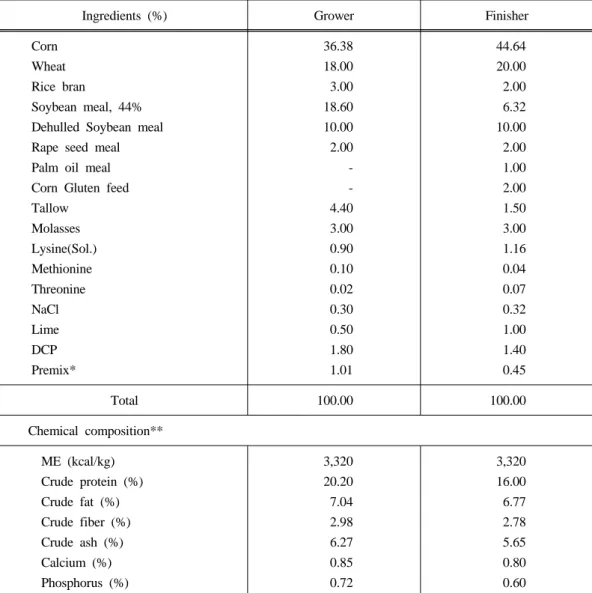
The two phase basal diets: grower and finisher were prepared to contain 3,320 kcal ME/kg and 20.20 and 16.00% CP, respectively. Basal diets were formulated to meet or exceed NRC (1998) recommendations. The ingredient and chemical composition of basal diets used during both the experiments are presented in Table 1.
All diets were provided by meal form. Feed and water offered ad libitum to all pigs
throughout the experiment. During the experiment period, individual body weight and feed intake
of pigs were measured at the time of starting and at the end of each phase. Average daily gain (ADG), average daily feed intake (ADFI) and feed conversion ratio (FCR) were calculated during feeding trial.
Table 1. Formula and chemical composition of experimental diets in grower and finisher phases
Ingredients (%) Grower Finisher
Corn Wheat Rice bran
Soybean meal, 44%
Dehulled Soybean meal Rape seed meal Palm oil meal Corn Gluten feed Tallow
Molasses Lysine(Sol.) Methionine Threonine NaCl Lime DCP Premix*
36.38 18.00 3.00 18.60 10.00 2.00 - - 4.40 3.00 0.90 0.10 0.02 0.30 0.50 1.80 1.01
44.64 20.00 2.00 6.32 10.00 2.00 1.00 2.00 1.50 3.00 1.16 0.04 0.07 0.32 1.00 1.40 0.45
Total 100.00 100.00
Chemical composition**
ME (kcal/kg) Crude protein (%) Crude fat (%) Crude fiber (%) Crude ash (%) Calcium (%) Phosphorus (%)
3,320 20.20 7.04 2.98 6.27 0.85 0.72
3,320 16.00 6.77 2.78 5.65 0.80 0.60
* Provide per kg diet: Vit A, 10,000 IU; Vit D
3, 2,000 IU; Vit E, 42 IU; Vit K, 5 mg; Vit B
2, 9.6 mg;
Vit B
6, 2.45 mg; niacin, 49 mg; biotin, 0.05 mg; Cu, 140 mg; Fe, 179 mg; Zn, 179 mg; Mn, 12.5 mg;
Co, 0.25 mg; Se, 0.4 mg.
** Calculated values.
3. Statistical Analysis
All data generated in this experiment were analyzed as a randomized complete block design by using the GLM procedure of SAS (1995). To determine the efficacy of difference on animal performance and feed cost, the data were analyzed by one-way ANOVA. Replicate was the experimental unit for all the analysis. The means were separated by using the Duncan’s multiple range test (Duncan, 1995). Probability values less than 0.05 were considered statistically significant.
Ⅲ. Results and Discussion 1. Grower Pigs
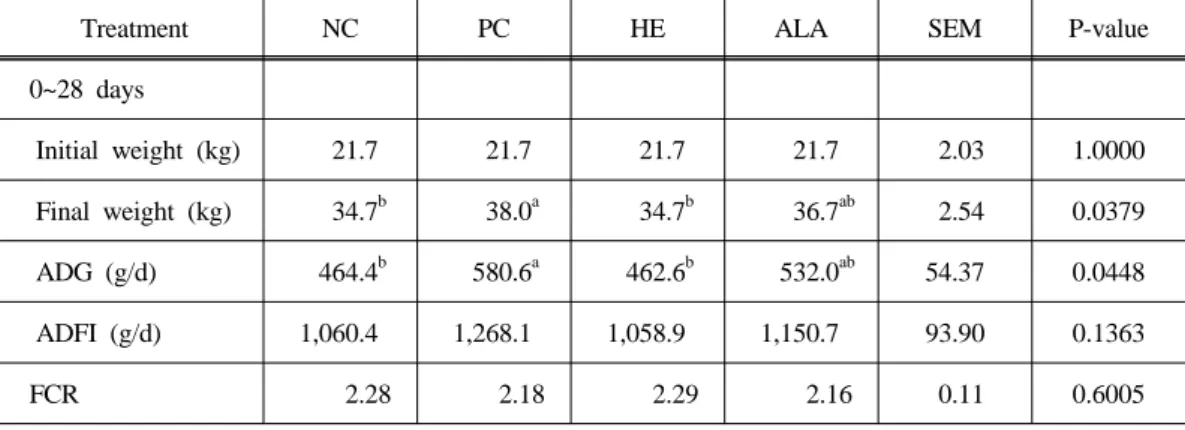
In the trial done for the grower pigs (Table 2), animals under the PC group showed a significantly (p<0.05) higher growth rate at 580.6 g/day followed by the treatment group ALA (p<0.05) at 532.0 g/day, they were 25% and 15% higher compared to the NC group, respec- tively. Growth rate of the NC group and the treatment group HE was very similar. Feed intake tends to have a similar trend with growth rate, feed intake of PC group (1,268.1 g/day) was 20% higher compared to the NC group, while the ALA group (1,150.7 g/day) was 9% higher
Table 2. Effect of antibiotics and alternatives on performance of grower pigs
Treatment NC PC HE ALA SEM P-value
0~28 days
Initial weight (kg) 21.7 21.7 21.7 21.7 2.03 1.0000
Final weight (kg) 34.7
b38.0
a34.7
b36.7
ab2.54 0.0379
ADG (g/d) 464.4
b580.6
a462.6
b532.0
ab54.37 0.0448
ADFI (g/d) 1,060.4 1,268.1 1,058.9 1,150.7 93.90 0.1363
FCR 2.28 2.18 2.29 2.16 0.11 0.6005
ADG=average daily gain, ADFI=average daily feed intake, FCR=Feed conversion ratio.
SEM=standard error of mean.
a,b
Means in the same row with different superscripts differ significantly (p<0.05).
compared to the NC group. However, in terms of feed conversion the treatment group ALA (2.16) tends to be more efficient in converting feeds than the PC group (2.18).
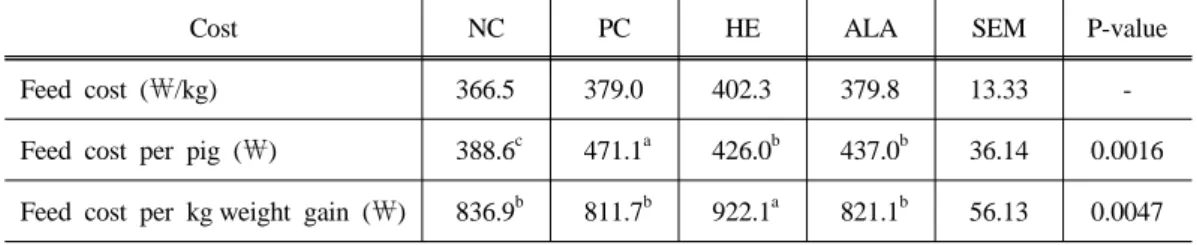
An attempt was made of evaluate the feed cost of using antibiotics and alternatives at growing pigs (Table 3). Total feed cost of HE and ALA groups were higher than PC group. However, there were marginal reductions in feed costs measured as feed cost per head in ALA and HE added diet (p<0.05). Than the feed cost per weight gain of ALA treatment was higher than the control group (PC) supplemented with antibiotics (p<0.05).
Based on the results on the trial for the grower pigs, we may assume that the higher feed intake of both the PC group and the treatment group ALA was because of a better health status or immunity, which resulted to a better growth rate and which was also reflected on their feed efficiency. The start of the trial was conducted at the onset of the spring season, and it was also during this time that the pigs were transferred from the nursery building to the growing/finishing building. Therefore, these two factors could have had a stressful effect on the animals, which was the reason that the PC group which was supplemented with antibiotics, had the highest growth rate and feed intake, while the treatment group ALA was the most efficient in feed conversion rate. Mateo (2006) hypothesized that the supplementation of ALA to nursery pigs improves heme synthesis that will in turn increase the synthesis of heme proteins such as hemoglobin. These heme-proteins would then increase the number of red blood cells thereby improving the immune status of nursery pigs.
Table 3. Effect of antibiotics and alternatives on feed cost of grower pigs
Cost NC PC HE ALA SEM P-value
Feed cost (₩/kg) 366.5 379.0 402.3 379.8 13.33 -
Feed cost per pig (₩) 388.6
c471.1
a426.0
b437.0
b36.14 0.0016 Feed cost per kg weight gain (₩) 836.9
b811.7
b922.1
a821.1
b56.13 0.0047 SEM=standard error of mean.
a,b
means in the same row with different superscripts differ significantly (p<0.05).
2. Finisher Pigs
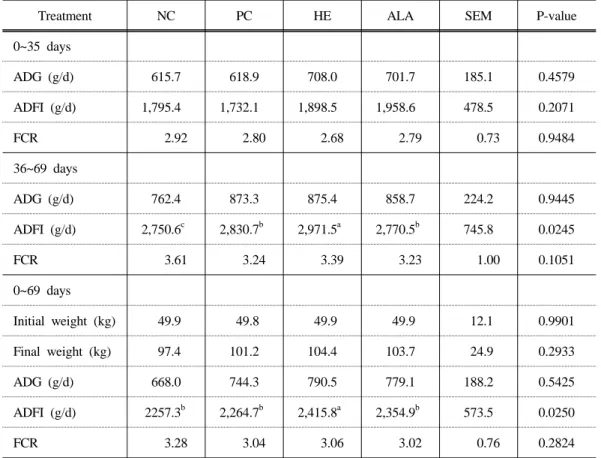
Table 4 summarizes the production performance for the trial done for the finishing pigs. Feed
intake was significantly (p<0.05) higher in the treatment group HE at 2,415.8 g/day, it was
followed by the treatment group ALA at 2,354.9 g/day and then by the treatment group NC
(2,257 g/day) and PC (2,264.7 g/day). There were no significant differences on the growth rate but it tends to have a similar trend as the feed intake, with the HE group having the highest growth rate at 790.5 g/day, followed by ALA group at 779.1 g/day, then the PC group at 744.3 g/day. However, although not significant and quite similar, the ALA group tends to have a better efficiency in feed conversion at 3.02, followed by PC group at 3.04 and lastly by the HE group at 3.06. The feed efficiency by the HE, ALA and the PC groups was similar to the trend on feed efficiency for the grower and finisher pigs.
Table 4. Effect of antibiotics and alternatives on performance of finisher pigs
Treatment NC PC HE ALA SEM P-value
0~35 days
ADG (g/d) 615.7 618.9 708.0 701.7 185.1 0.4579
ADFI (g/d) 1,795.4 1,732.1 1,898.5 1,958.6 478.5 0.2071
FCR 2.92 2.80 2.68 2.79 0.73 0.9484
36~69 days
ADG (g/d) 762.4 873.3 875.4 858.7 224.2 0.9445
ADFI (g/d) 2,750.6
c2,830.7
b2,971.5
a2,770.5
b745.8 0.0245
FCR 3.61 3.24 3.39 3.23 1.00 0.1051
0~69 days
Initial weight (kg) 49.9 49.8 49.9 49.9 12.1 0.9901
Final weight (kg) 97.4 101.2 104.4 103.7 24.9 0.2933
ADG (g/d) 668.0 744.3 790.5 779.1 188.2 0.5425
ADFI (g/d) 2257.3
b2,264.7
b2,415.8
a2,354.9
b573.5 0.0250
FCR 3.28 3.04 3.06 3.02 0.76 0.2824
ADG=average daily gain, ADFI=average daily feed intake, FCR=Feed conversion ratio.
SEM=standard error of mean.
a,b,c
means in the same row with different superscripts differ significantly (p<0.05).
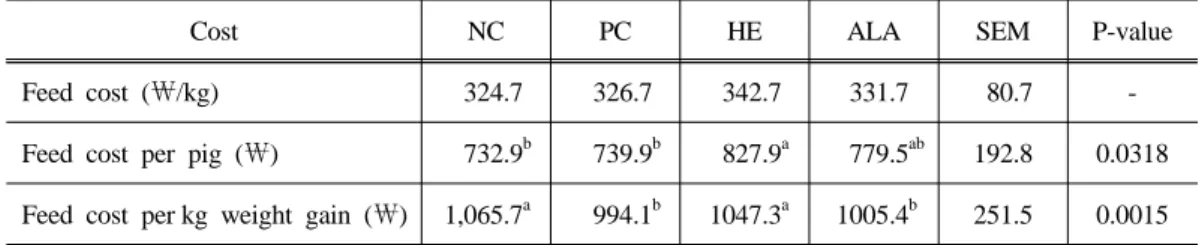
The results of feed cost, presented in Table 5, total feed cost of alternative antibiotics were
higher than antibiotics. However, in feed cost per pig and feed cost per weight gain, feed cost
of ALA group was lower than HE group and was similar to antibiotic treatment (p<0.05).
Table 5. Effect of antibiotics and alternatives on feed cost of finisher pigs
Cost NC PC HE ALA SEM P-value
Feed cost (₩/kg) 324.7 326.7 342.7 331.7 80.7 -
Feed cost per pig (₩) 732.9
b739.9
b827.9
a779.5
ab192.8 0.0318 Feed cost per kg weight gain (₩) 1,065.7
a994.1
b1047.3
a1005.4
b251.5 0.0015
₩ = won, Basal feed cost 360 won/kg, Chinese herb medicine 900 won/kg, CSP 4,500 won/kg, Choline 2,100 won/kg, Herb extract 60,000 won/kg, Enzyme 7,000 won/kg.
SEM=Standard error of mean.
a,b