왕대의 첨가수준이 반추위 in vitro 발효성상과 메탄 발생량에 미치는 영향*
1)
조성욱
**†․이신자
***†․이예준
**․김현상
**․
엄준식
**․최유영
**․배은지
****․이성실
*****Effects of Additional Levels of Phyllostachys bambusoides on Ruminal Fermentation Characteristics and
Methane Emission in in vitro
Jo, Seong-Uk․Lee, Shin-Ja․Lee, Ye-Jun․Kim, Hyun-Sang․
Eom, Jun-Sik․Choi, You-Young․Bae, Eun-Ji․Lee, Sung-Sill
The current study was to evaluate the antioxidant activity of Phyllostachys bambu- soides (PHB) as a feed additives and investigate whether its antioxidant activity could be helpful for increasing rumen fermentation characteristics and methane reduction. The antioxidant activity results showed that total polyphenols and flavo- noids contents were 43.54 ± 8.68 mg CE/g and 17.13 ± 0.45 mg QE/g, respectively, and the IC
50values for 1,1-diphenyl-2-prcrylhydrazyl (DPPH) and 2,2 ′-azino-bis (3- ethylbenzthiazoline-6- sulphonic acid) (ABTS) radical scavenging activity were 163.13 ± 19.25 µg/mL and 97.07 ± 4.46 µg/mL, respectively. Two heads of cannulated Hanwoo (450 ± 30 kg), consuming timothy hay and a commercial concentrate (60:40, w/w) twice daily (at 09:00 and 17:30) at 2% of body weight, with free access to water and a mineral block, were used as rumen fluid donors. An in vitro incubation experiment was performed after 6, 12, 24, 48, and 72 hr with PHB added at concentration of 2, 4, and 6% of timothy hay basis. Total gas emission decreased as the amount of PHB addition increased at 6 and 24 hr of incubation.
*****
본 연구는 농촌진흥청 연구사업(세부과제번호: PJ01477803)에서 지원 받았음.
*****
경상국립대학교 응용생명과학부(BK21) 대학원생 박사과정
*****
경상국립대학교 농업생명과학연구원&중점연구소 학술연구교수
*****
국립산림과학원 산림바이오소재연구소 연구사
*****
Corresponding author, 경상국립대학교 응용생명과학부(BK21), 농업생명과학연구소 & 중점연구소
교수([email protected])
†
These authors contributed equally to this work as the first authors.
However, PHB addition did not affect total volatile fatty acid production, and methane and carbon dioxide emission also decreased as the amount of addition increased at 48 hr of incubation. Therefore, PHB was expected to be used as methane reducing additives in the ruminants.
Key words : antioxidant activity, bamboo leaf, ruminant, methane emission, volatile fatty acid
Ⅰ. 서 론
지구에서 발생하는 온실가스의 10~12%가 농업에서 유래하며, 그 중 약 32%가 반추동물 의 반추위에서 유래하는 메탄가스인 것으로 알려져 있다(Smith et al., 2007). 축산업 내 온 실가스 저감을 위한 반추가축의 메탄 저감 연구는 필요한 실정이다. 반추위에서 발생되는 메탄은 탄수화물의 혐기성 발효의 부산물이며(Flachowsky, 2011; Meale et al., 2012), 섭취한 사료에너지의 2~12%가 손실된다(Johnson and Johnson, 1995). 즉 반추동물이 발생시키는 메 탄은 지구온난화에 부정적인 영향을 미칠 뿐만 아니라 반추동물의 생산성에 부정적인 영향 이 있어 메탄 저감을 위한 연구가 지속적으로 진행 중이다. 이에 따라 반추위 내 메탄 발생 량을 억제하기 위해 각종 식물원(Bodas et al., 2008), essential oil (Joch et al., 2016), 식용 가 능한 화합물(Goel and Makkar, 2012) 등을 사료 첨가제로 이용한 연구가 수행되어 있으며, 새로운 메탄저감제를 찾는 연구 또한 지속적으로 진행 중이다.
대나무 잎은 발한, 지혈, 중풍, 고혈압 등 민간요법으로 사용되었고, 최근 연구에서는 대 나무잎 추출물의 항산화 활성, 항돌연변이 효과, 간독성 억제 효과 및 항균 활성 등의 다양 한 생리활성이 보고되었다(Kim et al., 1996). Lee와 Moon (2003)의 연구에 따르면 국내에 자생하는 다섯 종의 식물에서 줄기와 잎의 항산화 효과를 측정하였을 때 왕대의 Trolox Equivalent Antioxidant Capacity가 가장 높았다고 하였다.
왕대는 중국 원산지며 국내 자생하는 대나무의 대표 종으로 대나무 분포의 26.2%를 차 지한다(Korea Forest Research Institute, 2016). 하지만 대나무는 영급에 따라 기관별 양분 분 포 및 화학적 구성 성분에 차이가 발생한다(Li et al., 2007). Wu 등(2002)에 따르면 대나무 에는 플라보노이드 계열의 화합물이 많이 함유되어 있으며, 왕대의 polyphenols은 catechin, chlorogenic acid, caffeic acid, 3-hydroxy benzoic acid, ferulic acid 등 5종이 확인되었으며 그 중 catechin과 3-hydroxy bezoic acid의 함량이 대부분의 비중을 차지한다는 연구 결과가 있 었다(Ju et al., 2005).
폴라보노이드 함량이 높은 일부 식물 추출물은 메탄 발생을 감소시키고 반추위 미생물 대사를 자극하여 조단백질과 neutral detergent fiber (NDF)의 분해율과 반추위 미생물 바이 오메스 생산과 효율을 높인다는 연구 결과가 있었다(Broudiscou et al., 2002, 2000). 그러므
로 왕대는 반추동물의 메탄 감소에 효과가 있을 것이다.
그러므로 “왕대는 반추동물의 메탄 감소에 효과가 있다”라는 가설을 수립하고 가설검증 을 위해 연구를 수행하였다. 이번 연구에서는 국내 자생 왕대 잎의 항산화 능력을 평가하 고, 메탄저감 사료첨가제로서 이용가능성을 확인하기 위해 왕대 첨가량에 따른 in vitro 반 추위 발효와 메탄 저감에 미치는 영향을 조사하였다.
Ⅱ. 재료 및 방법
1. 공시축 및 반추위액 채취공시축의 사양관리 및 연구절차는 경상대학교 동물실험윤리위원회 심의를 거쳐 사전 승 인을 획득하였다(승인번호: GNU-180130-A0007). 경상대학교 부설동물사육장(경남 진주시) 에서 반추위에 cannula가 장착된 한우 암소 2두(체중 450±30 kg)로부터 in vitro 반추위 발효 시험을 위한 시험용 반추위액을 채취하였다. 공시축의 사료 급여는 timothy와 농후사료(조 단백질 12%, 조지방 1.5%, 조섬유 15%, 조회분 12%, 칼슘 0.75%, 인 0.90%, 가소화 영양분 총량 69% 건물기준) 비율을 60:40 (w/w)로 하여 체중의 2%를 1일 2회(09:00 및 17:30) 분할 급여하였고, 물과 미네랄 블록은 자유섭취토록 하였다. 시험용 반추위액은 오전 사료 급여 전에 채취하였고, 4겹의 cheese cloth에 걸러서 보온 용기에 담아 실험실로 운반하였다. 잔 여 사료 입자 제거를 위해 cheese cloth로 다시 걸러낸 반추위액과 McDougall’s buffer를 1:1 의 비율로 혼합한 배양액을 39℃에서 혐기상태(O2-free N2)로 유지시켜 실험을 위한 배양액 으로 사용하였다.
2. 공시재료 및 in vitro 시험
1) 공시재료
In vitro 실험을 위한 기질은 timothy를 사용하였고, 왕대는 산림바이오소재연구소 가좌시 험림(경남 진주시 가좌동)에서 제공 받았다. 왕대는 채취 후 동결건조 하여 보관하였다. 기 질로 이용된 timothy와 왕대 잎은 1 mm screen이 장착된 wiley mill로 분쇄하여 사용하였다.
2) 시험설계
In vitro 시험은 nylon bag에 기질 timothy 0.3 g과 왕대 잎 첨가수준별(기질의 2, 4 및 6%) 로 담아 준비하였다. 배양액은 50 mL serum bottle에 준비된 혼합배양액을 분주하고 혐기 유지를 위해 O2-free N2 가스를 이용하였다. 배양은 39℃ shaking incubator에서 발효시간을
6, 12, 24, 및 48시간으로 설정하여 매 시간마다 샘플링 하여 분석을 진행하였다. 또한 각 처리당 4반복으로 총 64개의 serum bottle이 사용되었다.
3. 조사항목 및 분석방법
1) 일반성분 분석 및 항산화 능력 평가
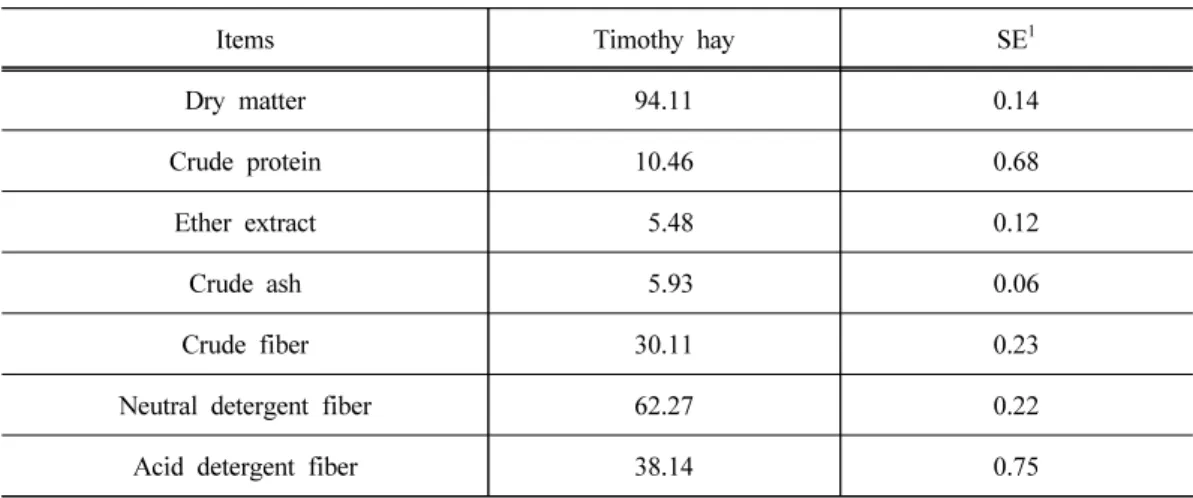
Timothy와 왕대 잎의 일반성분 분석은 AOAC (2012) 방법에 따라 실시하였고, NDF 및 acid detergent fiber (ADF)는 Van soest 등(1991)의 방법에 따라 분석하였다. Timothy의 일반 성분분석은 Table 1와 같다. 왕대 잎의 중성세제불용조단백질(Neutral detergent insoluble crude protein; NDICP)과 산성세제불용조단백질(Acid detergent fiber insoluble crude protein;
ADICP)은 Licitra 등(1996)의 방법에 따라 분석하였다.
Table 1. Chemical composition of timothy hay (Dry matter basis, %)
Items Timothy hay SE
1Dry matter 94.11 0.14
Crude protein 10.46 0.68
Ether extract 5.48 0.12
Crude ash 5.93 0.06
Crude fiber 30.11 0.23
Neutral detergent fiber 62.27 0.22
Acid detergent fiber 38.14 0.75
1SE: Standard error of 3 replicates.
DPPH 라디컬 소거능은 1,1-diphenyl-2-prcrylhydrazyl (DPPH)을 이용하여 Benzie와 Strain (1996)의 실험방법을 변형하여 측정하였다. 시료 100 µL에 methanolic DPPH radical 0.1 mM 용액 100 µL 첨가, 혼합하여 1시간 뒤 spectrophotometer를 이용하여 525 nm에서 optical density (O.D) 값을 측정하여 분석하였다.
2,2′-azino-bis (3- ethylbenzthiazoline-6- sulphonic acid; ABTS) 라디컬 소거능은 Re 등(1999) 의 실험방법을 변형하여 측정하였다. 7 mM의 ABTS 용액을 2.45 mM의 potassium persulfate 와 95%의 에탄올을 섞어 734 nm에서 O.D값이 0.70±0.02가 되게 만든 후 100 µL의 시료에 100 µL의 ABTS 용액을 섞고 30분 뒤 spectrophotometer를 이용하여 734 nm에서 O.D값을 측 정하여 분석하였다.
2) 폴리페놀 및 플라보노이드 함량 분석
총 폴리페놀 함량은 Singleton과 Rossi (1965)의 방법을 일부 변형하여 측정하였다. 또한 Folin-Cioalteu 시약을 이용하여 분석하였고, catechin을 이용한 표준 곡선에 따른 검량선을 작성하여 총 폴리페놀 함량을 계산하였다. 총 플라보노이드 함량은 Park 등(1997)의 방법을 일부 변형하여 분석하였고, quercetin을 이용한 표준 곡선에 따른 검량선을 작성하여 총 플 라보노이드을 계산하였다.
3) pH 및 건물 소화율
pH 측정은 각 발효 시간대별 배양액을 pH meter (S210 SevenCompact, Mettler-Toledo, Greifensee, Switzerlant)를 이용하여 측정하였다.
건물 소화율은 nylon bag을 수거하여 물을 채운 수조에 넣고 Heidolphs Rotamax 120 (Hei- dolph Instrument, Germany)를 이용하여 100 rpm에서 20분간 3회 세척 후, 65℃의 dry oven에 서 24시간 건조 후 건물 잔량을 측정하였다. 기질의 건조 전과 건조 후의 차를 구하고 백분 율로 환산하여 계산하였다.
4) 미생물 성장량
미생물 성장량은 Lee 등(2011)의 방법으로 배양액 1 mL를 채취한 다음, 원심분리기(VS- 15000 N, Vision, Korea)를 이용하여 3,000 rpm에서 3분간 원심 분리하여 사료 입자를 제거 하였다. 그 후 상등액을 14,000 rpm에서 3분간 재 원심 분리하여 미생물 pellet을 침전시킨 후 상등액을 제거하고, pellet에 sodium phosphate buffer (pH 6.5)를 1 mL 첨가 후 vortex로 교반시키는 세척 과정을 3회 반복 진행한 후 spectrophotometer (BIO-RAD Model 680)로 550 nm에서 O.D값을 측정하였다.
5) 총 가스, 메탄 및 이산화탄소 발생량
총 가스 발생량은 Theodorou 등(1994)의 방법으로 serum bottle의 head space에 있는 가스 발생량을 detachable pressure transducer 및 digital read-out voltmeter (Laurel Electronics, Inc., CA, USA)를 사용하여 측정하고, 그 후 6 mL vacutainer에 가스를 포집하여 gas chromatography (GC; HP 5890 Gas Chromatography, USA)를 사용하여 메탄 및 이산화탄소 발생량을 측정하 였다.
6) 휘발성지방산
배양액을 1.5 mL eppendorf tube에 1 mL 채취하여 원심분리기(VS-15000 N, Vision, Korea) 를 이용하여 12,000 rpm에서 3분간 원심 분리하여 사료 입자를 제거하고, 상층액을 0.20 µM syringe filter를 이용하여 2 mL serum bottle에 여과 후, 분석은 high performance liquid chro-
matography (Agilent-1200, Germany)를 이용하였다. 시료의 주입량은 20 µL였고, 이동상 용 액은 0.0085N H2SO4를 사용하였으며, 유속은 0.6 mL/min이었다. Column은 300 mm×7.8 mm I.d MetaCarb 87H (Varian, USA)를 사용하였으며, 온도는 35℃에서 사용하였다.
4. 통계처리
통계처리는 SAS package program (Statistical Analysis System software version 9.2, 2011)의 일반선형모형(General linear model)의 절차를 이용하여 분산분석을 하였고, 각 처리구 간의 유의성 검증을 위하여 Tukey의 다중검정방법으로 실시하였다. 또한 Polynomial contrasts를 이용하여 왕대가 반추위 발효 성상 및 가스 발생량에 미치는 효과(Linear, Quadratic and Cubic) 를 분석하였다. 또한, P값이 <0.05는 유의차가 있는 것으로 간주하였으며, 0.05≤P<0.1는 경향 이 있는 것으로 간주하였다. 메탄과 이산화탄소 농도의 상관관계는 Pearson product moment correlation을 이용하여 분석하였다.
Ⅲ. 결과 및 고찰
1. 왕대 잎의 화학적 성분 분석 및 항산화 능력
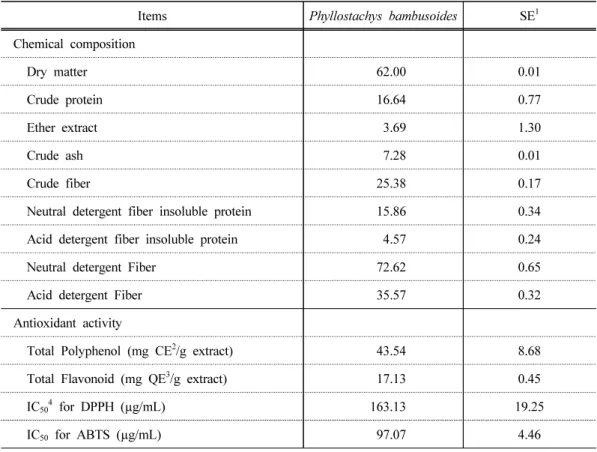
왕대의 화학적 성분 분석 결과와 항산화 능력은 Table 2와 같다. 왕대의 일반성분은 건물 함량 62%, 조단백질 16.64%, 조지방 3.69%, 조회분 7.28%, 조섬유 25.38%, NDF 72.62% 및 ADF 35.57%이었다. 총 폴리페놀 함량은 43.54 mg CE/g이며, 총 플라보노이드 함량은 17.13 mg QE/g이었다. Kim 등(2018)은 한국에 자생하는 Phyllostachys 3종의 추출용매에 따른 총 폴리페놀 함량을 측정하였으며, 22.80~40.34 mg/g로서 이번 연구에서 측정된 왕대의 폴리페 놀 함량이 더 높았다. Hu 등(2012)의 연구에 따르면 왕대 잎의 DPPH, ABTS 유리기 소거 활성은 IC50 값이 각각 848 및 44.3 µg/mL으로 보고하였는데 이번 연구에서의 DPPH 유리 기 소거 활성은 163.13 µg/mL으로 낮게 측정되었으며, ABTS는 97.07 µg/mL으로 높게 측정 되었다.
Items Phyllostachys bambusoides SE
1Chemical composition
Dry matter 62.00 0.01
Crude protein 16.64 0.77
Ether extract 3.69 1.30
Crude ash 7.28 0.01
Crude fiber 25.38 0.17
Neutral detergent fiber insoluble protein 15.86 0.34
Acid detergent fiber insoluble protein 4.57 0.24
Neutral detergent Fiber 72.62 0.65
Acid detergent Fiber 35.57 0.32
Antioxidant activity
Total Polyphenol (mg CE
2/g extract) 43.54 8.68
Total Flavonoid (mg QE
3/g extract) 17.13 0.45
IC
504for DPPH (µg/mL) 163.13 19.25
IC
50for ABTS (µg/mL) 97.07 4.46
Table 2. Chemical composition and antioxidant activity of Phyllostachys bambusoides (DM basis, %)
1SE : Standard error of 3 replicates.
2CE : Catechin equivalent.
3QE : Quercetin equivalent.
4IC50: Half maximal inhibitory concentration.
2. 반추위 pH, 미생물 성장량 및 건물 소화율
왕대 잎 첨가수준에 따른 pH와 미생물 성장량 측정 결과는 Table 3과 같다. 반추위에 존 재하는 미생물 군집에 의해 사료가 분해 및 발효되고 이는 숙주동물에게 매우 중요하다.
그 중 섬유소 분해 박테리아는 pH에 매우 민감하기 때문에 매우 중요한 요소이다(Hiltner and Dehority, 1983). 왕대를 첨가한 처리구의 pH는 6.18~7.37 범위였고, 배양 시간이 경과함 에 따라 pH는 지속적으로 감소하였다. 또한 발효 6 및 12시간대 왕대의 첨가량이 증가함에 따라 pH는 증가하였다(Linear effects, P=0.0335; P=0.0002). Hoover (1986)에 따르면 반추위 미생물 활동은 5.0~5.5이상이면 부정적인 영향을 받지 않기 때문에 이 연구에서 왕대의 첨 가가 미생물 활동에 부정적인 영향을 미치지 않았을 것이다. 또한 반추위 pH는 휘발성지방
Table 3. Effects of Phyllostachys bambusoides on pH and microbial growth rate in in vitro incubation
Incubation time (h) CON
1Treatment
2SEM
3P value
Contrast
PBL PBM PBH Linear Quadratic Cubic
pH
6 7.27 7.32 7.34 7.37 0.03 0.1689 0.0335 0.8309 0.6891
12 6.93
b6.94
b7.03
a7.05
a0.02 0.0010 0.0002 0.7496 0.0668
24 6.60 6.66 6.64 6.60 0.03 0.4971 0.7951 0.1486 0.7951
48 6.18 6.24 6.21 6.22 0.02 0.3942 0.4855 0.3434 0.2104
Microbial growth rate (O.D
4at 550 nm)
6 0.33 0.33 0.32 0.32 0.02 0.9418 0.6802 0.7759 0.7352
12 0.45 0.40 0.40 0.40 0.02 0.2594 0.1283 0.2154 0.6753
24 0.50 0.41 0.42 0.43 0.03 0.1896 0.1853 0.1071 0.4603
48 0.47 0.44 0.45 0.41 0.02 0.2440 0.0912 0.5662 0.3275
abMeans with different superscripts in the same column differ significantly (P<0.05).
1CON: Basal (substrate without additive).
2Treatments: PBL; Phyllostachys bambusoides 2% of substrate, PBM; 4% of substrate, PBH; 6% of substrate.
3SEM: standard error of the mean, n=4.
4O.D: optical density.
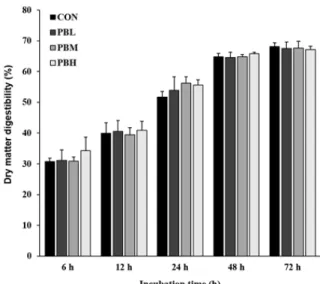
Fig. 1. Effect of Phyllostachys bambusoides on dry matter digestibility in in vitro incubation.
CON, Basal (substrate without additive); PBL, Phyllostachys bambusoides 2% of substrate; PBM, 4% of substrate; PBH, 6% of substrate.
Error bars are standard error of the mean (n=4).
산과 직접적인 관계는 잘 알려져 있는데, 빠르게 발효되는 탄수화물을 과다 급여하면 반추 위 pH는 주로 휘발성 지방산의 증가와 관련이 있다(Patra et al., 1996). Makkar (2003)에 따 르면 polypehnol은 단백질을 보호하여 박테리아의 분해를 방해한다고 하였다. 이번 연구에 서는 발효 초기인 6 및 12시간대에 왕대의 polyphenol이 단백질을 보호하여 첨가량이 증가 할수록 pH가 증가하였다고 생각한다. Busquet 등(2006)에 따르면 미생물 성장량은 식물의 2 차 대사산물에 의해 영향을 받지만, 이번 연구에서는 왕대의 첨가가 미생물 성장량에 영향 을 미치지 않았다. 건물 소화율 결과는 Fig. 1과 같으며, 대조구와 왕대 첨가구를 비교하였 을 때 유의적(P>0.05)인 차이를 보이지 않았다.
3. 총 가스, 이산화탄소 및 메탄 발생량
왕대 잎 첨가수준에 따른 가스 발생량 분석 결과는 Table 4와 같다. 총 가스 발생량은 발 효 6 및 24시간에 4% 및 6% 첨가구에서 대조구에 비해 유의적(P<0.05)으로 낮았으며, 첨가 량이 증가함에 따라 감소(Linear effects, 6 hr, P=0.0004; 24 hr, P=0.0055)하였다. 총 가스 발 생량은 발효, 휘발성지방산 생성 미생물 활동 및 성장과 밀접한 연관이 있다(Getachew et al., 2004). 발효 6시간에 첨가량이 증가함에 따라 총 가스 발생량의 감소는 높은 pH값을 보 인 결과에 영향을 미친 것으로 보인다. 그러나 총 가스 발생량의 감소로 인해 건물 소화율, 휘발성지방산 생성 및 미생물 성장에 부정적일 것이라고 생각하였지만, 유의미한 영향을 미치지 않았다. 메탄 발생량 및 메탄/총 가스는 발효 48시간에 첨가량이 증가함에 따라 감 소(Linear effects, P=0.022; P=0.0293)하였다. 플라보노이드는 식물의 2차 대사산물로 메탄 발생을 억제하고 반추동물의 건강과 생산성을 향상시키며(Bodas et al., 2012), 세포질 막 기 능, 박테리아 세포벽 합성 또는 핵산 합성의 억제를 통해 미생물에 작용한다(Cushnie and Lamb, 2005). 이 연구의 발효 48시간대 메탄 발생의 감소는 왕대의 플라보노이드가 메탄 생 성 미생물에 항균작용을 일으킨 것으로 생각된다. 또한 Kim 등(2015)의 연구에 따르면 플 라보노이드가 많이 함유된 식물 추출물이 반추위 메탄 발생량을 낮추었다. 이산화탄소 발생 량 및 이산화탄소/총 가스는 발효 48시간에 첨가량이 증가함에 따라서 감소(Linear effects, P=0.0188; P=0.0260)하였다. Correlation coeffcients에 기초하여 발효 48시간에 메탄 및 이산 화탄소 생성 사이의 양의 상관관계를 보였다(R2=0.9827, P<0.001). 이 결과는 반추동물의 장 내 메탄 생성의 약 80%이상은 이산화탄소와 수소를 기질로 사용한다는 연구결과를 뒷받침 한다(Whitman et el., 1992).
Table 4. Effects of Phyllostachys bambusoides on rumen gas profiles in in vitro incubation
Incubation time (h) CON
1Treatment
2SEM
3P value
Contrast
PBL PBM PBH Linear Quadratic Cubic
Total gas (mL ․ g
-1DM
4)
6 54.94
a53.69
ab51.79
b51.18
b0.61 0.0033 0.0004 0.6154 0.4924 12 86.95 85.01 85.28 83.24 1.33 0.3053 0.0939 0.9704 0.4786 24 120.18
a117.33
ab116.00
b115.64
b0.95 0.0219 0.0055 0.2212 0.8995 48 154.44 151.14 152.35 149.82 1.58 0.2489 0.1037 0.8119 0.2712 Methane (mL ․ g
-1DM)
6 2.93 3.25 3.27 3.21 0.22 0.6894 0.4105 0.4126 0.8237
12 6.73 6.00 6.97 6.26 0.52 0.5871 0.8550 0.9835 0.1942
24 12.79 11.84 12.51 13.09 0.71 0.6682 0.6261 0.3092 0.6157 48 22.02 21.96 19.79 18.97 0.93 0.1013 0.0220 0.6954 0.4259 Methane / Total gas (%)
6 5.34 6.06 6.31 6.27 0.45 0.4279 0.1582 0.4149 0.9224
12 7.73 7.05 8.17 7.53 0.58 0.6335 0.8475 0.9795 0.2169
24 10.64 10.09 10.78 11.32 0.57 0.5525 0.2974 0.3619 0.6093 48 14.25 14.51 12.98 12.67 0.55 0.0990 0.0293 0.6139 0.2496 Carbon dioxide (mL ․ g
-1DM)
6 13.79 14.82 15.29 15.98 0.99 0.4850 0.1370 0.8645 0.8638 12 32.35 28.30 32.12 29.38 2.47 0.5915 0.6492 0.7976 0.2357 24 46.56 44.03 44.86 47.31 2.99 0.8613 0.8185 0.4259 0.9022 48 74.34 74.46 66.79 63.30 3.25 0.0868 0.0188 0.5904 0.4299 Carbon dioxide / Total gas (%)
6 25.14 27.64 29.53 31.24 1.98 0.2115 0.0419 0.8448 0.9623 12 37.15 33.26 37.66 35.31 2.72 0.6762 0.9260 0.7840 0.2604 24 38.71 37.52 38.64 40.91 2.38 0.8025 0.4765 0.4870 0.9163 48 48.12 49.22 43.83 42.29 1.95 0.0890 0.0260 0.5148 0.2651
abMeans with different superscripts in the same column differ significantly (P<0.05).
1CON: Basal (substrate without additive).
2Treatments: PBL; Phyllostachys bambusoides 2% of substrate, PBM; 4% of substrate, PBH; 6% of substrate.
3SEM: Standard error of the mean, n=4.
4DM Dry matter.
3. 휘발성지방산 생성량
왕대 잎 첨가수준에 따른 휘발성지방산 분석 결과는 Fig. 2와 같다. 휘발성 지방산은 반 추동물의 주요 에너지 공급원이며, 에너지의 약 70%의 비중을 차지한다(Bergman, 1990). 이 번 연구에서 발효 12시간대 총 휘발성지방산 함량은 왕대의 첨가량이 증가할수록 quadratic (Quadratic effects, P=0.0439) 효과를 보였다. 발효 24시간에 왕대의 첨가는 휘발성지방산에 영향을 미치지 않았고, 발효 48시간대 butyrate 함량은 4%와 6% 첨가구에서 대조구에 비해 유의적으로(P<0.05) 높았으며, 첨가량이 증가함에 따라 증가(Linear effects, P=0.0001)하였다.
반추동물이 전분 함량이 높은 사료의 섭취량이 증가하면 propionate, 섬유질이 많은 사료의
Fig. 2. Effects of Phyllostachys bambusoides on volatile fatty acid production in in vitro incubation.
CON, Basal (substrate without additive); PBL, Phyllostachys bambusoides 2% of substrate; PBM, 4% of substrate; PBH, 6% of substrate.
Error bars are standard error of the mean (n=4).
a-bMeans with different superscript letters in the same row indicate significant differences (P<0.05).
섭취량이 증가하면 acetate의 농도가 상대적으로 높아지게 되는데(McDonald, 2002), 48시간 의 butyrate는 발효과정에서 acetate를 전구체로 사용기 때문에(Pryde et el., 2002) 증가한 것 이라고 생각한다. Li 등(2016)에 따르면 butyrate는 동물과 인간의 장 건강을 유지하는데 중 요하다. 또한 반추위 상피세포는 butyrate를 주요 에너지원으로 사용하고 발달을 자극하여 사 료 활용도를 향상 시키고(Scheppach, 1994), Kato 등(2011)의 연구에 따르면 sodium butyrate의 첨가는 송아지의 성장 능력을 향상 시키는 것으로 알려져 있으므로, 송아지의 첨가제로 기 질의 4 및 6%의 왕대를 첨가하는 것이 좋을 것이라고 생각한다. 이번 연구에서 사용된 왕 대는 섬유질이 많이 함유되어 있어 대조구에 비해 acetate 함량이 높아 질 것으로 예상하였 지만 유의적인(P>0.05)차이가 없었다. 반추위 그람 양성 박테리아는 발효 산물인 acetate, butyrate, formate, lactate 및 hydrogen 생산에 중요하다(Stewart, 1991). Cushnie와 Lamb (2005) 에 따르면 일부 플라보노이드는 그람 양성 박테리아에 선택적 항균효과가 있기 때문에 왕 대의 첨가에서 acetate 함량에 유의적인 차이가 없었다고 생각한다.
따라서 국내 자생 왕대 잎은 메탄 저감 사료 첨가제로서 이용가능성이 있는 것으로 확인 된다.
Ⅳ. 적 요
이번 연구는 반추동물의 메탄 감소에 효과가 있는 천연 사료첨가제를 찾고자 실시하였 다. 왕대의 총 폴리페놀 및 플라보노이드 함량은 각각 43.54 mg CE/g 및 17.13 mg QE/g이 였으며, DPPH 및 ABTS 유리기 소거 활성은 IC50 값이 각각 163.13 및 97.07 µg/mL으로 측 정되었다. In vitro 시험은 왕대의 첨가수준을 달리하여 발효 시간대별(6, 12, 24 및 48 hr) 실시하였다. pH는 발효시간동안 적정 범위였으며, 건물 소화율 및 미생물 성장량은 모든 발효 시간대별 처리구에서 대조구와 유의적(P>0.05)인 차이를 보이지 않았다. 총 가스 발생 량은 발효 6 및 24시간에 첨가량이 증가함에 따라 감소(Linear effects, 6 hr, P=0.0004; 12 hr, P=0.0055)하였다. 메탄 및 이산화탄소 발생량은 발효 48시간대 첨가량이 증가함에 따라 감 소하였다(Linear effects, P=0.022; P=0.0188). 또한 왕대의 첨가는 총 휘발성 지방산 생성량에 부정적인 영향을 미치지 않았고, 발효 48시간대 butyrate 함량은 첨가량이 증가함에 따라 증 가(Linear effects, P=0.0001)하였다. 따라서 플라보노이드를 함유하고 있는 왕대의 첨가는 in vitro 반추위 메탄을 저감할 수 있고 발효성상에 부정적인 영향을 미치지 않았다. 그러므로 반추동물 메탄저감 첨가제로서의 활용 가능성이 있을 것으로 기대된다.
[Submitted, January. 27, 2021; Revised, March. 3, 2021; Accepted, March. 23, 2021]
References
1. AOAC. 2012. Official Methods of Analysis of AOAC INTERNATIONAL, 19th Edition.
2. Benzie, I. F. and J. J. Strain. 1966. The ferric reducing ability of plasma (FRAP) as a measure of “antioxidant power”: the FRAP assay. Anal. Biochem. 239(1): 70-76.
3. Bergman, E. N. 1990. Energy contributions of volatile fatty acids from the gastrointestinal tract in various species. Physiol. Rev. 70(2): 567-590.
4. Bodas, R., S. López, M. Fernandez, R. García-González, A. B. Rodríguez, R. J. Wallace, and J. S. González. 2008. In vitro screening of the potential of numerous plant species as antimethanogenic feed additives for ruminants. Anim. Feed Sci. Technol. 145(1-4): 245-258.
5. Bodas, R., N. Prieto, R. García-González, S. Andrés, F. J. Giráldez, and S. López. 2012.
Manipulation of rumen fermentation and methane production with plant secondary metabo- lites. Anim. Feed Sci. Technol. 176(1-4): 78-93.
6. Broudiscou, L., Y. Papon, and A. F. Broudiscou. 2000. Effects of dry plant extracts on fer- mentation and methanogenesis in continuous culture of rumen microbes. Anim. Feed Sci.
Technol. 87(3-4): 263-277.
7. Broudiscou, L., Y. Papon, and A. F. Broudiscou. 2002. Effects of dry plant extracts on feed degradation and the production of rumen microbial biomass in a dual outflow fermenter.
Anim. Feed Sci. Technol. 101(1-4): 183-189.
8. Busquet, M., S. Calsamiglia, A. Ferret, and C. Kamel. 2006. Plant extracts affect in vitro rumen microbial fermentation. J. Dairy Sci. 89(2): 761-771.
9. Cushnie, T. T. and A. J. Lamb. 2005. Antimicrobial activity of flavonoids. Int. J. Antimi- crob. Agents. 26(5): 343-356.
10. Flachowsky, G. 2011. Carbon-footprints for food of animal origin, reduction potentials and research need. J. Appl. Anim. Res. 39(1): 2-14.
11. Getachew, G., P. H. Robinson, E. J. DePeters, and S. J. Taylor. 2004. Relationships between chemical composition, dry matter degradation and in vitro gas production of several ruminant feeds. Anim. Feed Sci. Technol. 111(1-4): 57-71.
12. Goel, G. and H. P. Makkar. 2012. Methane mitigation from ruminants using tannins and saponins. Trop. Anim. Health Prod. 44(4): 729-739.
13. Hiltner, P. and B. A. Dehority. 1983. Effect of soluble carbohydrates on digestion of cellu- lose by pure cultures of rumen bacteria. Appl. Environ. Microbiol. 46(3): 642-648.
14. Hoover, W. H. 1986. Chemical factors involved in ruminal fiber digestion. J. Dairy Sci.
69(10): 2755-2766
15. Hu, C. J., D. H. Xu, H. L. Chen, and K. Yuan. 2012. Contents of the total flavonoids and the total phenols and antioxidant activities in the leaf from different species of Phyllostachys.
Trans tech publications. 343: 1103-1108.
16. Joch, M., L. Cermak, J. Hakl, B. Hucko, D. Duskova, and M. Marounek. 2016. In vitro screening of essential oil active compounds for manipulation of rumen fermentation and methane mitigation. Asian. Australas. J. Anim. Sci. 29(7): 952.
17. Johnson, K. A. and D. E. Johnson. 1995. Methane emissions from cattle. J. Anim. Sci.
73(8): 2483-2492.
18. Ju, I. O., G. T. Jung, J. Ryu, J. S. Choi, and Y. G. Choi. 2005. Chemical components and physiological activities of bamboo (Phyllostachys bambusoides Starf) extracts prepared with different methods. Korean J. Food Sci. Thechnol. 37(4): 542-548.
19. Kato, S., K. Sato, H. Chida, S. Roh, S. Ohwada, S. Sato, P. Guilloteau, and K. Katoh. 2011.
Effects of Na-butyrate supplementation in milk formula on plasma concentrations of GH and insulin, and on rumen papilla development in calves. J. Endocrinol. 211(3): 241-248.
20. Kim, D. S., M. H. Choi, and H. Shin. 2018. Polyphenol contents and antioxidant activities of domestic bamboo leaves with different extraction solvents. J. Adv. Eng. and Tech. 11(1):
7-13.
21. Kim, E. T., L. L. Guan, S. J. Lee, S. M. Lee, S. S. Lee, I. D. Lee, S. K. Lee, and S. S.
Lee. 2015. Effects of flavonoid-rich plant extracts on in vitro ruminal methanogenesis, microbial populations and fermentation characteristics. Asian-australas. J. Anim. Sci. 28(4):
530.
22. Kim, M. J., M. W. Byun, and M. S. Jang. 1996. Physiological and antibacterial activity of bamboo (Sasa coreana Nakai) leaves. J. Korean Soc. Food Sci. Nutr. 25(1): 135-142 23. Korea Forest Research Institute. 2016. Distribution status of bamboo forest resources in
Korea. 16-27.
24. Lee, M. and G. Moon. 2003. Antioxidative effects of Korean bamboo trees, Wang-dae, Som- dae, Maengjong-juk, Jolit-dae and O-juk. Korean J. Food Sci. Technol. 35(6): 1226-1232.
25. Lee, S. J., N. H. Shin, G. M. Chu, and S. S. Lee. 2011. Effects of synbiotics containing anaerobic microbes and prebiotics on in vitro fermentation characteristics and in situ disappearance rate of fermented-TMR. Asian. Australas. J. Anim. Sci. 24(11): 1577-1586.
26. Li, X. B., T. F. Shupe, G. F. Peter, C. Y. Hse, and T. L. Eberhardt. 2007. Chemical changes with maturation of the bamboo species Phyllostachys pubescens. J. Trop. For. Sci.
19(1): 6-12.
27. Li, X., O. Højberg, N. Canibe, and B. B. Jensen. 2016. Phylogenetic diversity of cultivable
butyrate-producing bacteria from pig gut content and feces. J. Anim. Sci. 94(3): 377-381.
28. Licitra, G., T. M. Hernandez, and P. J. Van Soest. 1996. Standardization of procedures for nitrogen fractionation of ruminant feeds. Anim. Feed Sci. Technol. 57: 347-358.
29. Makkar, H. P. S. 2003. Effects and fate of tannins in ruminant animals, adaptation to tannins, and strategies to overcome detrimental effects of feeding tannin-rich feeds. Small Ruminant Res. 49(3): 241-256.
30. McDonald, P. 2002. Animal nutrition. Pearson education.
31. Meale, S. J., T. A. McAllister, K. A. Beauchemin, O. M. Harstad, and A. V. Chaves. 2012.
Strategies to reduce greenhouse gases from ruminant livestock. Acta Agric. Scand. A Anim.
Sci. 62(4): 199-211.
32. Park, Y. K., M. H. Koo, M. Ikegaki, and J. Contado. 1997. Comparison of the flavonoid aglycone contents of Apis mellifera propolis from various regions of Brazil. Arq. Biol.
Tecnol. 40(1): 97-106.
33. Patra, R. C., S. B. Lal, and D. Swarup. 1996. Biochemical profile of rumen liquor, blood and urine in experimental acidosis in sheep. Small Rumin. Res. 19(2): 177-180.
34. Pryde, S. E., S. H. Duncan, G. L. Hold, C. S. Stewart, and H. J. Flint. 2002. The micro- biology of butyrate formation in the human colon. FEMS Microbiol. Lett. 217: 133-139.
35. Re, R., N. Pellegrini, A. Proteggente, A. Pannala, M. Yang, and C. Rice-Evans. 1999. Antio- xidant activity applying an improved ABTS radical cation decolorization assay. Free Radic.
Biol. Med. 26(9-10): 1231-1237.
36. SAS. 2011. SAS/STAT Software for PC. Version 9.2. SAS Institute, Cary, NC, U.S.A.
37. Scheppach, W. 1994. Effects of short chain fatty acids on gut morphology and function. Gut.
35(1): S35-S38.
38. Singleton, V. L. and J. A. Rossi. 1965. Colorimetry of total phenolics with phosphomoly- bdic-phosphotungstic acid reagents. Am. J. Enol. Vitic. 16(3): 144-158.
39. Smith, P., D. Martino, Z. Cai, D. Gwary, H. Janzen, P. Kumar, B. McCarl, S. Ogle, F.
O’Mara, and C. Rice. 2007. Policy and technological constraints to implementation of greenhouse gas mitigation options in agriculture. Agric. Ecosyst. Environ. 118(1-4): 6-28.
40. Stewart, C. S. 1991. The rumen bacteria. In: Rumen Microbial Metabolism and Ruminant Digestion (Ed. J. P. Jouany) INRA Editions, Paris, France. 15-26.
41. Theodorou, M. K., B. A. Williams, M. S. Dhanoa, A. B. McAllan, and J. France. 1994. A simple gas production method using a pressure transducer to determine the fermentation kinetics of ruminant feeds. Anim. Feed Sci. Technol. 48(3-4): 185-197.
42. Van Soest, P. V., J. B. Robertson, and B. A. Lewis. 1991. Methods for dietary fiber, neutral
detergent fiber, and nonstarch polysaccharides in relation to animal nutrition. J. Dairy Sci.
74(10): 3583-3597.
43. Whitman, W. B., T. L. Bowen, and D. R. Boone. 1992. The methanogenic bacteria. The prokaryotes: a handbook on the biology of bacteria: ecophysiology, isolation, identification, applications. Springer-Verlag. New York. 1(2): 719-767.
44. Wu, J., S. Wu, T. Hsieh, and S. Chang. 2002. Effects of copper-phosphorous salt treatments on green colour protection and fastness of ma bamboo (Dendrocalamus latiflorus). Polym.
Degrad. Stab. 78(2): 379-384.