Effects of Organic Acids on In Vitro Ruminal Fermentation Characteristics and Methane Emission
Ji Un Ok
1†, Dong Uk Ha
2†, Shin Ja Lee, Eun Tae Kim
2, Sang Suk Lee
4, Young Kyun Oh
1, Kyoung Hoon Kim
1and Sung Sill Lee
2*
1
Animal Nutrition Team, National Institute of Animal Science, RDA, Suwon 441-706, Korea
2
Division of Applied Life Science (BK21 program) & Institute of Agriculture and Life Science (IALS), Gyeongsang National University, Jinju 600-701, Korea
3
Department of Animal Science, Gyeongbuk Provincial Collage, Yeacheon 757-807, Korea
4
Department of Animal Science & Biotechnology, Suncheon National University, Suncheon 540-950, Korea
Received June 1, 2012 /Revised August 7, 2012 /Accepted August 7, 2012The objective of this study was to evaluate the in vitro effects of organic acids on methane emission and ruminal fermentation characteristics. We expected our methodology to result in a decrease of methanogens attached to the surface of rumen ciliate protozoa by addition of organic acids and in particular a decrease in methane emission. A fistulated Holstein cow of 650 kg body weight was used as a donor of rumen fluid. Organic acids (aspartic acid, fumaric acid, lactic acid, malic acid, and suc- cinic acid) known to be propionate enhancers were added to an in vitro fermentation system and in- cubated with rumen fluid. The microbial population, including bacteria, protozoa, and fungi, were enumerated, and gas production, including methane and fermentation characteristics, were observed in vitro. Organic acids appeared to affect the rumen protozoan community. The rumen protozoal pop- uation decreased with the addition of aspartic acid, fumaric acid, lactic acid, and malic acid. In partic- ular, the methane emission was reduced by addition of lactic acid. The concentration of propionate with all organic acids that were added appeared to be higher than that of the control at 12 h incubation. Addition of organic acids significantly affected rumen bacteria and microbial growth. The bacteria in added fumaric acid and malic acid was significantly higher (p<0.05) and protozoa was sig- nificantly lower (p<0.05) than that of the control. Microbial growth with the addition of organic acids was greater than the control after 48 h incubation.
Key words : Organic acids, methane emission, ruminal fermentation, protozoa, VFA
†These authors contributed equally to this work.
*Corresponding author
*Tel:+82-55-772-1883, Fax:+82-55-772-1889
*E-mail : [email protected]
서 론
반추위 내 메탄생성은 지구온난화를 가속화 하고 반추위 내 에너지 소실을 야기하는 것으로 알려져 있다[17]. 반추동물 은 메탄생성의 가장 큰 원인 중의 하나로, 전 세계적으로 연간 81-92 MT의 메탄을 생성하는데, 이는 인류가 발생하는 메탄 생성량의 23-27%를 차지한다[10]. 최근, 반추위 내 미생물을 제어를 통해 반추위 내 메탄생성을 억제시키고, 영양소 효율 을 극대화하기 위한 연구가 활발히 진행되고 있다. 반추위 내 H
2를 이용하여 메탄생성균에 의해 메탄(CH
4)이 발생되는데, 반추위 내 H
2를 제거함으로써 메탄생성을 감소시킬 수 있을 것이다. 반추위 내 organic acids의 첨가는 대사 H
2의 경합에 의해, propionic acid의 생성을 증가시키고, 메탄에 의한 에너 지의 손실을 감소시킬 수 있다[3]. 이러한 반추위 내 메탄생성
억제를 위해 사료 내 organic acids의 첨가는 반추위 propionic
acid 생성과정의 중간 대사물질로써 대사과정의 H
2를 대신
이용함으로써 메탄생성을 감소하는 작용을 하는 것으로 알려
져 있다[5,11,14]. Fumaric acid, malic acid와 같은 organic
acids의 첨가는 propionic acid의 생성을 높이며, 사료 효율을
향상시키고, lactic acid와 메탄 생성을 억제시킨다[15]. 또한,
반추위 내 methanogen은 propionic acid 및 butyric acid의
전구물질인 aspartic acid, malic acid, fumaric acid등의 organ-
ic acids를 메탄 생성에 필요한 H
2와 경쟁적으로 이용한다
[2,4,13,18]. 그리고 propionic acid전구물질은 H
2를 제거하고
[19], 섬유소 분해 bacteria와 cellulose분해율을 증가한다고 알
려져 있다[2,18]. 따라서, 본 연구의 목적은 여러 가지 organic
acids를 첨가하여 in vitro 반추위 발효 성상, 건물소화율, 반추
위 혐기성 미생물 수(bacteria, fungi 및 protozoa) 및 메탄생성
에 미치는 영향과 기작을 규명하고자 한다.
재료 및 방법
공시동물 및 반추 위액채취
반추위액은 순천대학교 부속농장(순천시 서면 지본리 375 번지)의 반추위 cannula가 시술된 24개월령 체중 650 kg의 Holstein으로부터 채취하였다. 공시동물은 Italian rye grass와 배합사료를 6:4의 비율로 체중의 3% 수준으로 1일 2회 분할 (06:00 시, 16:00 시) 급여하였고, 물과 미네랄은 자유 섭취토록 하였다. 반추위액은 오전사료 급여 3시간 후 반추위 cannula 를 통하여 4겹의 cheese cloth로 여과하여 채취하였고, 채취한 위액은 혐기상태로 유지 한 2 l 유리병에 담은 후 실험실로 이동하였다.
공시시료 및 in vitro 배양
공시시료는 70℃ dry oven에서 24 hr 건조시킨 timothy를 2 mm 스크린으로 분쇄하여 기질로 이용하였고, 실험에 사용 된 organic acids (aspartic acid, fumaric acid, lactic acid, mal- ic acid 및 succinic acid)는 Sigma (Chemical Co., St. Louis, Mo, USA) 에서 구입하였다. Timothy 0.3 g과 각각의 유기산 들이 10 mM이 포함된 60 ml serum bottle에 McDougall buf- fer 10 ml과 위액 5 ml을 분주한 후 고무마개로 막고 알루미늄 캡을 씌워 혐기상태를 유지하였다. 혼합액은 39℃의 shaking incubator (Jeio Tech, SI-900R; 120 rpm)에서 시간대별(3, 6, 12, 24, 36 및 48 hr)로 배양하였다.
조사항목 및 방법
각 배양시간대별로 serum bottle의 배양액을 shaking in- cubator (Jeio Tech, SI-900R; 120 rpm)에서 꺼낸 후, 반추위 발효성상, 미생물 성장량 및 가스분석을 하였다. pH는 pH meter (MP230, Mettler Toledo, Switzerland)를 이용하여 측정 하였다. 건물 소화율은 Moore [17]의 방법을 이용하였으며, Filter paper (Watman. No. 1, GE Healthcare companies, UK) 를 이용하여 배양물 내 기질만을 거른 후 70℃ dry oven에서 24시간 건조한 뒤 측정하였다. 혐기성 bacteria 수는 Dehority's artificial medium [6]을 이용하였고, roll tube 방법 [9]으로 혐기배양 후 colony 수를 측정하였다. 혐기성 fungi는 Lowe's media [11]에 배양한 후, thallus 생성 수를 측정하였 다. 혐기성 protozoa의 수는 살아있는 protozoa (living cell)와 죽은 protozoa (dead cell)를 측정하기 위해 900 ml 증류수, 100 ml 35% formaldehyde, 2 g trypan blue, 8 g NaCl으로 구성된 TBFS (trypan blue- formalin-salin)용액으로 living cell 의 핵을 염색한 다음 Abe 등[1]의 방법에 따라 plankton coun- ter glass를 이용하여 현미경으로 측정하였다. 총 가스발생량 은 Ferorak와 Hrwdey [8]의 방법에 따라 water displacement apparatus를 이용하여 측정하였다. 메탄가스는 Porapak NQ column (Q 80-100 mesh)이 장착된 Gas Chromatography
(GC-2010; Shimadzu, Japan)를 이용하여 분석하였다. GC의 분석조건은 oven temperature 80℃, injector temperature 100℃, FID (Flame ionization detector) temperature 110℃로 하였으 며, total running time은 3분이었고, carrier gas는 He과 H
2가스를 이용하였다. 휘발성 지방산 발생량을 분석하기 위하여 pH 및 총 가스발생량을 측정한 후 반추위 배양물을 주사기를 이용하여 상층액을 vacutainer tube에 저장한 후 분석 시까지 -70℃에서 냉동보관 하였다. High performance liquid chro- matography (HPLC; Agilent Technolgies 1200 series, Agilent, Germany)를 이용하여 휘발성 지방산 함량을 분석하 였다. Lactic acid 분석 Detector는 UV/Visible detector (Agilent Technolgies 1200 series, Germany)를 사용하고, 210 nm 및 220 nm의 파장에서 분석하였다. MetaCard 87H (300 mm×7.8 mm; Varian, Germany)칼럼을 사용하였고, 칼럼의 사용온도는 35℃, total running time은 30분이었다.
통계처리
본 시험에서 얻은 결과들은 SAS Program [20]의 GLM (General Linear Model) procedure를 이용하여 분산분석을 하 였고, Duncan`s multiple range test [7]를 이용하여 p<0.05의 수준으로 유의성을 검증하였다.
결과 및 고찰
pH의 변화
반추위액이 첨가된 in vitro시험에서 organic acids를 첨가 하여 배양시간 별 pH 값을 측정한 결과는 Table 1과 같다.
배양 3 시간에서 모든 organic acids첨가구가 6.69에서 6.58 정도의 범위로 대조구에 비해 낮았고, malic acid 및 succinic acid첨가구는 전체배양 시간 동안 pH 값이 6.58에서 6.16의 범위로 대조구에 비해 낮았다. 이는 organic acids를 첨가로 인해 탄수화물 분해율 및 가스발생량은 증가하고, pH 값은 낮았다는 보고[2,19,21]와 일치하였다. Organic acids첨가구들 중 fumaric acid는 초기 배양시간인 3시간을 제외한 나머지 배양시간 동안 대조구에 비해 pH 값이 높았는데, 이는 반추위 in vitro 시험에서 배양액에 fumaric acid를 첨가하였을 때 pH 가 감소되었다는 보고[2]와는 상이하였다.
건물 소화율
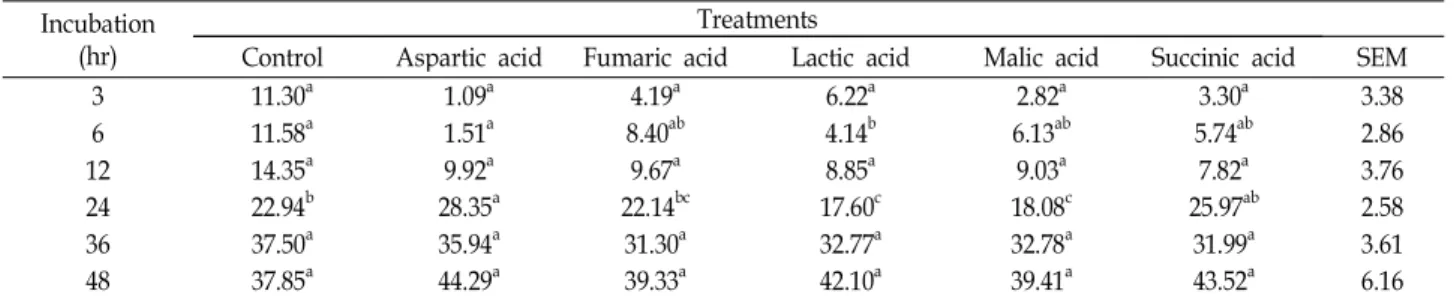
반추위액이 첨가된 in vitro시험에서 organic acids를 첨가
하여 배양시간 별 건물 소화율을 측정한 결과는 Table 2와 같
다. 기질로 사용된 timothy의 48시간 in vitro 건물 소화율은
38-44% 수준이었고, 건물 소화율에 있어 유의적인 차이는 없
었지만, 첨가구가 대조구에 비해 높았다. Organic acids의 첨
가는 반추위 내 H
2이용의 증가로 반추위 섬유소분해 bacteria
를 증가시키고, 섬유소 분해를 향상시킨다[2,19,21]. 따라서 본
Table 1. Effects of organic acids on pH value Incubation
(hr)
Treatments
Control Aspartic acid Fumaric acid Lactic acid Malic acid Succinic acid SEM
3 6.71a 6.69a 6.69a 6.65b 6.58c 6.58c 0.02
6 6.70a 6.67ab 6.71a 6.64b 6.59c 6.58c 0.02
12 6.65b 6.72a 6.70a 6.61c 6.59c 6.62bc 0.02
24 6.55a 6.54a 6.56a 6.49ab 6.45b 6.46b 0.05
36 6.38ab 6.39ab 6.42a 6.39ab 6.28b 6.30b 0.12
48 6.26b 6.36a 6.40a 6.23bc 6.16c 6.18bc 0.12
abcMeans with different superscripts in the same column differ significantly (
p
<0.05).Table 2. Effects of organic acids on
in vitro
dry matter disappearance (%) Incubation(hr) Treatments
Control Aspartic acid Fumaric acid Lactic acid Malic acid Succinic acid SEM
3 11.30a 1.09a 4.19a 6.22a 2.82a 3.30a 3.38
6 11.58a 1.51a 8.40ab 4.14b 6.13ab 5.74ab 2.86
12 14.35a 9.92a 9.67a 8.85a 9.03a 7.82a 3.76
24 22.94b 28.35a 22.14bc 17.60c 18.08c 25.97ab 2.58
36 37.50a 35.94a 31.30a 32.77a 32.78a 31.99a 3.61
48 37.85a 44.29a 39.33a 42.10a 39.41a 43.52a 6.16
abMeans with different superscripts in the same column differ significantly (
p
<0.05).Table 3. Effects of organic acids on rumen microbial growth rate (OD at 550 nm) Incubation
(hr) Treatments
Control Aspartic acid Fumaric acid Lactic acid Malic acid Succinic acid SEM
3 0.49b 0.64ab 0.82a 0.70ab 0.64ab 0.66ab 0.11
6 0.64a 0.67a 0.71a 0.67a 0.68a 0.67a 0.08
12 0.60ab 0.59ab 0.70a 0.66ab 0.58ab 0.55b 0.07
24 0.79a 0.97a 0.81a 0.74a 0.87a 0.78a 0.13
36 0.82b 0.87ab 0.93a 0.87ab 0.78b 0.80b 0.06
48 0.75b 0.85b 1.05a 0.91ab 0.79b 0.89b 0.08
abcMeans with different superscripts in the same column differ significantly (
p
<0.05).시험에서도 섬유소 분해 bacteria의 증가에 의해 가스 및 메탄 발생량이 높았고, 건물 소화율 또한 높았다.
반추위 미생물 성장량
반추위액이 첨가된 in vitro시험에서 organic acids를 첨가 하여 배양시간 별 미생물 성장량을 측정한 결과 Table 3와 같 다. 미생물 성장량은 배양 3시간에서 첨가구가 대조구에 비해 미생물 성장량이 유의적(p<0.05)으로 높았고, fumaric acid첨 가구는 전 배양시간 동안 가장 높았다.
혐기성 미생물 수 변화
반추위액이 첨가된 in vitro시험에서 organic acids를 첨가 하여 혐기성 미생물의 수를 측정한 결과는 Table 4와 같다.
Bacteria의 수는 대조구에 비해 fumaric acid 와 malic acid첨 가구에서 유의적(p<0.05)으로 많았고, fungi의 수는 적었다. 기 존 연구에서 methanogen은 protozoa와 공생관계에 있으므로,
protozoa의 성장이 메탄생성과 밀접한 관련이 있다고[18] 알 려져 있다. 하지만 본 시험에서는 protozoa의 수가 대조구에 비해 적었던 fumaric acid와 malic acid에서 메탄 발생량은 대조구에 비해 높았다.
총 가스 및 메탄 발생량
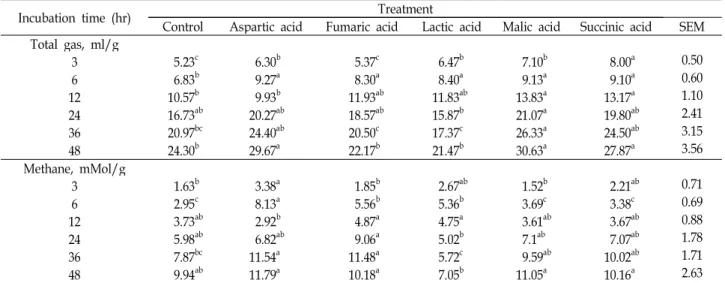
반추위액이 첨가된 in vitro실험에서 organic acids를 첨가 하여 배양시간 별 총 가스 및 메탄 발생량을 측정한 결과는 Table 5와 같다. 총 가스 발생량은 배양 48시간에 aspartic acid, malic acid 및 succinic acid첨가구에서 유의적으로 높았으며 (p<0.05), 특히 malic acid첨가구의 경우 전 배양 동안 대조구 보다 가스 발생량이 높았다(p<0.05). 메탄 발생량은 배양 48시 간에 lactic acid첨가구를 제외한 모든 첨가구에서 대조구에 비해 높았다. 이러한 결과는 organic acids를 첨가하여 메탄생 성이 감소하였다는 이전의 연구[2,5,12,16]와는 상이하였다.
Malic acid와 fumaric acid 등의 organic acids는 propionic
Table 4. Effects of organic acids on microbial diversity after 12 hr incubation Item
Microbe
Bacteria Live cell Protozoa Dead cell Fungi
cfu1)×107 cell×103 cell×103 tfu2)×102
Control 47.50±17.02c 13.50±2.84a 1.00±0.41b 12.00±5.00a
Aspartic acid 11.75±0.25d 12.50±2.90a 0.50±0.29b 4.25±1.49a
Fumaric acid 72.50±3.30b 2.25±1.25b 5.50±1.85a 7.50±3.86a
Lactic acid 9.50±1.66d 9.75±1.11a 0.50±0.50b 3.67±0.33a
Malic acid 171.50±5.81a 3.00±1.68b 3.00±0.82ab 7.33±2.03a
Succinic acid 17.25±1.60d 15.50±2.90a 0.25±0.25b 4.00±1.15a
Mean±standard error
1)colony formation unit/ml
2)thallus formation unit/ml
abcdMeans with different superscripts in the same column differ significantly (
p
<0.05).Table 5. Effects of organic acids on total gas and methane emission in
in vitro
Incubation time (hr) Treatment
Control Aspartic acid Fumaric acid Lactic acid Malic acid Succinic acid SEM Total gas, ml/g
3 5.23c 6.30b 5.37c 6.47b 7.10b 8.00a 0.50
6 6.83b 9.27a 8.30a 8.40a 9.13a 9.10a 0.60
12 10.57b 9.93b 11.93ab 11.83ab 13.83a 13.17a 1.10
24 16.73ab 20.27ab 18.57ab 15.87b 21.07a 19.80ab 2.41
36 20.97bc 24.40ab 20.50c 17.37c 26.33a 24.50ab 3.15
48 24.30b 29.67a 22.17b 21.47b 30.63a 27.87a 3.56
Methane, mMol/g
3 1.63b 3.38a 1.85b 2.67ab 1.52b 2.21ab 0.71
6 2.95c 8.13a 5.56b 5.36b 3.69c 3.38c 0.69
12 3.73ab 2.92b 4.87a 4.75a 3.61ab 3.67ab 0.88
24 5.98ab 6.82ab 9.06a 5.02b 7.1ab 7.07ab 1.78
36 7.87bc 11.54a 11.48a 5.72c 9.59ab 10.02ab 1.71
48 9.94ab 11.79a 10.18a 7.05b 11.05a 10.16a 2.63
abcMeans with different superscripts in the same column differ significantly (
p
<0.05).acid의 생성과정의 중간 대사물질로서, 이들 물질을 첨가하면 propionic acid생성이 증가하게 된다. 이 과정에서 H
2가 이용 되기 때문에 메탄 합성에 필요한 H
2가 줄어들어 메탄 발생량 이 감소하게 된다[2,4,12]. 하지만 본 시험에서 propionic acid 의 농도는 증가 하였지만(Table 6), 메탄 발생량은 감소되지 않았다. 이러한 결과는 Callaway 등[4]에 의하면 organic acid 만 단독으로 첨가하였을 경우 메탄생성 억제에 극히 적은 영 향을 미친다고 하였고, organic acid 및 monensin을 같이 첨가 하였을 경우 메탄생성 억제에 큰 영향을 미치는 결과로 볼 때 organic acid 단독으로 첨가하는 것 보다는 다른 물질과 혼합하여 사용하는 것이 메탄생성 억제에 더 효과적일 것으로 사료된다.
VFA 생성량
반추위액이 첨가된 in vitro시험에서 organic acids를 첨가
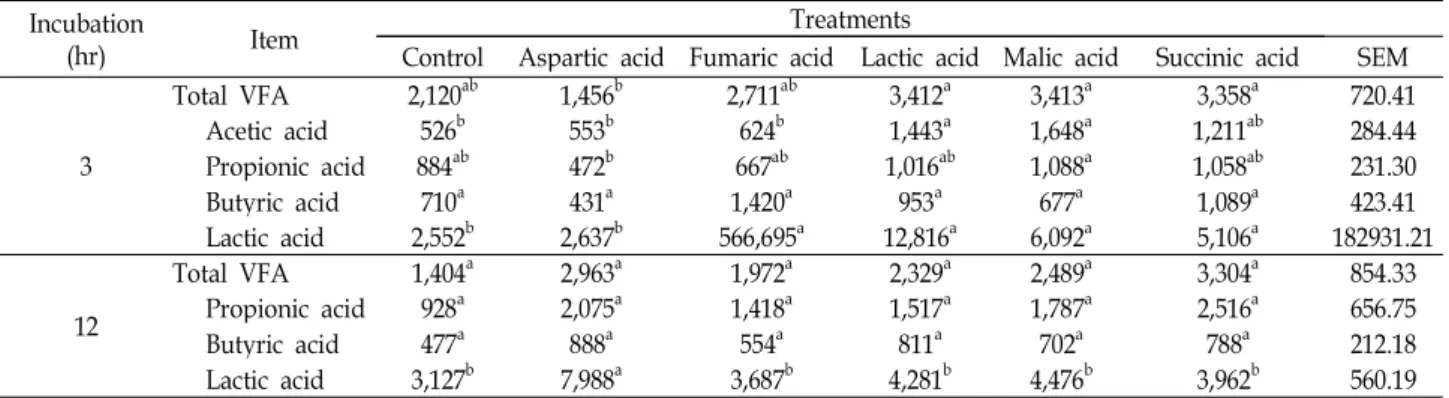
하여 배양시간 별 VFA을 측정한 결과는 Table 6와 같다. 총 VFA 농도는 대조구에 비해 첨가구에서 높았고, 배양 12시간 에서 aspartic acid가 유의적(p<0.05)으로 높았다. Propionic acid의 농도는 배양 12시간에 유의적인 차이는 없지만 첨가구 가 대조구에 비해 높았다. Malic acid와 fumaric acid와 같은 organic acids는 propionic acid의 전구물질로서, 이들의 첨가 로 인해 propionic acid생성이 증가하게 된다. 이 과정에서 H
2가 이용되기 때문에 메탄 합성에 필요한 H
2가 줄어들어 메탄 발생량이 감소하게 된다[2,4,12]. 하지만, 본 시험에서 pro- pionic acid는 메탄생성과 상관없이 건물 소화율이 높았던 첨 가구들에서 높았다.
이상의 실험 결과를 종합해 보면, organic acids를 첨가는
반추위 내 pH는 감소하였고 가스 발생량, 반추위 미생물 성장
량 및 propionic acid 모두 증가하였으며, 특히 lactic acid는
메탄생성을 억제하였다. 앞으로 organic acid와 다른 메탄억제
Table 6. Effects of organic acids on ruminal fermentation characteristics at 3 and 12 hr (ppm) Incubation
(hr) Item Treatments
Control Aspartic acid Fumaric acid Lactic acid Malic acid Succinic acid SEM 3
Total VFA 2,120ab 1,456b 2,711ab 3,412a 3,413a 3,358a 720.41
Acetic acid 526b 553b 624b 1,443a 1,648a 1,211ab 284.44
Propionic acid 884ab 472b 667ab 1,016ab 1,088a 1,058ab 231.30
Butyric acid 710a 431a 1,420a 953a 677a 1,089a 423.41
Lactic acid 2,552b 2,637b 566,695a 12,816a 6,092a 5,106a 182931.21 12
Total VFA 1,404a 2,963a 1,972a 2,329a 2,489a 3,304a 854.33
Propionic acid 928a 2,075a 1,418a 1,517a 1,787a 2,516a 656.75
Butyric acid 477a 888a 554a 811a 702a 788a 212.18
Lactic acid 3,127b 7,988a 3,687b 4,281b 4,476b 3,962b 560.19
abMean with different superscripts in the same row differ significantly (
p
<0.05).물질과 혼합하여 반추위 내 메탄생성 억제에 관한 구체적인 연구가 필요한 것으로 사료된다.
감사의 글
본 연구는 농림수산식품기술평가원(IPET) 농림수산식품 연구개발 지정공모과제의 지원과 경상대학교 농업생명과학 연구원(IALS) 및 BK21 농생명산업 글로벌인재 육성사업단으 로부터 지원 받음.
References
1. Abe, M., Shibu, H. and Kumeno, F. 1972. Improved method for counting rumen protozoa.
Jap. J. Zootech. Sci.
43, 535.2. Asanuma, N., Iwamoto, M. and Hino, T. 1999. Effect of the addition of fumarate on methane production by ruminal mi- croorganisms
in vitro
.J. Dairy Sci.
82, 780-787.3. Castillo, A. R., Gallardo, M. R., Maciel, M., Giordano, J. M., Conti, G. A., Gaggiotti, M. C., Quaino, O., Gianni, C. and Hartnell, G. F. 2004. Effects of feeding rations with genet- ically modified whole cottonseed to lactating Holstein cows.
J. Dairy Sci
. 87, 1778-1785.4. Callaway, T. R. and Martin, S. A. 1996. Effects of organic acid and monensin treatment on
in vitro
mixed ruminal mi- croorganism fermentation of cracked corn.J. Anim. Sci.
74, 1982-1989.5. Carro, M. D. and Ranilla, M. J. 2003. Influence of different concentrations of disodium fumarate on methane pro- duction and fermentation of concentrate feeds by rumen mi- cro-organisms
in vitro
.Br. J. Nutr.
90, 617-623.6. Dehority, B. A. and Scott, H. W. 1967. Extent of cellulose and hemicellulose digestion in various forages by pure cul- tures of rumen bacteria
. J. Dairy Sci.
50, 1136-1141.7. Duncan, D. B. 1995. Multiple range and multiple
F
test.Biometrics
11, 1-6.8. Fedorah, P. M. and Hrudey, S. E. 1983. A simple apparatus for measuring gas production by methanogenic cultures in serum bottles.
Environ. Tech. Lett.
4, 425-432.9. Hungate, R. E. 1966. The rumen and its microbes. Academic press, NY.
10. IPCC (Intergovernmental Panel on Climate Change) (2007) Climate Change. 2007. The Scientific Basis, (Cambridge University Press, Cambridge, UK).
11. Johnson, K. A. and Johnson, D. E. 1995. Methane emissions from cattle.
J. Anim. Sci.
73, 2483-2492.12. Lopez, S., Valdes, C., Newbold, C. J. and Wallace, R. J. 1999.
Influence of sodium fumarate addition on rumen fermenta- tion
in vitro
.Br. J. Nutr.
81, 59-64.13. Lowe, S. E., Theodorou, M. K., Trinci, A. P. J. and Hespell, R. B. 1985. Growth of anaerobic rumen fungi on defined and semi-defined media lacking rumen fluid.
J. Gen.
Microbiol.
131, 2225-2229.14. Martin, S. A. and Park, C. M. 1996. Effect of extracellular hydrogen on organic acid utilization by the ruminal bacte- rium
Selenomonas ruminantium
.Curr. Microbiol.
32, 327-331.15. Martin, S. A. and Streeter, M. N. 1995. Effect of malate on
in vitro
mixed ruminal microorganism fermentation.J. Anim.
Sci
. 73, 2141-2145.16. Martin, S. A. 1998. Manipulation of ruminal fermentation with organic acids: a review.
J. Anim. Sci.
76, 3123-3132.17. Moore, J. E. 1970. Procedure for two-stage in vitro digestion of forage. In L. E. Harrison (ed.). Nutrition research techni- que for domestic and wild animals
. J. Brit. Grassl. Sci
. 18, 18. Moss, A. R., Jouany, J. P. and Newbold, J. 2000. Methane119.production by ruminants: its contribution to global warming.
Ann. Zootech.
49, 231-253.19. Newbold, C. J., Lopez, S., Nelson, N., Ouda, J. O., Wallace, R. J. and Moss, A. R. 2005. Propionate precursors and other metabolic intermediates as possible alternative electron ac- ceptors to methanogenesis in ruminal fermentation
in vitro
.Br. J. Nutr.
94, 27-35.20. SAS. 1996. SAS User Guide. Release 6. 12th eds., SAS Inst.
Inc. Cary NC. USA.
21. Ungerfeld, E. M., Rust, S. R. and Burnett, R. 2003. Use of some novel alternative electron sinks to inhibit ruminal methanogenesis.