꿀풀 에탄올 추출물 및 분획물의 항산화성
박동식†·박미영·전상민·이진영·이영민·장환희·황경아·김재현 농촌진흥청 국립농업과학원 농식품자원부
Antioxidant Activity of Different Solvent Fractions from Prunella vulgaris var. lilacina
Dong Sik Park†, Mi Young Park, Sang Min Chon, Jin Young Lee, Young Min Lee, Hwan Hee Jang, Kyung A Hwang and Jae Hyun Kim
Department of Agrofood Resources, NAAS, RDA, Suwon 441-853, Korea.
ABSTRACT: The potential antioxidant activities of different fractions from Prunella vulgaris var. lilacina were assayed in vitro. Among several fractions, n-BuOH fraction showed the highest 1,1-di[henyl-2-picrylhydrazyl (DPPH) free radical scav- enging (IC
50= 0.50 ㎍/mL). The results of 2,2’-azinobis (3-ethylbenzothiazoline-6-sulfonic acid) diammonium salt (ABTS) radical scavenging activity and ferric reducing antioxidant power (FRAP) assay showed the concentration dependency and n-BuOH fraction appeared a better result than the other fractions at the same concentration in this study. Moreover the total phenol and flavonoid contents of n-BuOH fraction contained the highest level. Additionally, correlation analysis indi- cated a high correlation between the antiradical activity and the total phenolic and flavonoid contents (p < 0.001). It suggests that n-BuOH fraction obtained from the 70% EtOH crude extract of Prunella vulgaris var. lilacina has wide potential for use as a source of antioxidant material.
Key Words : ABTS, DPPH, Flavonoid Contents, Phenolic Contents, Prunella vulgaris var. lilacina
INTRODUCTION
There is considerable epidemiological evidence indicating an association between diets rich in fruits and vegetables and a decreased risk of cardiovascular diseases and certain forms of cancer originated by the presence of free radicals in the body (Gaté et al., 1999; Yeum et al., 2003). Therefore, there is consumer interesting in there being included in foods as additives and within the manufacture of medicines (Willcox et al., 2004).
Some of the most widely used antioxidants are vitamin C, vitamin E and carotenoids. These play an important role in reducing oxidative stresses that are caused by different factors but are mainly the by-product of physiological stress within the human body (Nordberg and Arnér, 2001). Some of these reactive oxygen species (ROS) can include super-oxide anion radicals, hydroxyl radicals and hydrogen peroxide. The imbalance of ROS and attempted elimination by the body can be the cause of
several chronic diseases, inflammations and neurological disorders (Halliwell, 1996). Antioxidants protect the body by scavenging free radicals and reducing the production of hydrogen peroxide within the body (Shahidi and Wanasundara, 1992).
Traditionally, herb and plant based medicines have played a large role in the history of human health.
However, there is still a lot of research to evaluate their properties and mechanisms. Some have suggested that the antioxidant properties of some herbs are behind their use as medicines. The phenol compounds of some herbs have acted as reducing agents, hydrogen donators and free radicals eliminators (Lee et al., 2011; Seo et al., 2009;
Shahidi and Wanasundara, 1992).
Prunella vulgaris var. lilacina is one of the most widely used medical plants in north-eastern Asian countries and have been used for traditional herbal medicine to treat fever, inflammation, dropsy, gonorrhea and cancer (Park et
†Corresponding author: (Phone) +82-31-299-0520 (E-mail) [email protected]
Received 2011 October 10 / 1st Revised 2011 November 25 / 2nd Revised 2011 December 7 / 3rd Revised 2011 December 15 / Accepted 2011 December 19
al., 2010). Although several studies have reported that it has many biological activities (Ryu et al., 2000; Psotová et al., 2003), little is known to regarding its antioxidant properties which is related to these beneficial properties.
The purpose of this study was to evaluate the several fractions (n-Hexane, CHCl
3, n-BuOH, and H
2O) from 70%
EtOH crude extract of Prunella vulgaris var. lilacina as new potential source of natural antioxidants. So, this study examined total phenolic and flavonoid contents of various fractions from 70% EtOH crude extract of Prunella vulgaris var. lilacina and evaluated their potential antioxi- dative activities by DPPH and ABTS radical scavenging activities. Additionally, the correlation between the total phenolic and flavonoid contents in the tested fractions and their antioxidant activities was investigated.
MATERIALS AND METHODS
1. Sample Preparation
The Prunella vulgaris var. lilacina was collected from agricultural fields in Yeongju, Gyeongbuk, Korea in Jul, 2007. Washed and chopped fresh Prunella vulgaris var.
lilacina was dried in a freeze dryer (at −70℃). The dried leaves and stem of Prunella vulgaris var. lilacina were extracted three times with 70% EtOH. The 70% EtOH extract powder (10 g) was suspended in 500 ml distilled water and extracted with 500 ㎖ of the fillowing solvents stepwise: n-hexane, CHCl
3and n-BuOH. Each fraction was filtered through Advantec No. 6 filter paper (Advantec, Toyo Roshi Kaish, Ltd., Tokyo, Japan). Filtered extracts concentrated under reduced pressure by rotary evaporator (EYELA N-1000 Rikakikai Co., LTD., Tokyo, Japan) at 40 ℃ and lyophilized by lyophilizer (Bondiro-PVTFD20R, Ilshine Lab Co. Ltd., Korea), and stored at −20℃ until used. The concentration extract powder (4.16 g) was further partitioned sequentially to give n-Hexane (0.56 g), CHCl
3(0.57 g), n-BuOH (1.41 g), H
2O (1.57 g) fractions in powder (Fig. 1).
2. Total phenol determination
Total phenols were determined by using the Folin- Ciocalteu reagent according to the method of Ainsworth and Gillespie (Ainsworth and Gillespie, 2007). Briefly, a 50 µL of various fractions was assayed with 250 µL Folin reagent and 500 µL of sodium carbonate (20%, w/v). The
mixture was vortexed and diluted with water to a final volume of 5 mL. After incubation for 30 min at room temperature, the absorbance was read at 765 ㎚.
3. Total flavonoid determination
The total flavonoids were detrmined using the method of Jia et al. (1999). A volume of 0.5 ㎖ of 2% AlCl
3ethanol solution was added to 0.5 mL of extract solution.
The mixture was incubated for 1 hr at room temperature for yellow color appearance; the absorbance was measured at 420 ㎚.
4. DPPH radical scavenging activity of fractions of EtOH-extracted Prunella vulgaris var. lilacina
The antioxidant activity of the extract and fractions, on the basis of their ability to scavenge the stable DPPH free radical, was determined using the method described by Braca et al. (2001). The absorbance at 517 ㎚ was determined, and Vit C was used as positive controls. The DPPH radical scavenging activity was calculated by the following formula:
DPPH radical scavenging activity (%) = [(A
0− A) / A
0] × 100 where A
0is the absorbance of the control and A is the absorbance of the Prunella vulgaris var. lilacina or the standard. The IC
50values are calculated as the concen- tration required to inhibit DPPH radical formation by 50%.
Fig. 1. Systemic solvent fractions of Prunella vulgaris var.
lilacina.
5. ABTS radical scavenging activity of fractions of EtOH-extracted Prunella vulgaris var. lilacina.
The spectrophotomeric analysis of ABTS
•+radical scavenging activity of Prunella vulgaris var. lilacina was determined according to the method described by Re et al. (1999). The absorbances at 734 ㎚ were determined for each concentration. The ABTS
•+radical scavenging activity was calculated using the following equation:
ABTS
•+scavenging effect (%) = [1 − (A
sample− A
control)] × 100 where A
sampleis the absorbance of the Prunella vulgaris var. lilacina or the standard and A
controlis the absorbance of the control. The IC
50values are calculated as the concentration required to inhibit ABTS radical formation by 50%.
6. FRAP assay of fractions of EtOH-extracted Prunella vulgaris var. lilacina.
The FRAP assay was performed according to the modified Benzie and Strain method (Benzie and Strain,
1996). The stock solutions included 300 mM acetate buffer (3.1 g C
2H
3NaO
2·3H
2O and 16 mL C
2H
4O
2), pH 3.6, 10 mM 2, 4, 6-tripyridyl-s-triazine (TPTZ) solution in 40 mM HCl and 20 mM FeCl
3·6H
2O solution. The fresh working solution was prepared by mixing 25 mM acetate buffer, 2.5 mL TPTZ solution and 2.5 mL FeCl
3·6H
2O solution and then warmed at 37 ℃ before using. Different concentrations of various fractions (50 µL) were allowed to react with 150 µL of FRAP solutions for 30 min in the dark condition. Regarding of the colored product (ferrous tripyridyltriazine complex) were then taken at 593 ㎚. The standard curve was linear between 0.15 and 5 mM FeSO
4. Results are expressed in FeSO
4equivalents mM.
7. Statistical analysis
Data were expressed as means ± S.D. Data were analyzed by one-way analysis of variance (ANOVA) followed by Duncan’s multiple range tests. A p value < 0.05 was considered as statistically significant. Correlations among data obtained were calculated using Pearson’s correlation coefficient (R).
RESULTS
1. Total phenolic and flavonoid contents of Prunella vulgaris var. lilacina fractions
Plant phenolics and flovonoids, in general, are highly effective free radical scavengers and antioxidants (Mustafa et al., 2010). Therefore, the contents of total phenolics in each fraction determined spectrophotometrically according to the Folin-Ciacateu method was expressed as gallic acid equivalents (GAE) (Table 1). Total pholyphenols ranged from 13.23 ± 0.58 to 127.11 ± 1.14, as mg GAE per 1 g dry residue, and total flavonoids ranged from 5.28 ± 3.12 to 93.31 ± 2.56, as mg rutin equivalents (RTE) per 1 g dry residue. The total phenolic and flavonoid contents of the
Table 1. Total phenol and flavonoid contents of various fractions from 70% EtOH crude extract of Prunella vulgaris var. lilacina.Fraction Total phenol contents (㎎ GAE/dry residue) Total flavonoid contents (㎎ RTE/dry residue)
70% EtOH crude extract
590.00 ± 0.18
b 65.23 ± 1.27b*n-Hexane
513.23 ± 0.58
e 10.34 ± 3.12dCHCl3
544.21 ± 1.02
c55.28 ± 3.12
en-BuOH 127.11 ± 1.14a 93.31 ± 2.56a
H2O
528.69 ± 1.51
d 25.12 ± 1.32c*Means with different superscripts in the same column (a-e) are significantly different at p < 0.05.
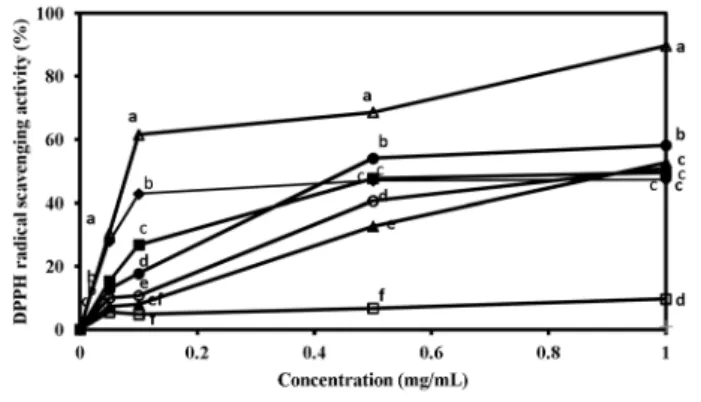
Fig. 2. DPPH radical scavenging activity of various fractions from 70% EtOH crude extract of Prunella vulgaris var.
lilacina. (■) 70% EtOH crude extract, (□) n-Hexane fraction, (●) n-BuOH fraction, (○) CHCl3 fraction, (▲) H2O fraction, (△) Vit. C, (◆) α-Tocopherol. Different superscripts indicate significant differences at p < 0.05 in the each concentration.
n-BuOH fraction were higher than that of the other fractions (Jeong et al., 2011).
2. DPPH radical scavenging activity of Prunella vulgaris var. lilacina fractions
The free radical scavenging activity of its derived fraction of Prunella vulgaris var. lilacina was assessed by DPPH assay. The IC
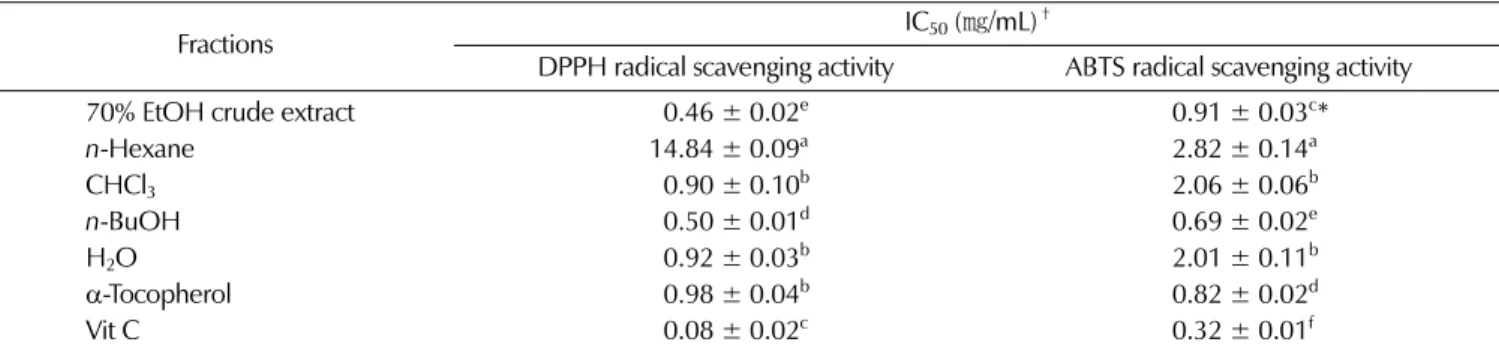
50value is a parameter widely used to measure that activity (Cuveler et al., 1992). As shown in Table 2, 70% EtOH crude extract and n-BuOH fractions showed the highest scavenging activity. In addition, the IC
50values of the n-Hexane, CHCl
3, and H
2O fraction were 14.84, 0.90, and 0.92 ㎎/mL, respectively. In this study, Vit C and α-tocopherol were measured as the positive controls, showing the IC
50values of 0.08 and 0.98 ㎎/mL, respectively (Table 2).
3. ABTS radical scavenging activity of Prunella vulgaris var. lilacina fractions
ABTS assay is based on the reaction between ABTS and potassium persulfate giving blue/green ABTS radical (ABTS
•+). With the addition of the antioxidants, decolori- zation is attained and measured spectrophotometrically at 734 ㎚. The ABTS radical scavenging activities of different fractions were increased with the sample concentrations (Fig. 3). n-BuOH fraction demonstrated the highest scavenging activity for the same concentration. The five fractions in descending order of strength of radical scavenging activity were n-BuOH > 70% EtOH crude extract > H
2O ≥ CHCl
3>
n-Hexane fraction (Fig. 3). These results suggested that the n-BuOH fraction has potential for use as source of antioxidant material.
4. FRAP value of of Prunella vulgaris var. lilacina fractions
The FRAP assay measures the reduction of ferric iron (Fe
3+) to ferrous iron (Fe
2+) in the presence of antioxidants, which are reductants with half-reaction reduction potentials above Fe
3+/Fe
2+. The ferric complexes reducing ability of different fractions was presented in Fig. 4. Similar to the results obtained for radaical scavenging assay, n-BuOH fraction showed very strong ferric ion reducing activities for the same concentration. The five fractions in descending order of strength of ferric ion reducing activity were n- BuOH > 70% EtOH crude extract > H
2O > CHCl
3> n-Hexane fraction.
5. Correlations analysis
The correlations between antioxidant contents and antioxidant activities were summarized in Table 3. There
Fig. 3. ABTS radical scavenging activity of various fractions from 70% EtOH crude extract of Prunella vulgaris var.lilacina. (■) 70% EtOH crude extract, (□) n-Hexane fraction, (●) n-BuOH fraction, (○) CHCl3 fraction, (▲) H2O fraction, (△) Vit. C, (◆) α-Tocopherol. Different superscripts indicate significant differences at p < 0.05 in the each concentration.
Table 2. DPPH and ABTS radical scavenging activity of different fractions from 70% EtOH extract of Prunella vulgaris var. lilacina.
Fractions IC50 (㎎/mL) †
DPPH radical scavenging activity ABTS radical scavenging activity
70% EtOH crude extract
50.46 ± 0.02
e 0.91 ± 0.03c*n-Hexane 14.84 ± 0.09a 2.82 ± 0.14a
CHCl3
50.90 ± 0.10
b 2.06 ± 0.06bn-BuOH
50.50 ± 0.01
d 0.69 ± 0.02eH2O
50.92 ± 0.03
b 2.01 ± 0.11bα-Tocopherol 50.98 ± 0.04
b 0.82 ± 0.02dVit C
50.08 ± 0.02
c 0.32 ± 0.01f† The effective concentration at which DPPH and ABTS radicals were scavenged by 50%. *Means with different superscripts in the same column (a-f) are significantly different at p < 0.05.
were positively high correlation between phenol contents and ABTS assay (R = 0.901, P < 0.001), phenol contents and FRAP assay (R = 0.916, P < 0.001), and flavonoid contents and ABTS assay (R = 0.826, P < 0.001). These results indicated that a relationship between flavonoid and phenolic compound concentrations in Prunella vulgaris var.
lilacina and their free radical scavenging activities. Therefore, the presence of phenolic and flavonoid compounds significantly contribute to their antioxidant potential. These correlation data are in agreement with previous studies that a highly positive relationship existed between total phenolic contents and antioxidative activity in many plants (Gursoy et al., 2009; Chukwumah et al., 2009).
DISCUSSION
In this study, total phenolic and flavonoid contents, antioxidantative capacities, and their correlations of the various fractions from 70% EtOH crude extract of
Prunella vulgaris var. lilacina were examined with useful methods.
DPPH and ABTS assays used for testing have been widely used to examine the antioxidative activities of plant extracts. It reported that these assays require relatively standard equipment and yield the fast and most reproducible results (Buenger et al., 2006). From these results, it was demonstrated that the n-BuOH fraction from 70% EtOH crude extract of Prunella vulgaris var. lilacina possessed an excellent antioxidative activity based on the DPPH, ABTS, and FRAP assay. Phenolic compounds are found in both eatable and uneatable plants, which have various biological effects, especially, including antioxidative activity. Phenolic compounds having one or more aromatic rings bearing one or more hydroxyl groups can potentially quench free radicals by forming resonance-stabilized phenoxyl radicals and therefore have redox properties (Rice-Evans et al., 1996; Bors and Michel, 2002). In our results, positive correlations were found between ABTS and FRAP assays and total phenolic and flavonoid contents. These results indicated that a relationship between phenolic compound concentration in various fractions from 70% EtOH crude extract of Prunella vulgaris var. lilacina and their free radical scavenging capacities. Therefore the presence of phenolic compounds in fractions contributes significantly to their antioxidative potential.
It was reported that the ethanol extract of Prunella vulgaris var. lilacina ameliorated drug-induced memory dysfunction (Park et al., 2010) and showed anti-allergic and anti-inflammatory activity (Ryu et al., 2000; Psotová et al., 2003). Previous studies indicated that the Prunella vulgaris var. lilacina contains several bioactive components including rosmarinic acid (Lamaison et al., 1991), anti- herpes simplex virus (HSV) polysaccharide (Xu et al.,
Fig. 4. FRAP value of different fractions from 70% EtOHextract of Prunella vulgaris var. lilacina. (■) 70% EtOH crude extract, (□) n-Hexane fraction, (●) n-BuOH fraction, (○) CHCl3 fraction, (▲) H2O fraction, (△) Vit. C, (◆) α-Tocopherol. Different superscripts indicate significant differences at p < 0.05 in the each concentration.
Table 3. Correlation coefficients (R) between the antioxidant properties and content of total phenol and flavonoid in Prunella vulgaris var.
lilacina†.
Total phenol content Total flavonoid content
DPPH radical scavenging activity
ABTS radical
scavenging activity FRAP value
Total phenol content 1.000
Total flavonoid content 0.914*** 1.000
DPPH radical scavenging activity 0.702 0.865 1.000
ABTS radical scavenging activity 0.901*** 0.826*** 0.771 1.000
FRAP value 0.916*** 0.887 0.894 0.902*** 1.000
† The correlations of Prunella vulgaris var. lilacina fractions in the scavenging activity of DPPH radical, ABTS radical, total phenol, and flavonoid contents used. ***p < 0.001.
1999), and 2, 3-dihydroxyurs-12-ene-28-oic acid (Woo et al., 2011). However, there are few studies on antioxidant effects of various fractions of its extracts. From this study, we could know that antioxidative activity of Prunella vulgaris var. lilacina was due to constitutes including in n-BuOH fraction.
In this study, it was demonstrated for the first time examined an excellent antioxidative activity testing assay and total phenolic and flavonoid contents of various fractions of the 70% EtOH crude extract from Prunella vulgaris var. lilacina. A key finding of the present study is that the n-BuOH fraction from 70% EtOH extract of Prunella vulgaris var. lilacina exhibited the strongest radical scavenging activity which is similar to α-tocopherol. The major known active components within the Prunella vulgaris var. lilacina are saponins, triterpenic acids, phenolic acids, and flavonoids (Alamed et al., 2009). Vulgarsaponin A and vulgasaponin B of n-BuOH fraction and rosmarinic acid of CHCl
3fraction are isolated from the Prunella vulgaris var. lilacina (Pérez-Fons et al., 2010; Wang et al., 1999). Future studies should focus on the identification of these antioxidants and purification of this plant ingredient into better agents with high efficacy and activity.
ACKNOWLEDGEMENTS
This study was supported by a grant from the Biogreen 21 Program (Project No. pj006457), Rural Development Administration, Republic of Korea.
LITERATURE CITED
Ainsworth EA and Gillespie KM. (2007). Estimation of total phenolic content and other oxidation substrates in plant tissues using Folin-Ciocalteu reagent. Nature Protocols. 2: 875-877.
Alamed J, Chaiyasit W, McClements DJ and Decker EA.
(2009). Relationships between free radical scavenging and antioxidant activity in foods. Journal of Agricultural Food Chemistry. 8:2969-2976.
Benzie IF and Strain JJ. (1996). The ferric reducing ability of plasma (FRAP) as a measure of "antioxidant power": the FRAP assay. Analytical Biochemistry. 239:70-76.
Bors W and Michel C. (2002). Chemistry of the antioxidant effect of polyphenols. Annals of the New York Academy of Sciences.
957: 57-69.
Braca A, De Tommasi N, Di Bari L, Pizza C, Politi M and Morelli I. (2001). Antioxidant principles from Bauhinia tarapotensis. Journal of Natural Products. 64: 892-895.
Buenger J, Ackermann H, Jentzsch A, Mehling A, Pfitzner I, Reiffen KA, Schroeder KR and Wollenweber U. (2006). An interlaboratory comparison of methods used to assess antioxidant potentials. International Journal of Cosmetic Science.
28:135-146.
Choi GP, Chung BH, Lee DI, Lee HY, Lee JH and Kim JD.
(2002). Screening of inhibitory activities on angiotensin converting enzyme from medicinal plants. Korean Journal of Medicinal Crop Science. 10:399-402.
Chukwumah Y, Walker LT and Verghese M. (2009). Peanut skin color: a biomarker for total polyphenolic content and antioxidative capacities of peanut cultivars. International Journal of Molecular Sciences. 10:4941-4952.
Cuveler ME, Richard H and Berst C. (1992). Comparison of the antioxidative activity of some acid-phenols: structure-activity relationship. Bioscience, Biotechnology, and Biochemistry. 56:
324-325.
Gaté L, Paul J, Ba GN, Tew KD and Tapiero H. (1999).
Oxidative stress induced in pathologies: the role of antioxidants.
Biomedicine & Pharmacotherapy. 53:169-180.
Gursoy N, Sihoglu-Tepe A and Tepe B. (2009). Determination of in vitro antioxidative and antimicrobial properties and total phenolic contents of Ziziphora clinopodioides, Cyclotrichium niveum, and Mentha longifolia ssp. typhoides var. typhoides.
Journal of Medicinal Food. 12:684-689.
Halliwell B. (1996). Antioxidants in human health and disease.
Annual Review of Nutrition. 16:33-50.
Jeong CH, Jeong HR, Choi GN, Kim DO, Lee U and Heo HJ.
(2011). Neuroprotective and anti-oxidant effects of caffeic acid isolated from Erigeron annuus leaf. Chinese Medicine. 24:25.
Jia Z, Tang M and Wu J. (1999). The determination of flavonoid contents in mulberry and their scavenging effects on superoxide radicals. Food Chemistry. 64:555-559.
Lamaison JL, Petitjean-Freytet C and Carnat A. (1991).
Medicinal Lamiaceae with antioxidant properties, a potential source of rosmarinic acid. Pharmaceutica Acta Helvetiae. 66:
185-188.
Lee JH, Park AR, Choi DW, Kim JD, Kim JC, Ahn JH, Lee HY, Choe M, Choi KP, Shin IC and Park HJ. (2011).
Analysis of chemical compositions and electron-donating ability of 4 Korean wild sannamuls. Korean Journal of Medicinal Crop Science. 19:111-116.
Mustafa RA, Abdul Hamid A, Mohamed S and Bakar FA.
(2010). Total phenolic compounds, flavonoids, and radical scavenging activity of 21 selected tropical plants. Journal of Food Science. 75:C28-C35.
Nordberg J and Arnér ES. (2001). Reactive oxygen species, antioxidants, and the mammalian thioredoxin system. Free Radical Biology & Medicine. 31:1287-1312.
Park SJ, Kim DH, Lee IK, Jung WY, Park DH, Kim JM, Lee KR, Lee KT, Shin CY, Cheong JH, Ko KH and Ryu JH.
(2010). The ameliorating effect of the extract of the flower of Prunella vulgaris var. lilacina on drug-induced memory impairments in mice. Food and Chemical Toxicology. 48:1671- 1676.
Psotová J, Kolár M, Sousek J, Svagera Z, Vicar J and Ulrichová J. (2003). Biological activities of Prunella vulgaris
extract. Phytotheraqpy Research. 17:1082-1087.
Re R, Pellegrini N, Proteggente A, Pannala A, Yang M and Rice-Evans C. (1999). Antioxidant activity applying an improved ABTS radical cation decolorization assay. Free Radical Biology & Medicine. 26:1231-2137.
Pérez-Fons L, Garzón MT and Micol V. (2010). Relationship between the antioxidant capacity and effect of rosemary (Rosmarinus officinalis L.) polyphenols on membrane phospholipid order. Journal of Agricultural and Food Chemistry.
13:161-171.
Rice-Evans CA, Miller NJ and Paganga G. (1996). Structure- antioxidant activity relationships of flavonoids and phenolic acids. Free Radical Biology & Medicine. 20:933-956.
Ryu SY, Oak MH, Yoon SK, Cho DI, Yoo GS, Kim TS and Kim KM. (2000) Anti-allergic and anti-inflammatory triterpenes from the herb of Prunella vulgaris. Planta Medica. 66:358-360.
Seo JS, Lee TH, Lee SM, Lee SE, Seong NS and Kim J.
(2009). Inhibitory effects of methanolic extracts of medicinal plants on nitric oxide production in activated marcrophage RAW 264.7 cells. Korean Journal of Medicinal Crop Science.
17:173-178.
Shahidi F and Wanasundara PK. (1992). Phenolic antioxidants.
Critical Reviews in Food Science and Nutrition. 32:67-103.
Wang ZJ, Zhao YY, Tu GZ, Hong SL and Chen YY. (1999).
Studies on the chemical constituents from Prunella vulgaris.
Acta Pharmaceutica Sinica. 34:679-681.
Willcox JK, Ash SL and Catignani GL. (2004). Antioxidants and prevention of chronic disease. Critical Reviews in Food Science and Nutrition. 44:275-295.
Woo HJ, Jun do Y, Lee JY, Woo MH, Yang CH and Kim YH.
(2011). Apoptogenic activity of 2,3-dihydroxyurs-12-ene-28-oic acid from Prunella vulgaris var. lilacina is mediated via mitochondria-dependent activation of caspase cascade regulated by Bcl-2 in human acute leukemia Jurkat T cells. Journal of Ethnopharmacology. 135:626-635.
Xu HX, Lee SH, Lee SF, White RL and Blay J. (1999).
Isolation and characterization of an anti-HSV polysaccharide from Prunella vulgaris. Antiviral Research. 44:43-54.
Yeum KJ, Aldini G, Chung HY, Krinsky NI and Russell RM.
(2003). The activities of antioxidant nutrients in human plasma depend on the localization of attacking radical species. Journal of Nutrition. 133:2688-2691.