구간 시변 지연을 고려한 전환 멀티-에이전트 시스템에 대한 일치 제어
Consensus Control for Switched Multi-agent Systems with Interval Time-varying Delays
박 명 진, 권 오 민
*
, 이 상 문, 박 주 현, 차 은 종(M. J. Park 1 , O. M. Kwon 1 , S. M. Lee 2 , Ju H. Park 3 , and E. J. Cha 1 )
1
Chungbuk National University
2
Daegu University
3
Yeungnam University
Abstract: This paper considers multi-agent systems with interval time-varying delays and switching interconnection topology. By construction of a suitable Lyapunov-Krasovskii’s functional, new delay-dependent consensus control conditions for the systems are established in terms of LMIs (Linear Matrix Inequalities) which can be easily solved by various effective optimization algorithms.
One numerical example is given to illustrate the effectiveness of the proposed methods.
Keywords: consensus, multi-agent systems, interval time-varying delay, switching interconnection topology, Lyapunov method
I. INTRODUCTION
MASs (Multi-Agent Systems) have received considerable attentions due to their extensive applications in many fields such as biology, physics, robotics, control engineering, and so on [1- 3,17-19,22,23]. A prime concern in these systems is the agreement of a group of agents on their states of leader by interaction.
Namely, this problem is a consensus problem. Specially, consensus problem with a leader is called a leader-following consensus problem or consensus regulation. Recently, this problem has been applied in various fields such as vehicle systems [4], intelligent decision support system for power grid dispatching [5] and networked control systems [6].
During the last few years, the MASs are being put to use in the consensus problem for time-delay which occurs due to the finite speed of information processing in the implementation of this system. It is well known that time-delay often causes undesirable dynamic behaviors such as performance degradation, and instability of the network. It should be pointed out that analyzing the consensus problem of the MASs with time-delay can be regarded as investigating the asymptotical stability of MASs.
Since the consensus issue is a prerequisite to the applications of MASs, various approaches to consensus criteria for MASs with time-delay have been investigated in the literature [7-10]. By
Lyapunov-based approach and related space decomposition technique, a coordination problem was addressed for the MASs with jointly connected interconnection topologies [7]. Xiao et al.
[8] had studied a consensus problem for discrete-time MASs with changing communication topologies and bounded time-varying communication delays. Tian et al. [9] studied the consensus problem for the MASs with both communication and input delays.
By construction of a Lyapunov-Krasovskii’s functional with the idea of delay partitioning, Qin et al. [10] derived consensus condition in directed networks of agents with switching topology and time delay. The above mentioned literature mainly have addressed for the consensus conditions of the MASs. However, consensus controller design for MASs has not been fully investigated yet.
Motivated by this mentioned above, in this paper, new delay- dependent consensus control problem for MASs with interval time-varying delays and switching interconnection topology will be studied. Here, delay-dependent analysis has been paid more attention than delay-independent one because the sufficient conditions for delay-dependent analysis make use of the information on the size of time delay [11]. That is, the former is generally less conservative than the latter. By construction of a suitable Lyapunov-Krasovskii’s functional, the criteria are derived in terms of LMIs which can be solved efficiently by use of standard convex optimization algorithms such as interior-point methods [12]. One numerical example is included to show the effectiveness of the proposed methods.
Notation: R n is the n -dimensional Euclidean space, and
m n
R denotes the set of m n real matrix. For symmetric matrices X and Y, X Y (respectively, X Y ) means that the matrix X Y is positive definite (respectively, nonnegative).
X
denotes a basis for the null-space of X. I and 0 denotes identity matrix and zero matrix, respectively, with appropriate Copyright© ICROS 2012
* 책임저자(Corresponding Author)
논문접수: 2012. 2. 26., 수정: 2012. 3. 20., 채택확정: 2012. 3. 27.
박명진, 권오민: 충북대학교 전기공학부 ([email protected]/[email protected])
이상문: 대구대학교 전자공학부([email protected]) 박주현: 영남대학교 전기공학과([email protected]) 차은종: 충북대학교 의학과([email protected])
※ This research was supported by Basic Science Research Program through the NRF (National Research Foundation of Korea) funded by the Ministry of Education, Science and Technology (2011-0009273).
This research was also supported by Basic Science Research Program
through the NRF (National Research Foundation of Korea) funded by
the Ministry of Education, Science and Technology (2012-0000479).
dimensions. || || refers to the Euclidean vector norm and the induced matrix norm. diag { } denotes the block diagonal matrix. represents the elements below the main diagonal of a symmetric matrix. stands for the notation of Kronecker product.
II. PROBLEM STATEMENTS
The interaction topology of a network of agents is represented using an undirected graph G ( , , ) A with a node set
{1,..., }, N
an edge set {( , ) : , i j i j } , and an adjacency matrix A [ a ij ] R N N
of a graph is a matrix with nonnegative elements satisfying a ii = 0 and a ij a ji 0. If there is an edge between i and j, then the elements of matrix A described as a ij a ji 0 ( , ) i j . The set of neighbors of node i is denoted by N { j : ( , ) i j }. The degree of node i is denoted by deg( ) i j N
a ij . The degree matrix of graph G is diagonal matrix defined as D diag {deg(1),...,
deg( )}. N The Laplacian matrix L of graph G is defined as .
L D A More details can be seen in [13].
Consider the MASs with the following dynamic of agent i
( ) ( ) ( ), 1,..., ,
i i i
x t Fx t Bu t i N (1)
where N is the number of agents, x t i ( ) R is the state of n agent i, u t i ( ) R is the consensus protocol, and m F R n n
and B R n m
are known constant matrices.
According to the work [1] and [7], an algorithm of consensus protocol can be described as
( ) ( ) ( ( ) ( ))), 1,..., ,
i
i i ij i j
j N
u t Kx t a x t x t i N
(2)
where K R n n
is protocol gain matrix, a ij are the interconnection weights defining
0, if agent is connected to agent , 0, otherwise.
ij
ij
a i j
a
The multi-agent system is said to achieve consensus if the following definition.
Definition 1 [20,21]: Given an undirected communication graph G, the multi-agent systems (1) are said to be consensusable under the protocol (2) if for any finite x i (0), i 1,..., N , the control protocol can asymptotically drive all agents close to each other, i.e.,
lim || i ( ) j ( ) || 0, 1,..., .
t x t x t i N
With communication delay, a consensus algorithm can be
( ) ( ) ( ( ) ( ( ))).
i
i i ij i j
j N
u t Kx t a x t x t h t
(3)
Here, h(t) is a interval time-varying continuous function satisfying 0 h m h t ( ) h M , h t ( ) h d ,
where h m and h M are positive scalars.
In this paper, we consider consensus for MASs with consensus algorithm (3) and switching interconnection topology. It should be noted that ˆ G denote the topology composed of the agents, and
{ G k ˆ k , 1,..., } N
defined the union of the topology.
A model of Multi-agent systems with the consensus algorithm (3) and switching interconnection topology are summarized as
( ) ( ) ( ( )),
1,..., , ( ), ˆ ,
i i
k k
i ij i ij j
j N j N
x t F BK a B x t a Bx t h t
i N k t G
(4)
where I
{1,..., } N are the index set associated with the elements of , ( ) : t R
I
is a switching signal.
For the convenience, let us define x t T ( ) [ x t
1T ( ),..., x t T N ( )].
Then, the system (4) can be rewritten as
( ) ( ( ) ( ) ( )
( ) ( ( )),
k N
k
x t I F BK D B x t
A B x t h t
(5)
where
1 1
[ ] ,
1,..., .
k k k k k
ij N N j Nj
j N j N
A a
D diag a a
The aim of this paper is to design the delay-dependent consensus control of the multi-agent systems (5) with interval time-varying delays and switching interconnection topology. This means a consensus stability analysis for the system (5). In order to do this, we introduce the following definition and lemmas.
Lemma 1 [14]: For any constant matrix M M T 0, the following inequality holds:
( )
( ) ( )
( ) ( ) ( ) .
( ( )) ( ( ))
T
t T
t h t
x t M M x t
h t x s Mx s ds
x t h t M x t h t
Lemma 2 [15]: Let R n , R T n n
, and R m n
such that rank ( ) n . The following statements are equivalent:
(i) T 0, 0, 0, (ii)
T
0.
III. MAIN RESULTS
In this section, we propose new consensus criterion and controller design method for system (5). For simplicity of matrix representation, e i i ( 1,...,5) R
5Nn Nn
are defined as block entry matrices (e.g., e
2 [0, ,0,0,0] I T ). The notations of several matrices are defined as:
)], ( ), ( )), ( ( ), ( ), ( [ )
( t x
Tt x
Tt h
mx
Tt h t x
Tt h
Mx
Tt
T
[( ( ) ( ),0 ,( ),0 , ],
k k k
N Nn Nn Nn
I F BK D B A B I
1
e I
1( N P e )
5T e I
5( N P e )
1T ,
2 1 1 2 1 2 1 3 2
3 2 3 4 3 4
(( ( )) ( ( ))
(1 ) ( ) ( ) ,
T T
N N
T T
d N N
e I Q Q e e I Q Q e
h e I Q e e I Q e
2 2
3 5 1 2 5
1 2 1 1 2
2 3 2 2 3 3 4 2 3 4
2 3 3 4 3 4 2 3
( ( ( ) ))
( )( )( )
( )( )( ) ( )( )( )
( )( )( ) ( )( ) ( ) ,
N m M m T
N T
T T
N N
T T T
N N
e I h R h h R e
e e I R e e
e e I R e e e e I R e e
e e I S e e e e I S e e
3
1
l .
l
(6)
Now, we have the following theorem.
Theorem 1. For given positive scalars h m , h M and h d , the agents in the system (5) are asymptotically consented for switching signal ( ), t if there exist positive definite matrices P R n n
,
( 1, 2,3),
n n
Q i R
i R i R n n
( i 1, 2) and any matrix S R n n
satisfying the following LMIs:
[ k
] T [ k
] 0, (7)
2
2
R S 0, R
(8)
where and k are defined in (6).
Proof: Let us consider the following Lyapunov-Krasovskii’s functional candidate as
1 2 3
,
V V V V (9)
where
1
2 1 ( ) 2
3
3 1
2
( )( ) ( ),
( )( ) ( ) ( )( ) ( )
( )( ) ( ) ,
( ) ( )( ) ( )
( ) (( ) ) ( )( ) ( ) .
m m
M
m m
M
T
N
t T t T
N N
t h t h t
t h T t h N
t T
m t h m N
t h T
M m t h M m N
V x t I P x t
V x s I Q x s ds x s I Q x s ds
x s I Q x s ds
V h h t s x s I R x s ds
h h h h t s x s I R x s ds
The time-derivative of V is calculated as
1
2 1 2
1 3
2
3
2 2
3 1 2
1
2 ( )( ) ( ),
( )( ( )) ( )
( )( ( )) ( )
(1 ) ( ( ))( ) ( ( ))
( )( ) ( ),
( )( ( ( ) )) ( )
( )( ) ( )
m
T
N T
N T
m N m
T
d N
T
M N M
T
N m M m
t T
m t h N
V x t I P x t
V x t I Q Q x t
x t h I Q Q x t h
h x t h t I Q x t h t
x t h I Q x t h
V x s I h R h h R x s
h x s I R x s ds
( )
m( )(
2) ( ) .
M
t h T
M m t h N
h h
x s I R x s ds
(10)
By using Lemma 1 and Theorem 1 in [16], the integral terms of the V
3can be bounded as
1
1 1
1
2
( )( ) ( )
( ) ( ) ( ) ( )
( ) ( ) ( ) ,
( ) ( )( ) ( )
m
m
M
t T
m t h N
T
N N
m N m
t h T
M m t h N
h x s I R x s ds
x t I R I R x t
x t h I R x t h
h h x s I R x s ds
( ) 2
( )
2
( ) ( )( ) ( )
( ) ( )( ) ( )
m
M
t h T
M m t h t N
t h t T
M m t h N
h h x s I R x s ds
h h x s I R x s ds
( ) 2 ( )
( ) ( )
2
1 ( ) 0
( ) ( )
1
( ) 1 ( ) ( )
m m
M M
t h T t h
t h t N t h t
t h t t h t
t h N t h
I R
x s ds x s ds
x s ds I R x s ds
( ) 2 ( )
( ) ( )
2
( ) ( ) ( ) ( )
( ) ,
( ) ( )
m m
M M
t h T t h
t h t N N t h t
t h t t h t
N
t h t h
x s ds I R I S x s ds
I R
x s ds x s ds
(11) where ( h M h t ( ))( h M h m ) .
1Therefore, from (9)-(11), the V has a new upper bound as ( ) ( ).
V T t t (12)
Also, the system (5) with the augmented vector ( ) t can be rewritten as k ( ) t 0. Then, a delay-dependent stability condition for the system (5) is
( ) ( ) 0
T t t
subject to k ( ) t 0. (13) where , k and ( ) t are defined in (6).
Here, there exist a positive scalar such that I . From (12) and (13), we have V x t ( )
2. Therefore, by Lyapunov theorem, it can be guaranteed that the system (5) is asymptotically stable.
Finally, by utilizing Lemma 2, the condition (13) is equivalent to the following inequality
[ k
] T [ k
] 0. (14) From the inequality (14), if the LMIs (7) satisfy, then stability condition (13) holds. This completes our proof. ■
Theorem 1 provides consensus criterion for system (5) in the framework of LMIs when the consensus protocol gain is known.
Based on the results of Theorem 1, we will propose consensus controller design method for system (5) which will be introduced as Theorem 2.
To design the consensus protocol gain, we add the following zero equation with any matrices Z 1 and Z 2 to be chosen as
1 2
0 2( x t I T ( )( N Z ) x t I T ( )( N Z )) k ( ). t (15) This zero equality will be used in Theorem 2. The notations of several matrices are defined for the simplicity of matrix representation in Theorem 2.
( 1, 2,3),
i i
Q XQ X i R i XR X i i ( 1, 2), S XSX ,
[( ),0,0,0,0],
k k
I N BK
[( I N B ),0,0,0,0],
5
{( N ),...,( N )}, X diag I X I X
5
{( N ),...,( N )}, Y diag I Y I Y
1
( N )
5T
5( N )
1T
e I X e e I X e
1 1 2 1 2 1 3 2
3 2 3 4 3 4
(( ( )) ( ( ))
(1 ) ( ) ( )
T T
N N
T T
d N N
e I Q Q e e I Q Q e
h e I Q e e I Q e
2 2
5 1 2 5
1 2 1 1 2
2 3 2 2 3
3 4 2 3 4
2 3 3 4
3 4 2 3
( ( ( ) ))
( )( )( )
( )( )( )
( )( )( )
( )( )( )
( )( ) ( ) ,
T
N m M m
N T N T
T N
T N
T T
N
e I h R h h R e
e e I R e e
e e I R e e
e e I R e e
e e I S e e
e e I S e e
1 1
2 2
0 0
0 0 .
0 0
T
Nn Nn
k k k
Nn Nn
I I
X Y X Y
I I
(16)
Theorem 2: For given positive scalars h m , h M , h d and the parameters γ 1 , γ 2 , the agents in the system (5) are asymptotically consented for switching signal ρ(t), if there exist positive definite matrices X R n n
, Q i R n n
( i 1, 2,3), R i R n n
( i 1, 2) and any matrices S R n n
and Y R n n
satisfying Eq. (8) and the following LMIs:
k 0,
(17)
where and k are defined in (16).
Then, system (5) under the consensus protocol gain K YX
1is asymptotically stable.
Proof: Let us define Z
1
1P and Z
2
2P in (15). With the same Lyapunov-Krasovskii’s functional candidate in (9), by using the similar method in (10) and (11), and considering zero equality in (15), a sufficient condition guaranteeing asymptotic stability for the system (5) can be
1 1
2 2
0 0
0 0 0,
0 0
T
N N
k k
N N
I P I P
I P I P
(18)
where and k are defined in (6).
Let us define X P
1and Y KX . Then, pre- and post- multiplying inequality (18) by matrix X which is defined in
(16) leads to LMIs (17). ■
IV. NUMERICAL EXAMPLES
In this section, one numerical example to illustrate the effectiveness of the proposed criteria will be shown.
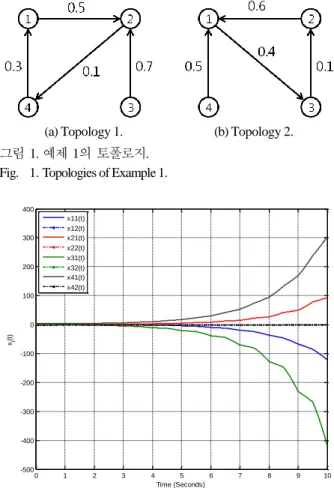
Example 1: Consider the Multi-agent systems (5) with the switching interconnection topology described in Fig. 1 and the following parameters
1 1 1 0
, .
0 0.1 0 1
F B
Here, the agents in Fig. 1 can be seen in the sense that each
agent, e.g., unmanned vehicle and soccer robot, needs information from its local neighborhood.
From Fig. 1, at switching interconnection topology are
Topology 1:
1 1
0 0.5 0 0 0.5 0 0 0
0 0 0 0.1 0 0.1 0 0
, .
0 0.7 0 0 0 0 0.7 0
0.3 0 0 0 0 0 0 0.3
A D
Topology 2:
2 2
0 0 0.4 0 0.4 0 0 0
0.6 0 0 0 0 0.6 0 0
, .
0 0.1 0 0 0 0 0.1 0
0.5 0 0 0 0 0 0 0.5
A D
For the system above, the protocol gain K with fixed h m =1, h M
= 5, h d = 0.5 and
1
2 1 by Theorem 2 is
2.2387 1
0 1.1387 .
K
(18)
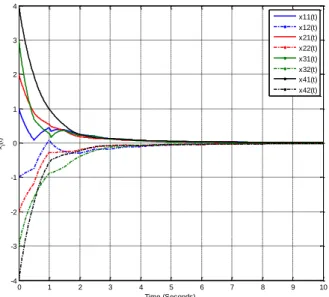
In order to confirm the obtained results with the condition of the time-delay as h t ( ) 4sin(0.12 ) 1, t the simulation results for the state responses are shown in Figs. 2 and 3. The switching
(a) Topology 1. (b) Topology 2.
그림 1. 예제 1의 토폴로지.
Fig. 1. Topologies of Example 1.
0 1 2 3 4 5 6 7 8 9 10
-500 -400 -300 -200 -100 0 100 200 300 400
Time (Seconds) xi(t)
x11(t) x12(t) x21(t) x22(t) x31(t) x32(t) x41(t) x42(t)
그림 2. 이득 K = 0 을 고려한 상태 응답.
Fig. 2. State responses with K = 0.
period of interconnection topology is 0.5 seconds. In Fig. 2, by reason of the instability of the system dynamics, the eigenvalues of the matrix F is 1 and -0.1, we know that the necessity of the protocol gain K. Fig. 3 shows that the systems with the state responses converge to zero under the obtained gain K in (18). This means the consensus stability of the system.
V. CONCLUSIONS
In this paper, the delay-dependent consensus control problem for the MASs with interval time-varying delays and switching interconnection topology is studied. To do this, the suitable Lyapunov-Krasovskii’s functional is used to investigate the feasible region of consensus criterion. Based on this, consensus control gain for the concerned systems has derived. One numerical example has been given to show the effectiveness and usefulness of the presented criteria.
REFERENCES
[1] R. O. Saber, J. A. Fax, and R. M. Murray, “Consensus and cooperation in networked multi-agent systems,” Proceeding of the IEEE, vol. 95, no. 1, pp. 215-233, 2007.
[2] W. Ren and R. W. Beard, “Consensus seeking in multi-agent systems under dynamically chainging interaction topologies,”
IEEE Transactions on Automatic Control, vol. 50, no. 5, pp.
655-661, 2005.
[3] J. Wang, D. Cheng, and X. Hu, “Consensus of multi-agent linear dynamic systems,” Asian Journal of Control, vol. 10, no. 2, pp.
144-155, 2008.
[4] W. Ren, “Consensus strategies for cooperative control of vehicle formations,” IET Control Theory and Applications, vol. 1, no. 2, pp. 505-512, 2007.
[5] W. Qiong, L. Wenyin, Y. Yihan, Z. Chuan, and L. Yong,
“Intelligent decision support system for power grid dispatching base on multi-agent system,” International Conference on Power System Technology (PowerCon 2006), pp. 1-5, 2006.
[6] P. DeLellis, M. diBernardo, F. Garofalo, and D. Liuzza,
“Analysis and stability of consensus in networked control
systems,” Applied Mathematics and Computation, vol. 217, pp.
988-1000, 2010.
[7] Y. Hong, L. Gao, D. Cheng, and J. Hu, “Lyapunov-based approach to multiagent systems with switching jointly connected interconnection,” IEEE Transactions on Automatic Control, vol.
52, no. 5, pp. 943-948, 2007.
[8] F. Xiao and L. Wang, “State consensus for multi-agent systems with switching topologies and time-varying delays,” Intnational Journal of Control, vol. 79, no. 10, pp. 1277-1284, 2006.
[9] Y. P. Tian and C. L. Liu, “Consensus of mulit-agent systems with diverse input and communication delays,” IEEE Transactions on Automatic Control, vol. 53, no. 9, pp. 2122- 2128, 2008.
[10] J. Qin, H. Gao, and W. X. Zheng, “On average consensus in directed networks of agents with switching topology and time delay,” International Journal of Systems Science, vol. 42, no. 12, pp. 1947-1956, 2011.
[11] S. Xu and J. Lam, “A survey of linear matrix inequality techniques in stability analysis of delay systems,” International Journal of Systems Science, vol. 39, no. 12, pp. 1095-1113, 2008.
[12] S. Boyd, L. E. Ghaoui, E. Feron, and V. Balakrishnan, Linear Matrix Inequalities in System and Control Theory, SIAM, Philadelphia, 1994.
[13] C. Godsil and G. Royle, Algebraic Graph Theory, Springer- Verlag; NY, 2001.
[14] K. Gu, “An integral inequality in the stability problem of time- delay systems,” Proceeding of the 39th IEEE Conference on Decision and Control, pp. 2805-2810, 2000.
[15] M. C. de Oliveira and R. E. Skelton, Stability tests for constrained linear systems, Springer-Verlag, Belrin, pp. 241-257, 2001.
[16] P. Park, J. W. Ko, and C. K. Jeong, “Reciprocally convex approach to stability of systems with time-varying delays,”
Automatica, vol. 47, no. 1, pp. 235-238, 2011.
[17] J.-H. Kim, Y.-H. Kim, S.-H. Choi, and I.-W. Park, “Evolutionary multi-objective optimization in robot soccer system for education,” IEEE Computational Intelligence Magazine, vol. 4, no. 1, pp. 31-41, 2009.
[18] J.-H. Kim and K.-H. Lee, “Multi-robot cooperation-based mobile printer system,” Robotics and Autonomous Systems, vol.
54, no. 3, pp. 193-204, 2005.
[19] E. M. Davidson, S. D. J. McArthur, J. R. McDonald, T.
Cumming, and I. Watt, “Applying multi-agent system technology in practice: automated management and analysis of SCADA and digital fault recorder data,” IEEE Transactions on Power Systems, vol. 21, no. 2, pp. 559-567, 2006.
[20] K. You and L. Xie, “Coordination of discrete-time multi-agent systems via relative output feedback,” International Journal of Robust and Nonlinear Control, vol. 21, pp. 1587-1605, 2011.
[21] K. Liu, G. Xie, and L. Wang, “Consensus for multi-agent systems under double integrator dynamics with time-varying communication delays,” International Journal of Robust and Nonlinear Control, DOI: 10.1002/rnc.1792.
[22] S. E. Kim and D. E. Kim, “Air-ground cooperation robots:
applications and challenges,” Journal of Institute of Control, Robotics and Systems (in Korean), vol. 16, no. 2, pp. 101- 106, 2010.
0 1 2 3 4 5 6 7 8 9 10
-4 -3 -2 -1 0 1 2 3 4
Time (Seconds) xi(t)
x11(t) x12(t) x21(t) x22(t) x31(t) x32(t) x41(t) x42(t)