†Corresponding author : 051-510-2633, [email protected]
* 이 논문은 2007학년도 부산대학교 박사후연수지원사업에 의하여 연구되었음.
온라인 환경에서 정보탐색활동과 학습자 특성과 상관관계
오은주․김정섭
†(부산대학교)
Individual Variables affecting Online Information Retrieval Behaviors
EunJoo OH․Jung-Sub KIM
†Pusan National University
(Received August 6, 2007 / Accepted December 5, 2007)
Abstract
본 연구는 인지양식이 온라인 학습의 성취도에 영향을 미치는 요인중의 하나라는 선행연구 결과 들을 토대로, 인지양식이 온라인 정보탐색능력에도 영향을 미치는지 그리고 어떤 다른 개인적인 특 성들이 온라인 정보탐색행위와 연관성이 있는지 고찰 하였다. 연구 대상은 대학원 석사과정과 박사 과정에 재학중인 학생 36명이었으며, 인지양식검사와 Ellis와 Haugan (1997)의 정보탐색행위 모델에 근거하여 연구자에 의해 제작된 설문조사를 실시하였다. 학생들에게 연구 주제를 주고 온라인상에 서 정보를 탐색하도록 시켰으며, 이들의 정보탐색행위 과정과 특성을 관찰하고 기록하였다.
인지양식검사 결과와 설문조사 결과를 양적 분석하고, 정보탐색행위 과정과 특성에 관한 질적 분석 한 결과에 의하면, 개인의 인지양식과 온라인시스템을 이용한 정보탐색능력과는 아무런 상관관계가 없었다. 반면에, 정보탐색행위는 컴퓨터 이용 능력, 온라인 도서관 시스템 사용경험/능력과 상관관계 를 보였다. 또한 검색한 정보에 대한 만족도는 정보탐색에 보내는 시간과 반비례 상관관계를 가지며, 대부분의 학습자들이 총 8단계의 정보탐색과정 중 " Browsing" 단계에 대부분의 시간을 보내는 것으 로 관찰 되었다. 끝으로 대부분의 학생들이 도서관 시스템 사용능력에 높은 효능감을 보였지만, 학교 온라인도서관 시스템이 사용하기 편리하지 않도록 설계되어있다고 대답했으며, 자신들의 연구를 위해 서 인터넷 검색엔진보다는 도서관 데이터베이스를 더 자주 사용하고 있는 것으로 나타났다.
Key Words : information retrieval activities, individual variables, online environments, cognitive styles
Ⅰ. Introduction
Information technology has had a great impact on research and development in many academic
disciplines, providing a wide variety of resources and many powerful tools to search for resources.
Transforming text-based information into a
digital format and making it available online has
improved information-seeking environments for
users by overcoming many barriers such as feasibility, accessibility, and efficiency in time and space. Recently, as an increasing number of individuals and organizations use online tools as their main channel for information resources, skills in retrieving electronic information become necessary for successful learning at school and performance at work.
Over the years, techniques for information retrieval systems (IR) have been tested, developed, modified, and improved in order to better support users in responses to their inquires concerning information seeking activities (Rasmussen, 2003).
However, studies often claim that in spite of advanced
features of these tools, current online library IR systems may not accommodate users' needs, particularly users with certain cognitive styles.
Recent studies on user characteristics in user-system interaction indicate that individuals are different in their abilities and ways of reacting to a system. Certain types of individuals are flexible and efficient in their uses of navigation tools while others are not. There are many studies conducted to discover underlying factors related to individuals' interactions with systems. However, only a few studies focused on online library systems and databases, especially the use of library resources by graduate students. There are many individual variables affecting information retrieval behaviors in online library systems. Among other user variables, this study focused on cognitive styles and online search experience, especially technology competency and familiarity with the systems. This study examined how these variables influence users' search performance and choice of navigational tools in online
retrieval environments based on Ellis &
Haugan (1997)'s model which is one of the exemplary information seeking behavior models.
Ⅱ. Literature review
1. Individual differences in their cognitive styles
Information seeking behaviors are heavily subjective and user-focused activities; individuals differ in their needs, value judgments, and styles of seeking and retrieving information.
The ways of using information systems are different based on individuals'needs, situations, contexts, and personal preferences in interacting with IR systems. Kim (1997) claimed that individuals are different in their ways of reacting to systems based on their characteristics. In particular, field related cognitive styles are one of the characteristics that greatly influence the ways of reacting to systems. The literature suggests that cognitive styles are a composite of individual characteristics that serve as relatively stable indicators of how individuals respond to certain circumstances. ( Witkin, Oltman, Raskin & Karp, 1971).
The outline of fieldrelated learning styles was suggested by Witkin, Oltman, Raskin, &
Karp (1971) and it is one paradigm of cognitive styles, "measuring individuals' perceptual and processing characteristics which influence the preferences and strategies that learners use to perceive, process, store, and recall information".
According to Witkin et al., (1971), individuals
have varying degrees of field dependency and
degrees of field dependency can be a measuring
tool to define individuals cognitive/learning
styles. These cognitive styles are divided into three types (field independent, fielddependent, and field neutral) based on levels of field independency and those three types of often used to identify two different types of learners (FI and FD learners). Field independent learners (FI learners) and Field Dependent learners (FD learners) reveal different characteristics in their attributes in reacting to tasks and handling information; field independent (FI) learners tend to be more analytical and organized in their learning, possessing strong problem solving-skills while field dependent (FD) learners are less structured, presenting difficulties in reorganizing information and attending to salient cues. In addition, FI learners are not easily influenced by surrounding environments, separating objects discretely from their backgrounds while FD learners are easily distracted by backgrounds.
Park (2004) reported that cognitive styles influence individuals' information retrieving behaviors and ways of information processing in virtual environments. According to the study, individuals are different in their selection of effective navigation tools and information retrieval procedures based on their background information and meta-cognition. In the same context, studies on learner characteristics and students' achievement (Byun & Choi, 2006;
Kim, 2004, Kim, 2003; Kim & Cho, 2006) proposed that there are subtle differences in the effectiveness of using online instructional materials since individuals have different ways of reacting to online systems. According to Byun and Choi (2006), effectiveness of multimedia integrated instruction is closely related to learners' cognitive styles; when multimedia materials are
used in instruction, field independent learners are more likely to be successful in their learning than field dependent learners might be. In addition, Kim and Cho (2006) suggested that individuals' cognitive styles should be considered when designing instruction for subjects that require strong problem solving skills. Many other studies (Kim, 2004; Park, 2004; Brenner, 1997) showed cognitive styles can be predictors of success in students' achievement in certain subject areas.
2. Cognitive styles and Information Retrieval (IR) Systems
However, Wang, Hawk, & Tenopir (2000) claimed that in many cases, the design of online information retrieval systems (i.e., online catalogs and databases) do not take into account individual differences in cognitive styles.
According to Chen (2002) and Daniels & Moore (2000), many IR systems are designed for individuals with FI cognitive styles and other users may get lost or be disoriented in online retrieval environments. The users might feel difficult to understand salient cues or have an inability to handle an overload of excessive stimuli through multiple channels while seeking information.
Many studies (Chen,2002; Daniels & Moore,
2000; Wang et al., 2000) agree that an IR
process is a problem-solving activity. Studies
focusing on relationships between cognitive
styles and individuals' success in retrieving
information on the Web have revealed that FI
learners with strong problem-solving skills
perform more efficiently in a searching process,
spending less time (Kim, 1997). Furthermore, FI
styles feel more comfortable with navigating in multifaceted hypermedia environments, while FD styles can be cognitively overloaded by excessive stimuli or dissonant cues contained in multiple channel messages and thus feel lost in hyperspace (Daniel & Moore, 2000).
On the other hands, studies such as Brenner (1997) and Wang, Hawk, & Tenopire (2001) failed to detect any significant interaction between cognitive styles and students' performance in online learning environments. Like this, while many studies did not find any correlations between learning styles and learning achievements in online environments, a majority of studies still reveal individual differences in information retrieval behaviors in using online IR systems.
3. Information retrieval behaviors
Researchers propose several different models of information processing and retrieval behaviors on the Web. In spite of a great variety of architectures of IR systems, when examining the stage of information process, users seem to experience similar stages in their ways of processing in each stage as a whole;
yet they are very different within the context of searching strategies, sequencing the steps, accessing, extracting, and evaluating information.
Thus, many researchers agree that technical and operational aspects of systems may not be sufficient to explain an IR process. Instead, investigation focusing on users' mental activities such as sense-making (Kuhlthau, 1993), cognitive, and behavioral approaches (Choo, Detlor, & Turnbull, 1997; Ellis & & Hugan, 1997) should be employed in order to deal with the complex nature of users' information
retrieval behaviors (Wang et al., 2000).
Kuhlthau (1993) interpreted information retrieval behaviors as a sense-making process. Information retrieval is a process of constructing and understanding from a state of uncertainty.
While Kuhlthau (1993) heavily focused on human cognitive status based on a traditional IR process, Ellis & Haugan (1997) described information retrieval patterns, balancing both human and system approaches. Ellis and Haugan's model was derived from the observations of engineers and research scientists and included eight categories: (a) surveying, (b) chaining, (c) monitoring, (d) browsing, (e) distinguishing, (f) filtering, (g) extracting, and (h) ending. Ellis &
Haugan's model is considered an exemplary process that most explains information seeking behaviors of human beings most logically.
Choo et al., (1998, 1999) adopted Ellis &
Haugan's version in order to create a
behavioral model on the Web by comparing
the information retrieval patterns with Web
moves. Through several studies focusing on
user behaviors, the researchers agreed that
information retrieval patterns on the Web differ
depending on the nature of information needs,
information seeking tactics, and the purpose of
information use. The information seeking process
is a personal activity that reflects individual
circumstances such as experience, mental states,
levels of knowledge, etc. Thus, the variables
that influence an IR process depends on a
combination of internal and external factors
that users might have. Oh & Lim (2004)
suggest that familiarity with IR systems is one
of the mostimportant factors in the success of
IR behaviors along with abilities in evaluating
information. Following is the table that
Stages Information
seeking behaviors Web activities
Surveying (Starting)
Comprising characteristic of initial search for information
Identifying websites/pages containing or pointing to information of interest
Chaining Following chains of citations
Following links on starting pages to other content-related sites
Monitoring
Keeping abreast of developments in an area by regularly following particular sources
Browsing
Casually looking for information in areas of potential interest
Scanning top-level pages:
lists headings site maps
Distinguishi ng
Using known differences between sources as a way of filtering the amount of information obtained
Selecting useful pages and sites
Filtering
Using certain criteria or
mechanisms when searching for information
Using filtering keys, check list or interface
Extracting
Activities associated with going through a particular source or sources
Receiving site updates using push, agents or profiles
Ending Selection of information
Selection of information
<Table 1> Ellis & Haugan's (1997) model of information seeking behaviors compared to web activities
compared Ellis and Haugan's model to web activities created by Choo et al., (1998, 1999).
4. Variables related to information retrieval behaviors
As mentioned above, studies have been conducted to discover underlying factors related to individuals' interactions with systems.
However, only a few studies focused on library systems and databases, especially the use of library resources by graduate students. There, it is important to worthwhile to examine variables affecting to IR behaviors when using online library systems. There may be many individual variables affecting IR behaviors.
Among other user variables, this study focused on cognitive styles and online search experience, especially technology competency and familiarity with the IR systems, and examined how these variables influence users' IR behaviors in online library environments based on Ellis and Haugan's model (1997). The Ellis & Haugan's model of IR behaviors was chosen to compare with cognitive styles for this study since the model was created by holistically approaches, covering mental and behavioral aspects of information retrieval activities.
Ⅲ. Method 1. Research questions
Four research questions were formulated to find out the variables affecting information retrieval behaviors and examine the predominant characteristics of information retrieval behaviors.
(1) Are individuals different in their
information retrieval behaviors based on their
cognitive styles?
(2) What other variables are related to information retrieval behaviors and how the variables are related to each other?
(3) What tare the characteristics of information retrieval behaviors in using online library systems?
(4) How do users perceive online library retrieval systems?
2. Participants
Total number of 36 graduate students at the southern university of the USA participated in the study. In detail, the participants in this study were students enrolled in IS (Information Science) 580 and EP (Educational Psychology) 662. IS 580 is a course that introduces theoretical foundations to graduate students in information science, examining the nature of information and problems associated with its behavior, representation, retrieval, and use.
The class was composed of 28 graduate students pursuing a MS degree in Information Science and 24 students participated in this study. EP 662 is a research design course for doctoral students dealing with issues related to designing and conducting studies using both qualitative and quantitative methods. The class was composed of 8 graduate students pursuing a Ph.D degree in Education and 4 graduate students pursuing a Ph.D degree in Audiology and Speech Pathology, and 12 students participated in this study.
3. Instruments
Data were collected through three instruments. Internal consistency of the survey instrument was tested by SPSS and reliability
of both survey and information retrieval activity were assured by three experts from the department of information science at the participating university.
(1) Group Embedded Figures Test (Witkin et al., 1971) (20 min.)
The Group Embedded Figures Test (GEFT), developed by Witkin, et al. (1971), is designed to measure individuals' levels of field independency by tracing simple forms from the larger complex figures containing them according to the instruction.
The test instrument consists of three sections with 25 items: the first section contains seven items for practice, and the second and the third sections contain nine items each for each section for scoring. The maximum score is 18 and three different types of cognitive styles (FI, FN,FD) are identified by the scores. The GEFT test was administered to the participating students for 20 minutes.
(2) Information Retrieval Behavior Survey (10 minutes)
The survey questionnaire was developed by one of the investigators to examine students' information seeking behaviors and their levels of competency in using computer technology and online resources. The questions were developed by adopting and modifying information from various sources by the investigators and those were composed of both open-ended and multiple choice questions with 5 Likert scale.
The questionnaire consists of 8 items asking
about technology competency (Section I), 12
items asking about use of online library
resources(Section II), 15 questions asking about
information seeking behaviors using online resources (Section III). In particular, the questions for information seeking behaviors were modified by the investigators based on Ellis and Haugan's behavioral model of information seeking activities (Ellis & Haugan, 1997). The internal consistency of this instrument proved by Cronbach's alpha of 0.8.
(3) Information Retrieval Activity (10 min.) Information retrieval activity was developed by one of the investigators to examine students' information seeking and retrieval processes. Students were asked to conduct research on "critical pedagogy" for 10 minutes and save the search results in a designated area.
The research topic was selected based on the knowledge that none of the participants had sought for the information about the topic before and 10 minutes of research time was set up to examine the skills in the use of library systems and decision making abilities. The search process was recorded by Camtasia (screen capture software) with permission of the students. The instructions were clearly described on the information retrieval activity sheet and a laptop computer was provided to each student.
4. Data collection procedures
A sample packet consisting of a cover letter and test instruments was sent to the instructors to ask for permission to administer the instruments in class. Upon receiving permission from the instructors, the investigators visited the classrooms and administered the tests.
GEFT test was administered for 20 minutes, and then the survey instruments were distributed to the participants. After finishing two instruments, participants who were in a doctoral program were asked to go to the computer room and the information retrieval activity sheet was given to them for performing the task as instructed. The students completed the instruments and activities according to the procedures given by the investigator, and the investigator collected the data upon completion. It took about one hour to complete all the data collecting procedures for each group.
5. Data analysis
Responses to the questionnaire were entered into SPSS, and the results were analyzed using the ANOVA and Pearson's correlation test. In addition, Independent Sample T-test used to compare the data by selected variables used for the study. Variables to be analyzed were;
(1) Cognitive styles: GEFT scores (GEFT test), (2) IR behaviors: information seeking behaviors (survey),
(3) Computer technology competency: skills in handling digital data, computer
using online resources, search engines, and computer systems (survey),
(4) IR system competency: skills in using online library systems(survey),
(5) Overhead: total time to spend information retrieval activities (retrieval activity), and
(6) Satisfaction: degree of being satisfied with
the retrieved results(retrieval activity).
Ⅳ. Research Findings 1. Cognitive styles and IR behaviors
According to the data analysis, out of the total 36 participants, 10 participants were identified FN, eight participants were identified FD, and 18 participants were identified FI learners. In order to find out whether IR behaviors are different based on cognitive styles, ANOVA was employed with three different types of cognitive styles. According to the data in Table2, no difference was found in individuals' IR behaviors based on their cognitive styles (FI, FD, FN). The Pearson's correlationship test was also employed to find out whether other variables (technology competency, IR system competency, success of IR process, overhead, and satisfaction) are related to cognitive styles but none of the variables was related to cognitive styles as well.
SS DF Mean square Sig.
Between .293 2 .146 .670
Within 11.8
90 33 .360
<Table 2> ANOVA for information retrieval behaviors based on cognitive styles
N Mean SD
FN 10 3.7111 .62240
FD 8 3.6806 .67308
FI 18 3.8765 .55476
<Table 3> Results of descriptive statistics
In addition, to find out whether FD users feel getting lost or being disoriented and have difficulties handling excessive information Chen (2002) and Daniels & Moore (2000) claimed, the student's responses to two questions below were analyzed by the three cognitive styles.
As Table 4 indicates, there was not any significant difference found in their answers based on their cognitive styles. Table 5 indicates that most students reported being confident in dealing with multiple stimuli and strong organization skills in dealing with online information in general. However, ironically, FD styles expressed stronger confidence in information organization skills than FI styles did. Therefore, T-test was adopted to find whether there is any difference between FI and FD styles. As Table 6 indicates, there was a significant difference in information organization skills between FI and FD styles.
Items:
(1) I feel overwhelmed when I have to deal with more than one information retrieval system to find information
(2) I can organize information that I find during the retrieval process.
Item SS DF Mean
square Sig.
#1 Between .211 2 .106 .816
Within 17.0
11 33 .515
#2 Between 5.34
4 2 2.672 .054
Within 27.5
44 33 0.835
<Table 4> ANOVA for information overload and
organization skills (Min =1, Max. =5)
Mean SD
#1 #2 #1 #2
FN 2.20 3.2 0.919 0.789
FD 3.0 4.25 1.195 0.463
FI 3.44 3.44 1.162 1.097
<Table 5> Results of descriptive statistics
T F Sig. Mean
difference
95% confidence Lower
Upper 2.633 23.997 .015 .806 .174 1.437
<Table 6> Independent T-test between FI and FD sytles
2. Variables related to IR behaviors
In order to find out what variables are related to information retrieval behaviors and how variables are related to each other, Pearson's correlation test was employed.
Computer technology competency
Satisfaction
IR behaviors .464(**) IR
competency .412(*)
Time -.762(*)
<Table 7> Pearson's correlationships among the variables
N Mean SD
IR behaviors 36 3.7870 .58997 Computer
Technology Competency
36 4.2743 .43999
IR
Competency 36 3.6136 .39916
Time 8 16.5262 6.74078
Satisfaction 11 3.45 1.036
<Table 8> Results of descriptive statistics
The data in Table 7 showed that IR behaviors had a significant relationship with computer technology competency (P<0.01). In addition, computer technology competency was correlated with competency using information retrieval systems (IR competency (P<0.01).
Particularly, the students with high levels of technology competency reported being more confident using online library systems (i.e., online catalogs, databases, online library loan services, and reserved materials) and they can efficiently use their time and strategies in retrieving relevant information.
Furthermore, overhead was significantly related to satisfaction with search results. The observations and quantified data from the information retrieval behavior revealed that students' satisfaction with their search results was correlated with the amount of time and effort they spent on the research. However, ironically, the relationship between the overhead and their satisfaction was inversed as Table 4 shows: the more time students spent searching, retrieving, and evaluating information, the less satisfaction they had with their results.
3. Patterns of information retrieval activity
In this section, data was analyzed based on
the observations of video clips that were
recorded during the information retrieval
activities. A list of checkmark with eight
categories was used to analyze the observed
data: (a) surveying, (b) chaining, (c) monitoring,
(d) browsing, (e) distinguishing, (f) filtering; (g)
extracting, and (h) ending.
Agree & Strongly agree
Statements % No. M SD
1. I feel confident in using online library catalog of my university.
72% 16 3.97 .810
2. I feel comfortable in using online databases of my university.
67% 24 3.92 .841
3. I feel comfortable
accessing reserved 78% 28 4.11 .820
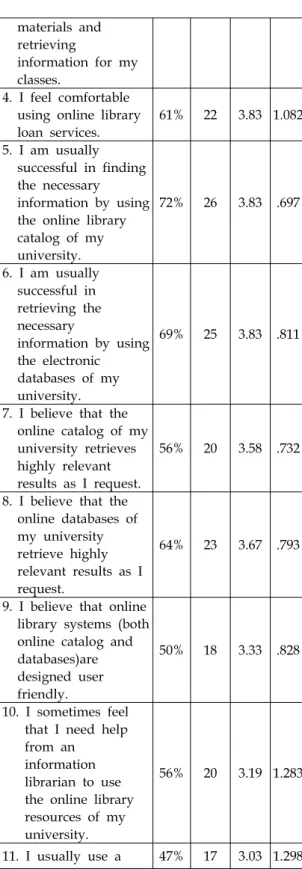
<Table 9> Students' perceptions of online library retrieval systems (N= 36, Min.=1 Max.=5)
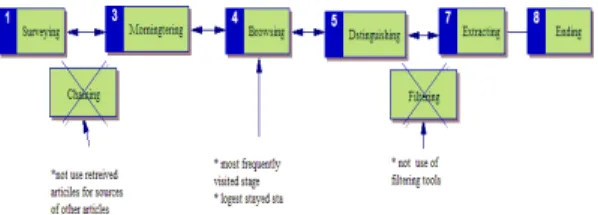
Fig. 1. Information retrieval behaviors observed.
According to the observed data in Figure1, students simultaneously went back and forth between stages according to their needs and each procedure did not occur in order as Ellis
& Haugan (1997) suggested. In addition, the stages such as chaining and filtering were not found: studentsdid not use articles as a source in order to find more publications by the same authors or subcategories for chaining, or extract articles from the retrieved data directly without filtering.
The students did not use authors or journals in order to find more resources but relied on the information that was retrieved by the systems automatically through keyword searching. When the students did not find enough information from the retrieved list, they went back to the browsing stage and started searching for more information with the same key words using different IR systems. In utilizing the features of the systems, the students used the basic search functions only by typing a keyword; nobody attempted to use advanced search options (e.g. document type, dates) in order to narrow the search options. It was also observed the participants used different navigation tools and function keys during the search process.
In general, the students tended to spend one
third of the total research time to browse the information using the IR systems, and the rest of the time was used to distinguish and extract the information by checking the related subject and reading the abstracts. When comparing the search results of ten participants (ten abstracts from each participants), it was found that everybody was different in the use of judgment in selecting the related articles with the given topic "critical pedagogy": each participant selected different articles and only one article was selected by twice by tow different participants. The students tended to rely on the titles when they selected related information: all the selected abstracts contained
"critical pedagogy" in the titles.
4. Students' perceptions of online library retrieval systems
(1) Students perceptions of online library
retrieval systems 12 questions were analyzed to
examine students' perceptions of online
retrieval systems.
materials and retrieving
information for my classes.
4. I feel comfortable using online library loan services.
61% 22 3.83 1.082 5. I am usually
successful in finding the necessary information by using the online library catalog of my university.
72% 26 3.83 .697
6. I am usually successful in retrieving the necessary
information by using the electronic databases of my university.
69% 25 3.83 .811
7. I believe that the online catalog of my university retrieves highly relevant results as I request.
56% 20 3.58 .732
8. I believe that the online databases of my university retrieve highly relevant results as I request.
64% 23 3.67 .793
9. I believe that online library systems (both online catalog and databases)are designed user friendly.
50% 18 3.33 .828
10. I sometimes feel that I need help from an
information librarian to use the online library resources of my university.
56% 20 3.19 1.283
11. I usually use a 47% 17 3.03 1.298
help menu or search hints in order to maximize the search results.
12. I have considered attending library workshops or training sessions to be able to utilize library systems more effectively.
64% 23 3.61 1.358
As shown in Table 9 and Figure 2, students reported being comfortable using the library systems. A majority responded that they felt confident in using the online library catalog (72%) and databases (67%). A similar number of students reported that they are usually
#9 #10 #11 #12 #13 #14 #15 #16 #17 #18 #19 #20 3
3.2 3.4 3.6 3.8 4 4.2
평균