• 검색 결과가 없습니다.

Electromagnetic Pulse Shielding Effectiveness and Construction Availability of Cast-In-Place Structures Using Corrugated Metal-Plates

N/A
N/A
Protected

Academic year: 2021

Share "Electromagnetic Pulse Shielding Effectiveness and Construction Availability of Cast-In-Place Structures Using Corrugated Metal-Plates"

Copied!
6
0
0

로드 중.... (전체 텍스트 보기)

전체 글

(1)

pISSN 1598-2033 eISSN 2233-5706

Journal of the Korea Institute of Building Construction, Vol. 13, No. 1

http://dx.doi.org/10.5345/JKIBC.2013.13.1.084 www.jkibc.org

Electromagnetic Pulse Shielding Effectiveness and Construction Availability of Cast-In-Place Structures Using Corrugated Metal-Plates

Kim, Suk Bong

1

Yoon, Sangho

2

Min, Gyung Chan

3

Ahn, Sungjin

4

Park, Young Jun

1*1)

Department of Civil Engineering and Environmental Engineering, Korea Military Academy, Nowon-Gu, Seoul,

139-799, Korea

1

Department of Defense Acquisition Program, Kwangwoon University, Seongbuk-Gu, Seoul, 139-701 Korea

2

Korea Technology Institute, Gwangju-Si, Gyeonggi-Do, 464-881, Korea

3

Department of Civil and Coastal Engineering, University of Florida, Gainesville, Florida, 32611, U.S.A

4

Abstract

This study aims to examine the effectiveness of electromagnetic pulse shielding in cast-in-place protective shelters using corrugated metal-plates, and then reviews their usability for the Republic of Korea Army. The Korea Corps of Engineering has evaluated corrugated metal-plates as a construction material for cast-in-place structures, which have to defend against mechanical impacts as well as electromagnetic pulses. Corrugated metal-plate is known as a superb mechanical protective material, so much so that it has been employed in ammunition magazines and artillery platforms in the armed forces. Moreover, as a metal, such as steel and copper, it is universally recognized as one of the most effective electromagnetic pulse shielding materials. In addition to effectively shielding from electromagnetic pulses and protecting against mechanical impacts, corrugated metal-plates should prove to be an appropriate construction material for the cast-in-place protective shelter in terms of construction availability and economic feasibility. The shielding effectiveness of the suggested structures is examined based on MIL-STD 188-125-1. A few frequency bands need an increase of 15∼30dB in shielding effectiveness because of unbidden apertures caused by flaws associated with welding, assembling, and material deformation. However, allowing for the approximately 40dB of shielding provided by soil; the examined structure, which is buried underground, can offset its shortcomings sufficiently.

Keywords : electromagnetic pulse (EMP), shielding effectiveness, corrugate metal-plate, cast-in-place (CIP)

1. Introduction

1.1 Research objectives

This study aims to examine the electromagnetic pulse shielding effectiveness of cast-in place (CIP) protective shelters employing corrugated metal-plates, and then review its usability.

Reinforced concrete is a main construction material to guarantee mechanical protection, but is

Received : December 23, 2012 Revision received : January 7, 2013 Accepted : January 8, 2013

* Corresponding author : Park, Young Jun [Tel: 82-2-2197-2853, E-mail: [email protected]]

ⓒ2013 The Korea Institute of Building Construction, All rights reserved.

less competent as an EMP shielding material[1,2,3].

Steel is noted as a superlative material to attenuate

an EMP, but is less reliable in terms of mechanical

protection because of its ductility[3]. Protective

facilities are built to defend against mechanical

impacts; nuclear, biological, and chemical

contamination; and electromagnetic pulse

(EMP)[1,2]. Thus far, a few main C4I(Command,

Communication, Control, Computer, and Intelligence)

facilities provide EMP protection[4]. However, it

could be problematic to reinforce the EMP shielding

function for less critical combat facilities or

equipment because it is difficult to defray the

30~40% additional expenses associated with EMP

shielding beyond mechanical protection[5,6]. A

(2)

corrugated metal-plate has been tested and proven to be a useful material in terms of mechanical protection[3]. Furthermore, a steel-plate provides reliable shielding capabilities against an EMP[7].

1.2 Research significance and necessities

From the military perspective, current armed forces strategies are based on information dominance, network-centric warfare, and expeditionary operations, all of which heavily rely on electronics or electric circuits. For this reason, it will be likely that adversaries will attempt to use an EMP to employ asymmetric attacks[8].

From the civil perspective, it is impossible to operate banking, transportation, communication and so on without electronic devices, so there is inevitably a need to protect these social systems against an EMP which could be used to cause enormous social turmoil[4,5,6].

2. Literature reviews

2.1 Corrugated metal-plates structures

The representative construction methods associated with EMP shielding are Modular Pan Type, Panel Type, and Welding Type[7]. These are additionally installed to block or attenuate the effects of EMP on existing mechanical protective structures built with reinforced concrete, and thus the problems related to cost and site-works cannot be ignored[5,6]. Due to these problems, it is difficult to apply these methods on protective structures for small units such as a protective shelter. The CIP structures, at first, were used to protect isolated, small facilities or functional equipment from the main C4I buildings in both the US and USSR during the Cold War Era. One of the main advantages of CIP structures is that they can, in part, eliminate the construction limitations

caused by the cost, in particular, related to the site-works[6].

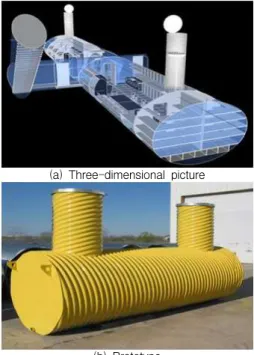
The Korea Corps of Engineering has taken account of a corrugated metal-plate as a construction material for the CIP structures as shown in Figure 1. A corrugated metal-plate is known as a superb mechanical protective material, so much so that it has been employed in ammunition magazines and artillery platforms in the armed forces. Moreover, as a metal, such as steel and copper, it is universally recognized as one of the most effective electromagnetic pulse shielding materials[7]. In addition to effectively shielding equipment from electromagnetic pulses and protecting it from mechanical impacts, corrugated metal-plates should prove to be a competent construction material for the cast-in-place protective shelter in terms of construction availability and economic feasibility.

(a) Three-dimensional picture

(b) Prototype

Figure 1. Cast-in-place structures 2.2 EMP occurrence

A nuclear detonation is the most likely scenario

(3)

Electromagnetic Pulse Shielding Effectiveness and Construction Availability of Cast-In-Place Structures Using Corrugated Metal-Plates

in which an EMP may be generated. Gamma rays discharged by the explosion hit air molecules, so that free electrons, which originally consisted of air molecules, are scattered and trapped in the magnetic field of the Earth. These electrons generate an oscillating electric current which radiates the coherent EMP. While nuclear weapons are the main EMP generators, they are also related to high power microwaves and electromagnetic bombs[4,5,6,7].

2.3 Electronic circuit vulnerability to EMP

Electrical and electronic devices or equipment could be wrecked by the EMP, the effects of which are explained with rise time, electrical field strength, and frequency contents. In other words, an EMP induces large voltage and current transients on electrical conductors, so that unprotected electrical and electronic circuits are devastated by ruinous and insuperable EMP rise time, field strength, and frequencies[4,5,6,7].

(a) Sectional view

(b) Side view

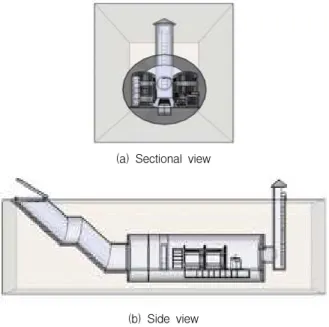
Figure 2. Concept of cast-in-place structures

2.4 Concept of cast-in-place structures

The concept of cast-in-place is as shown in

Figure 2. The minimum depth from the soil top to the top of the structure should be more than 3m.

2.5 EMP protection

EMP protection is defined with shield, grounding and bonding, and filtering. The shielding is usually associated with architectural fields, while the others are related to electric ones. The military and civil facilities should meet the shielding effectiveness requirements of MIL 188-125, MIL-STD 461F RS105; and ITU K.78(HEMP), ITU K.81(HEMP), and IEC SC 77C, respectively.

Continuous conductive enclosure is generally constructed from metal, typically steel and copper[7,9].

3. Research methodologies and progress

3.1 Design and manufacturing

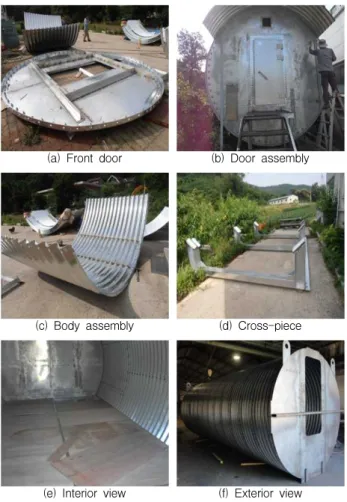
The CIP structure was not redesigned but manufactured along with its original prototype as shown in Figure 3. However, the devices or equipment such as the shielding doors, honey-comb grills, wave-guided below cutoffs, and signal point-of-entry were assembled or welded, after being tested to ensure they met the required standards according to MIL-STD 188-125-1.

3.2. Experiment

The frequency-dependent ratio, expressed in decibels (dB), of the received signal when receiving antenna is illuminated by electromagnetic radiation in the test calibration configuration, to the received signal through the electromagnetic barrier in the test measurement configuration. Assuming the antenna voltage proportional to the field strength is detected:

  log 

(4)

(c) Body assembly (d) Cross-piece

(e) Interior view (f) Exterior view

Figure 3. Manufacturing the cast-in-place structures using corrugated metal-plates

Where V

m

is the measured signal at the test area, V

c

is the calibration signal at the same frequency and transmitting antenna polarization, and corrections are applied for any difference in instrumentation system gain or attenuation between the calibration and measurement configurations. SE refers to the shielding effectiveness. Test frequencies shall be spaced approximately logarithmically within each decade, with minimum sampling density[7].

The experiments were performed along with the MIL-STD 188-125-1 from two exterior sides for the calibration signal at the same frequency and transmitting antenna polarization as shown in Figure 3. The signals at the test areas, V

m

are measured as shown in Figure 5.

a) Facade, 20∼200MHz (b) Flank, 20∼200MHz

(c) Facade, 200Mhz∼1Ghz (d) Flank, 200Mhz∼1Gh Figure 4. Experimental setups for measuring calibration signals

Figure 5. The experimental setup for measuring signals at test areas

4. Results

CIP structures were designed and developed by

the US and USSR in the 1970s. The main purpose

of CIP structures in the armed forces is to provide

protective shelter for C4I equipment or for troops

that are isolated physically but connected

functionally to the headquarters. The Republic of

Korea Army; in particular, the Korea Corps of

(5)

Electromagnetic Pulse Shielding Effectiveness and Construction Availability of Cast-In-Place Structures Using Corrugated Metal-Plates

Engineering, considers the CIP structures using corrugated metal-plates, which are so advantageous in terms of structural strength, construction availability, and economic feasibility, as a protective shelter for small units or critical military electric or electronic circuits. Corrugated metal-plates are already commonly used in ammunition magazines and artillery platforms thanks to their structural strength as a protective material. Furthermore, it is verified that the CIP structures using corrugated metal-plates contribute to reducing construction costs by up to 40%

compared to the use of concrete facilities reinforced with metal-plates to attenuate the EMP.

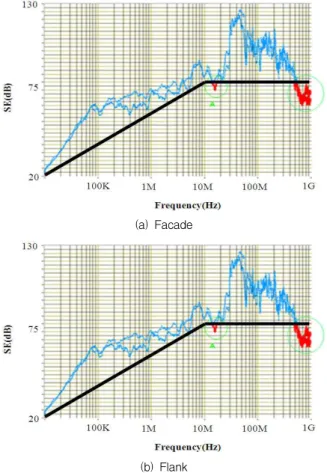
The measured values should be above the straight, thicker line in Figure 6, which indicates the minimum shielding effectiveness.

(a) Facade

(b) Flank

Figure 6 Shielding effectiveness of cast-in-place structures using corrugated metal-plates

Several frequency bands, in which the measured shielding effectiveness is lower than the minimum requirement of MIL-STD 188-125-1, need an increase in shielding effectiveness of 15~30dB because of unbidden apertures caused by flaws associated with welding, assembling, and material deformation as shown in Figure 7. However, allowing for the approximately 40dB shielding provided by humid soil; the examined structure, which is buried underground, can offset its shortcomings sufficiently as shown in Figure 8.

(a) Welding (b) Assembly (c) Deformation

Figure 7. Apertures caused by welding, assembling, and material deformation

Figure 8. Shielding obtained through humid soils of 3m thickness

5. Conclusion

In this study, shielding effectiveness of CIP

structures using corrugated metal-plates was

examined along with the requirements and

procedures shown in MIL-STD 188-125-1.

(6)

couple of bands require an increase of 15~30dB to meet the minimum shielding effectiveness requirement. When determining pass/fail MIL-STD 188-125-1 asks that below-specification shielding effectiveness values are not disregarded if it can be demonstrated that the reading is due to an ambient noise source that cannot practically be eliminated or identified flaws which can be improved.

Considering that more than 40 dB shielding effectiveness can be provided by the soil, the examined CIP structures using corrugated metal-plates, which are buried underground, are enough to offset the shortcoming in specific frequency bands. Consequently, it could be concluded that CIP structures using corrugated metal-plates provide satisfactory EMP shielding effectiveness and are applicable to the EMP shelter.

Acknowledgement

This research was funded by the Ministry of National Defense.

References

1. Department of US Army. TM 5-855-1: Fundamentals of Protective Design (Non-nuclear). Washington DC:

Department of the Army Technical Manual; c1965. 455 p.

2. Kang YC, Kim SB, Oh KD, Baek SH, Kim TW, Ye MC, Lee JH, Park YJ, Han SS. Protective Structural Engineering.

Seoul (Korea): Cheongmumgak; 2005. 520 p.

3. Kim SB, Beak SH, Lee JH, Lee SH, Baek JH. A Study on Protective Design Standards for Major Military Facilities.

Seoul (Korea): Ministry of National Defense; 2012. 320 p.

4. Kim SB, Kim TW, Lee JH. The Study for Design Criteria about Electromagnetic Pulse Pretoection for Military Facilities.

Seoul (Korea): Korea Military Academy; 2008. 72 p.

5. Kim SB, Han SS, Kang YC, Baek SH. A Study for the

Academy; 2008. 99 p.

6. Kim SB, Kim WD, Bang SK, Baek SH, Hwang HS. A Study for the Plan of Protective Facility from EMP and NBC. Seoul:

Korea Military Academy; 2011. 112 p.

7. Department of Defense. MIL-STD 188-125-1: High Altitude Electromagnetic Pulse (HEMP) Protection for Ground-based C4I Facilities Performing Critical, Time-urgent Mission.

Washington DC: US Department of Defense; c1994. 98 p.

8. Miller CR. Electromagnetic Pulse Threats in 2010.

Montgomery: US Air University; c2005. Chapter 12; p.

385-410.

수치

Figure 1. Cast-in-place structures 2.2 EMP occurrence
Figure 2. Concept of cast-in-place structures
Figure 5. The experimental setup for measuring signals at test areas
Figure 7. Apertures caused by welding, assembling, and material deformation

참조

관련 문서

(4) Apply RF pulses (electromagnetic waves) for exciting spins in the position of which resonant frequency is same to one of the applied pulses.. (5) Turn off the pulses then

In this study, the RESRAD-RECYCLE 3.10 computer code was used to evaluate individual and collective doses due to the recycling of radioactive metal waste

The metal biopsy test of both specimens did not show any microscopic cracks in the heat affected zone and the base metal, and both samples were free from

CMP process is effectively used to flat dielectric layer such as IMD, ILD, PMD and metal layer such as W, Al, Cu in order to perform multi layer

 Enhancement of Formability  Microstructure control : Metal forming by applying electric current during deformation Electrically-Assisted Manufacturing

The concerned study is now believed to make a contribution to protecting the seniors in Korea from committing a suicide and to reduce the suicidal

Assuming perfect conductors, a coaxial transmission line having an inner conductor can support

The total charge density from the metal surface and specifically adsorbed anions in inner layer is equal to the charge from solvated ions in diffuse layer. σ metal + σ inner =