Isolation and Identification of Inhibitory Compounds from Morus alba cv.
Kuksang on α-amylase and α-glucosidase
Moo-Young Choi
1and Young-Je Cho
2*
1Department of Food and Nutrition, College of Health Science, Sangji University, Wonju 220-702, Korea
2School of Food Science and Biotechnology/Food Bio-Industry Institute, College of Agriculture and Life Sciences, Kyungpook National University, Daegu 702-701, Korea
Received March 3, 2015 /Revised August 13, 2015 /Accepted August 18, 2015
The objective of this research was to evaluate the inhibitory activities of phenolic compounds isolated from mulberry (Morus alba) leaves of 109 types against α-amylase and α-glucosidase. The inhibitory activity of the water extracts from Morus alba cv. Kuksang against α-amylase and α-glucosidase were determined as 93.8% and 48.7% respectively. The total phenolic content of extracts from Morus alba cv. Kuksang was 9.7±0.2 mg/g soluble in water and 14.3±0.2 mg/g soluble in ethanol. The inhibitory activity of the water extracts from Morus alba cv. Kuksang at 200 μg/ml phenolics concentration against α-amylase and α-glucosidase were determined as 100% and 82.6% respectively. The purification of in- hibitory compounds was carried out by Sephadex LH-20 and MCI-gel CHP-20 column chromatog- raphy using a gradient elution procedure by nomal phase type (EtOH→distilled water) and reverse phase type (distilled water→MeOH). The quercetin was confirmed to be the chemical structure of the inhibitory compound against α-amylase and α-glucosidase by spectroscopic analysis of FAB-MS, NMR and IR spectrum.
Key words : α-Amylase, α-glucosidase, Morus alba cv. Kuksang, purification, identification
*Corresponding author
*Tel : +82-53-950-7755, Fax : +82-53-950-7762
*E-mail : [email protected]
This is an Open-Access article distributed under the terms of the Creative Commons Attribution Non-Commercial License (http://creativecommons.org/licenses/by-nc/3.0) which permits unrestricted non-commercial use, distribution, and reproduction in any medium, provided the original work is properly cited.
Journal of Life Science 2015 Vol. 25. No. 8. 870~879 DOI : http://dx.doi.org/10.5352/JLS.2015.25.8.870
Introduction
As humans desires to live long, various studies have been undertaken in order to find available materials from natural sources, which have varied physiological functions, such as antibacterial, antioxidant, anticancer functions, or strong im- munosuppressive activity [22]. Most of biological active ma- terials are phenolic compounds in plants and these are main- ly composed of flavonoids, simple phenol, phenolic acid, phenylpropanoids, and phenolic quinine. They also play im- portant antibacterial, anti-allergy, antioxidant, anticancer, anti-tumor, anti-mutans, anti-heart disease, and anti-diabetes role [9].
Morus alba cv. Kuksang has been used to treat diabetes, stroke, and beriberi disease, so diabetes is divided into three types those dependant on insulin, independent on insulin and of those desiring insulin types, a further 91% are in-
depending on insulin type which mainly occurs after 40 years because of low insulin activating or producing small amounts of insulin [9, 20, 21]. As the epidemiologic inves- tigation, a local resident who has kept a traditional life style would rarely occur in independent type diabetes, but people who moved from a developing country to an advanced country would occur remarkably [18]. Insulin independent type diabetes, which constitute the larger portion of diabetes patients has been studied in order to control the diabetes and the absorption of sugar using α-amylase inhibit [2, 23].
α-Amylase is the enzyme used to resolve α-D-(1,4)-glucan bond of carbohydrates so it is very important for humans, animals, bacteria and insects. The α-amylase inhibitor for treating diseases (diabetes, obesity, over blood sugar, ets.), concerned with carbohydrates, is originated from wheat, barley and, leguminous plants [3, 6, 16, 24] which are almost glucoprotein, but there are a few reports about inhibitory materials being founds in medicine from medicinal plants and bacteria [7, 14], In addition, there is nothing to develop anti-diabetes foods using natural materials in order to pre- vent diabetes. In this study, we tried to obtain basic diabetes data to determine and develop functional food materials which have inhibitory effects on α-amylase and α-glucosi- dase of isolated phenolic compounds from Morus alba cv.
Kuksang extracts.
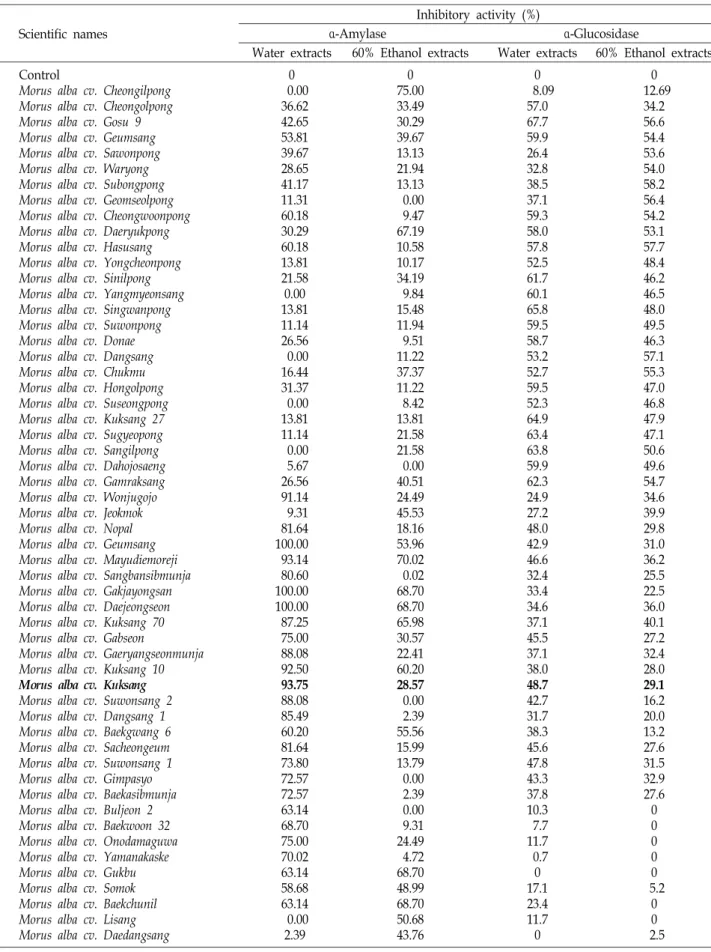
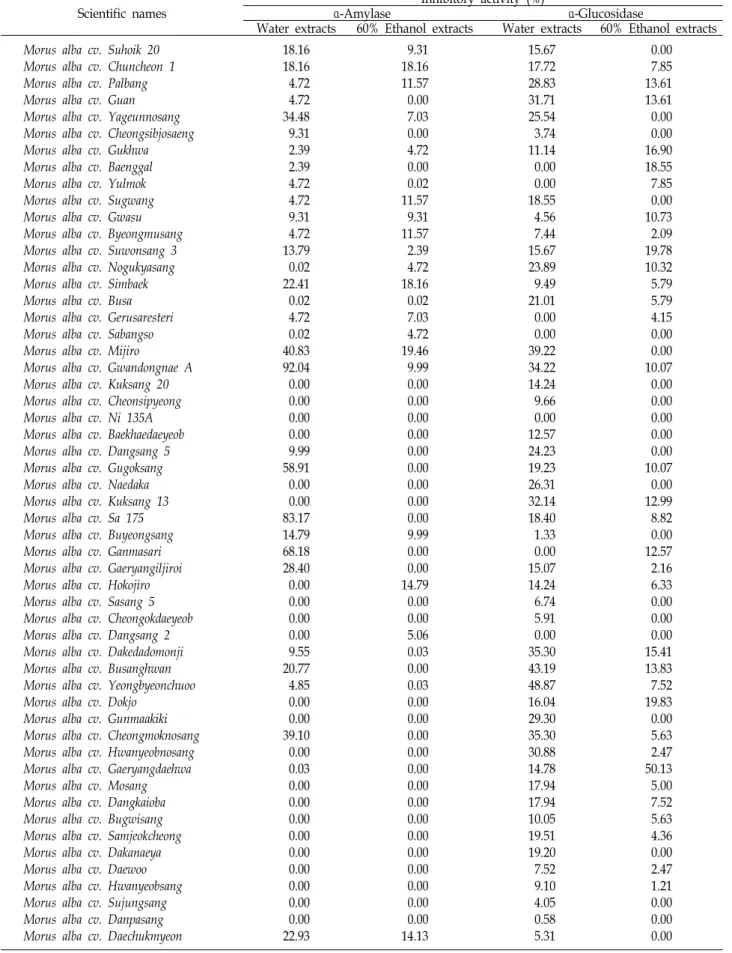
Table 1. Inhibitory activity of water and ethanol extracts from various mulberry leaves (Morus alba L.) against α-amylase and α- glucosidase
Scientific names
Inhibitory activity (%)
α-Amylase α-Glucosidase
Water extracts 60% Ethanol extracts Water extracts 60% Ethanol extracts Control
Morus alba cv. Cheongilpong Morus alba cv. Cheongolpong Morus alba cv. Gosu 9 Morus alba cv. Geumsang Morus alba cv. Sawonpong Morus alba cv. Waryong Morus alba cv. Subongpong Morus alba cv. Geomseolpong Morus alba cv. Cheongwoonpong Morus alba cv. Daeryukpong Morus alba cv. Hasusang Morus alba cv. Yongcheonpong Morus alba cv. Sinilpong Morus alba cv. Yangmyeonsang Morus alba cv. Singwanpong Morus alba cv. Suwonpong Morus alba cv. Donae Morus alba cv. Dangsang Morus alba cv. Chukmu Morus alba cv. Hongolpong Morus alba cv. Suseongpong Morus alba cv. Kuksang 27 Morus alba cv. Sugyeopong Morus alba cv. Sangilpong Morus alba cv. Dahojosaeng Morus alba cv. Gamraksang Morus alba cv. Wonjugojo Morus alba cv. Jeokmok Morus alba cv. Nopal Morus alba cv. Geumsang Morus alba cv. Mayudiemoreji Morus alba cv. Sangbansibmunja Morus alba cv. Gakjayongsan Morus alba cv. Daejeongseon Morus alba cv. Kuksang 70 Morus alba cv. Gabseon
Morus alba cv. Gaeryangseonmunja Morus alba cv. Kuksang 10 Morus alba cv. Kuksang Morus alba cv. Suwonsang 2 Morus alba cv. Dangsang 1 Morus alba cv. Baekgwang 6 Morus alba cv. Sacheongeum Morus alba cv. Suwonsang 1 Morus alba cv. Gimpasyo Morus alba cv. Baekasibmunja Morus alba cv. Buljeon 2 Morus alba cv. Baekwoon 32 Morus alba cv. Onodamaguwa Morus alba cv. Yamanakaske Morus alba cv. Gukbu Morus alba cv. Somok Morus alba cv. Baekchunil Morus alba cv. Lisang Morus alba cv. Daedangsang
0 0.00 36.62 42.65 53.81 39.67 28.65 41.17 11.31 60.18 30.29 60.18 13.81 21.58 0.00 13.81 11.14 26.56 0.00 16.44 31.37 0.00 13.81 11.14 0.00 5.67 26.56 91.14 9.31 81.64 100.00 93.14 80.60 100.00 100.00 87.25 75.00 88.08 92.50 93.75 88.08 85.49 60.20 81.64 73.80 72.57 72.57 63.14 68.70 75.00 70.02 63.14 58.68 63.14 0.00 2.39
0 75.00 33.49 30.29 39.67 13.13 21.94 13.13 0.00 9.47 67.19 10.58 10.17 34.19 9.84 15.48 11.94 9.51 11.22 37.37 11.22 8.42 13.81 21.58 21.58 0.00 40.51 24.49 45.53 18.16 53.96 70.02 0.02 68.70 68.70 65.98 30.57 22.41 60.20 28.57 0.00 2.39 55.56 15.99 13.79 0.00 2.39 0.00 9.31 24.49 4.72 68.70 48.99 68.70 50.68 43.76
0 8.09
57.0 67.7 59.9 26.4 32.8 38.5 37.1 59.3 58.0 57.8 52.5 61.7 60.1 65.8 59.5 58.7 53.2 52.7 59.5 52.3 64.9 63.4 63.8 59.9 62.3 24.9 27.2 48.0 42.9 46.6 32.4 33.4 34.6 37.1 45.5 37.1 38.0 48.7 42.7 31.7 38.3 45.6 47.8 43.3 37.8 10.3 7.7 11.7 0.7 0 17.1 23.4 11.7 0
0 12.69
34.2 56.6 54.4 53.6 54.0 58.2 56.4 54.2 53.1 57.7 48.4 46.2 46.5 48.0 49.5 46.3 57.1 55.3 47.0 46.8 47.9 47.1 50.6 49.6 54.7 34.6 39.9 29.8 31.0 36.2 25.5 22.5 36.0 40.1 27.2 32.4 28.0 29.1 16.2 20.0 13.2 27.6 31.5 32.9 27.6 0 0 0 0 0 5.2
0 0 2.5
Table 1. Continued
Scientific names Inhibitory activity (%)
α-Amylase α-Glucosidase
Water extracts 60% Ethanol extracts Water extracts 60% Ethanol extracts Morus alba cv. Suhoik 20
Morus alba cv. Chuncheon 1 Morus alba cv. Palbang Morus alba cv. Guan Morus alba cv. Yageunnosang Morus alba cv. Cheongsibjosaeng Morus alba cv. Gukhwa Morus alba cv. Baenggal Morus alba cv. Yulmok Morus alba cv. Sugwang Morus alba cv. Gwasu Morus alba cv. Byeongmusang Morus alba cv. Suwonsang 3 Morus alba cv. Nogukyasang Morus alba cv. Simbaek Morus alba cv. Busa Morus alba cv. Gerusaresteri Morus alba cv. Sabangso Morus alba cv. Mijiro
Morus alba cv. Gwandongnae A Morus alba cv. Kuksang 20 Morus alba cv. Cheonsipyeong Morus alba cv. Ni 135A Morus alba cv. Baekhaedaeyeob Morus alba cv. Dangsang 5 Morus alba cv. Gugoksang Morus alba cv. Naedaka Morus alba cv. Kuksang 13 Morus alba cv. Sa 175 Morus alba cv. Buyeongsang Morus alba cv. Ganmasari Morus alba cv. Gaeryangiljiroi Morus alba cv. Hokojiro Morus alba cv. Sasang 5 Morus alba cv. Cheongokdaeyeob Morus alba cv. Dangsang 2 Morus alba cv. Dakedadomonji Morus alba cv. Busanghwan Morus alba cv. Yeongbyeonchuoo Morus alba cv. Dokjo
Morus alba cv. Gunmaakiki Morus alba cv. Cheongmoknosang Morus alba cv. Hwanyeobnosang Morus alba cv. Gaeryangdaehwa Morus alba cv. Mosang Morus alba cv. Dangkaioba Morus alba cv. Bugwisang Morus alba cv. Samjeokcheong Morus alba cv. Dakanaeya Morus alba cv. Daewoo Morus alba cv. Hwanyeobsang Morus alba cv. Sujungsang Morus alba cv. Danpasang Morus alba cv. Daechukmyeon
18.16 18.16 4.72 4.72 34.48 9.31 2.39 2.39 4.72 4.72 9.31 4.72 13.79 0.02 22.41 0.02 4.72 0.02 40.83 92.04 0.00 0.00 0.00 0.00 9.99 58.91 0.00 0.00 83.17 14.79 68.18 28.40 0.00 0.00 0.00 0.00 9.55 20.77 4.85 0.00 0.00 39.10 0.00 0.03 0.00 0.00 0.00 0.00 0.00 0.00 0.00 0.00 0.00 22.93
9.31 18.16 11.57 0.00 7.03 0.00 4.72 0.00 0.02 11.57 9.31 11.57 2.39 4.72 18.16 0.02 7.03 4.72 19.46 9.99 0.00 0.00 0.00 0.00 0.00 0.00 0.00 0.00 0.00 9.99 0.00 0.00 14.79 0.00 0.00 5.06 0.03 0.00 0.03 0.00 0.00 0.00 0.00 0.00 0.00 0.00 0.00 0.00 0.00 0.00 0.00 0.00 0.00 14.13
15.67 17.72 28.83 31.71 25.54 3.74 11.14 0.00 0.00 18.55 4.56 7.44 15.67 23.89 9.49 21.01 0.00 0.00 39.22 34.22 14.24 9.66 0.00 12.57 24.23 19.23 26.31 32.14 18.40 1.33 0.00 15.07 14.24 6.74 5.91 0.00 35.30 43.19 48.87 16.04 29.30 35.30 30.88 14.78 17.94 17.94 10.05 19.51 19.20 7.52 9.10 4.05 0.58 5.31
0.00 7.85 13.61 13.61 0.00 0.00 16.90 18.55 7.85 0.00 10.73 2.09 19.78 10.32 5.79 5.79 4.15 0.00 0.00 10.07 0.00 0.00 0.00 0.00 0.00 10.07 0.00 12.99 8.82 0.00 12.57 2.16 6.33 0.00 0.00 0.00 15.41 13.83 7.52 19.83 0.00 5.63 2.47 50.13 5.00 7.52 5.63 4.36 0.00 2.47 1.21 0.00 0.00 0.00
Materials and Methods
Sample
109 types mulberry leaves were purchased from a sericul- tural laboratory in Sangju city, Gyeongbuk, Korea and then ground as 40 mesh after dried at 45℃ in dry oven.
Preparation of mulberry leaves extracts
One gram of mulberry leaves powder was added to 200 ml of distilled water and boiled until the volume was re- duced to 100 ml and then used as water extracts after being cooled. One gram of Morus alba cv. Kuksang powder was stirred in 100 ml of 80% ethanol at room temperature for 24 hr, centrifuged at 10,000 rpm for 15 min, then filtered through the supernatant with Whatman No. 1, and prepared as alcohol extracts.
Total phenolic assay
One milliliter of water extract and 80% ethanol extract were added into test tubes and mixed with 5 ml distilled water and 1 ml 95% ethanol and then 0.5 ml 1 N Folin-cio- calteu reagent was added. After 5 min, 1 ml 5% Na
2CO
3solution was added and the reacted mixture was allowed to stand for 60 min, then the absorbance was measured at 725 nm. The calculation was established using the standard curve with gallic acid [1].
α-Amylase inhibitory activity
The α-amylase inhibitory activity was determined by agar diffusion method [8]. The plate was prepared by putting 5 g agar and 5 g soluble starch into 500 ml distilled water and then sterilizing them at 121℃ for 15 min. The control was prepared by mixing 0.8 ml distilled water and 0.2 mL α-amylase (1,000 unit/ ml) and samples were prepared by mixing Morus alba cv. Kuksang extracts and enzyme, then they were added into disc paper on the plate, incubated at 37℃ for 3 days and then was added 5 ml I₂/KI (5 mM I
2in 3% KI), colored for 15 min, and the percentage of en- zyme inhibition was calculated by inhibition (%)=[(square of control - square of sample)/square of control] ×100.
Soluble starch as the substrate was prepared by using 1%
soluble starch in 0.2 M acetate buffer (pH 4.8). Mixed 0.5 ml substrate, 0.2 ml α-amylase and 0.3 ml of 0.2 M acetate buffer (pH 4.8), and then 0.2 ml distilled water was added into the control, 0.2 ml sample was added into the reactive group, they then stood at 50℃ for 10 min, colored by adding 1.0 ml I₂/KI solution and diluted with 5 ml distilled water.
Next, the produced glucose was measured at the absorbance of 550 nm [12]. Glucose was calculated using the standard curve which was prepared by pure glucose, and the percent- age of enzyme inhibition was calculated by inhibition (%)
= [1-(glucose products of sample/glucose products of con- trol)] ×100.
α-Glucosidase inhibitory activity
The α-glucosidase inhibitory activity was measured by Tibbot et al. [25] method. The substrate was prepared by us- ing p-nitrophenol-α-D-glucopyranoside (PNPG) in 50 mM sodium succinate buffer (pH 4.2). Mixed 1 ml substrate and 0.1 ml α-glucosidase, and then 0.1 ml distilled water was added into the control, 0.1 ml sample was added into the reactive group, then left to stand at 37℃ for 30 min, colored by adding 0.1 ml of 1 N NaOH and then the PNP that had formed ⍴-nitrophenol (PNP) was measured at the absorb- ance of 400 nm. The PNP was calculated using the standard curve which was prepared by pure ⍴-nitrophenol, and the percentage of enzyme inhibition was calculated by inhibition (%) = [1-(PNP products of sample/PNP products of control)]
×100.
Purification of inhibitory compound against α- amylase and α-glucosidase
Distilled water was added to 5 kg dried Morus alba cv.
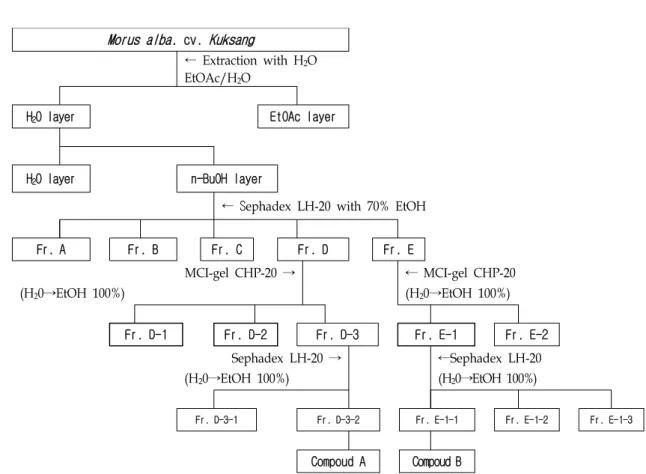
Kuksang and shaken for 24 hr., centrifuged at 5,000 rpm for 30 min, and the obtained supernatant and precipitates. The process was repeated three times. The filtered and con- centrated solution with rotary evaporator was loaded on a Sephadex LH-20 (5×120 cm) column as Fig. 1, then we ob- tained five fractions A~E using 70% ethanol as a solvent.
After concentrating of each fraction, their inhibitory activ- ities against α-amylase and α-glucosidase was assayed. The active fractions were reloaded on an open Sephadex LH-20 (3×60 cm) and MCI-gel CHP-20P (3×60 cm) column. These fractions were developed on silica-gel TLC plates (5×5 cm) with solvents of benzen : ethylfomate : formate (1:7:1, v/v/v), sprayed with F₂Cl₃/K₃Fe(CN)₆ then colored at 70℃ and in order to confirm the isolated degree of the phe- nolic compound [19].
The chemical and physical properties of the phe- nolic compound
The melting point of the isolated material was measured
by micro-electrothermal equipment with 1 g of sample. The
Morus alba. cv. Kuksang
← Extraction with H2O EtOAc/H2O
H20 layer EtOAc layer
H20 layer n-BuOH layer
← Sephadex LH-20 with 70% EtOH
Fr. A Fr. B Fr. C Fr. D Fr. E
MCI-gel CHP-20 → (H20→EtOH 100%)
← MCI-gel CHP-20 (H20→EtOH 100%)
Fr. D-1 Fr. D-2 Fr. D-3 Fr. E-1 Fr. E-2
Sephadex LH-20 → (H20→EtOH 100%)
←Sephadex LH-20 (H20→EtOH 100%)
Fr. D-3-1 Fr. D-3-2 Fr. E-1-1 Fr. E-1-2 Fr. E-1-3
Compoud A Compoud B
Fig. 1. A procedure for the isolation of phenolic compounds from Morus alba cv. Kuksang.
IR spectrum was assayed by the halogenic alkalic tablet method, the nuclear magnetic resonance (NMR) spectrum (
1H and
13C-NMR) was investigated by melting 10 mg whole purified subjects with DMSO solvent and comparing them with a tetramethylsilane (TMS) standard using proton mag- netic resonance (PMR, 300 MHz). The mass spectrum was measured using negative ion fast atom bombardment mass (FAB-MS) spectrum with 1 g sample under decompression (10
-4~10
-6mmHg). Thioglycerol was used as the solvent, and mass analysis was carried on 22~28 eV emitter current, and 6~7 kV accelerative pressure of the ion source. Element anal- ysis was assayed with 1 mg sample which removed the moisture by decompressive drying for 48 hr, and analyzed the amount of hydrogen and carbon by auto element analyzer, also oxygen was calculated based on molecular weight [15].
Results and Discussion
Inhibitory activity against α-amylase and α-gluco- sidase of extracts from various mulberry leaves
An inhibitory material against α-amylase and α-glucosi- dase which are the essential enzymes on carbohydrate me- tabolism was researched, and activities were found from
varied mulberry leaves extracts (Table 5.). Among the mul- berry leaves of 109 species, three species which had the both of inhibitory activities on α-amylase and α-glucosidase were selected and they were identified as Napal, Kuksang, and Sacheongeum. Especially, the Kuksang leaf had the most ex- cellent inhibitory activities on α-amylase as 93.75% and α- glucosidase as 48.7%, so we chose Kusang as the sample for our study. Thus, mulberry leaves extracts because of their behavior at the final step of starch digestion, being con- cerned with inhibiting the activities of α-amylase and α -glucosidase, could be possible use mulberry leaves for dia- betes treatment as being able to remedy the faults of diabetes medicine and resolve side-effects.
Content of phenolic compounds in Morus alba cv.
Kuksang extracts
Phenolic compounds are one of the second metabolic ma-
terials, bonds easily with huge molecule because their vari-
ous structures and molecular composition, and has various
biological functions such as antioxidant, and antibacterial ac-
tivities [Blois, 1958]. In this study, phenolic compounds were
9.7±0.2 mg/g soluble in water and 14.3±0.2 mg/g soluble
in ethanol (Table 2). When compared to the report of Moon
Table 2. Content of total phenolics in water and 60% ethanol extracts from Morus alba cv. Kuksang
Content of phenolics (mg/g)
Water extracts 60% Ethanol extracts
9.7±0.2 14.3±0.2
Each value represents the mean±SD (n=6).
Table 3. Inhibition of extracts from Morus alba cv. Kuksang on α-amylase activity
Sample Water extracts 60% Ethanol extracts Positive control
(Acarbose) Clear zone (cm2) Inhibition (%) Clear zone (cm2) Inhibition (%) Inhibition (%) Control
Morus alba cv. Kuksang
13.9±0.6 0.9±0.2
- 93.8±1.1*
13.9±0.6 9.9±0.1
- 28.6±0.8
- 40.0±2.3 Each value represents the mean±SD (n=6), concentration of sample was 200 μg/ml phenolics. p<0.05.
Table 4. Inhibition of extracts from Morus alba cv. Kuksang on α-glucosidase activity
Sample Water extracts 60% Ethanol extracts Positive control
(Acarbose) PNP (μg/mL) Inhibition (%) PNP (μg/mL) Inhibition (%) Inhibition (%) Control
Morus alba cv. Kuksang
3.5±0.2 1.8±0.1
- 48.7±2.9*
3.5±0.2 2.5±0.1
- 29.1±3.6
- 67.9±2.1 Each value represents the mean±SD (n=6), concentration of sample was 200 μg/ml phenolics. p<0.05.
et al. [17], the phenolic compounds of Morus alba cv. Kuksang extracts were higher than Camellia sinensis (10.9 mg/g), Phellinus lieus (17.9 mg/g), and Artemisia iwayomogi (6.7 mg/g).
α-Amylase inhibitory activity of Morus alba cv.
Kuksang extracts
As α-amylase is the essential enzyme for carbohydrate metabolism, we compared each phenolic compounds in Morus alba cv. Kuksang extracts (Table 3). The α-amylase in- hibitory effects showed that the inhibitory rate was 93.8±1.1% in water and 28.6±0.8% in ethanol extracts. Paek and Kim [20] reported that Distylum racemosum has lots of phenolic compounds at the end of its leaves in order to pro- tect itself from pathogenic bacteria and vermin, so the phe- nolic contents of Crataegi fructus extracts which have higher inhibitory effects against α-amylase, are supposed to have the α-amylase inhibitory effects.
α-Glucosidase inhibitory activity of Morus alba cv.
Kuksang extracts
Water soluble of α-glucosidase inhibitory activity from Morus alba cv. Kuksang extracts was higher than ethanol solu- ble as 48.7±2.9% and 29.1±3.6%(each 200 μg/ml) (Table. 4).
Lee et al. [13] reported that PA inhibits some functions to be related with carbohydrates. Most of ⍶-amylase inhibitory materials from plants are concerned with protein but PA is a phenolic system and inhibits α-amylase and α-glucosidase.
So, the phenolic material of Morus alba cv. Kuksang extracts can also be suggested to inhibit the enzyme activity of carbo- hydrate hydrolysis.
The purification of phenolic compound by open column chromatography from Morus alba cv. Kuksang extracts
500 mg of powder from Morus alba cv. Kuksang extracts was partitioned with ethyl acetate (EtOAc) and butanol (BuOH) to give three fractions
H2O(216.2 mg/20 g), ethyl acetate (154.4 mg/20 g), and butanol (105.3 mg/20 g) (Table 4). The phenolics in each fraction were the highest at
H2O, and the α-glucosidase inhibitory activity was the highest in n-butanol as 27.6% (Table 5) but the α-glucosidase inhibitory activity was relatively low with activity being below 30%.
So the butanol layer which had higher activities on both two
enzyme was purified, isolated and identified as the active
substance. To purify the inhibitory substance on α-amylase
and α-glucosidase from Morus alba cv. Kuksang extracts,
Sephadex LH-20 column (5×120 cm) chromatography was
used and 5 fractions were obtained (Fig. 1). The phenolics
of each fraction were higher at fraction D and fraction E
as 32.2 μg/ml and 29.4 μg/ml, respectively (Table 6). When
the inhibitory activities of α-amylase and α-glucosidase were
measured by fixing the phenolic concentration of fractions
as 200 μg/ml in fraction D and E, they had 100% inhibitory
activity on α-amylase and had the inhibitory activity on α-
Table 5. The contents of phenolic compounds and inhibition effect of solvent fraction from Morus alba cv. Kuksang extracts on α-amylase and α-glucosidase activity
Solvent Phenolics content
(mg/20 g)
Inhibitory activity (%)
α-Amylase α-Glucosidase
Ethyl acetate layer Butanol layer H2O layer
154.4±0.3 105.3±1.6 216.2±1.7
100* 100* 54.2±0.9*
9.6±0.1 27.6±0.1* 12.5±0.2 Phenolics content in extracts were 200 μg/ml for inhibitory activity on α-amylase and α-glucosidase activity. p<0.05.
Fig. 2. Inhibitory activity of α-amylase from phenolics fractions D and E by Sephadex LH-20 column chromatography.
Table 6. Content of phenolic compounds and inhibition activ- ities of α-amylase and α-glucosidase from phenolics fractions by Sephadex LH-20 column chromatography
Fraction Phenolics content (μg/ml)
Inhibitory activity (%) α-Amylase α-Glucosidase Control
A B C D E
- 0.0±0.1 1.4±0.1 12.6±0.5 32.2±1.2 29.4±1.1
- - 1.6±0.5 76.4±5.6* 100.0±3.7* 100.0±6.8*
- - - 3.9±0.2 12.6±1.4 19.4±1.1 Phenolics content in extracts were 200 μg/ml for inhibitory ac- tivity on α-amylase and α-glucosidase activity. p<0.05.
glucosidase as 12.6% and 19.4%, respectively (Table 6, Fig.
2). Hulme and Johnes [10] reported when plant extracts were isolated, enzyme inhibition was high in specific fractions, Cho et al. [5] reported that polyphenolics were able to be partition as numbers of hydroxyl group in phenolics, so this study can be concluded that it is similar to Hulme and Johnes report [10] because enzyme inhibition was confirmed at specific fraction (fraction D and E) of Morus alba cv.
Kuksang extracts.
The first fractions were partitioned with Sephadex LH-20
dextran gel and MCI-gel which are available to isolate the structural isomer phenolics by a gradient of ethanol→dis- tilled water as normal phase type and distilled water→meth- anol as reverse phase type. Fig. 1 shows three substances (comp. D-1~comp. D-3) were yielded from fraction D and two substances (comp. E-1 and E-2) were obtained from frac- tion E, and every substance showed the inhibitory activity.
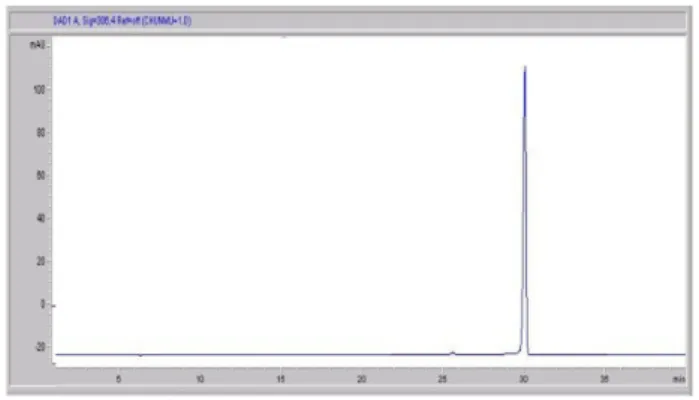
Especially, fraction E-1 showed the highest inhibitory activ- ity as 35.25±1.42% against α-glucosidase. In the partitions of fractions D and E, fraction D-3 and E-1 were confirmed to have the enzyme inhibitory activities so they were lyophi- lized (Table 7). The lyophilized compound was purified by Sephadex LH-20 column (3×50 ㎝) chromatography using distilled water→ethanol (100%) gradient elution and D-3-1 and D-3-2 were gained from fraction D-3, also E-1-1, E-1-2 and E-1-3 were obtained from fraction E-1 (Fig. 1). The result to determine the enzyme inhibition effect, fractions D-3-2 and E-1-1 showed the inhibitory activities (Table 8) so the two substances were confirmed to be purified by HPLC (Fig.
3), and they were the same substances, D-3-2 and E-1-1.
The identification of the purified compound
The result of analyzing the purified compound which had
Table 7. Inhibitory activities of phenolics fraction from Sephadex LH-20 on α-amylase and α-glucosidase
Fraction α-Amylase α-Glucosidase
Glucose (μg/ml) Inhibition (%) PNP (μg/ml) Inhibition (%)
Control 320.8±5.6 - 3.66±0.21 -
D
D-1 D-2 D-3
323.2±4.7 321.5±1.6 151.9±6.2
- - 52.7±6.3*
3.64±0.60 3.65±0.42 2.75±0.23
- - 24.9±1.7
E E-1
E-2
215.1±3.8 325.5±3.0
32.9±3.2 -
2.37±0.33 3.66±0.38
35.3±1.4 -
Each value represents the mean±SD (n=6), phenolics content in extracts were 200 μg/ml for inhibitory activity on α-amylase and α-glucosidase activity. p<0.05.
Table 8. Inhibitory activities of phenolics fraction from Sephadex LH-20 on α-amylase and α-glucosidase
Fraction α-Amylase α-Glucosidase
Glucose (μg/ml) Inhibition (%) PNP (μg/ml) Inhibition (%)
Control 325.6±3.9 - 3.56±0.18 -
D-3 D-3-1
D-3-2
323.9±6.7 101.8±8.3
- 68.7±2.2*
3.56±0.53 2.51±0.61
- 29.5±0.7
E-1
E-1-1 E-1-2 E-1-3
167.9±5.2 326.6±2.7 325.2±8.8
48.4±2.3* - -
2.15±0.12 3.57±0.14 3.55±0.69
39.6±1.2* - -
Each value represents the mean±SD (n=6), phenolics content in extracts were 200 μg/ml for inhibitory activity on α-amylase and α-glucosidase activity. p<0.05.
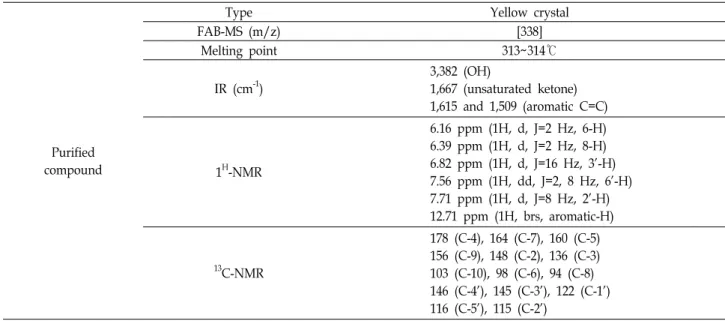
Table 9. Spectroscopic data of purified compound with inhibitory activity on α-amylase and α-glucosidase from Morus alba cv. Kuksang
Purified compound
Type Yellow crystal
FAB-MS (m/z) [338]
Melting point 313~314℃
IR (cm-1)
3,382 (OH)
1,667 (unsaturated ketone) 1,615 and 1,509 (aromatic C=C)
1H-NMR
6.16 ppm (1H, d, J=2 Hz, 6-H) 6.39 ppm (1H, d, J=2 Hz, 8-H) 6.82 ppm (1H, d, J=16 Hz, 3'-H) 7.56 ppm (1H, dd, J=2, 8 Hz, 6'-H) 7.71 ppm (1H, d, J=8 Hz, 2'-H) 12.71 ppm (1H, brs, aromatic-H)
13C-NMR
178 (C-4), 164 (C-7), 160 (C-5) 156 (C-9), 148 (C-2), 136 (C-3) 103 (C-10), 98 (C-6), 94 (C-8) 146 (C-4'), 145 (C-3'), 122 (C-1') 116 (C-5'), 115 (C-2')
the most excellent inhibitory activity was that the mp 313~314℃, IR spectrum showed a absorbance band at 3382 cm
-1due to the hydroxy group, 1167 cm
-1due to the un- saturated ketone, 1615 and 1509 cm
-1due to the aromatic C=C, and m/z 338[M]
-at the negative FAB-MS spectrum (Table 9). The purified compound from Morus alba cv.
Kuksang was yellow crystal, it has mp 313~314℃, a molec-
ular weight of 338 at negative FAB-MS spectrum, and IR
spectrum investigated absorption bands at 3,382(OH), 1,667
(unsaturated ketone), 1,615 and 1,509 (aromatic C=C). ¹H-
NMR spectrum showed doublets at δ 616 ppm (1H, d, J=2
Hz, 6-H), 6.39 ppm (1H, d, J=2 Hz, 8-H), 6.82 ppm (1H, d,
J=16 Hz, 3'-H), 7.71 ppm (1H, d, J=8, Hz, 2'-H) and a double
doublet at 7.56 ppm (1H, dd, J=2, 8 Hz, 6'-H) and 12.71 ppm
Fig. 3. Chromatography of purified D-3-2(compound A) and E-1-1(compound B) from Morus alba cv. Kuksang extracts.
Fig. 4. The structure of the purified compound.
(1H, brs, aromatic-H').
13C NMR spectrum showed at 178 ppm (C-4), 164 ppm (C-7), 160 ppm (C-5), 156 ppm (C-9), 148 ppm (C-2), 136 ppm (C-3), 103 ppm (C-10), 98 ppm (C-6), 94 ppm (C-8), 146 ppm (C-4'), 145 ppm (C-3'), 122 ppm (C-1'), 116 ppm (C-5') and 115 ppm (C-2'), and these results are similar to Jang report [11], and so purified compound was identified with quercetin (Fig. 4).
References
1. AOAC. 1989. Official method of analysis. 14th ed. Associa- tion of official analytical chemists, Washington DC. 43, 1-3.
2. Baik, S. C., Kim, J. B., Cho, M. J., Kim, Y. C., Park, C. K., Ryou, H. H., Choi, H. J. and Rhee, K. H. 1990. Prevalence of Helicobacter pylori infection among normal Korean adults(in Korean). J. Kor. Soc. Microbiol. 25, 455-462.
3. Bhatia, S. J., Kochar, N., Abraham, P., Nair, N. and Mehta, A. P. 1989. Lactobacillus acidophilus inhibits growth of Campylobacter pylori in vitro. J. Clin. Microbiol. 27, 2328-2338.
4. Blois, M. S. 1958. Antioxidant determination by the use of stable free radical. Nature 26, 1198-1199.
5. Cho, Y. J., An, B. J. and Choi, C. 1993. Isolation and enzyme inhibition of tannins from korean green tea. Kor. Biochem.
J. 26, 216-223.
6. Diker, K. S. and Hascelik, G. 1994. The bactericidal activity of tea against Helicobacter pylori. Lett. Appl. Microbiol. 18, 299-300.
7. Feng, G. H., Richardson, M., Chen, M. S., Kramer, K. J., Morgan, T. D. and Reek, G. R. 1996. Amylase inhibitors
from wheat: Amino acid sequences and patterns of in- hibition of insect and human α-amylases. Insect. Biochem.
Molec. 26, 419-426.
8. Fuwa, H. 1954. A new method for microdetermination of amylase activiy by the use of amylose as substrate. J.
Biochem. 41, 583-603.
9. Huang, M. T., Ho, C. T. and Lee, C. Y. 1992. Phenolic com- pounds in food In phenolic compounds in food and their effects on health Ⅱ. Maple Press, New York, p. 2-7.
10. Hulume, A. C. and Jones, J. D. 1952. The isolation of chloro- genic acid from the apple fruit. Biochem. J. 53, 337-340.
11. Jang, I. M. 2003. treatise on asian herbal medicines. Natural products Science Institute of Seoul national university, p.
2110-2111.
12. Kim, J. H., Kim, M. U. and Cho, Y. J. 2007. Isolation and identification of inhibitory compound from Crataegi fructus on α-amylase and α-glucosidase. J. Kor. Soc. Appl. Biol. Chem.
50, 204-209.
13. Lee, W. Y., Ahn, J. K., Park, Y. K. and Rhee, H. I. 2004.
Inhibitory effects of proanthocynidin extracted from dis- tylium racemosum of α-amylase and α-glucosidase activities.
Kor. J. Pharmacogn. 35, 271-275.
14. Markwick, N. P., Laing, W. A., Cristeller, J. T., Reid, S. J.
and Netwton, M. R. 1996. α-amylase activities in larval midgut extraxcts from four species of Lepidoptera (Tortricidae and Gelechiidae): Response to pH and to inhibitors from wheat, barley, kidney bean, and streptomyces, J. Econ.
Entomol. 89, 39-45.
15. Matsuo, T. and Ito, S. 1978. The chemical structure of ka- ki-tannin from immature fruit of the Persimmon (Diospyros kaki L.). Agric. Biol. Chem. 42, 1637-1643.
16. Midolo, P. D., Lambert, J. R., Hull, R., Luo, F. and Grayson, M. S. 1995. In vitro inhibition of Helicobacter pylori NCTC 11637 by organic acids and lactic bacteria. J. Appl. Bacteriol.
79, 475-479.
17. Moon, J. S., Kim, S. J., Park, Y. M., Hwang, I. S. and Kim, E. H. 2004. Antimicrobial effect of methanol extracts from some medicinal herbs and the content of phenolic compounds. Kor. J. Food Preserv 11, 207-213.
18. Moon, S. J. and Hong, S. M. 1996. A study on the relation between psychological stress and stress hormone, nutri- tional status of patients with non-insulin dependent dia- betes mellitus. Kor. J. Nutr. 29, 889-898.
19. Nonaka, G. H. 1989. Isolation and structure elucidation of tannins. Pure Appl. Chem. 61, 357-363.
20. Paek, N. S. and Kim, Y. M. 1998. α-Glucosidase inhibition by culture broth of Streptomyces sp. NS15. Kor. J. Food Nutr.
11, 640-646.
21. Park, S. W., Chung, Y. S., Yun, Y. S., Cha, B. S., Song, Y.
D., Lee, H. C. and Huh, K. B. 1998. Insulin resistance and relate factors in the healthy young men. Diabetes 22, 504-512.
22. Park, S. Y. and Kim, J. W. 1992. Screening and isolation of the antitumor agents from medecinal plants (I). Kor. J.
Pharmacogn. 23, 264-267.
23. Rhee, K. H., Youn, H. S., Baik, S. C., Lee, W. K., Cho, M.
J., Choi, H. J., Maenh, K. Y. and Ko, K. W. 1990. Prevalence
초록:국상( Kuksang ) 뽕잎( Morus alba L.)으로부터 α-amylase와 α-glucosidase 저해 물질 분리 및 동정
최무영
1․조영제
2*
(1상지대학교 보건과학대학 식품영양학과, 2경북대학교 농업생명과학대학 식품공학부/식품생물산업연구소)
109종의 뽕잎 종류 중 국상 품종 뽕잎으로부터 α-amylase와 α-glucosidase 저해작용을 가지는 페놀성화합물을 분리하여 저해활성을 검토하였다. 국상 뽕잎의 물추출물에서 α-amylase와 α-glucosidase 저해 활성이 각각 93.8%
와 48.7%를 나타내었다. 국상뽕잎 추출물의 페놀화합물의 함량은 물 추출물에서 9.7±0.2 mg/g, 60% ethanol 추출 물에서 14.3±0.2 mg/g으로 나타났으며, 국상뽕잎 물 추출물 200 μg/ml의 농도에서 α-amylase와 α-glucosidase 저해활성이 각각 100%와 82.6%로 나타났다. 국상뽕잎으로부터 α-amylase와 α-glucosidase 저해활성을 가지는 천 연물을 분리하기 위하여 국상뽕잎 물추출물을 Sephadex LH-20과 MCI-gel을 이용하여 normal phase type인 EtOH→H
2O와 reverse phase type인 H
2O→MeOH로 유기용매의 농도를 증가시키며 gradient로 용출하여 정제하 였다. α-Amylase와 α-glucosidase 저해활성을 가지는 정제물은 FAB-MS, NMR과 IR spectrum을 구조 분석한 결 과 quercetin으로 동정되었다.
of Helicobacter pylori infection in Korea (in Korean). J. Kor.
Soc. Microbiol. 25, 475-490.
24. Tabak, M., Armom, R., Potasman, I. and Neeman, I. 1996.
In vitro inhibition of Helicobacter pylori by extracts of thyme.
J. Appl. Bacteriol. 80, 667-672.
25. Tibbot, B. K. and Skadsen, R. W. 1996. Molecular cloning and characterization of a gibberellin-inducible, putative α- glucosidase gene from berley. Plant Mol. Biol. 30, 229-241.