Thymic Stromal Lymphopoietin ( TSLP ) Gene Polymorphisms are not Associated with Rheumatoid Arthritis in a Korean Population
Sam-Youn Lee
1*, Ji-in Yu
2and Soo-Cheon Chae
2*
1
Department of Thoracic & Cardiovascular Surgery,
2Department of Pathology, School of Medicine, Wonkwang University, Iksan, Chonbuk 570-749, Korea
Received November 9, 2011 /Revised December 12, 2011 /Accepted December 16, 2011
Thymic stromal lymphopoietin (TSLP) is a novel IL-7-like hematopoietic cytokine. Human TSLP is produced by epithelial cells, stromal cells, and mast cells. The TSLP gene is highly expressed in syno- vial fluid specimens derived from rheumatoid arthritis (RA) patients. We previously identified four single nucleotide polymorphisms (SNPs) and one variation site in human TSLP gene. In this study, we analyzed the genotypic and allelic frequencies of the TSLP SNPs between RA patients and healthy controls. We also investigated the relationships between SNP genotypes and the RF levels and an- ti-synthetic cyclic citrullinated peptide (CCP) levels in RA patients. We then calculated the haplotype frequencies defined by these SNPs for both groups. The genotype and allele frequencies of the TSLP SNPs did not differ significantly between the RA patients and the healthy controls. We also found that TSLP SNPs in the RA patients had no significant association with the levels of RF or anti-CCP.
Our results suggest that TSLP SNPs are not associated with susceptibility to RA.
Key words : TSLP, polymorphism, RA, RF, anti-CCP
*Corresponding author
*Tel:+82-63-850-6793, Fax:+82-63-852-2110
*E-mail : [email protected]; [email protected]
Introduction
Rheumatoid arthritis (RA) is one of the most common au- toimmune diseases, and is arisen by the complex interaction between multiple genetic factors and environmental factors [7]. A characteristic feature of RA is the presence of rheuma- toid factors (RFs) and RF-containing immune complexes in both the circulation and synovial fluid [6]. RFs are auto-anti- bodies that recognize the Fc region of immunoglobulin G (IgG) antibodies and their isotypes. RF has been widely used as a screening test for patients with arthritis. RF is prognosti- cally useful to correlates with functional [17] and outcomes in both RA and early inflammatory polyarthritis [8]. A high- ly specific autoantibody system has been described for RA, in which the synthetic cyclic citrullinated peptide (CCP) with deiminated arginines is used as the antigen for the anti-CCP antibodies [15]. Anti-CCP antibodies are locally present at the site of inflammation in RA [14], and citrullinated pro- teins are found in the RA synovium [2].
Thymic stromal lymphopoietin (TSLP) gene product was proposed to signal through a heterodimeric receptor com- plex composed of the TSLP receptor (TSLPR) and the IL-7R alpha chain [12,13]. Human TSLP is involved in dendritic
cell maturation [16,18]. The TSLP strongly activates CD11
+dendritic cells (DCs) and induces production of the Th2-attracting chemokines TARC (thymus and activa- tion-regulated chemokine; also known as CCL-17) and MDC (macrophage-derived chemokine; CCL-22) [16]. TSLP-acti- vated DCs prime CD4
+T helper cells produce proallergic cytokines IL-4, IL-5, IL-13, and tumor necrosis factor-α (TNF- α ), while down-regulating IL-10 and IFN- γ. TSLP is highly expressed in bronchial epithelium and submucosa in allergic asthma [19], and also expressed in synovial fluid specimens derived from RA patients [10]. These results suggest that TSLP might be involved in allergic diseases as well as in inflammatory arthritis such as RA. We previously identified four single nucleotide polymorphisms (SNPs) and one varia- tion site in human TSLP gene, and showed that the TSLP SNPs are associated with susceptibility to allergic rhinitis [20].
To determine whether the TSLP SNPs are associated with
the susceptibility to RA, we analyzed the genotypic and al-
lelic frequencies of the TSLP SNPs on genomic DNA samples
isolated from the RA patients and the healthy controls. We
further investigated the relationships between the genotypes
of SNPs and the RF levels and anti-CCP levels in the RA
patients. Finally, we calculated the haplotype frequencies de-
fined by these SNPs in both groups.
Materials and Methods Patients and DNA samples
The DNA samples used in this study were provided by the Biobank of Wonkwang University Hospital, which is a member of the National Biobank of Korea and this Biobank is supported by the Ministry of Health and Welfare Affairs.
On the basis of approval and informed consent from the institutional review board, we obtained the genomic DNAs from 457 RA patients and 568 healthy controls. The clinical parameter of the study subjects is summarized in Table 1.
Genomic DNA was extracted from the leukocytes in the pe- ripheral blood by a standard phenol-chloroform method or by using a Genomic DNA Extraction kit (iNtRON Biotechnology, Korea) according to the manufacturer's directions. RA was diagnosed according to the criteria of the American Rheumatism Association [1]. Anti-CCP level in the RA patients was determined by enzyme-linked im- munosorbent assay (ELISA) using DIASTAT anti-CCP kit (MBL Co, Nagoya, Japan) and read by automated EIA ana- lyzer, CODA (Bio-RAD Co, Japan). Anti-CCP antibody was considered positive when the absorbance was higher than the cut-off value (5U/ml). The concentration of anti-CCP an- tibody was estimated by interpolation from a dose-response curve based on standards. RF level in the RA patients was measured by the latex fixation test using Hitachi 7170S (Hitachi Co, Tokyo, Japan). The cutoff for positivity was 18 IU/ml for RF. Healthy controls were recruited from the gen- eral population, and had received comprehensive medical testing at the Wonkwang University Hospital. All subjects in this study were Korean.
Genotype analysis
Genotype analysis of the TSLP SNPs, g.-1914A>G (rs3806932), g.-847C>T (rs3806933), g.-82C>T (rs2289276) and g.1117C>T, was performed by high resolution melting (HRM) analysis, as previously described [20].
Statistic analysis
The RA patients and healthy control groups were com- pared using case-control association analysis. χ
2tests were employed to estimate the Hardy-Weinberg equilibrium (HWE). Pair-wise comparison of the bi-allelic loci was em- ployed for the analyses of linkage disequilibrium (LD). The haplotype frequencies of TSLP for multiple loci were esti-
mated using the expectation maximization (EM) algorithm with SNPAlyze software (DYNACOM, Yokohama, Japan).
Logistic regression analyses (SPSS 11.5) were used to calcu- late the odds ratios (with the 95% confidence intervals). The ANOVA method was applied to define the RF and anti-CCP levels of each genotype from the individual RA patients, and followed by Scheffe test for the after-verification. A P-value of less than 0.05 was considered to indicate statistical significance.
Results
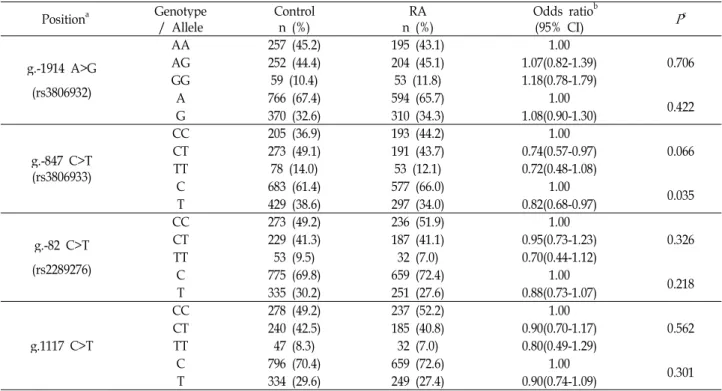
The genotype frequencies of all loci were in HWE (p>0.05, data not shown). Although the genotype and allele fre- quency of g.-847C>T in RA patients was somewhat different from those of healthy controls group (p=0.066 and 0.035, re- spectively), the genotype and allele frequencies of the g.-1914A>G, g.-82C>T and g.1117C>T SNPs were not sig- nificantly different between the RA patients and healthy con- trols (Table 2). We further analyzed the genotype and allele frequencies between the females of the control group and the RA patients because the RA patients were predom- inantly female compared with the healthy control subjects.
The genotype and allele frequencies of the TSLP SNPs were not significantly different between the female of the RA pa- tients and the healthy controls (Table 3). These results sug- gest that the SNPs of the TSLP gene could not be associated with the susceptibility to RA (Table 2, 3).
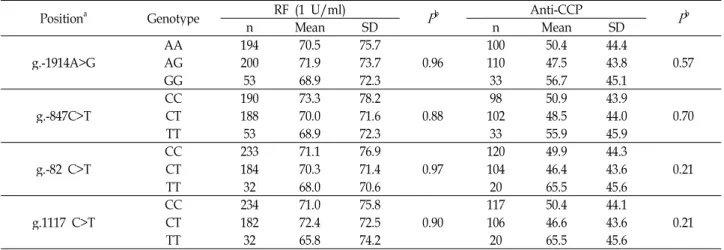
We also found that TSLP SNPs in the RA patients have no significant association with the levels of RF and anti-CCP (Table 4).
Finally, we estimated the haplotype frequencies of the g.-1914A>G, g.-847C>T, g.-82C>T and g.1117C>T poly- morphisms of TSLP gene between the healthy controls and the RA patients (Table 5). Although the minor haplotypes (ATCC and ATTT) were significantly different in RA pa-
Table 1. Clinical characteristics of the study subject RAa Controla
Number of subjects 457 568
Age (years) 53.1±12.2 40.7±7.0
Gender (male/female) 87/370 354/214
RF levels (IU/ml) 70.8±68.3 -
Anti-CCP (U/ml) 49.5±46.1 -
aData are means±standard deviation.
Table 2. Genotype and allele frequencies of the
TSLP
gene polymorphisms in RA patients and health controls Positiona Genotype/ Allele Control
n (%) RA
n (%) Odds ratiob
(95% CI)
P
cg.-1914 A>G (rs3806932)
AA 257 (45.2) 195 (43.1) 1.00
0.706
AG 252 (44.4) 204 (45.1) 1.07(0.82-1.39)
GG 59 (10.4) 53 (11.8) 1.18(0.78-1.79)
A 766 (67.4) 594 (65.7) 1.00 0.422
G 370 (32.6) 310 (34.3) 1.08(0.90-1.30)
g.-847 C>T (rs3806933)
CC 205 (36.9) 193 (44.2) 1.00
0.066
CT 273 (49.1) 191 (43.7) 0.74(0.57-0.97)
TT 78 (14.0) 53 (12.1) 0.72(0.48-1.08)
C 683 (61.4) 577 (66.0) 1.00 0.035
T 429 (38.6) 297 (34.0) 0.82(0.68-0.97)
g.-82 C>T (rs2289276)
CC 273 (49.2) 236 (51.9) 1.00
0.326
CT 229 (41.3) 187 (41.1) 0.95(0.73-1.23)
TT 53 (9.5) 32 (7.0) 0.70(0.44-1.12)
C 775 (69.8) 659 (72.4) 1.00 0.218
T 335 (30.2) 251 (27.6) 0.88(0.73-1.07)
g.1117 C>T
CC 278 (49.2) 237 (52.2) 1.00
0.562
CT 240 (42.5) 185 (40.8) 0.90(0.70-1.17)
TT 47 (8.3) 32 (7.0) 0.80(0.49-1.29)
C 796 (70.4) 659 (72.6) 1.00 0.301
T 334 (29.6) 249 (27.4) 0.90(0.74-1.09)
a Calculated from the translation start site.
b Logistic regression analyses were used for calculating OR (95% CI; confidence interval).
c Value was determined by Fisher’s exact test or χ2test from a 2×2 contingency table.
Table 3. Genotype and allele analyses of the
TSLP
gene polymorphisms in the female RA patients and healthy controls Positiona Genotype/ Allele Control
n (%) RA
n (%) Odds ratiob
(95% CI)
P
cg.-1914 A>G (rs3806932)
AA 89 (42.18) 166 (45.23) 1.00
0.706
AG 94 (44.54) 159 (43.33) 0.91(0.63-1.30)
GG 28 (13.27) 42 (11.44) 0.80(0.47-1.38)
A 272 (64.45) 491 (66.89) 1.00 0.403
G 150 (35.55) 243 (33.11) 0.90(0.70-1.15)
g.-847 C>T (rs3806933)
CC 80 (38.65) 160 (44.94) 1.00
0.252
CT 95 (45.89) 154 (43.26) 0.81(0.56-1.17)
TT 32 (15.46) 42 (11.80) 0.66(0.39-1.12)
CT 255 (61.59)159 (38.41) 474 (66.57)238 (33.43) 0.81(0.63-1.04)1.00 0.093
g.-82 C>T (rs2289276)
CC 104 (50.00) 193 (52.45) 1.00
0.677
CT 86 (41.35) 150 (40.76) 0.94(0.66-1.34)
TT 18 (8.65) 25 (6.79) 0.75(0.39-1.44)
CT 294 (70.67)122 (29.33) 536 (72.83)200 (27.17) 0.90(0.69-1.17)1.00 0.452
g.1117 C>T
CC 103 (48.59) 195 (53.13) 1.00
0.280
CT 88 (41.50) 148 (40.33) 0.89(0.62-1.27)
TT 21 (9.91) 24 (6.54) 0.60(0.32-1.14)
CT 294 (69.34)130 (30.66) 538 (73.30)196 (26.70) 0.82(0.63-1.07)1.00 0.155
a Calculated from the translation start site.
b Logistic regression analyses were used for calculating OR (95% CI; confidence interval).
c Value was determined by Fisher’s exact test or χ2test from a 2×2 contingency table.
Table 4. Analysis of RF and anti-CCP levels among each genotype of
TSLP
SNPs in RA patientsPositiona Genotype RF (1 U/ml)
P
b Anti-CCPP
bn Mean SD n Mean SD
g.-1914A>G AA 194 70.5 75.7
0.96 100 50.4 44.4
0.57
AG 200 71.9 73.7 110 47.5 43.8
GG 53 68.9 72.3 33 56.7 45.1
g.-847C>T CC 190 73.3 78.2
0.88 98 50.9 43.9
0.70
CT 188 70.0 71.6 102 48.5 44.0
TT 53 68.9 72.3 33 55.9 45.9
g.-82 C>T CC 233 71.1 76.9
0.97 120 49.9 44.3
0.21
CT 184 70.3 71.4 104 46.4 43.6
TT 32 68.0 70.6 20 65.5 45.6
g.1117 C>T CC 234 71.0 75.8
0.90 117 50.4 44.1
0.21
CT 182 72.4 72.5 106 46.6 43.6
TT 32 65.8 74.2 20 65.5 45.6
a Calculated from the translation start site.
b Values were analyzed by ANOVA.
Table 5. Haplotype frequencies of
TSLP
SNPs in RA patients and healthy controlsHaplotypes Frequencya
Control RA Chi-square
P
bg.-1914A>G g.-847C>T g.-82C>T g.1117 C>T
A C C C 0.608 0.645 2.799 0.108
G T T T 0.266 0.261 0.048 0.835
G T C C 0.052 0.061 0.836 0.365
A T C C 0.033 0.009 12.149 0.001
A T T T 0.021 0.003 11.161 0.004
others 0.020 0.021 - -
a Values were constructed by EM algorithm with genotyped SNPs.
b Values were analyzed by permutation p-value.
tients as compared to those of the healthy controls (p=0.001 and 0.004, respectively), the distributions of major hap- lotypes, ACCC, GTTT and GTCC were not significant differ- ence between the RA patients and the healthy controls (Table 5). These results suggest that the haplotypes of the TSLP polymorphisms are not associated with RA susceptibility.
Discussion
RA is one of the representative autoimmune diseases worldwide, and is characterized by inflammation of synovial tissues and the formation of rheumatoid pannus, which is capable of eroding adjacent cartilage and bone and causing subsequent joint destruction. We previously suggested that the exon 4 variations of the Tim-1 gene [3], the eotaxin-3 poly- morphisms [5], and TBX21 polymorphisms [4] are associated with RA susceptibility.
TSLP is critical in the development and maintenance of
atopic allergic disease as a master switch for allergic in- flammation at the epithelial cell-DC interaction [9,11]. TSLP is highly expressed in the keratinocytes of skin lesions of the atopic dermatitis patients and is associated with DCs ac- tivation [16]. The expression level of TSLP is also induced in bronchial epithelium and submucosa in allergic asthma [19] as well as in synovial fluid specimens derived from RA patients [10]. We previously suggested that the TSLP SNPs are associated with susceptibility to allergic rhinitis [20].
In this study, we analyzed the genotype of TSLP SNPs
in RA patients and healthy controls. The genotype and allele
frequencies of TSLP SNPs in RA patients were not sig-
nificantly different from those in the healthy controls group
(Table 2). This result suggests that the TSLP SNPs not asso-
ciated with the susceptibility to RA. We also compared the
genotype and allele frequencies of the female in RA patients
and the healthy controls because of RA more prevail in
female. The genotype and allele frequencies of the TSLP
SNPs were not associated with the female RA patients (Table
3). These results suggest that the TSLP SNPs may be not affected by the gender of RA patients.
The hallmarks of RA are RF and anti-CCP, therefore fur- ther evaluation was made to see these SNPs have associa- tions with RF and anti-CCP levels in RA patients. The associ- ation levels were measured by ANOVA and compared the relationship. However there are no significant association between the RF and anti-CCP levels and the genotype of TSLP SNPs in RA patients (Table 4). These results suggest that the TSLPR SNPs are not affected to RF and anti-CCP levels production in RA patients.
The distribution of the major haplotypes of the TSLP SNPs in the RA patients was not different from the healthy controls (Table 5). These results suggest that the haplotypes of the TSLP polymorphisms are not associated with RA susceptibility.
In conclusion, the results of this study suggest that TSLP not associated with the pathogenesis of RA.
Acknowledgement
The genomic DNAs for this study were provided by the Biobank of Wonkwang University Hospital, a member of the National Biobank of Korea, which is supported by the Ministry of Health and Welfare Affairs. This research was supported by Wonkwang University in 2010.
References
1. Arnett, F. C., S. M. Edworthy, D. A. Bloch, D. J. McShane, J. F. Fries, N. S. Cooper, and et al. 1988. The American Rheumatism Association 1987 revised criteria for the classi- fication of rheumatoid arthritis.
Arthritis Rheum
. 31, 315-324 2. Baeten, D., I. Peene, A. Union, L. Meheus, M. Sebbag, G.Serre, E. M. Veys, and F. De Keyser. 2001. Specific presence of intracellular citrullinated proteins in rheumatoid arthritis synovium: relevance to antifilaggrin autoantibodies.
Arthritis Rheum.
44, 2255-2262.3. Chae, S. C., J. H. Song, S. C. Shim, K. S. Yoon, and H. T.
Chung. 2004. The exon 4 variations of
Tim-1
gene are asso- ciated with rheumatoid arthritis in a Korean population.Biochem. Biophys. Res. Commun.
315, 971-975.4. Chae, S. C., S. C. Shim, and H. T. Chung. 2009. Association of
TBX21
polymorphisms in a Korean population with rheu- matoid arthritis.Exp. Mol. Med.
41, 33-41.5. Chae, S. C., Y. R. Park, S. C. Shim, I. K. Lee, and H. T.
Chung. 2005.
Eotaxin-3
gene polymorphisms are associated with rheumatoid arthritis in a Korean population.Hum.
Immunol
. 66, 314-320.6. Edwards, J. C. and G. Cambridge. 1998. Rheumatoid arthri- tis: the predictable effect of small immune complexes in which antibody is also antigen.
Br. J. Rheumatol.
37, 126-130.7. Gregersen, P. K. 1999. Genetics of rheumatoid arthritis: con- fronting complexity.
Arthritis Res.
1, 37-44.8. Harrison, B., W. Thomson, D. Symmons, B. Ollier, N. Wiles, T. Payton, E. Barrett, and A. Silman. 1999. The influence of HLA-DRB1 alleles and rheumatoid factor on disease out- come in an inception cohort of patients with early in- flammatory arthritis.
Arthritis Rheum.
42, 2174-2183.9. Ito, T., Y. H. Wang, O. Duramad, T. Hori, G. J. Delespesse, N. Watanabe, F. X. F. Qin, Z. Yao, W. Cao, and Y. J. Liu.
2005. TSLP-activated dendritic cells induce an inflammatory T helper type 2 cell response through OX40 ligand.
J. Exp.
Med.
202, 1213-1223.10. Koyama, K., T. Ozawa, K. Hatsushika, T. Ando, S. Takano, M. Wako, F. Suenaga, Y. Ohnuma, T. Ohba, R. Katoh, H.
Sugiyama, Y. Hamada, H. Ogawa, K. Okumura, and A.
Nakao. 2007. A possible role for TSLP in inflammatory arthritis.
Biochem. Biophys. Res. Commun.
357, 99-104.11. Liu, Y. J. 2006. Thymic stromal lymphopoietin: mast switche for allergic inflammation.
J. Exp. Med.
203, 269-273.12. Pandey, A., K. Ozaki, and H. Baumann. 2000. Cloning of a novel receptor subunit required for signaling by thymic stromal lymphopoietin.
Nat. Immunol.
1, 59-64.13. Park, L. S., U. Martin, and K. Garka. 2000. Cloning of the murine thymic stromal lymphopoietin (TSLP) receptor:
Formation of a functional heteromeric complex requires in- terleukin 7 receptor.
J. Exp. Med.
192, 659-670.14. Reparon-Schuijt, C. C., W. J. Van Esch, C. Van Kooten, G.
A. Schellekens, B. A. de Jong, W. J. van Venrooij, F. C.
Breedveld, and C. L. Verweij. 2001. Secretion of anti-citrul- line-containing peptide antibody by B lymphocytes in rheu- matoid arthritis.
Arthritis Rheum.
44, 41-47.15. Schellekens, G. A., H. Visser, B. A. de Jong, F. H. van den Hoogen, J. M. Hazes, F. C. Breedveld, and W. J. van Venrooij. 2000. The diagnostic properties of rheumatoid ar- thritis antibodies recognizing a cyclic citrullinated peptide.
Arthritis Rheum.
43, 155-163.16. Soumelis, V., P. A. Reche, and H. Kanzler. 2002. Human epithelial cells trigger dendritic cell-mediated allergic in- flammation by producing TSLP.
Nature Immunol
. 3, 673-680.17. Van der Heide, A., J. W. Jacobs, H. C. Haanen, and J. W.
Bijlsma. 1995. Is it possible to predict the first year extent of pain and disability for patients with rheumatoid arthritis?
J. Rheumatol.
22, 1466-1470.18. Watanabe, N., Y. H. Wang, and H. K. Lee. 2005. Hassall's corpuscles instruct dendritic cells to induce CD4+CD25+reg- ulatory T cells in human thymus.
Nature
436, 1181-1185.19. Ying, S., B. O’Connor, J. Ratoff, Q. Meng, K. Mallett, D.
Cousins, D. Robinson, G. Zhang, J. Zhao, T. H. Lee, and C. Corrigan. 2005. Thymic stromal lymphopoietin ex- pression is increased in asthmatic airways and correlates with expression of Th2-attracting chemokines and disease severity.
J. Immunol.
174, 8183-8190.초록: TSLP 유전자의 다형성은 한국인 류마티스관절염 발생에 영향을 미치치 않는다 이삼윤
1*․유지인
2․채수천
2*
(
1원광대학교 의과대학 흉부외과,
2병리학교실)
TSLP 유전자는 IL-7와 유사한 새로운 조혈성 사이토카인이다. 인간의 TSLP는 상피세포, 기질세포 및 비만세포
에서 만들어진다. TSLP는 류마티스관절염 환자의 윤활성 활액에서 높은 발현을 나타낸다. 이전 연구에서 우리들
은 사람의 TSLP유전자에서 4개의 유전자다형성 및 한 개의 변이를 발굴하였다. 이 연구에서는, 우리들이 발굴한
TSLP유전자의 유전자다형성의 유전자형 및 대립형질의 비율을 건강한 정상인과 류마티스관절염 환자에서 비교 분석하였으며, 류마티스관절염 환자에 있어서 유전자형에 따른 RF 및 anti-CCP의 정도를 비교 분석하였다. 또한, 양쪽 그룹에서 이들 유전자다형성에 의한 일배체형 비율을 비교 분석하였다. 그 결과, 류마티스관절염 환자군과 건강한 정상인 군 사이에 있어서 유전자형, 대립형질 비율뿐만 아니라 일배체형 비율에 큰 차이를 보이지 않았다.
이 결과는 TSLP유전자의 유전자다형성은 류마티스관절염 감수성에 영향을 미치지 않음을 암시한다.
20. Zhang, M. H., Y. S. Kim, E. H. Jin, K. M. Kim, J. H. Lee, C. S. Li, Q. Zhang, K. J. Yun, S. C. Chae, and H. T. Chung.
2008. Identification of polymorphisms in thymic stromal
lymphopoietin (