40(2) : 123 127 (2009)
123
자원에서 분리한 플라보노이드의 생리활성
최두연·최은진·김청룡·신지은·우은란
*
조선대학교 약학대학
Biological Activity of Flavonoids Isolated from Aster tataricus L.
Doo-youn Choi, Eun Jin Choi, Qinglong Jin, Ji Eun Shin and Eun-Rhan Woo
* College of Pharmacy, Chosun University, Gwangju 501-759, Republic of Korea
Abstract −
In an ongoing investigation into anti-oxidative compounds from natural products, the EtOAc soluble fraction of Aster tataricus L. (Compositae) showed significant anti-oxidative activity on the NBT superoxide scavenging assay. By means of an activity-guided purification, three flavonoids, kaempferol (
1), quercetin (
2), astragalin (
3) and one monoterpene glycoside, shionoside A (
4) were isolated. Their structures were determined spectral analyses. Compounds
2and
3showed potent anti- oxidative activity, while, compounds
1and
4were inactive (IC
50>120
µg/mL). In addition, these compounds were examined for the effect of interleukin-6 (IL-6) production in TNF-
αstimulated MG-63 cell. Compounds
1-
3showed negligible inhibitory activity against IL-6 production in TNF-
αstimulated MG-63 cell, and compound
4was inactive.
Key words −
Aster tataricus L., antioxidant, IL-6 inhibitory activity
자원
( Aster tataricus L.)
은국화과(Compositae)
에속하는식물로한국
,
중국,
일본원산으로심산지역의습지에서자라는다년생초로서높이
1~1.5 m
이지만재배한것은2 m
에달하고근경이짧으며윗부분에서가지가갈라지고짧 은털이있다
. 1)어린순을나물로하며뿌리와전초는폐한,
폐열
,
폐허로인한해수가래,
천식에유효하며항균작용이있어서대장균
,
이질균,
변형간균,
녹농균및콜레라균에일정한억제작용을나타내는것으로알려져있다
. 2)자원에는
saponin, epifriedelin, friedelin, shionone, astersaponin
등이
함유되어있다
. 3-6)본연구실에서는국내자생식물로부터생
리활성물질탐색에대한연구를계속해왔으며생리활성검 색결과자원의에틸아세테이트분획물이항산화활성및
IL-6
방출에영향을미치는것이관찰되어이들분획으로부터활성물질의정제를시도하고자본연구에착수하였다
. Human interlukin (hIL)-6
는cytokine
의일종으로일부는림프구계통의세포가생성하며면역조정역할을하고조혈 작용을조절하는것으로알려져있다
.
대부분의cytokine
은표적세포의세포표면수용기를통하여작용하고호르몬과 유사하며항세포증식작용
,
항미생물작용,
항종양작용등이있어감염
,
염증,
자가면역질환,
종양치료제로사용되고있다
. 7-8)세포는 TNF-
α에의해서 damage
를받게되고이때
IL-6
가세포밖으로방출되게되는데본실험에서는MG-63
세포를이용하여자원으로부터분리한화합물들이
Il-6
의유리에어떠한영향을미치는가를측정하였다
. 재료 및 방법
실험재료 − 본실험에사용한자원
( Aster tataricus L . )
은광주시내의약재상에서구입하여감정한후사용하였으며
자료의일부는표준품
(CU-958)
으로조선대학교약학대학표본실에보관하고있다
.
시약 및 기기 − 융점측정기는
Fisher Scientific (Model 307N0043, Canada)
를사용하였고 선광도는AUTOPOL
®automatic polarometer (Rudolph Research Flangers, NJ 07836)
를사용하였으며IR
스펙트럼은JASCO FT/IR-300E (JASCO Co., Japan)
를 사용하였다. FAB-MS
는JMS 700 (JEOL, Japan)
을 사용하였고1 H-NMR과 13 C-NMR은
VARIAN Unity Inova 500
및 JEOL JNM-LA 300
을사용
VARIAN Unity Inova 500
및JEOL JNM-LA 300
을사용하였다
.
분취용컬럼크로마토그라피의packing material
로는
Kieselgel 60 (230-400 mesh, ASTM, Art. 9385, Merck), Kieselgel 60 (40-60
µm, Art. 9385, Merck), LiChroprep RP-18 (40-63
µm, Merck), Lipophilic Sephadex LH-20 (Bead size 25-100
µm, Sigma)
을 사용하였다. Thin layer chromatography
용plate
는precoated silica gel 60 F 254
plate (layer thickness 0.25 mm, 20×20 cm, Art. 5715,
*교신저자(E-mail):[email protected]
(Tel):062-230-6369
Merck)
와precoated RP-18 F 254 S plate (layer thickness 0.25 mm, 20×20 cm, Art. 15423, Merck)
를사용하였으며추출및컬럼크로마토그라피용용매는
1
급시약을기타시약은
1
급또는특급을각각사용하였으며발색시약으로는10%
H 2 SO 4를사용하였다.
추출 및 분리 − 자원
(Aster tataricus L . ) 2.4 kg
을MeOH
로3
시간동안3
회반복환류냉각열탕추출하고여과한후감압농축하여
575.3 g
의MeOH extract
를얻었다. MeOH extract
를 증류수로 현탁하고CH 2 Cl 2 , EtOAc, n- BuOH
및H 2 O
순으로 계통분획하여각각34.5 g, 23.5 g, 59.6 g, 301.0 g
의분획물을얻었다.
항산화활성을나타낸EtOAc
분획7 g
을silica gel
을이용하여컬럼크로마토그라피를실시하였다
.
용매는CH 2 Cl 2 : EtOAc : MeOH = 20 : 1 : 1
을이용하여용출시키고각각의분획들은TLC pattern
에따라유사한것들을합쳐
8
개의sub-fraction
을얻었다. Sub-Fr. E2
에대해서Sephadex LH-20
을이용하여MeOH : H 2 O = 4 : 6
을전개용매로하여컬럼크로마토그라피를실시하여 화합물 1
(17 mg)
을 얻었다.
화합물 1은UV 254 nm
와365 nm
에서모두갈색형광을나타냈고10%
황산용액에서노란색으로발색되었다
. Sub-Fr. E3
에대해서Sephadex LH-20
을이용하여MeOH : H 2 O = 4 : 6
을용매로하여컬럼크로마토그라피를실시한결과화합물 2
(7 mg)
를얻었다
. Sub-Fr. E6
에대해서Sephadex LH-20
을MeOH : H 2 O =4 : 6
을용매로하여컬럼크로마토그라피를실시한 후
silica gel
을 이용하여CHCl 3 : MeOH : H 2 O =10 :
1.1 : 0.1
을용매로하여컬럼크로마토그라피를실시하여화합물 3
(4.8 mg)
을얻었다. Sub-Fr. E7
에대해서Sephadex LH-20
을이용하여MeOH : H 2 O = 4 : 6
을용매로하여컬럼크로마토그라피와
silica gel
을이용하여CHCl 3 : MeOH : H 2 O = 10 : 1.1 : 0.1
을용매로하여컬럼크로마토그라피를실시하고
RP-18
을이용하여MeOH : H 2 O = 1 : 1
을용매로하여컬럼크로마토그라피를실시한후다시
RP-18
을이용하여
MeOH : H 2 O = 4 : 6
을용매로하여컬럼크로마토그라피를실시한결과화합물 4
(14.9 mg)
를얻었다.
화합물 1 −
Yellow amorphous powder; m.p., 276~277 o C;
IR, v KBr max 3335 (OH), 2923 (CH), 1613 (C=O), 1173 (C- O) cm -1 ; FAB-MS, m/z 287 [M+H] + , 154, 136; 1 H-NMR (500 MHz, DMSO- d
6)
δ: 8.05 (2H, d J =9.0 Hz, H-2', 6'), 6.93 (2H, d, J =9.0 Hz, H-3', 5'), 6.44 (1H, d, J =2.0 Hz, H-8), 6.19 (1H, d, J =2.0 Hz, H-6); 13 C-NMR (125 MHz, DMSO- d
6)
δ: 176.4 (C-4), 164.4 (C-7), 161.2 (C-5), 159.7 (C-4'), 156.7 ( C-9), 147.3 (C-2), 136.1 (C- 3), 130.0 (C-2'), 130.0 (C-6'), 122.2 (C-1'), 115.9 (C-3'), 115.9 (C-5'), 98.7 (C-6), 94.0 (C-8).
화합물 2 −
ESI-MS, m/z 301([M-H] +; ; 1 H-NMR (500 MHz, DMSO- d
6)
δ: 7.77 (1H, d, J =2.1 Hz, H-2'), 7.67
(1H, dd, J =8.5, 2.1 Hz, H-6'), 6.92 (1H, d, J =8.5 Hz, H- 5'), 6.43 (1H, d, J =2.0 Hz, H-8), 6.22 (1H, d, J =2.0 Hz, H-6); 13 C-NMR (125 , DMSO- d
6)
δ: 175.9 (C-4), 164.0 (C-7), 160.8 (C-5), 156.2 (C-9), 147.7 (C-4'), 146.9 (C-2), 145.1 (C-3'), 135.8 (C-3), 122.1 (C-1'), 120.1 (C-6'), 115.7 (C-5'), 115.2 (C-2'), 103.1 (C-10), 98.3 (C-6), 93.5 (C-8).
화합물 3 −
Yellowish crystal; m.p., 176~180 o C; IR, v KBr max 3450 (OH), 1660 (C=O) cm -1 ; ESI-MS, m/z 471[M+Na] + ; 1 H-NMR (500 MHz, CD 3 OD)
δ: 8.05 (2H, d, J =9.0 Hz, H-2', 6'), 6.89 (2H, d, J =9.0 Hz, H-3', 5'), 6.39 (1H, br d, H-8), 6.19 (1H, br d, H-6), 5.23 (1H, d, J =7.5 Hz, H-1"), 3.56 (1H, H"-6a), 3.36 (1H, H"-6b), 3.50-3.09 (4H, H-2", 3", 4", 5") ; 13 C-NMR (125 MHz, CD 3 OD)
δ: 179.6 (C-4), 167.1 (C-7), 163.2 (C-5), 161.7 (C-4'), 159.1 (C-9), 158.7 (C-2), 135.6 (C-3), 132.4 (C-6'), 132.4 (C-2'), 123.0 (C-1'), 116.2 (C-3'), 116.2 (C-5'), 105.6 (C-10), 104.3 (C-1''), 100.4 (C-6), 95.1 (C-8), 78.2 (C-5"), 78.6 (C-3"), 75.9 (C-2"), 71.5 (C-4"), 62.8 (C-6").
화합물 4 −
Plate crystal; m.p., 120~125 o C; [
α] D 25 +4.23 o (c=0.10, in MeOH); IR, v KBr max 3375 (OH), 1630, 1592 (aromatic C=C), 1170, 1085 (C-O)cm -1 ; FAB-MS, m/z 285 [M-H] + ; 1 H-NMR (500 MHz, CD 3 OD)
δ: 5.02 (d, J =2.5 Hz, H-1"), 4.22 (d, J =8.0 Hz, H-1'), 3.98 (br dd, J= 11.5, 9.5 Hz, H-8b), 3.97 (d, J =9.5 Hz, H-2'), 3.91 (d, J =2.5 Hz, H-2"), 3.90 (br d, H-6'b), 3.77 (d, J =9.5 Hz, H-4"b), 3.61 (br dd, J= 11.0, 9.5, Hz H-8a), 3.58 (2H, s, H-5"), 3.52 (dd, J =9.5, 6.5 Hz, H-6'a), 3.38 (1H, dd, J =6.5, 2.0 Hz, H-5'), 3.28 (d, J =9.5 Hz, H-4'), 3.15 (1H, s, H-4"a), 2.28 (1H, br s, H-1), 1.73 (2H, s, H-2, 4), 1.68 (1H, br d, H-7, syn), 1.63 (1H, br d, H-5b), 1.44 (1H, br d, H-6b), 1.28 (1H, br d, H-5a), 1.26 (1H, br d, H-6a), 1.20 (1H, br d, H-7, anti), 0.94 (3H, s, exo, H-10), 0.89 (3H, s, endo, H-9); 13 C-NMR (125 MHz, CD 3 OD)
δ: 111.1 (C-1"), 104.6 (C-1'), 80.7 (C-3"), 78.3 (C-3'), 78.1 (C-2"), 77.0 (C-5'), 75.2 (C-2'), 75.1 (C-4"), 71.8 (C-4'), 69.7 (C-6'), 68.7 (C-8), 65.8 (C-5"), 50.9 (C-2), 50.8 (C-4), 41.9 (C- 1), 38.2 (C-7), 37.9 (C-3), 33.0 (C-10), 25.6 (C-5), 22.2 (C-6) 21.6 (C-9).
NBT Superoxide Scavenging Assay −
NBT superoxide scavenging assay
는조금수정된방법을사용하였다. 15 mM Na 2 EDTA (50 mM KH 2 PO 4 /KOH pH 7.4 in d.w.)
용액20
µl, 0.6 mM NBT
용액50
µl, 50 mM KOH
에 녹인3 mM hydroxanthine 30
µl
를취한 다음일정농도로녹인sample 100
µl
를첨가한다.
여기에xanthine oxidase (1 unit in 10 ml buffer)
용액50
µl
를넣은후25 o C incubator
안에서
30
분동안산화가일어나도록반응을시킨다음570 nm
microplate reader
를통해흡광도를측정하였다.
시료를녹였던
5% DMSO in buffer
용액을control
로하였으며실험의표준물질로는
allopurinol
을사용하였다.
항산화활성(%)
은control
에대한상대적인퍼센트즉, [(rate of control - rate of sample reaction)/rate of control]×100
으로표시하였다. 9-10)
Cytotoxicity Assay − 본실험에서는
SRB
검색법을이용하여세포독성을측정하였으며사용한세포주는
MG-63
으로세포주는
10% FBS
가포함된DMEM
배지를사용하여37 o C, 5% CO 2 incubator
에서 배양하고, 10
회이상계대한후
tripsinization (trypsin-EDTA)
하여single cell suspension
을확보한뒤
,
세포의성장속도를고려하여적정수의세포(3×10 4 )
를96-well plate
에200
µl
씩 접종하였다.
시료는DMSO
에10 mg/ml
되도록용해시키고,
실험농도에따라serial dilution
하여DMSO
의최종 농도가1%
이하가되도록
100
µl
씩각well
에첨가하였다.
검체투여가끝난plate
는
37 o C, 5% CO 2존재하에서 48
시간배양하였다.
배양이
종료된후부착성세포는
10% formalin solution 100
µl
를가하여실온에서
30
분동안충분히고정시켰다.
고정된각well
의세포로부터formalin
을제거하기위해증류수로5
회세척한후건조시켰다
.
건조된well
에1% acetic acid
에녹인
0.4% SRB (sulforhodamaine B)
용액100
µl
를가한후,
상온에서
30
분이상방치하여충분히염색시키고1% acetic acid
로5
회세척하여건조시켰다.
완전히건조시킨후200
µl
의
10 mM Tris-base
용액(pH 8.0)
으로염색된세포를부유시켜
, micro plate reader
를 사용하여540 nm
에서OD (optical density)
를측정하였다.
세포주에대해대조군의평균
OD
값과실험군의평균OD
값을비교하여세포독성(%)
을구하였다
. 11-13)
Cytotoxicity (% inhibition) = (1- T/C) × 100 C :
대조군의평균OD
값T :
실험군의평균OD
값MG-63 세포에서 IL-6의 유리 확인 실험 − 세포주는
10%
FBS
가 포함된DMEM
배지를 사용하여37 o C, 5% CO 2
incubator
에서culture dish
에 증식시킨MG-63
세포를24 well plate
에적정수의세포(3×10 4 )
를500
µl
씩접종한후하루동안배양하고배지를교체하였다
.
여기에TNF (tumor necrosis factor)-
α와세포독성이없는농도의sample
을처리한후
37 o C incubator
에서배양한후24
시간과48
시간뒤각각
70
µl
씩배지를채취하여냉동보관하였다. 96 well plate
에l
차antibody 100 µl(anti-human IL-6 2
µg/mL in 0.1 M NaHCO 3 )
를 넣은 후4 o C
에서overnight
하여1
차antibody
가96 well plate
에부착되도록하였다.
결합되지않은
1
차antibody
를씻어내기위해washing solution (0.05%
Tween 20 in PBS) 100
µl
로3
번 씻어낸 후blocking
solution (3% BSA in PBS) 200
µl
를처리하고실온에서2
시간동안방치한후
washing solution 200
µl
로2
번씻어낸다
.
위에서24
시간후와48
시간후에채취한배양액50
µl
와
blocking solution 50
µl
를넣어실온에서4
시간또는4 o C
에서
overnight
하여1
차antibody
와 결합하도록 하였다. 100
µl
의washing solution
으로4
번세척한후100
µl
의2
차antibody (biotin conjugated rat anti-human IL-6 1 n/mL in blocking sol.)
를첨가하여45
분동안결합시킨뒤결합되지않은
2
차antibody
를100
µl
의washing solution
으로6
번세척하여씻어냈다
. 100
µl streptavidin HRP (sol. 0.1% BSA, 0.05% Tween 20 in tris buffered saline pH 7.3)
를첨가하여20
분동안결합시킨뒤washing solution
으로6
번세척하였다
. TMB (Tetra Methyl Benzidine) 100
µl
를넣어발색시킨즉시
micro plate reader
를사용하여450 nm
에서흡광도를측정하였다
. IL-6
의저해활성은Inhibition (%) = (A-B)/A
× 100 [Where A is the IL-6 concentration when the TNF- a only was treated, and B is the IL-6 concentration when the compounds were treated]
로하였다. 14-15)
결과 및 고찰
화합물 1은황색분말상의물질로서
m.p.
는276~277 o C
이며
10% H 2 SO 4 발색에서 황색을 나타냈다. 1 H-NMR spectrum
에서 flavonoid A ring
의 H-6
과 H-8
의 signal
이각
각 δ
6.19(1H, d, J =2.0 Hz)
및 δ6.44(1H, d, J =2.0 Hz)
에서 나타났으며
B ring
의H-2', H-3', H-5', H-6'
의AA'BB' type coupling
이 δ8.05
와δ6.93
에서관찰되어kaempferol
로추정할 수있었다
. 13 C-NMR spectrum
에서는C-3
가 δ136.1
로이동되어나타나므로hydroxyl
기로치환되어있음을알수있었고
,
δ176.4
에서C-4
의carbonyl
기를관찰할수있었으며 δ
159.7
의피크로C-4'
위의수소가hydroxyl
기로치환되어있음을알수있었다
.
이상의분광학적인결과및문헌상의
data
와의비교를통해화합물1은kaempferol
로동정하였다
. 16-19)
화합물 2는황색분말상의물질로서
10% H 2 SO 4 발색에서
황색을나타냈다. 1 H-NMR spectrum
에서 flavonoid A ring
의
H-6
과H-8
의signal
이각각 δ6.22 (1H, d, J =2.0 Hz)
및δ
6.43 (1H, d, J =2.0 Hz)
에서나타났으며B ring
의ABX type
의H-2', H-5', H-6'
의signal
이 각각 δ7.77(1H, d, J =2.0 Hz),
δ6.92 (1H, d, J =8.5 Hz),
δ7.67 (1H, dd, J =8.5, 2.0 Hz)
에서나타나quercetin
으로추정할수있었다.
또한13 C-NMR spectrum에서 quercetin
의특징적인피크들이 δ
135.8,
δ 175.9,
δ 145.1,
δ 147.7
에서관찰되었다.
이상의분
광학적인결과및문헌상의
data
와의비교를통해화합물 2는
quercetin
으로동정하였다. 16-19)
화합물 3은황색결정성물질로
m.p.
는176~180 o C
로나타났으며
10% H 2 SO 4발색에서황색을나타냈다. 1 H-NMR spectrum
의 aromatic
영역에서화합물 1과아주흡사한스
펙트럼을나타냈으며δ
5.23 (1H, d, J =7.5 Hz)
의피크및 δ3.56-3.09
에 당의 수소 피크가 관찰되어 화합물 3은kaempferol glycoside
로추정할수있었다.
산가수분해결과비당체부분
kaempferol
로확인되었고당부분은TLC
결과표준품인
D-glucose
와 일치하였다.
당의 결합형태는anomeric
수소의결합상수가7.5 Hz
로나타나 β-
결합을하고 있는것으로 추정되었다
.
이상의 결과들은13 C-NMR spectrum에서도확인할수있었다.
분광학적인결과및문
헌상의
data
와의비교를통해화합물 3은astragalin
으로동정하였으며이식물로부터는처음으로분리된화합물이었 다
. 16-19)
화합물 4는백색의판상결정성물질로
m.p.
는120~125 o C
였고
10% H 2 SO 4에서 황색으로 나타났다. 1 H-NMR spectrum
에서는 H-7(syn)
와 H-7(anti)
의 signal
이 각각 δ
1.68 (br d)
및 δ 1.20 (br d)
에서관찰되었으며 H-9 (endo)
와
H-10 (exo)
의signal
이 각각 δ0.89 (3H, s)
및 δ1.00 (3H, s)
에나타났다.
두개의anomeric proton
이각각 δ4.22 (1H, d, J =8.0 Hz, H-1')
와5.02 (1H, d, J = 2.5 Hz, H-1")
로
coupling constant
가나타났고문헌치와의비교를통해두개의당이각각β로결합한것으로추정하였다
. 13 C-NMR spectrum
에서는두개의methyl carbon
이d 21.6
과33.0
에서, 3
개의methylene carbon
이 δ22.2, 25.6, 68.7
에서, 3
개의methine carbon
이 δ41.9, 50.9, 50.8
에서 한 개의quaternary carbon
이 δ37.9
에서 관찰되었으며4
개의oxymethylene carbone
이δ68.7, 69.7, 75.1, 65.8
에서, 5
개의
oxymethine carbon
이δ75.2, 78.3, 71.9, 77.0, 78.1
에서,
하나의
hydroxylated quaternary carbon
이 δ80.7
에서,
그리고두개의
anomeric carbon
이 δ104.6, 111.1
에서관찰되었Fig. 1.
Chemical structures of compounds
1-
4isolated from A. tataricus
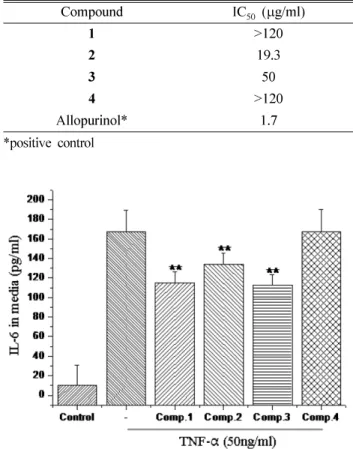
Table I.
Antioxidative activity of compounds
1-
4isolated from A. tataricus
Compound IC
50(
µg/ml)
1
>120
2
19.3
3
50
4
>120
Allopurinol* 1.7
*positive control
Fig. 2.
Effects of compounds
1-
4on IL-6 production from TNF-
αstimulated MG 63
MG-63 (3×10
4cells/well) was incubated for 24 h. Culture
were incubated with or without compounds and then
stimulated with TNF-
αfor 24h. IL-6 in the supernatant was
measured by ELISA. Results were expressed as the
mean±S.E. from three different experiments. ** p <0.05
compared with TNF-
αtreated values.
다
.
또한1 H- 1 H COSY와 HSQC spectrum
을통하여각각의
carbon
과 proton
을귀속시킨후 HMBC spectrum
에서 C-8
과
glucose
의 1
번수소, glucose 6
번탄소와 apiose 1
번탄소사
이의
correlation peak
를확인하여각결합위치를확인하였다
.
이상의분광학적인결과및문헌상의data
와의비교를통해화합물 4는
shionoside A
로동정하였다. 20) (Fig. 1
참조).
자원
EtOAc
의분획으로부터분리한화합물1-4에대해서NBT superoxide scavenging assay
에의한항산화활성을검토한결과
(Table 1
참조) quercetin
의 IC 50값이 19.3
µg/ml
로가장강력한활성을나타냈고이와같은활성은화합물 구조에있어서
ortho-dihydroxy (catechol)
에기인한것으로판단되었다
. 21)또한화합물 1-4가 MG-63
세포에서 IL-6
의
유리에미치는영향을검토한결과화합물1-4의
IL-6
유리량은각각
115±10.02, 134.0±5.43, 113.2±6.9, 167.0±12.73pg/
ml
로나타났다.
이들결과로부터화합물 1-4의IL-6
유리(%)
는
69.2±6.01, 80.4±3.25, 67.8±4.13, 100±10.67%
로 각각나타나화합물 4는전혀활성이없으며화합물 1-3은약한
IL-6
유리저해활성을나타내는것으로관찰되었다.
사 사
NMR
측정에도움을주신한국기초과학지원연구원광주 분소에감사드립니다.
참고문헌
1.
이창복(1980)
대한식물도감, p. 738.
향문사,
서울. 2.
배기환(1999)
원색도감.
한국의자연시리즈13
한국의약용식물
, p. 492.
교학사,
서울.
3. Chung, D. K. (1978) Studies on the development of anti- carcinomatous resources chemical constituents of the root of Aster divaricatus L . Kor. J. Pharmacogn.
9: 73-75.
4. Cheng, D. L., and Shao, Y. (1994) Terpenoid glycosides from the roots of Aster tataricus . Phytochemistry
35: 173-176.
5. Cheng, D. L., Shao, Y., Hartmann, R., Roeder, E., and Zhao, K. (1996) New pentapeptides from Aster tataricus. Phy- tochemistry
41: 225-227.
6. Nagao, T., Okabe, H., and Yamauchi, T. (1990) Studies on the constituents of Aster tataricus L. III. Structures of Aster saponins E and F isolated from the root. Chem. Pharm. Bull.
38
: 783-785.
7. Chang, S. W., Beak, S. H., Kim, C. H. and Lim, S.
S. (2002) Interleukin-6 and interleukin-10 in experimentally induced rat inflammation.
대한치과보존학회지 27: 232- 8. Mysliwiec, J., Kretowski, A., Topolska, J., Stepien, A. and 238.
Kinalska, I. (2002) The influence of corticosteroids on IL-6/
IL-6R system in patients with Graves' ophthalmopathy. Pol .
Arch. Med. Wewn.
108: 739-744.
9. Piao, M. S., Kim, M. R., Lee, D. G., Park, Y.-K., Hahm, K.- S., Moon, Y. H. and Woo, E.-R. (2003) Antioxidative con- stituents from Buddleia officinalis. Arch. Pharm. Res.
26: 453-457.
10. Kirby, A. J. and Schmidt, R. J. (1997) The antioxidant activity of chinese herbs for eczema and of placebo herbs-I. J . Eth- nopharmacol.
56: 103-108.
11. Skehan, P., Storeng, R., Scudiero, D. A., Monks, A., McMa- hon, J., Vistica, D., Warren, J. T., Bokesch, H. and Kenny, S.
(1990) A new colorimetric cytotoxicity assay for anticancer- drug screening. J. Natl. Cancer Inst.
82: 1107-1112.
12. Rubinstein, L. V., Shoemaker, R. H., Paul, K. D., Simon, R.
M., Tosini, S., Skehan, P., Scudiero, D. A. and Monks, A.
(1990) Comparison of in vitro anticancer-screening data gen- erated with a terazolium assay versus a protein assay against a diverse panel of human tumor cell lines. J. Natl. Cancer Inst.
82: 1113-1118.
13. Monks, A., Scudiero, D., Cronise, P., Vaigro-Wolff, A., Goo- drich, M. G., Campbell, H., Mayo, J. and Boyd, M. (1991) Feasibility of a high flux anticancer drug screen using a diverse panel of cultured human tumor cell line. J. Natl. Can- cer Inst .
83: 757-767.
14. Joo, S. S., Kang, H. C., Lee, M. W., Choi, Y. W. and Lee, D.
I. (2003) Inhibition of IL-6 in osteoblast-like cell by isofla- vones extracted from Sophorae fructus . Arch Pharm. Res.
26: 1029-1035.
15. Liu, Q. H., Jeong, J.-E., Choi, E. J., Moon, Y. H. and Woo, E.- R. (2006) A new furofuran lignan from Geranium thunbergii . Arch. Pharm. Res .
29: 1109-1112.
16. Markham, K. R. and Wallace, J. W. (1980) C-glycosylx- anthone and flavonoid variation with in the Filmy-Ferns (hypomenophyllaceae). Phytochemistry
19: 415-421.
17. Kim, M. J. (2001) Chemical constituents and biological activ- ities from the leaves and stem of Prunus persica (L.) Batsh.
College of Pharmcy, Chungbuk National University, Ph. D.
thesis p 28-29, 31.
18. Peng, Z. F., Strack. D., Baumert, A., Subramaniam, R., Goh, N. K., Chia, T. F., Tan, S. N. and Chia, L. S. (2003) Anti- oxidant flavonoids from leaves of Polygonum hydropiper L.
Phytochemistry
62: 219-228.
19. Crublet, M.-L., Long, C., Sevent, J., Hadi, H. A. and Lavaud, C. (2003) Acylated flavonol glycosides from leaves of Plan- chonia grandis . Phytochemistry
64: 586
-589.
20. Nagao, T., Okabe, H. and Yamauchi, T. (1998) Studies on the constituents of Aster tataricus L., f. I. structures of shion- osides A and B, monoterpene glycosides isolated from the root. Chem. Pharm. Bull.
36: 571-577.
21. Pietta, P. G. (2000) Flavonoids antioxidants. J. Nat. Prod .
63: 1035-1042.
(2009년 5월 22일 접수)