• 검색 결과가 없습니다.

Crustal Movement at Ol Doinyo Lengai based on GPS Measurements

N/A
N/A
Protected

Academic year: 2021

Share "Crustal Movement at Ol Doinyo Lengai based on GPS Measurements"

Copied!
6
0
0

로드 중.... (전체 텍스트 보기)

전체 글

(1)

Crustal Movement at Ol Doinyo Lengai based on GPS Measurements

Meshili, Valerie Ayubu

1)

· Kwon, Jay Hyoun

2)

Abstract

Continuously monitoring of Horizontal and Vertical movements in vulnerable areas due to earthquakes and volcanic activities is vital. These geohazard activities are the result of a slow deformation rate at the tectonic plate boundaries. The recent development of GPS (Global Positioning System) technology has made it possible to attain a millimeter level changes in the Earth’s crust. This study used continuously observed GPS data at the flank of Ol Doinyo Lengai volcanic Mountain to determine crustal motion caused by impinging volcano from mantle convention. We analyzed 8 GPS observed from June 2016 to Dec 2019 using a well-documented Global Kalman Filter GAMIT/GLOBK software. The resulting velocity from GAMIT/GLOBK analysis was then used to compute the relative motion of our study area with respect to Nubia plate. Our analysis discovered a minor motion of less than 5mm/year in both horizontal and vertical components.

Keywords : Horizontal and Vertical Crustal Movement, Global Positioning System, Geodetic Velocity, Ol Doinyo Lengai, East African Rift

1. Introduction

The eastern branch of the great EAR (East African Rift) is well known for its richness in magma which makes it an ideal place to study crustal motion associated with magmatic activities (Corti, 2012; Ring et al., 2018). Ol Doinyo Lengai Mountain studied here is an active volcanic mountain located on the eastern branch of EAR, Tanzania. It is bordered by Lake Natron and Natron border fault. Its summit elevation is 2,890metres (Dawson, 1962). The records of periodic eruptions of ash and lava at Ol Doinyo Lengai is dated back to early 1880s with the increase in precision in the 20

th

Century.

Recent explosive activities of Ol Doinyo Lengai occurred in September 2007 and continued to 2008 (Keller et al., 2010).

Lately, space geodetic techniques have been used in determining crustal motions. Among the many space geodesy systems; GPS has recently advanced in determining horizontal and vertical velocity fields in a well-defined reference frame (Altamimi et al., 2011). These derived GPS velocity patterns serve many applications ranging from various normal surveying to geophysical applications such as tectonic studies, seismic studies, deformation studies and plate kinematics studies (Segall and Davis, 1997).

The determination of accurate horizontal and vertical velocity field in areas characterized by volcanic eruptions is crucial for understanding and interpreting geophysical processes occurring at volcanoes. Our study provides the first horizontal and vertical crustal motion analysis at Ol Doinyo

Received 2020. 06. 08, Revised 2020. 07. 07, Accepted 2020. 08. 23

1) Member, M.S. Student, Dept. of Geoinformatics, University of Seoul (E-mail: [email protected]) 2) Corresponding Author, Member, Professor, Dept. of Geoinformatics, University of Seoul (E-mail: [email protected])

https://doi.org/10.7848/ksgpc.2020.38.5.401 Original article

This is an Open Access article distributed under the terms of the Creative Commons Attribution Non-Commercial License (http://

(2)

Lengai based on continuous GPS measurements from stations located around the mountain. The results presented in this paper are tied to the latest release ITRF2014 (International Reference Frame 2014). Compared to this study, the analysis of previous velocity fields on earlier studies, for example (Stamps et al., 2008; Saria et al., 2014) were mainly focused on the whole part of the EAR and some were tied on the older version of ITRF.

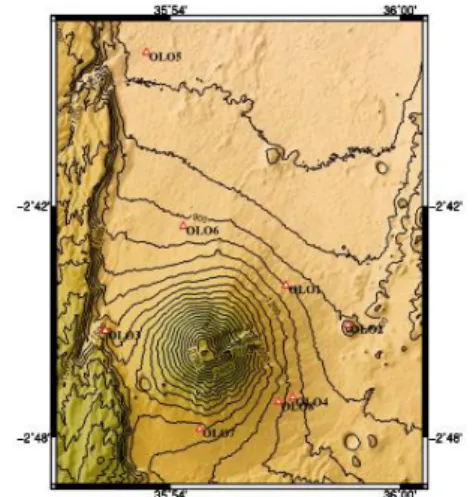
Fig. 1. GPS stations installed at Ol Doinyo Lengai Fig. 1. shows how GPS equipment’s are distributed around our study area. Stations OLO1-OLO5 were established in 2016 while the remaining 3 stations were deployed in the area in the following years. Station OLO3 is strategically positioned on the Natron fault flank so that it can detect both rift motion as well as volcano deformation.

1.1 Previous works

Due to the fact that the study area is located within a divergent tectonic boundary, where the African tectonic plate is in a process of breaking into two major plates namely Nubia plate to the north and Somalia plate to the south. This fact has given the region a spotlight on many geophysical studies. In 2007-2008 occurrence of magma-seismic events in the area has created opportunities to study the interaction between faulting and volcanic deformation. The magma-seismic events caused deformation and faulting in the area which was observed by InSAR (Interferometric Synthetic Aperture Radar) measurements, Envisat as well as campaign-style GPS

measurements of 2006 and 2008 (Baer et al., 2008; Calais et al., 2008). The findings gave evidence of strain accumulation which is caused by the initial stages of continental rifting and thinning of the crust. InSAR observations show that the July 17

th

, 2007 deformation resulted from a dyke intrusion of about 7kms. Another work was done in the region to determine the rate of extension of the East African Rift by using GPS data, earthquake slip vectors, as well as spreading rate data. The finding resulted from this work shows that there is an extension rate of 5.2 mm/year across the EAR basin with an east-west extension on the northern and central parts of the EAR (Saria et al., 2014).

2. Methodology

2.1 Data processing

The GPS data sets processed here include 3.5 years of

continuous observations (June 2016 –Dec 2019) of 8 stations

(OLO1-OLO8) (Stamps et al., 2016; Stamps et al., 2017)

located at Ol Doinyo Lengai which are shared freely and

can be downloaded from UNAVCO (University NAVSTAR

Consortium) archives (www.unavco.org). We processed

our GPS data by using GAMIT/GLOBK software version

10.70 (Herring et al., 2010) following processing strategies

explained in (Nocquet et al., 2006). Our processing involves

two main phases; GAMIT phase and GLOB phase. In the

first phase, GAMIT (Fig. 2(a)) was used to process double-

differences GPS data of both our study area and regional

reference stations. Other data which were included in this

initial phase are IGS (International GNSS Service) final

orbits, satellite vectors, tropospheric delay parameters,

earth orientation parameters as well as antenna phase

center models from IGS (Schimid et al., 2007), solid Earth

and polar tide corrections (McCarthy and Petit, 2004), and

ocean loading corrections using FES2004 model (Lyard et

al., 2006). The resulted output of the initial phase was loose

constrained daily least-squares adjustment estimates for

the station coordinates, orbital parameters, carrier phase

ambiguities, and their corresponding variance-covariance

matrix. The second phase involves the combination of

results obtained from initial phase with the global solution

for the IGS stations used which were downloaded at MIT

(3)

(Massachusetts Institute of Technology) in SINEX (Solution Independent Exchange) format. The combination was done in a two-way approach. The first approach is by using GLRED (Global Parameter REDucing) program to obtain positional time series and the second approach was done by using GLOBK software (Fig. 2(b)) to obtain position and velocities (Table 1 and 2).

The global combination allows us to optimally tie our solution to the latest ITRF2014 (Altamimi et al., 2016).

(a) GAMIT processing to obtain regional loose solution in SINEX format

(b) GLOBK combination of regional loose solution and global loose solution

Fig. 2. Flow charts showing GAMIT/GLOBK processing

3. Results and Analysis

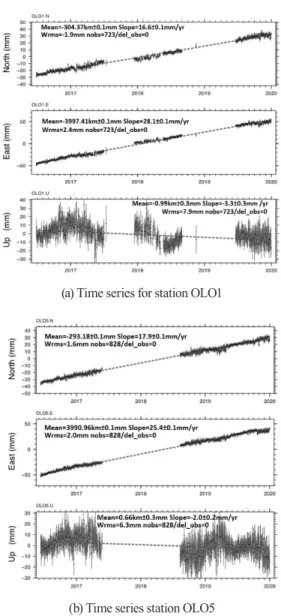
Fig. 3(a) and 3(b) show the selected position time series for station OLO1 and station OLO5 respectively. The two sites are among the sites which have data of more than 3 years of continuous observations. The jumps were removed using time series analysis program embedded in GLOBK software that corrects for gaps, outliers, and estimates correlated noise in relation to time by using realistic sigma algorithm.

(a) Time series for station OLO1

(b) Time series station OLO5

Fig. 3. GPS position time series of some selected sites from the study area

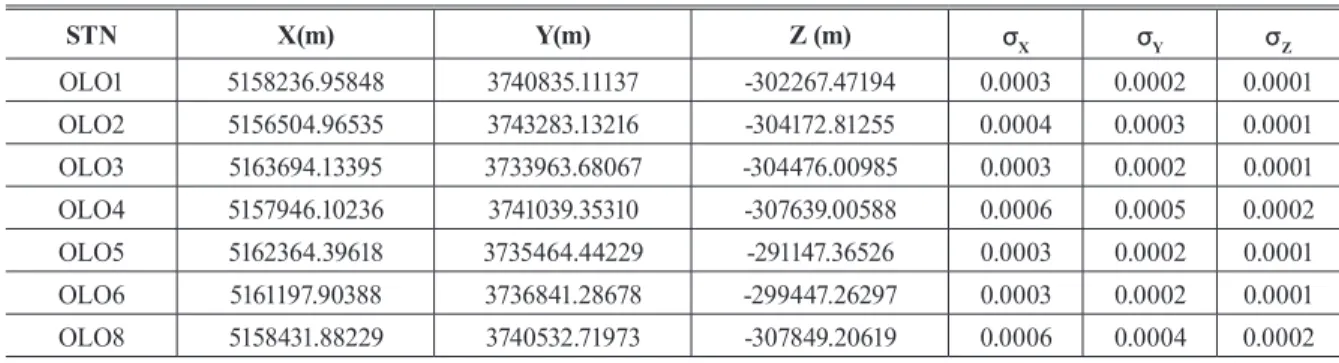
Position and their accuracies (Table 1) presented in ECEF (Earth-Centered, Earth-Fixed) system obtained in our second step of processing.

We analyze the velocity field of our experiment sites (Table 2) and plot absolute velocities (Fig. 3(a)) which show that they follow a north east pattern which agrees with the theory that African plate tectonically moves in northeast direction. Other stations like OLO7 was found to have unreliable data for analysis.

We then computed the relative motion of our study area (Fig.

(4)

4(b)) based on Nubia tectonic plate. Nubia tectonic plate covers the largest part out of five quantified plate from the African deformed plate, which began on early Miocene (Njoroge et al., 2015). Given the size of Nubia plate compared to other plates, and its low level of tectonic activities in its interior, it has been suggested to be the base for the AFREF (African Geodetic Reference Frame) (Saria et al., 2013).

In order to obtain the relative motion of Ol Doinyo Lengai, we first compute the angular velocity of Nubia and determines how other plates are deforming with respect to Nubia. With that respect, we started by inverting Nubia’s angular velocity with respect to no net rotation frame (ITRF14) based on previous studies developed method. We analyzed the IGS stations and among 42 stations used in this study, 13 stations were found to be located on Nubian plate. The stations include ADIS, MAS1, ZAMB, RBAY, SUTH, SUTM, ULDI, HARB, BJCO, YKRO, HRAO, WIND and NKLG.

In order to determine the best GPS stations clearly defines stable Nubia plate from a set of 13 stations, we repeatedly removed one station at a time and examined whether each site

velocity statistically fits well to the rigid plate model without certain site using Chi-squares statistic and F-ratio test (Stein and Gordon, 1984; Saria et al., 2013). Eq. (1) below illustrates the F- ratio defining the standard statistical test used to compare variances of distribution (degree of freedom estimates).

� = (Χ

− Χ

)/(�

− �

) Χ

� Χ

��� �

, (1)

Where

� = (Χ

− Χ

)/(�

− �

) Χ

� Χ

is Chi –square and �

��� �

� = (Χ

− Χ

)/(�

− �

) Χ

� Χ

��� � and

� = (Χ

− Χ

)/(�

− �

) Χ

Χ

��� �

are degree of freedom for the estimates

Since the subset of stations that best fit a rigid plate rotation must achieve a Chi-square close to a unit, a set of three sites among thirteen sites meets the requirement. The sites which were found to have a Chi square closer to a unit are BJCO, SUTM and SUTH.

Relative motion (Fig. 4(b)) shows that most of the stations have a counter-clockwise direction. Relative movement indicates a motion of less than 5mm/year. Although this study Table 1. Position and Accuracies of experiment sites

STN X(m) Y(m) Z (m) σ

X

σ

Y

σ

Z

OLO1 5158236.95848 3740835.11137 -302267.47194 0.0003 0.0002 0.0001

OLO2 5156504.96535 3743283.13216 -304172.81255 0.0004 0.0003 0.0001

OLO3 5163694.13395 3733963.68067 -304476.00985 0.0003 0.0002 0.0001

OLO4 5157946.10236 3741039.35310 -307639.00588 0.0006 0.0005 0.0002

OLO5 5162364.39618 3735464.44229 -291147.36526 0.0003 0.0002 0.0001

OLO6 5161197.90388 3736841.28678 -299447.26297 0.0003 0.0002 0.0001

OLO8 5158431.88229 3740532.71973 -307849.20619 0.0006 0.0004 0.0002

STN Latitude (˚) Longitude (˚) V

e (mm/year)

V

n (mm/year)

σ

e (mm/year)

σ

n (mm/year)

correlation

OLO1 35.95022 -2.73421 28.07 17.15 0.07 0.06 0.046

OLO2 35.97718 -2.75140 27.90 15.57 0.56 0.47 -0.022

OLO3 35.87139 -2.75398 25.47 19.07 0.08 0.07 0.097

OLO4 35.95324 -2.78277 27.72 17.63 0.27 0.23 -0.039

OLO5 35.88934 -2.63368 24.95 18.33 0.06 0.05 -0.019

OLO6 35.90551 -2.70871 21.68 18.25 0.16 0.14 -0.016

OLO8 35.94699 -2.78462 27.72 17.63 0.27 0.23 -0.039

Table 2. Position and Velocities of our experiment sites

(5)

used only GPS data, the result obtained are consistent with the previously published results of the kinematics of EAR 5.4mm/

year (Saria et al., 2013), 5.2mm/year (Saria et al., 2014) at Afar Triple Junction, 7.0mm/year (Stamps et al., 2008) which used a combination of GPS data and earthquake slip vector data.

However, the 5mm/year crustal motion found in this study is based on the smaller part of the EAR and serves as a base for studying the impending volcano at Ol Doinyo Lengai. The relative motion increases on the eastern side of the mountain compared to west side as shown by stations OLO1, OLO2, OLO4 and OLO8 in which we speculate the motion to be caused by Natron Fault as the study area is located in the nearby Natron fault and within the divergent boundary formed by the EAR.

Vertical velocities (Fig. 4(c)) show both subsidence and uplifting with most of the stations having a motion of less than 5mm/year which might suggest swelling of the mountain due to magma activities.

4. Conclusion

We used GPS derived velocities from available stations installed at Ol Doinyo Lengai mountain to analyze present- day horizontal and vertical crustal motion. Based on our analysis we found out that the mountain is subjected to crustal motion of less than 5mm/year for both horizontal and vertical component. The counter clockwise direction showed by the relative motion is possibly caused by the Natron border fault

motion. The vertical movement shows minor subsidence and minor uplifting on different parts of the mountain. This might have been caused by volcanic deformation but more work needs to be done to prove this hypothesis by including different data type in the analysis like earthquake slip vector data and satellite data as well as volcanic deformation models like Mogi model. Improved geodetic coverage on the mountain is however essential for further analysis and for monitoring of volcanic activities.

Acknowledgment

We thank various organizations for making their data and software available for research. We thank UNAVCO (TZVOLCANO Data authored by Stamps et al. (2016) and Stamps et al. (2017)), IGS and MIT for providing open access to their GNSS data, products and data processing software. The data used in this study were downloaded freely online from the following archives: IGS [www.igs.org], UNAVCO [www.

unavco.org], SIO [sopac.ucsd.edu] and MIT [http://acc.igs.org/

reprocesss.html]. The GPS data is based on services provided by the GAGE Facility, operated by UNAVCO, Inc., with support from the National Science Foundation and the National Aeronautics and Space Administration under NSF Cooperative Agreement EAR-1724794.

(a) Absolute velocity (b) Relative velocity (c) Vertical velocity

Fig. 4. Observed crustal motion from the selected sites

(6)

References

Altamimi, Z., Rebischung, P., Metivier, L., and Collilieux, X.

(2016), ITRF2014: A new release of the International Terrestrial Reference Frame modeling nonlinear station motions, Journal of Geophysical Research: Solid Earth, Vol. 121, No. 8, pp.

6109-6131.

Altamimi, Z., Xavier, C., and Laurent, M. (2011), ITRF2008:

an improved solution of the international terrestrial reference frame, Journal of Geodesy, Vol. 85, No. 8, pp. 457-473.

Baer, G., Hamiel, Y., Shamir, G., and Nof, R. (2008), Evolution of magma-driven earthquake swarm and triggering of the nearby Oldoinyo Lengai eruption, as resolved by InSAR, ground observations and elastic modeling, East African Rift, 2007, Earth and Planetary Science Letters, Vol. 272, No.1-2, pp. 339-352.

Calais, E., d'Oreye, N., Albaric, J., Deschamps, A., Delvaux, D., Deverchere, J., and Oyen, A. (2008), Strain accomodation by slow slip and dyking in a youthful continental rift, East Africa, Nature, Vol. 456, No. 7223, pp. 783-787.

Corti, G. (2012), Evolution and characteristics of continental rifting: Analog modeling-inspired view and comparison with examples from the East African Rift System, Tectonophysics, Vol. 522, pp.1-33.

Dawson, J. (1962), The geology of oldoinyo lengai, Bulletin Volcanologique, Vol. 24, No. 1, pp. 349-387.

Herring, T., King, R., and McClusky, S. (2010). Introduction to gamit/globk, Massachusetts Institute of Technology, Cambridge, Massachusetts.

Keller, J., Klaudius, J., Kervyn, M., Ernst, G., and Mattsson, H. (2010), Fundamental changes in the activity of the natrocarbonatite volcano Oldoinyo Lengai, Tanzania, Bulletin of Volcanology, Vol. 72, No. 8, pp. 893-912.

Lyard , F., Lefevre, F., Letellier, T., and Francis, O. (2006), Modelling the global ocean tides: modern insights from FES2004, Ocean Dynamics, Vol. 56, No. 5-6, pp. 394-415.

McCarthy, D. and Petit, G. (2004), IERS conventions, International Earth Rotation and Reference Systems Service (IERS)-2003, 23 July, Frankfurt am Main, Germany, pp. 1-127.

Njoroge, M., Malservisi, R., Voytenko, D., and Hackl, M. (2015).

Is Nubia plate rigid? A geodetic study of the relative motion of different cratonic areas within Africa, REFAG 2014, Springer,

pp. 171-180.

Nocquet , J., Willis, P., and Garcia, S. (2006), Plate kinematics of Nubia-Somalia using combined DORIS and GPS solution, Journal of Geodesy, Vol. 80, No. 8-11, pp. 591-607.

Ring, U., Christian, A., and Friedemann, S. (2018), The East African Rift system, Mountains, climate and biodiversity, Oxford: Willey Blackwell, pp. 391-411.

Saria, E., Calais, E., Altamimi, Z., Willis, P., and Farah, H. (2013), Anew velocity field for Africa from combined GPS and DORIS space geodetic solutions: contribution to the definition of the African reference frame (AFREF), Journal of Geophysical Research: Solid Earth, Vol. 118, No. 4, pp. 1677-1697.

Saria, E., Calais, E., Stamps, D., Delvaux, D., and Hartnady, C. (2014), Present-day kinematics of the East African Rift, Journal of Geophysical Research: Solid Earth, Vol. 119, No.

4, pp. 3584-3600.

Schimid, R., Steigenberger, P., Gendt, G., Ge, M., and Rothacher, M. (2007), Generation of consistent absolute phase-center correction model for GPS receiver and satellite antennas, Journal of Geodesy, Vol. 81, No. 12, pp. 781-798.

Segall, P. and Davis, J. (1997), GPS applications for geodynamics and earthquake studies, Annul Review of Earth and Planetary Sciences, Vol. 25, No. 1, pp. 301-336.

Stamps, D., Calais, E., Saria, E., Hartnady, C., Nocquet, J., Ebinger, C., and Fernandes, R. (2008), A kinematic model for the East African Rift, Geophysical Research Letters, Vol. 35, No. 5, pp. 1-6.

Stamps, D.S., Saria, E., Ji, K.H., Jones, R., Ntambila, D., Daniels, M., and Mencin, D. (2016), TZVOLCANO - [OLO1-OLO5]- [OLO1-OLO5]_OLO_TZA2016 P.S., UNAVCO, GPS/GNSS Observations Dataset, https://doi.org/10.7283/T5TB15P4; https://doi.

org/10.7283/T5JS9P7J; https://doi.org/10.7283/T5Z31XFX; https://

doi.org/10.7283/T55M64H7; https://doi.org/10.7283/T5PK0DXZ.

Stamps, D.S., Saria, E., Ji, K.H., Jones, R., Ntambila, D., Daniels, M., and Mencin, D. (2017), TZVOLCANO - [OLO6-OLO8]- [OLO6-OLO8]_OLO_TZA2017 P.S., UNAVCO, GPS/GNSS Observations Dataset, https://doi.org/10.7283/T51V5CR2; https://

doi.org/10.7283/T5F47MW0; https://doi.org/10.7283/T59C6W64.

Stein, S. and Gordon, R. (1984), Statistical tests of additional plate

boundaries from plate motion, Earth and Planetary Science

Letters, Vol. 69, No. 2, pp. 401-412.

수치

Fig. 1. GPS stations installed at Ol Doinyo Lengai Fig. 1. shows how GPS equipment’s are distributed around  our study area
Fig. 2. Flow charts showing GAMIT/GLOBK processing
Table 2. Position and Velocities of our experiment sites

참조

관련 문서

Thepl antspeci esappeared i n bi ol ogyⅡ textbook publ i shed by the 7th educati onal process and those pl anted at some hi ghschool campuses were comparati vel y studi ed.The

Pol y(2, 3, 4, 5-tetraphenyl )si l ol es (1 1 1, so cal l ed pol ysi l ol e, PTPS) shown i n Scheme1possessboth 2, 3, 4, 5-tetraphenyl -1-si l acycl openta- 2, 4-di

Keywords: Anti-Soviet & Anti-Communist Movement, North Korea, Sinuiju Incident, Anti-Trusteeship Movement, Land Reform, Provincial, City and County People's

contest-based and ( ).. Sport for all movement 4.. 사회체육, 생활체육, 평생체육.. Sport for all movement.. 2) 선진국의 사회체육 표어.. Recreation for

O3 Search TRIPs with intermediate stop at a city 5 times/day OL O4 Create a new CLIENT record 500 times/day OL O5 Make a reservation 20,000 times/day OL , / y O6 Delete

Houses of Parliaments, London (Sir Barry & Pugin)... Houses of

For this study—our third on global workforce trends, follow- ing studies in 2014 and 2018—Boston Consulting Group and The Network surveyed some 209,000 people in 190 countries

Azure Data Factory (ADF) is a cloud-based data integration service that allows you to orchestrate and automate data movement and data transformation. Ingesting data can