• 검색 결과가 없습니다.

The effects of work environment monitoring organization's analysts' equipment and chemical substance incident response to the safety management awareness

N/A
N/A
Protected

Academic year: 2021

Share "The effects of work environment monitoring organization's analysts' equipment and chemical substance incident response to the safety management awareness"

Copied!
7
0
0

로드 중.... (전체 텍스트 보기)

전체 글

(1)

The effects of work environment monitoring organization's analysts' equipment and chemical substance incident response to the safety

management awareness

1)

Hyun-A Park*, Seo-Yeon Choi**, Dong-Ho Rie***

Abstract

In this paper, we propose a method to investigate the safety consciousness of a analyst incident response. This study conducted a statistical survey on 154 analysts who hired as expert in environment monitoring organizations in South Korea.

The results of the analyses showed that respondents had good awareness on the equipment incident response and complied with laboratory safety regulations very well. Secondly, respondents were aware of the importance in the order of equipment incident response, an analytical laboratory incident response, and the cause of a chemical substance associated incident in an analytical laboratory in regarding the regulation compliance for creating a safe laboratory environment and the securement of laboratory safety. Therefore, (it was identified that) it would be necessary to create a safe environment and integrate a safety management system.

▸Keyword: analytical laboratory, incident, chemical substance incident, safety management

I. Introduction

국내 작업환경측정은 1983년 산업안전보건법에 근거하여 작업환경측정규정 규정이 제정되면서 시작되었으며, 작업환경 측정기관 수는 2017년 현재 172개 기관이 운영되고 있어 산업 현장의 작업환경과 근로자 건강관리에 큰 역할을 담당하고 있 다.

작업환경측정기관은 산업안전보건법 제42조(작업환경측정 등)에 따라 유자격 인력과 측정 및 분석을 위한 시설과 장비를 갖추어야한다.[1] 작업환경측정기관의 업무는 작업환경

측정과 분석으로 크게 분류할 수 있는데 작업환경측정기관 의 업무에 대한 평가는 국내 측정기관들은 작업환경측정 및

지정측정기관 평가 등에 관한 고시(이하 “고시”)에 따라 2회/

년 안전보건공단(이하 “공단”) 산업안전보건연구원(이하 “공단 연구원”)에서 실시하는 분석정도관리에 합격하여야 하며,

2012년부터는 현장실사를 통한 기관평가가 이루어지고 있 다.[2]

작업환경측정기관 분석실에서는 작업환경측정에 대한 환경 시료와 일부 기관에서는 특수검진에 의한 생체시료 분석을 위 하여 AAS(Atomic Absorption Spectroscopy), GC(Gas Chromatography), IC(Ion Chromatography) HPLC(High Performance Liquid Chromatography)등 분석 장비를 이용하

∙First Author: Hyun-A Park, Corresponding Author: Dong-Ho Rie

*Hyun-A Park([email protected]), Graduate School of Business Disaster Safety management system, Incheon National University

**Seo-Yeon Choi([email protected]), Dept. of Rehabilitation Health Management, Songwon University

***Dong-Ho Rie([email protected]), Fire Disaster Protection Research Center, Incheon National University

∙Received: 2017. 05. 10, Revised: 2017. 05. 17, Accepted: 2017. 05. 24.

(2)

며, 중금속, 유기화합물질, 산·알칼리 등의 분석을 실시한다. 분 석실은 기기 사용에 따른 전기적인 위험, 화학물질 및 폐액에 의한 화학적 위험, 베임 질림 등의 물리적 위험, 소변, 혈액 등 생체 시료에 의한 생물학적 위험, 폭발 등의 화재 위험, 방사선, 가스 등 기타 위험 요인들이 존재하며, 이중 작업환경측정기관 분석실은 분석기기 사용과 화학물질의 사용이 많기 때문에 화 재, 폭발, 누출 등으로 사고 가능성이 매우 높다.[3][4][5]

작업환경측정기관(103개소 대상, 2012년)의 총 장비 보유수 는 9,959대로 평균 96.7대, 평균 측정 인력은 6.89명으로 통계 분석 결과 장비 보유수가 증가할수록 인력도 증가하는 것으로 나타났으나 분석 장비의 의 경우 평균 보유수가 4.8대이지만 분석 장비가 증가하여도 인력 증가는 나타나지 않는 것으로 통 계 분석되어 측정 수의 증가는 분석사의 업무에 많은 영향을 미칠 것으로 예상된다.[2]

분석실 사고는 소규모로 발생하는 특성을 가지고 있고 외부 에 잘 알려지지 않기 때문에 실제 위험보다 낮게 평가되는 경 향이 있으며, 분석사의 경우에도 분석 업무에 대한 비중이 매우 크고 안전 교육의 미비 등으로 안전에 대한 의식 및 실전체계 가 충분히 활용되지 못하고 있다.[6]

최근 사회 전반에 대하여 안전에 관한 관심이 높아지고 있 고, 연구실 사고 관리를 위한 안전교육이 강화되고 있으나 아직 까지 작업환경측정기관 분석사에 대한 안전관리는 아직까지 부 족한 실정이다. 이에 본 연구에서는 작업환경측정기관 분석사 가 업무 시 가장 많이 사용하고 있는 기기와 화학물질에 대한 사고 대응이 안전 인식에 미치는 영향을 파악하여 추후 분석사 의 안전관리 방안 및 관리 체계 구축에 활용하고자 시도되었다.

II. Preliminaries

1. Analytical incident risk - electrical and chemical

국내 분석실에 관한 사고 및 관리는 연구 실험실을 중심으로 그 위험성을 파악하는 것이 중요하다. 분석사를 포함한 연구활 동 종사자는 기기 사용의 증가와 물리적, 화학적, 생물학적, 기 타 여러 위험 요인들에 노출되어 각종 사고가 빈번하게 발생하 고 있으며, 대부분 대학과 산업현장을 중심으로 연구가 이루어 졌다[7].

작업환경측정기관 분석실에서는 기기 사용과 화학물질에 사 용으로 인한 사고가 가장 많이 일어날 것으로 예상되는데 기기 사용은 전기적 위험과 관련성이 매우 높다. 기기 사용 시 화재, 감전, 기기의 오작동의 발생이 가능하며, 기기 사용 시 고도의 안전조작이 필요함에도 설비의 설치, 조작 등에 있어서 특정한 규제 없이 다루어지고 있는 것이 현실이며, 실험실 전기 안전에 대한 의식이 부족하다. 연구실 전기안전사고의 형태는 감전, 정

전기, 전기로 인한 사고로 크게 분류되는데 감전의 경우 노후한 기기 사용과 부주의한 취급이 원인이 되며, 정전기 등으로 인하 여 작업자가 쇼크나 화상을 입는 경우도 있다.[8]

화학물질에 의한 사고는 누출, 폭발, 이상반응 순으로 빈도 가 높게 나타나는데 작업환경측정기관의 경우 대부분 화학물질 을 이용하여 분석 장비를 가동하기 때문에 사고 발생 위험이 매우 높다고 할 수 있다.[9] 또한 한가지의 단일물질 사용이 아 닌 복합적인 형태의 물질 사용에 의한 사고와 분석사의 건강상 의 위험이 함께 존재하기 때문에 화학물질 관리는 매우 중요하 다.

작업환경측정기관과 유사한 소규모 사업장의 경우 화학물질 을 제조하는 정상적인 공정에서 사고보다는 시설의 정비·보수 작업과 같은 비정상작업 공정에서 폭발 또는 화학물질 누출사 고가 많았고 공정안전관리 여부에 따라 피해 규모가 다른 것으 로 보고되고 있어 작업환경측정기관 분석실의 안전관리체계 구 축이 화학물질 사고 관리를 위한 중요한 역할을 담당할 것으로 예상된다[10].

2. Laboratory safety awareness and management

연구 및 분석 활동을 하는 종사자는 약 40%가 안전사고를 경험하였거나 목격하였으며, 사고에 의한 안전의식의 영향은 약 6개월 정도 지속되는 것으로 나타났다.[11] 안전사고 예방 을 위하여 우선적으로 선행되어야 하는 것은 본인의 안전의식 에 대한 함양으로 안전의식 향상을 위하여 비의도적 행동을 줄 임으로서 위험에 노출되는 가능성을 감소할 수 있으며, 안전의 식 수준에 대한 정확한 파악 후 안전 교육이 이루어졌을 때 그 효과가 크다[12]. 안전교육 미이수자의 경우 이수자에 비하여 안전의식이 낮은 것으로 보고되고 있으나 교육에 대한 필요성 을 인지하고 있으며, 매일 실험, 분석 등의 업무를 담당자의 안 전의식이 높은 것으로 파악되어 안전의식에 대한 지속적인 관 리가 요구된다[11].

연구실과 분석실의 안전 관리 방안은 공통 위험 요인과 특성 별 위험 요인을 먼저 도출하는 것이 필요하다. 이를 위하여 정 기점검 체크리스트 작성과 관리가 필요하며, 분석사를 포함한 연구활동종사의 의무 교육이 현실화되고 위탁기관을 통한 정기 적인 안전관리가 이루어져야 할 것이다.[8]

III. Method

1. Research Subject

본 설문은 2016년 9월 15일부터 30까지 분석사 20명을 대

상으로 예비조사를 실시하였으며, 설문 문항을 수정하여 2016

년 10월부터 12월 까지 본 조사를 수행하였다.

(3)

작업환경측정기관 분석 담당자(이하 분석사)화학물질과 기 기 사용으로 발생할 수 있는 사고 대응에 대한 인식이 분석실 의 안전관리 인식에 미치는 영향을 파악하고자 분석사 166명 에 대하여 설문 조사를 실시하였으며, 이 중 ‘무응답’, ‘모름’ 등 의 응답이 불성실한 자료를 제외한 154명을 최종 대상자로 선 정하였다.

작업환경측정기관 분석 담당자의 기준은 산업안전보건법 시 행규칙 별표 12 지정측정기관 유형별 인력․시설 및 장비 기준 에 의하여 분석을 전담하는 사람[대학 또는 이와 같은 수준 이 상의 학교에서 산업보건(위생)학ㆍ환경보건(위생)학ㆍ환경공학 ㆍ위생공학ㆍ약학ㆍ화학ㆍ화학공학을 전공한 사람 또는 화학 관련 학과를 전공한 사람으로서 분석화학(실험)을 3학점 이상 이수한 사람]을 규정한다.

2. Research method

본 연구에 사용된 설문 문항은 일반적 특성 4문항, 분석사의 자격 특성 4문항, 화학물질 및 기기 사고 대응 인식 14문항, 분 석실 안전관리 인식 11문항으로 구성하였다. 설문 문항 중 화 학물질 및 기기 사고 대응 인식과 분석실 안전관리 인식은 그 림으로 보는 연구실 안전, 연구실험실 안전, 작업환경측정기관 의 실험실안전관리 실태 및 근로자들의 안전의식도 등의 문헌 자료를 본 연구에 맞도록 수정 보완하여 사용하였다.

3. Statistical Method

설문을 통해 얻은 자료는 SPSS 20.0을 사용하여 분석하였 다.일반적 특성 및 자격 특성의 변수들에 대하여 빈도 분석을 실시하였으며, 화학물질 및 기기 사고 대응 및 분석실 안전관리 에 대한 문항은 요인 분석 실시 후 각 요인별 문항의 신뢰도 확 보를 위하여 Cronbach's alpha를 이용한 신뢰도 분석을 실시 하였다. 화학물질 및 기기 사고 대응과 분석실 안전관리 인식의 상호 관련성을 파악하기 위하여 상관관계 분석을 실시하였으 며, 화학물질 및 기기 사고 대응이 분석실 안전관리 인식에 미 치는 영향은 회귀분석을 실시하였다.

IV. Results

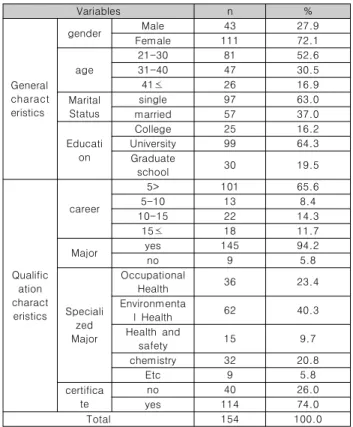
1. General characteristics and qualifications 본 연구에 참여한 대상자의 일반적 특성과 작업환경측정기 관 분석사로서의 자격 특성은 다음과 같다. 일반적 특성 중 성 별은 남성 27.9%, 여성 72.1%로 여성의 참여가 많았으며, 연 령은 21세 이상 30세 이하 52.6%, 31세 이상 40세 이하 30.5%, 41세 이상 16.9%로 41세 미만의 참여가 많은 것으로 나타났다. 결혼유무는 미혼 63.0%, 기혼 37.0%이고, 학력은 전 문대학 졸업 16.2%, 4년제 대학 졸업(재학 포함) 64.3%, 대학

원 석사 졸업(재학 포함) 19.5%로 나타났다.

자격 특성 중 전체 경력은 5년 미만이 65.6%, 5년 이상 10 년 미만 8.4%, 10년 이상 15년 미만 14.3%, 15년 이상11.7%

로 5년 미만 경력자가 가장 많았으며, 산업안전보건법 시행규 칙 별표 12 지정측정기관의 유형별 인력․시설 및 장비 기준에 의한 전공자는 94.2%, 비전공자는 5.8%로 나타났다. 전공 분 야는 산업보건 23.4%, 환경보건 60.3%, 안전보건 9.7%, 화학 20.8%, 기타 5.8%로 환경보건 전공자가 가장 많았으며, 관련 자격증 보유 여부에 대하여 미보유 26.0%, 보유 74.0%로 나타 났다(Table 1).

Variables n %

General charact eristics

gender Male 43 27.9

Female 111 72.1

age

21-30 81 52.6

31-40 47 30.5

41 26 16.9

Marital Status

single 97 63.0

married 57 37.0

Educati on

College 25 16.2

University 99 64.3

Graduate

school 30 19.5

Qualific ation charact eristics

career

5> 101 65.6

5-10 13 8.4

10-15 22 14.3

15 18 11.7

Major yes 145 94.2

no 9 5.8

Speciali zed Major

Occupational

Health 36 23.4

Environmenta

l Health 62 40.3

Health and

safety 15 9.7

chemistry 32 20.8

Etc 9 5.8

certifica te

no 40 26.0

yes 114 74.0

Total 154 100.0

Table 1. General characteristics and qualifications

2. Factor analysis on the awareness of chemical substance, equipment associated incidents, equipment associated incidents

2.1. Factor analysis on the awareness of chemical substance and equipment associated incidents

화학물질 및 기기 사용 시 발생할 수 있는 사고대응에 대한

인식의 요인 분석 결과 3개의 요인으로 분석되었다. 요인 1은

분석실 사고 처리, 대응방법, 사고 원인 등에 대한 문항이 포함

되어 ‘분석실 사고 대응 방법 인식’이라 명명하였고, 요인 2는

분석실 기기 사고에 대한 상황과 전파 경로, 사고 복구, 조치 체

계, 현장 파악 등에 대한 문항이 포함되어 ‘기기 사고 대응 방법

인식’이라 명명하였으며, 요인 3은 화학물질 사고 원인과 취급

자의 부주의에 대한 원인 등의 문항이 포함되어 ‘분석실 화학물

(4)

Variables Factor

Factor 1 Factor 2 Factor 3 incident management and suppression procedure during a chemical substance incident (e.g.,

chemical substance, reagent, and gas) in an analytical laboratory .890 .236 .110 Initial response to a chemical substance incident in an analytical laboratory .878 .236 .077 Restoration and post-suppression measures for a chemical substance incident in an analytical

laboratory .845 .352 .078

Know the coping measures to a chemical substance incident in an analytical laboratory .823 .211 .142 Know the method to identify the site condition and secure the information regarding a chemical

substance incident in an analytical laboratory .786 .271 .064

Know the major factors causing a chemical substance incident

in an analytical laboratory .682 .332 .351

Know the characteristics of a chemical substance incident in an analytical laboratory .566 .405 .412 Know the situation and propagation path for an equipment

incident(GC, AAS, HPLC, ICP, IC) in an analytical laboratory .257 .913 .079 Know the post-incident measure system for an equipment incident

in an analytical laboratory .316 .891 .004

Know the characteristics of an equipment incident in an analytical laboratory .167 .884 .099 Know the initial response for an equipment incident in an analytical laboratory .336 .875 -.031 Know the situation identification, access control, and data securement system for an equipment

incident in an analytical laboratory .396 .807 -.082

Know the incident during the transportation and delivery of chemical substances for a chemical

substance incident in an analytical laboratory .156 -.030 .845

Know an incident due to the negligence of a chemical substance handler .106 .001 .829

eigen value 4.857 4.454 1.765

explanatory (%) 34.690 31.815 12.610

accuracy (%) 34.690 66.505 79.115

Cronbach's alpha 0.939 0.958 0.693

item n 7 5 2

Table 2. Factor analysis on the awareness of chemical substance and equipment associated incidents 질 사고 원인 인식’라 명명하였다(Table 2). 화학물질 및 기기

사고 대응의 인식 문항에 대하여 Cronbach's alpha를 이용한 신뢰도 분석 결과 요인 1의 ‘분석실 사고 대응 방법 인식’은 0.939, 요인 2의 ‘기기 사고 대응 방법 인식’은 0.958, 요인 3 의 ‘분석실 화학물질 사고 원인 인식’은 0.693으로 신뢰도가 확 보되었다(Table 2).

3. Factor analysis on the awareness of an analytical laboratory safety management

분석실 안전관리 인식에 대한 요인 분석 결과 2개의 요인으 로 분석되었으며, 요인 1은 안전관리 규정 인식, 위험성 확인, 관리 규정 준수, 대응절차 숙지 등에 대한 문항이 포함되어 ‘분 석실 안전환경 조성을 위한 준수’라 명명하였고, 요인 2는 교육 훈련, 연구 활동 수행에 대한 도움 등에 대한 문항이 포함되어

‘분석실 안전 확보 인식’이라 명명하였다. 분석실 안전관리 인 식 문항에 대하여 Cronbach's alpha를 이용한 신뢰도 분석 결 과 요인 1의 ‘분석실 안전환경 조성을 위한 준수’는 0.872, 요 인 2의 ‘분석실 안전 확보 인식’은 0.880으로 신뢰도가 확보되 었다(Table 3).

4. Comparisons of the means regarding the factors affecting the awareness of chemical substance and equipment incident responses

화학물질 및 기기 사고 대응과 분석실 안전관리 인식에 대한 요인별 평균 비교 결과 화학물질 및 기기 사고 대응은 요인 1

‘분석실 사고 대응 방법 인식’ 3.156, 요인 2 ‘기기 사고 대응 방법 인식’ 3.641, 요인 3 ‘분석실 화학물질 사고 원인 인 식’3.111로 요인 2의 기기 사고 대응 방법 인식이 가장 높게 나 타났고, 분석실 안전관리 인식은 요인 1 ‘연구실 안전환경 조성 을 위한 준수’ 3.425, 요인 2 ‘분석실 안전관리 인식’ 3.316으 로 연구실 안전환경 조성을 위한 준수에 대한 인식이 높게 나 타났다(Table 4).

5. Correlations between the response to chemical substance and equipment associated incidents and the analytical laboratory safety management

화학물질 및 기기 사고 대응과 분석실 안전관리 인식에 대한

상호 관련성은 다음과 같이 화학물질 및 기기 사고 대응 인식

중 요인 1의 ‘분석실 사고 대응 방법 인식’과 요인 2의 ‘기기 사

고 대응 방법 인식’이 상호 관련성이 높은 것으로 나타났다

(r=0.613, p<0.001). 분석실 안전관리 인식의 요인 2의 ‘연구

실 안전 확보 인식’은 화학물질 및 기기 사고 대응 인식 중 요

인 1의 ‘분석실 사고 대응 방법 인식’(r=0.621), 요인 2의 ‘기기

사고 대응 방법 인식’(r=0.634)과 상호 관련성이 높은 것으로

나타났다. 분석실 안전관리 인식은 요인 1 ‘연구실 안전환경 조

성을 위한 준수’와 요인 2 ‘연구실 안전 확보 인식’(r=0.764)이

상호 관련성이 가장 높게 나타났으며, 이는 연구실 안전환경 조

성을 위한 준수에 대한 인식이 높을수록 연구실 안전 확보에

대한 인식도 함께 높아지는 것을 의미한다(Table 5).

(5)

Variables Factor

Factor 1 Factor 2

I know about the "Laboratory Safety Act." .773 .004

I know the major contents of the safety management regulations of an analytical laboratory. .718 .304

I believe that sufficient environment is being created for conducting safe analytical works. .711 .331 I verify the risk (e.g., MSDS) of substances we are treating in the analytical laboratory before

conducting an analytical work. .619 .356

I try to comply with laboratory safety management regulations when I conduct an analytical work. .615 .515 I am fully aware of the response procedure to an emergency situation such as an incident in an

analytical laboratory. .605 .378

I conduct an experiment after identifying risk factors associated with the facility. .602 .511 A training program helps to secure the analytical laboratory safety and conduct a safe analysis. .177 .881 I believe that a training program and its contents are suitable to secure the safety of the analytical

laboratory and protect the safety of analysts. .235 .800

The contents of the posted laboratory safety management regulations actually help to conduct safe

research and experimental activities. .420 .724

I actively participate in educations related to the analytical laboratory safety. .474 .665

eigen value 3.662 3.423

explanatory (%) 28.171 26.334

accuracy (%) 28.171 54.505

Cronbach's alpha 0.872 0.880

item n 7 4

Table 3. Factor analysis on the awareness of an analytical laboratory safety management

Variables

awareness of chemical substance and/or equipment associated incidents

awareness of an analytical laboratory safety management

Factor 1 Factor 2 Factor 3 Factor 1 Factor 2

awareness of chemical substance and/or equipment associated

incidents

Factor 1 1 .613** .310** .548** .621**

Factor 2   1 .044 .533** .634**

Factor 3     1 .231** .165*

awareness of an analytical laboratory safety

management

Factor 1       1 .764**

Factor 2         1

Table 5. Correlations between the response to chemical substance and equipment associated incidents and the analytical laboratory safety management

Factor Mean±SD

awareness of chemical substance and/or equipment

associated incidents

Factor 1 Know the response method to an incident in an analytical laboratory 3.156±0.737 Factor 2 Know the response method to an equipment incident 3.641±0.634 Factor 3 Know the response method to a chemical substance incident 3.111±0.837 awareness of an analytical

laboratory safety management

Factor 1 Compliance with regulations to create a safe analytical laboratory

environment 3.425±0.711

Factor 2 Secure the safety in an analytical laboratory 3.316±0.636 Table 4. Comparisons of the means regarding the factors affecting the awareness of chemical substance and equipment incident responses

6. The effects of the response to chemical substance and equipment incident on the awareness of laboratory safety environment creation

분석실 안전관리 인식 중 요인 1 ‘연구실 안전환경 조성을 위한 준수’에 화학물질 및 기기 사고 대응이 미치는 영향은 분 석실 사고 대응 방법 인식(t=3.027, p<0.01), 기기 사고 대응 방법 인식(t=4.574, p<0.001), 분석실 화학물질 사고 원인 인 식(t=2.171, p<0.05) 모두 영향을 미치는 것으로 나타났다. 화

학물질 및 기기 사고 대응 요인의 상대적 기여도를 나타내는 표준화 계수에 의하여 기기 사고 대응 방법 인식, 분석실 사고 대응 방법 인식, 분석실 화학물질 사고 원인 인식 순으로 영향 도가 큰 것으로 파악되었다(Table 6).

7. The effects of the response to chemical substance and equipment incident on securing the laboratory safety awareness

분석실 안전관리 인식 중 요인 2 ‘연구실 안전 확보 인식’에

(6)

화학물질 및 기기 사고 대응이 미치는 영향은 분석실 사고 대 응 방법 인식(t=4.086, p<0.001), 기기 사고 대응 방법 인식 (t=5.945, p<0.001)이 영향을 미치는 것으로 나타났다. 화학물 질 및 기기 사고 대응 요인의 상대적 기여도를 나타내는 표준 화 계수에 의하여 기기 사고 대응 방법 인식, 분석실 사고 대응 방법 인식 순으로 영향도가 큰 것으로 파악되었다(Table 7).

Variables B standard

error Beta t p-v

alue

constant .957 .319   2.9

97 .003

Factor 1 Know the response method to an incident in an analytical laboratory

.259 .085 .266 3.0

27 .003

Factor 2 Know the response method to an equipment

incident

.331 .072 .383 4.5

74 .000

Factor 3 Know the response method to a chemical substance incident

.173 .080 .151 2.1

71 .032

Table 6. The effects of the response to chemical substance and equipment incident on the awareness of laboratory safety environment creation

Variables B standard

error Beta t p-va

lue

constant 1.08

3 .261   4.1

50 .000

Factor 1 Know the response method to an incident in an analytical laboratory

.286 .070 .326 4.0

86 .000

Factor 2 Know the response method to an

equipment incident

.352 .059 .452 5.9

45 .000

Factor 3 Know the response method to a chemical substance incident

.069 .065 .068 1.0

73 .285

Table 7. The effects of the response to chemical substance and equipment incident on securing the laboratory safety awareness

Ⅴ. Conclusion

본 연구는 작업환경측정기관 분석사가 업무 시 가장 많이 사

용하고 있는 기기와 화학물질에 대한 사고 대응이 안전 인식에 미치는 영향을 파악하고 안전관리 방안 및 관리 체계 구축에 활용하고자 시도되었으며, 다음과 같은 결론을 제시한다.

화학물질 및 기기 사고 대응과 분석실 안전관리 인식은 기기 사고 대응 방법 인식이 가장 높고 분석실 안전관리 인식은 연 구실 안전환경 조성을 위한 준수에 대한 인식이 높게 나타났다.

또한 화학물질 및 기기 사고 대응과 분석실 안전관리에 대하 여 기기 사고 대응, 분석실 사고 대응, 분석실 화학물질 사고 원 인에 대한 인식 순으로 영향을 미치는 것으로 파악되었다.

현재 작업환경측정기관은 산업안전보건법 제 42조 제 9항과 작업환경측정 및 측정기관 평가 등에 관한 고시에 의하여 평가 를 받고 있으며, 그 결과에 의하여 S, A, B, C로 등급을 나누고 있다. 기관 평가를 통하여 작업환경 측정 업무에 대한 전문성을 확보하고 산업 현장의 작업환경 관리에 선도적인 역할을 담당 하고 있지만 실제 작업환경측정기관 근로자에 대한 관리는 잘 이루어지지 못하고 있는 실정이다.

따라서 기관 평가 시 분석실 사고 및 안전 관리가 적용되어야 할 것이며, 분석사에 대한 안전 교육의 의무화 등 관리에 대한 제도적 체계 마련이 요구된다. 또한 기기 사용, 사고 대응, 화학 물질 관리에 관한 안전 매뉴얼 확보, 정기적인 점검, 분석사의 교육 등에 대한 정보화 시스템을 통하여 지속적인 관리가 이루 어질 수 있는 체계 마련이 우선적으로 이루어져야 할 것이다.

REFERENCES

[1] Ministry of Employment and Labor(MoEL). Occupational Safety and Health Act, Act No. 10968. 2014

[2] jkjang. “Evaluation of the Possession of Measurement and Analytical Instruments in Domestic Work Environment Monitoring Service Providers (Ⅱ),“

Journal of Korean Society of Occupational and Environmental Hygiene, Vol. 24, No. 2, pp. 182-192, June. 2014.

[3] sijang, dmshin, tokim, kspark. “ Development of a Guideline for Accident Investigation and Management for an Experimental Laboratory,” Korean Journal of Hazardous Materials, Vol. 4, No. 1, pp. 57-64, June.

2016.

[4] kspark. “Development of Accident Taxonomy for Experimental Laboratory,” Journal of the Korean Society of Safety, Vol. 31, No. 5, pp. 49-53, Oct. 2016.

[5] thlee, djlee, jdpark, chshin. “Study fo the Characteristics

Analysis of Laboratory Chemical Accidents,” Fire

Science and Engineering, Vol. 30, No. 3, pp. 110-116,

June. 2016.

(7)

[6] yhhong. “Research of College Students Recognition for the Safety Management of Living and Laboratory,“ Fire Science and Engineering, Vol. 28, No. 4, pp. 89-96, Aug.

2014.

[7] sheom, sklee.“A Study on Analysis of Laboratory Accident with Root Cause Analysis,” Journal of The Korean Institute of Gas, Vol. 14, No. 4, pp. 1-5, Aug, 2010.

[8] dylee, “Development of a Standard Checklist for Protection to Electrical Accidents of Laboratory,”

Journal of The Korean Contents Association, Vol. 11, No. 3, pp. 108-115, Mar. 2011.

[9] djlee, thlee, chshin, “Study on Improvement Measures for Prevention and Countermeasure of Chemical Accident,” Fire Science and Engineering, Vol. 30, No.

5, pp. 137-143, Oct. 2016.

[10] kwlee, yrchoi, “Actual Condition and Realization of Important on Laboratory Safety Management in Chemical Laboratories,” Journal of The Korean Institute of Gas, Vol. 16, No. 2, pp. 60-66, Apr. 2012 [11] kckim, dhlee, “Status of Researchers' Safety

Consciousness and It's Improvement Measures in Government-Supported Research Institutes,” Journal of the Korea safety management & science. Vol. 14, No. 1, PP.15-22, Mar. 2012.

[12] hwkim, mslee, “A Study on the Development of the Measuring Scale of Safety Consciousness,” Journal of Korean Society for Health Education and Promotion, Vol. 19, No. 1, pp. 87-107, Mar. 2002.

Authors

Hyun A Park received a master's degree in social welfare in 2009 and currently studies doctoral Business Disaster Safety management at Incheon National University. She worked as an analytical researcher at the Ganghwa Hospital Workplace Measuring Room from 1996 to 1997.

She is currently working as a manager of the Sarang Industrial Envionmental Institute. She is interested in safety in occupational safety and health, labor and environment measurement laboratory.

Seo Yeon Choi received the B.S.

degrees in Industrial Chemistry from Dankook University and M.S degrees in Public Health from Korea University.

Ph.D. degrees in Industrial Engineering and degrees in Social & Preventive Medicine, from Inha University, from Korea, in 2008, 2014 respectively. Dr. Choi joined the faculty of the Department of Rehabilitation Health Management at Songwon University, Gwangju, Korea, in 2016. She is currently a Professor in the Department of Rehabilitation Health Management at Songwon University, She is interested in Occupational Health, Ergonomics, Safety culture.

Professor Dong Ho Rie is a master of mechanical engineering in 1985 and a doctor of mechanical systems engineering in 1991. Professor Dong Ho Rie is currently a professor in the Department of Safety Engineering at Incheon National University and is the Director of the Center for Fire Protection and Disaster Prevention.

He is interested in mechanical systems and fire

fighting.

수치

Table  1.  General  characteristics  and  qualifications
Table  2.  Factor  analysis  on  the  awareness  of  chemical  substance  and  equipment  associated  incidents 질  사고  원인  인식’라  명명하였다(Table  2)
Table  5.  Correlations  between  the  response  to  chemical  substance  and  equipment  associated  incidents  and  the  analytical  laboratory  safety  management
Table  7.  The  effects  of  the  response  to  chemical  substance  and  equipment  incident  on  securing  the  laboratory  safety  awareness

참조

관련 문서

– A system or plant equipment list or P&amp;ID, knowledge of equipment function and failure modes, knowledge of system or plant function and response to equipment

 A series of systems for configuring alarm and control functions by monitoring the states of main engine, generator, and auxiliary equipment, for securing the safety

In the current context, where the interconnectedness of the global economy has intensified greatly and the importance of a collective response to

웹 표준을 지원하는 플랫폼에서 큰 수정없이 실행 가능함 패키징을 통해 다양한 기기를 위한 앱을 작성할 수 있음 네이티브 앱과

_____ culture appears to be attractive (도시의) to the

1 John Owen, Justification by Faith Alone, in The Works of John Owen, ed. John Bolt, trans. Scott Clark, &#34;Do This and Live: Christ's Active Obedience as the

◦ Electromagnetic methods use the response of the ground to the propagation of incident alternating electromagnetic waves which are made up of two orthogonal vector

- 우선, 외부 전원이 없는 회로, 즉 초기조건에 의해서 전류, 전압이 결정되 는 회로의 응답 : natural response.. - 다음, 직류 전압이나 전류가