• 검색 결과가 없습니다.

Characteristics of shoulder pain, muscle tone and isokinetic muscle function according to the scapular position of elite boxers

N/A
N/A
Protected

Academic year: 2021

Share "Characteristics of shoulder pain, muscle tone and isokinetic muscle function according to the scapular position of elite boxers"

Copied!
7
0
0

로드 중.... (전체 텍스트 보기)

전체 글

(1)

http://crossmark.crossref.org/dialog/?doi=10.14474/ptrs.2020.9.2.98&domain=pdf&date_stamp=2020-6-25

Received: 20 May, 2020 Revised: 3 June, 2020 Accepted: 8 June, 2020

Corresponding author: Won-Seob Shin (ORCID https://orcid.org/0000-0002-6515-7020)

Department of Physical Therapy, College of Health and Medical Science, 62 Daehak-ro, Dong-gu, Daejeon 34520, Republic of Korea Tel: 82-42-280-2294 Fax: 82-42-280-2295 E-mail: [email protected]

This is an Open-Access article distributed under the terms of the Creative Commons Attribution Non-Commercial License (http://creativecommons.org/licenses/

by-nc/4.0) which permits unrestricted non-commercial use, distribution, and reproduction in any medium, provided the original work is properly cited.

Copyright © 2020 Korean Academy of Physical Therapy Rehabilitation Science https://doi.org/10.14474/ptrs.2020.9.2.98

pISSN 2287-7576 eISSN 2287-7584

Phys Ther Rehabil Sci 2020, 9 (2), 98-104 www.jptrs.org

Characteristics of shoulder pain, muscle tone and isokinetic muscle function according to the scapular position of elite boxers

Ju-Hong Lee a , Ho Kim b , Won-Seob Shin a,b,c

a

Department of Physical Therapy, Graduate School of Health and Medicine, Daejeon University, Daejeon, Republic of Korea

b

Department of Physical Therapy, Graduate School, Daejeon University, Daejeon, Republic of Korea

c

Department of Physical Therapy, College of Health and Medical Science, Daejeon University, Daejeon, Republic of Korea

Objective: The shoulders are a particularly an important body part for elite boxers. The purpose of this study was to investigate the characteristics of the upper trapezius (UT), infraspinatus (IS) muscle tone, pain, and isokinetic muscle function of shoulder movements such as external rotation, internal rotation, protraction, and retraction according to the scapular position of elite boxers of the Korean national team.

Design: Cross-sectional study.

Methods: Using the double square method, the scapular position was measured and divided into the forward scapular position group (n=8) with a measurement distance of 135 mm or more, and the normal scapular position group (n=10) with a measurement distance of less than 135 mm. Through the numeric rating scale of the subject, the pain value displayed during movement was mea- sured. The muscle tone of the subjects’ UT and IS were measured. The isokinetic muscle function of ER, IR, protraction, and re- traction were measured using isokinetic exercise equipment.

Results: The results of this study showed statistically significant differences when comparing muscle tone of the UT and IS, shoulder pain, isokinetic function of ER and IR, protraction, and retraction according to scapular position (p<0.05).

Conclusions: The findings of this study were that shoulder muscle tone, pain, and isokinetic muscle function were affected ac- cording to the scapular position of elite boxers. In the future, this information may be a useful indicator when studying the effects of medium and long-term intervention in elite boxers who possess these characteristics.

Key Words: Athletes, Boxing, Muscles, Pain, Scapula

Introduction

A lot of people are participating in exercise to improve the quality of life in their daily lives. Among them, there are am- ateur athletes who enjoy sports as a hobby and elite athletes who exercise professionally. A common phenomenon in amateur athletes or elite athletes is that they are exposed to the risk of sports injuries [1,2]. Sports injuries are classified as chronic injuries caused by repeated loads, collisions with opponents or facilities during training or competition, and

injuries caused by excessive loads on the musculoskeletal

system. Sports injuries can be prevented beforehand, re-

search on the mechanism of injuries, protective equipment

or warm-up exercises can prevent acute injuries, and chronic

injuries can be prevented by adjusting training methods or

the exercise environment [3]. Boxing and hockey were the

most common causes of acute sports injuries among male

and female athletes in a study that analyzed sports injuries

during the official training period for elite athletes, such as

national athletes [4]. Boxing is a speculative event that re-

(2)

quires the person to move violently for 3 minutes and 3 rounds and competes with opponents, and is a high-strength game without sufficient recovery due to a 1-minute break between rounds [5]. Boxers continue to train their attack skills such as jabs, straights, hooks, and uppercuts, as well as evasive techniques such as ducking, weaving, and sway us- ing shoulders along with various physical exercises such as speed, strength, muscle endurance, and cardiopulmonary endurance [6-8]. In a study record of physical injuries to sports players, the boxing event showed a high degree of in- juries occurred with wrist bending due to differences in hit- ting angles, shoulder injuries due to long hooks, and back muscle tension due to training [9]. Athletes have reported that the likelihood of injuries is further increased by greater amount of training to improve performance and develop skills [10]. Shoulders are particularly important for boxers because of their movement characteristics, and when should- er injuries appear, problems with training or performance can be fatal. In fact, it was suggested that the cause of should- er injuries was more likely to be caused by wrong movement than hitting [11]. Recently, studies on the necessity of inter- vention are increasing through injury and physical charac- teristics of various athletes. There are studies that have in- vestigated the characteristics of the shoulder joints of base- ball players and swimmers that have mentioned the need for intervention, and suggested the importance of conditioning through the characteristics of golf players [12-14]. In pre- vious studies, scapular position of elite athletes were meas- ured for forward shoulder postures, and isokinetic muscle functions were compared to provide basic data for rehabili- tation programs [15]. The forward shoulder posture appears as a shortening of the anterior shoulder muscles, such as the serratus anterior, upper trapezius (UT), and pectoralis mus- cles by pulling the front of the scapular, affecting body align- ment and muscle weakness, causing pain in the head, neck, and shoulders. It is one of the unstable postures that neg- atively affect musculoskeletal function [16]. In Korea, stud- ies related to the physical fitness of boxing athletes and stud- ies related to exercise dynamics related to boxing move- ments have been reported [17,18]. However, there has been no research on the risk of injury due upper extremity func- tion, muscle condition, and shoulder blade position for box- ers, and this is very incomplete.

Therefore, the purpose of this study was to investigate the characteristics of pain, muscle tension, and isokinetic mus- cle function of the shoulder muscles according to the scap- ular position of elite boxers of the Korean national team.

Methods Participants

This study recruited 18 elite male boxers who entered the National Olympic Team Jincheon Athletes’ Village from De- cember 2017 to October 2018. The selection criteria for the candidates were 1) those who were currently living as ath- letes and have entered the national Athletes’ Village, and 2) those with no orthopedic history (surgery) within the past 3 months of the shoulder joint. The exclusion criteria were 1) those with neurological disorders on the shoulders and 2) those who could not participate due to severe shoulder pain during all evaluations or examinations of this study and ex- ercise intervention. The subjects of this study agreed in writ- ing to understand and participate in the purpose of this study and proceeded after being deliberated by the Institutional Review Board of Daejeon University (1040647-202004-HR- 014-01).

Procedure

Eight subjects in the forward scapula posture group and ten subjects in the normal scapula posture group were as- signed after measuring the position of the shoulder blades of all subjects. The subject’s subjective pain was measured af- ter measuring the muscle tension of the upper and lower ex- tensor muscles. Experiments were conducted using an iso- kinetic equipment to measure muscle strength of angular ve- locity of 60° and angular velocity of 180° for shoulder pro- traction, retraction, internal rotation (IR), and external rota- tion (ER).

Outcome measures Scapular position

The double square method was used to measure the scap- ular position. The measuring position allowed the athlete to stand with his back against the wall in a relaxed position.

The evaluator measured the distance between the front of the acromion process and the wall surface [19,20]. Double square (Model #420EM; Johnson Level and Tool Manufacturing, Inc., Mequon, WI, USA) was used to measure the distance between the subject and the wall, and the right and left sides were measured twice alternately. A person with a scapular position of 135 mm or more was presented as an forward shoulder posture (Figure 1) [16].

Muscle tone

The Myoton Pro (Myoton AS, Tallin, Estonia) was used

(3)

Figure 1. Double square methods. Figure 2. Myoton Pro (Myoton AS, Tallin, Estonia).

to measure muscle tension in the shoulder muscle. Among the muscle tension of the shoulders, the examination was performed on the UT and IS muscles, which are correlated with the inward and backward rotations and the inner and outer rotations. In order to assess the muscle tone, UT was marked with a surgical marker pen in the middle part of the line connecting the spinous process of C7 and the end of the acromion, and the middle belly of the infraspinatus fossa for IS [21].

Subjects sat on a chair with a backrest to relax and main- tain a comfortable posture. In repetitive measurement, one person performed the measurements in order to increase the internal reliability of the examiner. In the measurement envi- ronment, factors affecting the generation of resonant motion such as noise and vibration were limited and measured at an appropriate temperature (22°C-24°C) and humidity (45%- 60%). In order to produce accurate measurement variables, the subjects were instructed to avoid unnecessary tension to create resonant cavities in the tissue, and instructed to relax as much as possible during the measurement. Regardless of the measuring angle, the measuring probe (polycarbonate probe, 3 mm) was always measured at a right angle (vertical) from the skin. In this study, all measurements were made us- ing the Multiscan mode, and the average number of tap repe- titions was measured three times, five times each, the me- chanical impulse transmission time was set to 15 millisec- onds, and the transmission interval was set to 0.8 seconds (Figure 2).

Pain

A numeric rating scale was used to evaluate shoulder pain during the subject’s movement. After explaining that a 0 in- dicated that there was no pain at all, and a 10 indicated se- vere, unbearable pain, the subject was asked to quantify their current pain level. Subjective pain on the dominant shoulder of the subject was selected from 0 to 10 [22].

Muscle performance

Measurement of muscle function of the shoulder was per- formed using the Biodex System4 (Biodex Medical Systems, Shirley, NY, USA). For the measurement, the pre-training was conducted so that the maximum effort was made by the athletes during the measurement, and light warm-up ex- ercises and stretches were performed for about 10 minutes.

The measurement motions were measured for protraction

and retraction, IR and ER. The shoulders and chest of the op-

posite side were fixed with a belt connected to the chair so

that unnecessary movements other than the shoulders were

not repeated. The dynamic strength evaluation of athletes

was performed at a slow load speed of 60°/sec and a medium

load speed of 180°/sec [23,24]. In the order of protraction

and retraction, after three exercises at angular velocity of

60°/sec, the maximum force was measured five times on the

right and left sides, and the angular velocity of 180°/sec on

the right and left after three exercises. It was measured 20

times each alternately. In the order of measuring IR and ER,

after 3 exercises at an angular velocity of 60°/sec, it was

measured right and left 5 times at maximum force, and after

(4)

Figure 3. Biodex System4 (Biodex Medical Systems, Shirley, NY, USA).

Table 1. General characteristics of subjects (N=18) Variable FSP group

(n=8)

NSP group

(n=10) χ

2

/t Age (y) 25.75 (5.00) 26.30 (2.75) −0.297 Height (cm) 173.63 (6.93) 178.70 (6.57) −1.591 Weight (kg) 68.38 (19.14) 72.30 (12.18) −0.530 Weight division

(light/heavy)

5/3 5/5 0.281

Dominant arm (left/right)

3/5 6/4 0.900

Values are presented as mean (SD) or number only.

FSP: forward scapular position, NSP: normal scapular position.

Table 2. Comparison on muscle tone and pain according to the

scapular position (N=18)

Variable FSP group (n=8)

NSP group

(n=10) t

NRS (points) 5.25 (0.71) 1.90 (0.57) 11.167**

UT muscle tone (Hz)

Right 17.82 (1.18) 16.25 (0.72) 3.486**

Left 17.38 (0.98) 16.09 (1.27) 2.356*

IS muscle tone (Hz)

Right 14.68 (1.08) 13.05 (0.93) 3.439**

Left 14.36 (0.87) 13.20 (0.52) 3.515**

Values are presented as mean (SD).

FSP: forward scapular position, NSP: normal scapular position, UT:

upper trapezius, IS: infraspinatus, NRS: numeral rating scale.

*p<0.05, **p<0.01.

3 exercises at 180°/sec. The left was measured alternately 20 times (Figure 3) [25].

Data and statistical analysis

Data collected through this study were statistically proc- essed using IBM SPSS Statistics for Windows, Version 25.0 (IBM Co., Armonk, NY, USA).

For the general characteristics of the subjects, the mean and standard deviation were presented using descriptive sta- tistics, and an independent t-test and chi square test were conducted to test for homogeneity between groups. The Shapiro-Wilk test for normality test was performed and the independent t-test was used to compare the physical charac- teristics of elite boxers according to the scapular position.

The statistical significance level was set to α=0.05.

Results

General characteristics of the study subjects

There were eight subjects in the forward scapula posture groups and ten subjects in the normal scapula posture group.

Table 1 shows the general characteristics such as age, height, weight, weight, and superior arm.

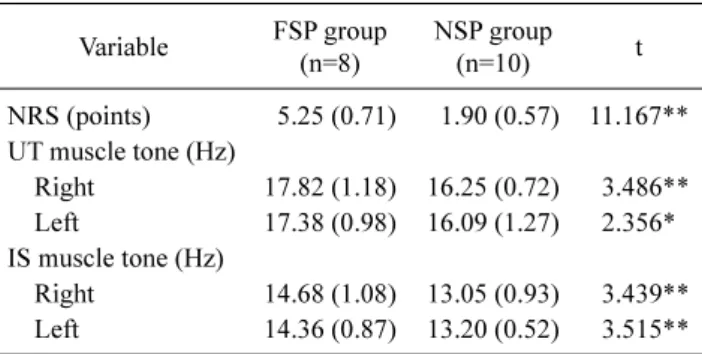
Comparison of pain and muscle tone between the two groups according to the scapular position. As a result of com- paring the pain and muscle tone of each muscle according to the scapular position, statistically significant differences were shown in the muscle tension of bilatearl UT, dominant shou- ler pain and the IS muscle tone. Pain and low muscle tone were seen in the normal scapular position (NSP) group com- pared to the forward scapular position (FSP) group ( p<0.05) (Table 2).

Comparison of angular velocity 60°/sec muscle strength of two groups according to the scapular position

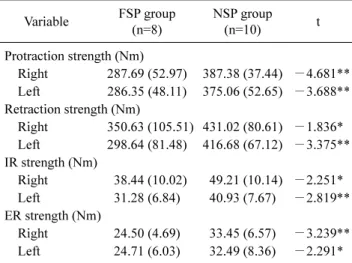
As a result of comparing the angular velocity 60°/sec muscle strength of each movement according to the scapular position, there was a statistically significant difference in right protraction, rectraction, IR, ER, left protraction, re- traction, IR, and ER. The NSP group showed greater muscle strength than the FSP group ( p<0.05) (Table 3).

Comparison of angular velocity 180°/sec muscle strength of two groups according to scapular position

As a result of comparing the angular velocity 180°/sec

muscle strength of each movement according to the position

of the scapular, there was a statistically significant differ-

ence in the right protraction, retraction, IR, ER, left pro-

traction, retraction, IR and ER. The NSP group showed

greater muscle strength than the FSP group ( p<0.05) (Table

4).

(5)

Table 4. Comparison of 180°/sec angular velocity peak torque of ER, IR, protraction, retraction according scapular position

(N=18)

Variable FSP group (n=8)

NSP group

(n=10) t

Protraction strength (Nm)

Right 238.70 (55.53) 339.76 (77.70) −3.093**

Left 218.94 (57.92) 307.75 (68.13) −2.932**

Retraction strength (Nm)

Right 327.88 (65.13) 433.69 (99.76) −2.709**

Left 292.03 (90.91) 405.84 (79.83) −2.828**

IR strength (Nm)

Right 35.28 (7.54) 45.38 (10.50) −2.286*

Left 34.06 (6.70) 43.23 (9.06) −2.383*

ER strength (Nm)

Right 21.10 (6.67) 35.70 (7.59) −4.274**

Left 18.36 (4.47) 25.94 (5.53) −3.216**

Values are presented as mean (SD).

ER: external rotation, IR: internal rotation, FSP: forward scapular position, NSP: normal scapular position.

* p<0.05, **p<0.001.

Table 3. Comparison of 60°/sec angular velocity peak torque of ER, IR, protraction, retraction according to scapular posi-

tion (N=18)

Variable FSP group (n=8)

NSP group

(n=10) t

Protraction strength (Nm)

Right 287.69 (52.97) 387.38 (37.44) −4.681**

Left 286.35 (48.11) 375.06 (52.65) −3.688**

Retraction strength (Nm)

Right 350.63 (105.51) 431.02 (80.61) −1.836*

Left 298.64 (81.48) 416.68 (67.12) −3.375**

IR strength (Nm)

Right 38.44 (10.02) 49.21 (10.14) −2.251*

Left 31.28 (6.84) 40.93 (7.67) −2.819**

ER strength (Nm)

Right 24.50 (4.69) 33.45 (6.57) −3.239**

Left 24.71 (6.03) 32.49 (8.36) −2.291*

Values are presented as mean (SD).

ER: external rotation, IR: internal rotation, FSP: forward scapular position, NSP: normal scapular position.

* p<0.05, **p<0.001

Discussion

The purpose of this study was to investigate changes in the characteristics of shoulder muscle pain, muscle tension, and isokinetic muscle function according to the scapular po- sition of elite boxers. As a result of comparing the pain and muscle tension of each muscle according to the the scapular position, statistically significant differences appeared in right UT, IS, left UT, and inraspinatus pain. Pain and de- creased muscle tone were seen in the FSP group compared to the NSP group ( p<0.05).

Due to the excessive use of the trapezius muscles, should- er joint instability may occur due to relative muscle weak- ness or imbalance of the activation pattern between the mus- cles, and secondary impingement syndrome may appear [26].

It has been reported that if the shoulder range of motion is improved by reducing the tension of the UT muscles, the risk of injury to athletes can be reduced [21]. The IS muscle is the involved rotator cuff muscle of the shoulder joint. It has been reported to cause shoulder joint widening due to weakness or injury, limitation of ER, and instability of the shoulder joint, requiring continuous pain and range of motion evalua- tion [27-29]. Of these, if one of these muscles lose its func- tion, in severe cases, pain and movement limitations appear, resulting in physiological deformation of the muscle, there- by reducing functions such as muscle strength and flexibility [30].

As a result of comparing muscle strength of angular ve- locity 60° and angular velocity 180° for each movement ac- cording to the scapular position, statistically significant dif- ferences in right protraction, retraction, IR, ER and left pro- traction, retraction, IR, and ER were found, and the NSP group exhibited greater strength according to higher angular velocity compared to the FSP group ( p<0.05). Kim et al stat- ed that ER and IR are important indicators for shoulder joint movement and require continuous evaluation [31]. Athletes who raised their arms frequently (overhead posture) re- ported structural deformation due to repeated training and many movements in abnormal scapular postures, and re- ported abnormal correlation with shoulder disease and ab- normal shoulder postures or injuries. Abnormal scapular po- sitions or injured shoulder joints were found to have de- creased trapezius muscle activity [32,33]. In previous stud- ies, abnormal scapular position was associated with concave glenohumeral joint movement [34].

Due to the nature of boxing, there is a structural imbalance in the shoulders depending on the position of the scapula.

Previous studies have shown that the pre-punch phase of boxers have similarities to baseball pitching [35], and abnor- mal scapular positions and problems with shortening of the posterior and anterior joint capsule the shoulder joint in box- ers may cause limited upper limb function and injury [11].

Having said that external and IR also affects muscle

strength and endurance, shoulder injury not only leads to

(6)

muscle strength loss but also affects performance in tennis players, and through the excessive use of the shoulder, such as in rowing players, it has been reported that myofascial pain and shoulder impingement syndrome are exhibited [36-38]. In addition, not only is it possible for field hockey athletes using isokinetic equipment during shoulder training to prevent injury of the serratus anterior, middle trapezius, and lower trapezius muscles, it has been reported that it pre- vents injury to the shoulder joint and improves performance [39].

Isokinetic exercise is widely used in training to improve muscle strength, agility, and endurance, as well as in studies involved with muscular contraction and speed, rehabilita- tion exercise, judgment of exercise effect, diagnosis and pre- scription of exercise condition. In relation to isokinetic ex- ercise, the speed of the exercise load is the most important variable, and most of all, it is widely used to scientifically understand the local injury factors of athletes. Therefore, it is considered to be suitable as an evaluation tool for this study.

In this study, it was considered that it was appropriate to distribute the subjects to groups according to their scapular position, indicating the pathological condition of the should- er joint through positive correlation with shoulder impinge- ment syndrome [15].

There were a few limitations in this study. First, it is diffi- cult to generalize the information obtained from the results due to the small number of subjects in the experimental group and the control group. Second, the athletes included in this study were composed of only male and so character- istics of female athletes could not analyzed. However, the re- sults of this study are expected to be an important indicator in relation to shoulder injuries of boxers. Future studies will require mid- and long-term intervention studies of elite ath- letes with these characteristics, and further studies of areas with high risk of physical injury other than shoulder joint in- juries are needed.

In conclusion, this study was was conducted with 18 elite athletes who qualified for the National Athlete’s Village for Korean national boxing, and was conducted to investigate changes in the characteristics of shoulder pain, muscle ten- sion, and isokinetic muscular function according to scapular position. As a result of comparing the pain and muscle ten- sion of each muscle according to scapular position, statisti- cally significant differences were found in the right, upper left back trapezius and IS muscles. In the NSP group com- pared to FSP group. Pain and decreased muscle tone were

observed. As a result of comparing the isokinetic muscle function of 60° and 180° for each movement according to the scapular position, significant differences appeared in right and left protraction, retraction, IR, and ER. The NSP group exhibited greater muscle strength compared to the FSP group.

Conflict of Interest

The authors declared no potential conflicts of interest with respect to the authorship and/or publication of this article.

References

1. Uitenbroek DG. Sports, exercise, and other causes of injuries: re- sults of a population survey. Res Q Exerc Sport 1996;67:380-5.

2. Lee JH. Sports injury and rehabilitation. J Coaching Dev 2008;

10:31-40.

3. Lee KT, Song BY, Young KW, Kim NM, Kim CY, Park SR.

Analysis of the injuries in professional soccer player. Korean J Sports Med 2000;18:176-80.

4. Kim EK, Kim TG. Analysis of sports injuries among Korean na- tional players during official training. J Korean Data Inf Sci Soc 2014;25:555-65.

5. El-Ashker S, Nasr M. Effect of boxing exercises on physiologi- cal and biochemical responses of Egyptian elite boxers. J Phys Educ Sport 2012;12:111-6.

6. Whiting WC, Gregor RJ, Finerman GA. Kinematic analysis of human upper extremity movements in boxing. Am J Sports Med 1988;16:130-6.

7. Kim JJ, Ham WT, Lee YR. Biomechanics comparative analysis of the boxing hook punch according to skill level. Korean J Sports Sci 2013;22:1311-20.

8. Kim SJ, Woo BH. Biomechanical analysis of left and right hook type on trunk motion in boxing. Korean J Sports Sci 2013;22:

1519-29.

9. Kim TW, Choi KJ, Moon YJ, Song JH, Park SH, Kim EK, et al.

Analysis of sports injury induced behavior in summer sports.

Korean J Sport Sci 2015;26:690-701.

10. Lee KT, Kim JS, Choi BO. Analysis of seasonal injuries in pro- fessional football player. J Korean Orthop Soc Sports Med 2006;

5:135-40.

11. Lenetsky S, Brughelli M, Harris NK. Shoulder function and scapular position in boxers. Phys Ther Sport 2015;16:355-60.

12. Ahn NY, Kim HS, Kim KJ. Isokinetic muscle function and injury of shoulder joint in baseball player. J Coaching Dev 2013;15:

183-8.

13. Moon SJ, Kyeun SN, Kim B, Lee SJ, Eo SJ, Lee SS, et al. ROM characteristics of shoulder and hip joint in competitive swimmers.

Korea J Sport 2017;15:743-54.

14. Hwang JH, Choi HS, Shin WS. Effects of real-time feedback

training on weight shifting during golf swinging on golf perform-

ance in amateur golfers. Phys Ther Rehabilit Sci 2017;6:189-95.

(7)

15. Kim HC, Kim YJ, Lee JH. The influences of forward shoulder posture on incidence of impingement syndrome and isokinetic muscular function in elite athletes. J Korea Soc Wellness 2017;

12:613-21.

16. Peterson DE, Blankenship KR, Robb JB, Walker MJ, Bryan JM, Stetts DM, et al. Investigation of the validity and reliability of four objective techniques for measuring forward shoulder posture.

J Orthop Sports Phys Ther 1997;25:34-42.

17. Oh CH, Shin ES, Kim JP, Rho DS. The kinetics analysis on the one-two straight punch motion in boxing. Korean J Sports Sci 2012;21:1509-18.

18. Kim KJ, Song HS, Min SK. Body composition and specific physical fitness profiles of the Korean national amateur boxers.

Exerc Sci 2016;25:33-42.

19. Moezy A, Sepehrifar S, Solaymani Dodaran M. The effects of scapular stabilization based exercise therapy on pain, posture, flexibility and shoulder mobility in patients with shoulder im- pingement syndrome: a controlled randomized clinical trial.

Med J Islam Repub Iran 2014;28:87.

20. Laudner KG, Wenig M, Selkow NM, Williams J, Post E. Forward shoulder posture in collegiate swimmers: a comparative analysis of muscle-energy techniques. J Athl Train 2015;50:1133-9.

21. Kisilewicz A, Janusiak M, Szafraniec R, Smoter M, Ciszek B, Madeleine P, et al. Changes in muscle stiffness of the trapezius muscle after application of ischemic compression into my- ofascial trigger points in professional basketball players. J Hum Kinet 2018;64:35-45.

22. Farrar JT, Troxel AB, Stott C, Duncombe P, Jensen MP. Validity, reliability, and clinical importance of change in a 0-10 numeric rating scale measure of spasticity: a post hoc analysis of a randomized, double-blind, placebo-controlled trial. Clin Ther 2008;30:974-85.

23. Utter A, Gross F, Dasilva S, Kang J, Suminski R, Borsa P, et al.

Development of a wrestling-specific performance test. J Strength Cond Res 1997;11:88-91.

24. Perrin DH. Isokinetic exercise and assessment. Champaign: Human Kinetics Publishers; 1993.

25. Roach KE, Budiman-Mak E, Songsiridej N, Lertratanakul Y.

Development of a shoulder pain and disability index. Arthritis Care Res 1991;4:143-9.

26. Cools AM, Dewitte V, Lanszweert F, Notebaert D, Roets A, Soetens B, et al. Rehabilitation of scapular muscle balance: which ex-

ercises to prescribe? Am J Sports Med 2007;35:1744-51.

27. Seitz AL, McClure PW, Finucane S, Boardman ND 3rd, Michener LA. Mechanisms of rotator cuff tendinopathy: intrinsic, extrinsic, or both? Clin Biomech (Bristol, Avon) 2011;26:1-12.

28. Park MC, Tibone JE, Lee TQ. History, physical examination, ra- diographic anatomy, and biomechanics and physiological func- tion of the rotator cuff. Oper Tech Sports Med 2012;20:201-6.

29. Lee SH, Kim YH, Lee DG, Lee KB, Lee GC. Osteokinematic analysis during shoulder abduction using the C-arm. Phys Ther Rehabilit Sci 2017;6:208-13.

30. Ehrich D, Gebel R. Therapie und aufbautraining nach sport- verletzungen. Munster: Philippka Sportverlag; 2000.

31. Kim BR, Yi DH, Yim JE. Effect of postural change on shoulder joint internal and external rotation range of motion in healthy adults in their 20s. Phys Ther Rehabilit Sci 2019;8:152-7.

32. Cools AM, Witvrouw EE, Declercq GA, Vanderstraeten GG, Cambier DC. Evaluation of isokinetic force production and asso- ciated muscle activity in the scapular rotators during a pro- traction-retraction movement in overhead athletes with impinge- ment symptoms. Br J Sports Med 2004;38:64-8.

33. Cools AM, Witvrouw EE, Mahieu NN, Danneels LA. Isokinetic scapular muscle performance in overhead athletes with and with- out impingement symptoms. J Athl Train 2005;40:104-10.

34. Lewis JS, Wright C, Green A. Subacromial impingement syn- drome: the effect of changing posture on shoulder range of movement. J Orthop Sports Phys Ther 2005;35:72-87.

35. Turner A, Baker E, Miller S. Increasing the impact force of the rear hand punch. Strength Cond J 2011;33:2-9.

36. Park SY, Kim H. Influence of isokinetic shoulder rotation strength by altered shoulder posture and characteristics of shoulder joint in overhead throwers. Korean Soc Living Environ Syst 2012;19:

817-24.

37. Kim SY. A comparative study on isokinetic muscular strength of internal and external rotation on shoulder for shoulder injuries in tennis players. Korean J Sports Sci 2017;26:1359-66.

38. Byoun KS. Study of isokinetic muscular on the shoulder in Canadian canoe athlete [Master thesis]. Cheongju: Cheongju Uni- versity; 2009.

39. Vanderstukken F, Borms D, Berckmans K, Spanhove V, Cools AM.

Relative scapular-muscle ratios during maximal isokinetic shoulder-

girdle strength performance in elite field hockey players. J Athl

Train 2020;55:274-81.

수치

Figure 1. Double square methods. Figure 2. Myoton Pro (Myoton AS, Tallin, Estonia).
Table 2. Comparison on muscle tone and pain according to the
Table 3. Comparison of 60°/sec angular velocity peak torque  of ER, IR, protraction, retraction according to scapular

참조

관련 문서

Objectives : The purpose of this study was to investigate the effects of general characteristics, health characteristics, mental health characteristics, suicidal

The purpose of this study was to investigate the impact of social capital and positive psychology capital on the will of start-up according to experience

The purpose of this study is to establish and design the characteristics of summer resorts according to the design manual, develop cultural products using

Results after 4 weeks showed that both deep neck bending muscle exercise+general neck strengthening exercise group showed decreased pain and improved functional status

The purpose of this study was to investigate the lower extremity muscle strength and student health of male middle school students. Twenty middle school

The third was combination of levator palpebrae, superior rectus, inferior oblique muscle weakness(n=5) and the fourth was the third group plus medial rectus

The improvement factors of the performance showed significant increase in muscle strength, muscle endurance, cardiovascular endurance, power, agility and

In the health fitness category of the adult women who underwent instrument pilates exercise, they were statistically significant in muscle strength,