• 검색 결과가 없습니다.

The Effects of Modified Chin Tuck Exercise on the Cervical Curvature, the Strength and Endurance of the Deep Cervical Flexor Muscles in Subjects with Forward Head Posture

N/A
N/A
Protected

Academic year: 2021

Share "The Effects of Modified Chin Tuck Exercise on the Cervical Curvature, the Strength and Endurance of the Deep Cervical Flexor Muscles in Subjects with Forward Head Posture"

Copied!
7
0
0

로드 중.... (전체 텍스트 보기)

전체 글

(1)

The Effects of Modified Chin Tuck Exercise on the Cervical Curvature, the Strength and Endurance of the Deep Cervical Flexor

Muscles in Subjects with Forward Head Posture

Kang Hyojeong, PT, MS   Yang Hoesong, PT, Ph.D

ǂ

ǂ

Dept. of Physical Therapy, Cheongam College, Professor

Abstract

Purpose : The purpose of this study was to investigate the effects of chin tuck exercise (CTE) on the craniovertebral angle (CVA), strength and endurance of deep cervical flexor (DCF) muscles in subjects with forward head posture(FHP). This study was performed on 30 subjects with FHP.

Method : Thirty subjects were divided into two groups; modified CTE (n=15), conventional CTE (n=15). Both of the group per- formed the exercise 4 times a week for 6 weeks. The subjects performed CTE in two different methods; modified CTE, with device designed that help keep cervical lordois curve, and coventional CTE, without using device. The CVA was measured using Image software version. A pressure biofeedback unit was used to measure the strength and endurance of the DCF muscles. The data was analyzed by the paired t-test for comparing before and after changes of variables in each group and the independent t-test for com- paring the between groups.

Result : There was statistically significant difference of before and after strength and endurance of DCF muscles in modified CTE (p<0.05). There was statistically significant difference of before and after only endurance of DCF muscles in conventional CTE (p<0.05). There was statistically significant difference of between the two group in strength of DCF muscles (p<0.05).

Conclusion : Muscle strength to stabilize the spine plays an important role in maintaining a good posture. Therefore, we suggest that the application of CTE with a device designed to maintain the lordotic curvature in the neck is likely to yield better outcomes in FHP subjects in future studies.

Key words : cervical curvature, deep cervical flexor muscles, endurance, modified chin tuck exercise, strength

ǂ

Corresponding author : Yang Hoesong, [email protected]

1)

Received : May 17, 2019 | Revised : June 19, 2019 | Accepted : June 24, 2019

※ This research was supported by Basic Science Research Program through the National Research Foundation of Korea(NRF) funded by

(2)

. Introduction

A forward head posture (FHP), which is defined as the head being carried forward in the sagittal plane, can lead to the loss or reversal of the normal cervical lordosis. More specifically, FHP generally refers to a condition where the mid and lower cervical spine forms a loss of the normal curvature while the upper cervical spine (sub-occipital) is excessively extended (Braun & Amundson, 1989; Johnson, 1998; Khayatzadeh et al., 2017). The deep segmental cervical muscles such as the deep cervical flexor (DCF), are important for the control and support of the cervical lordosis and maintenance of cervical spine postural form (Boyd-Clark et al., 2001; Boyd-Clark et al., 2002; Conley et al., 1995; Mayoux-Benhamou et al., 1994; Vasavada et al., 1998). The muscle thickness of the longus colli of subjects with a FHP was reduced compared to that of subjects without a FHP (Ishida et al., 2015), thereas the muscle of the suboccipital extensors, superior obliques, inferior obliques, and rectus capitis was shorted (Page et al, 2010; Sahrmann, 2010).

FHP is one of the most common causes of rounded shoulders, migraines, myofascial pain syndrome, muscle tone imbalance, muscle spasms, numbness or tingling in the hands and arms (Chiou et al., 2012; Diab & Moustafa, 2012; Fernandez et al., 2007; Page et al., 2010; Yip et al., 2008; Yoo et al., 2008).

The neck stabilization exercises have gained recognition as the ideal method to keep the cervical spine in its normal position by strengthening the deep cervical flexor (DCF) muscles, including the longus capitis and colli muscles (Noh et al., 2013). While the head moves in various directions, the DCF muscles support the weight of the head in cooperation with each other and stabilize the neck through their low intensity static endurance.

The chin tuck exercise is generally used as an exercise method to strengthen DCF muscles. Previous studies discuss neck pain and its serious implications and suggest Mckenzie

chin tuck exercise, one of the DCF exercises, as an effective therapeutic exercise by demonstrating its effectiveness in subjects with FHP (Cagnie et al., 2008;

Iqbal et al., 2013; Kong et al., 2017; Murray et al., 2015:

Noh et al., 2013). After Mckenzie chin tuck exercise was modified by several studies. The methods had involved putting a rolled towel under neck to maintain the cervical curvature (Durall, 2012) or using a pressure sensor for visual feedback or a sling for resistance in supine position.

Some studies suggested the method without curvature support unit (Cagnie et al., 2008).

In studies have used rolled towels to maintain the cervical curvature, which is likely to proceed without considering the degree of curvature of the patient or not used, so it may be necessary to exercise with a device considering the degree of curvature. Therefore, we performed to determine the effects of chin tuck exercise while using a this device on cervical curvature as well as strength and endurance of the DCF muscles.

Ⅱ. Methods

1. Subjects

This study recruited students from college in the S city, South Korea, and 80 students voluntarily agreed to partic- ipate in the experiment after being informed of the purpose and methods of this study. Some students were excluded from the study for having acute neck pain, a previous his- tory of neck surgery, neurological or orthopedic problems in the neck, other conditions that might affect the experi- ment, a fracture or other structural abnormality of the joint, nerve or a psychiatric problem/inability to understand in- structions, or if they had participated in a neck re- habilitation program over the last six months.

A total of 30 subjects determined to have CVA of less

than 52° in their photograph and were finally included upon

(3)

their consent (Durall, 2012). The 30 subjects were randomly divided into the experimental group (n=15), who performed the modified chin tuck exercise with a device at the back of their neck to maintain the lordotic curvature of the

cervical spine, and the control group (n=15), who performed the chin tuck exercise without using a device.

The general characteristics of the subjects are summarized in Table 1.

Experimental group (n=15) Control group (n=15)

Age (years) 20.47±0.92 21.00±2.10

Height (cm) 163.53±6.84 165.20±6.84

Weigh t(kg) 56.80±7.54 60.60±7.24

Table 1. Characteristics of study subjects (n=30)

2. Instruments

The subjects were allowed to stand in a relaxed posture by placing their tragus of ears at the side of the postural grating plate on the side, and then gazing at the points shown on the front of the subject to prevent postural changes.

To measure the CVA, a sticker was affixed to the C7 vertebra, tragus of ears, and a acromion of shoulder of the subject. We took a digital camera (KENOX S600, Samsung, Korea) at a distance of 80 cm from the subject (Cheung Lau et al., 2009). The CVA was measured using Image software version 1.47 (National Institutes of Health, Bethesda, MD, USA). The CVA was measured as the angle formed by a horizontal line from the C7 vertebra and a line drawn from the tragus of the ear to the C7 vertebra on a lateral view photograph (Nejati et al., 2014).

A pressure biofeedback unit (Stabilizer

®

, Chattanooga, Hixson, TN, USA) was used to measure the strength and endurance of the DCF muscles. The strength and endurance of the DCF muscles were measured while the subject was lying in a supine position with a neutral head position and the device set at approximately 40 mmHg at the back of their neck (Murray et al., 2015). The strength of the DCF muscles was calculated and recorded as the average of the maximal voluntary contraction measured three times, which

the subjects produced by pressing down on the device to the maximum extent possible while performing the chin tuck exercise. And then the endurance of the DCF muscles was measured by an electronic stopwatch with a holding time pressing the device with force of 50 % of the maximal voluntary contraction of retraction force after 2 minutes of rest (Murray et al., 2015).

3. Procedures

Both groups undertook an exercise training program consisting of warm up exercises and the main chin tuck exercise four times a week for six weeks. The warm-up exercises included neck flexion and extension, lateral flexion to the right and left sides, and rotation to the right and left as a set without restriction on training duration, and the set was repeated three times. The chin tuck exercise, which tuck the chin and press the neck down into the floor with tilt the head down as if nodding "yes" was performed in the supine position, and the examiner palpates their sternocleidomastoid muscle to minimize compensation during exercise.

The experimental group performed a modified chin tuck

exercise maintaining the lordotic curvature of the neck. In

order to maintain the lordotic curvature of the neck in a

lying position, a height adjustable device was placed

(4)

between the neck and the floor and the height was raised to the extent that the subject did not feel uncomfortable.

This height was used as a reference value, and the height for increasing lordotic curvature of the neck was reset on a weekly basis.

The control group performed a general chin tuck exercise without maintaining the lordotic curvature of the neck. The general chin tuck exercise was performed by placing pressure biofeedback between the neck and the floor and setting the reference value to 20 mmHg for all subjects equally and then keeping the pressure soft and slow by 2 mmHg until 30 mmHg The holding time was 10 seconds, 10 repetitions, and the rest time of 10 seconds between the contractions. And gradually increased the holding time and frequency by 20 % (Kim, 2015).

Exercise was performed for 6 weeks, 4 times a week, 40 minutes a day. During the chin tuck exercise, the head was not lifted from the floor in order to selectively strengthen the DCF muscles of the neck.

4. Statistical analysis

Statistical analysis was performed using SPSS version 18.0 (IBM Co., Chicago, IL, USA). A paired t-test was used to evaluate the differences in the two groups before and after exercise. An independent t-test was used to evaluate the differences between the groups. An α=0.05 was considered statistically significant.

Ⅲ. Results

1. Differences in the two groups before and after exercise

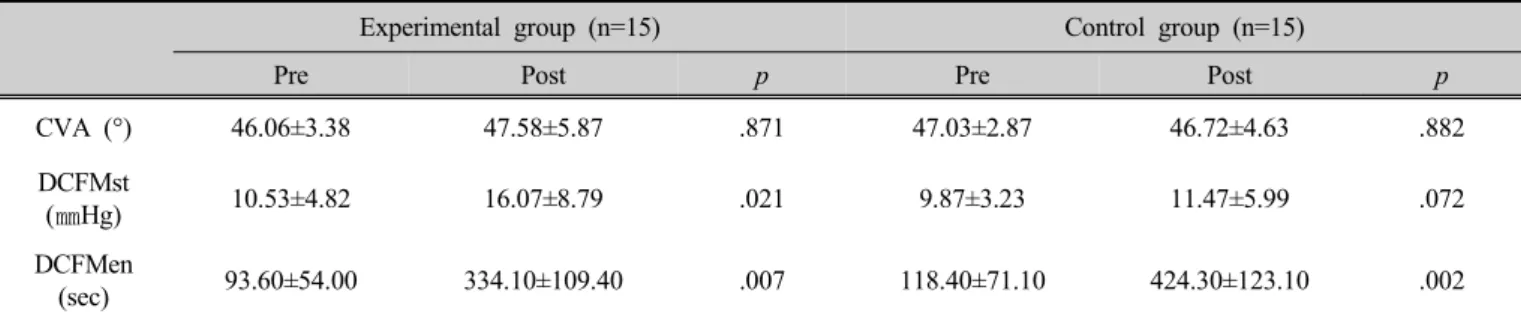
Based on the CVA measured before and after exercise, both the experimental and control groups showed no significant changes in CVA. Comparing the changes in the strength of the DCF muscles, the experimental group showed a statistically significant increase after exercise (p<0.05), whereas the control group showed no significant change. However, both groups showed statistically significant improvement in muscle endurance after exercise (Table 2).

Experimental group (n=15) Control group (n=15)

Pre Post p Pre Post p

CVA (°) 46.06±3.38 47.58±5.87 .871 47.03±2.87 46.72±4.63 .882

DCFMst

(㎜Hg) 10.53±4.82 16.07±8.79 .021 9.87±3.23 11.47±5.99 .072

DCFMen

(sec) 93.60±54.00 334.10±109.40 .007 118.40±71.10 424.30±123.10 .002

Mean±SD, CVA; craniovertebral angle, DCFMst; deep cervical flexor muscles strengthen, DCFMen; deep cervical flexor muscles endurance

Table 2. Comparison of parameters pre and post exercise (n=30)

2. Differences between the groups

There was a statistically significant difference in strength

between the two groups (p<0.05). But no statistically

significant difference in endurance (Table 3).

(5)

Experimental group (n=15) Control group (n=15) p

CVA (°) 1.52±5.89 -0.31±5.18 .17

DCFM strengthen (㎜Hg) 5.53±3.87 1.60±3.17 .023

DCFM endurance (sec) 240.53±55.4 305.87±56.0 .075

Mean±SD, CVA; craniovertebral angle, DCFM; deep cervical flexor muscles

Table 3. Comparison of changes between groups (n=30)

Ⅳ. Discussion

Many studies have been performed to investigate the effects of various neck exercises, including chin tuck exercise, on CVA, muscle activity, and the strength and endurance of the DCF muscles in subjects with FHP.

However, there has been little research on differences in the effects of modified chin tuck exercise with corrected alignment on cervical curvature, the strength and endurance of the DCF muscles. so we conducted this study to determine the effects of modified chin tuck exercise with maintain the cervical curvature on the CVA, the strength and endurance of the DCF muscles.

Kong et al. (2017) reported that a 4-week modified cervical exercise, which performed three times per day was effective for correcting FHP in smartphone users. As the result, the mean of the participants’ CVA was significantly increased from 49.0±5.1 to 57.8±4.8 (p<0.05). The results of this study showed that there were not significant differences between pre and post exercise in both group in CVA. However the mean was increased from 46.06±3.38 to 47.58±5.87 in experimental group, and decreased from 47.03±2.87 to 46.72±4.63 in control group. This finding implies that the chin tuck exercise combined with a device designed to help form an angle of cervical lordosis was more effective than general chin tuck exercise in forming a cervical lordosis angle and eventually correcting FHP.

Iqbal et al. (2013) reported that neck exercises, including chin tuck exercise with a biofeedback balloon placed at the

back of the subject's neck, significantly increased the strength and endurance of the DCF muscles. In this study, the post-exercise strength of the DCF muscles increased in the experimental and control groups, but only the experimental group showed a statistically significant increase the strength of the DCF muscles (p<0.05). Thus, the application of an exercise device that helped subjects maintain their cervical curvature appears to have contributed to this result.

The post-exercise endurance of the DCF muscles showed statistically significant increases in both groups, matching the findings of previous studies. The deep flexor muscles play the greatest role in maintaining the stability of the cervical vertebrae, and when the stability of each segment of the cervical vertebrae falls, the movement of the superficial flexor muscle such as sternocleidomastoid becomes more active than in the deep cervical flexor muscles (Winters et al., 1993). For this reason, the modified exercise in this study provided the stability of each segment of the cervical vertebrae, which is thought to result in improved muscular strength of the deep flexor muscles.

This study has limitations that may have affected the

results: the camera stand was not adjusted according to the

height of the subjects when taking a picture of each subject

and quantification of the device to maintain the curvature of

the neck is necessary. If we consider the method to

overcome these limitations, we can get better results.

(6)

Ⅴ. Conclusion

The purpose of this study was to determine the effects of chin tuck exercise combined with a device for cervical curvature. The chin tuck exercise performed with a device to allow FHP subjects to maintain the lordotic curvature in their neck led to significant increases in the strength of the DCF muscles. Therefore, we suggest that the application of chin tuck exercise combined with a device designed to maintain the lordotic curvature in the neck is likely to yield better outcomes in FHP subjects in future studies.

Reference

Boyd-Clark LC, Briggs CA, Galea MP(2001). Comparative histochemical composition of muscle fibres in a pre- and a postvertebral muscle of the cervical spine. J Anat, 199(6), 709-716.

Boyd-Clark LC, Briggs CA, Galea MP(2002). Muscle spindle distribution, morphology, and density in longus colli and multifidus muscles of the cervical spine.

Spine, 27(7), 694-701.

Braun BL, Amundson LR(1989). Quantitative assessment of head and shoulder posture. Arch Phys Med Rehabil, 70(4), 322-329.

Cagnie B, Dickx N, Peeters I, et al(2008). The use of functional MRI to evaluate cervical flexor activity during different cervical flexion exercises. J Appl Physiol (1985), 104(1), 230-235.

Cheung Lau HM, Wing Chiu TT, Lam TH(2009). Clinical measurement of craniovertebral angle by electronic head posture instrument, a test of reliability and validity. Man Ther, 14(4), 363-368.

Chiou WK, Chou WY, Chen BH(2012). Notebook computer use with different monitor tilt angle, effects on posture, muscle activity and discomfort of neck pain users. Work, 41(1), 2591-2595.

Christensen ST, Hartvigsen J(2008). Spinal curves and health, a systematic critical review of the epidemiological literature dealing with associations between sagittal spinal curves and health. J Manipulative Physiol Ther, 31(9), 690-714.

Conley MS, Meyer RA, Bloomberg JJ, et al(1995).

Noninvasive analysis of human neck muscle function.

Spine, 20(23), 2505-2512.

Diab AA, Moustafa IM(2012). The efficacy of forward head correction on nerve root function and pain in cervical spondylotic radiculopathy, a randomized trial.

Clin Rehabil, 26(4), 351-361.

Durall CJ(2012). Therapeutic exercise for athletes with nonspecific neck pain, a current concepts review. Sports Health, 4(4), 293-301.

Fernandez de Las Peñas C, Cuadrado ML, Pareja JA(2007).

Myofascial trigger points, neck mobility, and forward head posture in episodic tension-type headache.

Headache, 47(5), 662-672.

Ishida H, Suehiro T, Kurozumi C, et al(2015). Correlation between neck slope angle and deep cervical flexor muscle thickness in healthy participants. J Bodyw Mov Ther, 19(4), 717-721.

Iqbal ZA, Rajan R, Khan SA, et al(2013). Effect of deep cervical flexor muscles training using pressure biofeedback on pain and disability of school teachers with neck pain. J Phys Ther Sci, 25(6), 657-661.

Johnson GM(1998). The correlation between surface measurement of head and neck posture and the anatomic position of the upper cervical vertebrae. Spine, 23(8), 921-927.

Khayatzadeh S, Kalmanson OA, Schuit D, et al(2017).

Cervical spine muscle-tendon unit length differences between neutral and forward head postures, biomechanical study using human cadaveric specimens.

Phys Ther, 97(7), 756-766.

Kim JY(2015). Effects of deep cervical flexors

strengthening exercise on cervical-shoulder angle,

disability index and pain and in patients with chronic

(7)

neck pain. Korean J Orthop Man Ther, 21(2), 33-37.

Kong YS, Kim YM, Shim JM(2017). The effect of modified cervical exercise on smartphone users with forward head posture. J Phys Ther Sci, 29(2), 328-331.

Mayoux-Benhamou MA, Revel M, Vallée C, et al(1994).

Longus colli has a postural function on cervical curvature. Surg Radiol Anat, 16(4), 367-371.

Murray M, Lange B, Nørnberg BR, et al(2015). Specific exercise training for reducing neck and shoulder pain among military helicopter pilots and crew members, a randomized controlled trial protocol. BMC Musculoskelet Disord, 16, 198.

Nejati P, Lotfian S, Moezy A, et al(2014). The relationship of forward head posture and rounded shoulders with neck pain in Iranian office workers. Med J Islam Repub Iran, 28(1), 164-170.

Noh HJ, Shim JH, Jeon YJ(2013). Effects of neck stabilization exercises on neck and shoulder muscle activation in adults with forward head posture. JDCTA, 7(12), 492-498.

Page P, Frank C, Lardner R(2010). Assessment and treatment of muscle imbalance, the Janda approach. 1st ed, Champlain, Human Kinetics, pp.195.

Sahrmann S(2010). Movement system impairment

syndromes of the extremities, cervical and thoracic spines. St Louis, Mosby, pp.51-86.

Vasavada AN, Li S, Delp SL(1998). Influence of muscle morphometry and moment arms on the moment-generating capacity of human neck muscles.

Spine, 23(4), 412-422.

Winters JM, Peles JD, Osterbauer PJ, et al(1993).

Three-dimensional head axis of rotation during tracking movements. a tool for assessing neck neuromechanical function. Spine, 18(9), 1178-1185.

Yip CH, Chiu TT, Poon AT(2008). The relationship between head posture and severity and disability of patients with neck pain. Man Ther, 13(2), 148-154.

Yoo WG, Yi CM, Cho SH, et al(2008). Effects of the height of ball-backrest on head and shoulder posture and trunk muscle activity in VDT workers. Ind Health, 46(3), 289-297.

Yoon SH(2017). The immediate effect of postural

correction using a stick on shoulder muscle activity and

strength during isometric shoulder in subjects with

forward head and rounded shoulder posture. Graduate

school of Inje University, Republic of Korea, Master’s

thesis.

수치

Table 1. Characteristics of study subjects    (n=30)
Table 2. Comparison of parameters pre and post exercise      (n=30)
Table 3. Comparison of changes between groups      (n=30)

참조

관련 문서

This study compared the effects of the initial head position (i.e., a HHP versus a relaxed head position) of subjects with and without a FHP on the thickness of the deep

PURPOSE: The purpose of this study was to compare the effects of three interventions (intervention by passive range of motion exercise plus manual cervical traction, Mulligan’s

The purpose of this study was to investigate the effects of combined exercise training and chiropractic on the grip strength and cervical muscle strength of subjects with forward

Purpose : The purpose of this study was to investigate the effect of 2 weeks of backward walking exercise (BWE) on cervical angle and gait parameters

Purpose : The purpose of this study was to evaluate the effect of craniocervical flexion exercise on deep cervical flexor thickness and gait in children with

Original Article Immediate Effects of Roller Massage for Posterior Neck Muscles on the Muscle Strength and Range of Motion for Cranio-Cervical Flexion in Subjects With Forward