• 검색 결과가 없습니다.

Effect of 2 Weeks Backward Walking Exercise on Cervical Angle and Gait Parameters in College Students with Forward Head Posture

N/A
N/A
Protected

Academic year: 2021

Share "Effect of 2 Weeks Backward Walking Exercise on Cervical Angle and Gait Parameters in College Students with Forward Head Posture"

Copied!
10
0
0

로드 중.... (전체 텍스트 보기)

전체 글

(1)

2주간 뒤로 걷기 운동이 앞쪽 머리 자세 대학생들의 목뼈 각도와 걸음 변수에 미치는 영향

박한규

1

박 진

1

동주대학교 물리치료과 교수,

2

드림솔병원 근골격계센터 물리치료사

Effect of 2 Weeks Backward Walking Exercise on Cervical Angle and Gait Parameters in College Students with Forward Head Posture

Han-Kyu Park, PT, Ph.D

1

Jin Park, PT, Ph.D

1

Dept. of Physical Therapy, Dongju College, Professor

2ǂ

Center of Musculoskeletal, Drimsol Hospital, Physical Therapist

Abstract

Purpose : The purpose of this study was to investigate the effect of 2 weeks of backward walking exercise (BWE) on cervical angle and gait parameters in college students with forward head posture.

Methods : Fifteen subjects participated in the experiment. All the participants had a craniovertebral angle (CVA) of 55 degrees or less. The purpose of the study was explained to all the subjects prior to participation, and volunteered to take part in the study.

A camera capable of taking pictures of the lateral plane was installed at a distance of 1.5 meters from each subject. Images of forward head posture were obtained before and after performing the BWE, and the CVA and craniorotational angle (CRA) were compared pre- versus post exercise. Foot pressure and gait parameters (step length of left and right, stride length, stance of left and right, swing of left and right, step time of left and right, and stride time) were measured using a rehabilitation treadmill. The subjects performed the BWE for 2 weeks. The exercise program consisted of a 5-minute warm-up exercise, 20-minute main exercise, and 5-minute cool-down exercise. In the main exercise, the treadmill speed was set to 2.4 km/h in the first week and 3.4 km/h in the second week. A paired t test was used to compare the CVA and CRA and gait parameters before and after the exercise.

Results : Comparison of the CVA and CRA before and after the BWE revealed a significant difference post exercise, with a marked improvement in forward head posture after the exercise (p<.05).

Conclusion : Based on the results of this study, the BWE is considered to be an effective exercise for the forward head posture.

Also, additional research is needed to shed light on the impact of the BWE on gait parameters.

Key Words : backward walking exercise, craniorotational angle, craniovertebral angle, forward head posture, gait

ǂ

교신저자 : 박진, [email protected]

1)

논문접수일 : 2021년 7월 8일 | 수정일 : 2021년 7월 29일 | 게재승인일 : 2021년 8월 6일

(2)

Ⅰ . 서 론

정보기술의 발달로 스마트폰과 컴퓨터의 사용이 증가 하면서 장시간 화면을 볼 때 머리와 목의 위치가 몸통 (torso)보다 앞쪽으로 유지되며 비정상적인 정렬의 결과 로 앞쪽 머리 자세(forward head posture), 등뼈의 뒤굽음 (kyphosis) 증가와 둥근 어깨(rounded shoulder)가 발생한 다(Kang 등, 2012; Kim & Kim, 2019; Lynch 등, 2010). 젊 은 사람들중에 잘못된 자세로 인한 근육뼈대계 통증 중 에서 허리 통증 다음으로 목 통증이 가장 흔한 통증으로 나타났으며 특히 청소년 17.2 %에서 목 통증을 경험한 다(Hoftun 등, 2011; Nejati 등, 2015). 앞쪽 머리 자세는 목 통증 뿐 아니라 운동학적인 측면과 근육의 활성도에 영향을 준다(Szeto 등, 2002). 앞쪽 머리 자세는 목뼈의 안정성에 아주 중요한 역할을 하는 깊은 목뼈 굽힘근육 들(deep cervical flexor)은 약해지고 길어져서 아래 목뼈

가 굽힘이 나타나고, 위등세모근, 뒤통수밑근

(suboccipital), 반가시근(semispinalis), 머리널판근 (splenius), 목빗근(sternocleidomastoids), 어깨올림근들 (levator scapulae muscles)은 짧아져 위 목뼈가 과다폄이 나타난다(Sikka 등, 2020; Szeto 등, 2002). 이러한 근육의 불균형 뿐 아니라 목 돌림과 굽힘에 큰 영향을 주며 정 적 균형 조절에 부정적인 영향을 미친다(Mahmoud 등, 2019).

앞쪽 머리 자세는 머리의 앞쪽 이동과 등의 뒤굽음이 증가하여 비정상적인 목과 어깨의 정렬을 초래하고 전 체적인 척추와 골반까지 영향을 주어 허리 통증, 움직임 의 패턴 변화 즉 신체의 무게중심을 앞쪽으로 이동시켜 잘못된 패턴의 걸음을 유도한다(Pozzo 등, 1991;

Sangtarash 등, 2015). Kalsi-Ryan 등(2020)은 정상적인 목 뼈의 곡선을 유지하지 못하고 척수가 압박받는 만성 퇴 행성 목뼈 척수병증(degenerative cervical myelopathy)을 가진 사람들은 걸을 때 인체의 무게중심이 앞쪽으로 향 하며 안정성이 필요한 한발 딛기나 양발 딛기(single and double support)에서 위운동신경세포(upper motor neuron) 와 고유수용성 감각의 기능이상으로 걸음에 부정적인 영향을 준다고 하였다. Dietz(1992), Drew 등(2004) 그리 고 Musa 등(1992)은 비정상적인 목 정렬의 변화는 자세

유지나 걸을 때 안정성을 제공하는 내림척수로 (descending tracts)인 적색척수로(rubrospinal tract), 그물척 수로 (reticulospinal tract), 안뜰척수로(vestibulospinal tract) 에 영향을 미친 결과라고 하였다. 따라서 앞쪽 머리 자 세로 발생하는 목뼈의 변화 그리고 이차적으로 발생하 는 척추 전체의 변화, 무게중심의 앞쪽 이동으로 걸음에 도 영향을 미치기 때문에 이러한 비정상적인 정렬과 움 직임의 패턴을 효과적으로 해결하기 위하여 걷기 운동 이 추천된다(Hoogkamer 등, 2014).

걷기 운동은 다리, 골반, 몸통과 목, 머리의 서로 유기 적인 관계를 유지하며 적절한 관절운동범위와 안정성을 가져오기 때문에 몸의 불안정성과 전체적인 정렬을 효 과적으로 조절할 수 있다(Hoogkamer 등, 2014; Park 등, 2020). Ansari 등(2018)은 뒤로 걷기 운동(backward walking exercise)은 앞으로 걷기 운동(forward walking exercise)보다 관절 역학적(kinetics)이고 운동학적인 (kinematics) 효과를 언급하였다. 뒤로 걷기 운동은 걸음 시간과 빈도의 증가, 걸음 능력과 균형 능력 증가, 지구 력을 증가시킨다(Nadeau 등, 2016; Thomas & Fast, 2000).

뒤로 걷기 운동은 앞으로 걷기 운동보다 많은 근육의 동 원과 활성도, 걸음 거리(step length) 증가, 신진대사와 산 소 소비가 훨씬 높다(Foster 등, 2016; Kim 등, 2013;

Moriello 등, 2014). 뒤로 걷기 운동은 시각 정보가 부족 하여 걸음 속도는 느리지만 균형이나 움직임의 증가를 가져온다(Kim 등, 2013). Jansen 등(2012)은 뒤로 걷기는 앞으로 걷기만큼 중추 유형 발생기(central pattern generator)를 발생시킨다. Joshi 등(2015)은 뒤로 걷기 시 디딤기 초기에 발꿈치가 닿지 않으며 무릎-넙다리 관절 의 낮은 압박력을 일으키며 무릎관절에 흡수되는 힘을 감소시킨다. 또한 Balasukumaran 등(2019)은 뒤로 걷기 동안 다리 근육의 활성은 높은 운동단위의 동원을 일으 킨다고 하였다. 앞쪽 머리 자세와 관련한 선행연구에서 는 초등학생을 대상으로 실시한 뒤로 걷기 운동이 목뼈 중력선과 곡선에서 유의한 차이를 확인하였다(Jo, 2018).

Park 등(2020)은 앞쪽 머리 자세 대학생을 대상으로 뒤로

걷기 운동의 단기적인 효과를 확인한 결과 머리척추각

과 머리회전각에서 유의한 차이가 나타났다. 또한 뒤로

걷기 운동과 유사한 이점을 가지고 있는 아래 방향으로

진행되는 트레드밀 위에서 걷기 운동은 머리척추각과

(3)

등뼈의 뒤굽음에서 일반적인 트레드밀 군과 비교하여 유의한 차이를 확인하였다(Lee, 2020).

따라서 선행연구들을 바탕으로 본 연구는 앞쪽 머리 자세를 교정하기 위한 부분적인 치료적 접근법을 넘어 척추의 전반적인 정렬과 무게중심의 변화 그리고 걸음 에까지 영향을 미치고 앞으로 걷기 운동보다 많은 운동 학적인 효과를 가지고 있는 뒤로 걷기 운동을 2주간 앞 쪽 머리 자세를 가진 20대 대상자들에게 실시하여 앞쪽 머리 자세의 머리척추각과 머리회전각뿐만 아니라 목 정렬의 변화로 나타나는 비정상적인 걸음에 어떠한 영 향을 미치는지 확인하고자 진행하였다.

Ⅱ. 연구 방법

1. 연구 대상

본 연구는 2021년 5월 3일부터 14일까지 2주 동안 부

산 D대학교에 재학중인 20대 대학생들을 대상으로 본 연구의 목적과 방법에 대하여 설명을 듣고 자발적으로 동의한 자들 중에 귀의 중심이 어깨의 부리돌기(coracoid process)보다 2.5 ㎝ 이상 앞에 위치한 대상자 42명중 머 리척추각이 55 ˚이하인 자 19명을 최종적으로 선정하 였다(Kim, 2012; Park 등, 2020). 대상자 산출은 Park 등 (2020)의 연구 결과를 토대로 G*Power 3.1.9.4 프로그램 을 이용하여 효과크기 1.12, 유의수준 .05, 검정력 80 % 로 계산하여 7명의 표본수가 산출되었다. 중도 탈락을 감안하여 앞쪽 머리 자세를 가진 19명을 대상으로 실시 하였으나 실험 도중 코로나 19의 특수한 상황(자가격리 및 진료) 2명과 개인 사정 2명이 중도 탈락하여 최종 15 명을 대상으로 실시하였다. 연구에 참여한 대상자들은 과거 수술 경험이 없으며 평상시 운동을 하지 않는 자들 중에서 트레드밀 위에서 뒤로 걷기가 가능한 자들로 선 정하였다. 본 연구는 헬싱키 선언에 의한 연구윤리를 준 수하였다. 대상자들의 일반적인 특성은 Table 1과 같다.

Characteristics Values

Age (years) 23.71±5.61

a

Gender (M/F) 8/7

Height (㎝) 168.29±8.30

Weight (㎏) 69.12±17.84

CVA

b

(˚) 50.09±4.60

a

Mean±standard deviation,

b

CVA; craniovertebral angle

Table 1. General characteristics of subjects (n= 15)

2. 연구 절차 및 방법

1) 머리척추각과 머리회전각

뒤로 걷기 운동 중재 전 머리척추각과 머리회전각을 확인하기 위하여 대상자들의 목뼈 7번 가시돌기(spinous process)와 귀구슬(tragus)에 마커를 이용하여 표시를 하 였다. 대상자들은 맨발로 제자리 걸음을 5회 시행한 뒤 편안한 자세로 양팔을 몸통 옆에 두고 머리의 가장 편안 한 자세를 만들기 위하여 머리의 굽힘과 폄을 큰 폭으로 시작하여 점차적으로 폭을 줄이면서 머리의 가장 자연

스러운 자세를 만드는 자가 균형 자세(self balance

posture)를 실시하였다. 눈에 의한 머리 자세의 변화를 줄

이기 위하여 대상자들의 키를 고려하여 각자의 눈높이

에 맞는 정면의 한 지점을 설정하여 바라보게 하였다

(Park 등, 2015; Son, 2012). 그리고 대상자의 1.5 m 떨어

진 곳에 대상자들의 어깨 높이에 맞는 삼각대를 설치하

여 카메라(SM-G988N, Samsung, Korea)를 이용하여 사진

을 촬영하였다. 머리척추각은 제7 목뼈의 가시돌기를 기

준으로 수평선을 긋고 제7 목뼈의 가시돌기와 귀구슬 부

분을 연결한 선이 만나는 각을 의미하며 아래 목뼈의 굽

(4)

힘 상태를 나타낸다. 머리척추각이 40 ˚ 이하이면 심각 한 앞쪽 머리 자세를 의미한다. 48 ˚~55 ˚이면 가벼운 앞쪽 머리 자세를 의미하고 55 ˚ 이상이면 정상 상태를 의미한다. 머리회전각은 제7 목뼈의 가시돌기와 귀구슬 을 연결한 선과 귀구슬과 가쪽 눈구석을 연결한 선에 의 해 형성된 각으로 위 목뼈의 폄 정도를 나타낸다. 앞쪽 머리 자세의 경우 머리회전각은 145 ˚ 이상으로 나타 난다(Park 등, 2015; Salahzadeh 등, 2014; Silva 등, 2010)(Fig 1).

Fig 1. Cranial angle (craniovertebral angle (A), craniorotation angle (B) with Image J)

촬영과 사진 분석은 각각 동일한 측정자가 실시하였 다. 촬영 사진의 각도 분석은 프리웨어(freeware) 프로그 램인 Image J(NIH, Image J, USA)를 이용하여 머리척추 각과 머리회전각을 3회 측정하여 평균값을 채택하였다 (Park 등, 2020). Image J는 1997년 미국국립보건원 (national institutes of health; NIH) 웨인 러스번드에 의해 처음 사용된 프로그램으로 이미지를 다양한 방법으로 분석하기 위하여 자주 사용되는 프로그램이다(Rueden 등, 2017; Sun 등, 2015). 뒤로 걷기 운동 2주 중재 후 머 리척추각과 머리회전각은 같은 방법으로 측정하였다.

2) 걸음 변수

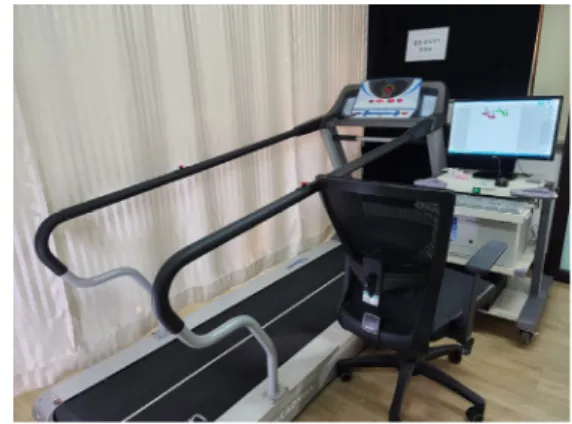
뒤로 걷기 운동 중재 전 대상자들의 걸음 변수를 확인 하기 위하여 걸음 분석 트레드밀(Zebris FDM-Treadmill

AP1171, Apsun Iic, Germany)장비를 이용하였다(Fig 2).

걸음 장애가 있는 환자를 대상으로 걸음 능력 회복 및 증진을 위하여 걸음 훈련기기와 걸음 능력의 감소와 치 료에 따른 기능회복을 객관적으로 알기 위한 분석장치 로 걸음 분석계와 의료용 압력계가 설치된 장치이다. 장 치 위에서 서거나 걸으면서 발생하는 압력의 변화 그리 고 걸음 변수들의 정보를 소프트웨어 Zebris FDM에서 결과값 산출 및 출력이 가능한 시스템으로 구성 되어있 다(Apsun Inc, 2020). 재활용 트레드밀 위에서 10초간 서 있는 정적인 상태에서의 발바닥 압력(foot pressure) 그리 고 30초간 걸을 때 나타나는 동적인 상태에서의 발바닥 압력, 걸음 길이(step length), 큰걸음 길이(stride length), 디딤기(stance phase), 흔듦기(swing phase), 걸음 시간(step time)을 확인하였다. 걸음 변수 측정 시 걸음 속도는 장 비의 메뉴얼에 따라 각자 대상자들의 가장 편안한 걸음 속도를 확인하기 위하여 예비 실험 결과 남자 대상자들 은 3.5 ㎞/h, 여자 대상자들은 2.5 ㎞/h로 설정하였다. 모 든 걸음 변수의 결과값은 3회 측정하여 평균값을 채택하 였다. 뒤로 걷기 운동 2주 중재 후 걸음 변수는 위와 같 은 방법으로 재측정하였다. 걸음 변수와 발바닥 압력 측 정 시에 대상자들은 맨발로 측정하였다.

Fig 2. Gait analysis

3) 운동 방법

본 연구에서의 뒤로 걷기 운동 프로그램은 기존 선행

연구인 Park 등(2020)의 운동 방법을 수정 및 보완하여

실시하였다. 2주간 주 3회 30분간 뒤로 걷기 운동을 실

시하였다. 운동 프로그램의 진행은 대상자들은 맨발로

(5)

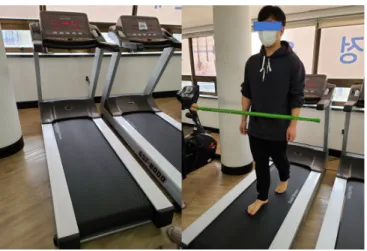
트레드밀(Gold stone GST-8000, SAMHYUNG, Korea)에 서 준비운동으로 기존 설정값인 시속 1.4 ㎞/h로 5분간 실시하였다. 본 운동은 1주차에는 시속 2.4 ㎞/h로 20분 간 실시하였다. 2주차 본 운동은 시속 3.4 ㎞/h로 20분간 실시하였다. 마무리 운동은 시속 1.4 ㎞/h로 5분간 실시 하였다. 본 운동 20분은 10분 운동, 1분 휴식, 10분 운동 으로 설정하였다(Table 2). 트레드밀에서 뒤로 걷기 운동

을 할 때 대상자들의 적당한 보폭과 거리를 유지하기 위 하여 트레드밀 중간에 막대(bar)를 두었다(Fig 3). 본 실 험 전에 대상자들에게 적당한 연습 시간을 제공하였다.

트레드밀에서 뒤로 걷기 운동을 할 때 대상자들이 어지 러움과 감각 이상을 호소할 때에는 즉시 운동을 멈추었 다.

Warm up- 5 minutes at 1.4 ㎞/h on the treadmill

Main exercise

First week- 20 minutes at 2.4 ㎞/h on the treadmill (After 10 minutes exercise, 1 minutes rest and 10 minutes exercise)

Second week- 20 minutes at 3.4 ㎞/h on the treadmill (After 10 minutes exercise, 1 minutes rest and 10 minutes exercise) Cool down- 5 minutes at 1.4 ㎞/h on the treadmill

Table 2. Exercise program

Fig 3. Exercise method

3. 자료분석

대상자들의 결과값에 대한 통계처리를 위하여 SPSS 22.0(SPSS Inc., Chicago IL, USA)을 통하여 분석하였다.

샤피로 윌크(Shaprio Wilk)를 통해 정규성 검정을 확인하 였다(p>.05). 뒤로 걷기 운동 중재 전과 후의 목뼈 각도 와 걸음 변수의 변화를 확인하기 위하여 대응표본 t-검 정(paired t-test)을 실시하였다. 자료의 모든 통계학적 유 의수준(p)은 .05로 검정하였다.

Ⅲ . 결 과

1. 목뼈 각도의 변화 비교

뒤로 걷기 운동에 따른 목뼈 각도의 변화 비교는

Table 3과 같다. 2주간 뒤로 걷기 운동 전과 후의 머리척

추각과 머리회전각에서 유의한 차이가 나타났다(p<.05).

(6)

Parameters Pre exercise Post exercise t p

CVA 50.09±4.60

a

54.40±5.30 -4.33 .00

CRA 151.05±7.65 146.61±7.23 2.77 .01

a

Mean±SD, CVA; craniovertebral angle, CRA; craniorotational angle

Table 3. Comparison of CVA and CRA before and after walking backward exercise (unit: ˚)

2. 걸음 변수의 변화 비교

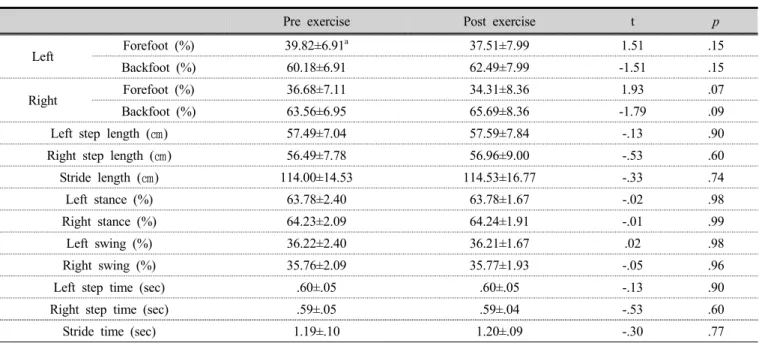
뒤로 걷기 운동에 따른 걸음 변수들의 변화 비교는 Table 4와 같다. 2주간 뒤로 걷기 운동 전과 후의 왼쪽과

오른발의 앞쪽과 뒤쪽 압력, 왼쪽과 오른쪽의 걸음 거리, 큰걸음 거리, 왼쪽과 오른쪽의 디딤기, 왼쪽과 오른쪽의 흔듦기, 왼쪽과 오른쪽의 걸음 시간, 큰걸음 시간에서 유 의한 차이가 나타나지 않았다(p>.05).

Pre exercise Post exercise t p

Left Forefoot (%) 39.82±6.91

a

37.51±7.99 1.51 .15

Backfoot (%) 60.18±6.91 62.49±7.99 -1.51 .15

Right Forefoot (%) 36.68±7.11 34.31±8.36 1.93 .07

Backfoot (%) 63.56±6.95 65.69±8.36 -1.79 .09

Left step length (㎝) 57.49±7.04 57.59±7.84 -.13 .90

Right step length (㎝) 56.49±7.78 56.96±9.00 -.53 .60

Stride length (㎝) 114.00±14.53 114.53±16.77 -.33 .74

Left stance (%) 63.78±2.40 63.78±1.67 -.02 .98

Right stance (%) 64.23±2.09 64.24±1.91 -.01 .99

Left swing (%) 36.22±2.40 36.21±1.67 .02 .98

Right swing (%) 35.76±2.09 35.77±1.93 -.05 .96

Left step time (sec) .60±.05 .60±.05 -.13 .90

Right step time (sec) .59±.05 .59±.04 -.53 .60

Stride time (sec) 1.19±.10 1.20±.09 -.30 .77

a

Mean±SD

Table 4. Comparison of gait parameters before and after walking backward exercise (n= 15)

Ⅳ . 고 찰

본 연구는 앞쪽 머리 자세에 의해 변화하는 골반 및 척추의 정렬과 비정상적인 걸음을 교정하기 위하여 걷 기 운동의 장점을 활용한 뒤로 걷기 운동을 통하여 앞쪽 머리 자세의 대학생들을 대상으로 2주간 뒤로 걷기 운동 이 목뼈 각도와 걸음 변수에 미치는 영향을 확인하기 위 하여 진행하였다.

본 연구에서 실시한 뒤로 걷기 운동은 관절 및 운동

역학적인 부분에서 걸음 시간과 빈도 증가, 걸음 능력

및 균형 증가를 가져온다(Ansari 등, 2018; Nadeau 등,

2016). 또한 근 활성도의 증가, 신진대사와 산소 소비의

증가, 움직임의 증가를 가져온다(Foster 등, 2016; Kim

등, 2013). 결과적으로 앞쪽 머리 자세에서 나타나는 머

리의 앞쪽 이동, 등뼈의 뒤굽음 증가, 움직임 패턴의 변

화로 나타나는 걸음 패턴을 교정하기 위하여 걷기 운동

특히 뒤로 걷기 운동이 추천된다(Hoogkamer 등, 2014;

(7)

Jansen 등, 2012; Park 등, 2020).

본 연구 결과 2주간 뒤로 걷기 운동 후 머리척추각과 머리회전각에서 유의한 차이를 확인하였다. Park 등 (2020)은 20대 대학생을 대상으로 실시한 뒤로 걷기 운 동의 즉각적인 효과를 확인한 결과 머리척추각과 머리 회전각에서 유의한 차이를 확인하였다. Lee(2020)는 20~30대 남자들을 대상으로 실시한 4주간 아래 방향의 트레드밀에서의 훈련이 머리척추각의 증가를 확인하였 다. Jo(2018)는 앞쪽 머리 자세의 초등학생을 대상으로 실시한 앞·뒤 걷기 운동을 통하여 목뼈 중력선은 뒤로 걷기에서 유의한 차이가 나타났으며 목뼈 곡선은 앞쪽 걷기는 5 ˚의 증가, 뒤로 걷기는 8 ˚의 증가가 나타났 으며 그룹 간의 유의한 차이를 확인하였다. 이러한 결과 는 뒤로 걷기 운동은 전체적인 체중을 지지하기 위하여 지면 반발력을 빠르게 증가시키며(Carneiro 등, 2012), 더 많은 근육신경의 동원으로 허리의 유연성, 골반의 정렬 그리고 인체 중심부 근육들의 활성화를 가져온 결과라 고 하였다(Bono, 2004; Hao & Chen, 2011; Heck &

Sparano, 2000). 또한 뒤로 걸을 때 시각적인 정보의 부족 으로 나타나는 불안정성을 조절하기 위하여 균형이나 움직임의 증가가 나타난 결과라고 하였다(Kim 등, 2013). 트레드밀에서 뒤로 걷기 운동할 때 무게중심에 대한 바른 자세 정렬에 필요한 목뼈 주위 근육들의 자극 과 배 근육들의 활성화가 근육신경의 자극으로 자세 유 지에 필요한 근육들의 활성화로 인하여 나타난 결과라 고 하였다(Lee, 2020; Park 등, 2020). 가장 중요한 것은 무게 중심적인 측면에서 뒤로 걷기 운동은 발가락이 먼 저 닿고 발꿈치가 닿으면서 앞쪽 머리 자세 대상자들의 척추 앞쪽으로 떨어지는 무게중심과 트레드밀 진행 방 향에 대한 대상작용의 결과라고 생각한다(Park 등, 2020).

목뼈의 변화와 관련된 걸음 변수의 의미 있는 변화는 왼쪽과 오른쪽 발의 앞쪽과 뒤쪽의 압력분포에서 유의 한 차이는 없었지만, 왼쪽 발 앞쪽의 압력분포는 운동후 – 2.31±5.91로 줄었으며 왼쪽 발 뒤쪽의 압력분포는 운동 후 2.31±5.91로 늘었다. 오른쪽 발 앞쪽의 압력분포는 운 동후 –2.37±4.75로 줄었으며 오른쪽 발 뒤쪽의 압력분포 는 운동후 2.13±4.63으로 늘었다. 결과적으로 뒤로 걷기 운동을 통한 근육신경의 동원, 인체 중심부 근육의 활성,

무게중심 이동과 관련된 자세 조절에 의한 목뼈 변화와 연관성이 있는 변화라고 생각한다(Balasukumaran 등, 2019; Kim 등, 2013; Moriello 등, 2014; Park 등, 2020).

뒤로 걷기 동안 시각 정보의 부족은 공간적, 시간적 걸음 변수의 증가를 가져와 결과적으로 걸음을 증가시 키기 위한 치료적 전략으로 고려된다고 하였으며(Zhao 등, 2010), 다른 걸음 훈련보다 뒤로 걷기 운동은 다리 근육의 협동작용(muscle synergy activation) 효과에 따른 신경 -근육 조절 증진에 효과적이라고 하였다(Hoogkamer 등, 2014; Zhang 등, 2014). Wang 등(2018)은 뒤로 걷기 운동은 앞으로 걷기 보다 걷는 속도와 큰 걸음 거리의 증가를 확인하였다. 뇌졸중 환자들을 대상으로 6주간 30 분 동안 주 5회 뒤로 걷기 운동을 실시한 결과 일어나 걷기 검사에서 유의한 차이를 확인하였다(Kang & Kim, 2018). 뇌졸중 환자들을 대상으로 8주간 총 30분 동안 주 3회 실시한 결과에서는 걷는 속도, 마비측 걸음 거리 그 리고 큰 걸음 거리에서 유의한 차이를 확인하였다(Shin

& Kang, 2017). 뇌성마비를 대상으로 8주간 30분 동안 실시한 트레드밀 위에서의 뒤로 걷기 운동을 통하여 시 공간적인 요소 중에서 양쪽 걸음 거리와 오른쪽 디딤기 시간이 유의한 차이가 나타났는데 이는 안정성과 대칭 성의 증가를 간접적으로 의미한다고 하였다(Kim, 2011).

Hao와 Chen(2011)은 평균 나이 7.19세 청소년을 대상으 로 12주간 주 2회씩 25분간 실시한 뒤로 걷기 운동을 통 하여 균형을 평가한 결과 뒤로 걷기 운동을 실시한 실험 군의 균형에 유의한 증가가 나타났지만 운동학적 분석 에서는 유의한 차이가 없었다. 그러나 앞으로 걷기와 비 교하여 뒤로 걷기 운동은 오른쪽 다리의 디딤기와 흔듦 기에서 증가, 큰 걸음 거리, 걷는 속도가 감소하였다.

뒤로 걷기 운동과 걸음과 관련된 선행 연구들의 결과

와는 달리 걸음 변수와 관련된 본 연구의 결과에서는 유

의한 차이가 나타나지 않았다. 신경계 환자들이나 청소

년을 대상으로 장기간 뒤로 걷기 운동을 실시한 선행연

구들과 본 연구 결과를 비교한 걸음 변수에서 가장 큰

차이점은 본 연구의 대상자들은 신체 건강한 대상자들

이며 신체 비대칭성의 크기 정도가 적은 그리고 앞쪽 머

리 자세의 각도가 가벼운 정도를 의미하는 머리척추각

평균 50 ˚ 이하의 대상자들을 대상으로 2주간 주 3회

30분간 실시한 결과라고 생각한다. 젊은 대상자들을 감

(8)

안하여 주별로 각기 다른 트레드밀 속도를 적용하였음 에도 본 연구의 대상자들에게 운동 강도와 중재 기간이 부족했던 것으로 생각된다.

본 연구 설계와 결과를 바탕으로 몇 가지 제한점이 존 재한다. 대상자 선정 기준에서 중증도 수준의 앞쪽 머리 자세 대상자 선정이 부족하였다. 뒤로 걷기 운동 시간 및 강도의 수정이 필요하다. 또한 2주간 뒤로 걷기 운동 이 목뼈의 변화와 걸음 변수에 미치는 영향을 확인하기 위한 사전적 연구의 의미로 대조군이 없었다. 따라서 본 연구의 제한점을 수정 및 보완하여 추가적인 연구가 이 루어져야 할 것으로 생각된다.

Ⅴ . 결 론

본 연구는 앞쪽 머리 자세인 20대 대학생 15명을 대상 으로 2주간 뒤로 걷기 운동이 머리척추각과 머리회전각 그리고 걸음 변수에 미치는 영향을 알아보고자 진행하 였다. 본 연구의 결과를 바탕으로 뒤로 걷기 운동은 앞 쪽 머리 자세의 목뼈 변화에 효과적으로 판단이 되지만 걸음 변수와 관련하여서는 부족한 대상자 선정기준, 중 재 강도 및 시간의 제한점 그리고 대조군과의 비교 연구 설계 들을 수정 및 보완하여 추가적인 연구가 이루어져 야 할 것으로 생각된다.

참고문헌

Ansari B, Bhati P, Singla D, et al(2018). Lumbar muscle activation pattern during forward and backward walking in participants with and without chronic low back pain:

an electromyographic study. J Chiropr Med, 17(4), 217-225. https://doi.org/10.1016/j.jcm.2018.03.008.

Balasukumaran T, Olivier B, Ntsiea MV(2019). The effectiveness of backward walking as a treatment for people with gait impairments: a systematic review and meta-analysis. Clin Rehabil, 33(2), 171-182.

https://doi.org/10.1177/0269215518801430.

Bono CM(2004). Low-back pain in athletes. J Bone Joint Surg Am, 86(2), 382-396.

Carneiro LC, Michaelsen SM, Roesler H, et al(2012).

Vertical reaction forces and kinematics of backward walking underwater. Gait Posture, 35(2), 225-230.

https://doi.org/10.1016/j.gaitpost.2011.09.011.

Dietz V(1992). Human neuronal control of automatic functional movements: interaction between central programs and afferent input. Physiol Rev, 72(1), 33-69.

https://doi.org/10.1152/physrev.1992.72.1.33.

Drew T, Prentice S, Schepens B(2004). Cortical and brainstem control of locomotion. Prog Brain Res, 143, 251-261. https://doi.org/10.1016/S0079-6123(03)43025-2.

Foster H, DeMark L, Spigel PM, et al(2016). The effects of backward walking training on balance and mobility in an individual with chronic incomplete spinal cord injury: a case report. Physiother Theory Pract, 32(7), 536-545. https://doi.org/10.1080/09593985.2016.1206155.

Hao WY, Chen Y(2011). Backward walking training improves balance in school-aged boys. Sport Med Arthrosc Rehabil Ther Technol, 3, Printed Online.

https://doi.org/10.1186/1758-2555-3-24.

Heck JF, Sparano JM(2000). A classification system for the assessment of lumbar pain in athletes. J Athl Train, 35(2), 204-211.

Hoftun GB, Romundstad PR, Zwart JA(2011). Chronic idiopathic pain in adolescence-high prevalence and disability: the young HUNT study 2008. Comparative Study Pain, 152(10), 2259-2266. https://doi.org/10.1016/

j.pain.2011.05.007.

Hoogkamer W, Meyns P, Duysens J(2014). Steps forward in understanding backward gait: from basic circuits to rehabilitation. Exerc Sport Sci Rev, 42(1), 23-29.

https://doi.org/10.1249/JES.0000000000000000.

Jansen K, Groote FD, Massaad F, et al(2012). Similar

muscles contribute to horizontal and vertical

acceleration of center of mass in forward and backward

walking: implications for neural control. J Neurophysiol,

107(12), 3385–3396. https://doi.org/10.1152/jn.01156.

(9)

2011.

Jo BG(2018). The effect of forward and backward walking on turtle neck syndrome in elementary students.

Graduate school of Korea National Sport University, Republic of Korea, Master’s thesis.

Joshi S, Vij JS, Singh SK(2015). Retrowalking: a new concept in physiotherapy and rehabilitation. Int J Sci Res, 4(10), 152-156.

Kalsi-Ryan S, Rienmueller AC, Riehm L, et al(2020).

Quantitative assessment of gait characteristics in degenerative cervical myelopathy: a prospective clinical study. J Clin Med, 9(3), Printed Online. https://doi.org/

10.3390/jcm9030752.

Kang JH, Park RY, Lee SJ, et al(2012). The effect of the forward head posture on postural balance in long time computer based worker. Ann Rehabil Med, 36, 98-104.

https://doi.org/10.5535/arm.2012.36.1.98.

Kang TW, Kim BR(2018). The effect of backward walking exercise using a mirror on balance and gait in patients with stroke. J Korean Soc Phys Med, 13(2), 53-60.

https://doi.org/10.13066/kspm.2018.13.2.53.

Kim EK, Kim SG(2019). Forward head posture (FHP) angle and plantar pressure resulting from oscillatory stimulation training of the shoulder joint: a randomized controlled trial. J Back Musculoskelet Rehabil, 32(1), 37-42. https://doi.org/10.3233/BMR-160748.

Kim SG(2011). Effectiveness of backward gait training on the treadmill in children with cerebral palsy. Graduate school of Catholic University of Daegu, Republic of Korea, Master’s thesis.

Kim SG, Ryu YU, Je HD, et al(2013). Backward walking treadmill therapy can improve walking ability in children with spastic cerebral palsy: a pilot study. Int J Rehabil Res, 36(3), 246-252. https://doi.org/10.1097/

MRR.0b013e32835dd620.

Kim YJ(2012). The effect of ballet program on turtle neck syndrome in office workers. Graduate school of Hanyang University, Republic of Korea, Master’s thesis.

Lee JH(2020). Effect of a 4-week downhill treadmill

walking exercise in subjects with thoracic kyphosis and forward head posture. Graduate school of Yonsei University, Republic of Korea, Master’s thesis.

Lynch SS, Thigpen CA, Mihalik JP, et al(2010). The effects of an exercise intervention on forward head and rounded shoulder postures in elite swimmers. Br J Sports Med, 44(5), 376-381. https://doi.org/10.1136/

bjsm.2009.066837.

Mahmoud NF, Hassan KA, Abdelmajeed SF, et al(2019).

The relationship between forward head posture and neck pain: a systematic review and meta-analysis. Review Curr Rev Musculoskelet Med, 12(4), 562-577.

https://doi.org/10.1007/s12178-019-09594-y.

Moriello G, Pathare N, Cirone C, et al(2014). Comparison of forward versus backward walking using body weight supported treadmill training in an individual with a spinal cord injury: a single subject design. Physiother Theory Pract, 30(1), 29-37. https://doi.org/10.3109/

09593985.2013.798845.

Musa I, Lawes N(1992). Understanding neuromuscular plasticity: a basic for clinical rehabilitation. London, Edward Arnolds.

Nadeau SE, Dobkin B, Wu SS, et al(2016). The effects of stroke type, locus, and extent on long-term outcome of gait rehabilitation: the LEAPS experience. Neurorehabil Neural Repair, 30(7), 615-625. https://doi.org/10.1177/

1545968315613851.

Nejati P, Lotfian S, Moezy A, et al(2015). The study of correlation between forward head posture and neck pain in Iranian office workers. Int J Occup Med Environ Health, 28(2), 295-303. https://doi.org/10.13075/ijomeh.

1896.00352.

Park HK, Kim TH, Kim DW(2020). The immediate effect of the backward walking exercise and verbal command on the forward head posture of college students in their 20s. Phys Ther Korea, 27(3), 185-190. https://doi.org/

10.12674/ptk.2020.27.3.185.

Park HK, Lee SY, Kim TH(2015). The exception case

about the diagnose forward head posture using the

(10)

craniovertebra angle, craniorotation angle and cobb angle: a case report. J Korean Soc Phys Med, 10(2), 29-34. https://doi.org/10.13066/kspm.2015.10.1.29.

Pozzo T, Berthoz A, Lefort L, et al(1991). Head stabilization during various locomotor tasks in humans.

II. Patients with bilateral peripheral vestibular deficits.

Exp Brain Res, 85(1), 208-217. https://doi.org/10.1007/

BF00230002.

Rueden CT, Schindelin J, Hiner MC, et al(2017). ImageJ2:

ImageJ for the next generation of scientific image data.

BMC Bioinformatics, 18(1), Printed Online.

https://doi.org/10.1186/s12859-017-1934-z.

Salahzadeh Z, Maroufi N, Ahmadi A, et al(2014).

Assessment of forward head posture in females:

observational and photogrammetry methods. J Back Musculoskelet Rehabil, 27(2), 131-139. https://doi.org/

10.3233/BMR-130426.

Sangtarash F, Manshadi FD, Sadeghi A(2015). The relationship of thoracic kyphosis to gait performance and quality of life in women with osteoporosis. Osteoporos Int, 26(8), 2203-2208.

https://doi.org/10.1007/s00198-015-3143-9.

Shin KH, Kang SH(2017). Changes in balance and gait following backward walking exercise in hemiplegic stroke patients. J Korean Soc Phys Med, 12(2), 21-31.

https://doi.org/10.13066/kspm.2017.12.2.21.

Sikka I, Chawla C, Seth S, et al(2020). Effects of deep cervical flexor training on forward head posture, neck pain, and functional status in adolescents using computer regularly. BioMed Res Int, 2020, Printed Online. https://doi.org/10.1155/2020/8327565.

Silva AG, Punt TD, Johnson MI(2010). Reliability and validity of head posture assessment by observation and a four-category scale. Man Ther, 15(5), 490-495.

https://doi.org/10.1016/j.math.2010.05.002.

Son MJ(2012). The effect of postural training through action observation on forward head posture and rounded shoulder posture. Graduate school of Hanseo University, Republic of Korea, Master’s thesis.

Sun Z, Wang Y, Ji S, et al(2015). Computer-aided analysis with image J for quantitatively assessing psoriatic lesion area. Skin Res Technol, 21(4), 437-443. https://doi.org/

10.1111/srt.12211.

Szeto GP, Straker L, Raine S(2002). A field comparison of neck and shoulder postures in symptomatic and asymptomatic office workers. Appl Ergon, 33(1), 75-84.

https://doi.org/10.1016/s0003-6870(01)00043-6.

Thomas MA, Fast A(2000). One step forward and two steps back: the dangers of walking backwards in therapy. Am J Phys Med Rehabil, 79(5), 459-461. https://doi.org/

10.1097/00002060-200009000-00011.

W ang JJ, Yuan W X, An RP(2018). Effectiveness of backward walking training on spatial-temporal gait characteristics: a systematic review and meta-analysis. Hum Mov Sci, 60, 57-71.

https://doi.org/10.1016/j.humov.2018.05.007.

Zhang X, Zhang Y, Gao X, et al(2014). Investigating the role of backward walking therapy in alleviating plantar pressure of patients with diabetic peripheral neuropathy.

Arch Phys Med Rehabil, 95(5), 832-839. https://doi.org/

10.1016/j.apmr.2014.01.003.

Zhao H, Huo H, Zhang J, et al(2010). Foot pressure and gait features during fitness backward walking of the elders. Chin J Rehabil Med, 25, 435-438.

Apsun Inc. http://www.apsuninc.com/products/products.

php?ptype=view&prdcode=1505060010&catcode=

101000 Accessed February 3, 2020.

수치

Table 1. General characteristics of subjects   (n= 15)
Fig 2. Gait analysis
Fig 3. Exercise method
Table 4. Comparison of gait parameters before and after walking backward exercise    (n= 15)

참조

관련 문서

This study showed that cervical and thoracic stretching and strengthening exercise program can improve spinal posture alignment for decreasing forward head

curve angle. The combination of upper thoracic mobilization and mobility exercise produced better overall outcomes in CVA treatment compared with upper cervical

Background: The purpose of this case study was to investigate into the effect of complex ex- ercise program on the postural change, gait and balance ability in

Objects: The purpose of this study to investigated the effects of backward walking with inclined treadmill training on the gait in chronic stroke patients.. Methods: A total

The purpose of this study was to investigate the effects of combined exercise training and chiropractic on the grip strength and cervical muscle strength of subjects with forward

Effects of cervical stabilization exercise using pressure biofeedback on neck pain, forward head posture and acoustic characteristics of chronic neck pain patients with

Purpose : The purpose of this study was to evaluate the effect of craniocervical flexion exercise on deep cervical flexor thickness and gait in children with

Purpose : The purpose of this study was to compare the effect of exercise on the neck muscles activities between scapular stability and McKenzie stretch exercise in the