
A Yellow Waxy Corn Single Cross Hybrid ‘Goldchal’ with High Carotenoid Content
6
0
0
전체 글
(2) 카로티노이드 함량이 많은 노란찰옥수수 ‘골드찰’. 고 보고하였으며, Park et al.(2016)은 기능성 찰옥수수의 하나로. 아세톤+헥산(1:1 v/v) 용액 100 ml를 넣고 상온에서 2시간 동안. 안토시아닌의 함량이 높은 청춘찰을 개발하였다. 검정찰옥수수. 교반한 다음 추출액을 감압 여과하였다. 남은 잔사에 같은 용매. 뿐만 아니라, 많은 육종가들이 카로티노이드의 함량이 높은 노란. 200 ml로 세척하였다. 추출액을 실온 암소에서 하루 동안 방치한. 찰옥수수를 개발하려고 연구해왔다. Lee et al.(2017)은 노란찰. 후, 10% KOH/메탄올 용액 200 ml를 넣고 질소 가스로 충진하여. 옥수수의 자식계통과 단교잡종의 카로티노이드 함량을 분석한. 30분 동안 상온 암실에서 검화하였다. 증류수 200 ml로 세척한. 결과 인공교배 후 25~27일에 가장 높았으며, 교잡종이 자식계통. 다음 증류수를 분리하고 추출액을 무수황산나트륨으로 탈수하. 에 비해 함량이 높았다고 하였다.. 고 감압 농축하였다. 농축물을 0.01% BHT/클로로포름 용액으로. 따라서 강원도 농업기술원에서는 카로티노이드 함량이 높은 노란찰옥수수를 육성하고자 하였으며,그 결과 조합능력평가와. 재용해하고 645 nm에서 흡광도를 측정하였다. β-카로틴으로 검량선을 작성하여 카로티노이드 함량을 측정하였다.. 강원도 지대별 시험 및 전국 지역적응시험을 통하여 카로티노이. 식미 관능 평가는 농촌진흥청 국립식량과학원 중부작물과. 드 함량이 높을뿐만 아니라 수량성도 우수한 ‘골드찰’을 개발하. 연구원 10명을 선정하여 비교 평가법으로 지역적응시험 3년. 였다. 이 논문에서는 개발된 노란찰옥수수 ‘골드찰’의 육성 경위. 동안 조사하였고, 1은 아주 나쁨, 3은 나쁨, 5는 보통, 7은 좋음,. 와 주요 특성을 보고하고자 한다.. 9는 아주 좋음으로 평가하여 평균값을 계산하였다. 내도복성을 조사하기 위하여 개화 후에 도복된 개체수 비율을. 재료 및 방법. 조사하였다. 병해 저항성을 살펴보기 위하여 깨씨무늬병(Bipolaris maydis), 그을음무늬병(Exserohilum turcicum)을 자연발생 조건. 재배법. 에서 출사 후 풋옥수수 수확 전에 조사하였으며, 충해로는 조명나방. 2013년부터 2015년까지 홍천 등 전국 5지역에서 수행한 지역. (Ostrinia furnacalis)을 풋옥수수 수확기에 피해가 발생한 이삭수. 적응시험을 통하여 ‘골드찰’의 특성을 조사하고 수량을 검정하. 를 조사하였다.. 였으며, 4반복으로 표준품종인 ‘일미찰’과 비교하였다. 무기질 비료의 시용량(N-P2O5-K2O)은 10a당 14.6-3-6 ㎏이고, 퇴비는. 채종 시험. 1.5톤이었다. 질소질 비료의 반은 밑거름으로, 반은 7-8엽기에. 지형적으로 격리된 홍천의 한 노지 포장에서 2015년에 ‘골드. 웃거름으로 주었다. 인산질 비료와 칼리질 비료, 퇴비는 모두. 찰’의 채종 시험을 수행하였다. 4월 15일에 종자친과 화분친을. 밑거름으로 시용하였다. 재식 밀도는 ha당 66,000주로, 재식. 동시 파종하였다. 종자친과 화분친을 2:1로 웅주 간파하였으며,. 거리는 열간 거리 60 cm, 주간 거리 25 cm이었으며, 한 시험구당. 재식 밀도는 80×30 cm이었다. 종자친의 웅수는 몇 차례에 걸쳐. 4열 5 m로 하였다. 지역에 따라 4월 중하순에 파종하였는데,. 수작업으로 제거하였다. 농촌진흥청 농업과학기술 연구조사분. 2립씩 파종한 다음 출현하고 나서 1개체만 남기고 솎아주었다.. 석기준(RDA 2012)에 따라 화분비산기, 출사기, 이삭 특성, 100 립중, 채종량을 조사하였다.. 주요 특성 조사. 결과 및 고찰. 농촌진흥청 농업과학기술 연구조사분석기준(RDA 2012)에 따라 생육 및 수량 특성을 조사하였다. 간장과 착수고는 시험구별 10주씩 조사하였으며, 출사일수는 시험구별 전체 개체 중 50%. 육성 경위. 이상의 개체에서 수염이 출현하였을 때를 출사기로 하여 파종일. ‘골드찰’(강원찰40호)은 자식계통 HW16을 종자친으로 하고. 로부터 계산하였다. 수량 특성은 각 시험구의 가운데 2열에서. 자식계통 HW17을 화분친으로 하여 교배된 단교잡종이다(Fig.. 10주씩 20주를 수확한 다음, 포엽을 제거한 이삭의 길이가 10. 1). 종자친인 HW16은 2007년에 해외에서 수집하여 분리 0세대. cm 이상인 이삭을 대상으로 조사하였다.. 50번으로 공시한 다음 형매교배 및 자식의 과정을 거쳐 선발되었. 카로티노이드 함량의 분석은 Chandler & Schwartz (1988)와. 다. 화분친인 HW17은 2007년 해외에서 수집하여 분리 0세대. Jeong et al. (2006)의 방법을 따랐다. 찰옥수수 시료 10 g에. 46번으로 공시한 다음 형매교배 및 자식의 과정을 거쳐 선발되었. 100 ml의 50% 메탄올 용액을 넣고 상온에서 2시간 동안 교반하. 다. 2010년에 HW16과 HW17을 교배하였으며, 2011년에 ‘홍교. 여 수용성 색소를 추출하였다. 추출액을 분리하고 남은 잔사에. 205’의 이름으로 강원도 홍천에서 조합능력검정 시험을 수행하 269.
(3) 韓育誌(Korean J. Breed. Sci.) 50(3), 2018. ♀. '07. '07 Winter. '08. '08 Winter. '09. ♂. '07. '08. '08 Winter. '09. '09 Winter. Generation. S0. S1. S2. S3. S4. S5. 0750. B. 1. 1. 2. 1. Year. ♀. '09 Winter. '10 '11-'12. Inbred. Hybrid. HW16 ⇒. ♂. 0746. B. Procedure. 1. 2. '13-'15. '10. 1. Honggyo 205. Gangwonchal40 (Goldchal). Yield trial. Regional yield trial. HW17. Pedigree selection. Fig. 1. Breeding procedure of ‘Goldchal’.. (a). (b). (C). (d). Fig. 2. Photos for plant(a), ear(b), tassel(c), and ears after husking(d) of ‘Goldchal’. Table 1. Inherited characteristics of ‘Goldchal’ compared with ‘Ilmichal’. Hybrid. Type. Anthocyanin coloration Sheath of Leaf. Glumes of tassel. Anthers of tassel. Silks. Seed color. Goldchal. Single cross. Medium. Very weak. Very weak. Weak. Yellow. Ilmichal. Single cross. Medium. Very weak. Weak. Weak. White. 였다. 2012년에 강원도 3개 지역(홍천, 평창, 정선)에서 생산력을. 안토시아닌 색소는 ‘일미찰’과 달리 없거나 매우 약하다. ‘일미. 검정하였고, ‘강원찰40호’로 2013년부터 2015년까지 전국 5개. 찰’의 종실색은 흰색인데 반해 ‘골드찰’은 노란색이다(Fig. 2).. 지역(수원, 홍천, 청원, 대구, 진주)에서 실시한 전국 지역적응시. ‘골드찰’의 출사일수는 ‘일미찰’에 비해서 2일 늦은 74일이고,. 험에서 평가하였다. 그 결과 카로티노이드 함량이 높은 다수성. 간장과 착수고율은 각각 193 cm와 45%로 ‘일미찰’에 비해 낮았. 노란찰옥수수 신품종으로 인정되어, 2015년 12월에 농촌진흥청. 다(Table 2). 분지수는 0.6개로 일미찰의 1.2개보다 적었다. 이삭. 신품종선정위원회에서 ‘골드찰’로 명명하였다.. 의 길이와 폭은 각각 20.0 cm와 4.6 cm로 ‘일미찰’과 대등하였다. ‘골드찰’의 카로티노이드 함량은 15.8 mg/kg으로 ‘일미찰’의. 주요 특성. 0.8 mg/kg보다 매우 높았다(Table 3). Lee et al.(2017)은 시험에. ‘골드찰’의 부위별 안토시아닌 색소 함량은 ‘일미찰’과 마찬가. 쓰인 노란찰옥수수 가운데 가장 카로티노이드 함량이 높은 자식. 지로 제1엽의 엽초는 중간 정도이며,웅수의 약은 없거나 매우. 계통은 KY2로 15.4 mg/kg이었고, 교잡종에서는 KY2/KY39가. 약하고, 자수 수염은 약하게 표현된다(Table 1). 웅수의 약의. 11.2 mg/kg로 가장 높았다고 하였는데, 이와 비교하였을 때. 270.
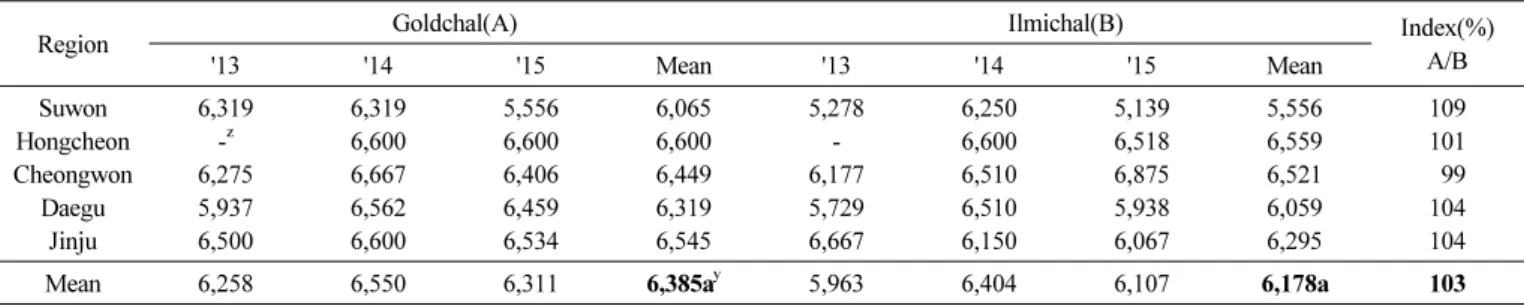
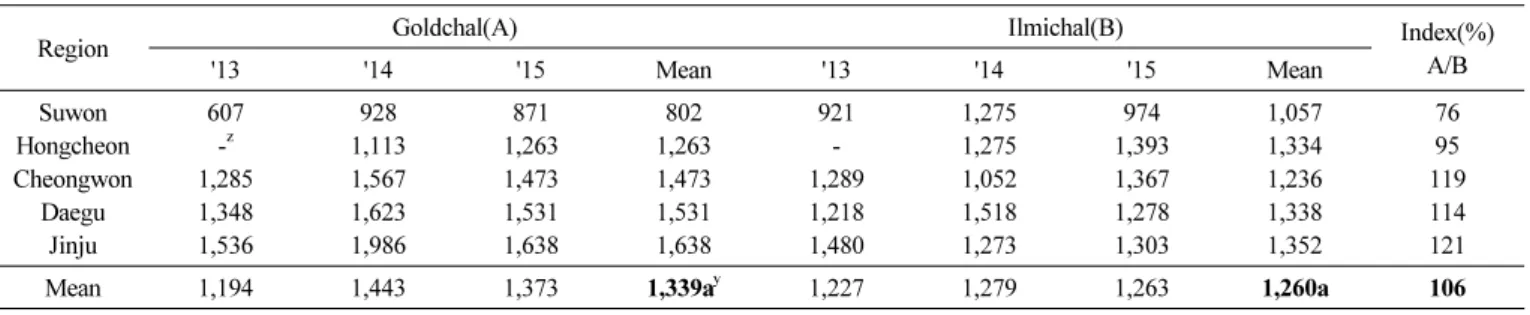
(4) 카로티노이드 함량이 많은 노란찰옥수수 ‘골드찰’. Table 2. Agronomic characteristics of ‘Goldchal’ compared with ‘Ilmichal’. Days to silking. Ear characteristics. Plant height (cm). Relative ear position (%). Number of tillers. Length (cm). Diameter (cm). Goldchal. z. 74±8.0a. 193±36b. 45±6.0b. 0.6±0.6b. 20.0±2.5a. 4.6±0.24a. Ilmichal. 72±6.8a. 223±24a. 53±3.9a. 1.2±0.6a. 19.5±1.3a. 4.5±0.16a. Hybrid. z. mean±standard deviation. Hybrids with same letter in each column are not significantly different at the 0.05 probability level.. Table 3. Grain qualities and sensory evaluation of ‘Goldchal’ compared with ‘Ilmichal’. Hybrid. Carotenoid content (mg/kg). Appearance. Stickiness. Texture. Preference. 92.6±1.8a 92.1±1.9a. 5.2±0.4a 5.2±0.5a. 4.2±0.8a 5.2±0.7a. 4.5±0.7a 5.3±0.5a. 4.4±0.9a 5.4±0.6a. z. Goldchal Ilmichal. Sensory evaluation (1: poor – 9: excellent). Amylopectin content (%). 15.8±0.9a 0.8±0.1b. z. mean±standard deviation. Hybrids with same letter in each column are not significantly different at the 0.05 probability level.. Table 4. Resistance to lodging, disease and insect of ‘Goldchal’ compared with ‘Ilmichal’. Hybrid. Lodging (1-9)z. Goldchal Ilmichal. Disease resistance (0-9). Insect damage (0-9). Southern leaf blight (Bipolaris maydis)y. Northern leaf blight (Exserohilum turcicum)y. Corn borer (Ostrinia furnacalis)x. 1.2±0.3bw. 3.0±0.9a. 1.0±0.4a. 2.0±0.6a. 1.9±0.5a. 3.0±0.7a. 1.0±0.5a. 2.3±0.9a. z. 1: None, 3: <10%, 5: 30-50%, 7: 50-60%, 9: >70% 0: None, 1: <1%, 3: 1-10%, 5: 10-20%, 7: 20-40%, 9: >40% 0: None, 1: <1%, 3: 1-5%, 5: 5-10%, 7: 10-20%, 9: >20% w mean±standard deviation. Hybrids with same letter in each column are not significantly different at the 0.05 probability level. y x. Table 5. Number of ears per 10a of ‘Goldchal’ compared with ‘Ilmichal’ in regional yield trials for three years. Goldchal(A). Ilmichal(B). '13. '14. '15. Mean. '13. '14. '15. Mean. Index(%) A/B. Suwon Hongcheon Cheongwon Daegu Jinju. 6,319 z 6,275 5,937 6,500. 6,319 6,600 6,667 6,562 6,600. 5,556 6,600 6,406 6,459 6,534. 6,065 6,600 6,449 6,319 6,545. 5,278 6,177 5,729 6,667. 6,250 6,600 6,510 6,510 6,150. 5,139 6,518 6,875 5,938 6,067. 5,556 6,559 6,521 6,059 6,295. 109 101 99 104 104. Mean. 6,258. 6,550. 6,311. 6,385a. 5,963. 6,404. 6,107. 6,178a. 103. Region. y. z. Poor emergence of ear and spreading of pollen due to continuous rain in Hongcheon in 2013 Hybrids with same letter in a row are not significantly different at the 0.05 probability level.. y. ‘골드찰’의 카로티노이드 함량은 높은 편이었다. ‘골드찰’의 아. (Table 4). ‘골드찰’의 간장이 작고 착수고율이 낮은 것(Table. 밀로펙틴 함량은 92.6%로 ‘일미찰’의 92.1%와 비슷하였는데,. 2)이 한 원인으로 여겨진다. 깨씨무늬병(Bipolaris maydis)과. Jung et al.(2001)이 보고한 찰옥수수의 아밀로펙틴 함량 범위. 그을음무늬병(Exserohilum turcicum)에 대한 내병성과 조명나. (84.1-95.8%)에 있었으며, 주요 재배 품종인 미백2호와 미흑찰. 방(Ostrinia furnacalis)에 대한 내충성은 ‘일미찰’과 비슷하였다.. 의 92.9%(Park et al. 2007a)와 91.3%(Park et al. 2007b)와. 전국 5개 지역에서 2013년부터 2015년까지 3년간 실시한. 비슷한 수준이었다. ‘골드찰’의 식미 관능 평가의 결과는 4.2-5.2. 지역적응시험의 결과에 따르면, ‘골드찰’의 이삭수와 이삭중은. 로 ‘일미찰’의 5.2-5.4와 대등하였다.. 각각 10a당 6,385개와 1,339 kg으로 ‘일미찰’의 6,178개와 1,260. ‘골드찰’의 내도복성은 1.2로 ‘일미찰’에 비해 우수하였다. kg에 비하여 낮지 않았다(Tables 5, 6). 10a당 이삭수에 있어 271.
(5) 韓育誌(Korean J. Breed. Sci.) 50(3), 2018. Table 6. Fresh ear weight (kg/10a) of ‘Goldchal’ compared with ‘Ilmichal’ in regional yield trials for three years. Goldchal(A). Ilmichal(B). '13. '14. '15. Mean. '13. '14. '15. Mean. Index(%) A/B. Suwon Hongcheon Cheongwon Daegu Jinju. 607 -z 1,285 1,348 1,536. 928 1,113 1,567 1,623 1,986. 871 1,263 1,473 1,531 1,638. 802 1,263 1,473 1,531 1,638. 921 1,289 1,218 1,480. 1,275 1,275 1,052 1,518 1,273. 974 1,393 1,367 1,278 1,303. 1,057 1,334 1,236 1,338 1,352. 76 95 119 114 121. Mean. 1,194. 1,443. 1,373. 1,339ay. 1,227. 1,279. 1,263. 1,260a. 106. Region. z. Poor emergence of ear and dispersion of pollen due to continuous rain in Hongcheon in 2013 Hybrids with same letter in a row are not significantly different at the 0.05 probability level.. y. Table 7. Seed production trial of ‘Goldchal’ in Hongcheon in 2015. Planting ratio. Inbred. Planting date. Pollen dispersal period. Silking date. 2 : 1 (♀:♂). HW16(♀) HW17(♂). 4.15. 4.15.. 7.11. ~ 7.16.. 7.8. -. 미백2호와 미흑찰의 6,243개(Park et al. 2007a)와 6,344개(Park. Ear (cm) Length. Diameter. 100 kernel weight (g). F1seedyield (kg/10a). 17.8 -. 4.0 -. 27.2 -. 186 -. 적 요. et al. 2007b)와 대등하였고, 10a당 이삭중은 967 kg(Park et al. 2007a)과 1,093 kg(Park et al. 2007b)에 비해 우수하였다.. ‘골드찰’은 강원도농업기술원에서 2015년에 개발한 단교잡 종 노란찰옥수수로서, 자식계통 HW16을 종자친으로 하고. 채종 시험. HW17를 화분친으로 하여 교배한 신품종이다. ‘골드찰’의 10a당. 화분친인 HW17의 화분비산 기간(7. 11. ~ 7. 16)에 종자친인. 이삭수와 이삭중은 각각 6,385개와 1,339 kg으로 ‘일미찰’과. HW16의 출사기(7. 8.)가 있었으므로, ‘골드찰’의 종자를 생산할. 대등하였다. ‘골드찰’의 카로티노이드 함량은 15.8 mg/kg으로. 때에 화분친과 종자친을 동시에 파종하여도 수정이 순조롭게. ‘일미찰’의 0.8 mg/kg보다 높았다. 도복에 대한 저항성은 ‘일미. 이루어질 것으로 판단된다(Table 7). 종자친과 화분친을 2:1의. 찰’에 비해 우수하였으며, 병해충에 대한 저항성은 ‘일미찰’과. 비율로 웅주 간파하였을 때의 채종량은 10a당 186 kg였으며,. 큰 차이를 보이지 않았다. 채종시험 결과 동시 파종하였을 때. 이는 일미찰과 미백2호, 미흑찰의 10a당 채종량인 각각 135. 화분친의 화분비산기에 종자친이 출사하여 채종에 큰 문제가. kg(Jung et al. 2006), 156 kg(Park et al. 2007a), 110 kg(Park. 없을 것으로 판단되며, 종자친과 화분친을 2:1 비율로 웅주 간파. et al. 2007b)과 비교해보면 높은 수준이었다.. 하였을 때의 채종량은 10a당 186 kg였다. 품종등록 번호: 제6722호. 적응지역 및 재배상의 유의점 전국 어느 지역에서나 ‘골드찰’의 재배가 가능하다. 찰옥수수 열성 인자(wx)를 가지고 있으므로, 사료용 옥수수 등 다른 종류의 옥수수와는 200 m 이상 떨어뜨려서 재배하여야 한다. 또한 잡종 강세를 이용한 단교잡종이므로, 종자를 매년 새로 구입하여 재배 하여야 한다. 칼리 양분이 부족한 경우에는 이삭의 끝달림이 불량할 수 있으므로 칼리질 비료를 충분히 주는 것이 좋다. 또한 습해에 약하므로 비가 자주 많이 올 때에는 물이 잘 빠지도록 관리하여야 한다. 최상의 품질을 위해서는 적기에 수확하는 것이 좋다. 272. 사 사 본 논문은 농촌진흥청 시험연구사업(과제번호: PJ007389032 018)의 지원에 의해 이루어진 것임.. REFERENCES 1. Chandler LA, Schwartz SJ. 1988. Isomerization and losses of trans-β-carotene in sweet potatoes as affected by processing treatments. J Agric Food Chem 36: 129-133..
(6) 카로티노이드 함량이 많은 노란찰옥수수 ‘골드찰’. 2. Eldahshan OA. 2013. Carotenoids: A review. Adv Res Pharm Biol 3: 345-352.. hybrid cultivar, ‘Mibaek 2’ with good eating quality and lodging resistance. Korean J Breed Sci 39: 108-109.. 3. Huang B, Wang Z, Park JH, Ryu OH, Choi MK, Lee JY,. 13. Park KJ, Park JY, Seo YH, Ryu SH, Choi JK, KIM HY.. Kang YH, Lim SS. 2015. Anti-diabetic effect of purple. 2016. Anthocyanin-rich purple waxy corn single cross. corn extract on C57BL/KsJ db/db mice. Nutr Res Pract 9: 22-29.. hybrid ‘Cheongchunchal’. Korean J Breed Sci 48: 541-546. 14. Park KJ, Ryu SH, Min HK, Seo JS, Park JY, Goh BD,. 4. Jeong CH, Ko WH, Cho JR, Ahn CG, Shim KH. 2006.. Jang JS, Kim NS. 2007b. A new black waxy corn hybrid. Chemical components of Korean paprika according to. cultivar, ‘Miheugchal’ with good eating quality and high. cultivars. Korean J Food Preserv 13: 43-49.. yield. Korean J Breed Sci 39: 106-107.. 5. Jung TW, Moon HG, Cha SW, Kim SL, Kim SK, Son. 15. Park SU, Cha SW, Son YH, Park RK, Hong JK, Park KY,. BY. 2001. Comparison of grain quality characteristics in. Song SH, Kim UH. 1992. A new early maturing and high. waxy corn hybrids with a white and a black colored. quality single cross waxy corn hybrid ‘Chalok 1’. Res Rep. pericarp. Korean J Breed Sci 33: 40-44. 6. Jung TW, Moon HG, Son BY, Kim SJ, Cha SW, Min HK,. RDA 34: 61-64. 16. Rural Development Administration (RDA). 2012. Agricultural. Choi HJ, Ryu IM. 2006. A new waxy corn hybrid cultivar,. Science Technology Standards for Investigation of Research.. ‘Ilmichal’ with good eating quality and lodging resistance. Korean J Breed Sci 38: 135-136.. pp. 366-385. 17. Seo YH, Kim IJ, Min HK, Rhee HI, Park SU. 1999a. Fatty. 7. Korean Statistical Information Service (KOSIS). 2018. htt. acid composition and antioxidative activity in waxy corn. p: //kosis.kr/statisticsList/ statisticsListIndex.do?menuId=M _01_01&vwcd=MT_ZTITLE&parmTabId=M_01_01. (Zea mays L.) F1’s. Korean J Food Sci Technol 31:. 8. Lee HB, Park BY, Ji HC, Cho JW, Kim SH, Mo EK, Lee. 1415-1420. 18. Seo YH, Kim IJ, Yie AS, Min HK. 1999b. Electron. MR. 2006. Antioxidant activity and agronomic characteristics. donating ability and contents of phenolic compounds,. of colored waxy corns. Korean J Crop Sci 51(S): 179-184.. tocopherols and carotenoids in waxy corn (Zea mays L.). Korean J Food Sci Technol 31: 581-585.. 9. Lee JS, Son BY, Kim JT, Bae HH, Kim SG, Baek SB. 2017. Change of total carotenoid contents and antioxidant activities of yellow waxy corns (Zea mays L.) depending on harvest time. Korean J Breed Sci 49: 359-368. 10. Lee JS, Son BY, Kim JT, Ku JH, Han OK, Baek SB, Moon JK, Hwang JJ, Kwon YU. 2012. Change of total anthocyanin contents and antioxidant activities of purple waxy corns (Zea mays L.) inbred lines and hybrids during grain filling. Korean J Breed Sci 44: 290-300. 11. Lee WK, Lee HB, Choi JE, Choi CY, Choe BH, Park SU. 1992. Agronomic characteristics of glutinous maize, Huin Chal 1. J Agri Sci Chungnam Nat’l Univ 19: 269-272. 12. Park KJ, Park JY, Ryu SH, Goh BD, Seo JS, Min HK, Jung TW, Huh CS, Ryu IM. 2007a. A new waxy corn. 19. Seo YH, Kim IJ, Yie AS, Rhee HI, Min HK. 1999c. Genetic analysis of fatty acid composition in waxy corn. Korean J Breed Sci 31: 63-69. 20. Seo YH, Heo NK, Jung YS, Rhee HI, Min HK. 2000. Effects of NPK fertilizers on antioxidant activity of corn (Zea mays L.). Korean J Soil Sci Fert 33: 85-91. 21. Seo YH, Park KJ, Kim IJ, Min HK, Park SU. 1999d. Genetic analysis of antioxidative activity in waxy corn (Zea mays L.). Korean J Breed Sci 31: 254-260. 22. Yu MH, Kim EO, Choi SW. 2010. Quantitative changes of hydroxycinnamic acid derivatives and anthocyanin in corn (Zea mays L.) according to cultivars and heat processes. J Korean Soc Food Sci Nutr 39: 843-852.. 273.
(7)
수치

관련 문서
박 열 수 조선대학교 대학원 Review of human and animal studies on maxillary sinus grafting for implant placement
Methods to overcome insufficient bone due to poor bone quality, the pneumatization of a maxillary sinus and other anatomical limitations of implant placement
Time series of vertical cross section of potential vorticity and wind vector calculated by Case 1 along the A-A' line indicated at Fig.. Same
Photonic crystals containing rugate structure result in a mirror with high reflectivity in a specific narrow spectral region and are prepared by applying
For any axis—angle pair (AK, 0), there is another pair, namely, (_AK, —0), which results in the same orientation in space, with the same rotation matrix describing it.
The aim of this study was not only to compare the differences of ego-resilience between students with high experience and students with low experience in
At the end of the study, a reevaluation of each study case was performed with the same questionnaire. The result shows there has been a meaningful result in the group
Pentad geopotential height at the 200 hPa for pre heavy rain phase (left), heavy rain phase (middle) and their difference of heavy rain phase minus pre heavy (right).. Units
Note that the boundary with the smallest misorientation is made up of a row of dislocations, whereas the high-angle boundaries have a disordered structure in
