−
147
−Enhancement in Selectivity of Nonenzymatic Glucose Sensors Based on Mesoporous Platinum by A.C. Impedance
Sejin Park and Hankil Boo
†,*
Basic Science Research Institute, Sungshin Women’s University, 249-1 Dongsun-dong, Seongbuk-gu, Seoul 136-742, Korea
†
The Cooperative Center for Nano-Bio Applied Technology, Sungshin Women’s University, 249-1 Dongsun-dong, Seongbuk-gu, Seoul 136-742, Korea
(Received June 27, 2008 : Accepted July 16, 2008)
Abstract :
Improvement of the selectivity of nonenzymatic glucose based on mesoporous platinum (H
1-ePt) by using A.C. impedance is reported. The idea of the present work is based on the novel effect of the mesoporous electrode that the apparent exchange current due to glucose oxidation remarkably grows although the reaction kinetics on the surface is still sluggish. It is expected that the enlarged apparent exchange current on the mesoporous electrode can raise the sensitivity of admittance in A.C. impedance to glucose concentration. At a low frequency, A.C. impedance could become more powerful. The admittance at 0.01 Hz is even more sensitive to glucose than to ascorbic acid while amperometry exhibits the inverse order of sensitivity. This is the unique behavior that is neither observed by A.C. impedance on flat platinum electrode nor obtained by amperometry. The study shows how the combination of A.C. impedance and nano-structured surface can be applied to the detection of sluggish reaction such as electrochemical oxidation of glucose.
Keywords :
Impedance, Mesoporous platinum, Nonenzymatic glucose sensor, Nano-structured surface.
1. Introduction
Many studies of nonenzymatic glucose detection have been performed to avoid the drawbacks of enzymatic glucose sensors, their lack of stability of enzymes. Basic studies of the electrochemical oxidation of glucose on the electrodes were reported,
1-7)and amperometric measurements of glucose were attempted.
8,9)Another approaches were also taken, for example, electrochemical techniques combined with chemical receptor for glucose.
10-13)Most of the previous studies of the amperometric detection by direct electrochemical oxidation of glucose did not overcome the problems of low selectivity and sensi- tivity, poisoning by chloride ion and toxicity of heavy metal atoms modifying the electrode.
But, our previous report on the nonenzymatic glucose detection using mesoporous platinum (H
1-ePt) showed astonishing improvement in terms of sensitivity, selectivity, and poisoning by chloride ion.
9)We showed
in that report that bare Pt with nanoscopic roughness could be successfully applied to amperometric detection of glucose even if biological concentration of ascorbic acid (AA) and 4-acetamidophenol (AP) presented as interferences. The key idea of that study is based on the fact that the roughness of mesoporous electrodes is even smaller than the scale of the chronoamperometric diffusion field in most cases. Since the diffusion layers extend several micrometers away from the electrode surface in milliseconds, reactants inside the mesopores (2~50 nm in diameter)
14)are depleted in diffusion-controlled elec- trochemical systems as illustrated in Fig. 1(A). As a result, the faradaic currents of rapidly oxidizable and/or reducible reactants are proportional to the apparent geometric area of the electrode, regardless of its mesoporous roughness.
15)On the other hand, faradaic currents associated with kinetic-controlled elec- trochemical events are sensitive to the nanoscopic surface area of the electrode, rather than to its geometric area (Fig. 1(B)). Deeper and denser mesopores on an electrode surface generate larger roughness factors,
*E-mail: [email protected]
that is, the ratio of nanoscopic surface area to the geometric surface area. The fabrication method and the properties of H
1-ePt films with cylindrical hex- agonally arrayed pores (pore diameter, 2.5nm; pore-pore distance 5.0 nm) have been previously reported upon.
9,14,16-29)Highly enlarged electrode areas, in nanoscale terms, boost the faradaic currents of the sluggish reaction exclusively as depicted in Fig. 1(C).
The study of the amperometric detection of glucose on H
1-ePt shows one methodology how the sensitivity for a kinetic-controlled reaction vs. diffusion-controlled one can be enhanced on bare electrode without any chemical or enzymatic treatments. Another methodology for the exclusively selective enhancement of kinetic- controlled reaction is the use of A.C. impedance.
A series of reports of Hall et al.
30-33)are the only
examples that A.C. impedance technique was used to accomplish nonenzymatic and selective detection.
They demonstrated a selective detection for hydrogen peroxide in the presence of ascorbic acid as inter- fering species by measuring A.C. impedance. The selective detection was successful under specific measurement condition, that is, (1) dc-potential range where the oxidation of ascorbic acid occurs in a diffusion-controlled manner whereas that of hydrogen peroxide occurs in a kinetic-controlled manner and (2) low A.C. frequencies, where the contribution of the double layer was not significant.
Intuitively, if the electrochemical reaction becomes more diffusion limited, the magnitude of the ac- response diminishes, whereas an oscillation in the given potential still allows an appreciable oscillation of current in the kinetic-controlled system. Thus, the A.C. signal of hydrogen peroxide was larger than ascorbic acid when it was measured at dc-potential where the electrochemical oxidation of hydrogen peroxide was under kinetic control and that of ascorbic acid was under diffusion control. This is the first trial to tune the A.C. signal for greater sen- sitivity to the kinetically less-favored species, which was not available by traditional amperometry.
32)As noted above, although our previous work on the amperometric detection of glucose using mesopo- rous Pt showed good selectivity in condition of physiological concentration of ascorbic acid and ace- tamidophenol, it is more desirable to achieve higher selectivity. Because the electrochemical oxidation of glucose is diffusion-controlled, a similar situation met by Hall et al. is expected to be valid for the mixture of glucose and ascorbic acid. Now, we expect that adopting A.C. impedance technique will be an effective approach to enhance the nonenzymatic selectivity of mesoporous Pt electrode.
2. Electrochemical Experiments
Reagents
Octaethylene glycol monohexadecyl ether C
16EO
8(Fluka), hydrogen hexachloroplatinate hydrate (Aldrich), sulfuric acid,
D-(+)-glucose (Sigma),
L-ascorbic acid (Aldrich), and 4-acetamidophenol (Sigma) were used without purification.
Instruments
Electrochemical experiments were performed Fig. 1. Schematic representation of the effect of pore
structure on electrochemical reactions.
with an electrochemical analyzer (Model CH660, CH Instruments Inc., Austin, TX 78733). Ag/AgCl (3M KCl) and platinum foil (5 cm×5 cm) were used as a reference and counter electrode, respectively. A platinum rod electrode (0.02 cm
2) was used as a substrate electrode for H
1-ePt film.
Preparation of liquid crystal
C
16EO
8(0.42 g), distilled water (0.29 g), and hydrogen hexachloroplatinate hydrate (0.29 g) were mixed, and the temperature was raised to 80
oC until the mixture became transparent and homogeneous.
Electrodes were inserted into the homogeneous mixture, and the temperature was lowered to room temperature (~23~26
oC). At this stage, the mixture became a highly viscous liquid crystalline phase.
Electrodeposition of H
1-ePt
Platinum deposition was carried out on a polished platinum rod electrode at constant potential ( − 0.06 V vs. Ag/AgCl). The resulting H
1-ePt electrode was placed in distilled water for 1 hr to extract C
16EO
8. After the extraction was repeated 3~4 times, electro- chemical cleaning was performed using a cycling potential between +1.0 and − 0.45 V versus Ag/AgCl in 0.5 N sulfuric acid until reproducibly identical cyclic voltammograms were obtained.
Area measurements and electrochemical cleaning All the electrochemical measurements were done in 3-electrode system. The surface area of Pt was determined by measuring the area under the hydrogen desorption peak of cyclic voltammogram in 0.5 N sulfuric acid solution. Electrochemical cleaning of the platinum electrode was performed before each mea- surement by applying potential step from − 0.2 V (5 sec) to 1.2 V (20 Sec) vs. Ag/AgCl in 0.5 N sulfuric and transferring the platinum electrode to 0.5 N KOH to dissolve out the adsorbed oxidative product.
After area of the electrode was measured in sulfuric acid solution by cyclic voltammetry, and then it was used for the electrochemical measurement.
Electrochemical measurements
Evaluation of H
1-ePt electrode as a glucose sen- sor was performed in aerated 0.1 M phosphate buff- ered saline (PBS) solution containing 0.15 M NaCl, and NaN
3was not used because it blocks the oxida- tion of glucose. The dc-amperometric curves were
obtained in a quiescent solution a few seconds after stopping the stirring that was required to mix the materials added (i.e., glucose, AA, and AP). Current changes 100 seconds after adding glucose to specific were treated as specific responses to the glucose in the solution. The signals for AA and AP were mea- sured 100 seconds later.
Impedance measurements were carried out at dc- potential of 0.4 V vs. Ag/AgCl with A.C. amplitude of 10 mV. The measurements were begun after 120 seconds of pre-equilibrium time from 100 kHz to 0.01 Hz.
3. Results and Discussion
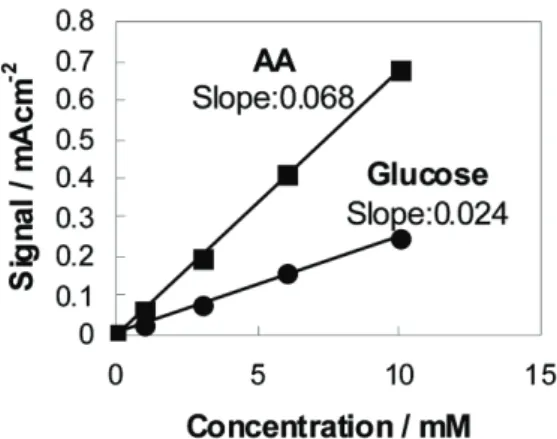
The amperometric signal of ascorbic acid (AA) is ca.
2.8 times larger than that of glucose of the same con- centration, 6 mM on H
1-ePt (Fig. 2). According to the result of previous report,
9)Pt-s (roughness factor, 2.6) shows signals of 12.3 μ Acm
−2for 0.1 mM AA and 0.138 μ Acm
−2for 6.0 mM glucose, and the sensitivity for AA is ca. 5,000 times higher than that of glucose of the same concentration. However, the amperometric signal from ascorbic acid is still larger than that from glucose, and so more improvement in selec- tivity is required.
In the present study, we combine A.C. amperometric measurement with mesoporous surface of H
1-ePt to improve the selectivity for glucose. The dc-potential on which A.C. perturbation would be added was deter- mined to be +0.4 V vs. Ag/AgCl. The amperometric
Fig. 2. Typical dc-amperometric signals measured on H
1-ePt
(roughness factor: 225) in PBS solution containing glucose
(circle) and AA (square) of the same concentration
(6 mM).
determination was also performed at the same potential.
Possible reactions at the potential are platinum oxide formation, oxidation of ascorbic acid, and oxidation of glucose.
In PBS solution, Pt surface undergoes oxide formation whether the glucose or AA exists or not. Among numerous reports by many authors,
1-7)there is a common feature on the mechanism for the oxide formation. Briefly, one-electron (per one Pt atom) transfer reaction occurs below the specific potential (i.e., 1.1 V vs. RHE for 0.5 M H
2SO
4solution) and then another one-electron transfer reaction occurs coupled with place change reaction of platinum and oxygen at higher potential. Ascorbic acid is oxidized on platinum in the potential range where platinum oxide is formed.
The mechanism of ascorbic acid oxidation was proposed as the reversible adsorption on platinum covering ca.
68% of the hydrogen adsorption sites, and then oxidation to dehydroascorbic acid.
34-36)Glucose undergoes elec- trochemical oxidation on Pt in three potential ranges;
hydrogen adsorption, double layer, and oxide for- mation region.
From cyclic voltammogram of previous report,
9)it was confirmed that platinum oxide formation and glucose oxidation in platinum oxide region begin near 0.4 V vs. Ag/AgCl. However, the oxidation current peak for AA is shown near 0.13 V vs. Ag/AgCl, and diffusion current was observed at 0.4 V. Sum-
marizing the situation of H
1-ePt at 0.4 V vs. Ag/
AgCl, (1) faradaic current flows due to formation of platinum oxide within mono-layer, diffusion-controlled oxidation of AA, and kinetic-controlled oxidation of glucose (2) and faradaic current due to platinum oxide formation always exists as background, but its magnitude should be very small because the oxidation rarely occurs beyond mono-layer.
The measurements were done in three kinds of solutions, PBS blank solution and PBS solutions containing 6 mM glucose or 6 mM ascorbic acid (AA). Nyquist plots in Fig. 3 show the impedance spectra measured with H
1-ePt in PBS solution (A) and then with (B) glucose or (C) AA added to PBS solution. Because AA is oxidized much faster than glucose at the electrode and the concentration of AA of the electrode surface is depleted, the oxidation of AA is mass-transfer controlled and Warburg impedance become important at low frequencies. On the other hand, Warburg impedance of glucose oxidation is neglected at given frequencies due to the slow kinetics of glucose oxidation.
Table 1 shows the admittance values at 0.012 Hz at each solution. Clear amperometric response was observed for glucose at A.C. frequency of 0.012 Hz.
The addition of glucose increases the admittance by 0.5, due to the decrease of charge transfer resistance.
However, the addition of ascorbic acid decreases the admittance by 0.1. The presence of ascorbic acid affects on the dc-amperometric signal by ca. 2.8 times more than glucose, but affects on the A.C. amperometric signal only by 0.20 times. It is clear that the signal for glucose becomes much larger than that of ascorbic acid, when A.C. impedance gets combined with H
1-ePt instead of amperometry, although the improvement ratio
Fig. 3. Nyquist plots of H
1-ePt in (A) PBS solution, (B) glucose, and (C) AA solution.
Table 1. Results of A.C. impedance and amperometry performed with H
1-ePt
Y/
Ω−1at 0.012 Hz
a ΔbI/mAcm
−2mol
-−1,cPBS 1.3 - -
Glucose 1.8
−0.5 0.024
AA 1.2
−0.1 0.068
Ratio
d −00.20 2.8
−−a
admittance measured by A.C. impedance with H
1-ePt (roughness factor: 149).
b
difference of admittance from that of PBS.
c
current density measured by dc-amperometry signal measured with H
1-ePt (roughness factor, 225, from slope in Fig. 2).
d
ratios of measured values for AA to those for glucose.
may depend on the roughness factor and other measure- ment conditions, e.g. dc-potential, pH, etc.
The reason why the A.C. impedance signal for glucose is larger than AA can be explained in the same ways how Hall et al. explained higher admit- tance for hydrogen peroxide than for AA.
37-41)Anal- ogously to their principle, the admittance for AA oxidation (a diffusion-controlled reaction) is much smaller than that of oxidation of glucose (a kinetic-
controlled reaction), at sufficiently low frequency.
The equivalent circuits for the platinum surface in the PBS solution containing glucose or AA are pre- sented in Fig. 4. Because the faradaic current path for platinum oxide formation exists always, the impedance element for the path ( Z
f,PtO) should be placed in parallel with the other faradaic impedance elements for the electrochemical oxidation of glucose ( Z
f,glucose) or AA ( Z
f,AA). In PBS solution containing glucose (Fig. 4(A)), Z
f,glucoseis approximated to charge transfer resistance ( R
ct,glucose), because the oxidation of glucose is kinetic-controlled. Moreover, R
ct,glucoseis smaller than Z
f,PtO, and so the whole equivalent cir- cuit can be represented by parallel combination of dou- ble layer capacitance and R
ct,glucose. In the case of AA, Z
f,AAcan be approximated to Warburg impedance ( Z
W,AA), because the electrochemical oxidation of AA is diffusion-controlled. Because the magnitude of Z
wis proportional to ω
−1/2as equation 1, the impedance of ascorbic acid becomes infinite as frequency decreases.
(1) Thus, it is expected that the faradaic impedance resulted from the oxidation of ascorbic acid has very large value in low frequency range. If the frequency is low enough for the Z
f,AAto be much larger than
Z
f,PtO, the total impedance may be determined by the parallel combination of C
dland Z
f,PtO.
Actually, the Nyquist plot of AA in Fig. 3 show similar shape and values with PBS in low frequency
ZW
2
ω
----
⎝ ⎠⎛ ⎞1/2σ
=
Fig. 5. Plots of
ZIMvs. frequency measured with (A) flat Pt (r.f., 120) and (B) L
2-ePt (r.f., 120) at dc potential of 0.4 V vs.
Ag/AgCl and A.C. amplitude of 10 mV. PBS blank solution (solid circle), and PBS solution containing 6 mM AA (open square) or 6 mM glucose (open diamond).
Fig. 4. Schematic presentation of the approximated
equivalent circuits for (A) glucose and (B) AA at low
frequency.
range. For glucose, Warburg impedance does not appear in the measured frequency range, and the impedance plot falls into the part of semicircle with diameter corresponding to the value of charge transfer resistance ( R
ct,glucose), which decreases as the concentration of glucose increases.
As a result, in sufficiently low frequency range,
Z
f,AAdoes not significantly affect on the whole impedance, whereas Z
f,glucosepredominates the whole impedance. Thus, addition of AA does scarcely changes the A.C. impedance, but the increase of glucose concentration results in the decrease of A.C.
impedance (increase of A.C. admittance).
It is noticeable that the impedance change owing to glucose is obvious on mesoporous electrode surface, whereas the impedance change is negligible on flat surface (solid circle in Fig. 5(A) and (B)). On Pt-s, the oxidation of glucose is too slow to result in the dif- ference in admittances. Furthermore, Pt-s responses very sensitively to the presence of AA. Thus, it is the use of mesoporous structured surface that makes the selectivity improvement by A.C. impedance method possible, in terms of glucose.
Although previous works by Hall et al. showed successful results in discrimination of hydrogen peroxide from ascorbic acid on flat glassy carbon electrode, it was a demonstration example that can be applied to the redox reactions whose rate is high enough to result in the increase of admittance even on a flat electrode surface. The reactions with negligibly slow reaction-rate have been out of the application range of A.C. imped- ance method combined with flat electrode surface. The present study is the first demonstration, in our knowl- edge, that realizes A.C. impedance detection of very sluggish reaction.
4. Conclusions
We accomplished more improvement of nonenzy- matic selectivity for glucose of mesoporous platinum (H
1-ePt) by using A.C. impedance instead of amperometry. It was possible only on a mesoporous surface, which boosts up the sluggish reaction of glucose. We believe that this study is an important example showing that mesoporous surface makes an analytical method (i.e. A.C. impedance detection of glucose), which has been inapplicable to species with sluggish electron transfer kinetics (i.e. glucose) applicable.
Acknowledgement
“This work was supported by the Korea Research Foundation Grant funded by Korea Govern- ment(MOEHRD)” (KRF-2006-353-C00024)
References
1. Y. B. Vassilyev, O. A. Khazova, and N. N. Nikolaeva,
“kinetics and mechanism of glucose electrooxidation on different electrode-catalysts: Part I. Adsorption and oxidation on platinum” J. Electroanal. Chem. ,
196, 105 (1985).
2. B. Beden, F. Largeaud, K. B. Kokoh, and C. Lamy,
“Fourier transform infrared reflectance spectroscopic investigation of the electrocatalytic oxidation of -glucose:
Identification of reactive intermediates and reaction products” Electrochim. Acta ,
41, 701 (1996).
3. I. T. Bae, E. Yeager, X. Xing, and C. C. Liu, “In situ infrared studies of glucose oxidation on platinum in an alkaline medium” J. Electroanal. Chem. ,
309, 131 (1991).
4. M. Sakamoto and K. Takamura, “Catalytic oxidation of biological components on platinum electrodes modified by adsorbed metals: Anodic oxidation of glucose”
Bioelectrochem. Bioener. ,
9, 571 (1982).
5. G. Kokkinidis and N. Xonoglou, “Comparative study of the electrocatalytic influence of underpotential heavy metal adatoms on the anodic oxidation of monosaccharides on Pt in acid solutions” Bioelectrochem. Bioener. ,
14, 375 (1985).
6. G. Wittstock, A. Strubing, R. Szargan, and G. Werner,
“Glucose oxidation at bismuth-modified platinum electrodes” J. Electroanal. Chem. ,
444, 61 (1998).
7. X. Zhang, K.-Y. Chan, J.-K. You, Z.-G. Lin, and A. C. C.
Tseung, “Partial oxidation of glucose by a PtWO
3electrode” J. Electroanal. Chem. ,
430, 147 (1997).
8. Y. Sun, H. Buck, and T. E. Mallouk, “Combinatorial Discovery of Alloy Electrocatalysts for Amperometric Glucose Sensors” Anal. Chem. ,
73, 1599 (2001).
9. S. Park, T. D. Chung, and H. C. Kim, “Nonenzymatic glucose detection using mesoporous platinum” Anal.
Chem. ,
75, 3046 (2003).
10. E. Shoji, and M. S. Freund, “Potentiometric Sensors Based on the Inductive Effect on the pKa of Poly(aniline): A Nonenzymatic Glucose Sensor” J. Am.
Chem. Soc. ,
123, 3383 (2001).
11. E. Shoji and M. S. Freund, “Potentiometric Saccharide Detection Based on the pKa Changes of Poly(aniline boronic acid)” J. Am. Chem. Soc. ,
124, 12486 (2002).
12. S. Arimori, S. Ushiroda, L. M. Peter, A. T. A. Jenkins, and T. D. James, “A modular electrochemical sensor for saccharides” Chem. Commun. , 2368 (2002).
13. S.-J. Choi, B.-G. Choi, and S.-M. Park, “Electrochemical Sensor for Electrochemically Inactive -D(+)-Glucose Using -Cyclodextrin Template Molecules ” Anal. Chem. ,
74