연구논문
발효한약의 항생제 다제내성균 Pseudomonas aeruginosa를 억제하는 항균활성
류지연1, 박영자2, 김현수3*
Antibacterial Activity of Fermented Korean Medicine Against Multi-drug Resistant Pseudomonas aeruginosa
Ryu, Ji-Yeon1, Young-Ja Park2, and Hyun-Soo Kim3*
접수: 2011년 10월 6일 / 게재승인: 2011년 12월 11일
© 2011 The Korean Society for Biotechnology and Bioengineering
Abstract:1)Bacterial antibiotic resistance is a real and growing problem for both Gram positive and Gram negative bacterial pathogens in the hospital setting. Among Gram negative bacteria, the ubiquitous bacterium Pseudomonas aeruginosa is a particular concern in immunocompromised and burn patients. The present study evaluated antibacterial activity and efficacy of a Korean herbal medicine against eight multi-drug resistant clinical isolates of P. aeruginosa (0225, 0254, 0347, 0826, 1113, 1378, 1731, and 2492) isolated at Daegu Catholic University Hospital. Methanol extracts of
Galla rhois (5 and 10 mg/mL) displayed inhibition diameters
for isolate 2492 of 10 and 12 mm, respectively, in a conventional disc diffusion assay. In seven kinds of Korean herbal medicines, increased inhibitory power of Lonicera japonica, Gardeniajasminoides, Galla rhois, and Scultellaria baicalensis was
evident with the fermentation of six kinds of lactic acid bacteria. Three lactic acid bacteria (Lactobacillus plantarum1대구가톨릭대학교병원 진단검사의학과
1Department of Laboratory Medicine, Daegu Catholic University, Medical Center, Daegu 705-718, Korea
2서라벌대학 임상병리과
2Department of Clinical Pathology, Sorabol College, Gyeongju-si, Gyeongbuk 780-711, Korea
3계명대학교 자연과학대학 미생물학과
3Department of Microbiology, College of Natural Science, Keimyung University, Daegu 704-701, Korea
Tel: +82-53-580-5284, Fax: +82-53-580-5284 e-mail: [email protected]
subsp. plantarum KCTC 3108, L. casei KCTC 3109, and L.
fermentum KCTC 3112) were identified as excellent strains
for the production of antibacterial materials. In the six Korean herbal medicine extracts, strong inhibitory activity of fermented Forsythia suspensa, Glycyrrhizae radix, Lyciumchinense, Platycodon grum, and Schizandra chinensis with
five kinds of lactic acid bacteria was evident for seven multi-drug resistant P. aeruginosa isolates.Keywords: Multi-drug resistance Pseudomonas aeruginosa, Antibiotics, Bioconversion, Korean herbal medicine, Lactic acid bacteria
1. 서론
현대과학과 의학의 발전으로 인간 생명 연장이 조금씩 실현 되고 있으나 한편으로는 감염에 취약한 노령인구의 증가, 만성 퇴행성 질환자의 증가, 항생제 남용 및 장기간의 항생 제 사용으로 인한 항생제 내성균 증가, 각종 인체 내 삽입술 의 확대 등 의학이 발달할수록 병원 감염은 급속히 증가하고 있어 매우 심각한 문제점을 야기하고 있다.
원내 감염은 일반 병동보다는 중환자실이나 면역저하환자 대상 병동에서 병원감염률이 높게 발생하는 경향을 보여주고 있으며, 특히 중환자실은 일반 입원실보다 약 6배 높게 발생 하는 것으로 보고되고 있다 [1]. 국내 병원 내 감염보고에 서 나타난 균주 중 가장 많은 것은 Staphylococcus aureus (20∼22%)이며 그 다음으로 많이 분리되는 균이 Pseudomonas
aeruginosa (8∼18%)이다. 그 외에도 Escherichia coli, Serratia, Actinobacter, Klebsiella, Enterobacter, Streptococcus 등이
분리되고 있다 [2-4]. 이 중에서 P. aeruginosa는 건강한 사람 의 소화기에 상재하며 피부, 비점막 (nasal mucosa) 및 인두 (throat) 등에서도 상재할 수 있으며 폐렴, 비뇨기계 감염, 창상감염, 패혈증 등의 원내감염의 원인이 된다 [5,6].P. aeruginosa는 병원 내 폐렴 및 요로 감염에서 흔히 동정
되는 Gram 음성 간균 (병원성 폐렴 18.1%, 요로감염 16.3%) 으로 알려져 있으며, Gram 음성 간균에 의한 병원 균혈증에 서도E. coli와 Klebsiella spicies에 이어 세 번째로 흔하며,
전체 균혈증의 7위를 차지할 정도로 드물지 않다 [7]. 이러한P. aeruginosa에 의한 감염의 치료는 실제 임상에서 조기에
발견하여 적절하게 치료하는 것이 쉽지 않으며, P. aeruginosa 에 의한 bloodstream infection은 심각하고 치명적일 수 있는 상태로 18%∼62%의 사망률을 보여 균혈증으로 인한 사망 의 경우 2위를 차지하는 것으로 알려져 있다 [8]. 오늘날 사 용 중인 항생물질은 의학의 발달과 함께 지속적으로 발견, 개발되어 질병치료에 널리 사용되고 있으나, 점차 내성이 생긴 병원성 미생물이 출현하게 되면서 현 의학계에서는 심 각성이 크게 대두되고 있는 실정이다. 특히 P. aeruginosa 와 Acinetobacter baumannii의 경우 지금까지 Gram 음성 세균 감염의 치료의 최후의 보루로 여겨지던 carbapenem 계열의 항생제마저도 내성인 균주가 확산되어 큰 문제가 되 고 있다 [9,10]. P. aeruginosa의 경우, 다수의 항생제 및 항균 화학요법제에도 내성을 보이는 다제내성 녹농균 (MRPA, multi-resistant P. aeruginosa)으로 폐렴이나 패혈증 등에 발병 시 치료가 힘든 내성균으로 분류되고 있다 [11,12].다제내성
Acinetobacter (MRAB, Multi Drug Resistant A.
baumanii) [10,13]은 최근 일본에서 사망자가 보고되어 경각심
을 야기 시켰으며, 새로운 내성 균주들의 출현에 따른 내성균 대처를 위한 항생물질의 개발은 빠르게 진행되고 있다 [14,15].본 연구에서는 옛 부터 인간이 지속적으로 사용해 온 천연 재료인 식물을 대상으로 하여 미생물에 대한 항균활성이 있 는 한약재를 선정하여 연구를 수행하였다. 생약제와 식용식물, 향신료 등은 천연 보존료를 개발하기 위한 좋은 소재가 되며 항균제 및 방부제에 대한 실험이 활발하게 이루어지고 있으 며 오배자 [16], 도꼬마리 [17], 황금, 고삼, 연교 등의 추출 물은 이미 각각 특정 미생물에 대한 항균활성을 나타낸다는 사실이 알려져 있다 [18-20].
한약재의 발효는 전통 한약재를 미생물이 잘 이용할 수 있 도록 찌거나 삶은 후 미생물을 접종하여 고체 및 액체배양을 하는 것으로 한약의 발효를 위하여 사용되는 미생물은 유산 균이나 Bacillus sp. 및 버섯 균사체 등이 있는데 이 중에서 유산균이 가장 많이 사용되며, 한약에서 유산균의 생육특성 을 확인하는 연구가 보고되고 있다 [21,22]. 발효한약의 기능 성에 대한 연구는 주로 항산화, 항암 및 알레르기 억제 효과 를 확인하여 이루어지고 있다. 버섯균사체로 복령과 후박을 발효하였을 때 항산화 효과가 다소 떨어졌으나 인체 간암 세포주에서 항암 활성이 뚜렷하게 나타났다는 보고 [23]와 용안육을 청국장 균으로 발효하였을 때 전자공여능이 높고 자궁경부암세포 및 간암세포에 대한 항암 활성이 높아졌다
는 보고가 있다 [24].
따라서 본 연구는 최근 증가 하고 있는 다제내성균에 대한 항균제 개발을 목표로 하여 다제내성균 P. aeruginosa를 대상 으로 한약 재료로부터 발효를 통한 새로운 항균물질을 개발 하기 위해 추출물의 발효 전후의 항균활성을 비교하여 그 상승효과를 보고하고자 한다.
2. 재료 및 방법 2.1. 사용 한약재
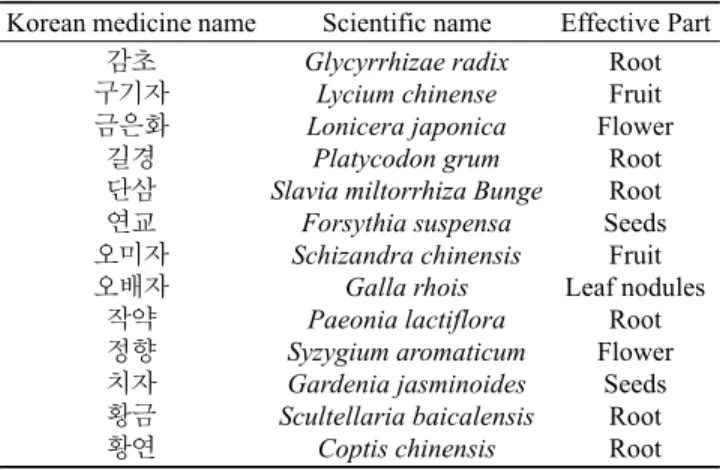
본 연구에 사용된 한약재는 약제내성을 가지지 않은 일반
P. aeruginosa에 항균 효과가 있는 한약재 13가지를 선정
하였으며, 대구광역시 약령시소재 한약방에서 건조 상태가 좋은 것을 구입하여 깨끗이 손질 한 후 사용하였다 (Table 1).Table 1. List of Korean medicinal plants used for antimicrobial experiments
Korean medicine name Scientific name Effective Part 감초
구기자 금은화 길경 단삼 연교 오미자 오배자 작약 정향 치자 황금 황연
Glycyrrhizae radix Lycium chinense Lonicera japonica
Platycodon grum Slavia miltorrhiza Bunge
Forsythia suspensa Schizandra chinensis
Galla rhois Paeonia lactiflora Syzygium aromaticum Gardenia jasminoides Scultellaria baicalensis
Coptis chinensis
Root Fruit Flower
Root Root Seeds
Fruit Leaf nodules
Root Flower
Seeds Root Root
2.2. 한약재의 추출 및 농축
한약재 추출은 열수 및 메탄올을 사용하였으며, 열수 추출은 각 한약재 10 g에 3차 증류수 100 mL를 첨가하여 100℃
에서 끓여 증발시킨 후 최소량을 여과하여 감압 농축하였다.
메탄올 추출은 한약재 10 g에 메탄올 100 mL를 첨가하여 28℃
에서 24시간 동안 overnight 시킨 후 여과하여 감압 농축하였다.
2.3. 시험균주
본 실험에 사용된 시험 균주는 그람 양성인
Bacillus substilis
PCI 219와 그람 음성인 E. coli KCTC 1682, 다제내성 P.aeruginosa를 사용하였다. P. aeruginosa는 대구가톨릭대
학교 진단검사의학과 미생물부에서 환자의 가검물로부터 분 리한 후 MicroScanⓇ으로 항생제 감수성 검사를 실시하여 8 균주 (0225, 0254, 0347, 0826, 1113, 1378, 1731, 2492)를 선별하여 사용하였으며, 8 균주의 항생제 내성은 Table 2와 같다. MicroScanⓇ은 Ca2+와Mg2+가 함유된 Mueller-Hinton 배지에 다양한 항생제가 희석되어 있어 검사 대상인 미생물 의 최소억제농도 (MIC) 또는 정량적인 감수성 (susceptible, intermediate, resistant)을 억제하는 가장 낮은 항균제 농도를 확인하는 것이 가능하다.Table 2. Antibiotics sensitivity of Pseudomonas aeruginosa by MicroScanⓇ
Antibiotics
Strains Pseudomonas aeruginosa 0225* 0254* 0347* 0826* 1113* 1378* 1731* 2492*
Sensitivity Amikacin
Ampicillin
Ampicillin/sulbactam Aztreonam
Cefepime Cefotaxime Ceftazidime Ceftriaxone Cephalothin Ciprofloxacin Gentamicin Imipenem Levofloxacin Meropenem Piperacillin
Piperacillin/tazobactam Ticarcillin/CA Tobramycin
Trimethoprim/sulfametho S - - R S R I R
- - S R - S - I R S -
S R R R I - I R R S S S - - R S R S R
S R R R I - R R R R S R - - R S R S R
I - - I R R I R
- S - R
- R
- I R S -
S - - I S R I R
- S S S S S - I - S -
S I R S I - S R R R I S - - S S S S R
S - - I I R
I R
- R
- S R S - R R S -
R S R S S - S - R R S S - - S S S S R I: intermediate; R: resistant; S: sensitible.
*:Antibiotics resistant strains.
-: Untested.
2.4. 한약의 발효
2.4.1. 발효미생물의 선정 및 배양
유용미생물은 GRAS 미생물로서 유산균을 선정하였으며, Table 3에서 보는 바와 같이 한국생명공학연구원 유전자원 센터 유전자은행 (KCTC)에서 분양을 받아 lactobacilli MRS 배지 (proteose peptone No. 3, 10 g, beef extract 10 g, yeast extract 5 g, dextrose 20 g, polyoxyethylene sorbitan monooleate 1 g, ammonium citrate 2 g, magnesium sulfate 0.1 g, manganese sulfate 0.05 g, dipotassium phosphate 2 g, sodium acetate 5 g/L, pH 6.5, Difco Co.)에 계대배양한 후 균체를 20% glycerol이 포함된 저장액에 넣어 -70℃에 보관하였으 며, 실험에 사용하기 전 계대배양을 실시하였다.
Table 3. Used Lactobacillus strains
Strains Sources
Lactobacillus brevis KCTC 3498 Lactobacillus casei KCTC 3109
Lactobacillus delbrueckii subsp. bulgaricus KCTC 3635 Lactobacillus fermentum KCTC 3112
Lactobacillus helveticus KCTC 3545
Lactobacillus plantarum subsp. plantarum KCTC 3108
Pickled cabbage Cheese Fermented beets Human feces
Emmental (Swiss) cheese Bulgarian yogurt
2.4.2. 한약재 발효
한약재의 발효는 사용 한약재의 추출 농축액을 5 mg/mL의 농도로 MRS배지에 첨가하여 멸균 하였다. 사용 유산균은
계대배양한 stock액 (1 × 10⁸ CFU/mL)을 제조한 후, 0.2%
(v/v)가 되도록 추출 농축액 (5 mg/mL)을 첨가한 멸균 MRS 배지에 접종하였다. 배양은 37℃에서 5일간 배양하여 배양 일수별로 sampling을 하였으며, 배양액은 4℃, 1,000 × g에서 10분간 원심분리 후 상등액을 실험에 사용하였다.
2.5. 항균활성
한약재 추출물 및 발효 한약의 항균활성은 agar diffusion법 으로 측정하였다. 시험 균주는 LB배지 (peptone 10 g, yeast extract 5 g, sodium chloride 5 g/L, pH 6.8)와 Nutrient 배 지 (beef extract 3 g, peptone 5 g/L, pH 6.8, Difco Co.)에 계대배양 하였으며, 4℃에서 보관하여 사용하였다. 열수 추출 과 메탄올 추출을 통해 얻어진 추출액은 각각 0.5 mg/mL, 1 mg/mL, 2.5 mg/mL, 5 mg/mL와 10 mg/mL의 농도로 희석 하였다. 각각의 희석한 추출액과 발효 후 얻어진 상등액 20 μL 를 paper disc에 첨가하여 건조시킨 후, 시험 균주가 함유된 평판배지 위에 얹고 37℃에서 1일간 배양하여 생성된 저지 환의 유무 및 크기를 통해 판단하였다.
3. 결과 및 고찰 3.1. 한약재 추출액의 pH
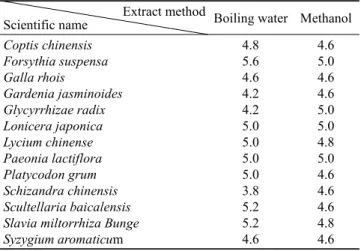
한약재 추출액의 pH는 시험균의 항균활성에 미칠 수 있는 영향을 고려하여 검토하였다. Table 4에서 보는 바와 같이 열수추출 및 메탄올 추출액의 pH는 3.8∼5.6의 약산성 영역 을 보였으며, 한약재 추출액의 항균활성은 pH에 의해 크게 영향은 받지 않는 것으로 확인되었다.
Table 4. pH of extracts by boiling water and methanol Extract method
Scientific name Boiling water Methanol
Coptis chinensis Forsythia suspensa Galla rhois
Gardenia jasminoides Glycyrrhizae radix Lonicera japonica Lycium chinense Paeonia lactiflora Platycodon grum Schizandra chinensis Scultellaria baicalensis Slavia miltorrhiza Bunge Syzygium aromaticum
4.8 5.6 4.6 4.2 4.2 5.0 5.0 5.0 5.0 3.8 5.2 5.2 4.6
4.6 5.0 4.6 4.6 5.0 5.0 4.8 5.0 4.6 4.6 4.6 4.8 4.6
3.2. 한약재 추출 농축액의 항균활성
열수 추출과 메탄올 추출을 통해 얻어진 한약재 추출액의 항균활성은 각 추출물을 0.5 mg/mL, 1 mg/mL, 2.5 mg/mL, 5 mg/mL와 10 mg/mL의 농도가 되게 물과 메탄올로 희석하 고, 20 μL를 paper disc에 첨가하여 건조시킨 후 시험 균주 가 함유된 평판배지 위에 얹고 37℃에서 1일간 배양하였다.
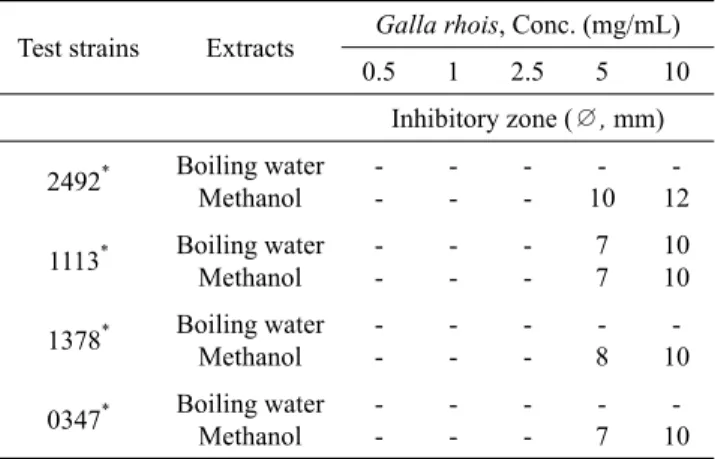
생성된 저지환의 유무와 크기를 확인한 결과, Table 5와 6에
서 보인 바와 같이 13가지의 한약재 추출물 중 오배자와 황연 추출물이 다재내성
P. aeruginosa에 항균활성을 나타내
었다. 오배자 추출물의 경우 5 mg/mL와 10 mg/mL의 농도 에서 항균력을 보였으며, 특히 열수 및 메탄올 추출물은 내성 균 1113에 모두 각각 7 mm와 10 mm의 항균 활성을 나타내 었다. 오배자 메탄올 추출액은 내성균 2492에 각각 10 mm 와 12 mm의 다소 강한 항균 활성을 나타내었으며 (Fig. 1), 내성균 1378에서 각각 8 mm와 10 mm, 내성균 0347에서 각각 7 mm와 10 mm의 항균활성을 나타내었다. 황연의 경 우 (Table 6) 메탄올 추출액에서 내성균 1378에 10 mg/mL 의 농도에서 8 mm의 약한 항균활성을 나타내었다. 그러나 13종류의 한약재 열수 추출액과 메탄올 추출액 모두 일반 시험균 B. substilis PCI 219와 E. coli KCTC 1682에는 항균 활성을 나타내지 않았다 (결과 미게재).Table 5. Antibacterial activity of extracts by boiling water and methanol from Galla rhois
Test strains Extracts Galla rhois, Conc. (mg/mL)
0.5 1 2.5 5 10
Inhibitory zone (∅, mm) 2492* Boiling water
Methanol - -
- -
- -
- 10
- 12 1113* Boiling water
Methanol - -
- -
- -
7 7
10 10 1378* Boiling water
Methanol - -
- -
- -
- 8
- 10 0347* Boiling water
Methanol - -
- -
- -
- 7
- 10
*:Antibiotics resistant Pseudomonas aeruginosa.
-: No-inhibition.
A: control (methanol); B: 10 mg/mL; C: 5 mg/mL Fig. 1. Antibacterial activity of methanol extracts from Galla rhois on Pseudomonas aeruginosa 2492.
3.3. 추출한약재의 발효에 의한 항균활성
한약재 추출물 자체의 항균 활성은 Table 5와 6에서 보인 바 와 같이 13가지 한약재 중 오배자와 황연 메탄올 추출물에서 만 다제내성
P. aeruginosa에 약한 항균 활성을 보였으므로,
새로운 강력한 항균성 물질의 생산을 위해 한약재 추출물 중 메탄올 추출물을 대상으로 6종의 Lactobacillus 균주를 이용 한 bioconversion을 통하여 유산발효를 시킨 후 항균활성을 검토하였다.Table 6. Antibacterial activity of extracts by boiling water and methanol from Coptis chinensis
Test strain Extracts Coptis chinensis, Conc. (mg/mL)
0.5 1 2.5 5 10
Inhibitory zone (∅, mm) 1378* Boiling water
Methanol - -
- -
- -
- -
- 8
*:Antibiotics resistant Pseudomonas aeruginosa.
-: No inhibition.
3.3.1. 황연, 치자, 금은화, 황금, 오배자추출물의 유산발효 항균활성
유산발효는 실험재료 및 방법에 따라 6종의 Lactobacillus 균주를 7가지의 한약재인 황연, 치자, 금은화, 황금, 오배자, 단삼, 작약의 메탄올 추출액 (5 mg/mL)이 함유된 MRS배지 에 각각 접종하여 5일째 배양액을 대상으로 내성균에 대한 항균활성을 검토하였다. 그 결과 단삼과 작약을 제외한 5가 지 한약재는 내성균에 대한 항균활성을 나타내었다. 특히
Lactobacillus casei KCTC 3109 (B)로 발효 시 치자 메탄올
추출액은 내성균 0225에서 22 mm (Table 7), 내성균 2492 에서 17 mm (Table 8)로 가장 강한 항균활성을 나타냈으며, 금은화 메탄올 추출물은 내성균 0225에서 17 mm, 내성균 1731에서 17 mm, 내성균 2492에서 16 mm로 높은 항균활성 을 나타내었다. 황금 메탄올 추출액을 첨가하여 Lactobacillusplantarum subsp. plantarum KCTC 3108 (A)로 발효 시
항균활성은 내성균 1731에서 19 mm로 가장 크게 나타났 다 (Table 8). 오배자 메탄올 추출액은 미발효 시 5 mg/mL의 농도에서 내성균 2492, 1378, 0347과 1113에 대해 7 mm∼10 mm (Table 7)의 항균력을 보였으나, Lb. plantarum subsp. plantarum KCTC 3108 (A)로 발효 시에는 내성균 0225와 1731을 포함한 6 균주에 10 mm∼19 mm의 높은 항균활성을 나타내었으며 (Table 7,8), 내성균에 강력한 저해물질의 생산이 예상되었다. 특히 Lb. plantarum subsp.
plantarum KCTC 3108 (A)는 5가지 약재에 발효 시 다제
내성 6 균주에 10 mm∼19 mm의 항균활성을 나타내어 한약재 발효에 우수한 유산균으로 평가되었다. 황연의 경 우 Table 6에서 보인 바와 같이 5 mg/mL 첨가농도에서는 내성균 1378을 포함하여 항균력이 없으나, 동일농도에서Lb. plantarum subsp. plantarum KCTC 3108 (A)를 이용
한 발효 시에는 내성균 1378을 제외한 0225, 0347, 1113, 1731과 2492에서 9 mm∼13 mm의 새로운 항균활성을 나타 내었다 (Table 7,8).Table 7. Antibacterial activity of fermented methanol extracts from Coptis chinensis, Galla rhois, Gardenia jasminoides, Lonicera japonica, and Scultellaria baicalensis on Pseudomonas aeruginosa 0225*, 0347*and 1113*
Test
strains Scientific name Lactobacillus strains
A B C D E F
Inhibitory zone (∅, mm)
0225*
Coptis chinensis Galla rhois Gardenia jasminoides
Lonicera japonica Scultellaria baicalensis
11 15 16 12 16
- - 22 17 -
- 12 15 16 15
- - 14 13 -
- - 14 15 8
- - 14 15 10
0347*
Coptis chinensis Galla rhois Gardenia jasminoides
Lonicera japonica Scultellaria baicalensis
9 13
- 9 10
- 13 11 13 -
- 8 10
7 -
- - - - -
- - - - -
- - - - -
1113*
Coptis chinensis Galla rhois Gardenia jasminoides
Lonicera japonica Scultellaria baicalensis
9 13
8 8 9
- 12
9 10
- - 9 6.5 6.5 6.5
- - - 8 6.5
- - 7 6.5
- - - 9 6.5
- A: Lactobacillus plantarum subsp. plantarum KCTC 3108, B:
Lactobacillus casei KCTC 3109, C: Lactobacillus fermentum KCTC 3112, D: Lactobacillus brevis KCTC 3498, E: Lactobacillus helveticus KCTC 3545, F: Lactobacillus delbrueckii subsp. bulgaricus KCTC 3635.
*:Antibiotics resistant Pseudomonas aeruginosa.
-: No-inhibition.
Table 8. Antibacterial activity of fermented methanol extracts from Coptis chinensis, Galla rhois, Gardenia jasminoides, Lonicera japonica, and Scultellaria baicalensis on Pseudomonas aeruginosa 1378*, 1731*and 2492*
Test
strains Scientific name Lactobacillus strains
A B C D E F
Inhibitory zone (∅, mm)
1378*
Coptis chinensis Galla rhois Gardenia jasminoides
Lonicera japonica Scultellaria baicalensis
- 10 10 10 -
- 10 10 12 -
- 9 - - -
- - - - -
- - - - -
- - - - -
1731*
Coptis chinensis Galla rhois Gardenia jasminoides
Lonicera japonica Scultellaria baicalensis
13 11 14 17 19
- - 14 17 -
- 8 14 16 13
- - 13 14 -
- - 12 14 -
- - 10 14 -
2492*
Coptis chinensis Galla rhois Gardenia jasminoides
Lonicera japonica Scultellaria baicalensis
12 19 12 12 13
- 16 17 16 -
- 10
9 8 8
- - - 8 -
- - 8 8 -
- - 13
9 - A: Lactobacillus plantarum subsp. plantarum KCTC 3108, B:
Lactobacillus casei KCTC 3109, C: Lactobacillus fermentum KCTC 3112, D: Lactobacillus brevis KCTC 3498, E: Lactobacillus helveticus KCTC 3545, F: Lactobacillus delbrueckii subsp. bulgaricus KCTC 3635.
*:Antibiotics resistant Pseudomonas aeruginosa.
-: No-inhibition.
Table 9. Antibacterial activity of methanol extracts from Coptis chinensis, Galla rhois, Gardenia jasminoides, Lonicera japonica, and Scultellaria baicalensis on Bacillus substilis PCI 219
Test
strain Scientific name Lactobacillus strains
A B C D E F
Inhibitory zone (∅, mm) Bacillus
substilis PCI 219
Coptis chinensis Galla rhois Gardenia jasminoides
Lonicera japonica Scultellaria baicalensis
18 15 18 24 17
19 15 22 22 -
13 11 18 20 11
12 - 18 18 -
13 - 18 24 -
13 - 16 16 - A: Lactobacillus plantarum subsp. plantarum KCTC 3108, B:
Lactobacillus casei KCTC 3109, C: Lactobacillus fermentum KCTC 3112, D: Lactobacillus brevis KCTC 3498, E: Lactobacillus helveticus KCTC 3545, F: Lactobacillus delbrueckii subsp. bulgaricus KCTC 3635
-: No-inhibition
13가지 약재추출물은 일반 시험균인 B. substilis PCI 219 및
E. coli KCTC 1682에 항균력을 보이지 않았으나 (결과
미게재), Lb. plantarum subsp. plantarum KCTC 3108 (A) 및Lb. fermentum KCTC 3112 (C)로 발효한 5종의 한약재
는 모두 B. substilis PCI 219에서도 11 mm∼24 mm로 강한 항균활성을 나타냈으며 (Table 9), E. coli KCTC 1682와 내 성균 0826과 0254에는 Lactobacillus 균주로 발효시킨 발효 한약재 모두 항균활성을 나타내지 않았다 (결과 미게재).6종의 Lactobacillus 균주로 한약재 메탄올 추출액을 발효 하였을 때 항균활성은 금은화, 치자, 오배자, 황금 추출액의 순으로 높게 나타났으며, 사용 유산균 중 Lb. plantarum subsp. plantarum KCTC 3108, Lb. casei KCTC 3109와 Lb.
fermentum KCTC 3112가 내성균을 억제하는 항균성 물질
을 발효 전보다 발효 후 많이 생산하는 우수한 균으로 확인 되었다. 이 결과에서 한약재 추출물을 대상으로 유산균 발 효를 통한 bioconversion은 다제내성균을 억제하는 새로운 물질의 생산가능성이 확인되었다.3.3.2. 연교, 감초, 구기자, 길경, 오미자, 정향의 유산발효 항균활성
앞의 5가지 한약재의 유산발효 (Table 7∼9)는 5일째에 항 균력이 우수하였으므로, 동일한 조건에서 6가지 한약재인 연교, 감초, 구기자, 길경, 오미자와 정향의 메탄올 추출액의 유산발효는 3일과 5일간 수행한 후 항균 활성을 측정하였다.
Table 9에서 6종의 유산균으로 발효한 5가지 한약재는 일반 세균인 B. substilis PCI 219에만 강한 항균활성이 확인되었 으나, 6가지 한약재의 발효는 Table 9와 달리 Lb. plantarum subsp. plantarum KCTC 3108 (A)로 발효 시와 정향추출물 의 발효 시 항균력을 보이지 않았다 (Table 10,11). Lb. casei KCTC 3109 (B)와 나머지 5 균주는 5일간 발효 시 다제 내성균에 12 mm∼24 mm의 우수한 항균활성을 나타내었 으며 (Table 10), E. coli KCTC 1682에 대한 항균활성은
Lb. casei KCTC 3109 (B)가 가장 우수하였으며, 연교, 구
기자, 오미자와 길경을 이용한 발효 시 항균활성을 나타내었다 (Table 11).
Table 10. Antibacterial activity of culture broth by methanol extracts from Forsythia suspensa, Glycyrrhizae radix, Lycium chinense, Platycodon grum, Schizandra chinensis and Syzygium aromaticum on Bacillus substilis PCI 219
Test strain Scientific name
Incubation time (days)
Lactobacillus strains
A B C D E F
Inhibitory zone (∅, mm)
Bacillus substilis PCI 219
Forsythia suspensa
3 5
- -
19 16
18 17
8 13
13 14
13 15 Glycyrrhizae
radix
3 5
- -
19 24
17 20
12 18
18 18
18 18 Lycium
chinense
3 5
- -
22 24
18 18
13 16
18 20
20 18 Platycodon
grum
3 5
- -
21 21
18 19
13 14
21 22
20 20 Schizandra
chinensis
3 5
- -
18 21
15 15
8 12
17 18
17 17 Syzygium
aromaticum 3 5
- -
- -
- -
- -
- -
- - A: Lactobacillus plantarum subsp. plantarum KCTC 3108, B:
Lactobacillus casei KCTC 3109, C: Lactobacillus fermentum KCTC 3112, D: Lactobacillus brevis KCTC 3498, E: Lactobacillus helveticus KCTC 3545, F: Lactobacillus delbrueckii subsp. bulgaricus KCTC 3635.
-: No-inhibition.
Table 11. Antibacterial activity of culture broth by methanol extracts from Forsythia suspensa, Glycyrrhizae radix, Lycium chinense, Platycodon grum, Schizandra chinensis and Syzygium aromaticum on E. coli KCTC 1682
Test strain
Scientific name
Incubation time (days)
Lactobacillus strains
A B C D E F
Inhibitory zone (∅, mm)
E. coli KCTC 1682
Forsythia suspensa
3 5
- -
19 11
11 9
- 10
- 12
- 11 Glycyrrhizae
radix
3 5
- -
9 -
9 -
- -
- -
- - Lycium
chinense
3 5
- -
9 13
9 9
- 9
- 9
- 9 Platycodon
grum
3 5
- -
11 11
- 9
- -
- -
- 9 Schizandra
chinensis
3 5
- -
11 12
10 -
9 -
9 -
9 - Syzygium
aromaticum 3 5
- -
- -
- -
- -
- -
- - A: Lactobacillus plantarum subsp. plantarum KCTC 3108, B:
Lactobacillus casei KCTC 3109, C: Lactobacillus fermentum KCTC 3112, D: Lactobacillus brevis KCTC 3498, E: Lactobacillus helveticus KCTC 3545, F: Lactobacillus delbrueckii subsp. bulgaricus KCTC 3635.
-: No-inhibition.
Table 12. Antibacterial activity of culture broth by methanol extracts from Forsythia suspensa, Glycyrrhizae radix, Lycium chinense, Platycodon grum, Schizandra chinensis and Syzygium aromaticum on Pseudomonas aeruginosa 0225
Test strain
Scientific name
Incubation time (days)
Lactobacillus strains
A B C D E F
Inhibitory zone (∅, mm)
0225
Forsythia suspensa
3 5
- -
14 8
12 11
10 8
11 8
11 11 Glycyrrhizae
radix
3 5
- -
13 12
13 9
11 9
11 12
12 8 Lycium
chinense
3 5
- -
13 15
12 14
14 15
9 15
9 16 Platycodon
grum
3 5
- -
13 9
12 11
11 12
9 12
11 14 Schizandra
chinensis
3 5
- -
14 11
14 12
12 11
14 12
10 13 Syzygium
aromaticum 3 5
- -
- -
- -
- -
- -
- - A: Lactobacillus plantarum subsp. plantarum KCTC 3108, B:
Lactobacillus casei KCTC 3109, C: Lactobacillus fermentum KCTC 3112, D: Lactobacillus brevis KCTC 3498, E: Lactobacillus helveticus KCTC 3545, F: Lactobacillus delbrueckii subsp. bulgaricus KCTC 3635.
*:Antibiotics resistant Pseudomonas aeruginosa.
-: No-inhibition.
Table 13. Antibacterial activity of culture broth by methanol extracts from Forsythia suspensa, Glycyrrhizae radix, Lycium chinense, Platycodon grum, Schizandra chinensis and Syzygium aromaticum on Pseudomonas aeruginosa 0254
Test strain
Scientific name
Incubation time (days)
Lactobacillus strains
A B C D E F
Inhibitory zone (∅, mm)
0254*
Forsythia suspensa
3 5
- -
18 20
14 12
12 12
12 10
13 9 Glycyrrhizae
radix
3 5
- -
13 10
10 12
8 12
12 12
11 12 Lycium
chinense
3 5
- -
14 20
10 17
8 15
14 21
12 20 Platycodon
grum
3 5
- -
16 13
15 13
12 12
15 12
15 13 Schizandra
chinensis
3 5
- -
13 20
12 16
10 16
13 20
13 20 Syzygium
aromaticum 3 5
- -
- -
- -
- -
- -
- - A: Lactobacillus plantarum subsp. plantarum KCTC 3108, B:
Lactobacillus casei KCTC 3109, C: Lactobacillus fermentum KCTC 3112, D: Lactobacillus brevis KCTC 3498, E: Lactobacillus helveticus KCTC 3545, F: Lactobacillus delbrueckii subsp. bulgaricus KCTC 3635.
*:Antibiotics resistant Pseudomonas aeruginosa.
-: No-inhibition.
Table 14. Antibacterial activity of culture broth by methanol extracts from Forsythia suspensa, Glycyrrhizae radix, Lycium chinense, Platycodon grum, Schizandra chinensis and Syzygium aromaticum on Pseudomonas aeruginosa 0347
Test strain
Scientific name
Incubation time (days)
Lactobacillus strains
A B C D E F
Inhibitory zone (∅, mm)
0347*
Forsythia suspensa
3 5
- -
10 10
10 9
9 9
9 8
8 8 Glycyrrhizae
radix
3 5
- -
12 15
11 13
8 11
11 14
11 16 Lycium
chinense
3 5
- -
13 16
15 12
13 12
20 14
17 16 Platycodon
grum
3 5
- -
10 14
10 10
9 13
8 14
7 8 Schizandra
chinensis 3 5
- -
9 9
7 8
8 9
8 9
8 10 Syzygium
aromaticum 3 5
- -
- -
- -
- -
- -
- - A: Lactobacillus plantarum subsp. plantarum KCTC 3108, B:
Lactobacillus casei KCTC 3109, C: Lactobacillus fermentum KCTC 3112, D: Lactobacillus brevis KCTC 3498, E: Lactobacillus helveticus KCTC 3545, F: Lactobacillus delbrueckii subsp. bulgaricus KCTC 3635.
*:Antibiotics resistant Pseudomonas aeruginosa.
-: No-inhibition.
Table 15. Antibacterial activity of culture broth by methanol extracts from Forsythia suspensa, Glycyrrhizae radix, Lycium chinense, Platycodon grum, Schizandra chinensis and Syzygium aromaticum on Pseudomonas aeruginosa 0826
Test strain
Scientific name
Incubation time (days)
Lactobacillus strains
A B C D E F
Inhibitory zone (∅, mm)
0826*
Forsythia suspensa
3 5
- -
16 18
13 14
9 13
10 16
10 16 Glycyrrhizae
radix
3 5
- -
12 19
10 15
11 13
10 16
10 18 Lycium
chinense
3 5
- -
21 21
16 12
14 13
21 18
21 18 Platycodon
grum
3 5
- -
12 23
12 19
9 15
12 17
19 20 Schizandra
chinensis
3 5
- -
15 19
13 16
11 14
12 17
13 18 Syzygium
aromaticum 3 5
- -
- -
- -
- -
- -
- - A: Lactobacillus plantarum subsp. plantarum KCTC 3108, B:
Lactobacillus casei KCTC 3109, C: Lactobacillus fermentum KCTC 3112, D: Lactobacillus brevis KCTC 3498, E: Lactobacillus helveticus KCTC 3545, F: Lactobacillus delbrueckii subsp. bulgaricus KCTC 3635.
*:Antibiotics resistant Pseudomonas aeruginosa.
-: No-inhibition.
Table 16. Antibacterial activity of culture broth by methanol extracts from Forsythia suspensa, Glycyrrhizae radix, Lycium chinense, Platycodon grum, Schizandra chinensis and Syzygium aromaticum on Pseudomonas aeruginosa 1113
Test strain
Scientific name
Incubation time (days)
Lactobacillus strains
A B C D E F
Inhibitory zone (∅, mm)
1113*
Forsythia suspensa
3 5
- -
- 7
- -
- -
- -
- - Glycyrrhizae
radix
3 5
- -
- 7
- -
- -
- -
- - Lycium
chinense
3 5
- -
7 7
- -
- -
- -
- - Platycodon
grum
3 5
- -
- -
- -
- -
- -
- - Schizandra
chinensis
3 5
- -
8 7
7 7
- -
- -
- - Syzygium
aromaticum 3 5
- -
- -
- -
- -
- -
- - A: Lactobacillus plantarum subsp. plantarum KCTC 3108, B:
Lactobacillus casei KCTC 3109, C: Lactobacillus fermentum KCTC 3112, D: Lactobacillus brevis KCTC 3498, E: Lactobacillus helveticus KCTC 3545, F: Lactobacillus delbrueckii subsp. bulgaricus KCTC 3635.
*:Antibiotics resistant Pseudomonas aeruginosa.
-: No-inhibition.
Table 17. Antibacterial activity of culture broth by methanol extracts from Forsythia suspensa, Glycyrrhizae radix, Lycium chinense, Platycodon grum, Schizandra chinensis and Syzygium aromaticum on Pseudomonas aeruginosa 1378
Test
strain Scientific
name Incubation time (days)
Lactobacillus strains
A B C D E F
Inhibitory zone (∅, mm)
1378*
Forsythia suspensa
3 5
- -
13 19
12 16
10 12
11 16
10 17 Glycyrrhiza
e radix
3 5
- -
11 12
11 12
10 12
11 11
11 10 Lycium
chinense 3
5 -
- 10 15 9
15 9 9 11
15 10 15 Platycodon
grum
3 5
- -
13 17
11 14
9 11
13 19
13 19 Schizandra
chinensis
3 5
- -
13 13
14 13
10 10
13 13
14 12 Syzygium
aromaticum 3 5
- -
- -
- -
- -
- -
- - A: Lactobacillus plantarum subsp. plantarum KCTC 3108, B:
Lactobacillus casei KCTC 3109, C: Lactobacillus fermentum KCTC 3112, D: Lactobacillus brevis KCTC 3498, E: Lactobacillus helveticus KCTC 3545, F: Lactobacillus delbrueckii subsp. bulgaricus KCTC 3635.
*:Antibiotics resistant Pseudomonas aeruginosa.
-: No-inhibition.
Table 18. Antibacterial activity of culture broth by methanol extracts from Forsythia suspensa, Glycyrrhizae radix, Lycium chinense, Platycodon grum, Schizandra chinensis and Syzygium aromaticum on Pseudomonas aeruginosa 1731
Test strain
Scientific name
Incubation time (days)
Lactobacillus strains
A B C D E F
Inhibitory zone (∅, mm)
1731*
Forsythia suspensa
3 5
- -
14 15
13 12
13 10
12 14
11 14 Glycyrrhizae
radix
3 5
- -
13 13
13 11
10 9
12 11
12 11 Lycium
chinense
3 5
- -
15 19
13 14
10 12
13 18
14 17 Platycodon
grum
3 5
- -
12 13
13 12
13 10
13 12
13 12 Schizandra
chinensis
3 5
- -
11 14
11 11
11 12
11 14
11 14 Syzygium
aromaticum 3 5
- -
- -
- -
- -
- -
- - A: Lactobacillus plantarum subsp. plantarum KCTC 3108, B:
Lactobacillus casei KCTC 3109, C: Lactobacillus fermentum KCTC 3112, D: Lactobacillus brevis KCTC 3498, E: Lactobacillus helveticus KCTC 3545, F: Lactobacillus delbrueckii subsp. bulgaricus KCTC 3635.
*:Antibiotics resistant Pseudomonas aeruginosa -: No-inhibition
Table 19. Antibacterial activity of culture broth by methanol extracts from Forsythia suspensa, Glycyrrhizae radix, Lycium chinense, Platycodon grum, Schizandra chinensis and Syzygium aromaticum on Pseudomonas aeruginosa 2492.
Test strain
Scientific name
Incubation time (days)
Lactobacillus strains
A B C D E F
Inhibitory zone (∅, mm)
2492*
Forsythia suspensa
3 5
- -
20 15
15 13
11 10
21 10
19 10 Glycyrrhizae
radix
3 5
- -
14 20
14 16
13 16
13 16
13 15 Lycium
chinense
3 5
- -
14 14
12 12
11 12
11 13
11 13 Platycodon
grum
3 5
- -
16 15
13 15
10 12
18 16
17 16 Schizandra
chinensis
3 5
- -
15 13
13 11
10 10
13 10
13 10 Syzygium
aromaticum 3 5
- -
- -
- -
- -
- -
- - A: Lactobacillus plantarum subsp. plantarum KCTC 3108, B:
Lactobacillus casei KCTC 3109, C: Lactobacillus fermentum KCTC 3112, D: Lactobacillus brevis KCTC 3498, E: Lactobacillus helveticus KCTC 3545, F: Lactobacillus delbrueckii subsp. bulgaricus KCTC 3635.
*:Antibiotics resistant Pseudomonas aeruginosa -: No-inhibition
내성균에 대한 항균활성은 앞의 결과 (Table 7∼9)와 달리
Lb. plantarum subsp. plantarum KCTC 3108 (A) 발효 시와
정향추출물의 발효는 항균활성을 보이지 않았다 (Table 12∼19). 내성균 0225의 경우, Lb. delbrueckii subsp. bulgaricus KCTC 3635 (F)로 5일간 발효한 구기자가 16 mm로 가장 강한 항균활성을 보였으며, 연교, 감초, 길경, 오미자를 발효한 5 균 주는 3일간 배양 시에 항균활성이 우수하였다 (Table 12).
내성균 0254에 대한 항균 활성은 Lactobacillus속의 5 균주 로 구기자와 오미자 추출물을 5일간 발효 시 항균활성이 우수 하였으며, 연교, 감초와 길경 추출물의 발효는 3일째가 우수 하거나 비슷한 항균활성을 보였다 (Table 13). 내성균 0347 에 대한 항균활성은 발효된 구기자, 감초와 길경에서 항균 활성이 양호하였으나 발효된 연교와 오미자는 약한 항균 활성을 보였으며 (Table 14), 내성균 0826에 대한 항균활성 은 5가지 유산균발효 결과, 구기자의 경우 3일째 항균효과가 우수하였으며, 나머지 연교, 감초, 길경과 오미자는 5일간 발효 시 강한 항균활성을 보였다 (Table 15). 그러나 내성균 1113에 대한 항균활성은 Lb. casei KCTC 3109 (B)로 발효 시 연교, 감초, 구기자와 오미자에만 아주 약한 활성을 보였 다 (Table 16). 내성균 1378에 대한 항균활성은 연교, 구기자 와 길경에 5종의 Lactobacillus 균주 모두 5일간 발효 시 항균 활성이 우수하였으며, 감초와 오미자는 다소 약한 항균활성 을 보였다 (Table 17). 내성균 1731에 대한 항균 활성은 5일간 발효한 구기자가 가장 우수하였으며 (Table 18), 내성균 2492 에 대한 항균 활성은 감초와 길경을 5일간 발효 시 가장 항균 활성이 우수 하였다 (Table 19). 이들 결과에서 Lactobacillus 속의 5 균주로 연교, 감초, 구기자, 길경, 오미자와 정향 추 출물을 발효 시 구기자 추출물이 내성균 1113을 제외한 다제내성 7 균주에 우수한 항균활성을 보였다. 앞의 결과 (Table 7,8)와 비교할 때, 10가지 한약재인 황연, 치자, 금은 화, 황금, 오배자, 연교, 감초, 구기자, 길경과 오미자의 추출 물을
Lactobacillus 균주로 발효하였을 때 유산발효 전보다
발효 후에 bioconversion에 의한 내성균을 억제할 수 있는 강 력한 새로운 항균성 물질의 생산이 가능하다고 사료되었다.4. 결론
본 연구는 일반적인 병원에서의 기회 감염균으로 알려진 녹 농균 (Pseudomonas aeruginosa)에 항균활성을 갖는 13가지 한약재 추출물 (열수 및 메탄올)을 대상으로 추출물 자체 및 메탄올 추출물을 6종의 Lactobacillus 균주로 유산발효 시킨 후 다제 내성균으로 분리된 P. aeruginosa를 억제하는 새로운 항균성 물질의 생산을 확인하였다. 한약재를 열수와 메탄올을 이용하여 추출, 농축한 후 0.5 mg/mL, 1 mg/mL, 2.5 mg/mL, 5 mg/mL, 10 mg/mL 농도로 희석하여 다제내성