• 검색 결과가 없습니다.

Effect of Prunetin on TNF-${\alpha}$-Induced MUC5AC Mucin Gene Expression, Production, Degradation of $I{\kappa}B$ and Translocation of NF-${\kappa}B$ p65 in Human Airway Epithelial Cells

N/A
N/A
Protected

Academic year: 2021

Share "Effect of Prunetin on TNF-${\alpha}$-Induced MUC5AC Mucin Gene Expression, Production, Degradation of $I{\kappa}B$ and Translocation of NF-${\kappa}B$ p65 in Human Airway Epithelial Cells"

Copied!
5
0
0

로드 중.... (전체 텍스트 보기)

전체 글

(1)

Effect of Prunetin on TNF-α-Induced MUC5AC Mucin Gene Expression, Production, Degradation of IκB and

Translocation of NF-κB p65 in Human Airway Epithelial Cells

Jiho Ryu, B.S.

1,

*, Hyun Jae Lee, Ph.D.

1,

*, Su Hyun Park, B.S.

1

, Md. Asaduzzaman Sikder, Ph.D.

1

, Ju- Ock Kim, M.D., Ph.D.

1,2

, Jang-Hee Hong, M.D., Ph.D.

1

, Jeong Ho Seok, M.D., Ph.D.

1

and Choong Jae Lee, Ph.D.

1

1

Department of Pharmacology,

2

Pulmonology Section, Department of Internal Medicine, Chungnam National University Hospital, Chungnam National University School of Medicine, Daejeon, Korea

Background: We investigated whether prunetin significantly affects tumor necrosis factor-α (TNF-α)-induced MUC5AC mucin gene expression, production, inhibitory kappa B (IκB) degradation and nuclear factor kappa B (NF-κB) p65 translocation in human airway epithelial cells.

Methods: Confluent NCI-H292 cells were pretreated with prunetin for 30 minutes and then stimulated with TNF-α for 24 hours or the indicated periods. MUC5AC mucin gene expression and mucin protein production were measured by reverse transcription polymerase chain reaction and enzyme-linked immunosorbent assay, respectively. The effect of prunetin on TNF-α-induced degradation of IκB and translocation of NF-κB p65 was investigated by western blot analysis.

Results: We found that incubation of NCI-H292 cells with prunetin significantly inhibited mucin production and down- regulated the MUC5AC gene expression induced by TNF-α. Prunetin inhibited TNF-α-induced degradation of IκB and translocation of NF-κB p65.

Conclusion: This result suggests that prunetin inhibits the NF-κB signaling pathway, which may explain its role in the inhibition of MUC5AC mucin gene expression and production regulated by the NF-κB signaling pathway.

Keywords: Mucins; MUC5AC Protein, Human; Prunetin

Introduction

Mucus in the airway is very important in defense against invading pathogenic microorganisms, chemicals and particles.

The protective function of airway mucus is due to the visco- elasticity of mucins. Mucins are macromolecular glycoproteins present in the airway mucus and have peptide backbones and carbohydrate branches. To date, twenty one or more MUC genes have been reported as coding the peptide backbone of human mucins and, among them, MUC5AC is remarkably expressed in airway goblet cells. However, any abnormality in the quality or quantity of mucins not only cause altered airway physiology but may also impair host defenses often leading to serious airway inflammatory diseases including chronic bron- Copyright © 2013

The Korean Academy of Tuberculosis and Respiratory Diseases.

All rights reserved.

Address for correspondence: Choong Jae Lee, Ph.D.

Department of Pharmacology, Chungnam National University College of Medicine, 266 Munhwa-ro, Jung-gu, Daejeon 301-747, Korea Phone: 82-42-580-8255, Fax: 82-42-585-6627

E-mail: [email protected]

*Jiho Ryu and Hyun Jae Lee contributed equally to this work.

Received: Sep. 11, 2013 Revised: Oct. 10, 2013 Accepted: Oct. 15, 2013

cc
It is identical to the Creative Commons Attribution Non-Commercial

License (http://creativecommons.org/licenses/by-nc/3.0/).

(2)

chitis, cystic fibrosis, asthma, and bronchiectasis

1,2

. Therefore, we suggest it is valuable to find the possible activity of control- ling (inhibiting) the excessive mucin production (secretion) by the natural products derived from various medicinal plants that have been used for the management of airway diseases in folk medicine

3-6

. According to many reports, prunetin, a flavo- noidal compound derived from licorice, Glycyrrhiza glabra L., showed inhibition of activities of phosphodiesterase, aldehyde dehydrogenase, alcohol dehydrogenase and antioxidative ac- tivities

7-10

. In our previous study, we demonstrated that prune- tin inhibited epidermal growth factor (EGF)- or phorbol esters (PMA)-induced MUC5AC protein and gene expression in MUC5AC-producing NCI-H292 cells

6

. However, to the best of our knowledge, there are no reports about the effect of prunetin on mucin gene expression, production, degradation of inhibi- tory kappa B (IκB) and translocation of nuclear factor kappa B (NF-κB) p65 stimulated by tumor necrosis factor-α (TNF-α) from airway epithelial cells. Therefore, in this study, we checked whether prunetin affects airway MUC5AC gene expression, production, degradation of IκB and translocation of NF-κB p65 induced by TNF-α from NCI-H292 cells, a human pulmonary mucoepidermoid cell line, which are frequently used for the purpose of elucidating intracellular signaling pathways in- volved in airway mucin production and gene expression

11-13

.

Materials and Methods

1. Materials

All the chemicals and reagents used in this study includ- ing prunetin (purity, 98.0%) were purchased from Sigma (St.

Louis, MO, USA) unless otherwise specified. Anti-NF-κB p65, anti-IκBα, anti-actin, and anti-poly(ADP-ribose) polymerase antibodies were purchased from Santacruz Biotechnology (Santa Cruz, CA, USA).

2. Cell culture

NCI-H292 cells, a human pulmonary mucoepidermoid carcinoma cell line, were purchased from the American Type Culture Collection (ATCC, Manassas, VA, USA) and cultured in RPMI 1640 supplemented with 10% fetal bovine serum (FBS) in the presence of penicillin (100 units/mL), streptomy- cin (100 μg/mL) and HEPES (25 mM) at 37

o

C in a humidified 5% CO

2

, 95% air water-jacketed incubator. For serum depri- vation, at 60% confluence, cultures were washed twice with phosphate-buffered saline (PBS) and recultured in RPMI 1640 with 0.2% FBS for 24 hours.

3. Treatment of cells with prunetin

After 24 hours of serum deprivation, cells were pretreated

with varying concentrations of prunetin for 30 minutes and treated with TNF-α (10 ng/mL, 0.2 nM) for 24 hours in serum- free RPMI 1640. Prunetin was dissolved in dimethylsulfoxide and treated in culture medium (final concentrations of dimeth- ylsulfoxide, 0.5%). 0.5% dimethylsulfoxide did not affect mucin gene expression and production from NCI-H292 cells. After 24 hours, cells were lysed with buffer solution containing 20 mM Tris, 0.5% NP-40, 250 mM NaCl, 3 mM EDTA, 3 mM EGTA and protease inhibitor cocktail (Roche Diagnostics, IN, USA) and collected to measure the production of MUC5AC protein (in 24- well culture plate). The total RNA was extracted for measuring the expression of MUC5AC gene (in 6-well culture plate) by us- ing reverse transcription polymerase chain reaction (RT-PCR).

For western blot analysis, cells were treated with prunetin for 24 hours and then treated with TNF-α for the indicated periods.

4. MUC5AC mucin analysis using enzyme-linked immunosorbent assay (ELISA)

MUC5AC protein was measured by using ELISA. Cell ly- sates were prepared with PBS at 1:10 dilution, and 100 μL of each sample was incubated at 42

o

C in a 96-well plate, until be- ing dry. Plates were washed three times with PBS and blocked with 2% bovine serum albumin for 1 hour at room tempera- ture. Plates were again washed three times with PBS and then incubated with 100 μL of 45M1, a mouse monoclonal MUC5AC antibody (1:200, NeoMarkers, Fremont, CA, USA) which was diluted with PBS containing 0.05% Tween 20 and dispensed into each well. After 1 hour, the wells were washed three times with PBS, and 100 μL of horseradish peroxidase- goat anti-mouse IgG conjugate (1:3,000) was dispensed into each well. After 1 hour, plates were washed three times with PBS. Color reaction was developed with 3,3’,5,5’-tetrameth- ylbenzidine (TMB) peroxide solution and stopped with 1 N H

2

SO

4

. Absorbance was read at 450 nm.

5. Total RNA isolation and RT-PCR

Total RNA was isolated by using Easy-BLUE Extraction Kit (Intron Biotechnology Inc., Seongnam, Korea) and reverse transcribed by using AccuPower RT Premix (Bioneer Corp., Daejeon, Korea) according to the manufacturer’s instruc- tions. Two micrograms of total RNA was primed with 1 μg of oligo(dT) in a final volume of 30 μL (RT reaction). Two microli- ters of RT reaction product was PCR amplified in a 20 μL by us- ing Thermoprime Plus DNA Polymerase (ABgene, Rochester, NY, USA). Primers for MUC5AC were (forward) 5’-TGA TCA TCC AGC AGG GCT-3’ and (reverse) 5’-CCG AGC TCA GAG GAC ATA TGG G-3’. As quantitative controls, primers for Rig/

S15 rRNA, which encodes a small ribosomal subunit protein,

a housekeeping gene that was constitutively expressed, were

used. Primers for Rig/S15 were (forward) 5’-TTC CGC AAG

TTC ACC TAC C-3’ and (reverse) 5’-CGG GCC GGC CAT

(3)

GCT TTA CG-3’. The PCR mixture was denatured at 94

o

C for 5 minutes followed by 35 cycles at 94

o

C for 30 seconds, 60

o

C for 30 seconds and 72

o

C for 30 seconds and for final extension, 1 cycle at 72

o

C for 10 minutes. After PCR, 15 μL of PCR products were subjected to 1% agarose gel electrophoresis and visual- ized with ethidium bromide under a transilluminator.

6. Preparation of nuclear and cytosolic extracts

NCI-H292 cells (confluent in 150 mm culture dish) were pretreated for 24 hours at 37

o

C with 50 μM of prunetin and then stimulated with TNF-α (50 ng/mL, 1.0 nM) for the indi- cated periods. After the treatment, the cells were harvested using 3× trypsin-EDTA solution and then centrifuged in a microcentrifuge (1,200 rpm, 3 minutes, 4

o

C). The supernatant was discarded and the cell pellet was washed by suspend- ing in PBS. The cytoplamic and nuclear protein fraction were extracted using NE-PER nuclear and cytoplasmic extraction reagent (Thermo-Pierce Scientific, Waltham, MA, USA) ac- cording to the manufacturer’s instructions. Both extracts were stored at −20

o

C. Protein content in extract was determined by Bradford method.

7. Detection of proteins by western blot analysis Cytosolic, nuclear and whole cell extracts containing pro- teins (each 20−60 μg as protein) were subjected to 7−15%

sodium dodecyl sulfate polyacrylamide gel electrophoresis and then transferred onto the polyvinylidene difluoride membrane. The blots were blocked using 5% skim milk and probed with appropriate primary antibody in blocking buf- fer overnight at 4

o

C. The membrane was washed with PBS and then probed with the secondary antibody conjugated with horseradish peroxidase (Calbiochem, La Jolla, CA, USA).

Immunoreactive bands were detected by an enhanced che- miluminescence kit (Pierce ECL western blotting substrate;

Thermo Scientific).

8. Statistical analysis

Means of individual group were converted to percent con- trol and expressed as mean±SEM. The difference between groups was assessed using one-way ANOVA and Duncan’s multiple range test as a post-hoc test. p<0.05 was considered as significantly different.

Results

1. Effect of prunetin on TNF-α-induced MUC5AC mucin production

Prunetin inhibited TNF-α-induced MUC5AC mucin pro-

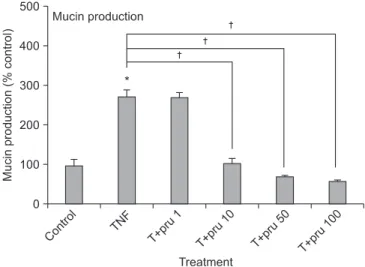
duction. The amounts of MUC5AC mucin in the cells of prunetin-treated cultures were 100±14%, 275±15%, 269±13%, 105±12%, 71±4%, and 59±3% for control, TNF-α 10 ng/mL only, TNF-α plus prunetin 1 μM, TNF-α plus prunetin 10 μM, TNF-α plus prunetin 50 μM and TNF-α plus prunetin 100 μM, respectively (Figure 1).

2. Effect of prunetin on TNF-α-induced MUC5AC mucin gene expression

MUC5AC gene expression induced by TNF-α was also in- hibited by pretreatment with 10, 50, and 100 μM of prunetin (Figure 2).

3. Effect of prunetin on TNF-α-induced IκBα degrada- tion

At 5 minutes after treatment, TNF-α showed the maximal induction of IκBα degradation. However, preincubation of NCI-H292 cells with 50 μM of prunetin prior to TNF-α expo- sure suppressed IκBα degradation (Figure 3).

Figure 1. Effect of prunetin on tumor necrosis factor-α (TNF-α)- induced MUC5AC mucin production. NCI-H292 cells were pre- treated with various concentrations of prunetin (1, 10, 50, and 100 μM) for 30 minutes and then stimulated with TNF-α (10 ng/mL) for 24 hours. Cell lysates were collected for measurement of MU- C5AC mucin production by enzyme-linked immunosorbent assay.

Three independent experiments were performed and the repre- sentative data were shown. Each bar represents the mean±SEM of three culture wells in comparison with that of the control, set at 100%. *Significantly different from control (p<0.05).

Significantly different from TNF-α alone (p<0.05). Concentration unit is μM. Pru:

prunetin.

(4)

4. Effect of prunetin on TNF-α-induced nuclear translo- cation of NF-κB p65

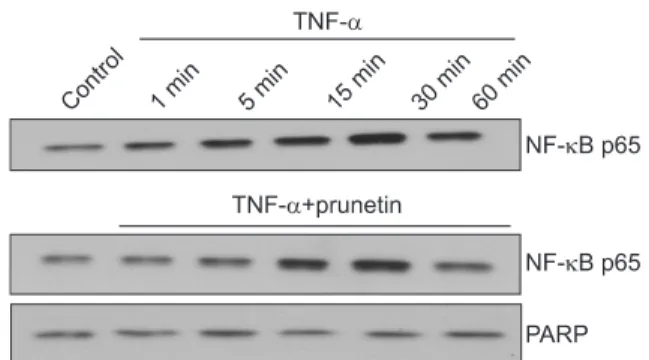
Nuclear translocation of NF-κB p65 by TNF-α was inhibited by pretreatment with 50 μM of prunetin. In the nuclear frac- tion of the TNF-α only-treated cells, there was an increase in nuclear translocation of p65 gradually and reached optimal level at 30 minutes. However, in the cells treated with prunetin plus TNF-α, the level of p65 was gradually decreased as com- pared to the TNF-α only-treated cells (Figure 4).

Discussion

Trial to develop a useful pharmacological tool for regulating production and/or secretion of mucin, the macromolecular glycoproteins present in the airway mucus, is a promising ap- proach to the effective control of severe inflammatory pulmo- nary diseases involving the hyperproduction and/or hyperse- cretion of airway mucus

14

. As aforementioned in introduction, prunetin, a flavonoidal compound derived from licorice, Glycyrrhiza glabra L., showed inhibition of activities of phos- phodiesterase, aldehyde dehydrogenase, alcohol dehydroge- nase and antioxidative activities

7-10

and showed inhibition of EGF- or PMA-induced MUC5AC protein and gene expression in MUC5AC-producing NCI-H292 cells

6

. However, to the best of our knowledge, there are no reports about the effect of prunetin on mucin gene expression, production, degradation of IκB and translocation of NF-κB p65 stimulated by TNF-α in airway epithelial cells. As can be seen in results, we found that prunetin inhibited MUC5AC mucin gene expression and production of MUC5AC mucin protein, induced by TNF-α (Figures 1, 2). This result suggests that prunetin can regulate mucin gene expression and production induced by TNF-α, through directly acting on airway epithelial cells. TNF-α has been reported to be a stimulant for secretion and gene expres- sion of MUC5AC mucin in normal human airway epithelial cells

13,15,16

. After binding its receptor, TNF-α activates several intracellular signal transduction cascades among which the NF-κB pathway is very important. The transcription factor NF-κB has been a potential therapeutic target. NF-κB is a het- erodimer composed of p65, p50, and IκBα subunits present Figure 2. Effect of prunetin on tumor necrosis factor-α (TNF-α)-

induced MUC5AC mucin gene expression. NCI-H292 cells were pretreated with 1, 10, 50, and 100 μM of prunetin for 30 minutes and then stimulated with TNF-α (10 ng/mL) for 24 hours, respec- tively. MUC5AC mucin gene expression was measured by reverse transcription polymerase chain reaction. As a quantitative control, Rig/S15 rRNA, which encodes a small ribosomal subunit protein, a housekeeping gene that was constitutively expressed, was used.

Three independent experiments were performed and the repre- sentative data were shown. Concentration unit is μM. Pru: prune- tin.

Figure 3. Effect of prunetin on tumor necrosis factor-α (TNF-α)- induced degradation of inhibitory kappa B alpha (IκBα). NCI-H292 cells were incubated with 50 μM prunetin for 24 hours and treated with TNF-α (50 ng/mL) for the indicated periods. Cytoplasmic extracts were prepared and analyzed by western blot using the antibody against anti-IκBα. The results shown are representative of three independent experiments. Equal protein loading was evalu- ated by β-actin levels.

Figure 4. Effect of prunetin on tumor necrosis factor-α (TNF-α)- induced nuclear translocation of nuclear factor kappa B (NF-κB) p65. NCI-H292 cells were either untreated or pretreated with 50 μM prunetin for 24 hours at 37

o

C and then stimulated with TNF-α (50 ng/mL) for the indicated periods. Nuclear protein extracts were prepared and resolved on 10% sodium dodecyl sulfate poly- acrylamide gel electrophoresis, transferred onto a polyvinylidene difluoride membrane, and probed with an antibody against p65.

The results shown are the representative of three independent

experiments. To ensure equal protein loading, the membrane was

re-probed with the anti-poly(ADP-ribose) polymerase (PARP) anti-

body.

(5)

in the cytoplasm as an inactive state. In response to various stimuli, the IκBα subunit is phosphorylated and degraded, thereby facilitating the translocation of p50-p65 heterodimer to the nucleus. p50-p65 acts as a transcription factor regulat- ing the expression of numerous genes including MUC5AC

17

. As shown in results, prunetin affected the degradation of IκBα which is required for NF-κB activation of transcription. At 5 minutes after treatment, TNF-α showed the maximal induc- tion of IκBα degradation. However, preincubation of NCI- H292 cells with prunetin prior to TNF-α exposure inhibited the degradation of IκBα (Figure 3). Also, nuclear translocation of NF-κB p65 by TNF-α was inhibited by pretreatment with 50 μM of prunetin. In the nuclear fraction of the TNF-α only- treated cells, there was an increase in nuclear translocation of p65 gradually and reached optimal level at 30 minutes.

However, in the cells treated with prunetin plus TNF-α, the level of p65 was gradually decreased as compared to the TNF-α only-treated cells (Figure 4). The result from this study suggests a possibility of using prunetin as a new efficacious mucoregulator for pulmonary diseases especially in conjunc- tion with inflammation, although further studies are essential.

Taken together, the inhibitory actions of prunetin on airway mucin gene expression and production might explain, at least in part, the traditional use of Glycyrrhiza glabra L., as an anti- inflammatory and anti-allergic agent for airway inflammatory diseases, in traditional oriental medicine. We suggest it is valuable both to find the natural products that have specific inhibitory effects on mucin gene expression and/or produc- tion and to search the optimal chemical moieties derived from the chemical structure of prunetin which can be useful as an efficacious regulator for mucin production in hypersecretory status of various chronic pulmonary diseases, through future studies.

Acknowledgements

This research was supported by a grant (12172KFDA989) from Korea Food & Drug Administration in 2012.

References

1. Adler KB, Li Y. Airway epithelium and mucus: intracellular signaling pathways for gene expression and secretion. Am J Respir Cell Mol Biol 2001;25:397-400.

2. Basbaum C, Lemjabbar H, Longphre M, Li D, Gensch E, Mc- Namara N. Control of mucin transcription by diverse injury- induced signaling pathways. Am J Respir Crit Care Med 1999;160(5 Pt 2):S44-8.

3. Heo HJ, Lee SY, Lee MN, Lee HJ, Seok JH, Lee CJ. Genistein and curcumin suppress epidermal growth factor-induced MUC5AC mucin production and gene expression from hu-

man airway epithelial cells. Phytother Res 2009;23:1458-61.

4. Lee HJ, Lee SY, Bae HS, Kim JH, Chang GT, Seok JH, et al.

Inhibition of airway MUC5AC mucin production and gene expression induced by epidermal growth factor or phorbol ester by glycyrrhizin and carbenoxolone. Phytomedicine 2011;18:743-7.

5. Lee HJ, Lee SY, Jeon BK, Lee JW, Kim YS, Lee MN, et al. Effect of platycodin D on airway MUC5AC mucin production and gene expression induced by growth factor and proinflamma- tory factor. Biomol Ther 2010;18:294-9.

6. Lee HJ, Lee SY, Lee MN, Kim JH, Chang GT, Seok JH, et al.

Inhibition of secretion, production and gene expression of mucin from cultured airway epithelial cells by prunetin. Phy- tother Res 2011;25:1196-200.

7. Jung HA, Kim AR, Chung HY, Choi JS. In vitro antioxidant ac- tivity of some selected Prunus species in Korea. Arch Pharm Res 2002;25:865-72.

8. Keung WM. Biochemical studies of a new class of alcohol de- hydrogenase inhibitors from Radix puerariae. Alcohol Clin Exp Res 1993;17:1254-60.

9. Ko WC, Shih CM, Lai YH, Chen JH, Huang HL. Inhibitory effects of flavonoids on phosphodiesterase isozymes from guinea pig and their structure-activity relationships. Biochem Pharmacol 2004;68:2087-94.

10. Sheikh S, Weiner H. Allosteric inhibition of human liver al- dehyde dehydrogenase by the isoflavone prunetin. Biochem Pharmacol 1997;53:471-8.

11. Li JD, Dohrman AF, Gallup M, Miyata S, Gum JR, Kim YS, et al.

Transcriptional activation of mucin by Pseudomonas aerugi- nosa lipopolysaccharide in the pathogenesis of cystic fibrosis lung disease. Proc Natl Acad Sci U S A 1997;94:967-72.

12. Takeyama K, Dabbagh K, Lee HM, Agusti C, Lausier JA, Ueki IF, et al. Epidermal growth factor system regulates mucin pro- duction in airways. Proc Natl Acad Sci U S A 1999;96:3081-6.

13. Shao MX, Ueki IF, Nadel JA. Tumor necrosis factor alpha- converting enzyme mediates MUC5AC mucin expression in cultured human airway epithelial cells. Proc Natl Acad Sci U S A 2003;100:11618-23.

14. Rogers DF, Barnes PJ. Treatment of airway mucus hyperse- cretion. Ann Med 2006;38:116-25.

15. Song KS, Lee WJ, Chung KC, Koo JS, Yang EJ, Choi JY, et al.

Interleukin-1 beta and tumor necrosis factor-alpha induce MUC5AC overexpression through a mechanism involving ERK/p38 mitogen-activated protein kinases-MSK1-CREB activation in human airway epithelial cells. J Biol Chem 2003;278:23243-50.

16. Fischer BM, Rochelle LG, Voynow JA, Akley NJ, Adler KB.

Tumor necrosis factor-alpha stimulates mucin secretion and cyclic GMP production by guinea pig tracheal epithelial cells in vitro. Am J Respir Cell Mol Biol 1999;20:413-22.

17. Li Q, Verma IM. NF-kappaB regulation in the immune system.

Nat Rev Immunol 2002;2:725-34.

수치

Figure 1. Effect of prunetin on tumor necrosis factor-α (TNF-α)- (TNF-α)-induced MUC5AC mucin production
Figure 3. Effect of prunetin on tumor necrosis factor-α (TNF-α)- (TNF-α)-induced degradation of inhibitory kappa B alpha (IκBα)

참조

관련 문서

Inhibitory effect of Quercetin and Aronia extract on the MITF, Tyrosinase, TRP-1, TRP-2 and Actin in expression B16F10 cells.. Inhibitory effect of C3G on the Tyrosinase,

IL, interleukin; MCP, monocyte chemoatactant protein; MIG, monokine induced by gamma interferon; TIMP, tissue inhibitor of metalloproteinases; TNF, tumor

https://quizlet.com/_8gkp6x?x=1qqt&amp;i=2tig8t 첨부한 프린트 자ㅊ ㄹㅎ료를 미리 부모님들께보내주세요.. 온라인 수업에 아이들 이

Inhibitory effects of classified methanol extracts of Smilax china L on the COX-2 and iNOS expression of human colorectal cancer cell lines... Inhibitory

4 &gt; Effects of Taro on COX-2 expression and iNOS expression(hot water) in human thyroid cancer cells. The cells were pretreated for 48hours with either

PI3K inhibition decreased antioxidants/GD-induced apoptosis in A549 cells, and PI3K inhibitor LY294002 had inhibitory effect on antioxidants/GD-induced caspase-3

Moreover, we found that treatment of HSC with resveratrol increased Lipin1 expression and inhibited TGF- b-activated fibrogenic gene expression via Lipin1 regulation,

포에서 We s t e r nbl ot 을 통해 HJ ME가 i NOS의 단백질 발현을 농도의존적으로 저해 하는 것을 확인하였다( Fi g.6) .그러므로 환삼덩굴은 i NOS의 발현을