Original article KOREAN JOURNAL OF APPLIED ENTOMOLOGY
한국응용곤충학회지 ⓒ The Korean Society of Applied Entomology
Korean J. Appl. Entomol. 55(2): 103-107 (2016) pISSN 1225-0171, eISSN 2287-545X
DOI: http://dx.doi.org/10.5656/KSAE.2016.03.0.006
The Genus Paracymus Thomson (Coleoptera: Hydrophilidae) new to Korea
Dae-Hyun LEE and Kee-Jeong AHN*
Department of Biology, Chungnam National University, Daejeon 34134, Korea
꼬마검정물땡땡이속(딱정벌레목: 물땡땡이과)의 국내 첫 보고
이대현ㆍ안기정*
충남대학교 생물과학과
ABSTRACT: Taxonomy of Korean Paracymus Thomson is presented. The genus and two species [Paracymus aeneus (Germar) and P.
zaitzevi Shatrovskiy] are identified for the first time in the Korean Peninsula. Habitus and SEM photographs, distribution map, key and diagnoses of the known species are provided.
Key words: Taxonomy, Paracymus, Hydrophilidae, Coleoptera, Korea
초 록: 한국산 꼬마검정물땡땡이속(Paracymus Thomson)의 분류학적 연구를 수행하였다. 꼬마검정물땡땡이속, 염전꼬마검정물땡땡이[P. aeneus (Germar)]와 꼬마검정물땡땡이(P. zaitzevi Shatrovskiy)를 한반도에서 처음 보고한다. 종에 대한 성충의 외형 과 주사전자현미경 사진, 분포도, 식 별 형질 및 검색표를 제시한다.
검색어: 분류, 꼬마검정물땡땡이속, 물땡땡이과, 딱정벌레목, 한국
*Corresponding author: [email protected]
Received February 5 2016; Revised March 14 2016 Accepted April 4 2016
The genus Paracymus Thomson contains 81 described species worldwide (Hansen, 1999; Short and Fikáček, 2011) and nine species in Palaearctic region (Hansen, 2004; Minoshima, 2014). One species have been recorded in China, two species in Japan and two species in the Far East of Russia (Hansen, 2004; Minoshima, 2014).
Members of Paracymus are characterized by the combination of the following features: dorsal surface of body black; antenna with eight antennomeres; maxillary palpus as long as or shorter than antenna; mesoventrite with a projection pointed apically;
elytra with sutural stria and without rows of serial punctures;
five abdominal sternites visible (Minoshima, 2014).
In this paper, we report two Paracymus species [Paracymus aeneus (Germar) and P. zaitzevi Shatrovskiy] for the first time in Korea. Habitus and SEM photographs, distribution map, key and diagnoses of the species are provided.
Materials and Methods
To identify Korean Paracymus species more reliably, we compared them with voucher specimens in the Natural History Museum (NHM), London, United Kingdom. The specimens used in this study are deposited in Chungnam National University Insect Collection (CNUIC), Daejeon, Korea. The terms and measurements of specimens mainly followed Komarek (2004) and Archangelsky et al. (2005).
Systematic accounts
Family Hydrophilidae Latreille Subfamily Hydrophilinae Latreille
Genus Paracymus Thomson, 1867 꼬마검정물땡땡이속(신칭) Paracymus Thomson, 1867: 120 (type species: Hydrophilus aeneus Germar, 1824).
Fig. 1. Habitus. A: Paracymus aeneus (Germar), 2.6 mm; B: P. zaitzevi Shatrovskiy, 1.7 mm.
Eumetacymus Brèthes, 1922: 263 (type species: Eumetacymus virescens Brèthes, 1922).
Paracymorphus Kuwert, 1888: 39 (type species: Paracymorphus globuloides Kuwert, 1888).
Key to the species of the Paracymus in Korea
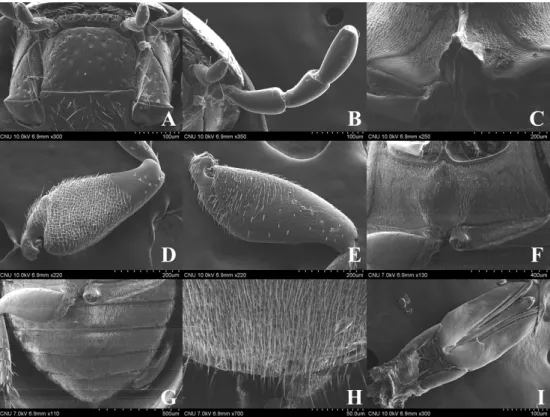
1. Body more than 2.0 mm; mesofemur (Fig. 2E) with pubescence on basal half; sternite VII (Fig. 2H) without a row of spines on apical margin ··· P. aeneus - Body less than 2.0 mm; mesofemur (Fig. 3E) with pubescence
on basal two-third; sternite VII (Fig. 3H) with a row of spines on apical margin ··· P. zaitzevi
Paracymus aeneus (Germar, 1824) 염전꼬마검정물땡땡이 (신칭) (Figs. 1A, 2, 4)
Hydrophilus aeneus Germar, 1824: 96.
Hydrobius punctulatus Sturm, 1836: 15.
Hydrobius salinus Bielz, 1851: 152.
Laccobius cupreus Dalla Torre, 1877: 68.
Diagnosis. Length 2.5-3.0 mm. Ventral surface of body most reddish brown. Width of frons about 3.5 times as wide as eye. Mentum (Fig. 2A) subquadrate, 1.5 times as wide as long.
Maxillary palpomere (Fig. 2B) 2 about 4.0 times as long as 1, broad apically. Profemur (Fig. 2D) with pubescence on basal two-third. Mesoventral process (Fig. 2C) falcon-shaped, protrude;
carina protrude, rounded in lateral view. Mesofemur (Fig. 2E) with pubescence on basal half. Sternite VII (Fig. 2H) rounded
apical margin, without a row of spines. Median lobe (Fig. 2I) of aedeagus slender, gradually narrowed apically, shorter than paramere, widest at base; apical part rounded. Paramere (Fig.
2I) broad, widest at base; inner margins nearly straight; outer margins straight; apical part protrude and rounded.
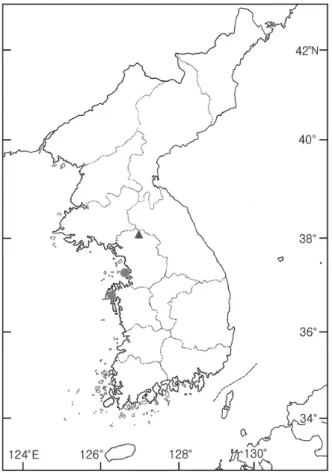
Material examined. KOREA: Chungnam Prov.: 7 exx, Taean-gun, Nam-myeon, Sinon-ri, N36°51′49.23″ E126°12′
23.75″ 7 m, 30 VII 2013, DH Lee, pond on abandon salt farm (2♂♂1♀, on slides); Gyeonggi Prov.: 8 exx, Ansan-si, Danwon-gu, Daebudong-dong, Dongju-salt farm, N37°14′ 05.60″ E126°36′19.55″ 4 m, 7 XI 2013, DH Lee, IS Yoo, SG Lee, saline pond near salt farm.
Distributions: Asia: Korea, Japan, Russia (East Siberia, Far East), Iran, Israel, Kyrgyzstan, Kazakhstan, Mongolia, Tajikistan, Turkmenistan, Turkey, Europe: Albania, Austria, Bulgaria, Croatia, Czech Republic, Denmark, France, Great Britain, Germany, Greece, Ireland, Italy, The Netherlands, Norway, Poland, Romania, Russia (South European Territory), Slovenia, Spain, Sweden, Ukraine; North Africa: Egypt, Tunisia.
Remarks. This species can be distinguished from P. chalceolus (Solsky) by protarsal claw as long as tarsomere 1 in male and median lobe elongate.
Paracymus zaitzevi Shatrovskiy, 1989 꼬마검정물땡땡이 (신칭) (Figs. 1B, 3, 4)
Paracymus zaitzevi Shatrovskiy, 1989: 190.
Diagnosis. Length 1.6-1.8 mm. Ventral surface of body
Fig. 2.Paracymus aeneus. A: mentum (ventral aspect); B: maxillary palpi (ventral aspect); C: mesoventral process (ventral aspect); D:
profemur (ventral aspect); E: mesofemur (ventral aspect); F: metaventrite (ventral aspect); G: sternites (ventral aspect); H: apical part of sternite VII (ventral aspect); I: aedeagus (ventral aspect).
Fig. 3.Paracymus zaitzevi. A: mentum (ventral aspect); B: maxillary palpi (ventral aspect); C: mesoventral process (ventral aspect); D:
profemur (ventral aspect); E: mesofemur (ventral aspect); F: metaventrite (ventral aspect); G: sternites (ventral aspect); H: apical part of sternite VII (ventral aspect); I: aedeagus (ventral aspect).
Fig. 4. Distribution map. Paracymus aeneus (circle), P. zaitzevi (triangle).
most dark brown. Width of frons about 3.0 times as wide as eye. Mentum (Fig. 3A) transverse subquadrate, 2.0 times as wide as long. Maxillary palpomere (Fig. 3B) 2 about 4.0 times as long as 1, widest at apical third. Profemur (Fig. 3D) with pubescence on basal half. Mesoventral process (Fig. 3C) falcon- shaped, protrude; carina weakly protrude, broadly rounded in lateral view. Mesofemur (Fig. 3E) with pubescence on basal two-third. Sternite VII (Fig. 3H) rounded apical margin, with a row of spines. Median lobe (Fig. 3I) of aedeagus slender, broad subapical part, shorter than paramere, widest at base; apical part rounded. Paramere (Fig. 3I) slender, widest at base; slightly curved at apical third; apical part rounded.
Material examined. KOREA: Gyeonggi Prov.: 12 exx.
Yeoncheon-si, Yeoncheon-eub, Dongmak-ri, N38°06′45.13″
E127°06′45.13″ 104 m, 26 IX 2014, DH Lee, SG Lee, JS Lee, pond (2♂♂, on slides).
Distribution. Korea, Russia (Far East).
Remarks. This species can be distinguished from P. chalceolus
(Solsky) by the small size (less than 2.0 mm) and from P.
orientalis Orchymont by the subapical part of median lobe broad.
Acknowledgements
We thank C. Taylor (NHM, London), Y. N. Minoshima (Kitakyushu Museum of Natural History and Human History, Kitakyushu) and H. Yoshitomi (Ehime University Museum, Matsuyama) for providing voucher specimens and literature.
Financial support was provided by a grant from the National Institute of Biological Resources (NIBR), funded by the Ministry of Environment (MOE) of the Republic of Korea (NIBR 201601203).
Literature Cited
Archangelsky, M., Beutel, R.G., Komarek, A., 2005. Chapter 10.
Hydrophilidae, in: Beutel, R.G., Leschen, R.A.B. (Eds.), Handbuch der zoologie/handbook of zoology, Volume IV, Arthropoda:
Insecta, Part 38, Coleoptera, Beetles, Volume 1: Morphology and systematics (Achostemata, Adephaga, Myxophaga, Polyphaga partim). Walter de gruyter, Berlin, New York, pp. 158-183.
Bielz, E.A., 1851. Der schlossberg bei déva und seine umgebung in entomologischer bezeihung beschrieben. Verhandlungen und mitteilungen des siebenbürggischen vereins für naturwissenschaften zu hermannstadt 2, 146-154.
Brèthes, J., 1922. Descripción de varios Coleópteros de Buenos Aires. Anales de la sociedad ientifíca Argentina 94, 263-305.
Dalla Torre, C.W., 1877. Synopsis der Insecten oberösterreichs.
Jahresbericht des vereins für naturkunde in linz 8, 15-74.
Germar, E.F., 1824. Insectorum species novae aut minus cognitae, Descriptionibus illustratae. Vol. 1. Coleoptera. 24+624 pp., 2 pls.
Halae, J. C. Hendel et Fil.
Hansen, M., 1999: World catalogue of insects. Volume 2.
Hydrophiloidea (s. str.) (Coleoptera). Apollo Books, Stenstrup.
Hansen, M., 2004. Family Hydrophilidae, in: Löbl, I., Smetana, A.
(Eds.), Catalogue of Palaearctic Coleoptera, Vol. 2, Hydrophiloidea, Histeroidea, Staphylinoidea. Apollo Books, Stenstrup, pp. 44-68.
Komarek A., 2004. Taxonomic revision of Anacaena Thomson, 1859 I. Afrotropical species (Coleoptera: Hydrophilidae). Koleop.
Rdsch. 74, 303-349.
Kuwert, A., 1888. Tre nuovi coleotteri di Sicilia. Il Naturalista Sciliano 8[1888-1889], 38-39.
Minoshima, Y.N., 2014. The identity of the Japanese species of the genus Paracymus Thomson (Coleoptera, Hydrophilidae). Elytra
new series 4(1), 143-149.
Shatrovskiy, A. G., 1989. Hydraenidae, Hydrophilidae, in: Ler, P.A. (Eds.), Opredelitel’ nasekomykh dal’nego vostoka SSSR v shestitomakh. Volume 3. Zhestkokrylye (Part 1). Nauka, Leningrad, pp. 260-293.
Short, A.E.Z., Fikáček, M., 2011. World catalogue of the Hydrophiloidea (Coleoptera):additions and corrections II (2006-2010). Acta
Entomologica Musei Nationalis Pragae 51(1), 83-122.
Sturm, J., 1836. Deutschlands fauna in abbidungen nach der natur mit beschreibungen. V. Abtheilung. Die Insecten. Zehntes bändchen.
Käfer. Nürnberg: J. Sturm, 108 pp., pl. 216-227.
Thomson, C.G., 1867. Skandinaviens Coleoptera. Synoptiskt bearbetade. Supplementum. Tom. IX. Lund: Lundbergska Boktryckeriet, 407 pp.