• 검색 결과가 없습니다.

Effect on Customer Satisfaction of the Emotional Intelligence of Members at Service Providing Department in the Hotel; A Case of Five Star Hotels in Daejeon

N/A
N/A
Protected

Academic year: 2021

Share "Effect on Customer Satisfaction of the Emotional Intelligence of Members at Service Providing Department in the Hotel; A Case of Five Star Hotels in Daejeon"

Copied!
9
0
0

로드 중.... (전체 텍스트 보기)

전체 글

(1)

¶ Corresponding Author: Jung-Soo Kim, Dept. of Hotel Culinary, Daeduk University, 64, Gijeongbuk-ro, Yuseong-gu, Daejeon si, Tel. +82-10-6310-9818, Fax. +82-42-866-0437, E-mail: [email protected]

Culinary Science & Hospitality Research. 2016;22(1):126-134.

https://cshr.jams.or.kr/ ISSN  2466‐0752  (Print) ISSN  2466‐1023  (Online)

Effect on Customer Satisfaction of the Emotional Intelligence of Members at Service Providing Department in the Hotel;

A Case of Five Star Hotels in Daejeon

Jung-Soo Kim

Dept. of Hotel Culinary, Dae-Duk University

ABSTRACT: This study examines effect in customer satisfaction of the emotional intelligence of members at service providing department in the hotel; A case of five star hotels in Dajeon Research hypotheses were developed based on previous literature, and data were collected from 350 employees working at the hotel restaurant service business located in Daejeon, ROK, were investigated herein The collected data were then analysed using frequence reliability For this research analysis, a self-recording method was used where and examiner explains the survey and respondents writhen down their answers to survey questions Statistical processing in this study was done through data cidubg and data cleaning then with the SPSS(Statistical Package for Social Science)v. 18.0. This result the emotional intelligence of service-pro- viding employees at food service department of hotel was found to have a positive effect on customer satisfaction via understanding of others and emotional control. And the understanding of oneself, under- standing of others and emotional control in emotional intelligence had a positive effect on job sa- tisfaction. Emotional control, and emotioal use were found to affect organizational commitment posi- tively.

Keywords: emotional intelligence, customer satisfaction, hotel

INTRODUCTION

In the hotel industry, the management organiza- tion of large-scale specialized restaurant generally refers to the restaurant organization, kitchen organi- zation and management organization. These three organizations are divided according to the area of business to achieve administractive goals. The ma- nagement organization should also maintain mu- tually complimentary relationships along with their independent nature[1].

The food service department of hotel has strong dependence on labor and shares the nature of labor intensive industry. But it is unique that personnel

management activities, facility management activi-

ties and service management activities in the hotel

management process should all be efficiently coordi-

nated as one single general system to deliver effec-

tive management performance[2]. In other words,

the service ability of organizational members has a

huge effect on the image of the hotel business and

its sales increase and proper human resource ma-

nagement is the way to improve business produc-

tivity and competitiveness. In the modern society,

unlike the division or roles among service providers

in the previous production-centered systems, all of

the organizational members are increasingly enga-

ged in service provision. In this situation, they need

(2)

to continue self-innovation in an organized manner to create conditions favorable to gain satisfaction from jobs and be committed to the organization tasks, lowering turnover rate.

Effective HR management is an important indi- cation of success or failure of the corresponding organization. In this aspect, HR management should be implemented in a well-organized manner to en- sure flexible response to the changing organization- al environment. Also by managing the overall organ- izational aspects stably and service providing staff members efficiently employees' job satisfaction and organizational aspects stably and service providing staff members efficiently, employees' job satisfaction and organizational commitment will be increased, enhancing their job performance as well. In this mechanism, the sales profit of hotel restaurants will be deeply affected after all[3].

HR management in this nature requires a fresh idea and approach inside an organization. Successful future of an organization is dependent on effective HR development and management based on the co- operation and coordination among the sub-units of it. That is, for the continued growth and long term survival of an organization, excellent organizational members should be secured and manager should provide proper support and effort for them to maxi- mize their capacity.

To this end, organizational members should vol- untarily participate and be absorbed into work and on this basis, joint goals should be achieved to adapt to environmental changes. As such, to achieve a common organizational goal, members' will to co- operate is essential. Therefore, for the maximization of subordinates' potential capacity, systematic sup- port inside the organization is all the more necessary along with appropriate caring and assistance as a key source of psychological behavior for each of them to satisfy their self-competency.

Bandura (1977) presented the idea of self-com- petency through the social cognitive theory. Here, he contended that self-competency did not mean whether a person had a certain ability or skill itself and we needed to help someone become confident in his or her own ability and skill that the person can complete something successfully. In other words.

organizational members need to be sufficiently sup-

ported to fully exercise their belief or assessment on own ability to do as series of activities, motivate, bring human resources, etc. necessary to achieve a certain task within the organization as a way of cog- nitive mechanism mediating behavioral change.

As such, the stronger the self=competence belief on own ability and skill, people tend to set higher goals and put in more voluntary work, resulting in higher performance. Therefore, self-competency has an effect on individual job performance and func- tions as a cause of job performance. This causal rela- tionship, in tum, affects the re-evaluation of self- competence to produce highly customer-oriented service after all. In This process, self-competence is finally linked to future motivation and performance achievement to make one continue or give up own behaviors. Based on this role and process, Gist &

Mitchell (1992) claimed that, to enhance individual and organizational performance, organizational sup- port and self-competence should be increased in any case.

In the job of service provision, workers need to satisfy customer needs while dealing with the ser- vice discrepancy related to expectation on roles in line with employees' characteristics. And this job re- quires own emotion along with emotional intelli- gence. This is an effort to suppress or control one's actual emotion or one's emotion to express different emotion from actual emotion with receptive own emotional intelligence to support the service quality toward customers[4].

As such employees in the service industries are re- quired to exercise a higher level of emotional in- telligence than those in other job areas. They should be always customer oriented so that customers are satisfied with their services. To this end, the employ- ees should sincerely take care of customers. In this sense, their emotional intelligence is intensively re- quired.

In this recognition, this present study seeks to

present academic and industrial implications based

on empirical investigation on how large the differ-

ence is in the effect of emotional intelligence of

workers at foodservice department of hotel on cus-

tomer satisfaction according to the regulation effect

of self-competence of service providing employees

at food service department of hotel to test the dif-

(3)

ference of regulation effect according to organiza- tional support and self-competence intensity on the effect of their emotional intelligence on customer satisfaction, which they experience during work.

THEORETICAL BACKGROUND

Emotional Intelligence

Emotional intelligence refers to the ability to ob- serve, evaluate and differentiate own emotion and feelings and those of others and utilize such recog- nized information in inducing a thought and be- havior. However, this definition was criticized for it limitation of not including emotional thinking. Ac- cordingly, the emotional intelligence was re-defined as the ability to precisely perceive, recognize and ex- press emotion; ability to produce or use emotion to facilitate thinking; ability to understand emotion and emotional knowledge; and ability to control emotion in order to facilitate emotional development and in- telligent development[5].

Emotional intelligence is consisted of own emo- tion understanding, ability to perceive own emotion precisely and understand and express; others' emo- tion understanding to perceive and understand oth- er people's emotion; self-control ability to control own emotion and take an appropriate action in a given situation; and emotion use ability to apply own accumulated emotional information effectively to perform and achieve a job.

In emotional intelligence, emotional control and altruistic behaviors have a high relevance[6]. This is to control emotion and help maintain positive emo- tion while stably pursuing social interaction with other people. In this aspect, it can explain efforts to help others with their issues or problems. This mecha- nism indicates that the higher the work satisfaction in an employee, he or she is more likely to behave more proactively to help others. That is, people with high emotional intelligence better understand own emotion to better control and use own emotion;

and better understand others' emotion to provide more efficient response to others' emotion they ob- served. On the other hand, people with lower emo- tional intelligence cannot effectively understand and control own emotion, thought they perccive one, and my face limitation in the use thereof. Also, they

may not efficiently respond to others as they have a poor understanding of others' feelings.

In this sense, based on pervious literature, the present study seeks to note the nature of emotional intelligence in analyzing the role of emotional in- telligence affecting people working in the frontline of service provision.

Customer Satisfaction

Customer satisfaction refers to corporate business activity from the perspective of customers. It means that corporate marketing activity should be percei- ved from customers' viewpoint and pursue custom- ers' interests increase[7]. Customer satisfaction is de- fined as the satisfaction of customer needs in the interatction between employees and customers. The relationship between service providing company and customers is built in the process of listening to customer voices, trying to understand customer needs, providing precise and relevant information to customers, keeping a promise with customers, etc [8]. Service providers with high customer satisfaction show more activities to increase customer satisfac- tion and such behaviors for higher customer satis- faction encourage long-term relationship between the service provider and customers. For this reason, customer satisfaction is significant[9].

Given these multiple sets of definition, customer satisfaction is important to all of the enterprises but especially vital in the service industry[10]. It is view- ed that customer satisfaction emphasizes the im- portance of service employees' attitude for customer satisfaction and delivers the message for business managers to select employees with the way of thinking centered on customer satisfaction.

Relationship among Sub-Concepts

In emotional intelligence, emotional control and altruistic behaviors have a high relevance. This is to control emotion and help maintain positive emotion while stably pursuing social interaction with other people. In this aspect, it can explain efforts to help others with their issues or problems. This mecha- nism indicates that the higher the work satisfaction in an employee, he or she is more likely to behave more proactively to help others.

In the field of service provision, employees with

(4)

Figure 1. Effect on customer satisfaction of the emotional intelligence of members at service providing department in the hotel industry.

higher customer satisfaction tend to enjoy the act of service provision to customers itself and such a tendency results in enhanced work performance. In other words, only those employees who are satisfied with own work can provide service with the mindset for customer satisfaction with caring and enthusiasm toward customers.

People with high emotional intelligence better understand own emotion; become able to regulate and use own emotion; and better understand others' emotion to efficiently respond to the emotion they observed.

HYPOTHESIS

Relationship between Emotional Quotient and Customer-Satisfaction

Emotional intelligence of service-providing em- ployees at food service department of hotel for cus- tomer satisfaction behaviors has an important effect on customer satisfaction. This means that the emo- tional intelligence[11] experienced by employees in the interaction process with customers results in higher service quality through helping behavior for customers[12].

Thus, the current study proposes following hy- potheses:

Hypothesis 1: Emotional intelligence of service-

providing employees in the hotel industry will have a significant effect on customer satis- faction.

METHODS

Research Model

In this study, it was assumed that researchers sup- ported job-oriented approach and emotional in- telligence affected customer satisfaction. According to the effect of emotional intelligence on customer satisfaction, it is noted that emotional intelligence has two opposite sides at the same time. While emotional intelligence implementation successfully meets organizational requirements and customer satisfaction by complying with organizational norms [13], depending upon the case, it sometimes causes the contradiction between employees' own emotion and emotional intelligence required by the organ- ization to result in emotional dissonance. In this case, diverse negative consequences could be ca- used such as alienation from one's own emotion and its accompanied self-esteem degradation, job dissa- tisfaction, low organizational commitment, and chan- ging jobs, In this recognition, this study plans to conduct an empirical investigation in reflection of the effect of these factors on customer satisfac- tion[14].

In this study, the research model was designed as

(5)

the following diagram in order to examine the effect on customer satisfaction of the emotional intelli- gence of service-providing employees in food ser- vice department of hotel; and regulation effect ac- cording to organization support and self-compe- tence in the relationship between emotional intelli- gence and customer satisfaction.

Measurement

Wong & Low(2002) defined the ideal of emotional intelligence as the ability to understand and control own and others' emotion and to effectively utilize the perceived emotion. This present study employs the emotional intelligence assessment scale of Wong

& Low(2002), which explained emotional intelligence in 4 different dimensions of self-emotion understan- ding, others' emotion understanding, emotional con- trol and emotional use through 16 questions. The cognitive aspect of members' emotion will be as- sessed herein with this 5-point likert scale.

Customer satisfaction is for employees to under- stand customers' needs and desire and perform ac- tivities to meet such needs and desire. In this study, 5-question tool was used, which was used by Seong- su Park(2009) who adopted and modified the tool in the study by Schepers, Falk, Ruyter, Jong and Hammerschmidt(2012).

To analyze the demographic characteristics of the sample, nominal scale was utilized herein to assess 7 demographic survey questions on gender, age, martial status, academic/occupational career, and of- fice position.

Organizational support is the organization or for measurements in this study perceived beliefs you may have about the extent to which under consi- deration is evaluated his contribution from the firm Eisnberger et al (1986, 1990) has developed mea- surement tools modified to fit the company overall situation in our country. our company has supported me composed of questions such as 5-point Likert scale, seven questions.

Bandura (1977) and Jones (1986) is a self-com- petence for themselves on individuals successfully perfom certain tasks in the new situation expected degree, it is the practice of person’s role or organiza- tional needs this so confident and skilled in the study using a survey out of Jones 5 items used in

the research(1986) topic complements the concep- tual definition of Bandura (1977) was composed of a this 5-point Likert scale.

Data Collection

To examine the effect on customer satisfaction of the emotional intelligence job attitude of service- providing employees at food service department of hotel, 350 employees working at the hotel restau- rant service business located in Daejeon, ROK, were investigated herein.

For this research analysis, a self-recording method was used where and examiner explains the survey and respondents writhe down their answers to sur- vey questions. The average time for respondents to answer the question was 10~15 minutes.

The survey period was 10 days from October 11 to 20, 2015. Of the distributed 350 sets of ques- tionnaires, at least 300 sets are planned to be col- lected and any poorly-answered ones will be ex- cluded for the final analysis herein.

Data Analysis

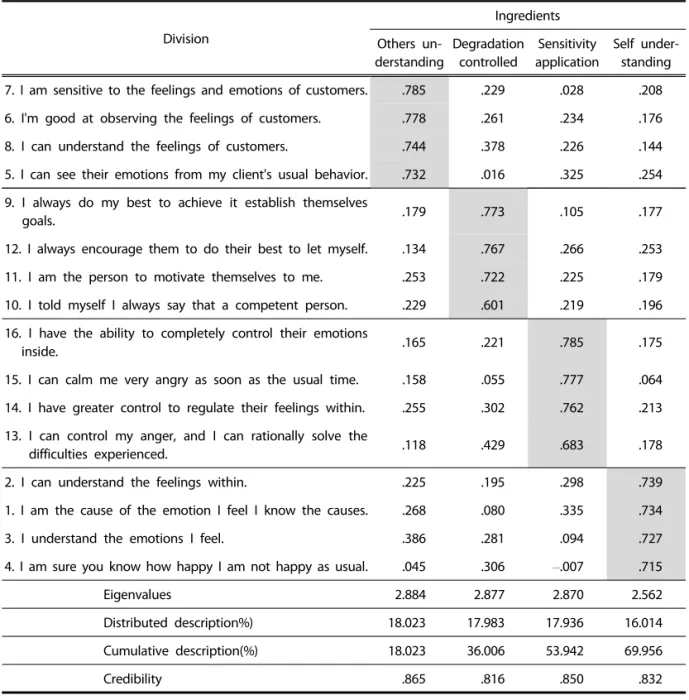
Statistical processing in this study was done th- rough data coding and data cleaning then with the SPSS(Statistical Package for Social Science) v. 18.0 and verified validity & credibility reliability about emotional intelligence Table 1. show the result. The result of the factor analysis for the 16 questions about the emotional intelligence. As a result, a total of four factors were derived, it was given a name based on the central concept of the factors that make up each item factors. Factor 1 (18.0.23%) was named ‘understanding of others’ Factor 2 (17.983%) was named “emotion control, Factor 3 (17.936%) were named ”sensibility activity, Factor 4 (16.014%) were named as ‘self-understanding’, These four fac- tors load values ±.40 above appear extracted and in- terpreted by some that are factor is feasible ±.60 above appear it can be viewed as reliable level.

Survey Composition

In this study, the survey questionnaire is consisted

of emotional intelligence, customer satisfaction, or-

ganization support, self-competence and general

matters at the high level.

(6)

Division

Ingredients Others un-

derstanding

Degradation controlled

Sensitivity application

Self under- standing 7. I am sensitive to the feelings and emotions of customers. .785 .229 .028 .208 6. I'm good at observing the feelings of customers. .778 .261 .234 .176 8. I can understand the feelings of customers. .744 .378 .226 .144 5. I can see their emotions from my client's usual behavior. .732 .016 .325 .254 9. I always do my best to achieve it establish themselves

goals. .179 .773 .105 .177

12. I always encourage them to do their best to let myself. .134 .767 .266 .253

11. I am the person to motivate themselves to me. .253 .722 .225 .179

10. I told myself I always say that a competent person. .229 .601 .219 .196 16. I have the ability to completely control their emotions

inside. .165 .221 .785 .175

15. I can calm me very angry as soon as the usual time. .158 .055 .777 .064 14. I have greater control to regulate their feelings within. .255 .302 .762 .213 13. I can control my anger, and I can rationally solve the

difficulties experienced. .118 .429 .683 .178

2. I can understand the feelings within. .225 .195 .298 .739

1. I am the cause of the emotion I feel I know the causes. .268 .080 .335 .734

3. I understand the emotions I feel. .386 .281 .094 .727

4. I am sure you know how happy I am not happy as usual. .045 .306

.007 .715

Eigenvalues 2.884 2.877 2.870 2.562

Distributed description%) 18.023 17.983 17.936 16.014

Cumulative description(%) 18.023 36.006 53.942 69.956

Credibility .865 .816 .850 .832

Table 1. Validity & credibility reliability verification about emotional intelligence

RESULTS

Descriptive Statistics of Sample

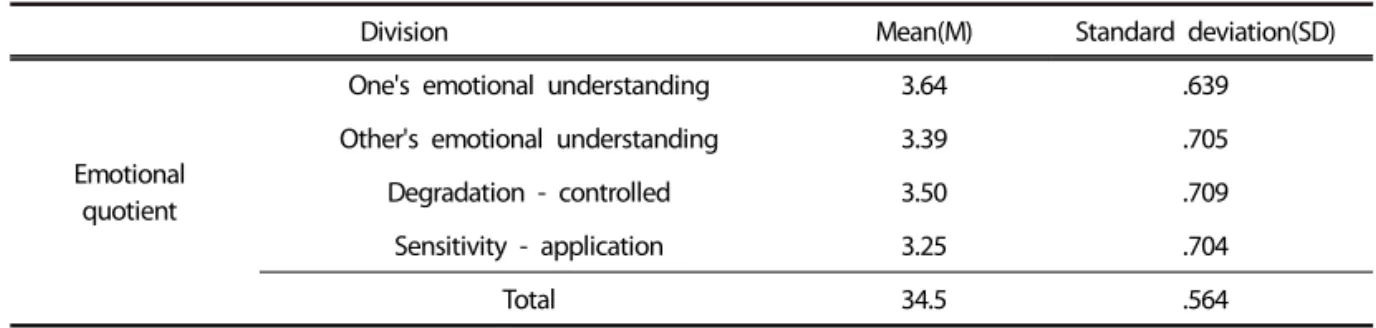
Table 3 shows the results of descriptive statistics, As a result, 'One's emotional understanding'(M=3.64) is the highest result, 'Degradation-controlled'(M=

3.50), 'Other's emotional understanding'(M=3.39), 'Sen- sitivity - application'(M=3.25) appeared in regular se- quence, generally emotional quotient appeared ave- rage 3.45.

Characteristics of Sample

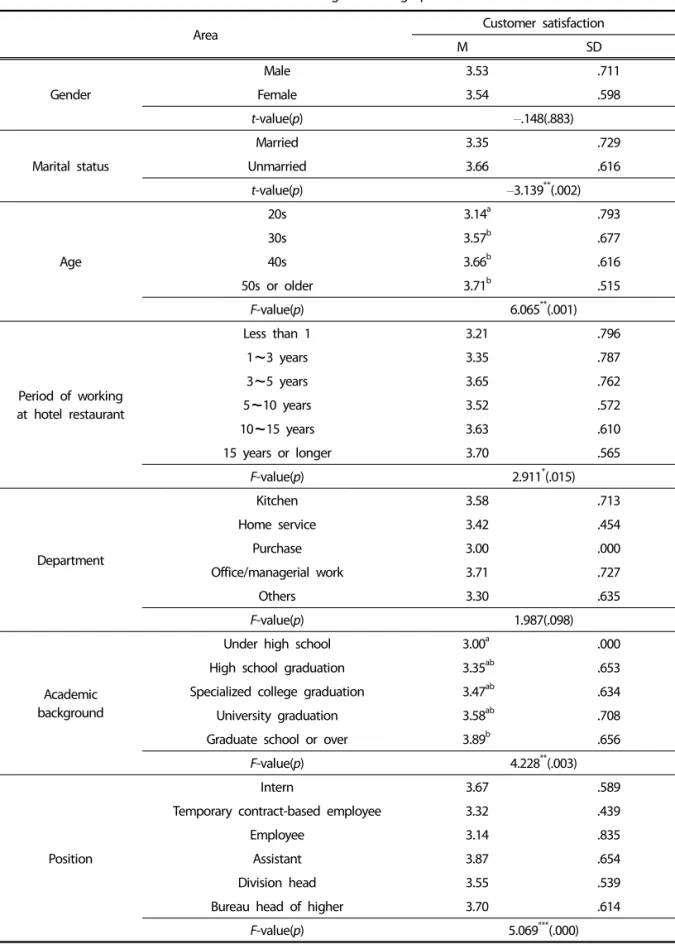
Table 4 shows the results of analyzing any differ-

ence in customer satisfaction according to demo-

graphic characteristics. As a result, depending upon

the marital status, statistically significant difference

was found in customer satisfaction (p<.01), and cus-

tomer satisfaction was found relatively higher in

married status. According to age, there was statisti-

cally significant difference in customer satisfaction

(9<.01). There was difference in average levels of the

group of those in their 20s and 30s, group of those

(7)

Area No. of questions Source Emotional intelligence 16

Customer satisfaction 5 Organization support 7

Self-competence 5

General matters 7

Table 2. Survey composition

Division Mean(M) Standard deviation(SD)

Emotional quotient

One's emotional understanding 3.64 .639

Other's emotional understanding 3.39 .705

Degradation - controlled 3.50 .709

Sensitivity - application 3.25 .704

Total 34.5 .564

Table 3. General emotional quotient

in 40s and 50s, and group of those in 50s or older.

Depending upon the period of work at hotel food service department, statistically significant difference was found in customer satisfaction (9<.05). There was difference in average levels between the groups working for less than 1 year, 3~5 years, 10~15 years and over 15 years and the groups working for 1~3 years and 5~10 years. Concerning the academic background, statistically significant difference was found in customer satisfaction (p<.01). The group with high-school graduation or lower and the group with graduate school or higher showed difference in their averages. Concerning the income level, statisti- cally significant difference was found in customer satisfaction(9<.001). Difference in average was found among the group with KRW 1~2 million and group with KRW 2.01~3 million abd group with KRW 4.01 million or over, respectively. As for one's major area of study, statistically significant difference was found in customer satisfaction (p<.01). Customer satisfac- tion was found higher in cooking and hotel-related areas of study. Other than these, gender and depart- ment of work showed no statistical difference (9

>.05).

DISCUSSION AND CONCLUSIONS

Practical Implications

Deajeon hotel industry professional restaurant ser- vuce practician of affective intelligence is customer satisfacttion measurement in others understanding, degradation-controlled is postive effect a job satis- faction in sphere of influence is self-knovledge, oth- ers understanding is positive effect on influence emotional quotient is organizational commitment ef- fect on degradation-controlled and sensitivity appli- cation is organizational commitnet effect on influ- ence appear hotel industry service practician is emo- fional quotient in customer satisfaction measure- ment will have a beneficial influence on Table 1 adopt hypothesis

Academic Implications

Emotional intelligence of service-providing em- ployees at food service department of hotel for cus- tomer satisfacton behaviors has an important effect on customer satisfaction. This means that the emo- tional intelligence experienced by employees in the interaction process with customers results in higher service quality through helping behavior for custo- mers.

Study Limitations

In emotional intelligence, emotional control and

altruistic behaviors have a high relevance this is to

control emotion and help mailtain positive emotion

while stably pursuing social interaction with other

people. In this aspect, it can explain efforts to help

others with their issues or problems, This mecha-

nism indicates that the higher the work satisfaction

in an employee, he or she is more likelt to behave

more proactively to help others, That is people with

high emotional intelligence better understand own

(8)

Area Customer satisfaction

M SD

Gender

Male 3.53 .711

Female 3.54 .598

t-value(p)

.148(.883)

Marital status

Married 3.35 .729

Unmarried 3.66 .616

t-value(p)

3.139

**

(.002)

Age

20s 3.14

a

.793

30s 3.57

b

.677

40s 3.66

b

.616

50s or older 3.71

b

.515

F-value(p) 6.065

**

(.001)

Period of working at hotel restaurant

Less than 1 3.21 .796

1 3 years 3.35 .787

3 5 years 3.65 .762

5 10 years 3.52 .572

10 15 years 3.63 .610

15 years or longer 3.70 .565

F-value(p) 2.911

*

(.015)

Department

Kitchen 3.58 .713

Home service 3.42 .454

Purchase 3.00 .000

Office/managerial work 3.71 .727

Others 3.30 .635

F-value(p) 1.987(.098)

Academic background

Under high school 3.00

a

.000

High school graduation 3.35

ab

.653

Specialized college graduation 3.47

ab

.634

University graduation 3.58

ab

.708

Graduate school or over 3.89

b

.656

F-value(p) 4.228

**

(.003)

Position

Intern 3.67 .589

Temporary contract-based employee 3.32 .439

Employee 3.14 .835

Assistant 3.87 .654

Division head 3.55 .539

Bureau head of higher 3.70 .614

F-value(p) 5.069

***

(.000)

Table 4. Difference in customer satisfaction according to demographic characteristics

(9)

emotion to better control and use own emotion and better understand others emotion to provide more efficient response to others emotion they observed.

On the other hand, people with lower emotional in- tellgence cannot effectively understand and control own emotion thought they perccive one, and my face limitation in the use therof, Also, they may not efficiently respond to others as they have a poor un- derstanding of others’ fellings.

REFERENCES

[1] Jin YH (1997). Study on the Menu Engineering of Food Service Department of Hotel. Doctorate Thesis of Graduate School of Kyonggi University centering on p. 43, Doctorate Thesis of Graduate School of Kyonggi University, centering on p.3.

[2] Kim KY (1996). Study on Model Development for Hotel Kitchen Facility Arrangement Management System: Population Engineered Spatial Arrange- ment Model. Doctorate Thesis of Graduate Sch- ool of University, p.2.

[3] Kim GH (2011). Effect of the Kitchen Environment of Hotel Cooking Employees on Self-Competen- ce, Organization Commitment and Job Perfor- mance. Doctorate Thesis of Graduate School of Dongeui University, p.2.

[4] Kim GH (2011). Understanding of Emotional La- bor in Service Society. International Labor Brief.

Vol. 5.

[5] Salovey P, Mayer JD (1997). What is emotional intelligence? In P. Salovey & D. Sluyter(Eds). Emo- tional Development and Emotionalintelligence.

Mplications for Educators, pp.3-31), Basic.

[6] Staw BM, Sutton RL, Pelled SH (1994). Employee positive emotions and favorable outcomes at the

workplace. Organization Science 5:51-71.

[7] Ahn JS (2004). Study on customer satisfaction ac- cording to the personal-relations tendency of ho- tel employees. Journal of Tourism Management Research 22., pp. 183-202.

[8] Park SH (1996). Study on the Effect of Employees' Job Satisfaction on Customer Satisfaction, Mas- ter's Degree Thesis of Graduate School of Kyong- gi University, 9.30.

[9] Kim CH (2008). Study on Teachers' Customer Sa- tisfaction. Graduate School of Education, Han- yang University, Master's Degree Thesis, pp. 14- 18.

[10] Maxham Hartline, McKee (2000). Corridors of in- fluence in the dissemination of customer-ori- ented stategy to customer contact service em- ployees. Journal of Marketing 64(2):43-49.

[11] Losekem Donileen R, Spencer E, Chil l (1986).

Actors in search of a character: student, social woker’s quest, for professional identity. Symbol- ic Interaction 9(2):245-258.

[12] Amy W (1993). The affective consequences of service work: Managing emotions on the job.

Work and Occupations 20(2):205-235.

[13] Rafaeli A, Sutton RI (1989). "The expression of emotion in organizational life. Research in Orga- nizational Behavior 11:31-42.

[14] Grandy A (2003). When "the show must go on":

Surface and deep acting as predictors of emo- tional exhaustion and service delivery". Acade- my of Management Journal 46(1):86-96.

Received: 10 DEC, 2015

Revised: 28 DEC, 2015

Accepted: 1 JAN, 2016

수치

Figure 1. Effect on customer satisfaction of the emotional intelligence of members at service providing department in the hotel industry.
Table 1. Validity &amp; credibility reliability verification about emotional intelligence
Table 3. General emotional quotient
Table 4. Difference in customer satisfaction according to demographic characteristics

참조

관련 문서

The index is calculated with the latest 5-year auction data of 400 selected Classic, Modern, and Contemporary Chinese painting artists from major auction houses..

It considers the energy use of the different components that are involved in the distribution and viewing of video content: data centres and content delivery networks

After first field tests, we expect electric passenger drones or eVTOL aircraft (short for electric vertical take-off and landing) to start providing commercial mobility

1 John Owen, Justification by Faith Alone, in The Works of John Owen, ed. John Bolt, trans. Scott Clark, &#34;Do This and Live: Christ's Active Obedience as the

The objective of this study is to understand the effects of walking activity using fairy tales on the peer competence and emotional intelligence of

In this regard, this study analyzes the effect of the job characteristics and work environment of workers with physical disabilities on job satisfaction

The purpose of this study is to identify how the Customer Satisfaction (CS) policy affects the employees'level of stress and satisfaction, and to minimize the

The purpose of this study is to clarify the effect of identification affirmation according to K-Pop star image on the desire of middle school students to participate