• 검색 결과가 없습니다.

Development of Variation Marker of Myzus persicae by Altitude

N/A
N/A
Protected

Academic year: 2021

Share "Development of Variation Marker of Myzus persicae by Altitude"

Copied!
9
0
0

로드 중.... (전체 텍스트 보기)

전체 글

(1)

KOREAN JOURNAL OF APPLIED ENTOMOLOGY

한응곤지 50(4): 325~333 (2011) ⓒ The Korean Society of Applied Entomology

Kor. J. Appl. Entomol.

DOI: http://dx.doi.org/10.5656/KSAE.2011.11.0.59

고도에 따른 지역별 복숭아혹진딧물 집단 변이 마커 개발

김주일*ㆍ권 민

*농촌진흥청 국립식량과학원 고령지농업연구센터

Development of Variation Marker of Myzus persicae by Altitude

Ju Il Kim* and Min Kwon

Highland Agriculture Research Center, National Institute of Crop Science, Rural Development Administration, Pyeong-chang 232-955, Korea

ABSTRACT: This study focused on the green peach aphid, Myzus persicae, as an indicator pest in Chinese cabbage cultivation to develop a genetic marker. We hypothesized that M. persicae gene flow is related to climate change. Genetic variation was analyzed using five local populations collected at different altitudes (157 m, 296 m, 560 m, 756 m and 932 m above sea level) in Hoengseong, Pyeongchang, and Gangneung areas, plus a laboratory strain used as an outgroup. There were no differences in ecological characteristics among strains.

Esterase isozyme pattern and inter-simple sequence repeat (ISSR) PCR results showed significantly different bands between laboratory and wild, local populations. However, there was no difference among local populations. Partial fragments of ribosomal RNA (rRNA) and mitochondrial cytochrome oxidase I (mtCO I) were amplified and their nucleotide sequence was analyzed. Single nucleotide polymorphisms (SNPs) were detected in internal transcribed spacer-2 (ITS-2) and mtCO I regions among the five local populations.

These SNPs can be use to discriminate different populations of M. persicae to monitor gene flow.

Key words: Climate change, Single nucleotide polymorphism (SNP), Inter-simple sequence repeat (ISSR), Myzus persicae

초 록: 기후변화에 따른 고도별 곤충의 유전 변이를 분석하고자 배추에서 복숭아혹진딧물(Myzus persicae)을 지표해충으로 변이 분석이 가능한 마 커를 개발하고자 하였다. 즉, 지역의 기후가 변하면 유전자가 변동할 것이라는 가설 하에 실내에서 누대 사육된 계통을 비교집단으로 가정하고 횡 성, 평창과 강릉 지역에서 고도별 5개 지역(157 m, 296 m, 560 m, 756 m, 932 m)에서 채집된 지역 집단간의 변이를 찾고자 하였다. 생태적 변 이는 모든 집단에서 찾을 수가 없었고, 에스터레이즈 동위효소 분석 및 inter-simple sequence repeat (ISSR) PCR 결과에서 실내 사육 계통과 지역 집단간의 차이는 보였으나 지역 집단간의 큰 차이는 찾을 수가 없었다. 그러나 rRNA와 mtCO I 부분 염기서열을 분석하여 5개의 지역집단 내에서 internal transcribed spacer-2 (ITS-2) 와 mtCO I에 각각 한 개씩의 단일염기다형성(SNP)를 발견하였다. 이SNP는 유전 변동 추적이 가능한 매우 유용한 마커로 사용 될 수 있다.

검색어: 기후변화 , 에스터레이즈 동위효소 , inter-simple sequence repeat (ISSR), 단일염기 다형성 , 복숭아혹진딧물

*Corresponding author: [email protected]

Received October 4 2011; Revised November 2 2011;

Accepted November 17 2011

전 세계적인 지구온난화로 인하여 농업생태환경의 변화가 초래되고 있다(Gornall et al., 2010). 이러한 농업생태 환경변화 는 긍정적 측면과 부정적 측면을 가지고 있는데, 긍정적 측면은 연평균 기온이 높아짐에 따라 겨울철 시설 재배 시 난방비가 적 게 들어가고 추위에 약한 작물의 재배 한계지가 넓어진다는 것 등이다. 그러나 연평균 기온이 높아짐에 따라 고랭지 작물의 재 배 면적이 줄어들고, 아열대 지방 병해충의 침입은 물론 2000년

대 초반부터 문제가 되어온 충북 영동지방의 갈색여치 대발생

등 예기치 못한 병해충 발생 등의 부정적 측면이 있다(Na et al.,

2007). 뿐만 아니라 강수량의 변화 등의 기후변화 문제도 함께

나타나는데, 이러한 기후변화는 재배적지의 변화 및 빠르게 변

화하는 농업생태환경의 요구에 맞는 병해충 예찰 시스템을 절

실히 필요로 하고 있다(Birch et al., 2011). 따라서 농업생태 환

경의 변화에 따른 지표종을 찾고 기후 변화에 따른 변화추이를

예측 할 수 있는 모델을 만든다면 영동지방의 갈색여치 대 발생

같은 이상번식을 줄여 안정적인 식량 생산에 기여 할 것이다. 이

러한 연구의 세계적인 추이를 살펴보면, 초파리의 일종인

(2)

Drosophila subobscura를 이용하여 24년에 걸친 표본의 염색체 역위(inversion) 빈도를 조사하여 세계적 온난화와 생물의 변화 를 보고하였다(Balanya, 2006). 또한 Umina et al., (2005) 은 오 스트레일리아에서 기후변화에 따른 초파리의 alcohol dehydro- genase polymorphism을 분석하여 기후 변화에 따른 생물의 변 화를 보고하였다. 물론 짧은 시간 내에 온난화가 유전자의 변화 를 보이고 이것을 추적하기는 무리가 있을 수도 있으나, 장기적 인 환경의 변화가 유전자 및 종의 진화를 유도함은 여러 논문에 서 보고 되고 있다(Kellermann et. al., 2009; Schoville and Roderick, 2010). 특히, Schoville and Roderick (2010)은 기후 변화와 더불어 캘리포니아 산악지대 30곳에 서식하는 갈르와벌 레의 유전적 차이 및 분화를 보기 위하여 mitochondrial cytochrome oxidase II (mtCO II) 등의 유전자의 변이를 바탕으 로 분석하였다. 즉, 유전자의 변이가 하나의 마커가 될 수 있음을 시사하는 것이다. 과거 호박벌의 종간, 종내의 변화를 찾을 수 있 는 방법을 연구한다거나(Berezovskaia, 2002), 누에의 품종에 따른 유전적 차이를 분석하거나 (Nagaraju, 2001) 동종 식물에 서 유전적 차이를 분석 할 경우(Godwin, 1997), PCR을 이용한 RFLP (Restriction fragment length polymorphism), RAPD (Random Amplification of Polymorphic DNA), ISSR(inter simple sequence repeat) PCR 등을 이용한 분석 방법을 많이 사 용하였다. 이러한 방법 중 ISSR-PCR은 1994년 작물의 육종과 교잡에 대한 마커로서 연구되기 시작하여 (Gupta et al., 1994;

Zietkiewicz et al., 1994) 동종 군집내 계통분류학 등에서도 많 이 사용되었으며 (Crawford et al., 2001; Mort et al., 2003), 누에 의 특정 형질에 대한 마커로서 활용하고자 하였다(Chatterjee and Mohandas, 2003). 곤충의 경우 다양한 지역의 배추좀나방 유전적 구조와 진화관계를 규명하려는 시도도 있었다(Roux et al., 2007). 뿐만 아니라 복숭아혹진딧물의 기생곰팡이인 Pandora neoaphid 의 유전적 다양성을 살펴보기도 하였으며 (Tymon and Pell, 2005) 진딧물과 매우 가까운 오배자면충(Schlechtendalia chinensis)과 먹이가 되는 붉나무(Rhus chinensis)의 관계를 살 펴보기도 하였다.

단일염기 다형성; single nucleotide polymorphism (SNP) 역 시 집단 유전학 등 유전적 차이를 살펴보는데 매우 중요한 방법 으로 곤충에서도 많이 사용되고 있다. 최근 전체 유전체 염기서 열이 밝혀지는 곤충의 종 수가 늘어나고 있어 앞으로 더 주목 받 는 방법이라 할 수 있다(Puinean et al., 2010; Richards et al., 2010). 쇠똥구리의 일종인 Onthophagus taurus의 집단 유전학의 도구로서 SNP를 언급하였고(Choi et al., 2010), Drosophila serrata에서도 성 분리와 기후 적응 연구에서 SNP의 중요성에 대해 보고하였다(Frentiu et al., 2009). 집단 유전학에서 많이 사

용되고 있는 microsatellite 마커와 SNP를 비교하기도 하였으며 (Coates et al., 2009), 곤충에서 SNP를 검출하는 다양한 방법을 제시하기도 하였다(Black and Vontas, 2007).

본 연구에서는 배추라는 동일 기주에서 자라는 복숭아혹진 딧물의 집단간의 차이를 보고자 하였으며, 손 쉽게 그 차이를 검 출 할 수 있는 마커를 개발하고자 하였다. 복숭아혹진딧물은 우 리나라 전역에 분포 할 뿐만 아니라 중요한 농업해충임으로 표 고별 서식 환경이 다른 집단간의 차이를 확인 할 수 있는 마커를 개발한다면 활용도가 매우 넓을 것이다.

재료 및 방법

표고별 복숭아혹진딧물 산자수 검정

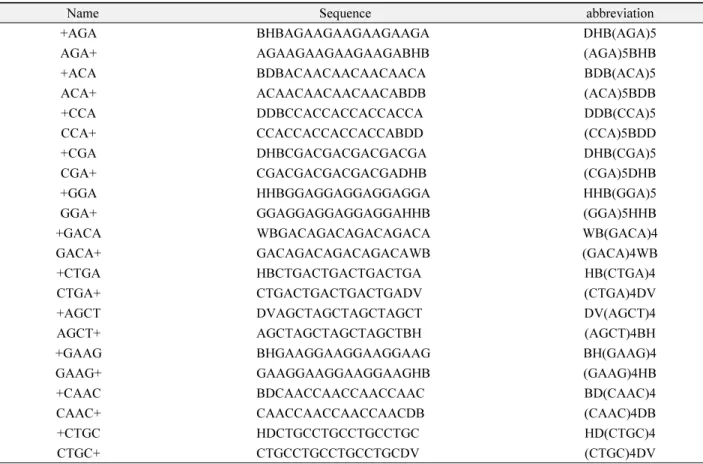
복숭아혹진딧물 (Myzus persicae)은 횡성군 새말 IC근처 (157 m), 횡성군 매화산방 근처 (296 m), 횡성(하)휴계소 근처 (560 m-A), 대관령면 고령지농업연구센터 연구포장 (756 m), 강릉시 왕산면 안반덕 고랭지 배추 재배지(932 m)와 ISSR-PCR 수행 시 매우 근접한 지역 간의 변이 가능성을 조사하기 위하여 횡성(하)휴게소에서 1 km가량 떨어진 민족사관 고등학교 근처 (560 m-B)에서도 채집하였다. 채집 방법은 각 지역당 다섯 포장 이상에서 채집하였으며, 동일 비율로 모아 사육하였다. 채집 시 기는 2008년 5월 초에서 6월 말까지 노지 배추 포장에서 채집하 였다. 고도가 다른 지역에서 채집하였기 때문에 배추의 정식시 기가 지역마다 달라서 강릉의 경우 6월 중순까지도 정식이 이루 어졌다. 채집시기가 늦어지면 유전적으로 동일한 개체들을 잡 을 확률이 높아지기 때문에, 초기 발생하는 개체들을 채집하기 위하여 각 지역별 배추 정식 후 20일 이내 채집하였다. 이질비교 집단으로 사용한 복숭아혹진딧물 실험실 계통은 1980년대 이 후 실험실에서 지속적으로 사육된 계통으로 국립농업과학원에 서 분양 받아 사용하였다. 복숭아혹진딧물은 고령지농업연구센 터 곤충 사육실에서 배추를 이용하여 25±3℃, 16L:8D, 60% RH 조건에서 사육하였다. 표고별 산자수를 검정하고자 위와 같은 사육조건에서 어린 배추에 종령 약충 3마리를 각각 지름 5.5 cm 디쉬에 옮겨 놓고 첫 산자를 시작한 시점을 기준으로 하여 1일간 산자수를 반복하여 측정하였다. 성충까지의 기간은 태어나서 첫 산자를 시작한 시점을 기준으로 하였으며 모든 실험은 5반복 을 수행하였다.

에스터레이즈 동위효소 (Esterase isozyme) 분석

각 집단별 복숭아혹진딧물 무시충 성충을 500 ㎕ 정도 분량

(3)

Table 1. Primers used in ISSR-PCR analysis of M. persicae

Name Sequence abbreviation

+AGA BHBAGAAGAAGAAGAAGA DHB(AGA)5

AGA+ AGAAGAAGAAGAAGABHB (AGA)5BHB

+ACA BDBACAACAACAACAACA BDB(ACA)5

ACA+ ACAACAACAACAACABDB (ACA)5BDB

+CCA DDBCCACCACCACCACCA DDB(CCA)5

CCA+ CCACCACCACCACCABDD (CCA)5BDD

+CGA DHBCGACGACGACGACGA DHB(CGA)5

CGA+ CGACGACGACGACGADHB (CGA)5DHB

+GGA HHBGGAGGAGGAGGAGGA HHB(GGA)5

GGA+ GGAGGAGGAGGAGGAHHB (GGA)5HHB

+GACA WBGACAGACAGACAGACA WB(GACA)4

GACA+ GACAGACAGACAGACAWB (GACA)4WB

+CTGA HBCTGACTGACTGACTGA HB(CTGA)4

CTGA+ CTGACTGACTGACTGADV (CTGA)4DV

+AGCT DVAGCTAGCTAGCTAGCT DV(AGCT)4

AGCT+ AGCTAGCTAGCTAGCTBH (AGCT)4BH

+GAAG BHGAAGGAAGGAAGGAAG BH(GAAG)4

GAAG+ GAAGGAAGGAAGGAAGHB (GAAG)4HB

+CAAC BDCAACCAACCAACCAAC BD(CAAC)4

CAAC+ CAACCAACCAACCAACDB (CAAC)4DB

+CTGC HDCTGCCTGCCTGCCTGC HD(CTGC)4

CTGC+ CTGCCTGCCTGCCTGCDV (CTGC)4DV

B : G+T+C, H : A+T+C, D : G+A+T, V : G+A+C, W : A+T

씩 모은 다음 0.1% Triton X-100가 포함된 0.1M Tris-HCl pH 7.8 완충액 500 ㎕를 넣고 얼음 에서 조직분쇄기를 이용하여 균 질화 한 후 약 10,000g로 4℃에서 20분간 원심분리 하였다. 원심 분리 후 상등액을 지질 제거용 필터에 넣고 7,000 g으로 4℃에서 5분간 원심분리 하였다. 필터를 통과한 용액을 Bradford 방법 (Bradford, 1972) 으로 단백질정량 한 후 단백질 원으로 사용하 였다. Triton X-100는 Bradford 반응시약을 교란하는 물질로 알 려져 있으나 예비 실험 결과 0.5% 이상 일 때 교란 효과가 측정되 어, 정량 분석에 큰 문제는 없었다.

각 추출 단백질 시료(10 ㎍)를 비변성전기영동과 등점전전기 영동으로 단백질 분리를 실시하였다. 비변성전기영동 수직 전 기영동 장치(Novex mini cell, X-cell sure lock, Invitrogen)를 사 용하였으며 젤과 연속완충액에는 0.1% Triton X-100를 첨가하 였으며, 4℃에서 120 V로 90분간 분리하였다. 두 장의 젤을 한 장은 Coommassie Blue R-250을 이용하여 염색을 하였으며, 나 머지 한 장은 에스터레이즈 활성염색으로, 1 mM alpha naphthyl acetate 용액에 5분간 반응시킨 후 0.2% fast blue RR salt 용액에 밴드가 보일 때까지 반응시킨 후 세척하였다.

등전점전기영동은 pH 3-7 pre-cast IEF gel (Novex, Invitrogen)

과 PAGE를 수행한 전기영동장치를 이용하였으며 음극 완충액 은 20 mM lysine, 20 mM arginine을 양극 완충액은 7 mM phosphoric acid 를 각각 사용하였다. 분리 조건은 4℃에서 100 V 60분, 200 V 60분, 500 V 30분이었다. 분리 후 젤을 0.1 M Tris-HCl pH 7.8 완충액에 10분간 넣어 복원 시킨 후 위와 같이 에스터레이즈 활성염색을 하였다.

ISSR-PCR 분석

각 집단별 복숭아혹진딧물 주형 DNA 1 ㎕, 0.5 pM 프라이머

2 ㎕, 10 X PCR 완충액, dNTP (각각 최종 농도가 0.2 mM),

EXTaq 을 넣고 총량을 20 ㎕로 맞추어 PCR을 수행하였다. PCR

조건은 94℃ 4분간 변성과정을 거쳐 94℃ 20초, 표에서 제시된

annealing 온도에 맞추어 20초, 72℃ 30초로 35회 반복하여 증

폭하였고 마지막에 72℃에서 5분간 처리하였다. PCR 산물은

Metaphor 가 0.5% 함유된 2% 아가로스 젤을 이용하여 전기영동

후 밴드 형성 양상을 분석하였다. 사용된 프라이머는 기존의 논

문에서 사용된 7개 (Tymon and Pell, 2005; Roux et al., 2007)를

제외하고는 자체 설계하여 사용하였다(Table 1).

(4)

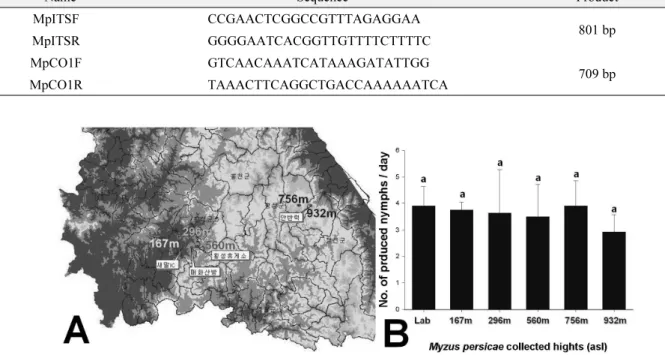
Table 2. Primers used in analysis of M. persicae rRNA and mtCO I

Name Sequence Product

MpITSF CCGAACTCGGCCGTTTAGAGGAA

801 bp

MpITSR GGGGAATCACGGTTGTTTTCTTTTC

MpCO1F GTCAACAAATCATAAAGATATTGG

709 bp

MpCO1R TAAACTTCAGGCTGACCAAAAAATCA

Fig. 1. Comparison of the number of aphids produced by 5 local populations collected from different cabbage fields (A) and lab strain reared at 25 ℃. The same letter indicates that the means are not significantly different (p>0.05, Duncan's multiple range test, SAS institute).

Lab: laboratory strain, 167 m: collected at Hengseong around the Semal IC, 296m: collected at Hengseong around the Maewhasanbang pension, 560 m: collected at Hengseong around the Hengseong (Sosa) service area, 756 m: collected at Pyeongchang around the experimental fields of the highland agriculture research center, 932 m: collected at Gangneung around the Anbanduck highland cultivation area.

rRNA, mtCO I 부분 염기서열 분석

각 집단별 복숭아혹진딧물 무시충 성충을 20 ㎕ 정도 분량씩 모은 다음 DNAzol (MRC) 400 ㎕를 넣고 조직분쇄기를 이용하 여 균질화 하였다. 이후 과정은 MRC사에서 제공하는 방법에 따 라 DNA를 추출하였다. 추출된 DNA는 20 ㎕ 기준 PCR 수행 시 50 ng 정도를 넣었다. 주형 DNA 1 ㎕, 0.5 pM 프라이머 1 ㎕씩, 10 X PCR 완충액, dNTP (각각 최종 농도가 0.2 mM), EXTaq (TaKaRa, Shiga, Japan)을 넣고 total volume을 20 ㎕로 맞추어 PCR 을 수행하였다(Table 2). PCR조건은 94℃ 4분간 변성과정 을 거쳐 94℃ 20초, 55℃(rRNA) 50℃(mtCO I) 20초, 72℃ 30 초로 35회 반복하여 증폭하였고 마지막에 72℃에서 5분간 처리 하였다. PCR 산물은 전기영동으로 확인 후 High pure PCR product purification kit (Roche applied science) 을 이용하여 PCR 산물을 정제, 농축하였다. 실험 방법은 kit에서 제공되는 방 법을 따랐다. 정제, 농축된 PCR산물의 염기서열을 분석하였다 (NICEM sequencing facility, SNU, Seoul, Korea). 염기서열 분석 결과는 Lasergene software (DNASTAR, Madison, WI)를 이용 하여 Clustral V방법으로 정렬하고 분석하였다.

결과 및 고찰

표고별 복숭아혹진딧물 산자수 검정

실험실에서 누대 사육된 실험실 계통과 표고별 채집된 각 집 단의 하루 산자수는 약 3~5마리로 집단간의 통계적 유의차는 없었다 (Fig. 1). 이러한 결과는 집단간의 차이보다 집단 내 개체 간의 차이가 크기 때문으로 사료된다. 집단별 약충 기간 또한 7 일 정도로 집단간의 차이보다 개체간 차이가 컸다. 국내에서 복 숭아혹진딧물에 대해서 말라치온 감수성과 저항성 계통의 온도 별 발육 양상을 비교한 결과 와 큰 차이가 없는 것으로 보고 되었 다(Song and Motoyama, 1996). 또한, 무시충 약충과 성충을 기준 하였을 때 각 집단의 형태적인 차이도 거의 찾아 볼 수가 없었다.

에스터레이즈 동위효소분석

실험실 계통 및 지역 집단 무시충 성충의 전체적인 단백질 발

현양상은 비변성 전기영동으로 단백질 분리 후 Coomassie 염색

하여 확인하였다. 집단간의 약간의 차이가 있음은 확인 할 수 있

(5)

Fig. 2. Molecular forms of all protein (Coomassie staining, A) and general esterases (B, C) from M. persicae identified by native PAGE (B) or native IEF (C). Native PAGE gels and running buffer contained 0.1% triton X-100. Identical amounts (10 ㎍) of all strain samples from M. persicae were run for 90 min at 120V (A,B) or focused for 60 min at 100V, for 60 min at 200 V, and for 30 min at 500V in a cold chamber (C).

1: laboratory strain, 2 (167 m): collected at Hengseong, 3 (296 m):

collected at Hengseong, 4 (560 m): collected at Hengseong, 5 (756 m): collected at Pyeongchang, 6 (932 m): collected at Gangneung.

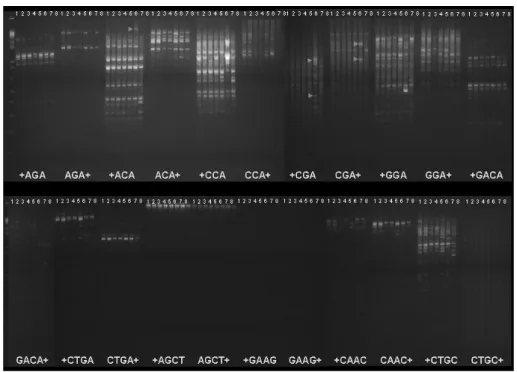
Fig. 3. Inter-simple sequence repeat (ISSR) profiles of laboratory strain and 6 local populations of M. persicae based on 22 primers.

1 (167 m): collected at Hengseong, 2 (296 m): collected at Hengseong, 3 (560 m-A): collected at Hengseong, 4 (756 m): collected at Pyeongchang, 5 (932 m): collected at Gangneung, 6: laboratory strain, 7 (560 m-B): collected at Heng-seong around the Korean Minjok leadership academy which located around the Hengseong (Sosa) service area, 8: negative control.

었으나, 표고별 집단간 상관성은 찾을 수가 없었다 (Fig. 2A). 같 은 조건에서 비변성전기영동 처리 후 에스터레이즈 활성염색을 수행한 결과 실험실 계통과 야외집단간의 차이가 보여질 뿐 표 고별 집단 간의 상관성은 찾기 어려웠다(Fig. 2B). 일반적으로 Ser-His-Glu의 촉매 삼각부위를 가지고 있는 에스터레이즈는 다양한 동위효소를 형성하는 다중유전자 패밀리를 이루고 있으

며 살충제 저항성은 물론 다양한 생리작용에 관여하고 있어, 온 도 등의 외부환경이 다른 지역집단을 비교하는데 좋은 효소이 다(Oakeshott et al., 1999; Xianchun et al., 2007). 비변성 등전점 전기영동을 통하여 비교한 결과, 실험실 계통과 지역 집단간에 는 pI. 5~6사이에서 동위효소들의 발현양상이 크게 차이가 나타 났다(Fig. 2C). 최근 2년간 홍천, 횡성, 평창, 강릉 등의 주요 배추 재배단지에서 채집된 복숭아혹진딧물의 살충제 저항성을 조사 한 결과 카바메이트계와 피레스로이드계에 대해 고도의 저항성 을 보였으며, 조사된 지역집단간의 약제별 저항성 정도는 큰 차 이가 없었다(미발표문헌. 에스터레이즈는 복숭아혹진딧물에 서 체색변이 등 다양한 생리작용에 관여한다는 보고가 있으나 (Shigehara and Takada, 2004), 체색은 모두 붉은색이었으며 사 육 환경은 동일 하였기 때문에 지역 집단과 살충제 노출 없이 오 랜 시간 누대 사육된 실험실 계통과 야외 채집 집단간의 에스터 레이즈 동위효소 발현 양상 차이는 살충제 저항성이 큰 영향을 미치는 것으로 사료 된다.

ISSR-PCR 분석

22개의 3~4개의 반복서열을 기초로 만든 ISSR-PCR용 프

라이머를 이용하여 ISSR-PCR을 수행하여 결과를 전기영동 후

확인하였다 (Fig. 3). PCR조건을 잡기 위하여 반복 실험을 수행

(6)

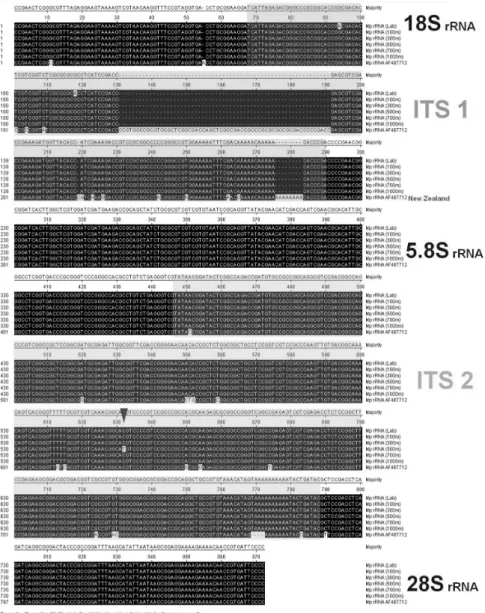
Fig. 4. Alignment of partial ribosomal RNA (partial 18S rRNA, ITS1, 5.8S rRNA, ITS2 and partial 28S rRNA) sequences from various local populations and laboratory strain of M. persicae.

Mp rRNA (Lab): laboratory strain, Mp rRNA (100 m): collected at Hengseong 167 m, Mp rRNA (300 m): collected at Hengseong 296 m, Mp rRNA (600 m): collected at Hengseong 560 m, Mp rRNA (700 m): collected at Pyeongchang 756 m, Mp rRNA (1000m): collected at Gangneung 932 m, Mp rRNA AF487712: M. persicae New zealand strain partial sequence of ribosomal RNA.

하였는데, 밴드 형성 양상에는 큰 차이가 없었다. 특히나 매우 근 접한 지역 간의 변이 유무를 확인하기 위하여 함께 조사한 560 m-A 와 560 m-B 집단 간의 차이는 물론 다른 지역 집단간의 차 이는 거의 보이지 않았다. 다만, +ACA, +CCA, +CGA, CGA+

등의 프라이머에서 볼 수 있듯이 실험실 계통은 지역 집단과는 상당히 유전적인 거리가 존재 한다는 것을 알 수 있었다. 이러한 프라이머를 이용하여 복숭아혹진딧물의 유전적 차이를 찾을 수 있다는 점을 확인하였으나, 초기 실험 설계에서 찾고자 했던 지 역 집단 특이적 마커는 찾기 어려웠다. 나비목에서도 그러한 마 커 탐색의 어려움에 대해서 언급하기도 하였다(Zhang, 2004).

rRNA와 mtCO I의 부분 염기서열 분석

각 집단별 복숭아혹진딧물 rRNA를 분석한 결과 뉴질랜드 계

통과 비교해 보았을 때, internal transcribed spacer-1 (ITS-1) 부

분에서 약 70 bp 정도의 염기가 크게 두 부분에 걸쳐 비어있었고

(61 bp, 8 bp), ITS-1 뿐 만 아니라 ITS-2 부분에서도 많은 변이가

관찰되었다. 지역 집단간의 차이는 미비하였으나 실험실 계통에

서 두 개의 단일 염기 다형성(single nucleotide polymorphism

(SNP))이 ITS-1에서 관찰되었으며, 횡성 지역(560 m) 집단에서

하나의 SNP가 ITS-2에서 발견되었다(Fig. 4). 앞서 언급한 560

(7)

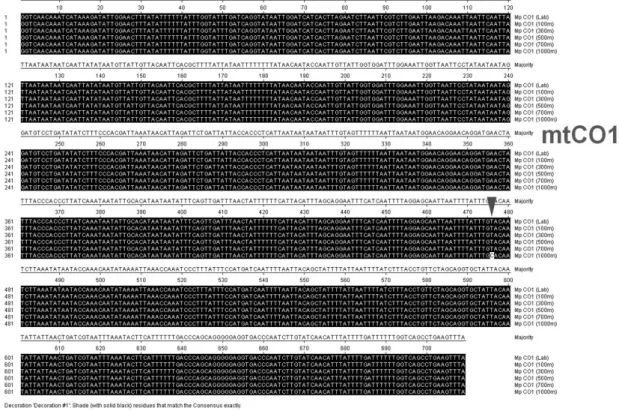
Fig. 5. Alignment of partial mitochondrial cytochrome oxidase I sequences from local populations and a laboratory strain of M. persicae.

Mp CO I (Lab): laboratory strain, Mp CO I (100 m): collected at Hengseong around 167m, Mp CO I (300 m): collected at Hengseong 296m, Mp CO I (600 m): collected at Hengseong 560 m, Mp CO I (700 m): collected at Pyeongchang 756 m, Mp CO I (1,000 m): collected at Gangneung 932 m.

A

B

Fig. 6. Nucleotide sequence chromatograms of the single nucleotide polymorphism (SNP) detected sites in internal transcribed spacer-2 (ITS-2) (A: CtoT) and mtCO I(B: TtoC) region among the five local populations and the laboratory strain. The CtoT SNP in ITS-2 was mixed in Hengseong strain (560 m) and TtoC SNP in mtCO I was exclusively conserved in the Gangneung strain (932 m).

1: laboratory strain, 2 (167 m): collected at Hengseong, 3 (296 m): collected at Hengseong, 4 (560 m): collected at Hengseong, 5 (756 m):

collected at Pyeongchang, 6 (932 m): collected at Gangneung.

(8)

m-A와 560 m-B 지역에서 모두 발견되었는데, 일부 개체 들은 SNP 가 존재하지 않는 경우도 있었다. 한 개체가 어떠한 이유로 SNP가 생기고 클론을 만들어 내서 그 클론이 마치 집단을 대변 하는 것처럼 보인다고 생각하기에는 무리가 있어 보이며, 채집 된 개체들의 채집 장소가 다양하고, 채집 시기가 발생 초이기 때 문에 전체적인 집단의 특성으로 이해하는 것이 합리적일 것이 다. 또한 이는 ITS2부분이 변이 축척이 되기 쉬운 부분임을 증명 하는 하나의 예라고 할 수 있겠다. 또 다른 예로 ITS2부분은 제주 지역 집단의 경우 4개의 SNP가 발견되는 등 상대적으로 많은 변 이가 존재하는 것으로 밝혀졌다(미발표문헌). 위의 결과를 바탕 으로 부분적인 rRNA 염기서열을 분석한 결과는 유전자은행에 등록하였다(NCBI GenBank accession number: FJ481522).

mtCO I은 캐나다 등 유전자은행에 등록된 다른 지역집단과 비교하였으나 차이가 없었고 다만 강릉 지역에서 채집된 집단 에서 SNP가 발견되었다(Fig. 5). 이 SNP는 아미노산의 변화를 가져오지 않는 일종의 침묵돌연변이라고 할 수 있다.

각 집단 내에 두 개의 SNP 축척 정도를 알아보기 위하여 지역 별 염기서열 분석 결과를 비교하였다. 일종의 quantitative sequencing (QS)이라고 할 수 있는데, 이미 발표된 논문에서와 같이 피크를 보고 분석하여 보면(Kwon et al., 2008), 횡성(560 m) 지역 집단에서 보여진 ITS-2부분의 CtoT SNP는 C가 40%정 도, T가 60% 정도의 비율로 존재하는 것을 알 수 있다. 그러나 강 릉(932m) 지역 집단 mtCO I 부분의 TtoC SNP는 T가 100%로 변이가 고정된 것으로 보여진다 (Fig. 6). 위의 결과를 종합해 보 면 ITS-2부분은 변이 축척이 더 쉬운 반면 다양한 마커를 찾고 그 변화 추이를 분석 할 수 있는 가능성이 더 크다고 할 수 있다.

파리목 및 총채벌레목 등 다양한 곤충에서도 ITS-2부분을 마커 로 개발하거나 동 종내 지역별 변이나 근연종 간의 차이를 분석 하는 등 다양한 연구가 이루어졌다(Farris et al., 2010; Matsumoto et al., 2009). 앞서 언급한 갈르와벌레와 담배가루이 등에서도 mtCO I 혹은 mtCO II부분을 이용하여 동종 간의 차이를 구명하 기도 하였다(Schoville and Roderick, 2010; Rao et al., 2011). 이 러한 SNP는 살충제 저항성 진단 및 관리에도 많이 사용되는데, QS 와 같은 방법을 이용하여 쉽게 검출 할 수 있을 뿐 만 아니라, 시기별, 지역별 변이를 조사하는데 매우 유용한 마커로 활용 할 수 있다(Kwon et al., 2008). 이러한 활용 가능성을 가진 SNP마 커는 오랜 시간이 흐른 뒤에도 같은 조건에서 분석이 가능함으 로 앞으로 온난화가 진행 됨에 따라 특정 SNP가 있는 집단의 이 동 또는 SNP변화 추이를 충분히 분석 할 수 있을 것이다.

Literature Cited

Balanya, J.M. Oller, R. B. Huey, G. W. Gilchrist and L. Serra 2006.

Global genetic change tracks global climate warming in Drosophila subobscura. Science 313: 1773-1775.

Berezovskaia, O.P., O. Moroz and A. Sidorenko. 2002. Intra- and interspecies differences in the ISSR-PCR patterns of bumble bee (Hymenoptera: Bombinae). Tsitol. Gene 36: 28-35.

Birch, A.N., G.S. Begg and G.R. Squire. 2011. How agro-ecological research helps to address food security issues under new IPM and pesticide reduction policies for global crop production systems. J.

Exp. Bot. 62: 3251-3261.

Black, W.C. 4

th

and J.G. Vontas. 2007. Affordable assays for genotyping single nucleotide polymorphisms in insects. Insect Mol. Biol. 16: 377-387.

Bradford, M. M. 1976 A rapid and sensitive method for the quantitation of microgram quantities of protein utilizing the principle of protein-dye binding. Anal. Biochem. 72, 248-254.

Chatterjee, S.N. and T. P. Mohandas 2003. Identification of ISSR markers associated with productivity traits in silkworm, Bombyx mori L. Genome 46: 438-447.

Choi, J.H., T. Kijimoto, R.E. Snell, H. Tae, Y. Yang, A.P. Moczek and J. Andrews 2010. Gene discovery in the horned beetle Onthophagus taurus. BMC Genomics 14: 703.

Coates, B.S., D.V.Sumerford, N.J. Miller, K.S. Kim, T.W.

Sappington, B.D. Siegfried and L.C. Lewis. 2009. Comparative performance of single nucleotide polymorphism and micro- satellite markers for population genetic analysis. J Hered. 100:

556-564.

Crawford, D., N.M. Tago, T.F. Stuessy, G.J. Anderson, G.

Bernardello, E. Ruiz, R.J. Jensen, C. M. Baeza, A. D. Wolfe and O.M. Silva. 2001. Inter simple sequence repeat (ISSR) variation in Lactoris fernandeziana (Lactoridaceae), a rare endemic of the Juan Fernandez Archipelago, Chile. Plant Species Biol. 16: 185-192.

Farris, R.E., R. Ruiz-Arce, M. Ciomperlik, J.D. Vasquez and R.

Deleón. 2010. Development of a ribosomal DNA ITS2 marker for the identification of the thrips, Scirtothrips dorsalis. J. Insect Sci.

10: 26.

Frentiu, F.D., M. Adamski, E.A. McGraw, M.W. Blows and S.F.

Chenoweth. 2009. An expressed sequence tag (EST) library for Drosophila serrata, a model system for sexual selection and climatic adaptation studies. BMC Genomics 21: 40.

Godwin, I.D., E.A. Aitken and L.W. Smith. 1997. Application of inter simple sequence repeat (ISSR) markers to plant genetics.

Electrophoresis 18: 1524-1528.

Gornall, J., R. Betts, E. Burke, R. Clark, J. Camp, K. Willett and A.

Wiltshire. 2010. Implications of climate change for agricultural productivity in the early twenty-first century. Phil. Trans. R. Soc.

B 365: 2973-2989.

(9)

Gupta, M., Y.S. Chyi, S.J. Romero and J.L. Owen. 1994. Amplifi- cation of DNA markers from evolutionarily diverse genomes using single primers of simple-sequence repeats. Theoret. Applied Genet. 89: 998-1006.

Kellermann, V., B. Heerwaarden, C.M. Sgrò and A.A. Hoffmann.

2009. Fundamental evolutionary limits in ecological traits drive Drosophila species distributions. Science 325: 1244-1246.

Kwon, D.H., K.S. Yoon, J.P. Strycharz, J.M. Clark and S.H. Lee.

2008. Determination of permethrin resistance allele frequency of human head louse populations by quantitative sequencing. J.

Med. Entomol. 45: 912-920.

Na, Y.N., H.S. Bang, M.H. Kim, Y.J. Oh, M.S. Han, M.K. Kim, K.A. Roh, J.T. Lee and D.R. Choi. 2007. The characteristic on egg-laying and vegetation grazing of Paratlanticus ussuriensis. Kor.

J. Environ. Agric. 26: 364-366.

Oakeshott, J.G., C. Claudianos, R.J. Russell and G.C. Robin. 1999.

Carboxyl/cholinesterases: a case study of the evolution of a successful multigene family. BioEssays 21: 1031-1042.

Matsumoto, Y., T. Yanase, T. Tsuda and H. Noda. 2009. Characteri- zation of internal transcribed spacer (ITS1)-ITS2 region of ribosomal RNA gene from 25 species of Culicoides biting midges (Diptera: Ceratopogonidae) in Japan. J. Med. Entomol. 46:

1099-108.

Mort, M.E., D.J. Crawford, G.A. Santos, O.J. Francisco, E.J.

Esselman and A.D. Wolfe. 2003. Relationships among the Macaronesian members of Tolpis (Asteraceae: actuceae) based upon analyses of inter-simple sequence repeat (ISSR) markers.

Taxon. 52: 511-518.

Nagaraju, J., K.D. Reddy, G.M. Nagaraja and B.N. Sethuraman.

2001. Comparison of multilocus RFLPs and PCR-based marker systems for genetic analysis of the silkworm, Bombyx mori.

Heredity 86: 588-597.

Puinean, A.M., S.P. Foster, L. Oliphant, I. Denholm, L.M. Field, N.S. Williamson and C. Bass. 2010. Amplification of a cytochrome P450 gene is associated with resistance to neonicotinoid insecticides in the aphid Myzus persicae. PLoS Genet. 24:

e1000999.

Rao. Q., C. Luo, H. Zhang, X. Guo and G.J. Devine. 2011.

Distribution and dynamics of Bemisia tabaci invasive biotypes in central China. Bull. Entomol. Res. 101: 81-88.

Roux, O., M. Gevrey, L. Arvanitakis, C. Gers, D. Bordat and L.

Legal. 2007. ISSR-PCR: tool for discrimination and genetic structure analysis of Plutella xylostella populations native to different geographical areas. Mol. Phylogenet. Evo. 43: 240-250.

Schoville, S.D. and G.K. Roderick. 2010. Evolutionary diversifi- cation of cryophilic Grylloblatta species (Grylloblattodea:

Grylloblattidae) in alpine habitats of California. BMC Evol. Biol.

10: 163.

Song, S.S. and N. Motoyama. 1996. Effect of temperatures on the growth of susceptible and malathion resistant green peach aphid strains. Kor. J. Appl. Entomol. 35: 297-301.

Shigehara, T. and H. Takada. 2004. Mode of inheritance of the polymorphic esterases in Myzus persicae (Hemiptera: Aphididae) in Japan. Bull Entomol. Res. 94: 65-74.

The International Aphid Genomics Consortium. 2010. Genome sequence of the pea aphid Acyrthosiphon pisum. PLoS Biol. 23:

e1000313.

Tymon, A.M. and J.K. Pell. 2005. ISSR, ERIC and RAPD techniques to detect genetic diversity in the aphid pathogen Pandora neoaphidi. Mycol. Res. 109: 285-293.

Umina, P.A., A.R. Weeks, M.R. Kearney, S.W. McKechnie and A.A. Hoffmann. 2005. A rapid shift in a classic cline pattern in Drosophila reflecting climate change. Science 308: 691-693.

Xianchun, L., A.S. Mary and R.B. May. 2007. Molecular Mechanisms of Metabolic Resistance to Synthetic and Natural Xenobiotics. Annu. Rev. Entomol. 52: 231-253.

Zhumei, R., Z. Bin, W. Dingjiang, M. Enbo, S. Deming and Z.

Yang. 2008. Comparative population structure of Chinese sumac aphid Schlechtendalia chinensis and its primary host-plant Rhus chinens. Genetica 132: 103-112.

Zietkiewicz, E., A. Rafalski and D. Labuda. 1994. Genome finger- printing by simple sequence repeat (SSR)-anchored polymerase chain reaction amplification. Genomics 20: 176-183.

Zhang, D.X. 2004. Lepidopteran microsatellite DNA: redundant

but promising. Trends in Ecol. Evol. 19: 507-509.

수치

Table 1.  Primers used in ISSR-PCR analysis of  M. persicae
Table 2.  Primers used in analysis of  M. persicae rRNA and mtCO I
Fig. 3.  Inter-simple sequence repeat (ISSR) profiles of laboratory strain and 6 local populations of  M
Fig. 4.  Alignment of partial ribosomal RNA (partial 18S rRNA, ITS1, 5.8S rRNA, ITS2 and partial 28S rRNA) sequences from various local  populations and laboratory strain of  M
+2

참조

관련 문서

This study aims to investigate whether major single nucleotide polymorphism (SNP)s and their haplotypes of the ADRB2 ( 2 β -adrenoceptor) gene are associated with children with

In this study, we applied a genome-wide association study (GWAS), by combining phenotyping and genotyping-by-sequencing (GBS), for the development of a single

A BLAST search of the internal transcribed spacer (ITS) region, TEF1-α and RPB2 gene sequences revealed that strain PTT-2 showed more than 99% nucleotide similarity with a strain

rs9362054RP1- 90L14.1T0.291.361.70×10-5 SNP, single nucleotide polymorphism; RAF, risk allele frequency in controls; OR, odds ratio; T2DM, type 2 diabetes mellitus; GWAS,