<論 文 >
3 종의 페루산 entomopathogenic fungi의 전자현미경적 구조와 ITS1, 5.8S ribosomal RNA gene, ITS2 의 염기서열 다양성
한상훈*·남성희·이희삼·여주홍
국립농업과학원 농업생물부
Comparison of scanning electron microscopic structures and nucleotide sequences variation of ITS1, 5.8S ribosomal RNA gene and ITS2 region
in three Peruvian entomopathogenic fungal isolates
Sang-Hoon Han*, Sunghee Nam, Heui-Sam Lee and Joo-Hong Yeo
Department of Agricultural Biology, National Academy of Agricultural Science, RDA, Suwon 441-100, Kore
(Received August 30, 2013, Accepted October 23, 2013)
ABSTRACT
In this study, nucleotide sequence structures of intergenic transcribed spacer (ITS) 1, complete 5.8S ribosomal RNA gene and ITS 2 region were analyzed to identify three Peruvian entomopathogenic fungal isolates. The isolates had highly conserved sequence region in 5.8S rRNA gene and unique sequences in ITS 1 and 2 region among them. 5.8S rRNA gene regions were highly conserved and showed high homoloies among tested isolates. In contrast, ITS region showed species-specific sequence region, resulting in inter-genus differencies. Scanning electron microscopic images of these isolates supported the result of ITS-based identification. From these result, Peruvian entomopathogenic fungal iso- late J270, J278, were identified as Beauveria bassiana and J271 was identified as Lecanicillium attenuatum.
Key words : Beauveria bassiana, Lecanicillium attenuatum, Intergenic transcribed spacer, Peruvian entomopatho- genic fungi, Bioinsecticide
서 론
18S, 5.8S, 28S ribosomal RNA gene 의 사이에 존재하 는 intergenic transcribed spacer (ITS) 1과 2의 염기서열 정 보는 매우 높은 종간 다양성으로 인해 진균류의 동정을 분자생물학적으로 수행하는데 있어 자주 이용되어 왔다 (Lee et al. 1995, Meyer et al. 2010). Genome 상에 반복 적으로 존재하는 multicopy region이므로 PCR을 이용할 경우 매우 작은 양의 genomic DNA로도 증폭이 용이한 장점을 가지고 있다. 이러한 장점 때문에 2011년도에 ITS 부위는 곰팡이류에 대한 DNA barcode marker로 선정되었 다 (Fungal Barcoding Consortium, www.fungalbarcoding.org).
1988 년 Shimazu 등은 Beauveria 속이 일반적으로 알려 져 있는 동충하초들이 포함되어 있는 Cordyceps 속의 무
성생식세대라고 처음으로 보고하였다. B. bassiana는 전세 계적으로 가장 흔하게 발견되는 곤충병원성 진균류이다 (Lee et al. 2010a). B. bassiana는 1838년 Bassi에 의해 곤 충병원성 진균 중 최초로 발견되었으며 (Lee et al. 2010b), 나비목 등 곤충의 유충, 번데기, 성충에 기생하여 독성 대 사 물질인 beauvericin을 분비하여 숙주를 폐사시킨다 (Min and Han 2002). 또 다른 곤충병원성 진균류의 한 종인 Lecanicillium attenuatum은 국내에서 목화 진딧물 방제제 로서의 적용에 관한 연구가 수행되었으며 (Kim and Kim 2007) 국내에서 복숭아혹 진딧물 방제 관련 특허가 출원 되었다 (Kwon et al. 2007). 곤충병원성 진균류를 이용한 해충의 방제는 화학 살충제에 비해 방제시간이 오래 걸리 고, 온도나 습도 같은 환경적 요인에 의해 영향을 받으며, 숙주 특이성 때문에 광범위한 해충 방제가 힘들며, 생산
*Corresponding author. E-mail:
[email protected]
비용이 비교적 높다는 단점을 가진다 (Khan et al. 2012).
그러나 숙주 곤충만을 가해하는 기주 특이성을 가지며, 균 주의 대량생산이 용이하고, 환경 및 사람이나 가축에 대한 독성이 거의 없고, 비잔류의 장점을 가지므로 친환경적 해 충방제를 위한 연구가 활발히 이루어져 왔다 (Bang et al.
2010, Lomer et al. 2001, Yoon et al. 1998, Rassette et al. 2011).
따라서, 본 연구는 최근 해충에 대한 미생물방제제로서 의 가치가 부각되고 있으며, 관련 연구가 국내외에서 활 발히 진행되고 있는 이들 두 곤충병원성 진균류들의 우 수 자원 확보를 위해 페루에서 채집된 곤충병원성 진균류 들 중 감염체의 형태적 특성이 이들 두 균주의 감염특성과 가장 유사한 3종의 시료들을 분류하고 ITS1, 5.8S rDNA, ITS2 염기서열 정보 분석과 전자현미경적 구조를 관찰함으 로써 이들의 유전학적, 형태학적 동정을 수행하고자 하였다.
재료 및 방법
1. 사용균주 및 배양조건
실험에 사용된 균주는 페루에서 채집된 PJ270, PJ271, PJ278 세 균주이다. 각각 Potato Dextrose agar (PDA) 상 에서 24
oC, 14 일간 배양한 후 형성된 균사체를 ampicillin 이 100 ug/ml 농도로 첨가된 PD broth 30 ml에 접종하고
24
oC 180 rpm 에서 4 ~ 5일간 충분히 배양한 후 homogenizer (Nissei, Japan) 를 이용하여 10,000 rpm에서 3분간 균사체 를 분쇄하고 12,000 g로 원심분리하여 균사체 만을 모아 이후의 실험에 사용하였다. Sequence 비교 분석에 사용된 reference 균들은 NCBI (National Center for Biotechnology Information) 의 GenBank database (http://www.ncbi.nlm.gov)에 ITS1-5.8S-ITS2 DNA 염기서열이 제공되는 strain들을 다운로 드하여 사용하였다. 이들에 대한 정보는 Table 1에 제시하였다.
2. DNA 추출 및 PCR
PCR 에 사용될 DNA template로 사용하기 위해 각 균주 들의 genomic DNA를 순수분리하였다. gDNA 순수분리 는 원심분리 후 상등액을 제거한 각각의 균사체 0.1 g을 ZR Fungal/ Bacterial DNA MiniPrep Kit(Zymo Research, USA) 를 이용하였으며 실험 절차는 제조사의 지시를 따랐다. 추출된 DNA는 spectrophotomer를 이용하 여 정량하고 10 ng씩을 PCR에 사용하였다. PCR에 사용 된 ITS1-5.8S rDNA gene-ITS2 primer쌍은 White 등이 (1990) 보고한 ITS1-F (5’-TCCGTAGGTGAACCTGCC-3’) 와 ITS4-R (5’-TCCTCCGCTTATTGATATGC- 3’)을 사용 하였다. PCR 반응은 2X HS PrimeTaq Premix (GeNet Bio, South Korea) 를 이용하여 Verti 96-well thermal cycler
Table 1. List of reference species for comparison of Peruvian entomopathogenic fungal isolates in ITS1-5.8S rDNA-ITS2 sequence diversitiesSpecies Strain
(isolate)
GenBank accession number
Country ITS1-5.8S rDNA-ITS2
Beauveria bassiana (A117) KC461113 Mexico
Beauveria bassiana MTCC 2028 JQ266095 India
Beauveria bassiana SD 15 KC551951 South Korea
Beauveria bassiana (EABb08 05Rf) KC753386 Spain
Beauveria brongniartii (SASRI SCHA2) JX110388 South Africa
Beauveria brongniartii ARSEF 8153 JF947191 Canada
Beauveria brongniartii 2753 GU373837 Switzerland
Beauveria brongniartii IMBST 291 FJ973055 Greece
Beauveria brongniartii (KH-II) KC879271 India
Cordyceps confragosa IFO 8579 AB079127 Japan
Cordyceps confragosa (LeLe1) JQ387576 Japan
Cordyceps confragosa (LeLe2) JQ387577 Japan
Lecanicillium attenuatum CGMCC 5328 JQ901939 China
Lecanicillium attenuatum (KYK 00324) AB378513 Japan
Lecanicillium attenuatum NBRC 103235 AB378510 Japan
Lecanicillium attenuatum NBRC 103237 AB360369 Japan
Lecanicillium attenuatum KYK 00034 AB378507 Japan
Lecanicillium lecanii (ICAL-6) FJ515770 Spain
(ABI, USA) 에서 수행하였다. PCR 온도조건은 95
oC, 5 분 동안 Predenaturation을 수행하고, 95
oC/15 초, 55
oC/15 초, 72
oC/20 초의 조건으로 35 cycle을 반복한 후, 72
oC/5 분으 로 postextension을 수행하였다. PCR이 완료된 각각의 시료 는 1.5% agarose gel과 1x TAE buffer를 사용하여 전기영동을 수행하고 1x SYBR safe DNA gel stain(invitrogen, USA)에 염색하여 단일 product 생성을 관찰한 후 Macrogen(South Korea) 에 양방향 sequencing을 의뢰하였다.
3. 염기서열 분석 및 neighbor joining tree의 제작 각 균주별로 결정된 염기서열은 MEGA5.2 (www.megasoftware.net) 를 사용하여 multiple alignment를 수행 하고 maximum likelihood analysis를 위해 nucleotide substitution model test 를 수행하고 최적 model로 제시된 Kimura-2 parameter model 을 이용하여 maximum likelihood analysis를 수행하고 neighbor-joining tree 를 제작하였다. Bootstrapping은 1,000회 수행하였고 Gaps/Missing Data Treatment option은 Complete Deletion 을 사용하여 분석하였다.
4. 주사전자현미경을 통한 미세구조의 관찰
주사전자현미경을 통한 형태적 특성을 관찰하기 위하여 PD 배지에서 액체배양한 세 개의 실험균주들을 2% 물한 천배지에 접종하고 24
oC 에서 14일간 배양하였다. 주사전 자현미경 촬영을 위한 시료의 전처리 과정은 국립농업과 학원 농산물안전성부 작물보호과 전자현미경실에 의뢰하 였고 주사전자현미경을 이용해 conidium, conidiophore 및 phialide 의 형태를 관찰하였다.
결과 및 고찰
1. ITS 부위의 염기서열 비교분석
ITS1, 2 및 5.8S rDNA 염기서열은 버섯류, 곤충 및 식 물병원균류에 대한 분자생물학적 유전정보를 이용한 분류 법으로 동일 속내 종간 및 속간 유연관계 분류에 가장 많 이 사용되어 왔다 (Ito and Hirano 1996, Nam et al. 1999, Kim et al. 2003). ITS1/ITS4 primer 쌍을 이용하여 증폭 된 PCR product의 염기서열 분석 결과를 바탕으로 GenBank 에서 제공하는 BLAST를 수행한 결과 PJ270과 PJ278은 모두 B. bassiana와 100%의 염기서열 상동성을 나타내는 것으로 나타났으며, PJ271은 Lecanicillium attenuatum과 100% 의 염기서열 상동성을 보이는 것으로 분석되었다.
실험에 사용된 페루산 3종의 ITS1-5.8S-ITS2 염기서열 정보와 GenBank에서 제공되는 Reference 종들의 ITS1- 5.8S-ITS2 염기서열을 이용하여 Mega5.2 프로그램으로 sequence alignment 분석을 수행하였다. ITS1, 2의 염기서
열은 진화속도가 매우 빠른 부분으로 18S rDNA와 5.8S rDNA, 26S rDNA 의 사이에 존재하므로 ITS1-5.8S rDNA- ITS2 부위의 염기서열 분석은 높은 염기서열 다양성과 높 은 염기서열 보존성을 가지고 있는 부위를 동시에 비교분 석함으로써 균류의 분류에 있어 자주 이용되어지고 있다.
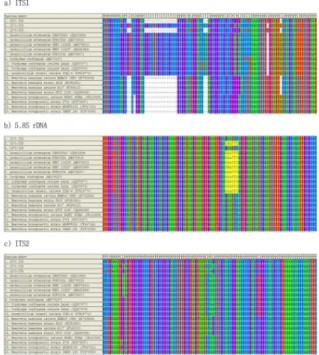
본 실험에 사용된 분리균들에서도 이들 부위의 염기서열은 ITS 부위의 매우 높은 다양성과 5.8S rDNA의 매우 높은 보 존성의 특징을 그대로 보여주었다 (Fig. 1b). 특히 ITS1에 서의 다양성이 두 분류군의 가장 큰 차이로 관찰되었다 (Fig. 1a). 이러한 결과는 종 동정에 있어 이들 부위의 염기 서열이 DNA barcode로 사용되어지는 근거를 확인할 수 있었다.
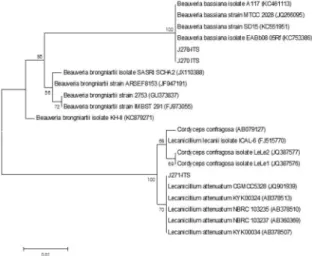
Alignment 결과를 바탕으로 neighbor-joining tree를 제 작한 결과(Fig. 2), J278과 J270 균주는 B. bassiana와, J271 균 주는 L. attenuatum과 100%의 염기서열 상동성을 반영하면서 동일 종묶음을 형성하는 것을 확인할 수 있었으며 이들의 bootstrap replication value 의 지지도는 B. bassiana group에서 100%, L. attenuatum group에서 70%를 보여주었다. 결국 ITS1 과 IST2를 기반으로 한 분자생물학적 종동정에서 J278과 J270 균주는 B. bassiana로, J271균주는 L. attenuatum으로 동정되었다.
Fig. 1. ITS1, complete 5.8S rDNA and ITS2 DNA sequence alignments of Peruvian entomopathogenic fungi isolates with reference strain sequences. Reference sequences were chosen by results of BLAST alignment of each isolate. This result was directly used to construct neighbor-joining tree. The ITS1 region shows higher diversity comparison with others (a). Region of 5.8S rRNA gene shows high conservation over a genus level (b).
The highlighted box of 5.8S rRNA region indicates EcoRI endonuclease which members of Beaveria do not have (b).
2. 주사전자현미경을 통한 형태적 특성 관찰
DNA 염기서열 분석결과에 따르면, PJ270과 PJ278은 B.
bassiana로, PJ271은 L. attenuatum으로 동정됨으로 이러 한 분석결과를 뒷받침하기 위해 주사전자현미경을 이용하 여 분류형질로 알려져 있는 현미경적 구조 관찰을 수행하였다.
B. bassiana는 다양한 곤충을 기주로 하며 감염된 곤충 의 표면은 백색의 분생포자로 뒤덮인다. 현미경적 구조는 phialide 에서 생긴 여러개의 마디 끝부분에 지그재그 모양 으로 분생포자가 발달하는 전형적인 특징을 가지고 있다.
이러한 구조적 특징은 PJ270과 PJ278에서 확인할 수 있 으며 ITS 염기서열 분석결과 L. attenuatum과 100% 상동 성을 보인 PJ271의 경우 누운 형태로 뻗는 균사로부터 (Fig. 3 하단 좌측) phialide들이 자라거나 2차 균사가지에 3 ~ 5 개 정도의 phialide들이 나오며, phialide의 끝에 한 개 씩의 분생포자가 만들어진다. PJ271의 경우 균사의 성장 및 2차 균사가지의 형태 등은 명확하게 관찰되었으나
phialide 의 구조 및 분생포자 생산의 형태 관찰은 이루어 지지 않았다. 따라서 광학현미경 하에서 phialide의 구조 및 분생포자 생산 형태를 관찰한 결과 L. attenuatum의 전 형적 구조를 확인할 수 있었으며 (Fig. 4) ITS 염기서열 분석의 종동정 정확성을 지지함을 확인하였다.
결과적으로 본 연구는 18S rDNA와 ITS1, 2 및 5.8S rDNA 염기서열 분석을 통해 페루산과 한국산 B. bassiana의 유 연관계를 분석하고자 하였다. 결과에서 확인한 바와 같이 각각의 염기서열 정보 만으로는 분리균들간의 유연관계 분석에서 낮은 해상도를 보이는 것을 확인할 수 있었으 며, 종내 유연관계 분석에도 multigene을 사용하였을 경우 deep branch level 에서 보다 높은 해상도의 결과를 얻을 수 있다는 것을 확인하였다. 본 실험의 분석 결과에 따르 면 한국산과 페루산 분리균간에 높은 수준에서의 차이는 관찰되지 않았으며, 보다 더 높은 수준의 분석을 위해서는 다른 유전자들에 대한 추가 분석이 필요할 것으로 판단된다.
전기한 바와 같이 B. bassiana와 L. attenuatum은 해충 에 대한 생물방제제를 위한 유용한 재료이며, 이들의 다 양한 숙주 특이성들에 대한 연구를 위해 전 세계에 널리
Fig. 2. Construction of neighbor-joining tree of entomopathogenicfungal isolates, which were collected in Peru, based on nucleotide sequences of ITS1, 5.8S rDNA and ITS2 regions. Reference sequences are taken from GenBank and the accession numbers are presented. Statistical method for tree construction was maximum likelihood and neighbor-joining method. Tree support values are taken by using bootstrap method and number of bootstrap replication was 1,000. Substitution model was Kimura 2-parameter. Gaps/missing data treatment was complete deletion.
The Scale bar and 0.01 at the left bottom means analytical genetic distance of 1%. Construction of neighbor-joining tree of entomopathogenic fungal isolates, which were collected in Peru, based on nucleotide sequences of ITS1, 5.8S rDNA and ITS2 regions. Reference sequences are taken from GenBank and the accession numbers are presented. Statistical method for tree construction was maximum likelihood and neighbor-joining method. Tree support values are taken by using bootstrap method and number of bootstrap replication was 1,000. Substitution model was Kimura 2-parameter. Gaps/missing data treatment was complete deletion. The Scale bar and 0.01 at the left bottom means analytical genetic distance of 1%.
Fig. 3. Scanning electronmicroscope (SAM) images of Peruvian entomopathogenic fungal isolates; PJ270, PJ271 and PJ278. All isolates were grown up on 2% water agar media for 14 days at 24oC.
Fig. 4. Conidia and phialides of Peruvian entomopathogenic fungal isolate PJ271. DIC. X1000S.
분포하고 있는 다양한 strain의 수집 및 보존은 해당 연구에 귀중한 재료로서 사용될 수 있을 것이다. 특히 화학 살충제 에 비해 안전성이 높은 장점을 가지고 있다는 점은 각종 농 약의 환경 오염 문제를 시급히 해결해야 하는 현 시대의 요 구에 매우 높은 매력을 가지고 있는 연구재료라는 사실이 이미 많은 연구들에 의해 입증되어져 왔으므로 실용화를 위 한 관련 연구들이 지속적으로 시도되어야 할 것으로 판단된다.
적 요
ITS 1, 2, 5.8S ribosomal RNA gene 염기서열 분석과 주사전자현미경 구조 분석을 통해 3종의 페루산 곤충병 원성진균들의 동정을 수행하고자 하였다. 이를 위해 두개 의 ITS 부위와 5.8S rRNA gene 부위를 포함하는 PCR product 를 증폭하여 염기서열 분석을 수행하였으며 분석 된 염기서열을 이용하여 NCBI의 BLAST를 이용하여 가 장 높은 상동성을 보이는 종들의 ITS1-5.8S-ITS2 염기서 열 정보와 비교분석을 위한 근연종들의 염기서열 정보를 다운로드하여 neighbor joining 분석을 수행하였다. 이를 통해 5.8S rRNA 유전자 염기서열은 속 수준에서도 거의 차이를 보여주지 않을 정도로 매우 안정적으로 보존되어 있 음을 확인할 수 있었으며 종간 구분이 모호한 결과를 보 여주었다. 그와 반대로 ITS 부위의 염기서열은 종에 매우 특이적임을 확인할 수 있었으며, 비교분석에 사용된 Beauveria bassiana strain 간의 차이는 확인할 수 없었다.
ITS 염기서열 분석결과를 뒷받침하고자 곤충병원성 진균 류의 동정을 위한 분류 key로 사용되는 미세구조 관찰을 위 해 주사전자현미경 관찰과 광학현미경 관찰을 통해 B. bassiana 및 Lecanicillium attenuatum의 전형적 구조를 관찰할 수 있었다.
감사의 글
본 연구는 2013년도 농촌진흥청 연구개발과제(PJ008559) 의 지원에 의하여 이루어진 결과이며 이에 감사드립니다.
또한 주사전자현미경과 관련하여 많은 도움을 주신 농촌 진흥청 이준성 선생님께 감사드립니다.
인용문헌
Bang HS, Jung MP, Kim MH, Han MS, Kang KK, Lee DB, Nam SH (2010) Pathogenicity screening of entomopathogenic fungus, Beauveria bassiana against Paratlanticus ussuriensis.
Kor J Envrion Agricul 29, 300∼303.
Ito Y, Hirano T (1996) First successful amplification of 18S ribosomal DNA of Cordyceps spp. by the PCR method.
Mycosci 37, 109∼110.
Khan S, Guo L, Maimaiti Y, Mijit M, Qiu D (2012) Entomopathogenic fungi as microbial biocontrol agent. Mol Plant Breeding 3, 63∼79.
Kim JJ, Kim KC (2007) Compatibility of entomopathogenic fungus Lecanicillium attenuatum and pesticide to control cotton aphid, Aphis gossypii. Int J Indust Entomol 14, 143∼146.
Kim SH, Lee YJ, Kim IB, Kim MG, Han JA, Hong MK, Lee SH, Lee JD (2003) Phylogenetic analysis of the entomopathogenic fungal species and taxonomical positions of ther commercial products. Kor J Life Sci 13, 400∼411.
Kwon OS, Kim JK, Park CH (2007) Entomopathogenic Lecanicillium attenuatum CNU-23, and agents and methods for controling green peach aphid using the same. KIPRIS. 1020070104197.
Lee GJ, An WG, Lee JD, Joo WH (1995) Evolutionary relationships of the genus Trichoderma and related taxa based on the partial sequences of 18S ribosomal RNA. Kor J Mycol 23, 318∼324.
Lee JO, Shrestha B, Sung GH, Han SK, Sung JM (2010a) Successful development of Cordyceps bassiana stromata from Beauveria bassiana. Kor Soc Mycol 38, 13∼16.
Lee KM, Nam SH, Yoon CS, Jeon JY, Yeo JH, Lee KG (2010b) Conditions for formation of synnemata from Beauveria bassiana. Kor J Appl Entomol 49, 43∼47.
Lomer CJ, Bateman RP, Johnson DL, Langewald J, Thomas M (2001) Biological control of locusts and grasshoppers. Annu Rev Entomol 46, 667∼702.
Meyer A, Todt C, Mikkelsen NT, Lieb B (2010) Fast evolving 18S rRNA sequences from Solenogastres (Mollusca) resist standard PCR amplification and give new insights into mollusk substitution rate heterogeneity. BMC Evolutionary Biology 10, 70.
Min EG, Han YH (2002) Optimal condition for mycelial growth of Beauveria bassiana and its extracellular enzyme activity. Kor J Microbiol 38, 50∼53.
Nam SH, Hwang JS, Cho SY, Goo TW (1999) Genetic relationship of Cordyceps spp. based on internal transscribed spacer sequences of ribosomal DNA. Kor J Seric Sci 41, 174∼179.
Rassette MSW, Pierpont EI, Wahl T, Berres M (2011) Use of Beauveria bassiana to control northern fowl mites (Ornithonyssus sylviarum) on roosters in an agricultural research facility. J Amer Labor Anim Sci 50, 910∼915.
Shimazu M, Mitsuhashi W, Hashimoto H (1988) Cordyceps brongniartii sp. nov., the teleomorph of Beauveria brongniartii. Trans Mycol Soc Jpn 29, 323∼330.
White T, Burns J, Lee S, Taylor J (1990) Amplification and direct sequencing of fungal ribosomal RNA genes for phylogenetics. pp.
482. In Innis, M. A. D. H. Gelfand, J. J. Sinsky and T. J. White.
(eds.), PCR protocols: a guide to methods and applications.
Academic Press, San Diego. California
Yoon CS, Yoon TJ, Park HS, Lee SG, Yoo JK, Lee JO (1998) Field evaluation of conidia of Beauveria bassiana (Balsamo) Vuillemin strain CS-1 against diamondback moth larvae. Kor J Pesticide Sci 2, 113∼118.