• 검색 결과가 없습니다.

A Case Report of Temporomandibular Bilateral Osseous Ankylosis Treated by Total Joint Replacement in Ankylosing Spondylitis

N/A
N/A
Protected

Academic year: 2021

Share "A Case Report of Temporomandibular Bilateral Osseous Ankylosis Treated by Total Joint Replacement in Ankylosing Spondylitis"

Copied!
7
0
0

로드 중.... (전체 텍스트 보기)

전체 글

(1)

Case Report

RECEIVED July 18, 2012, REVISED August 24, 2012, ACCEPTED November 22, 2012 Correspondence to Deok-Won Lee

Department of Oral and Maxillofacial Surgery, Kyung Hee University Dental Hospital at Gangdong 892, Dongnam-ro, Gangdong-gu, Seoul 134-727, Korea

Tel: 82-2-440-7517, Fax: 82-2-440-7369, E-mail: [email protected]

CC

This is an open access article distributed under the terms of the Creative Commons Attribution Non-Commercial License (http://creativecommons.org/licenses/

by-nc/3.0) which permits unrestricted non-commercial use, distribution, and reproduction in any medium, provided the original work is properly cited.

A Case Report of Temporomandibular Bilateral Osseous Ankylosis Treated by Total Joint Replacement in

Ankylosing Spondylitis

Tae-Hee Kim, Dong-Mok Ryu, Deok-Won Lee, Yu-Jin Jee, Sung-Ok Hong, Jae-Hoon Jung

Department of Oral and Maxillofacial Surgery, Kyung Hee University Dental Hospital at Gangdong

Abstract

Ankylosing spondylitis (AS) is a chronic autoimmune disease mainly involving the axial skeleton. The pathology of the disease is usually found at the sacroiliac joint, and half of the patients experience cervical spine invasion, but eventually, the whole spine is affected. The involvement of the temporomandibular joint (TMJ) in AS has not been investigated very well. A review of the literature revealed that there are only a few studies of TMJ involvement in AS that combined clinical and radiographic examinations. These studies show widely different results, ranging between 4% and 32%. We experienced Bilateral osseous ankylosis of the jaw treated by total alloplastic joint replacement in AS, and offer a case report.

Key words: Ankylosing spondylitis, Temporomandibular joint replacement

Introduction

Ankylosing spondylitis (AS) is a chronic autoimmune disease mainly involving the axial skeleton. Pathology of the disease is usually found at the sacroiliac joint, and half of the patients suffer from cervical spine invasion but eventually, the whole spine is affected. When the cervical spine is involved, anatomical anomaly develops, and movement of the cervical spine is limited resulting difficulty in head manipulation. Helenius et al. [1] reported that 37%

of the AS patients experience invasions into the tempor- omandibular joint (TMJ), and if temporomandibular joint is involved, mouth opening is limited or in worst case, mouth opening is completely impossible. We experienced

Bilateral temporomandibular osseous ankylosis of the jaw treated by total alloplastic joint replacement in AS.

Case Report

A 34-year-old man (44.7 kg, 132.7 cm) was admitted

to the oral and maxillofacial surgery department to receive

surgery for mouth opening disorder. The patient under-

went cervical spine u-bar insertion due to the secondary

spinal transformation and autologous TMJ reconstruction

at Cedars-Sinai Medical Center, USA in 1997. Tracheostomy

was performed in 1997 leaving a surgical scar on the neck

of the patient. After the time of the surgery in 1997, mouth

opening was about 25 mm but over the several years after

(2)

Fig. 1. Preoperative intraoral photo.

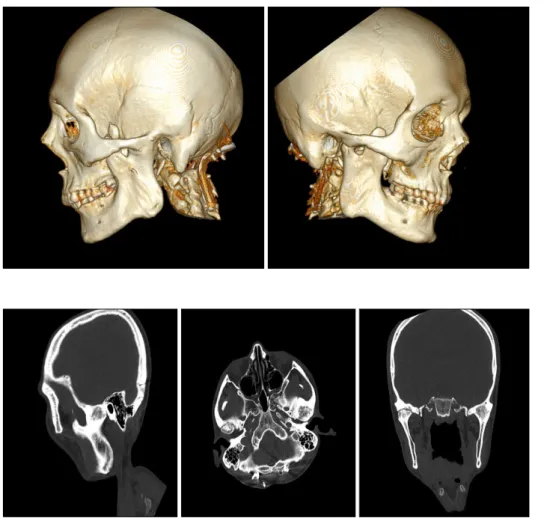
Fig. 2. Preoperative visualized 3 di- mensional display based on com- puted tomography.

Fig. 3. Preoperative axial, coronal, sagittal view based on computed tomography.

the surgery, abnormal coronoid process hypertrophy and TMJ ankylosis developed. Since then for more than 10 years, the patient could not take solid diet at all but liquid diet such as milk or soy milk only. In 2011, the time of assessment, mouth opening was completely impossible and assessment on Mallampati grade on airway disturbance

on oral cavity was also impossible (Fig. 1). Computed to- mography (CT) of both TMJs confirmed severe osseous ankylosis. Resection of the ankylotic mass and re- construction of both TMJs by total alloplastic joints was therefore seemed necessary (Fig. 2, 3).

Preoperative consideration was given to the rigidity of

(3)

Fig. 4. Operating table tilted by 60 degrees caused the rigidity of his lumbar ankylosing spondylitis.

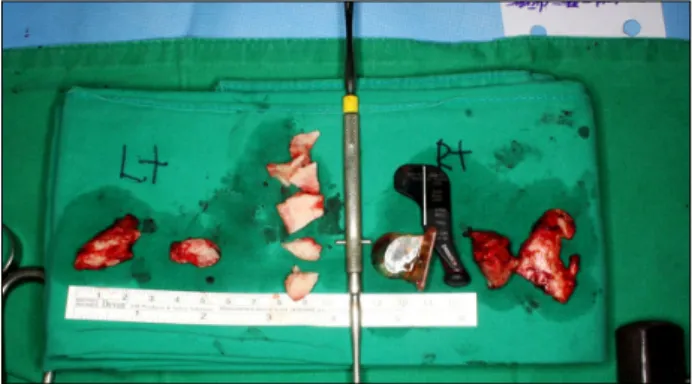
Fig. 5. Removed ankylotic bony mass.

his cervical spine and the ankylosis of the jaw. Due to complete AS, severe kyphosis developed in the thoracic and lumbar spine. In order to decide position and to assess possibility of fiberoptic bronchoscopic intubation, the pa- tient was admitted to the operating room one day prior to surgery. Upon completion of confirming the route up to the trachea via nasal cavity using 3 mm diameter fiber- optic bronchoscope (LF-DP, Olympus, Tokyo, Japan), we decided to perform fiberoptic bronchoscopic nasotracheal intubation. Operating on each side of his face posed a practical problem because of the rigidity of his cervical spine, which required a tilt of the operating table by 60 degrees on each side (Fig. 4). To maintain the dental occlu- sion and height of his lower face, we established temporary intermaxillary fixation using four intermaxillary screws and firm rubber ring.

Operation was performed in March 24, 2011. Surgical access was through bicoronal, bilateral preauricular and submandibular incisions because of the size and location of ankylosing mass. Bilateral exploration showed that the joint spaces were completely obliterated. Osteotomy of zy- gomatic arch was performed in advance to secure the clear view of the operation field, and then coronoidectomy was performed. This was to remove the action of the temporalis muscle and allow for greater mandibular opening. The ankylotic bony mass was cut on level of sigmoid notch (Fig. 5). Once this cut was made and the jaw opened, further bone was removed towards the base of the skull.

After the desired bone had been removed and the pre- operatively determined gap created, the glenoid fossa com- ponent of the prosthesis was fixed to the base of the zy-

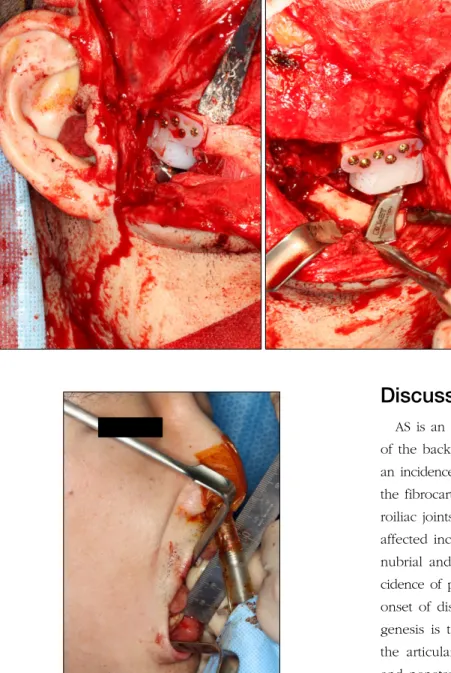
gomatic arch, using titanium screws. The ramus and con- dyle component was then placed in position through the submandibular incision, the condyle seated in the glenoid fossa and then fixed to the mandibular ramus using multi- ple titanium screws (Fig. 6). Prior to this, intermaxillary fixation was applied in order to maintain the occlusion.

The mandibular implant used the Biomet

Microfixation TMJ Replacement System (Biomet Microfixation, Jacksonville, FL, USA). Component is made from titanium alloy coating with a condylar head of cobalt-chromium-molybdenum (Co-Cr-Mo). The glenoid fossa component is ul- tra-high-molecular-weight polyethylene (UHMWPE). The operation on the opposite side followed the same se- quence, and achieved 30 mm mouth opening (Fig. 7).

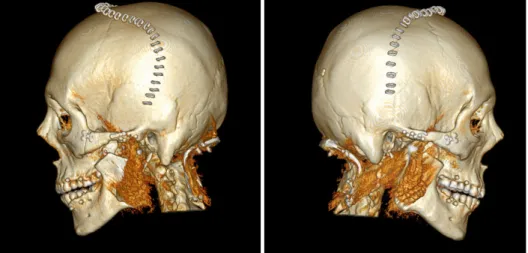
Postoperative CT and panorama showed the implants in the desired position (Fig. 8∼10).

Intravenous antibiotics were administered prophylacti-

cally (cephalothin 1 g three times a day [TID]) for 48 hours

and then oral antibiotics for a further ten days[2]. Patient

remained in hospital for 12 days, depending on recovery

(4)

Fig. 6. Joint replacement by Biomet

Microfixation temporomandibular joint Replacement System (Biomet Microfix- ation, Jacksonville, FL, USA).

Fig. 7. Achieved 30 mm mouth opening length.

and the home situation. A mouth gag and intermaxillary elastics was used for postoperative physiotherapy. There were no significant post-operative complications, and pa- tient was discharged in liquid-diet state. Mouth opening length was decreased to 25 mm from 30 mm on 3 months post-operative follow-up period, and maintained same 25 mm to 6 months follow-up period.

Discussion

AS is an inflammatory seronegative progressive disorder of the back. It mainly affects young male adults and has an incidence in white people of 1∼2%. It tends to involve the fibrocartilagenous structures, most commonly the sac- roiliac joints and the intervertebral discs. Other structures affected include the pubic symphysis, and the sternoma- nubrial and sternoclavicular joints. There is a higher in- cidence of peripheral joints being involved in patients with onset of disease before the age of 20 years. The patho- genesis is thought to involve synovial proliferation over the articular cartilage with subsequent loss of cartilage, and penetration of granulation tissue into the underlying bone[3,4].

The involvement of the TMJ in AS has not been widely recognized, and its incidence is disputed. Former studies have reported the involvement of the TMJ in AS between 4% and 32%[5]. Most investigations depended on the ortho- pantomogram which gives unreliable data on the TMJ[3].

In a combined clinical and radiographic study, fifty AS

patients were examined. Ten patients showed radiological

evidence of AS. However, only one was judged to have

AS on clinical grounds[3]. This disparity in clinical and

radiological signs suggests that the TMJ rarely seems to

be a severe problem for AS patients. It is felt that most

TMJ symptoms may be secondary to muscle spasm, oc-

(5)

Fig. 8. Postoperative visualized 3 di- mensional display based on com- puted tomography.

Fig. 9. Postoperative axial, coronal view based on computed tomo- graphy.

Fig. 10. Postoperative panoramic view.

clusal factors, and postural imbalance[6] and the literature is only sparsely populated with cases of true ankylosis.

There have been many attempts over the years at re- construction of the TMJ with both autologous and allo- plastic materials with varying degrees of success. In partic- ular, the costochondral graft has been used as an autolo- gous joint replacement for many years and many authors

have advocated its use. Costochondral grafts are still used as growth centre transplants in young patients but growth is variable[7,8]. In addition, the costochondral graft is often accompanied by bony ankylosis, particularly if the articular disc has been destroyed[9]. Various flaps and materials have been used to replace the missing or destroyed disc but none have been particularly successful[10].

Total alloplastic replacement of the TMJ has become a viable option for many people who suffer from TMJ disease where surgical reconstruction is indicated. Degenerative joint diseases such as osteoarthritis, rheumatoid arthritis, psoriatic arthritis, TMJ ankylosis, malunited condylar frac- tures and tumours can be successfully treated using this technique[11]. Therefore, in patients with AS, the total re- placement of the TMJ with an alloplastic joint system has become the treatment of choice.

In this case, total allopalstic joint replacement was per-

(6)

formed using bicoronal, bilateral preauricular and sub- mandibular approach. The common fundamental use of the bicoronal flap in TMJ surgery is to provide wide ex- posure of the temporal fossa, the temporomandibular join, meniscus, condyle, coronoid and mandibular ramus.

Regarding surgical approach, standard procedure of joint replacement is preauricular, submandibular approach. But in this patient, ankylosing mass was located adjacent to infratemporal area, and regarding the fact that it also showed osseous ankylosis with the skull base, additional bicoronal approach was performed. Zygomatic osteotomy was performed first to secure the clear surgical field, and then coronoidectomy. This was to remove the action of the temporalis muscle and allow for greater mandibular opening. The extent of the ankylosing bone was estab- lished preoperatively using the CT scan and clinically at the time of the operation. And also total joint replacements allow closer reproduction of the natural anatomy, avoids donor site morbidity, decreases the risk of reankylosis, and reduces operation time. Furthermore, they allow for imme- diate physiotherapy and rehabilitation with consequent in- creased benefit to the patient.

The mandibular implant used the Biomet

Microfixation TMJ Replacement System. Component is made from tita- nium alloy coating with a condylar head of Co-Cr-Mo. The glenoid fossa component is UHMWPE. In relation to hip, knee and shoulder prostheses, the metal on polyethylene articulation has been found to provide the best results[12].

Wolford[13] observed that metal-on-ultra high-molecular weight polyethylene total joint prosthesis provided statisti- cally significantly better postsurgical results related to in- cisal opening, pain, jaw function, and diet compared with metal on metal joint prosthesis. Studies have shown service life of 3 years[14] and 8 years[15] without evidence of unto- ward wear or failure.

Post-operative complications includes scar formation, fa- cial nerve damage, surgical site infection, gustatory sweat- ing, and external auditory meatus perforations, perforation into the middle cranial fossa and severe bleeding from the medial infratemporal fossa. No significant post-oper- ative complications were shown in this case. Intravenous antibiotics were administered prophylactically (cephalothin 1 g TID) for 48 hours and then oral antibiotics for a addi- tional seven days to prevent infection of the surgical site[2].

Mouth opening length measured during surgery was 30 mm, but it decreased to 25 mm on 3 months post-operative follow-up period. Observing CT, decrease of the mouth opening amount did not seemed to be involved with the influence of fibrotic scar tissue formation due to failing of material interposition, thus not considered as severe complication. One month after discharge from oromax- illofacial surgery department, patient had to take wedge osteotomy on T11 in orthopedic department, and was not able to actively maintain mouth opening exercise for 2 weeks. Oral intubation was able during orthopedic surgery.

Active mouth opening exercise was instructed on 3 months follow-up, and mouth opening length of 25 mm was main- tained to 6 months follow-up.

The current designs and recommendations from the manufacturers suggest a gap of 2.5 cm between the glenoid fossa and the ramus of the mandible being necessary to fit the prosthesis. This arbitrary removal of bone does not position the new mandibular condyle in an ideal loca- tion[16]. Therefore, mandibular opening is limited to a max- imum of approximately 30 mm between the incisor teeth, with no translation and no lateral movements. However, this does not seem to be a problem with patient acceptance as they are generally pain-free and are able to open their mouth to an acceptable degree and function relatively normally. Since Biomet

Microfixation TMJ Replacement System provides maximum 30 mm of mouth opening amount, result of the surgery was considered fairly success- ful, showing no other post-operative complications.

We were able to obtain successful results in total joint replacement reconstruction in a patient with bilateral oss- eous ankylosis of TMJ and AS. In the 3 months follow-up period, the mouth opening amount reduced to 25 mm from 30 mm, but maintained 25 mm to 6 months. Close observation is required in long term follow-up period.

References

1. Helenius LM, Hallikainen D, Helenius I, et al. Clinical and ra- diographic findings of the temporomandibular joint in pa- tients with various rheumatic diseases. A case-control study.

Oral Surg Oral Med Oral Pathol Oral Radiol Endod 2005;99:455-63.

2. Mercuri LG, Psutka D. Perioperative, postoperative, and pro-

phylactic use of antibiotics in alloplastic total tempor-

omandibular joint replacement surgery: a survey and prelimi-

(7)

nary guidelines. J Oral Maxillofac Surg 2011;69:2106-11.

3. Locher MC, Felder M, Sailer HF. Involvement of the tempor- omandibular joints in ankylosing spondylitis (Bechterew's dis- ease). J Craniomaxillofac Surg 1996;24:205-13.

4. Wilkinson M, Bywaters EG. Clinical features and course of ankylosing spondylitis; as seen in a follow-up of 222 hospital referred cases. Ann Rheum Dis 1958;17:209-28.

5. Maes HJ, Dihlmann W. Affection of the temporomandibular joints in spondylitis ankylopoeitica. Fortschr Geb Rontgenstr Nuklearmed 1968;109:513-6.

6. Crum RJ, Loiselle RJ. Temporomandibular joint symptoms and ankylosing spondylitis. J Am Dent Assoc 1971;83:630-3.

7. El-Sayed KM. Temporomandibular joint reconstruction with cost- ochondral graft using modified approach. Int J Oral Maxillofac Surg 2008;37:897-902.

8. Qudah MA, Qudeimat MA, Al-Maaita J. Treatment of TMJ an- kylosis in Jordanian children - a comparison of two surgical techniques. J Craniomaxillofac Surg 2005;33:30-6.

9. Saeed NR, McLeod NM, Hensher R. Temporomandibular joint replacement in rheumatoid-induced disease. Br J Oral Maxillofac Surg 2001;39:71-5.

10. Saeed N, Hensher R, McLeod N, Kent J. Reconstruction of the temporomandibular joint autogenous compared with alloplastic. Br J Oral Maxillofac Surg 2002;40:296-9.

11. Sidebottom AJ; UK TMJ replacement surgeons; British Association of Oral and Maxillofacial Surgeons. Guidelines for the replacement of temporomandibular joints in the United Kingdom. Br J Oral Maxillofac Surg 2008;46:146-7.

12. Schmalzried TP, Callaghan JJ. Wear in total hip and knee replacements. J Bone Joint Surg Am 1999;81:115-36.

13. Wolford LM. Factors to consider in joint prosthesis systems.

Proc (Bayl Univ Med Cent) 2006;19:232-8.

14. Giannakopoulos HE, Sinn DP, Quinn PD. Biomet microfixation temporomandibular joint replacement system: a 3-year fol- low-up study of patients treated during 1995 to 2005. J Oral Maxillofac Surg 2012;70:787-94.

15. Westermark A. Total reconstruction of the temporomandibular joint. Up to 8 years of follow-up of patients treated with Biomet(Ⓡ) total joint prostheses. Int J Oral Maxillofac Surg 2010;39:951-5.

16. Jones RH. Temporomandibular joint reconstruction with total

alloplastic joint replacement. Aust Dent J 2011;56:85-91.

수치

Fig. 2. Preoperative visualized 3 di- di-mensional display based on  com-puted tomography
Fig. 4. Operating table tilted by 60 degrees caused the rigidity of his lumbar ankylosing spondylitis.
Fig. 6. Joint replacement by Biomet Ⓡ Microfixation temporomandibular joint Replacement System (Biomet  Microfix-ation, Jacksonville, FL, USA).
Fig. 8. Postoperative visualized 3 di- di-mensional display based on  com-puted tomography.

참조

관련 문서

 Depression of the scapulothoracic joint is performed by the lower trapezius, latissimus dorsi, pectoralis minor, and the subclavius... Protractors of

Zao Wou-Ki generated the best H1 result for the entire Asian continent in Hong Kong; 53% of Zhang Daqian’s turnover was hammered there, and lots of new

The index is calculated with the latest 5-year auction data of 400 selected Classic, Modern, and Contemporary Chinese painting artists from major auction houses..

1 John Owen, Justification by Faith Alone, in The Works of John Owen, ed. John Bolt, trans. Scott Clark, "Do This and Live: Christ's Active Obedience as the

The Mann-whitney U test was used to compare and analyze the salivary cortisol concentration according to the duration of symptoms in the temporomandibular disorder patient group

Null hypotheses of this study was there is no difference in root canal length determination between conventional and heat-treated Ni-Ti files by 2

The torque analysis was performed acting on the joint of robot by modeling the kinematics and dynamics of the robot.. Load torque of the joint

Effect of hydrogen peroxide on photooxidation rate of aquouse Phenol and Chlorophenols solution in continuous flow system... Total ion chromatogram by