1. INTRODUCTION
In recent years, there is a large demand for wood-based composite panel, such as plywood, particleboard, and fiberboard in many countries.
Fiberboard is a wood-based composite product formed by combining wood fibers with a binder and by hot-pressing the mixture under high tem- perature and pressure (Thoemen et al., 2010). In
general, fiberboard can be classified depending on panel density. Low-density fiberboard has a density less than 400 kg/m
3, medium density fiberboard (MDF) has a density range of 400 ∼ 800 kg/m
3, high-density fiberboard called (HDF) has a density range of 800 ∼1100 kg/m
3(Suchsland and Woodson, 1986). The first com- mercial mass production of MDF has been made in 1965 in Deposit, New York, United States of
Original Article
Effect of Panel Density and Resin Content on Properties of Medium Density Fiberboard 1
Min-Kug Hong
2⋅Muhammad Adly Rahandi Lubis
2⋅Byung-Dae Park
2,3†ABSTRACT
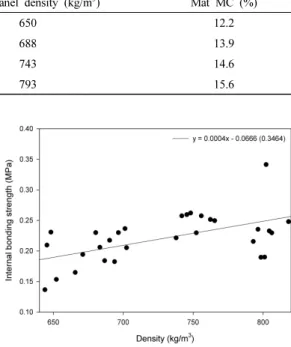
This study was conducted to evaluate the effect of panel density and resin content on properties of medium density fiberboard (MDF) to obtain some insights on MDF properties as a function of panel density and resin content. MDF panels with different panel densities such as 650, 700, 750 and 800 kg/m
3were manufactured by adjusting the amount of wood fibers in the mat forming. MDF panels were also fabricated by spraying 8, 10, 12, and 14% of urea-formaldehyde (UF) resins onto wood fibers in a drum-type mechanical blender to fabricate MDF panels with a target density of 650 kg/m
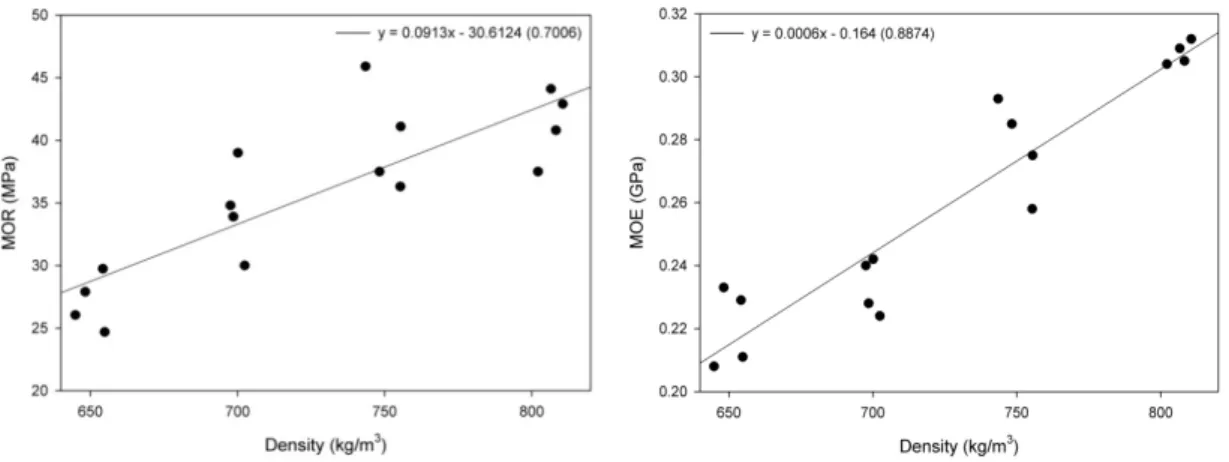
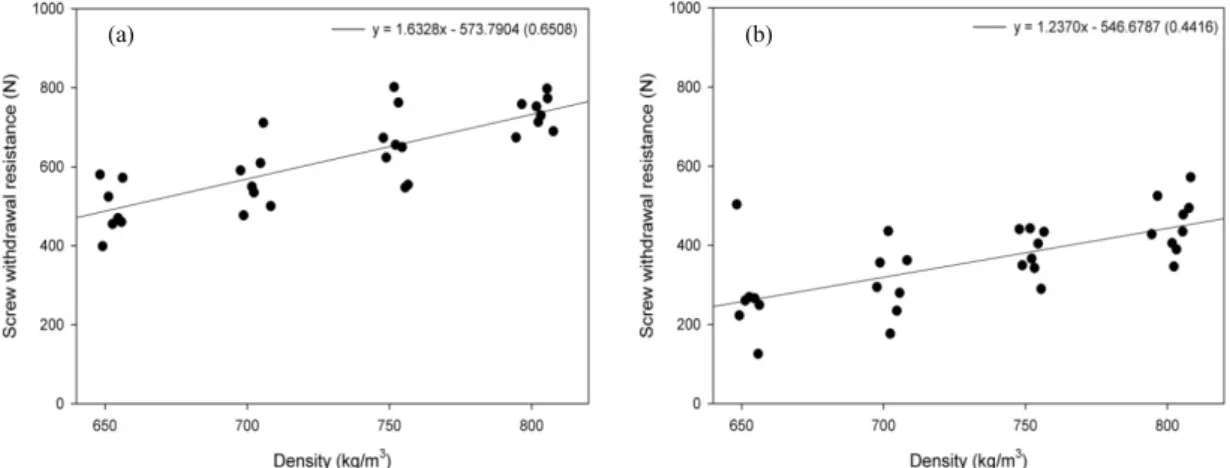
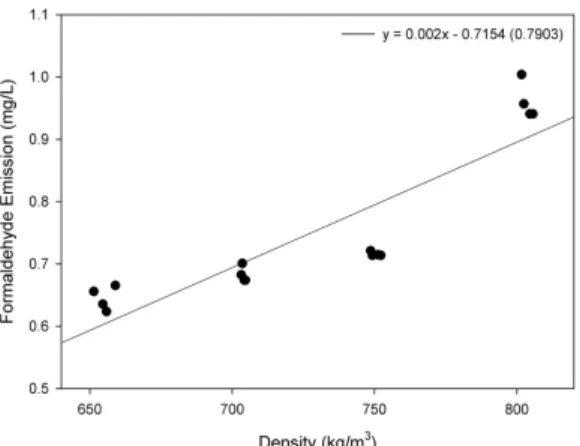
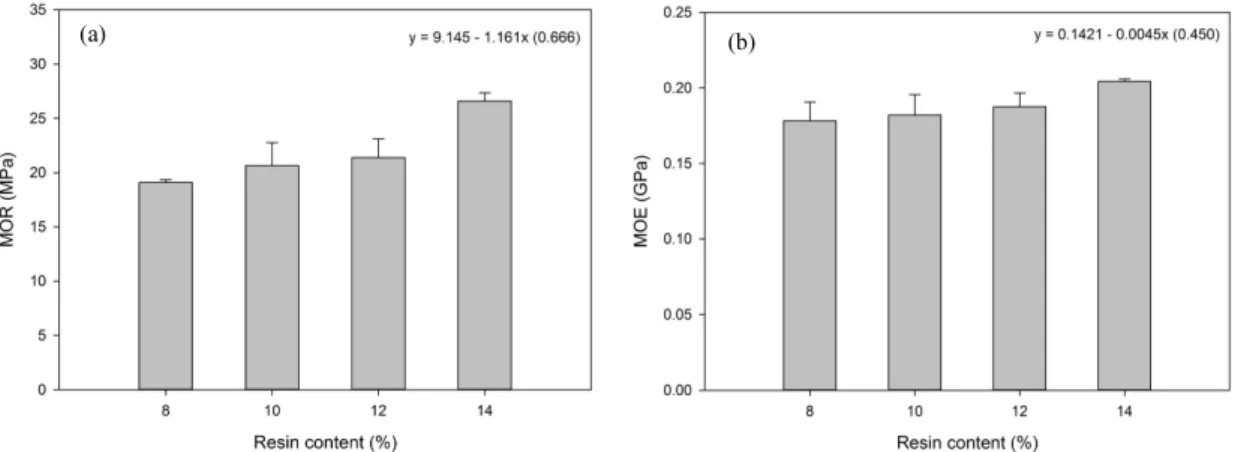
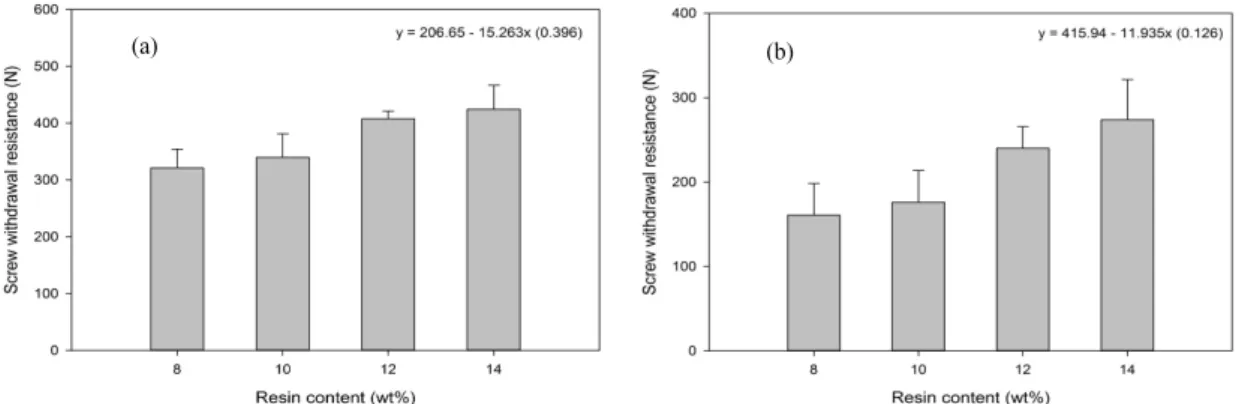
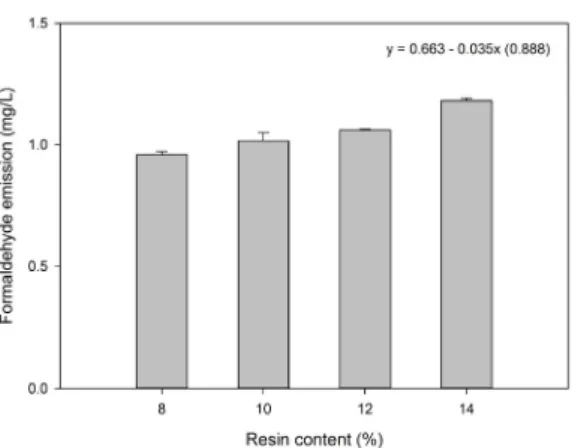
3. As the panel density and resin content increased, the internal bonding (IB) strength of MDF panel consistently increased. Modulus of rupture (MOR), modulus of elasticity (MOE) and screw withdrawal resistance (SWR) had a similar trend to the IB strength. In physical properties, thickness swelling (TS) and water absorption (WA) decreased with an increase in both panel density and resin content. In addition, the formaldehyde emission (FE) which increased as the panel density and resin content became greater. In overall, the panel density of MDF had more significant effect than the resin content in all properties of MDF panels, indicating that it was better to adjust the panel density rather than the resin content for MDF manufacture.
Keywords : medium density fiberboard, panel density, resin content, properties
1
Date Received June 29, 2017, Date Accepted July 15, 2017
2
Department of Wood and Paper Sciences, Kyungpook National University, Daegu 41566, Republic of Korea
3Institute of Agricultural Science and Technology, Kyungpook National University, Daegu 41566, Republic of Korea
†