• 검색 결과가 없습니다.

A Systems Engineering Approach for Uncertainty Analysis of a Station Blackout Scenario

N/A
N/A
Protected

Academic year: 2021

Share "A Systems Engineering Approach for Uncertainty Analysis of a Station Blackout Scenario"

Copied!
9
0
0

로드 중.... (전체 텍스트 보기)

전체 글

(1)

J. Ricardo Tavares de Sousa

*

, Aya Diab

Department of NPP Engineering, KEPCO International Nuclear Graduate School

Abstract : After Fukushima Dai-ichi NPP accident, the need for implementation of diverse and flexible coping strategies (FLEX) became evident. However, to ensure the effectiveness of the safety strategy, it is essential to quantify the uncertainties associated with the station blackout (SBO) scenario as well as the operator actions. In this paper, a systems engineering approach for uncertainty analysis (UA) of a SBO scenario in advanced pressurized water reactor is performed. MARS-KS is used as a best estimate thermal-hydraulic code and is loosely-coupled with Dakota software which is employed to develop the uncertainty quantification framework. Furthermore, the systems engineering approach is adopted to identify the requirements, functions and physical architecture, and to develop the verification and validation plan. For the preliminary analysis, 13 uncertainty parameters are propagated through the model to evaluate the stability and convergence of the framework. The developed framework will ultimately be used to quantify the aleatory and epistemic uncertainties associated with an extended SBO accident scenario and assess the coping capability of APR1400 and the effectiveness of the implemented FLEX strategies.

Key Words : Systems Engineering, APR1400, Uncertainty Analysis, Safety Analysis

(2)

1. Introduction

The Fukushima Dai-ichi NPP accident was caused by a tsunami which flooded the emer- gency power generators and electrical distribution system, leading to an extended station blackout (SBO). SBO is the complete loss of onsite and offsite alternating current electric power (AC power) to the nuclear power plant leading to the unavailability of all active motor-driven safety systems. This accident may therefore challenge the coping capability of existing and new nuclear power plant. Hence, implementation of batteries for at least eight hours and use of diverse and flexible coping strategies (FLEX) were proposed to enhance the coping capability of advanced nuclear reactors.

The FLEX strategy consist of using portable equipment to provide water and power to restore key safety functions. The FLEX strategy is categorized into three phases: relying on installed plant equipment, using on-site FLEX

equipment, obtaining off-site resources. The goal is to ensure that the NPP withstands the extended SBO for at least 72 hours [1].

This paper verifies the reliability and robustness of APR1400 safety strategy in the event of a SBO, given the FLEX portable equipment are employed. The best estimate plus uncertainty is the approach chosen to achieve the goal of this paper via a realistic safety analysis as recommended by regulatory body [2].

Systems Engineering approach (SE) is applied to the evaluation of APR1400 under an extended SBO to plan the tests in parallel with a corresponding phase of development as shown in the V-model in Figure 1. Hence, the reason of SE employment is to provide a set of verification and validation activities that guided this project development by linking each requirement to a validation or verification test with predefined success criteria [3][4].

[Figure 1] V-Model for evaluation of advanced nuclear reactor under SBO

(3)

2. Requirements Identification

2.1 Developed Mission Requirement

The requirements addressed in this work can be divided into mission requirement, originating requirements, and system and component re- quirements as seen in Table 1.

The mission requirement are derived from stakeholders' need. The stakeholders can be categorized into groups with economic, social, environmental and technical impact. After Fuku- shima accident, all those categories were affected.

The public suffer during and after the evacuation process. Moreover, the negative repercussions on the nuclear industry as evidenced by pressure from the anti-nuclear groups to shut down nuclear power plants, which in turn has economic and

technical impacts. In absence of nuclear power, the price of energy becomes more expensive which ultimately affects the public. Furthermore, utilities have to spend more money to enhance the safety and prove that the existing and new plants are able to cope with extended SBO by meeting the new requirements enforced by the regulators. The researches and scientists are therefore compelled to create feasible solutions to enhance the plants' safety. As the saying goes, a nuclear accident anywhere is a nuclear accident everywhere and everyone is affected.

The mission requirement shown in the Table 1 reflect the needs and goals of the stakeholders that is to evaluate the success of the new system design.

2.2 Developed Originating Requirements The originating requirements are based on the stakeholders' inputs and mission requirement.

For a given operational scenario, the objectives are identified and ordered according to their level of importance to formulate the objectives hierarchy. Perhaps the most common overarching objective of all stakeholders is to avoid or at least minimize the radioactive releases within the regulatory limits. A nuclear power plant therefore adopts the defense-in-depth safety philosophy via six radiation barriers: crystal fuel lattice, fuel rod cladding, pressure boundary, concrete shielding, containment and reinforced concrete shell. For the current work, the objective hierarchy focuses on maintaining the fuel integrity since transitioning to severe accident is excluded. The fuel cladding integrity as specified by the safety requirement of maintain the peak cladding temperature below 922 K is maintained as the primary goal of

<Table 1> Requirements of evaluation of APR1400 under SBO

Requirements Description

Mission Requirement

1. The system shall realistically evaluate APR1400 safety under extended SBO scenario.

Originating Requirements

1. The plant shall respect the safety criteria under SBO condition

2. The plant shall respect the safety criteria within 95% probability and 95% confidence under SBO condition

System and Component Requirements

1. The battery should last up to 8 hours under SBO condition

2. The FLEX equipment should be used to cope with SBO condition

3. The plant should provide feed and bleed to cope with SBO condition

4. The operator action shall not be faster than 30 minutes

5. AC power shall not be available under SBO are not available

6. The maximum shutoff head of primary mobile pump shall be 12.23 bar 7. The maximum shutoff head of secondary

mobile pump shall be 2.23 bar 8. All AC power pump shall not be available 9. All emergency diesel generators shall

not be available under SBO

10. Reactor coolant pump (RCP) seal

leakage should occur under SBO

(4)

SBO coping capability to prevent fuel damage.

Consequently, this work intend to prove that APR1400 is able to cope with extended SBO without breaking the first barrier.

The most important events in the SBO scenario are described as follows. At time 00:00h, station blackout occurs, reactor shutdown and TDAFWP starts automatically. At 00:03h, the RCP seal leakage occurs. This RCP seal leakage increase the challenge that the plant has to overcome. At 00:30, operator open the atmospheric dump valve (ADV) to start cooling down the system (conservatism). At 02:00, the mobile primary and secondary pump responsible to pump water into primary system and sec- ondary system are connected to the primary and secondary system. However, they are not able to pump water into the system due to the high pressure. At 08:00h, the battery is lost.

When the battery is over, the turbine drive auxiliary water pumps(TDAFWP) also stop.

The coping strategy is assumed successful if the system copes with the accident for a mission time of 72 hours.

The originating requirements states about the system capabilities which are derived from the mission requirements, and based on the operational scenario and objective hierarchy.

The originating requirements added to the mission requirements the importance of respecting the safety criteria with 95% probability and 95%

confidence. The safety criteria for SBO determined by Kang et al. [5] and Kozmenkon et al. [6]

are core level and peak cladding temperature.

Both safety parameters, core level and peak cladding temperature are related to each other and attempt to demonstrate the importance of maintaining the core covered and natural

circulation. The natural circulation on primary side, promoted by secondary side, allows continuously cooling of the core.

2.2 Developed Derived Requirements

This subsection describes the system require- ments and component requirements (Table 2).

The system requirements and component re- quirement (Table 1) detail the SBO accident characteristics by adding performance and constraints requirements. The System and com- ponents requirements impose limit for battery capability and shutoff head mobile pumps, restriction to operator action, AC power supply and EDGs. Furthermore, it suggest the use of FLEX equipment to overcome SBO challenge.

The system and component requirements demands the development of SBO APR1400 thermal hydraulic model to represent those features. The detailed requirements and par- ameters characteristics for thermal hydraulic modeling the APR1400 are omitted for brevity.

However, the most important requirements are described.

2.3 Architecture Design

This subsection shows the functional architecture

(Figure 2) of APR1400 under SBO. The first

level of functional architecture describes the

three main functions that need to be executed

to avoid a severe accident condition. The core

must to be covered with water. Hence, it is

necessary to provide water to primary system

to maintain the inventory when the collapsed

level of the core and, consequently, the

pressurizer (PZR) level are low. Furthermore,

the seal leakage should be minimized. The

RCP seal leakage that may be incurred due

(5)

lack of component cooling water. When the seal breaks, it causes a loss of primary inventory.

The core must be cooled to deal with the decay heat. The decay heat is the heat produced by the decay of radioactive fission products after a reactor has been shut down. The natural circulation provides a means to cool down the core by convection heat transfer and this phe- nomenon highly depends on the steam generator (SG) status.

The third main function is pressure release.

A high pressure during SBO accident may occur when the reactor is shutdown due to lack of proper cooling. This phenomenon affects the primary and secondary system. By releasing the secondary system pressure (bleed), a cooling flow path is established hence providing cooling to SG. By establishing a cooling flow path through the SGs, natural circulation within the core is maintained. It is worth noting that the pressure release primarily avoids equipment break due to system over pressurization.

As mentioned earlier, the leak in the primary side may be encountered due to lack of cooling to the RCP seal. When the seal breaks, it causes a loss of primary inventory.

The simplified physical architecture represents the main components under SBO condition.

They are linked to the functional architecture.

The equipment responsible to inject water on the primary side to cover the core are portable pump, safety injection tank (SIT). In the secondary system, the equipment responsible to inject water to SG are TDAFWP and portable pump and the ADV to establish a cooling path to the SG. PORSV and MSSV are the equipment responsible to release system pressure in the primary system and secondary system, re- spectively. The RCP is the component that suffers the leakage through the seal.

3. Verification and Validation

This section refers to the verification and validation of thermal hydraulic model and frame- work built to attempt to represent APR1400 under SBO and meet the requirements. Hence, the first step is to develop the thermal hydraulic model.

The evaluation of APR1400 under SBO in this work is conducted via a numerical simulation using MARS-KS. MARS (Multi-dimensional Analysis of Reactor Safety) is a best estimate thermal-hydraulic code code for the realistic multi-dimensional thermal-hydraulic system analysis of light water reactor transients, developed by KAERI [7].

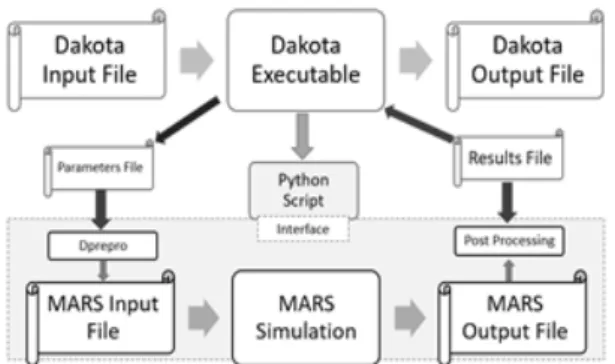
The framework was developed by loosely- coupling MARS-KS with Dakota. Dakota is mathematical toolkit used as a platform to run the uncertainty analysis using the thermal hydraulic system code. Figure 3 represents the framework. MARS-KS is treated as a black box and both codes exchange data by reading

[Figure 2] Functional Architecture of APR1400 under

SBO

(6)

and writing several text files. A separate process external to Dakota is created to run MARS-KS iteratively. A python script was developed to be the interface between the software responsible for executing and writing the uncertain parameters values generated by Dakota in MARS-KS input file, executing MARS-KS twice per iteration, and writing the selected parameters from MARS-KS output file on Dakota results file [8].

3.1 Unit and Integration Tests Verification The unit and integration tests attempt to address the derived requirements. These tests are at the code level and help to eliminate issues at an early stage. The unit test is setup to verify the components behavior inside the simulation while the integration test is setup to verify the successful integration of those components. The way to demonstrate the veri- fication process is by running the APR1400 model in MARS-KS code, collecting the results from MARS-KS code and plotting curves which represent the components and system re- quirements. The main goal of derived requirements is to simulate the station blackout in APR1400 and show the behavior of some components and system.

Figure 4 depicts the ADV flow and hence

demonstrates the operator action, 30 minutes from the accident as defined in the requirement.

Figure 5 represents the impact of utilizing FLEX on primary-side by pump operation in the simulation. The primary mobile pump is in standby condition at 2 hours, however, it is only able to inject water when the primary pressure (represented by PZR pressure) is lower than 0.1223 MPa and the PZR level is below 50%.

3.2 System Test Execution Validation

The system test execution addresses the originating requirements. The system test execution is validated in comparison with real plant data and other publications. It was done in 2 phases. First, the real plant data was obtained at [9]. Those data were compared to thermal hydraulic model results at steady state condition. The steady state conditions mismatch is 0.015 for reactor power (MWt), 0.004 for PZR pressure (MPa), 0.02 for core inlet tem- perature (K), 0.002 for core outlet temperature (K), 0.0 for SG pressure (MPa) and 0.0 for steam temperature (K).

Second, it was compared the results of the

[Figure 3] Uncertainty Analysis Framework

[Figure 4] RCP seal leakage flow rate as function of

time

(7)

transient file for SBO scenario without operator action and without TDAFWP. The thermal hydraulic model developed was compared against the results of Lee et al. [10]. The comparison show that the SG dryout happens at 10.9 hours in SBO with turbine driven auxiliary feed water in comparison with 12.2 hours of this model.

3.3 APR1400 Model Acceptance Test

The acceptance test is used to address the mission requirement. The uncertainty analysis framework was developed to be able to per- form the mission requirement under the SBO scenario for the APR1400 model.

3.3.1 Uncertainty Analysis

UA consist of 3 processes. First, identifying input uncertainties. Second, propagating these uncertainties through a computational model (MARS-KS). Third, performing statistical as- sessments on the resulting responses.

Identification of uncertain parameters is a significant process in the uncertainty analysis.

A PIRT has to be developed to identify the highly ranked phenomena and the safety par- ameters. The screening of uncertain parameters in this research were performed by the authors based on the PIRT developed by Kang et al. [5]

and uncertainty analysis performed by Kozmenkov et al. [6] and Lee et al. [10]. The uncertain parameters identified are: Reactor Power (UP1), Decay Heat Power (UP2), Fuel Heat Capacity (UP3), Fuel Thermal Conductivity (UP4), Initial Secondary Pressure (UP5), Initial PZR Pressure (UP6), Multiplier for liquid heat transfer mode (UP7), Multiplier for transition boiling mode (UP8), Multiplier for nucleate boiling mode (UP9), Initial total mass flow (UP10), Total

moment of inertia for RCPs (UP11), Form loss factor for PZR surge line (UP12), Form loss factor for SIT surge line (UP13), Initial pressure in SITs (UP14), Initial temperature in SITs (UP15), Initial coolant inventory in SITs (UP16), SITs actuation pressure (UP17), High Pressure Safety Injection water temperature (UP18).

The second step is sampling and propagating those parameters into thermal hydraulic model.

The third order Wilks' formula is applied to choose the minimum number of iterations necessary to respect with 95% probability and 95% confidence required by NRC and explicit in the originating requirement [2]. The advantage of Wilks' method is that the number of calculations is independent of the number of input par- ameters. Hence, 130 iterations was performed varying the input parameters related to initial conditions, boundary conditions, material properties and set points.

The third step is assessment of the response.

The platform allows the sensitivity analysis and uncertainty quantification. The sensitivity analysis in this work apply Spearman's rank-

[Figure 5] Pressurizer pressure and Flex on primary

flow as function of time to show dependency

between mobile pump shutoff head and

primary pressure

(8)

order correlation to measure the strength and direction (positive or negative) of association between parameters. The correlation is carry out among the uncertain input parameters, and among uncertain parameters and peak cladding temperature. The sensitivity analysis identifies the key input parameters that influences on the output of the system. The UQ will assess the reliability of the safety systems according to the acceptance criteria.

3.3.2 Verification of the Framework

A necessary condition to assure the robustness of the methodology is to assure that the uncertain parameters are independent. Hence, bias in the sensitivity analysis or uncertainty quantification is avoided. The partial rank correlation of input parameters is presented in the Table 4.

3.3.3 UA results

The evaluation of APR1400 model under SBO through acceptance test demonstrated reliability and robustness. Furthermore, wall heat transfer, thermal power generation, natural circulation and coolant flow were identified the most important phenomena.

The uncertain parameters that affect most the peak cladding temperature (Figure 6) are initial secondary pressure, initial pressure in pressurizer, reactor power, total moment of inertial for RCPs and fuel thermal conductivity.

The initial secondary pressure, initial PZR pressure, reactor power provokes a bigger cladding temperature in the beginning of accident when it reaches the maximum temperature.

Also, the total moment of inertia for RCPs have a significant influence in the beginning of

accident. The fuel thermal conductivity is directly related to the cladding temperature.

The maximum peak cladding temperature is 681 K much lower than 922 K that would indicate the onset of a severe accident condition.

The FLEX strategy is therefore a necessary intervention mechanism to overcome the challenges posed by the SBO.

4. Conclusion

This work performed an uncertainty analysis to confirm the reliability and robustness of APR1400 under SBO scenario, given the em- ployment of FLEX strategy. The Systems Engineering approach based on V-model demon- strated to be a useful tool to address the

<Table 4> Correlation of uncertain parameters

UP1 UP2 UP3 UP4 UP5 UP6 UP7

UP1 1.00 UP2 .00 1.00 UP3 .01 .02 1.00 UP4 .02 .04 .01 1.00 UP5 -.02 .00 -.02 .04 1.00 UP6 .01 .01 .00 .01 .04 1.00 UP7 .00 -.01 .02 -.02 .03 .02 1.00

[Figure 6] Sensitivity Analysis of peak cladding

temperature

(9)

requirements and to show the relationships between each phase of the development life cycle and its associated phase of testing.

To accomplish the purpose of this work an uncertainty analysis framework, composed of the coupling of Dakota and MARS, and a APR1400 Thermal hydraulic model were developed, verified and validated. Accordingly to results obtained, the fuel cladding did not undergo failure. Hence, APR1400 developed model succeeded to cope with an extended station blackout scenario applying FLEX strategy.

Acknowlegdments

This research was supported by the 2019 Research Fund of the KEPCO International Nuclear Graduate School (KINGS), Republic of Korea.

References

1. NEI, Diverse and Flexible Coping Strategies (FLEX) Implementation Guide, Rev.4, NEI 12-06, 2014.

2. NRC, Regulatory Guide 1.105, U.S. Nuclear Regulatory Commission, 1999.

3. Alexander Kossiakoff, Systems Engineering Principles and Practice, 2

nd

Edition, JohnWiley&sons, 2011.

4. I. S. Hwang, J. C. Jung. Development Process of FPGA-based Departure from Nucleate Boiling Ratio Algorithm Using System Engineering Approach, Journal of KOSSE, pp. 41-48, 2018.

5. K. H. Kang, C. H. Song, B. D. Chung, K. D.

Kim, S. W. Lee, K. Y. Choi, B. J. Yun, J. J.

Jeong, Y. S. Bang, Y. H. Ryu, H. G. Kim, C.

J. Choi, C. H. Ban, S. K. Sim. Development of a Phenomena Identification ranking Table (PIRT) for a Station Blackout (SBO) Accident of the APR1400, Transaction of the Korean Nuclear Society Autumn Meeting, Gyeongju, 2013.

6. Y. Kozmenkov, M. Jobst, S. Kliem, F.

Schaefer and P. Wilhelm. Statistical analysis of the early phase of SBO accidents for PWR, Nuclear Engineering and Design, pp.

131-141 2017.

7. KAERI, MARS Code Manual, KAERI/TR- 2812/2004 Korea Atomic Energy Research Institute, Daejon, 2009.

8. B.M. Adams, L.E. Bauman, W.J. Bohnhoff, K.R. and et al. Dakota, A Multilevel Parallel Object-Oriented Framework for Design Opti- mization, Parameter Estimation, Uncertainty Quantification, and Sensitivity Analysis, Sandia Technical Report SAND2014-4633, 2018.

9. KEPCO & KHNP. APR1400 Design Control Document Tier 2, APR1400-K-K-FS- 14002-NP Revision 0, 2018.

10. S.W. Lee, T.H. Hong, Y.S. Lee and H.T.

Kim, Extended Station Blackout Coping Capabilities of APR1400, Science and Tech- nology of Nuclear Installations, 2014.

11. S. W. Lee, B. D. Chung, Y.-S. Bang and S.

W. Bae, Analysis of Uncertainty Quantification Method by Comparing Monte-Carlo Method and Wilks' Formula, Nuclear Engineering and Technology, pp. 481-488, August, 2014.

12. S.-H. Kang, S. Eom, A. Diab and S.-J.

Oh, Examination of the coping strategies (FLEX) of APR1400 for extended station blackout using MARS code, Journal of Computational Fluids Engineering, pp.

55-66, 2017.

수치

Figure  5  represents  the  impact  of  utilizing  FLEX  on  primary-side  by  pump  operation  in  the simulation

참조

관련 문서

Ejectors is a fluid transportation device for which a principle is used that high-pressure fluid are spouted through driving pipe and the pressure

In the heating method by line heating, the initial properties of steel are changed by variables such as temperature, time, and speed. The experimental data

The used output data are minimum DNBR values in a reactor core in a lot of operating conditions and the input data are reactor power, core inlet

(Saturated zone is the zone in which the voids in the soil and rocks are filled with water at a pressure greater than atmospheric pressure).. (Unsaturated zone is the zone

• Resultant pressure forces on curved surfaces are more difficult to deal with because the incremental pressure forces vary continually in direction.. [Sol] Consider a free

Figure 8.1 A propane tank truck explosion due to fracture from initial cracks in

 Let us determine the natural response for the overdamped RLC circuit of Figure 9.4-1 when the initial conditions are v(0) and i(0) for the capacitor and the

However, except for the initial core and the reactor operation Reactor Power Cutback System ASI output and do not have precise instructions for the