생식원료 야채의 전처리공정에서 Hypochlorous Acid의 미생물 제어 효과
⁃
연구노트⁃
고소미․김정목
†
목포대학교 공과대학 식품공학과
Effect of Hypochlorous Acid to Reduce Microbial Populations in Dipping Procedure of Fresh Produce as Saengshik Raw Materials
So-Mi Koh and Jeong-Mok Kim
†
Dept. of Food Science & Technology, Mokpo National University, Jeonnam 534-729, Korea
Abstract
Pre-treatment steps of fresh produce as Saengshik raw materials are followed by initial clean-up, dipping, primary washing, and cutting. Hypochlorous acid solution was applied in the dipping step to reduce natural microflora. Also, procedures were changed by cutting, dipping and then primary washing, and the efficacy of hypochlorus acid was evaluated. Potatoes, carrots, kales, and angelicas were submerged in water or 100 ppm of hypochlorous acid for 5 min. After initial clean-up, the aerobic plate counts of potatoes, carrots, kales and angelicas were 4.7, 5.3, 5.6, and 5.7 log CFU/g, respectively. When samples were submerged into water, it only reduced the population of natural microflora by 0.2 to 1.1 log CFU/g, whereas when treated with hypochlorous acid, it reduced the population by 0.5 to 2.8 log CFU/g. Reductions of natural microflora in green leafy vegetables were more highly achieved than bulbs such as potatoes and carrots. However, the numbers of natural microflora were increased after cutting step. To control the cross contamination at the cutting process, the process was changed as follows: initial clean-up, cutting, dipping in hypochlorous acid, and then primary washing. It showed effective reduction of the population by 2.3 to 3.2 log CFU/g. Hypochlorous acid solution could be useful as a sanitizer for surface washing of fresh vegetables.
Key words: Saengshik, hypochlorous acid, HOCl
†
Corresponding author. E-mail: [email protected]
†
Phone: 82-61-450-2427, Fax: 82-61-454-1521
서 론
곡류, 과채류, 해조류, 버섯류 등을 원료로 하여 가열공정 을 거치지 않고 제조되는 생식은 원료가 가지고 있는 비타민 이나 미네랄 등의 영양성분이나 효소활성을 가열조리 식품 에 비하여 거의 그대로 유지할 수 있는 장점을 가지고 있다.
그러나 비가열 식품이라는 특성을 지닌 생식은 전통적으로 통곡식, 통야채의 개념으로 섭취해 온 것을 산업화한 것으로 최소한의 비가열 가공공정만을 거치게 되므로 식품원료 내 에 존재하는 미생물 또한 그대로 유지될 수밖에 없는 문제점 으로 내포하고 있으며(1) 특히 섭취 시에도 조리를 하지 않 고 물이나 우유에 희석하여 음용하는 경우가 대부분이므로 생식의 원료 및 제조공정에서 혼입된 유해 미생물에 노출될 수 있다(2). 일부 시판생식에서 식중독균인
Bacillus cereus가 검출되었고, 포자형성균과 대장균군도 검출되어 생식제 품들의 미생물학적 안전성에 대한 문제가 제기된 바 있다 (1). 생식의 효능이나 장점에 대한 연구는 많이 보고되었으 나(3-5), 미생물학적 품질평가 및 위생기준 설정, 그리고 생
식제품에 적합한 새로운 살균기술의 개발 등에 관한 연구는 아직까지 부족한 실정이다.
생식의 원재료는 대부분 신선한 채소, 과일 및 곡류이기 때문에 수확 후 빠른 이송과 처리가 필요하다. 입고된 원료 는 특성에 따라 수세, 정선 또는 탈피 공정을 거친다. 이후 세척된 원료는 생식제조사의 제품의 특성에 따라 곡류의 발 아나 채소류의 착즙과 일부 유효성분의 함량을 높이기 위한 효소 처리나 발효공정을 거친 후 비교적 저온에서 각종 성분 의 변화를 최소화하는 건조 공정을 거치게 된다(6,7). 이러한 생식제품의 원료 세척부터 최종제품 포장까지 각 제조공정 별로 생물학적 위해요인을 분석한 결과 생식원료에서 2.82
~8.23 log CFU/g의 총균수와 1.40~6.57 log CFU/g의 coli-
forms이 나타났고 최종제품에서는 총균수가 1.51~7.40 log
CFU/g이 검출되었다(7). 원료를 지하수나 수돗물로 세척하
고 동결건조 하여도 위해미생물은 완전히 제거되지 않으므
로 안전하고 효율적으로 처리할 수 있는 세척, 살균 방법에
대한 필요성이 높아지고 있다(8). 이들 식중독 원인균의 증
식억제를 위한 화학적인 방법으로 차아염소산, hydrogen
peroxide, potassium sorbate(9), benzoic acid(10), propionic acid, citric acid, acetic acid, lactic acid 등 유기산(11-14)과 NaCl(15) 및 기타 보존제를 단독으로 또는 병용한 실험결과 가 많이 보고되고 있다. 차아염소산소다와 물이 반응하여 생성되는 hypochlorous acid(HOCl)는 미생물 제어에 효과 가 있는 것으로 연구되어져있다(16-20). 따라서 본 연구에서 는 생식가공공정 중 원재료의 위해미생물을 분석하고 세척 과정에서 시료의 위해미생물의 변화와 오염 원인을 분석하 여 위해미생물 제어 및 저감화를 위하여 제조공정 개선 및 hypochlorous acid 용액의 살균효과에 대하여 조사하였다.
재료 및 방법
시료
본 실험에 사용된 시료는 생식원료 중 대표적으로 구근류 는 감자, 당근, 그리고 엽채류는 케일, 신선초를 이용하였다.
이 시료들은 ㈜ F&D(전남 무안)에서 공급받아 실험에 사용 하였다.
전처리공정에서 hypochlorous acid 용액으로 처리
생식원료의 부착미생물과 이물질 등을 제거하기 위해 세 척기로 세척한 뒤 세척된 원료를 100 ppm 농도의 hypo- chlorous acid 용액(Serius-Soft-Water production device, Sumitomo Corp., Osaka, Japan)에 5분간 침지한 후 잔류성 분을 제거하기 위해 흐르는 물로 세척하였다. 세척이 끝난 시료는 절단기로 세절되어졌다. 대조구의 경우에는 동일한 조건에서 hypochlorous acid 용액 대신에 용수로 처리하였다.
생식원료별 총균수 측정
시료 10 g에 90 mL의 멸균된 생리식염수를 가하여 2분간 Stomacher(BagMixer
®, Interscience, Saint Nom, France) 로 균질화한 후 시료 1 mL를 petri-dish 위에 분주하여 15~
20 mL의 Plate Count agar(PCA, Difco Lab., Sparks, MD, USA) 배지를 부어 잘 섞어 배양하거나(pour-plate method), 시료를 단계별로 희석한 후 0.1 mL를 Desoxycholate Lac- tose agar(Difco)에 도말하였다. 시료를 접종한 배지는 35
oC 에서 24~48시간 배양한 후 형성된 집락을 계수하여 log colony forming unit(CFU)로 표시하였다.
대장균군수(coliform groups) 측정
시료를 멸균된 생리식염수로 희석한 후, 균질화된 시료를 1 mL씩 취하여 pour plate method나 시료를 단계별로 희석 한 후 0.1 mL를 Desoxycholate Lactose agar(Difco)에 도말 하였다. 이들을 35±1
oC에서 20±1시간 배양하여 암적색의 colony를 계수, 환산하였다.
Escherichia coli
수 측정
시료를 멸균된 생리식염수로 희석한 후, 균질화한 시료를 1 mL씩 취하여 pour plate method나 시료를 단계별로 희석
한 후 0.1 mL를 Chromocult agar(Merck Co., Whitehouse Station, NJ, USA)에 spread하였다. 이들을 35±2
oC에서 24 시간 배양하여 진한 파란색 또는 보라색의 colony를 계수, 환 산하였다.
Bacillus cereus
수 분석
시료 10 g을 인산완충용액 90 mL로 희석하고 Stomacher 로 균질화한 뒤 균질화된 시료를 0.1 mL씩 취하여 Manni- tol-Egg Yolk-polymycin agar(Difco)에 spread하여 30
oC에 서 24시간 배양하여 혼탁한 환의 분홍색 colony을 계수, 환 산하였다.
Clostridium perfrigens
수 분석
시료 10 g을 90 mL의 pepton water에 희석하여 Stomacher로 균질화한 뒤 균질화된 시료 1 mL씩 취하여 Tryptose-Sulfite-Cycloserine agar(Oxoid, Hampshire, England)를 pour plate 한 후 35
oC에 20±2시간 동안 anae- robic jar(Oxoid)를 이용한 혐기적 조건에서 배양하여 불투 명 환의 검은색 집락을 계수, 환산하였다.
결과 및 고찰
Hypochlorous acid 용액을 이용한 세척 공정별 총균수 의 변화
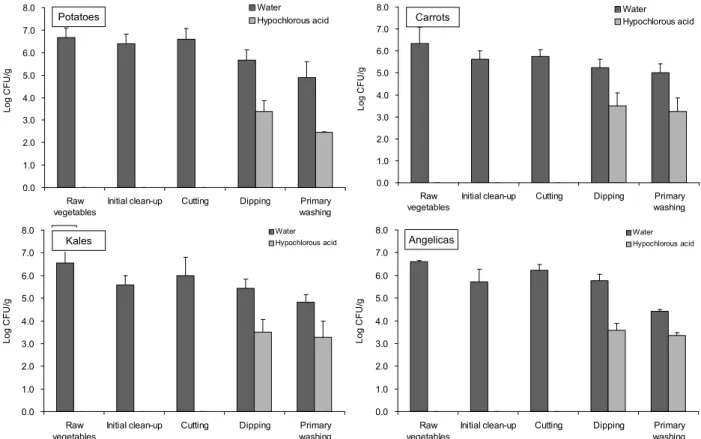
생식원료는 입고 후 세척 및 절단 등의 전처리를 한 후 가공이 이루어진다. 이때 전처리 공정 중 세척 후 침지 단계에 서 용수 대신 HOCl 용액으로 처리하여 미생물수의 변화를 측정한 결과는 Fig. 1에 나타나 있다. 감자, 당근, 케일, 신선 초의 초기 총균수가 각각 5.7, 5.9, 6.2, 5.8 log CFU/g로 검출 되었다. 전처리 단계에서 1차 세척(initial clean-up) 후에는 감자, 당근, 케일, 신선초의 총균수는 4.7, 5.3, 5.6, 5.7 log CFU/g이었으며, 물에 5분간 침지한 후 각각 0.2, 0.2, 0.4, 1.1 log CFU/g 감소하였다. 반면 1차 세척 후 HOCl 용액에 5분간 침지한 시료들은 0.5, 0.5, 1.3, 2.8 log CFU/g 감소하여 물보다 HOCl 용액에 침지하는 것이 살균효과가 더 좋았다. 또한 전 반적으로 구근류보다 엽채류에 살균효과가 높게 나타났다.
이는 식품원료들의 형태 및 구조적 차이에 의해 미생물감소 정도가 세척제와 세척방법에 따라 다르게 나타날 수 있다(21).
하지만 2차 세척(primary washing)이 끝난 원재료가 절단공
정을 거친 후 다시 미생물수가 0.1~2.7 log CFU/g만큼 증가
하였다. 이 같은 결과는 다른 과채류에 대한 연구결과에서도
나타나는데 가령 양배추, cantaloupe, honeydew 같은 과채류
를 칼로 절단하는 과정 중에 식품과 식품, 식품과 기기 사이에
서 교차오염이 발생하여 미생물의 수를 증가시키게 된다(22,
23). 절단 시 식품내부로의 오염은 절단기에 의한 교차오염
이 중요한 부분을 차지하고 있으며(24), 식품원료의 특성에
따라 미생물 교차오염의 정도가 다르게 나타날 수 있다(25,
26). 세절(Shredding)이나 절단과정 이전에 원료자체의 미
생물이나 절단기의 살균소독이 철저히 이루어져야 하며, 비
0.0 1.0 2.0 3.0 4.0 5.0 6.0 7.0 8.0
Raw vegetables
Initial clean- up
Dipping Primary washing
Cutting Potatoes
Log CFU/g
Water Hypochlorous acid
0.0 1.0 2.0 3.0 4.0 5.0 6.0 7.0 8.0
Raw vegetables
Initial clean-up Dipping Primary washing
Cutting Carrots
log CFU/g
Water Hypochlorous acid
0.0 1.0 2.0 3.0 4.0 5.0 6.0 7.0 8.0
Raw vegetables
Initial clean-up Dipping Primary washing
Cutting Kales
Log CFU/g
water
Hypochlorous acid
0.0 1.0 2.0 3.0 4.0 5.0 6.0 7.0 8.0
Raw vegetables
Initial clean-up Dipping Primary washing
Cutting Angelicas
Log CFU/g
Water Hypochlorous acid
Fig. 1. Changes in total microbial counts on potatoes, carrots, kales, and angelicas treated with hypochlorous acid at dipping stages before change of pre-treatment steps.
Table 1. Effect of decontamination with hypochlorous acid on the selected microorganisms in Saengshik raw materials before change of pre-treatment steps
Microorganisms Vegetables
Pre-treatment steps
Raw materials Initial clean-up Dipping
Water HOCl
Coliforms (log CFU/g)
Potatoes Carrots
Kales Angelicas
5.0 5.3 4.9 5.3
3.9 4.8 3.8 4.7
3.7 4.6 3.0 3.3
3.3 4.1 0.9 2.6
E. coli (log CFU/g)
Potatoes Carrots
Kales Angelicas
0.3 1.2 2.4 2.2
ND
1)0.6 0.5 1.2
ND 0.2 ND 0.3
ND ND ND ND
C. perfringens (log CFU/g)
Potatoes Carrots
Kales Angelicas
0.6 1.0 1.7 1.1
0.3 0.2 1.5 0.9
0.2 0.2 0.5 0
ND ND ND ND
B. cereus (log CFU/g)
Potatoes Carrots
Kales Angelicas
3.1 1.6 1.5 1.3
0.7 1.2 ND 0.3
0.6 1.1 ND ND
ND 0.2 ND ND
1)
ND: Not detected.
가열 공정으로 제조되는 생식은 절단 후 동결건조하기 때문 에 전처리 공정에서의 미생물 관리는 중요하다고 할 수 있다.
생식원료의 hypochlorous acid 용액에 대한 유해 미생 물의 변화
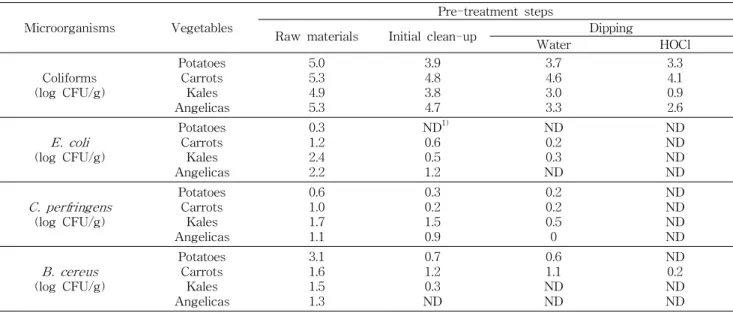
생식원료를 HOCl 용액에 침지 처리한 후 병원성 미생물
의 변화는 Table 1과 같다. 감자, 당근, 케일, 신선초의 초기 대장균군의 수는 각각 5.0, 5.3, 4.9, 5.3 log CFU/g로 검출되 었다. 이 생식원료들을 세척기로 1차 세척 후 물과 HOCl 용액으로 5분 동안 침지 처리하였다. 용수에 5분간 침지한 감자, 당근, 케일, 신선초에서의 대장균군 수는 각각 0.2, 0.2,
Potatoes Carrots
Kales Angelicas
0.0 1.0 2.0 3.0 4.0 5.0 6.0 7.0 8.0
Raw vegetables
Initial clean-up Cutting Dipping Primary washing Potatoes
Log CFU/g
Water Hypochlorous acid
0.0 1.0 2.0 3.0 4.0 5.0 6.0 7.0 8.0
Raw vegetables
Initial clean-up Cutting Dipping Primary washing Carrots
Log CFU/g
Water Hypochlorous acid
0.0 1.0 2.0 3.0 4.0 5.0 6.0 7.0 8.0
Raw vegetables
Initial clean-up Cutting Dipping Primary washing
KalesLog CFU/g
Water Hypochlorous acid
0.0 1.0 2.0 3.0 4.0 5.0 6.0 7.0 8.0
Raw vegetables
Initial clean-up Cutting Dipping Primary washing
AngelicasLog CFU/g
Water Hypochlorous acid
Fig. 2. Reduction of total microbial counts of potatoes, carrots, kales, and angelicas surface by dipping in hypochlorous acid after change of pre-treatment steps.
0.8, 1.4 log CFU/g로 나타났으나, HOCl 용액에 침지한 시 료에서는 각각 0.6, 0.7, 2.9, 2.1 log CFU/g로 대장균군의 수가 감소되었다. 이는 용수로만 침지 처리하는 것보다는 HOCl 용액에 침지 처리하는 것이 원료에서의 유해미생물 제어에 높은 효과를 기대할 수 있음을 보여주었다. 또한 물 과 HOCl 용액의 미생물 제거효과는 원료의 종류에 따라 다 소 차이가 있는 것으로 나타났는데, 특히 근채류보다는 엽 채류에 부착된 미생물의 제거가 용이함을 보여주었다. 이 같은 결과는 동일한 살균제로 과채류를 처리하여도 재료의 종류에 따라 영향을 받는다고 보고된 바 있다(27-29). 세척 전의 감자, 당근, 케일, 신선초에서
E. coli,
C. perfringens,
B. cereus등이 검출되었으며 전처리 단계를 거치면서 이들 미생물의 수는 감소하였다. 원료를 용수보다는 HOCl 용액 에 침지한 경우에 유해미생물이 검출되지 않기 때문에 생식 의 비가열처리 가공 특성상 원료에서 검출되는 유해미생물 을 제어하지 못하게 되면 최종제품까지 생존할 가능성이 높 다. 그러므로 미생물학적으로 안전한 제품 생산을 하기 위 해 단순히 용수로 세척하기보다는 살균제인 HOCl 용액으 로 세척 처리하는 것이 효과적임을 본 결과에서 보여주고 있다.
세척 공정 개선후의 hypochlorous acid 용액 처리에 따 른 총균수와 유해미생물의 변화
Fig. 1에서 보여주는 바와 같이 생식원료의 전처리공정
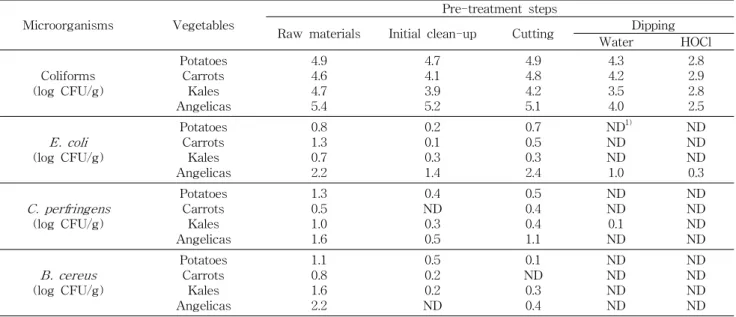
중 2차 세척후의 미생물 수보다 세척이 끝난 후 절단한 생식 원료들에서 미생물 수가 증가하게 나타나는데 이는 절단 공 정에서의 교차오염이 발생하기 때문에 공정을 개선할 필요 가 대두되었다. 그래서 생식 원재료를 먼저 절단한 뒤 HOCl 용액에 침지한 후 총균수를 측정하였고 그 결과는 Fig. 2에 나타내었다. 또한 이 같은 공정의 변화에 따른 대장균군,
E.coli
,
C. perfringens,
B. cereus에 대한 결과는 Table 2에 나타나있다. 생식원료의 초기 총균수는 각각 6.7, 6.4, 6.5, 6.6 log CFU/g를 나타내었으며, 생식원료들을 절단한 후 감 자는 0.2 log CFU/g, 당근은 0.2 log CFU/g, 케일은 0.4 log CFU/g, 신선초는 0.5 log CFU/g로 미생물수가 증가하였다.
이들을 물 또는 HOCl 용액에 5분간 침지처리 한 후 결과를 비교해보면, 단순히 물을 사용하였을 경우에는 각각 0.9, 0.6, 0.6, 0.4 log CFU/g 감소 효과가 나타났으나, HOCl 용액의 경우에는 각각 3.2, 2.3, 2.5, 2.6 log CFU/g로 훨씬 효과적으 로 미생물 감소가 이루어짐을 보여주었다. 이 같은 결과는 다른 연구자인 Izumi(30)의 절단된 당근, 감자를 물에만 세 척한 경우 미생물수가 0.4~0.6 log CFU/g로 감소한 경우와 유사한 결과이고, 절단되거나 또는 그렇지 않은 양상추를 prototype 세척수(detergents, baking soda, sodium lauryl sulfate)와 200 mg/L chlorine 세척수에 처리하였을 때 절단 된 양상추에서 더 높은 살균효과를 나타내는 연구결과와도 일치한다(31,32). 식품공전(33)에서는 생식 최종 제품에 대
Potatoes Carrots
Kales Angelicas
Table 2. Effect of decontamination with hypochlorous acid on the selected microorganisms in Saengshik raw materials after change of pre-treatment steps
Microorganisms Vegetables Pre-treatment steps
Raw materials Initial clean-up Cutting Dipping
Water HOCl
Coliforms (log CFU/g)
Potatoes Carrots
Kales Angelicas
4.9 4.6 4.7 5.4
4.7 4.1 3.9 5.2
4.9 4.8 4.2 5.1
4.3 4.2 3.5 4.0
2.8 2.9 2.8 2.5
E. coli (log CFU/g)
Potatoes Carrots
Kales Angelicas
0.8 1.3 0.7 2.2
0.2 0.1 0.3 1.4
0.7 0.5 0.3 2.4
ND
1)ND ND 1.0
ND ND ND 0.3 C. perfringens
(log CFU/g)
Potatoes Carrots
Kales Angelicas
1.3 0.5 1.0 1.6
ND 0.4 0.3 0.5
0.5 0.4 0.4 1.1
ND ND ND 0.1
ND ND ND ND
B. cereus (log CFU/g)
Potatoes Carrots
Kales Angelicas
1.1 0.8 1.6 2.2
0.5 0.2 0.2 ND
ND 0.1 0.3 0.4
ND ND ND ND
ND ND ND ND
1)
ND: Not detected.
한 미생물 규격이
C. perfringens는 1 g 당 10
2log CFU/g,
B. cereus는 1 g 당 10
3CFU/g 이하이다. 생식원료의 대장균 군,
E. coli,
C. perfringens,
B. cereus수는 절단 후 교차오염 에 의한 미생물의 수는 증가되었지만, 이는 생식 최종제품에 서의 미생물 규격에 나타난 숫자보다 적었다. 하지만 본 연 구에서는 공정의 변화로 절단 후 HOCl 용액에 5분간 침지하 는 공정이 이어지면 아주 효과적으로 이들 미생물들을 제어 할 수 있음을 보여주었다. 특히 대장균군에 대해서 HOCl 용액에 침지한 경우 감자는 2.1 log CFU/g, 당근은 1.9 log CFU/g, 케일은 1.4 log CFU/g, 신선초는 2.6 log CFU/g로 높은 감소효과를 나타내었다.
본 연구결과를 정리하면 일반적인 전처리 공정인 1차 세 척-침지-2차 세척-절단공정에서 원재료의 미생물수가 절단 후 급격히 증가하는 경향을 나타내었으나, 공정개선 후 1차 세척-절단-침지-2차 세척으로 전환하면 생식원 재료의 일반 미생물수와 유해 미생물의 수를 효과적으로 감 소시켰다. 하지만 단순히 물만을 이용한 세척과 침지는 유해 미생물을 제어할 수가 없으므로 타 원료간의 오염, 사용 기 계 기구와의 교차오염을 방지를 위해서도 hypochlorous acid의 사용이 효과적이었다. 따라서 생식 제조공정 중 생식 원료의 유해 미생물을 저감화 하기 위해서는 원료의 전처리 공정 개선이 필요하다. 또한 비가열 살균방법으로서 hypo- chlorous acid 같은 살균제를 이용하여 지속적이고 위생적인 공정관리가 이루어져야 한다. 또한 근래 소비가 증가하고 있는 야채류의 신선편의 식품의 제조공정에서도 이 같은 세 척 살균 공정이 필요하며 본 연구의 응용이 이루어질 수 있 다고 여겨진다.
요 약
생식 원재료 전처리공정은 1차 세척-침지-2차 세척-
절단공정으로 구성되며, 본 연구에서는 hypochlorous acid 를 침지공정에 적용하여 미생물을 제어하고자 하였다. 전처 리 단계에서 1차 세척 후에는 감자, 당근, 케일 및 신선초의 총균수는 4.7, 5.3, 5.6, 5.7 log CFU/g이 검출되었으며, 이를 물에 5분간 침지한 경우에는 각각 0.2, 0.2, 0.4, 1.1 log CFU/g를 감소시켰다. 반면 1차 세척 후 100 ppm hypo- chlorous acid 용액에 5분간 침지한 시료들은 0.5, 0.5, 1.3, 2.8 log CFU/g를 감소시켜 살균효과가 더 좋았으며, 구근류 (감자, 당근)보다는 엽채류(케일, 신선초)에 효과적이었다.
하지만 흐르는 물로 세척이 끝난 채소류는 절단공정을 거친 후 다시 0.1~2.7 log CFU/g만큼 미생물수가 증가하였다.
따라서 감자, 당근, 케일, 신선초에 대해 절단공정을 먼저하 고 나서 침지하는 공정을 한 경우, 물을 사용하였을 때는 각각 0.9, 0.6, 0.6, 0.4 log CFU/g, hypochlorous acid 용액에 침지한 후에는 각각 3.2, 2.3, 2.5, 2.6 log CFU/g를 감소시켰 다. 결론적으로 1차 세척-절단-침지-2차 세척으로 공정 을 개선하고 침지단계에서 hypochlorous acid 용액을 처리 하는 것이 일반미생물과 유해미생물을 효과적으로 제어할 수 있는 방법으로 나타났다.
감사의 글
본 논문은 2004년도 목포대학교 학술연구비 지원에 의하
여 연구되었으며 이에 감사드립니다.
문 헌