Full Search Equivalent Motion Estimation Algorithm for General-Purpose Multi-Core Architectures
Chun-Su Park
††
Dep. of Info. and Telecom. Eng. Sangmyung University
ABSTRACT
Motion estimation is a key technique of modern video processing that significantly improves the coding efficiency significantly by exploiting the temporal redundancy between successive frames. Thread-level parallelism is a promising method to accelerate the motion estimation process for multithreading general-purpose processors. In this paper, we propose a parallel motion estimation algorithm which parallelizes the motion search process of the current H.264/AVC encoder. The proposed algorithm is implemented using the OpenMP application programming interface (API) and can be easily integrated into the current encoder. The experimental results show that the proposed parallel algorithm can reduce the processing time of the motion estimation up to 65.08% without any penalty in the rate-distortion (RD) performance.
Key Words : Motion estimation, H.264/AVC, OpenMP, parallel processing English
1. Introduction
In recent years, multi-core processors are being widely promoted by the industry and have rapidly grown after single-core processors reached physical bottlenecks (power and thermal problems) [1, 2]. The multi-core central processing unit (CPU) is a single CPU package that consists of two or more independent processing cores, and multiple program threads are executed in parallel on distinct CPU cores such that the overall processing time can be decreased effectively. This multi-core processor architecture entails new challenges such as parallel algorithm designing, concurrent programming, and debugging to software developers because the performance of the multi-core processor is strongly dependent on software algorithms and implementation methods [3].
However, most of the current software including video codecs is still being developed on the basis of the single-core processing architecture, instead of the multi-core processing architecture [4]. That is, no data parallelism or function parallelism is considered
in most software development processes.
In modern video processing, block-based motion estimation is a key technique to reduce the temporal redundancy existing between adjacent frames [5, 6].
For each block in the current frame, the motion estimation process is to find the best prediction, called the reference block, which minimizes the matching difference between the two blocks within the predetermined search window. The motion vector (MV) is used for specifying the spatial displacement between the current and reference blocks. The motion estimation process requires intensive computation and memory communication for the block-matching
†E-mail : [email protected]
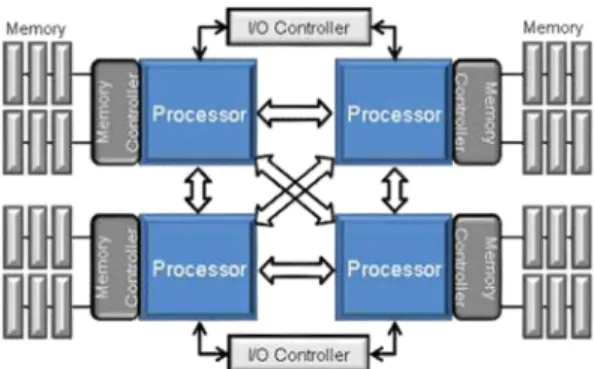
Fig. 1. Example of a general-purpose multi-core processor.
task. Therefore, it is well-known that motion estimation is the most time-consuming process of video encoders.
The simplest motion estimation algorithm is the full search (FS) algorithm [7]. This algorithm provides the optimal MV by exhaustively searching all possible positions within the search window. However, the FS algorithm is not a feasible solution for practical applications because of its heavy computational load.
Various fast search algorithms such as partial distortion elimination (PDE) and successive elimination algorithm (SEA) have been proposed to reduce the computational complexity of the motion estimation process without sacrificing the coding efficiency [8-10]. These algorithms reduce the amount of computation drastically by examining only a limited number of pixels in the search windows. In the current implementation, the H.264/AVC encoder adopts an FS-equivalent spiral search method to accelerate the motion estimation process [11]. The present study focuses on the spiral search and proposes a fast motion estimation algorithm based on thread-level parallelization for the H.264/
AVC encoder.
The rest of this paper is organized as follows.
Section 2 introduces the spiral search and analyzes the current implementation of the H.264/AVC encoder. Based on the analysis, a parallel motion estimation algorithm is proposed. The experimental results of the proposed algorithm are presented in Section 3. Finally, conclusions are drawn in Section 4.
2. Proposed parallel motion estimation algorithm
The H.264/AVC encoder uses the Lagrangian optimization technique to find the optimal MV for the inter-coded block [12]. It yields high performance in providing the optimal bit allocation to the MV. Let s and c(m) be, respectively, the original block and its reconstruction obtained by using the MV m. For the inter-coded block, rate-constrained motion estimation is performed to find the optimal MV by minimizing the following Lagrangian functional
(1)
where m
pis the prediction for the MV and λ is the Lagrange multiplier [13]. The distortion D(s, c(m)) is the sum of absolute differences (SAD) or the sum of squared differences (SSD) between the original block s and its reconstruction c(m). The rate R(m − m
p) specifies the number of bits required for encoding the difference between the original MV and the predicted one.
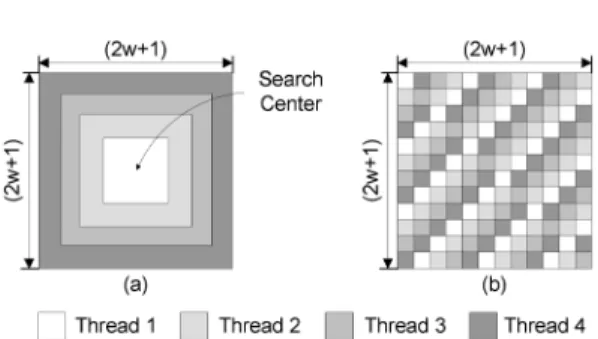
In general, the MV distribution is highly center- biased. Cheung et al. showed that most of the MVs concentrate on the search center, i.e., approximately 81.80% of the MVs are located in the central 5 × 5 square area [14]. In order to exploit the characteristics, the spiral search adopted in the H.264/AVC encoder starts the search process at the center of the search window and then moves the search position pixel by pixel in a spiral structure around the search center.
Note that, in the current implementation, the MV prediction m
pis used as an initial search center. The spiral search produces the best performance for the video signal that has the MV distribution gathered at the zero position (0,0). This is because the probability of finding the minimum matching error at the beginning of the search process will increase. It is well-known that the spiral search achieves better performance than the FS algorithm that uses raster scan order.
The spiral search establishes an inequality relation to accelerate the search process while preserving the rate-distortion (RD) optimized solution for the MV, given the Lagrange multiplier λ. Let Ψ be a search window of size (2w + 1) · (2w + 1) and , , be an MV indicating a possible pixel position in a spiral order. Then, Ψ is composed of pixel positions within the search window as follows
(2)
where W = (2w + 1) · (2w + 1). In the motion estimation process, after examining the sub-window , the encoder can obtain the current minimum RD cost as follows
J m s,m (
p) = D s,c m ( ( ) ) λ R m−m + ⋅ (
p) (3)
m
k∈ Ψ 0 k < ≤ ( 2w 1 + ) 2w 1 ⋅ ( + )
Ψ = { m
1, m
2, … m ,
W}
Ψ
k= { m
1, … m ,
k}
J
k minJ
k minmin J m { (
is,m
p) }
mi Ψk∈