• Innventia, Box 5604, SE-114 86, Stockholm, Sweden
† Corresponding Author: E-mail: [email protected]
Large Scale Applications of Nanocellulosic Materials - A Comprehensive Review -
Tom Lindström
†, Ali Naderi and Anna Wiberg
Received December 1, 2015; Received in revised form December 10, 2015; Accepted December 11, 2015
ABSTRACT
The common production methods of nanocellulosic (cellulosic nanofibrils, CNF) materials from wood are being reviewed, together with large scale applications and particularly papermaking applications. The high energy demand for producing CNF has been one particular problem, which has been addressed over the years and can now be considered solved. Another problem was the clogging of homogenizers/microfluidizers, and the different routes to decrease the energy demand. The clogging tendency, related to the flocculation tendency of fibres is discussed in some detail. The most common methods to decrease the energy demand are TEMPO-oxidation, carboxymethylation and mechanical/enzymatic pre-treatments in the order of increased energy demand for delamination. The rheology characteristics of CNF materials, i.e. the high shear viscosity, shear thinning and the thixotropic properties are being illuminated.
CNF materials are strength adjuvants that enhance the relative bonded area in paper sheets and, hence increase the sheet density and give an increased strength of the paper, particularly for chemical pulps. At the same time papers obtain a lower light scattering, higher hygroexpansion and decreased air permeability, similar to the effects of beating pulps. The negative effects on drainage by CNF materials must be alleviated through the appropriate use of microparticulate drainage aids. The use of CNF in films and coatings is interesting because CNF films and coatings can provide paper/board with good oxygen barrier properties, particularly at low relative humidities. Some other high volume ap- plications such as concrete, oil recovery applications, automotive body applications and plastic packaging are also briefly discussed.
Keywords: Nanocellulosic materials, NFC/MFC, NCC, large scale application, energy con- sumption
http://dx.doi.org/10.7584/ktappi.2015.47.6.005
Printed in Korea
1. Introduction
The annual global production of cellulose has been estimated to 7.5×10
10tonnes
1), which cor- responds to 3×10
10tonnes annual production of carbon. In order to provide a climate change per- spective this can be compared with the total an- nual carbon emission from fossil materials, which amounts to 9×10
10tonnes.
2)Hence, the world forests have a considerable positive effect on the global carbon cycle. It is, therefore understandable, that in spite of the fact that cellulose chemistry is well known, there are great contemporary efforts to develop new types of sustainable materials from cellulose such as cellulose nanocrystals, cellulose nanofibrils, cellulose microfibrills and the like. This effort encompasses top-down methods using en- zymatic or/and chemical/physical methodologies to break down wood and other plant materials as well as bottom-up procedures for producing cellulose from certain bacteria.
The nomenclature for nanocellulosic materials is not entirely uniform but there are three broad cat- egories of these materials
3): microfibrillar cellulose (MFC) or nanofibrillar cellulose (NFC), currently abbreviated CNF (cellulose nanofibrils), nanocrys- talline materials (NCC), now also abbreviated CNC and bacterial nanocellulose (BNC). Typical CNF materials have a fibril diameter from 3-60 nm and up to several microns in length. The span is large, ranging from 3 nm for TEMPO-oxidized fibrils to 60 nm for fibrils created without any chemical pre-treatments before communition of the fibres.
The diameter of NCC also ranges form 3-60 nm in diameter, but the material has a shorter length in the order of 100-250 nm. Hence, there are nu- merous types of nanocellulosic materials that are potentially suitable for different industrial applica- tions.
Cellulose nanofibrils (CNF) possess several excit- ing properties.
4-7)These materials are biodegrad-
able, can be produced from a variety of sustainable resources, and are characterized by their high spe- cific strength and stiffness values. Furthermore, CNF-based films display low density, porosity, and thermal expansion coefficient, together with high transparency and high strength. Hence, CNF may potentially be used in numerous industrial applica- tions.
In this communication, some of the high-volume applications of CNF are presented and the modes of actions of the materials in the applications are described. In this context, the predicted market sizes of CNF materials (in 5-10 years’ perspective) in each application are also included. The numbers are direct citations from the report of Cowie et al.
8), who have based their estimations on among others compiled governmental data, financial data and survey articles. However, it is pointed out that the quotations define upper estimates of the market sizes of NFC; as the estimates of Cowie et al. refer to the total usage of nanocellulosic mate- rials, which comprise not only CNF materials but also CNC and BNC materials.
2. Production of CNF materials from wood fibres
The manufacture of CNF materials goes back
to the developments at ITT Rayonier in the late
1970s, but these researchers
9,10)and researchers at
the then STFI (now Innventia)
11)concluded that the
energy consumption was very high. Early studies
11)at STFI in Stockholm, Sweden (now Innventia) es-
timated the energy consumption to around 30,000
kWh/tonne using a sulphite pulp. Later other
investigators determined that between 12,000-
70,000 kWh/tonne
12,13)was required to make CNF
from kraft pulps. The discrepancy between the
different numbers is likely due to the fact that at
the time of these investigations, there was no good
definition for what constitutes a CNF material.
Another major problem related to the manufac- turing of CNF was the clogging of homogenizers/
microfluidizers already at low fibre consistencies.
These two factors became major impediments for commercialisation of CNF at that time.
Interestingly, the original investigators at ITT-Rayonier found early that hydrophilic poly- mers such as cellulose derivatives and gums facil- itated the mechanical delamination process, which can be traced down to the fact that such additives can decrease the flocculation of fibres, which is the primary factor responsible for clogging. Neverthe- less, ITT-Rayonier abandoned further efforts in the CNF area. Their patent portfolio, see listings in e.g. Lindstr ö m et al.
7)constitutes, however, an interesting pool of information, concentrated not only to food additives but also on various aspects of the manufacturing process.
There are several different routes to decrease the high energy consumption and alleviate the clogging tendency in CNF manufacturing:
A. Electrostatically induced swelling by subjecting pulps to oxidative pre-treatments or grafting procedures, or simply producing a pulp with a high amount of charged groups. In this cate- gory TEMPO-oxidation and carboxymethyla- tion are the most used procedures by research investigators.
B. Mild acid- or enzymatic hydrolysis.
C. The use of stabilizers (deflocculants) as envis- aged by the original investigators.
When dealing with delamination procedures based on pulps with a high charge content (route A) it is important to maximize the swelling of the pulps by having the charged groups in their ionized form (having monovalent counter-ions). Hydrolysis (route B) is employed as a mean to decrease the cell wall integrity of fibres, but may be detrimental to the strength properties of CNF materials if the hydrolysis is driven to sufficiently low degrees of
polymerization of the fibres. In order to avoid floc- culation (route C), the concept of crowding factor
14)is useful:
In the relation (Eq. 1), N denotes the crowding factor, C
mthe mass concentration of fibres (%), L the fibre length in metre and ω the fibre coarseness (kg/m). According to the concept of Kerekes and Schell, a higher crowding factor is indicative of a higher tendency for fibre flocculation. As it can be seen in Eq. 1, the flocculation tendency decreases with decreasing fibre length and increasing the coarseness of the fibres. However, Eq. 1 does not take into account impact of the fibre-fibre friction on flocculation. It has been shown by Horvath and Lindstr ö m
15)that the higher the surface charge is, the lesser becomes the friction between fibres, due to the increased electrostatic repulsion between the fibres. Hence, chemical treatments such as TEM- PO-oxidation and carboxymethylation do not only decrease the cell wall cohesion, but also decrease the extent of flocculation, by which the clogging of homogenizers/microfluidizers can be alleviated.
In this context it is noted that the same beneficial effects can be achieved by the physical grafting of polyelectrolyte chains (viz. carboxymethyl cellulose (CMC)) onto fibres.
16,17)The carboxymethylation process (as a method to speed up refining) was discovered many years ago.
18)It is interesting to note that carboxymeth- ylation process is employed commercially today for the production of CMC.
The use of TEMPO-oxidation by using 2,2,6,6,-tetramethylpiperidine-1-oxyl (4-H-TEM- PO) radicals before a mild mechanical treatment in blenders offers a unique way to delaminate fibres and make CNF.
19)There are many publications on the use of 4-H-TEMPO to make CNF. 4-H-TEM- PO is a water-soluble radical that can be used for
[1]
the selective oxidation the primary C-6 hydroxyl groups of cellulose.
20-22)The most widely publicized procedure to make CNF is the TEMPO/NaBr/NaClO system under slight alkaline conditions. Under such conditions, the aldehyde intermediates formed by oxidation can undergo beta-elimination reactions, which reduces the degree of polymerization of cel- lulose. But this degradation can be largely avoided today.
23)Furthermore, TEMPO derivative nanofibrils with a high degree of polymerization can, however, be produced by using a 4-acetamido-TEMPO de- rivative, nanofibrils with a high degree of polymer- ization can be produced.
24)An enzymatic pre-treatment using endoglu- canases together with pre-refining before com- munition has been found to have a beneficial effects to reduce the energy consumption to make CNF.
25,26)Usually, the pulp is first pre-refined to enhance the accessibility of the fibre cell wall before the enzymatic treatment. Thereafter, the pre-treated fibres are extensively refined, as a mean to decrease the fibre length before homog- enization (which often is the mechanical delami- nation process in the CNF manufacturing) in order to decrease the clogging tendency. It is believed that the enzymatic approach is suitable for large- scale manufacturing of inexpensive CNF materials that can be useful for wet-end applications in papermaking and coating applications. It is noted that the large-scale production of enzymatically pre-treated CNF was demonstrated by Innventia in 2011 by the inauguration of world’s first pilot plant for CNF-manufacturing.
Mechanical delamination of fibres can be achieved by an array of methodologies. Nano- fibrillated cellulose (CNF) was for example pro- duced by high pressure homogenizers.
9,10)The two delamination methodologies to make CNF that oc- cur frequently in the literature are high-pressure homogenizers and the so called microfluidizers.
17,27)There are also other occurring methodologies, for example super grinding
28-30), a type of refiner grinding, where wood fibres are forced through a gap between a rotary and a stationary discs.
Cryo-crushing followed by disintegration and fibrillation has also been mentioned in the litera- ture.
31-33)Delamination with ball mills and ultra-sonifica- tion are other examples of methods for production of CNF.
34)And recently, conventional extruders have also been used to produce CNF.
35)It is noted that it is generally difficult to compare different delamination methods and to quantify the CNF quality vs. energy consumption. However, the accumulated experiences of Innventia have shown that CNF products based on homogenizers and microfluidizers display a more narrow size distri- bution (which is important in e.g. production of transparent films) as compared to when refiners are employed. Similar conclusions can be deducted from the contribution of Spence et al.
13)3. Large scale application areas of CNF: exemplified
3.1 Rheology characteristics of CNF materials
The potency of NFC as rheological modifiers was recognized already by the original inventors of the material.
9,36,37)This property can be ascribed to the rich rheological behaviour of the material.
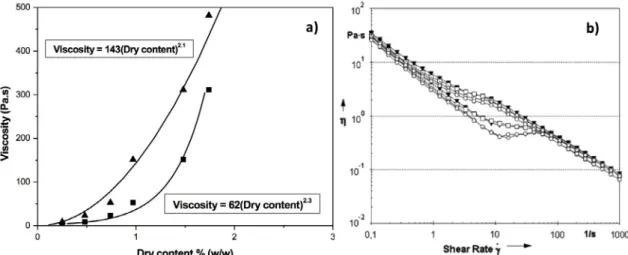
The complexity of the rheological properties arises from by the earlier mentioned highly anisotro- pic nature (aspect ratio > 100) of the nanofibrils, which severely restricts the rotational and trans- lational motion perpendicular to the axis of the nanofibrils, at much lower concentrations (< 0.1%
(w/w))
38,39)than observed for many spherically shaped particles (< 1% (w/w)).
40)http://papernet.se/news/innventia-inaugurated-expanded-pilot-plant/