P1-79 / H. K. Bae
• IMID 2009 DIGEST
Abstract
Thermal transfer of emitting layer from the donor film to the substrates depends on the physical interaction between the donor film, the emitting layer, and the hole-transport layer (HTL). The interfacial adhesion between the donor film and the EML, the cohesive force of the EML, and the interfacial adhesion between the EML and the HIL have to be optimized to achieve good LITI pattern quality.
It was found that surface pretreatment of the donor plate was important on the laser induced thermal transfer of the emitting layer onto the HIL layer of the OLED devices.
.
1. Introduction
Conventional, small-molecule full-color OLED manufacturing uses precision shadow masks to pattern-wise deposit the individual emitting layers. A disadvantage of this method is the difficulty of simultaneously having small pixels for high resolution and large-scale mother glass for high-volume manufacturing.
Alternative approaches to full-color OLED manufacturing include white OLEDs with color filter (CFA) and/or micro cavities, polymer light-emitting (a contact adhesion transfer process). Each of these
alternative methods has significant limitations with respect to either device performance and/or manufacturing.
2. Experimental
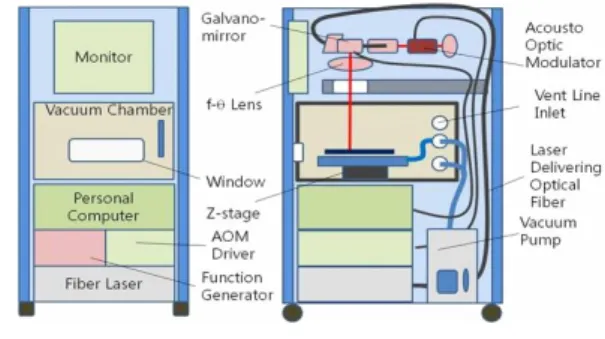
The LITI equipment and schematic mechanism of its process are shown in Fig. 1 and Fig. 2.
Fig. 1. Laser induced thermal imaging (LITI) system.
Effect of Surface Modification of Donor Plate on the Fabrication of
OLED Devices by LITI Process
Heung Kwon Bae
1, Jin Hoo Kim
1,Hyeok Yong Kwon
2, Yoon Soo Lee
3and Lee Soon Park
1,2,3*1Department of Polymer Science, Kyungpook National University, San-kuyk
Dong Daegu, Korea
TEL: +82-53-950-5627 e-mail: [email protected]
2Department of Sensor and Display Engineering, Kyungpook National
University San-kuyk Dong Daegu, Korea
3Advanced Display Manufacturing Research Center, Kyungpook National
University San-kuyk Dong Daegu, Korea
P1-79 / H. K. Bae
IMID 2009 DIGEST • Fig. 2. Schematic mechanism of LITI process.
The donor plate was prepared by the coating of carbon black photosensitive resist (PR) and UV curing followed by negative PR coating and UV curing (buffer layer)on the glass substrate as shown in Table 1.
TABLE 1. Preparation Conditions of Donor Plate (a) Spin Coating and Baking Condition
Step RPM Time Soft
Baking Post Baking Thickness BM Layer One Step 1,800 20Sec 80℃ For 30Sec - 360nm One Step 1,800 15Sec Buffer Layer Two Step 2,500 20Sec 80℃ For 30Sec 130℃ For 30Sec 560nm (b) UV exposure
The deposition of Alq3 emitting layer on the donor
plate and HIL layer on the ITO glass substrate are shown in Fig. 3.
Fig. 3. Preparation of donor plate and HIL deposited ITO glass before LITI process.
3. Results and Discussion
Compared with ink-jet printing, LITI color patterning requires a donor film or plate on which light-emitting materials are coated and a highly accurate laser-exposure unit. The donor film absorbs the laser beam through the light to heat conversion layer and converts it to heat to enable the thermal transfer of the emitting layer (EML) to the substrates.
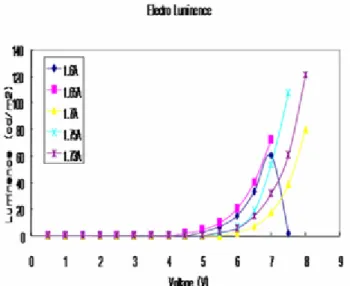
As shown in Fig. 4 and Fig. 5, the plasma treated donor plate with less contact angle resulted in much higher luminance value of the OLED devices.
Fig. 4. Contact angle of untreated donor plate and V-L Curve of
OLED device by LITI process.
Fig. 5. Plasma surface treated Donor plate and V-L curve of OLED device by LITI process. We tried to optimize the plasma treatment process on
the buffer layer of donor plate on which the light emitting Alq3 was deposited and transferred to the HIL layer in the LITI process. As shown in Fig.6 and
Fig. 7 the plasma treatment of buffer layer of donor film gave much higher luminance values when the
Donor Plate UV Exposure UV Exposure Time Total Exposure
BM Layer 13.65mw 20 Sec 273mJ
P1-79 / H. K. Bae
• IMID 2009 DIGEST
OLED devices were completed after the transfer of the Alq3 emitting layer from the donor plate. .
Fig. 6. V-L curves of OLEDs fabricated with the untreated donor plate in the LITI process
Fig. 7. V-L curves of OLEDs fabricated with the untreated donor plate in the LITI process
4. Summary
In this work preparation of donor plate and its effect on the laser induced thermal imaging (LITI) of light emitting layer on the OLED devices were studied. It was found that the pretreatment of the buffer layer of the donor plate was important on the laser induced thermal transfer of the emitting layer onto the HIL layer of the OLED devices.
5. References
[1] S. T. Lee, J. Y. Lee, M. H. Kim, M. C. Suh, T.M. Kang, Y. J. Choi, J. Y. Park, J. H. Kwon and
H. K. Chung, Society for Information Display 2002 International Symposium Digest (Boston, 2002), p. 784.
[2] R. Young and B. Young, Alternative Technology Display Report: OLED Technology (Display search, Austin, 2004).
[3] H. Yamada, T. Sano, T. Nakayama and I. Miyamoto, Appl. Surf. Sci. 197, 411 (2002). [4] H. K. Chung, in Proceedings of the OLED 2003 Conference (San Diego, 2003).