†Corresponding author
Tel.:+82-2-2210-2756; Fax: +82-2-2248-5110
E-mail address: [email protected]
재생 입구 직접증발냉각기 적용이 제습냉방시스템
성능에 미치는 영향
다쉬 울찌우타스, 오 명 도†
서울시립대학교 대학원 기계정보공학과, †서울시립대학교 기계정보공학과
Effects of performance analysis of a desiccant cooling system with a direct
evaporative cooler in the regeneration process
Dash Ulziiutas, Myung-Do Oh†
Graduated School of Mechanical Engineering, University of Seoul, Seoul 130-743, Korea
†
Department of Mechanical and Information Engineering, University of Seoul, Seoul 130-743, Korea
ABSTRACT: In this study the performance analysis and cooling capacity of desiccant cooling system incorporating regenerative cooler and direct evaporative cooler in the regeneration air inlet were investigated on the condition of low regeneration temperature and time rotation 180s and area ratio of regeneration to dehumidification section 0.7. The cooling capacity and COP are evaluated at various effectiveness values of the direct evaporative cooler or the regenerative evaporative cooler. As either of effectiveness of the regenerative and direct evaporative coolers of desiccant cooling system increases, both the cooling capacity and COP increase, but effectiveness value of regenerative cooler gives the opposite effect on the system performance. It is found that effectiveness of regenerative cooler less than 0.7 shows the optimum cooling capacity.
Key words : Desiccant cooling system(제습냉방시스템), Regeneration Evaporative cooler(재생증발냉 각기), Direct evaporative cooler(직접증발냉각기), Desiccant rotor(제습로터)
1. 서론 흡착(흡습) 제습냉방시스템은 증발기와 흡착식 제습기를 조합으로 이루어지는 시스템으로서 고 온 다습한 공기를 제습기를 이용하여 제습한 후 증발냉각기로 온도를 낮추어 냉방을 공급할 수 있는 독립형 제습증발냉방시스템이다. 이 시스템 은 여타의 전기구동압축기 없이 열에너지만으로 냉방공급이 가능하므로 에너지 절약형 시스템으 로 주목을 받고 있다.(1) 또한 작동유체로 물만 사 용하므로 CFC계열의 냉매사용에 의한 오존층 파 괴 등 기존의 냉방시스템에 의한 여러 가지 문제 를 해결할 수 있다. 또한 제습기에서 잠열부하 처 리가 용이하여 실내 공기질 향상을 위한 환기량 의 증대에 적합하다.(1,2) 재생증발냉각기(이하, REC)를 이용한 제습냉방 시스템에서 공급공기의 온도를 습도증가 없이 이 슬점온도보다 더욱 낮출 수 있는 장점이 있 다.(3,4,5)이로 인해 시스템의 성능을 향상시킬 수 있다. 본 연구에서는 냉방용량이 5kW이하의 소형냉 방기에 적용한 제습냉방시스템에 재생공기 도입 후에 직접증발냉각기(이하, DEC) 설치하여 고온 다습한 기후조건에 활용되는 낮은 재생온도 60°C의 경우 냉방용량과 시스템의 성능 해석을 수행하며, DEC 설치의 효과를 살펴봤다.
(a)System configuration
(b) Psychrometric chart
Fig. 1 Desiccant cooling system incorporating a regenerative and direct evaporative coolers
2. 시스템의 개요 제습로터, 현열교환기, REC, 그리고 재생 쪽 공 기 도입 후에 DEC를 설치한 제습냉방시스템을 Fig. 1 (a)에 나타내었다. 이 시스템에서는 도입공 기의 30%를 외부에서 흡입하는 방식을 사용하였 다. 공조공간으로 공급하기 위해 혼합된 공기는 제습로터를 지나며 고온건조해지고 재생을 위해 공기(ventilation 100%)와 열교환을 하여 감온된 다. 이때 재생을 위해 공기를 도입 직후 DEC를 통과시켜 냉각시킴으로써 공급공기의 온도를 더 낮출 수 있다. 이렇게 제습기 출구의 배기열을 이 용하여 재생공기 급기를 가열할 수 있도록 현열 교환기를 배치하며, 재생소요 열량을 크게 감소시 킬 수 있다. 예열된 재생공기는 히터 등을 이용하 여 재생을 위해 요구되는 온도까지 가열된다.(6) 이 시스템에서 표준 조건은 실내온도 27°C, 상대 습도 50%와 실외온도 35°C, 상대습도 40% 그리 고 재생온도 60°C이다. 시스템의 작동에 다른 공 기상태 변화는 Fig. 1 (b)의 습공기선도에 나타내 었다. 3. 시스템의 구성요소의 모델링 재생입구 DEC 적용 재생증발냉방시스템은 REC, 제습로터, 현열교환기, 가열기 DEC 등으로 구성되며, 전체 시스템의 성능은 각 구성요소의 성능에 의하여 결정된다.(2,6,7) REC 유용도(effectiveness), ,는 이론적으로 얻을 수 있는 최대 온도 차이에 대한 실제 온도 차이로 정의하였다. REC 출구의 이상적인 최저온 도는 유입공기의 이슬점온도이다. (1) 여기서, ; REC 입구온도, ; 재생증발냉각 기 출구온도, ; 이슬점온도이다. 제습로터의 출구 공기상태를 나타내기 위해서 는 수치해석을 사용한 별도의 프로그램을 이용하 여 구하였다. 현열교환기의 성능, ,은 고온부 입구온도와 저온부 입구온도 차이에 대하여, 고온부 또는 저 온부의 입출구 온도차의 비로 정의한다. ⇔ (2) 여기서, ; 현열교환기 출구온도(°C), ; 재생 쪽 입구온도(°C), ; 제습로터에서의 출구온도 (°C), ; REC 입구온도(°C) DEC 유용도, ,는 이상적으로 얻을 수 있는 최대온도 차이 대한 실제 상황에서 얻을 수 있는 온도 차이로 정의하였다. 실질적으로 얻을 수 있 는 최저온도는 DEC 입구 습구온도이다.
여기서, ; DEC 입구온도(°C), ; DEC 출구 온도(°C), ; DEC 입구습구온도(°C) 시스템의 냉방용량, ,은 실내 공급공기의 질량유량과 실내공기와 공급공기의 엔탈피차를 이용하여 다음 식과 같이 구할 수 있다. (4) (5) 여기서, ; 순환공기유량(kg/s), ; 제습 쪽 공기유량(kg/s), ; 외기공기의 도입율, ; 실내 공기 엔탈피, ;공조공간에 공급공기 엔탈피 재생공기를 재생온도까지 가열하는데 소모되는 재생열량, ,은 다음 식과 같이 구하였다. (6) 여기서, ; 재생 쪽 공기유량(kg/s), ; 히 터 출구 엔탈피(kJ/kg), ; 현열교환기 출구 엔탈 피(kJ/kg) 제습부와 재생부의 공기유량은 다음과 같다.
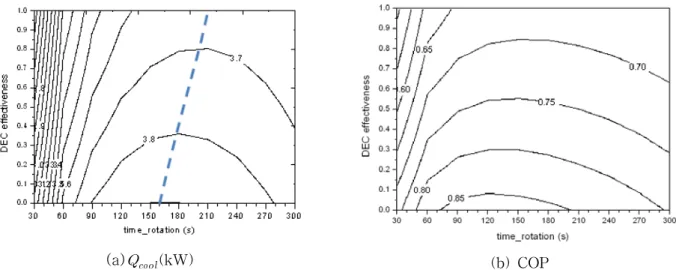
(7) (8) 여기서, ; 제습 쪽 공기유량(kg/s), ; 재생 쪽 공유량(kg/s), ; 제습로터 직경(m), ; 추기율 또는 외기공기의 도입율을 의 미하며, 본 연구에서는 0.3, ; 공기속도(m/s), ; 공기밀도( )은 1.106 전체 시스템의 COP는 다음과 같이 정의하였다. 4. 성능 해석 결과 및 분석 실내공기는 27°C, 50% RH, 실외공기는 35°C, 40% RH로 일정하게 유지하고, 현열교환기 유용 도가 0.8, 재생온도 60°C인 경우 제습로터 재생부 /제습부 면적비율이 0.7, 회전시간이 180s에(8) 대 하여 시스템의 냉방용량과 COP를 해석하였다. 첫 번째 해석의 목적은 DEC 유용도가 변화에 따라 냉방용량이 최대로 되는 제습로터 회전시간 을 정하고, 그 조건에서 재생부/제습부 면적비율 의 최적값을 찾기 위한 것이다. REC 유용도가 0.8, 0.4 일 때 DEC 유용도와 제습로터 회전시간 에 따른 냉방용량과 COP를 Fig. 2와 Fig. 3에 각 각 나타내었다. REC 유용도가 다른 2가지의 경우인 Fig.2(a), Fig.3(a)에서 DEC 유용도와 제습로터 회전시간 변화에 따라 DEC 유용도가 0에서 1.0의 값을 가 질 때 냉방용량이 최대(그림에서 점선으로 표시) 가 되는 회전시간이 160s-220s의 값을 가지고 그 변화의 폭이 크지 않으므로 따라서, REC 유용도 가 다르더러도 제습로터 회전시간을 180s로 일정 하다고 가정하였다. Fig. 4에서는 제습로터 회전시간 180s로 결정한 후 REC 유용도와 재생부/제습부 면적비율에 따 른 냉방용량과 COP을 Fig. 4에 나타내었다. Fig. 4(a)에서와 같이 제습로터 회전시간을 재생부/제 습부 면적비율이 REC 유용도가 0에서 1.0까지에 서 냉방용량의 최대값(그림에서 점선으로 표시)을 고려하면 보통의 REC 유용도 값인 0.5-0.7사이에 서는 일정 REC 값일 때 면적비 0.7일 때의 냉방 용량값과 최대냉방용량의 값이 크게 차이가 없으 므로 최적인 재생부/제습부 면적비를 0.7로 가정 하였다. 두 번째 해석은 선행된 해석에서 얻어진 최적 값인 제습로터 회전시간 180s와 재생부/제습부 면 적비 0.7일 때 본 연구에서 실행하는 제습냉방시 스템의 표준 조건에서 DEC 유용도와 REC 유용 도에 따른 전체 시스템의 냉방용량과 COP 관계(a) (kW)
(b) COP
Fig. 2 Contour of cooling capacity and COP of desiccant cooling system with REC effectiveness 0.8
(a) (kW)
(b) COP
Fig. 3 Contour of cooling capacity and COP of desiccant cooling system with REC effectiveness 0.4
(a) (kW)
(b) COP
Fig. 4 Contour of cooling capacity and COP of desiccant cooling system with rotation time 180s
(a) (kW) (b) COP
Fig. 5 Contour of cooling capacity and COP of desiccant cooling system with regeneration ratio 0.7 and rotation time 180s
를 고찰하였다. 그림 Fig. 5(a)에서 보듯이 REC 유용도가 0.7 이상의 경우 DEC 유용도 증가할 수 록 냉방용량이 감소한다. 그러나 REC 유용도가 0.7 이하의 경우는 DEC 유용도가 증가할수록 냉 방용량이 증가하게 된다. 여기서 DEC 유용도 0이 란 REC 만 설치된 경우를 의미한다. 즉 기존 REC 시스템에 어떠한 유용도를 갖는 DEC를 설 치하든 냉방용량이 증가한다고 할 수 있다. Fig. 5(b)에서 REC 유용도가 0.5 이상의 경우 DEC 유용도가 증가할수록 COP가 감소하고, REC 유용도가 0.5 이하의 경우 DEC 유용도가 증 가할수록 증가하게 된다. 그러나 COP는 에너지 효율면에서 중요하지만 제습냉방시스템의 경우 냉방용량이 커져야 효과 적이기 때문에 냉방용량이 더 중요한 성능인자가 된다. 따라서 기존 REC 유용도가 0.5-0.7인 경우 에는 DEC를 추가로 설치할 때 전체 시스템의 냉 방용량이 증가한다고 할 수 있다. 5. 결론 DEC 적용 제습냉방시스템의 냉방용량과 성능 을 시뮬레이션을 통하여 해석하여, 제습로터 재생 부/제습부 면적비율과 회전시간 최적화를 살펴보 고, 결과적으로 DEC 적용함의 효과를 파악하였 다. 1) 기준 외기조건(35°C, 상대습도 40%)에서 낮 은 재생온도 60°C인 제습냉방시스템의 제습로터 최적의 회전시간이 180s이다. 회전시간이 시스템 성능 변화에 미치는 영향이 상대적으로 크지 않 아 회전시간 선택(8)의 폭이 넓을 것으로 파악된 다. 2) 기준 외기조건(35°C, 상대습도 40%)에서 낮 은 재생온도가 60°C인 제습냉방시스템의 경우 제 습로터 회전시간이 180s를 가질 때 해당한 재생 부/제습부 면적비율이 0.7에서 결정이 되었다. 3) 본 논문에서 설정한 표준조건에서 설계된 제 습냉방시스템에서는 REC 유용도가 0.5-0.7인 경 우 DEC를 추가로 설치할 때 전체 시스템의 냉방 용량이 증가한다고 할 수 있다. 참고문현
1. Daou, K.,Wang, R.Z. and Xia, Z.Z., 2006, Desiccant cooling air conditioning : a review, Renewable and Sustainable Energy Reviews, Vol.10, pp. 55-77
2. Lee, JW., Lee, D.Y. and Kang, B. H., 2004, Cycle simulation of a desiccant cooling system with a regenerative evaporative cooler, Korean J. Air-Conditioning and Refrigeration Engineering, Vol.16, pp.566-573
3. Maclaine-Cross, I. L. and Banks, P. J., 1983, A general theory of wet surfase heat exchangers and its application to regenerative cooler, Journal of Heat Transfer, Vol. 103, pp. 579-585.
4. Lee, D. Y., Yoon, Y. I. and Lee, J. H., 2002 Optimal design and performance evalution of a finned regenerative evaporative cooler, Proc. 12th IHTC, pp. 261-266
5. Song, G. E. and Lee, D. Y., 2006, Development of a compact regenerative evapoartive cooler, Pros. 13th IHTC, HEX-30.
6. Young Soo Chang, Dae Young Lee, 2007, Effects of Individual Components on the
System Performance in a Desiccant Cooling System.
7. Jain, S. and Dhar, P. L., 1995, Evalution of solid desiccant-based evaporative cooling cycles for typical hot and humid climaties, Int. J. Refrig., Vol.18, pp. 287-296.
8. Chung, J. D., Lee, D. Y. and Yoon, S. M., 2007, Optimitization of the area ratio of regeneration to dehumidification and rotor speed on the condition of low regeneration