Unique determination of the hyperpolarizability
tensor ratio through depolarized
hyper-Rayleigh scattering under an external electric field
Jisoo Hwang, Byoungchoo Park, H. J. Chang, and J. W. WuDepartment of Physics, Ewha Womans University, Seoul 120-750, Korea Received July 30, 2001; revised manuscript received November 26, 2001
We have analyzed the depolarized hyper-Rayleigh scattering from a molecular system with partial macroscopic polar ordering. It is shown that the hyperpolarizability tensor ratio and the molecular dipole moment can be determined simultaneously by the measurement of depolarization as a function of external field strength. As an experimental example, we performed a quantitative analysis of the electric-field-dependent depolarized hyper-Rayleigh signal from a poly-␥-benzyl-L-glutamate solution, obtaining the dipole moment and the ratio of hyperpolarizability components as 4.0 D and 311/333⫽ ⫺0.81, respectively. © 2002 Optical Society of America
OCIS codes: 190.4160, 190.4710, 190.2620, 290.5870.
1. INTRODUCTION
In organic molecular systems, a macroscopic nonlinear optical response originates from molecular nonlinearities, and hyper-Rayleigh scattering (HRS) has been developed into a routine for measurement of microscopic molecular hyperpolarizabilities .1–3 Incoherent double-quantum light scattering from molecules whose orientation fluctu-ates gives rise to a HRS signal.4,5 In determining ex-perimentally, HRS is in strong contrast to electric-field-induced second-harmonic generation6–8(EFISHG) in that for HRS no external electric field is applied to the sample cell to break the macroscopic centrosymmetry. Hence it is possible to measure values of  of nonpolar and ionic species9–11as well as of traditional polar nonlinear optical molecules. Another advantage of HRS compared with EFISHG is the absence of contributions from the second hyperpolarizability ␥ to 2 harmonic signals. In EFISHG, both the first and the second hyperpolarizabili-ties, (⫺2; , ) and ␥ (⫺2; , , 0), contribute to the second-harmonic signal at 2 as a sum of ␥ ⫹ /5kT, and the precise determination of  requires a temperature-dependent measurement of harmonics sig-nals to discern each contribution as well as an indepen-dent measurement of the molecular dipole moment.12 Note that, in comparing the reported experimental values of , in EFISHG the projection of tensor components along the direction of the dipole moment具典 is experimen-tally measured, whereas in HRS the harmonic signal is proportional to the orientational average of the squares of a combination of all the tensor components present,具2典. An important feature of HRS in this respect is that a strongly depolarized second harmonic occurs, owing to the incoherent nature of double-quantum scattering and the third-rank tensorial property of ; from the
depolariza-tion measurement each tensor component can be deter-mined individually.13
In double-quantum scattering from molecules in an iso-tropic distribution there are five independent observables among six quadratics ofIJK(where I, J, and K are labo-ratory axes), namely, 具ZZZ2 典, 具XZZ2 典, 具XZZXYY典,
具ZZZZYY典, 具(ZYZ⫹ ZZY)2典, and具(XYZ⫹XZY)2典; in the experiment more than one depolarization ratio mea-surement is necessary for unique determination of each tensor component.4 For example, the intensities of 90° scattered harmonics with two orthogonal polarizations are measured for incident fundamentals with linear and circular polarization,3 or the incident polarization direc-tion is continually varied and the total scattered harmon-ics are measured.2 But the number of independent depo-larization ratios is determined by the molecular point-group symmetry, and sometimes it happens that the number of independent tensor components exceeds the maximum number of independent depolarization mea-surements, which is five. This is easily the case in the energy regime in which Kleinman symmetry is not valid. In other words, the depolarized HRS has limited value as a measurement technique in the determination of all the independent hyperpolarizability tensor components.
In this paper we introduce depolarized hyper-Rayleigh scattering under an external electric field (e-HRS) to in-crease the number of independent depolarization mea-surements, which enables us to uniquely determine the ratio of hyperpolarizability tensor components. e-HRS amounts to removing the degeneracy in具2典by imparting a partial polar ordering to the molecules whose orienta-tion is fluctuating through an external dc electric field. It is shown that this novel e-HRS process permits deter-mination of the sign and the magnitude of the
larizability tensor ratios as well as the molecular dipole moment, through measurement of the depolarization ra-tio as a funcra-tion of external electric-field strength. As an experimental example, the ratio of two dominant hyper-polarizability tensor components and the permanent di-pole moment of poly-␥-benzyl-L-glutamate (PBLG), one of the synthetic polypeptides,8 are determined through e-HRS, subsequently yielding the sign and the magnitude of each tensor component of.
2. THEORETICAL ANALYSIS
Let us look at how the intensities of harmonic scattered light will change on application of an external static elec-tric field. In a coarse-graining picture the HRS signal as
a second-order nonlinear optical process comes from local instantaneous noncentrosymmetric orientation of mol-ecules in a centrosymmetric macroscopic distribution. The local instantaneous deviation from centrosymmetry, in fact, results from a thermal fluctuation of the molecu-lar orientations. When an external static field is applied to the orientationally fluctuating molecules, a certain amount of polar ordering will take place; the order pa-rameter is determined from minimization of the Helm-holtz free energy of the system at a temperature T. Even in the presence of the aligning static electric field, sto-chastic thermal fluctuations still exist, giving rise to a lo-cal noncentrosymmetry to generate harmonic double-quantum scatterings, i.e., the e-HRS signal. At a first glance, e-HRS seems merely another extension of coher-Table 1. Six Quadratics ofIJK (I, J, and K; Laboratory Axes) Expressed in Terms of Coefficients
of Quadratic Functions of in Molecular Axes, p, q, r, All Differenta
␣⫽
兺
p ppp2 1⫽兺
p,q ppppqq 2⫽兺
p,q ppp共qpq⫹qqp兲 3⫽兺
p,q pqq2 A1 具⌽I p 6典 f() 2具⌽I4p⌽I2q典f() 2具⌽4Ip⌽I2q典f() 具⌽I4p⌽I2q典f() A2 具⌽I p 2⌽ Jp 4典 f() 2具⌽Ip 2⌽ Jp 2⌽ Jq 2典 f() 2具⌽Ip⌽Iq⌽Jp 3⌽ Jq典f() 具⌽Ip 2⌽ Jq 4典 f() A3 具⌽I p 2⌽ Jp 2⌽ Kp 2 典 f() 2具⌽I2p⌽J2p⌽2Kq典f() 2具⌽I2p⌽Jp⌽Jq⌽Kp⌽Kq典f() 具⌽2Ip⌽J2q⌽J2r典f() A4 8具⌽I p 2⌽ Jp 4典 f() 具⌽I2p⌽J2p⌽2Jq典f() 具⌽Ip⌽Iq⌽Jp 3⌽ Jq典f() 具⌽Ip⌽Iq⌽Jp 3⌽ Jq典f() ⫹具⌽I2p⌽J4q典f() ⫹具⌽I2p⌽J2p⌽J2q典f() A5 4具⌽I p 2⌽ Jp 4典 f() 8具⌽Ip⌽Iq⌽Jp 3 ⌽ Jq典f() 4具⌽Ip⌽Iq⌽Jp 3⌽ Jq典f() 4具⌽Ip 2⌽ Jp 2⌽ Jq 2 典 f() ⫹4具⌽I2p⌽J2p⌽J2q典f() A6 4具⌽I p 2⌽ Jp 2⌽ Kp 2 典 f() 8具⌽I2p⌽Jp⌽Jq⌽Kp⌽Kq典f() 8具⌽Ip 2⌽ Jp⌽Jq⌽Kp⌽Kq典f() 4具⌽Ip 2⌽ Jp 2⌽ Kq 2 典 f() 4⫽兺
p,q pqq共qpq⫹qqp兲 5⫽兺
p,q 共qpq⫹qqp兲2 ␥1⫽兺
p,q,r pqqprr ␥2⫽兺
p,q,r 共qpq⫹qqp兲共rpr⫹rrp兲 A1 2具⌽I p 4⌽ Iq 2典 f() 具⌽Ip 4⌽ Iq 2典 f() 具⌽Ip 2⌽ Iq 2⌽ Ir 2典 f() 具⌽Ip 2⌽ Iq 2⌽ Ir 2典 f() A2 2具⌽Ip⌽Iq⌽J3p⌽Jq典f() 具⌽I2p⌽Jp⌽Jq⌽Kp⌽Kq典f() 具⌽I2p⌽2Jq⌽J2r典f() 具⌽Ip⌽Iq⌽Jp⌽Jq⌽J2r典f() A3 2具⌽I p 2⌽ Jp⌽Jq⌽Kp⌽Kq典f() 具⌽Ip 2⌽ Jp⌽Jq⌽Kp⌽Kq典f() 具⌽Ip 2⌽ Jq 2⌽ Kr 2典 f() 具⌽Ip⌽Iq⌽Jp⌽Jr⌽Kq⌽Kr典f() A4 具⌽Ip⌽Iq⌽J3p⌽Jq典f() 具⌽Ip⌽Iq⌽J3p⌽Jq典f() 具⌽I2p⌽J2q⌽J2r典f() 具⌽Ip⌽Iq⌽Jp⌽Jq⌽J2r典f() A5 4具⌽Ip⌽Iq⌽Jp 3 ⌽ Jq典f() 2具⌽Ip⌽Iq⌽Jp 3 ⌽ Jq典f() 4具⌽Ip⌽Iq⌽Jp⌽Jq⌽Jr 2典 f() 具⌽Ip 2⌽ Jq 2⌽ Jr 2典 f() ⫹4具⌽I2p⌽J2p⌽2Jq典f() ⫹具⌽I2p⌽4Jq典f() ⫹3具⌽Ip⌽Iq⌽Jp⌽Jq⌽J2r典f() ⫹具⌽I2p⌽J2p⌽J2q典f() A6 8具⌽I p 2⌽ Jp⌽Jq⌽Kp⌽Kq典f() 2具⌽Ip 2⌽ Jp 2⌽ Kq 2 典 f() 4具⌽Ip 2⌽ Jq⌽Jr⌽Kq⌽Kr典f() 2具⌽Ip 2⌽ Jq⌽Jr⌽Kq⌽Kr典f() ⫹2具⌽I2p⌽Jp⌽Jq⌽Kp⌽Kq典f() ⫹2具⌽Ip⌽Iq⌽Jp⌽Jr⌽Kq⌽Kr典f() ␥3⫽兺
p,q,r pqq共rpr⫹rrp兲 ␦1⫽兺
p,q,r 共pqr⫹prq兲2 ␦2⫽兺
p,q,r 共qpq⫹prp兲共qpr⫹qrp兲 A1 2具⌽I p 2⌽ Iq 2⌽ Ir 2典 f() 12具⌽I2p⌽I2q⌽I2r典f() 具⌽I2p⌽I2q⌽I2r典f() A2 2具⌽Ip⌽Iq⌽Jp⌽Jq⌽J2r典f() 12具⌽2Ip⌽J2q⌽J2r典f() 具⌽Ip⌽Iq⌽Jp⌽Jq⌽Jr 2典 f() A3 2具⌽I p 2⌽ Jq⌽Jr⌽Kq⌽Kr典f() 12具⌽Ip 2⌽ Jq⌽Jr⌽Kq⌽Kr典f() 具⌽Ip 2⌽ Jq⌽Jr⌽Kq⌽Kr典f() A4 具⌽I p 2⌽ Jq 2⌽ Jr 2典 f() 12具⌽Ip⌽Iq⌽Jp⌽Jq⌽J2r典f() 具⌽Ip⌽Iq⌽Jp⌽Jq⌽J2r典f() ⫹具⌽Ip⌽Iq⌽Jp⌽Jq⌽Jr 2典 f() A5 8具⌽Ip⌽Iq⌽Jp⌽Jq⌽Jr 2典 f() 具⌽Ip 2⌽ Jq 2⌽ Jr 2典 f() 具⌽Ip 2⌽ Jq 2⌽ Jr 2典 f() ⫹具⌽Ip⌽Iq⌽Jp⌽Jq⌽J2r典f() ⫹3具⌽Ip⌽Iq⌽Jp⌽Jq⌽J2r典f() A6 8具⌽Ip⌽Iq⌽Jp⌽Jr⌽Kq⌽Kr典f() 具⌽I2p⌽2Jq⌽K2r典f() 2具⌽I2p⌽Jq⌽Jr⌽Kq⌽Kr典f() ⫹2具⌽Ip⌽Iq⌽Jp⌽Jr⌽Kq⌽Kr典f() aA1⫽具 ZZZ 2 典ent second-harmonic generation (SHG), similar to EFISHG. But e-HRS is fundamentally different from EFISHG in that it is still an incoherent process measured at the 90° scattering angle, with no necessity for phase matching between free and bound 2 waves. The e-HRS intensity, then, will be related to the rotational invariants of the orientational average of products of the directional cosines for the given macroscopic polar ordering intro-duced into the molecular system. This implies that on application of a static electric field there will be a change in the intensities of double-quantum scattered light with polarization parallel and perpendicular to the incident po-larization, IZ2and IX2, respectively, with a constant sum
IZ2⫹ IX2 that is independent of the electric-field strength. For a molecule with the single nonvanishing component333it is easy to see that a partial alignment of polar molecules along the Z direction will at once in-crease IZ2and decrease IX2, resulting in an overall reduc-tion of the depolarizareduc-tion ratio IX2/IZ2to a value less than the isotropic value of 1/5. However, when off-diagonal
tensor components in addition to 333are present in the molecule, we expect that the hyperpolarizability tensor components that are parallel and perpendicular to the permanent dipole moment will contribute in a different way to the e-HRS signal. The resultant depolarization ratio, in general, will be a complicated function of the electric-field strength, containing information on the structure of hyperpolarizability tensor components.
The orientational correlation of the molecular dipoles that are responsible for the HRS signal is described through the product of molecular hyperpolarizabilities in laboratory coordinates:
具IJKLMN典⫽具IpJqKrLsMtNu典pqrstu, (1) whereIpare the direction cosines that relate laboratory axes (IJK, LMN) to molecular axes ( pqr, stu) and the angle brackets denote the orientational average. The ro-tational invariants of the product of the directional cosine are well tabulated in the literature for the case of a ran-dom orientational distribution.4,5 In the presence of Table 2. Averaged Products of Six Direction Cosinesain the Presence of Polar Ordering, xÆ(EÕkT)
具I6p典f() 1 7i0共x兲 ⫹ 10 21i2共x兲 ⫹ 24 77i4共x兲 ⫹ 16 231i6共x兲 具Ip 4 Iq 2典 f() 1 35i0共x兲 ⫹ 1 21i2共x兲 ⫺ 16 385i4共x兲 ⫺ 8 231i6共x兲 具I2pI2qI2r典f() 1 105i0共x兲 ⫺ 1 55i4共x兲 ⫹ 2 231i6共x兲 具I2pJ4p典f() 1 35i0共x兲 ⫺ 3 55i4共x兲 ⫹ 2 77i6共x兲 具I2pJ4q典f() 3 35i0共x兲 ⫹ 3 14i2共x兲 ⫹ 201 3080i4共x兲 ⫹ 3 308i6共x兲 具I2pJ2pJ2q典f() 2 105i0共x兲 ⫹ 1 42i2共x兲 ⫺ 23 770i4共x兲 ⫺ 1 77i6共x兲 具I2pJ2qJ2r典f() 1 35i0共x兲 ⫹ 1 14i2共x兲 ⫹ 67 3080i4共x兲 ⫹ 1 308i6共x兲 具IpIq3JpJq典f() ⫺ 1 70i0共x兲 ⫹ 3 770i4共x兲 ⫺ 1 77i6共x兲 具IpIqJpJqJ2r典f() ⫺ 1 210i0共x兲 ⫺ 1 168i2共x兲 ⫹ 23 3080i4共x兲 ⫹ 1 77i6共x兲 具I2pJ2pK2p典f() 1 105i0共x兲 ⫺ 1 385i4共x兲 ⫹ 2 231i6共x兲 具I2pJ2pK2q典f() 1 35i0共x兲 ⫹ 1 42i2共x兲 ⫺ 37 770i4共x兲 ⫺ 1 231i6共x兲 具Ip 2 Jq 2 Kr 2典 f() 8 105i0共x兲 ⫹ 9 42i2共x兲 ⫹ 529 6160i4共x兲 ⫹ 1 231i6共x兲 具I2pJpJqKpKq典f() ⫺ 1 210i0共x兲 ⫹ 1 55i4共x兲 ⫺ 1 231i6共x兲 具I2pJqJrKqKr典f() ⫺ 1 42i0共x兲 ⫺ 1 14i2共x兲 ⫺ 19 616i4共x兲 ⫹ 4 231i6共x兲 具IpIqJpJrKqKr典f() 1 105i0共x兲 ⫹ 1 168i2共x兲 ⫺ 51 3080i4共x兲 ⫹ 1 231i6共x兲 a
an external electric field, the dipolar interaction
U⫽ ⫺E cos changes the orientational distribution
from the isotropic f0⫽ 1/4 to the Maxwell– Boltzmannian f() ⬀ exp(⫺U/kT) ⫽ exp(x cos ), where is the angle between the molecular dipole moment and the electric field and x ⬅E/kT.14 With the anisotropic orientational distribution f(), the double-quantum scat-tered light intensities are related to 具ZZZ2 典f() and
具XZZ 2 典
f(). For example,具ZZZ 2 典
f()is expressed in terms of three kinds of rotational invariant of the products of the directional cosines:
具ZZZ 2 典 f共兲⫽
兺
p Ap具Zp 6 典 f共兲⫹兺
p,q Bpq具Zp 4 Zq 2 典 f共兲 ⫹兺
p,q,r Cpqr具Z2p2ZqZ2r典f共兲, (2) where Ap, Bpq, and Cpqrare sums of quadratic functions of.4 Similar expressions can be obtained for具XZZ2 典f(),具␥ZZZZ2 典f(), and具␥XZZZ2 典f().
In the presence of static electric field E0along the Z di-rection, 2 harmonic signals are generated through the processes␥ (⫺2; , , 0) as well as (⫺2; , ), and the double-quantum scattered light intensity with polar-ization along the X and Z directions in e-HRS will be
Ii2⫽具iZZ2 典f()⫹具␥iZZZ2 典f()E02, with i ⫽ X, Z for a
Z-polarized incident fundamental. Let us make an order-of-magnitude estimate of relevant quantities to en-able us to compare e-HRS with EFISHG. For typical val-ues  ⬇ 10⫺30 and ␥ ⬇ 10⫺36esu of nonlinear organic molecules we get /5kT兩T⫽300 K⬇ 2.4 ⫻ 10⫺35 and ␥E0兩E0⫽500 V/cm⬇ 1.7 ⫻ 10
⫺36esu. It is important to note that ␥ is only 1 order of magnitude smaller than /5kT and hence is an approximation required for ig-noring the contribution of␥ in EFISHG, whereas ␥E0is 6 orders of magnitude smaller than  for e-HRS. These considerations lead to the conclusion that there is no es-sential contribution from␥ (⫺2; , , 0) to the e-HRS signal as a second-order nonlinear (2) process. Hence the depolarization ratio DZZZX(e-HRS) can be introduced in the same way as defined for HRS3:
DZZZX共e-HRS兲 ⫽ IX2 IZ2 ⫽ 具XZZ 2 典 f共兲 具ZZZ 2 典 f共兲 . (3)
For a given molecular system the expressions具XZZ2 典f() and 具ZZZ2 典f() can be obtained from the polar-order-imparted orientational average of the products of the mo-lecular hyperpolarizabilities; the nonvanishing compo-nents are determined from molecular point-group symmetry. Details of the relationship between具2典
f()in laboratory coordinates and the molecular hyperpolariz-abilities are listed in Tables 1 and 2.
As a concrete example of the above relationship to the experimental measurement reported here, we consider a cylindrically shaped molecule (C⬁v symmetry) that pos-sesses seven nonvanishing hyperpolarizability tensors, namely,333, 311⫽322, 131⫽232, and113⫽ 223, when the Kleinman symmetry is not assumed. From Tables 1 and 2, the relevant terms for a C⬁v symmetry molecule are expressed explicitly in terms of the spherical modified Bessel functions in(x):
具XZZ2 典f共兲⫽ 3332
再
冋
1 35i0共x兲 ⫺ 3 55i4共x兲 ⫹ 2 77i6共x兲册
⫹ 4冋
2 105i0共x兲 ⫹ 1 42i2共x兲 ⫺ 23 770i4共x兲 ⫺ 1 77i6共x兲册冉
311 333冊
⫹ 4冋
⫺1 70i0共x兲 ⫹ 3 770i4共x兲 ⫺ 1 77i6共x兲册冉
131⫹ 113 333冊
⫹ 4冋
1 70i0共x兲 ⫹ 1 56i2共x兲 ⫺ 69 3080i4共x兲册
⫻冉
131113 3332冊
⫹ 4冋
⫺ 2 105i0共x兲 ⫺ 1 168i2共x兲 ⫹ 1 88i4共x兲册
冉
311131⫹311113 333 2冊
⫹ 2冋
4 35i0共x兲 ⫹ 2 7i2共x兲 ⫹ 67 770i4共x兲 ⫹ 1 77i6共x兲册冉
311 333冊
2 ⫹ 2冋
1 70i0共x兲 ⫹ 1 56i2共x兲 ⫺ 69 3080i4共x兲册
⫻冋冉
131 333冊
2 ⫹冉
113 333冊
2册
冎
, 具ZZZ2 典f共兲⫽ 3332再冋
1 7i0共x兲 ⫹ 10 21i2共x兲 ⫹ 24 77i4共x兲 ⫹ 16 231i6共x兲册
⫹ 4冋
1 35i0共x兲 ⫹ 1 21i2共x兲 ⫺ 16 385i4共x兲 ⫺ 8 231i6共x兲册
⫻冉
311⫹ 131⫹113 333冊
⫹ 2冋
4 105i0共x兲 ⫹ 1 21i2共x兲 ⫺ 23 385i4共x兲 ⫺ 2 77i6共x兲册
⫻冉
311⫹ 131⫹113 333冊
2冎
. (4)From Eqs. (3) and (4) we find that permanent dipole moment plus three sets of hyperpolarizability ratios, i.e., 113/333, 131/333, and 311/333, can be deter-mined experimentally from the four macroscopic depolar-ization measurements of DZZZX(e-HRS) with different ex-ternal electric-field strengths applied. It is easy to see that for a given molecular symmetry group all the nonva-nishing hyperpolarizability tensor ratios can be obtained in principle because one can increase the number of
inde-pendent macroscopic quadratics ofIJK by changing the magnitude of the external field.
3. EXPERIMENT AND RESULT
Now we turn to experimental measurement. We employ PBLG (molecular weight⬃300,000; degree of polymeriza-tion, Dp⬃ 1300; from Sigma Chemicals) as the nonlinear optical molecule with which to study e-HRS, as it is known to possess ferroelectric-phase characteristics with
C⬁vmolecular point-group symmetry.15 PBLG is a well-known second-order nonlinear optical molecular system that shows virtually complete field-induced polar orienta-tion in ␣-helix-forming solvents at modest electric-field strengths.8,16 Also, the hyperpolarizabilities of PBLG measured by EFISHG are already available from the literature,8,15and we can make a direct comparison of val-ues measured by e-HRS and EFISHG techniqval-ues.
We prepared a solution with a concentration of 4 ⫻ 10⫺2 g/cm3in ethylene dichloride; after mixing for 24 h, the solution was contained in a long glass cell (7.5 cm ⫻ 2.5 cm ⫻ 1.0 cm), with indium tin oxide electroded glasses at the top and bottom to apply an external static electric field. The distance between the indium tin oxide electrodes was 1 cm, and the dc voltage applied between two indium tin oxide electrodes inside the sample cell pro-duced an electric field E0 of as much as 500 V/cm (Z di-rection). The experimental optical setup is the same as that for the usual HRS measurement. A Q-switched Nd:YAG laser operating at 1064 nm with a pulse width of 10 ns and a repetition rate of 10 Hz was employed. A combination of a half-wave plate and a linear polarizer varied the fundamental light intensity, and, after an IR pass filter, a lens with f⫽ 17.5 cm focused the laser beam propagating in the X direction into the sample cell (Fig. 1). At a 90° scattering angle (Y direction), 2 harmonics scattered from the sample solution were collected with an
f ⫽ 20 cm lens and fed into a photomultiplier tube after a
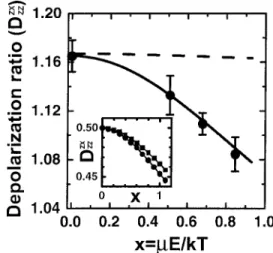
532-nm spike filter and a linear analyzer. With the inci-dent polarization fixed along the Z direction, the scattered harmonic intensities with polarization parallel IZ2 and perpendicular IX2to the direction of incident polarization were measured. Both IZ2and IX2had a quadratic depen-dence on the fundamental intensity, ensuring that the harmonics were from a second-order nonlinear process. Figure 2 shows the measured depolarization ratio (filled circles) as a function of external field strength. At the
zero external field, the depolarization ratio was⬃1.17, a rather large value compared to that of 0.2 for one-dimensional shaped molecules, which implies that in PBLG the off-diagonal tensor components are as impor-tant as diagonal component333. The data points DZZZX for E0⫽ 300, 400, 500 V/cm are also shown in Fig. 2.
Now, from Eqs. (3) and (4), we can obtain the values of the permanent dipole moment and the hyperpolarizabil-ity ratios. The least-squares fit provided the fit values of ⬃ 5200 D at T ⫽ 300 K with the literature value of lo-cal field factor L⬃ 4.7 of the solvent ethylene
dichloride,17 311/333⬃ ⫺0.81, 131/333⬃ 0, and 113/333⬃ 0. The maximum allowed values 131/333 and 113/333within the error bars of the experimental data points are found to be less than 10% of the ratio 311/333, which means that311is dominant among the off-diagonal tensor components and that other compo-nents are negligible. From the fit value of the dipole mo-ment we can deduce the dipole momo-ment of a monomeric unit of PBLG as/Dp⬃ 4.0 D, in a good agreement with the reported literature value of⬃4 D.15
4. DISCUSSION
To assess the versatility of e-HRS measurement we per-formed several analyses to determine how the relation-ship between the macroscopic depolarization ratio mea-surements and the microscopic hyperpolizability ratios behaves in various conditions. First, we assumed that the Kleinman symmetry holds among the off-diagonal components that appear in Eqs. (4), which means that 311⫽ 131⫽113, and attempted a least-squares fit for the ratio of tensor components,311/333, which resulted in the complex numbers ⫺0.36 ⫾ i0.31 from the mea-sured DZZZX of 1.17 at zero external field. Furthermore, the macroscopic depolarization ratio was found to in-crease as the external electric-field strength, contrary to the experimental observation. Second, we looked for an-other value of the ratio311/333, in addition to the value ⬃⫺0.81 obtained above, that could be obtained from the traditional HRS depolarization measurement, meaning Fig. 1. Laboratory coordinates for incident fundamental and
scattered harmonics. An external electric field was applied to the sample cell along the Z direction.
Fig. 2. Measured depolarization ratio DZZZXas a function of ex-ternal electric field strength. Solid and dashed curves,311/333 ⬃⫺0.81 and311/333⬃⫹1.22, respectively. Inset, example of the lift of degeneracy in DZZZX.
that no external static electric field was applied. For simplicity, we assumed that there are only two free pa-rameters, and 311/333, with 131⫽113⫽ 0 in Eqs. (4). The resultant value was311/333⬃ ⫹1.22, a posi-tive value, in contrast to the value⬃⫺0.81. To see how e-HRS measurement discriminates two tensor ratios, we attempted a least-squares fit of the experimental data points to dipole moment as a free parameter with 311/333⬃ ⫹1.22 fixed, and we could not get the appro-priate value for the dipole moment. When the literature value of the dipole moment, instead, was adopted, the change in the depolarization ratio with changes in the electric-field strength was not at all pronounced, as shown by the dashed curve in Fig. 2, which deviates sig-nificantly from the experimental data points. Third, as a simple example illustrating the ambiguity in determining tensor ratios through HRS, we considered a molecular system exhibiting DZZZX⫽ 0.5 when there was no external static field, to which correspond two values, 0.43 and ⫺0.53, of tensor ratio 311/333, for which both magni-tude and sign are different, when we again assumed that 131⫽ 113⫽ 0. As we pointed out above, the ambiguity in the tensor ratio comes from the fact that the intensity of harmonic scattered light is proportional to具2典, not to 具典, in HRS. But the application of a static electric field lifts the degeneracy in DZZZX, as depicted in the inset of Fig. 2 (filled squares, 0.43; filled circles, ⫺0.53), which shows the main advantage of using e-HRS measurement in determining the sign and relative value of 311/333. This situation is in contrast to that of EFISHG measure-ment, in which one measures the total sum of hyperpolar-izability tensor components projected in the direction of the dipole moment without being able to distinguish the diagonal from the off-diagonal components.
We compare our result with other literature values of. Park et al.18 reported SHG measurement of poly( ␥-benzyl-L-glutamate-co-␥-methyl-L-glutamate) (PBMLG) with a Dp of 800; this is one of the lyotropic cholesteric liquid crystals of poly(L-glutamate). They investigated the ferroelectric liquid-crystalline phase of PBMLG by measuring the polarization behavior of SHG. With the s-and p-polarization fundamental inputs, only p-polarized second harmonics are observed in the Maker’s fringe mea-surement, which is characteristic of C⬁vsymmetry. In a liquid-crystalline system with C⬁vsymmetry, macroscopic second-order nonlinear optical susceptibility (2) is re-lated to the molecular hyperpolarizabilities through the order parameters具Pi(cos)典(i⫽ 1, 2, 3) (Ref. 19):
ZZZ共2兲 ⫽ 1 5N
冋冉
3⫺ 2 311 333冊
具P1共cos兲典⫹ 2冉
1 ⫺ 311 333冊
⫻具P3共cos兲典册
333, ZXX共2兲 ⫽ 1 5N冋冉
1 ⫹ 4 311 333冊
具P1共cos兲典⫺冉
1 ⫺ 311 333冊
⫻具P3共cos兲典册
333. (5)They reported that ZZZ(2) ⫽ 2.1⫻10⫺10 and ZXX(2) ⫽ ⫺2.4 ⫻ 10⫺10esu. By introducing a generalized mean-field potential we calculated the order parameters
具Pi(cos)典 (i⫽ 1, 2, 3) with 333⫽ ⫹3.52 ⫻ 10⫺28esu, which corresponds to 333(monomer)⫽ ⫹4.4 ⫻ 10⫺31esu.19 It is worthwhile, based on this value and on the hyperpolarizability tensor ratio that we obtained, to estimate the magnitude and the sign of  that would have been measured by EFISHG for the PBLG solution. That is, EFISHG(monomer)⫽
333⫹ 2311⫽ 关1 ⫹ 2(311/333)兴333⫽ ⫺2.7 ⫻ 10⫺31esu. In Ref. 8, Le-vine and Bethea report an EFISHG value of  for PBLG in solution. With Dp of 2500, they obtained  ⫽ ⫹5 ⫻ 10⫺28 ⫾ 50% esu, corresponding to the monomeric valueEFISHG(monomer)⫽ ⫹2 ⫻ 10⫺31⫾ 50 % esu. The two values are comparable in magnitude.
5. CONCLUSIONS
In conclusion, we have used depolarized hyper-Rayleigh scattering under an external electric field to determine the hyperpolarizability tensor ratio. We demonstrated that for polar nonlinear optical molecules the absolute values including signs of the hyperpolarizability tensor ratio can be determined through depolarized hyper-Rayleigh scattering under an external field, even in the resonance regime where Kleinman symmetry is not valid. It should be noted that the e-HRS measurement allows one to discriminate between two possible hyperpolariz-ability ratios, including signs, experimentally in a unique way. As a specific example of this kind of measurement technique, we measured the electric-field-dependent de-polarized hyper-Rayleigh signal from a poly-␥-benzyl- L-glutamate solution to obtain the dipole moment and the ratio of hyperpolarizability components as 4.0 D and 311/333⫽ ⫺0.81, respectively.
ACKNOWLEDGMENTS
This research is supported by the Brain Korea 21 project and by Korea Research Foundation grant KRF-2001-015-DP0175.
J. W. Wu’s e-mail address is [email protected].
REFERENCES
1. K. Clays and A. Persoons, ‘‘Hyper-Rayleigh scattering in so-lution,’’ Phys. Rev. Lett. 66, 2980–2983 (1991).
2. G. J. T. Heesink, A. G. Ruiter, N. F. van Hulst, and B. Boel-ger, ‘‘Determination of hyperpolarizability tensor compo-nents by depolarized hyper Rayleigh scattering,’’ Phys. Rev. Lett. 71, 999–1002 (1993).
3. T. Verbiest, M. Kauranen, and A. Persoon, ‘‘Parametric light scattering,’’ J. Chem. Phys. 101, 1745–1747 (1994). 4. R. Bersohn, Y.-H. Pao, and H. L. Frisch, ‘‘Double-quantum
light scattering by molecules,’’ J. Chem. Phys. 45, 3184– 3198 (1966).
5. S. J. Cyvin, J. E. Rauch, and J. C. Decius, ‘‘Theory of hyper-Raman effects (nonlinear inelastic light scattering): selec-tion rules and depolarizaselec-tion ratios for the second-order po-larizability,’’ J. Chem. Phys. 43, 4083–4095 (1965). 6. B. F. Levine and C. G. Bethea, ‘‘Second and third order
hy-perpolarizabilities of organic molecules,’’ J. Chem. Phys. 63, 2666–2682 (1975).
7. M. Joffre, D. Yaron, and R. J. Silbey, ‘‘Second order optical nonlinearity in octupolar aromatic systems,’’ J. Chem. Phys. 97, 5607–5615 (1992).
8. B. F. Levine and C. G. Bethea, ‘‘Second order hyperpolariz-ability of a polypeptide ␣-helix: poly-␥-benzyl-L -glutamate,’’ J. Chem. Phys. 65, 1989–1993 (1976). 9. J. Zyss, ‘‘Octupolar organic systems in quadratic nonlinear
optics: molecules and materials,’’ Nonlinear Opt. 1, 3–18 (1991).
10. T. Verbiest, K. Clays, A. Persoons, F. Meyers, and J. L. Breda, ‘‘Determination of the hyperpolarizability of an octo-polar molecular ion by hyper-Rayleigh scattering,’’ Opt. Lett. 18, 525–527 (1993).
11. W. M. Laidlaw, R. G. Denning, T. Verbiest, E. Chauchard, and A. Persoons, ‘‘Large second-order optical polarizabil-ities in mixed-valency metal complexes,’’ Nature 363, 58–60 (1993).
12. K. D. Singer, J. E. Sohn, L. A. King, H. M. Gordon, H. E. Katz, and C. W. Dirk, ‘‘Second-order nonlinear-optical prop-erties of donor- and acceptor-substituted aromatic com-pounds,’’ J. Opt. Soc. Am. B 6, 1339–1350 (1989).
13. R. W. Terhune, P. D. Maker, and C. M. Savage,
‘‘Measure-ments of nonlinear light scattering,’’ Phys. Rev. Lett. 14, 681–684 (1965).
14. J. W. Wu, ‘‘Birefringent and electro-optic effects in poled polymer films: steady-state and transient properties,’’ J. Opt. Soc. Am. B 8, 142–152 (1991).
15. J. Watanabe, Y. Hirose, M. Tokita, T. Watanabe, and S. Miyata, ‘‘Polar structure in polypeptide cholesteric liquid crystals evidenced from observation of second-harmonic generation due to the helicoidal cavity effect,’’ Macromol-ecules 31, 5937–5939 (1998).
16. D. S. Chemla and J. Zyss, Nonlinear Optical Properties of Organic Molecules and Crystals (Academic, Orlando, Fla., 1987).
17. D. R. Lide, Handbook of Organic Solvents (CRC Press, New York, 1995).
18. B. Park, Y. Kinoshita, H. Takezoe, and J. Watanabe, ‘‘Fer-roelectricity in the lyotropic cholesteric phase of poly L-glutamate,’’ Jpn. J. Appl. Phys. 37, L136–L138 (1998). 19. B. Park, J. W. Wu, and H. Takezoe, ‘‘Generalized mean-field
potential description for ferroelectric ordering in nematic liquid crystals,’’ Phys. Rev. E 63, 21707-1–21707-7 (2001).