Analgesic efficacy of caudal dexamethasone
combined with ropivacaine in children
undergoing orchiopexy
by
Eun Mi Kim
Major in Medicine
Department of Medical Sciences
The Graduate School, Ajou University
Analgesic efficacy of caudal dexamethasone
combined with ropivacaine in children
undergoing orchiopexy
by
Eun Mi Kim
A Dissertation Submitted to The Graduate School of
Ajou University in Partial Fulfillment of the Requirements
for the Degree of
Ph. D. in medicine
Supervised by
Bong Ki Moon, M.D., Ph.D.
Major in Medicine
Department of Medical Sciences
The Graduate School, Ajou University
This certifies that the dissertation
of Eun Mi Kim is approved.
SUPERVISORY COMMITTEE
Sang Kee Min
Bong Ki Moon
Jong Yeop Kim
Yun Jeong Chae
Mi Hwa Chung
The Graduate School, Ajou University
December 19th, 2014
ACKNOWLEDGEMENTS
My most sincere thanks go to Professor Bong Ki Moon, whose
perspective criticism, kind encouragement, and willing assistance helped
me bring the project to a successful conclusion.
I also wish to express my gratitude especially to Professor Jae Hoon Lee
who gave me an opportunity and guided me from design of project to
completion of thesis in full.
I would like to thank Professors Sang Kee Min, Jong Yeop Kim,
Yun
Jeong Chae, and Mi Hwa Chung for their support and guidance.
I would like to give my special thanks to my husband, Myoung Kwan
Kwak, and my two daughters, Yeeun and Yena, for their love and
support.
Especially, I would like to thank my parents for everything they have
done for me and for helping me get to where I am today.
i
- ABSTRACT -
Analgesic efficacy of caudal dexamethasone combined with
ropivacaine in children undergoing orchiopexy
Introduction: Epidural administration of dexamethasone might reduce postoperative pain in adults. We evaluated whether a caudal block of 0.1 mg/kg dexamethasone combined with ropivacaine improves analgesic efficacy in children undergoing day-case orchiopexy.
Methods: This randomized, double-blind study included 80 children aged 6 months to 5 yr who underwent day-case, unilateral orchiopexy. Patients received either 1.5 ml/kg of 0.15% ropivacaine (Group C) or 1.5 ml/kg of 0.15% ropivacaine in which dexamethasone of 0.1mg/kg was mixed (Group D) for caudal analgesia. Postoperative pain scores, rescue analgesic consumption, and side-effects were evaluated 48 h after operation.
Results: Postoperative pain scores at 6 and 24 h post-surgery were significantly lower in Group D than in Group C. Furthermore, the number of subjects who remained pain free up to 48 h after operation was significantly greater in Group D [19 of 38 (50%)] than in Group C [4 of 37 (10.8%); P<0.001]. The number of subjects who received oral analgesic was significantly lower in Group D [11 of 38 (28.9%)] than in Group C [20 of 37 (54.1%); P=0.027]. Time to first oral analgesic administration after surgery was also significantly longer in Group D than in Group C (P=0.014). Adverse events after surgery including vomiting, fever, wound infection, and wound dehiscence were comparable between the two groups.
Conclusion: The addition of dexamethasone 0.1 mg/kg to ropivacaine for caudal block can significantly improve analgesic efficacy in children undergoing orchiopexy.
Keyword: Caudal anaesthesia, Children, Dexamethasone, Orchiopexy, Postoperative analgesia
iii
TABLE OF CONTENTS
ABSTRACT ··· ⅰ TABLE OF CONTENTS ··· ⅲ LIST OF TABLE ··· ⅳ LIST OF FIGURE ··· v Ⅰ. INTRODUCTION··· 1Ⅱ. PATIENTS AND METHODS ··· 3
Ⅲ. RESULTS ··· 7
Ⅳ. DISCUSSION ··· 15
Ⅴ. CONCLUSION ··· 21
REFERENCES ··· 22
LIST OF TABLE
Table 1. : Patient characteristics and intraoperative data ··· 9
Table 2. : Immediate postoperative CHEOPS and FLACC scores ··· 10
Table 3. : Consumption of oral analgesics at postoperative 24 h ··· 13
v
LIST OF FIGURE
Figure 1. : Pain scores during the 48 h postoperative period ··· 11 Figure 2. : Kaplan–Meier curve for time to first oral analgesic administration ··· 12
I. INTRODUCTION
Orchiopexy is commonly performed in children with cryptorchidism, and is associated with postoperative pain lasting several days (Ho and Keneally, 2000; Stewart et al., 2012). A recent report described pain after day-case orchiopexy in detail (Stewart et al., 2012). According to this report, children undergoing orchiopexy suffered moderate-to-severe pain at home in the first postoperative day requiring analgesics for an additional 3 days after surgery (Ho and Keneally, 2000; Stewart et al., 2012). Therefore, the appropriate management of postoperative pain in children undergoing orchiopexy needs to be further evaluated with a focus on better pain control.
Caudal block is one of the most commonly used regional analgesic techniques in paediatric urogenital surgery. To maximize the efficacy of caudal analgesia with local anaesthetics, various adjuncts have been investigated such as opioids, neostigmine, and α2-agonists (Ansermino et al., 2003; de Beer and Thomas, 2003; Engelman and Marsala, 2012). However, the use of caudal opioids is associated with nausea, vomiting, pruritus, urinary retention, and respiratory depression (de Beer and Thomas, 2003; Singh et al., 2011). Similarly, epidural administration of α2-agonists can produce hypotension, bradycardia, and
2
-sedation (Ansermino et al., 2003; de Beer and Thomas, 2003; Singh et al., 2011; Engelman and Marsala, 2012). Because of these adverse effects, such adjuncts might not be appropriate for children undergoing a day-case surgery (Ansermino et al., 2003; de Beer and Thomas, 2003).
Dexamethasone is commonly used perioperatively to manage postoperative pain, nausea, and vomiting, with the overall goal of ensuring a better recovery (De Oliveira et al., 2011; Steward et al., 2011; Waldron et al., 2013). Furthermore, previous reports demonstrated that epidural administration of dexamethasone can reduce postoperative pain and analgesic requirements in adults (Thomas and Beevi, 2006; Khafagy et al., 2010). Therefore, dexamethasone has the potential to be an efficacious adjunct to caudal epidural blocks. However, the analgesic properties of caudal dexamethasone have not been investigated fully in children. We designed this prospective, randomized, double-blind study to examine whether a caudal block of ropivacaine combined with dexamethasone improves analgesic efficacy in children undergoing day-case orchiopexy.
Ⅱ
. PATIENTS AND METHODS
This study was approved by the Institutional Review Board. After obtaining written informed consent from parents, we enrolled a total of 80 children aged 6 months to 5 yr of ASA physical status I or II, undergoing day-case, unilateral orchiopexy. Exclusion criteria included a history of developmental delay or mental retardation, type I diabetes, known or suspected coagulopathy, known allergy to any local anaesthetic or steroid, known congenital anomaly of the spine, or signs of spinal anomaly or infection at the sacral region.
No premedication was administered. Anaesthesia was induced with 2–3 mg/kg of propofol or 8% of sevoflurane in 100% oxygen. Standard monitors including electrocardiography, non-invasive arterial pressure, pulse oximetry, carbon dioxide, and gas analyser were applied during induction and maintenance of anaesthesia. The airway was established using a laryngeal mask airway (LMA). Anaesthesia was maintained with sevoflurane, and depth of anaesthesia was adjusted accordingly with a goal of 80–120% baseline arterial pressure and 4.7–6 kPa end-tidal carbon dioxide. Spontaneous breathing was maintained during surgery. After completion of surgery, the LMA was removed, and the child was sent to a post-anaesthetic care unit (PACU) so long as there was no compromise in airway or haemodynamic instability perioperatively.
Enrolled children were randomly assigned to either Group C (control) or Group D (dexamethasone adjunct) according to a computer-generated randomization table. For caudal blocks, Group C received 1.5 ml/kg of 0.15% ropivacaine (maximum volume 20 ml); Group
4
-D received 1.5 ml/kg of 0.15% ropivacaine in which dexamethasone 0.1 mg/kg was diluted (maximum volume 20 ml). Yuhan dexamethasone sodium phosphate injectate® (5 mg/ml, Yuhan Co., Seoul, Republic of Korea) was used in this study; 1 ml of Yuhan dexamethasone sodium phosphate injectate® contains methylparaben 0.85 mg and propylparaben 0.15 mg as preservatives. An investigator who did not participate in the care of the enrolled children prepared all study medications according to group assignment. Another investigator, who was blinded to group assignments, performed caudal blocks in all patients. After induction of anaesthesia, children were placed in a left lateral decubitus position. After the sacral cornua and hiatus were visualized by ultrasonography, the location of needle entry site was marked over the sacro-coccygeal ligament midway from the cornua. The optimal angle to approach the sacral epidural space was measured, and then a 5 cm short bevelled 22 G block needle was inserted into the sacral epidural space. An aspiration test was conducted to exclude intravascular placement. As the medication was being administered, turbulence in the sacral caudal space on ultrasound imaging of the transverse plane was checked to confirm the spread of injected medications into the epidural space. Fifteen minutes after performing the caudal block, surgery was initiated. The caudal block was considered to have failed if the patient moved his or her limbs, had an increase in heart rate, had an increase in mean arterial pressure, or both of more than 15% compared with baseline during the surgery. In such instances, the patient was to be withdrawn from the study and treated with 1–2 µg/kg of fentanyl.
Another investigator who was blinded to group allocation provided postoperative care and assessments. Postoperative pain during the hospital stay was assessed using the
Children's Hospital of Eastern Ontario Pain Scale (CHEOPS, 0–10) (Crellin et al., 2007) and the Faces Legs Activity Cry Consolability tool (FLACC, 0–10) (Willis et al., 2003) at 30 min and 1, 2, and 3 h after operation. A child with a score of more than 4 on both CHEOPS and FLACC received 0.5 µg/kg of fentanyl i.v. for rescue analgesia. Motor function was assessed using the following scale: 0, no motor block; 1, able to move legs; 2, unable to move legs. The presence of other adverse events including bradycardia, hypotension, respiratory depression, retching, vomiting, or urinary catheterization was evaluated. Hypotension and respiratory depression were defined as <80% of baseline arterial pressure and <95% of pulse oxygen saturation, respectively. The decision to place a urinary catheter for urinary retention and the evaluation of micturition were made by an urologist. Children were discharged from the hospital when they met the following discharge criteria: conscious, haemodynamically stable, tolerating oral intake, voiding, walking in an appropriate manner for age, with the absence of retching, vomiting, and other side-effects.
After discharge, pain was assessed by parents who were also blinded to group assignment. The investigator, who was blinded to group allocations and provided postoperative care, educated the parents on how to rate pain according to verbal and non-verbal expressions of pain and behavioural change after surgery on a numeric rating scale (NRS) from 0 to 10, with 0 representing ‘no pain’ and 10 representing ‘the worst pain possible’ (Wilson and Doyle, 1996). The parents were instructed to assess pain at least once an hour. Oral ibuprofen was prescribed for analgesia after discharge. Children received 5 mg/kg of ibuprofen for pain scores of 4 or greater on NRS. Information regarding pain levels and the use of analgesia after discharge was obtained via telephone calls to parents at 6, 24,
6
-and 48 h after surgery. The investigator inquired about present NRS, maximal NRS since the previous inquiry, and time and number of ibuprofen administration by parents. For NRS scores of zero at all time-points, the investigator asked the additional question of whether the child had been pain free for 48 h since the surgery. One week after operation, urologists checked the surgical wound to rule out other problems such as infection.
Statistical analysis was performed using IBM SPSS statistics 20 (SPSS Inc., Chicago, IL, USA). Based on previous study, a target sample size was calculated (Hong et al., 2009). Among patients who received caudal block with 1.5 ml/kg of 0.15% ropivacaine alone, 50% needed oral analgesics after discharge. To demonstrate a 35% difference in this study, at least 36 subjects in each group were required (α=0.05, β=0.1). Assuming an estimated 10% drop-rate, a total of 80 subjects were enrolled. Comparisons between the groups were performed with Student's t-test, the Mann–Whitney rank-sum test, the χ2 test, and Fisher's exact test when appropriate. A P value of <0.05 was considered significant.
Ⅲ
. RESULTS
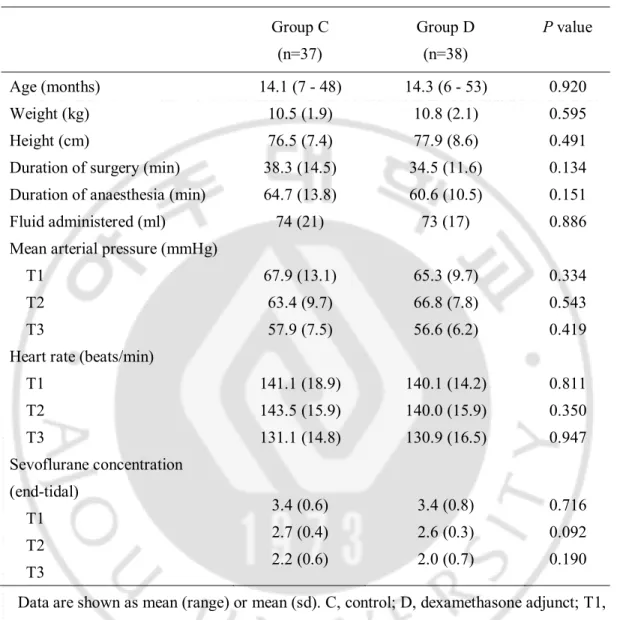
A total of 80 subjects were enrolled in the study and five were excluded in total. Three subjects (two in Group C and one in Group D) were excluded because attending anaesthesiologists administered propofol to treat agitation that could not be controlled by fentanyl administration. Another child in Group C received medications including a non-steroidal anti-inflammatory drug during the study period because of an upper respiratory infection after discharge. Lastly, we could not contact the parents of another child in Group D. Therefore, these five subjects were all excluded from the study. The two groups did not differ in terms of patient characteristic data and surgical profiles (Table 1). Caudal block was deemed successful in all subjects.
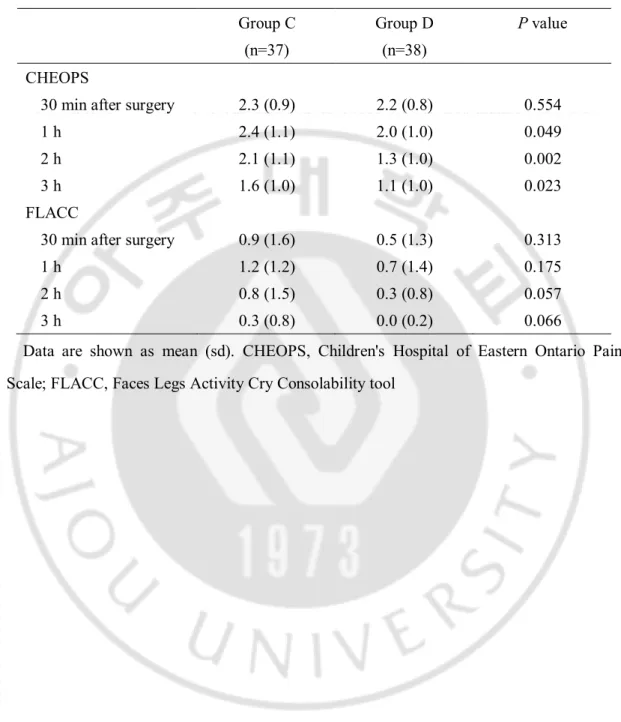
Until discharge from hospital, FLACC scores were comparable between the groups. CHEOPS scores at 1, 2, and 3 h after surgery were higher in Group C than in Group D with statistical significance (Table 2). However, the differences in CHEOPS scores between the groups were <1 point. There was no difference in the number of subjects who had rescue analgesia with fentanyl [seven subjects in Group C (18.9%) and four in Group D (10.5%), P=0.304].
There were no cases of motor block after surgery. Vomiting was observed in only one subject from Group C in the PACU. No other adverse events occurred. Similarities between the two groups were observed regarding time to micturition [174 (77) min in Group C and 156 (43) min in Group D, mean (sd); P=0.224] and time to discharge after surgery [239 (70)
8
-min in Group C and 219 (40) -min in Group D, mean (sd); P=0.134].
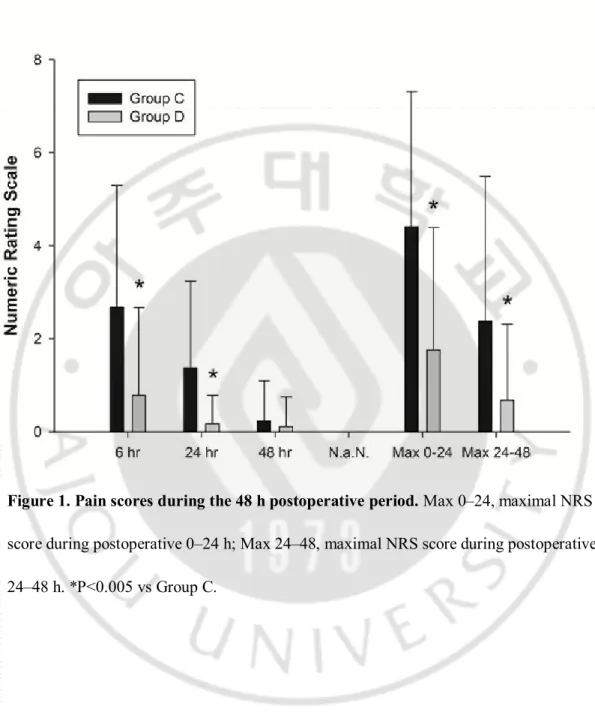
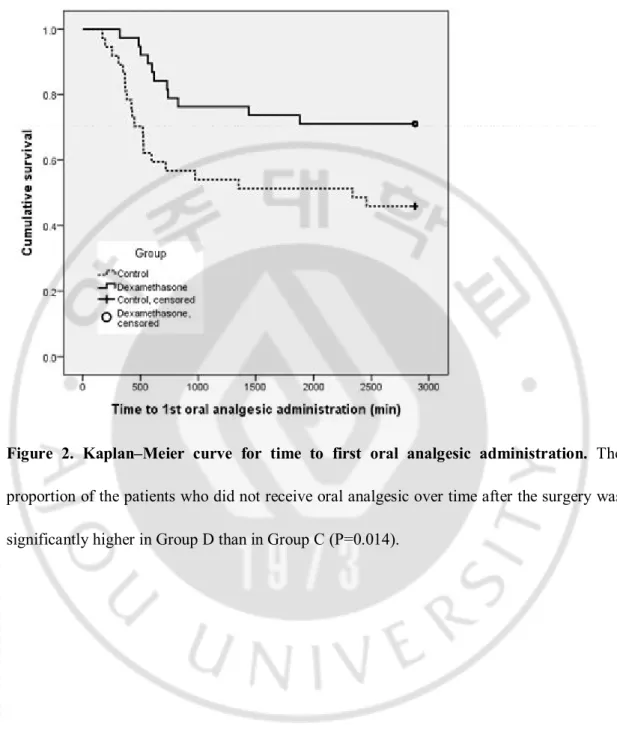
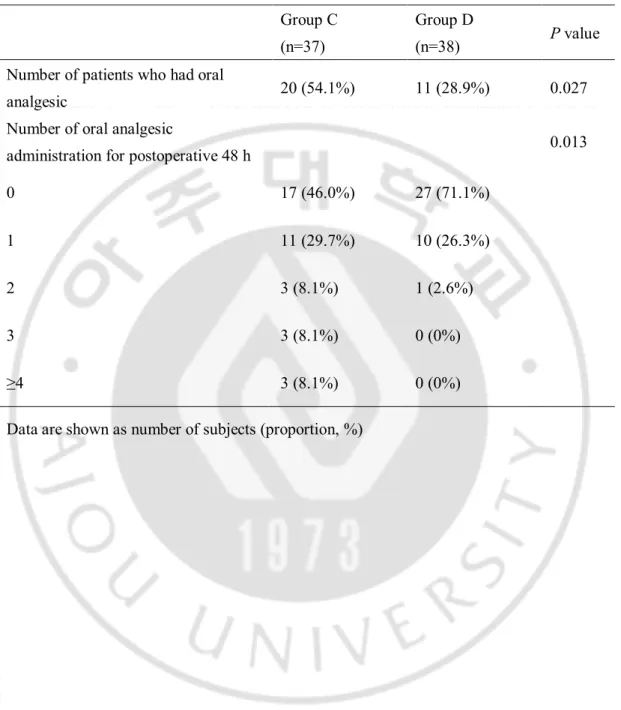
Figure 1 presents pain scores determined by parents during the 48 h postoperative period. Group D had significantly lower NRS scores than Group C, with the exception of scores at the 48 h postoperative mark. The number of subjects who were pain free during the 48 h postoperative period was significantly greater in Group D (19 of 38, 50%) than in Group C (four of 37, 10.8%, P<0.001). Consumption of oral analgesics during the postoperative 48 h is shown in Figure 2 and Table 3. According to a Kaplan–Meier curve depicting time to first oral analgesic administration after surgery, analgesic duration of Group D was significantly longer than that of Group C (P=0.014). The number of subjects who had oral analgesic during the postoperative 48 h was significantly less in Group D (11 of 38, 28.9%) than in Group C (20 of 37, 54.1%, P=0.027) and so was the number of oral analgesic administration (P=0.013).
Table 4 demonstrates adverse events after hospital discharge with no significant differences between the two groups. Postoperative wound dehiscence was seen in one case from each group, and the two patients recovered with conservative care within the 3 month follow-up period. Two subjects experienced vomiting in Group C, with no cases of vomiting in Group D after discharge.
Table 1. Patient characteristics and intraoperative data. Group C (n=37) Group D (n=38) P value Age (months) 14.1 (7 - 48) 14.3 (6 - 53) 0.920 Weight (kg) 10.5 (1.9) 10.8 (2.1) 0.595 Height (cm) 76.5 (7.4) 77.9 (8.6) 0.491
Duration of surgery (min) 38.3 (14.5) 34.5 (11.6) 0.134 Duration of anaesthesia (min) 64.7 (13.8) 60.6 (10.5) 0.151
Fluid administered (ml) 74 (21) 73 (17) 0.886
Mean arterial pressure (mmHg) T1 T2 T3 67.9 (13.1) 63.4 (9.7) 57.9 (7.5) 65.3 (9.7) 66.8 (7.8) 56.6 (6.2) 0.334 0.543 0.419 Heart rate (beats/min)
T1 T2 T3 141.1 (18.9) 143.5 (15.9) 131.1 (14.8) 140.1 (14.2) 140.0 (15.9) 130.9 (16.5) 0.811 0.350 0.947 Sevoflurane concentration (end-tidal) T1 T2 T3 3.4 (0.6) 2.7 (0.4) 2.2 (0.6) 3.4 (0.8) 2.6 (0.3) 2.0 (0.7) 0.716 0.092 0.190 Data are shown as mean (range) or mean (sd). C, control; D, dexamethasone adjunct; T1, immediately after induction of anaesthesia; T2, 5 min after skin incision; T3, end of surgery
- 10 -
Table 2. Immediate postoperative CHEOPS and FLACC scores. Group C (n=37) Group D (n=38) P value CHEOPS
30 min after surgery 2.3 (0.9) 2.2 (0.8) 0.554
1 h 2.4 (1.1) 2.0 (1.0) 0.049
2 h 2.1 (1.1) 1.3 (1.0) 0.002
3 h 1.6 (1.0) 1.1 (1.0) 0.023
FLACC
30 min after surgery 0.9 (1.6) 0.5 (1.3) 0.313
1 h 1.2 (1.2) 0.7 (1.4) 0.175
2 h 0.8 (1.5) 0.3 (0.8) 0.057
3 h 0.3 (0.8) 0.0 (0.2) 0.066
Data are shown as mean (sd). CHEOPS, Children's Hospital of Eastern Ontario Pain Scale; FLACC, Faces Legs Activity Cry Consolability tool
Figure 1. Pain scores during the 48 h postoperative period. Max 0–24, maximal NRS score during postoperative 0–24 h; Max 24–48, maximal NRS score during postoperative 24–48 h. *P<0.005 vs Group C.
- 12 -
Figure 2. Kaplan–Meier curve for time to first oral analgesic administration. The proportion of the patients who did not receive oral analgesic over time after the surgery was significantly higher in Group D than in Group C (P=0.014).
Table 3. Consumption of oral analgesics at postoperative 48 h. Group C
(n=37)
Group D
(n=38) P value
Number of patients who had oral
analgesic 20 (54.1%) 11 (28.9%) 0.027
Number of oral analgesic
administration for postoperative 48 h 0.013
0 17 (46.0%) 27 (71.1%)
1 11 (29.7%) 10 (26.3%)
2 3 (8.1%) 1 (2.6%)
3 3 (8.1%) 0 (0%)
≥4 3 (8.1%) 0 (0%)
- 14 -
Table 4. Incidence of complications after hospital discharge. Group C (n=37) Group D (n=38) P value Vomiting 2 (5.4%) 0 (0%) 0.240 Fever (>38.3℃) 3 (8.1%) 2 (5.3%) 0.829 Wound infection 0 (0%) 0 (0%) NA Wound dehiscence 1 (2.6%) 1 (2.7%) 1.0
.
Ⅳ
DISCUSSION
This study demonstrates the analgesic efficacy of caudal dexamethasone in children undergoing day-case orchiopexy. The addition of dexamethasone can increase the analgesic duration of caudal block with ropivacaine. Furthermore, pain severity and analgesic consumption decreased by the postoperative 48 h. Among subjects who received dexamethasone in their caudal block, half experienced no pain and 71% required no oral analgesics during the 48 h postoperative period—a significantly higher proportion compared with subjects who did not receive dexamethasone.
After day-case orchiopexy, children without caudal block reported clinically significant pain, and about 90% of them needed analgesia. Furthermore, about 70% required more than one type of analgesic (Stewart et al., 2012). Caudal block using ropivacaine alone can reduce pain and analgesic consumption after orchiopexy in children. About 46% of subjects in Group C with ropivacaine alone needed no analgesic after discharge, which is consistent with the finding of a previous study for paediatric orchiopexy, which demonstrated that caudal block with 1.5 ml/kg of 0.15% ropivacaine provided prolonged analgesia and reduced analgesic consumption after discharge, compared with that with 1.0 ml/kg of 0.225% ropivacaine (Hong et al., 2009).
Based on this study (Hong et al., 2009), we selected the former concentration and dose of ropivacaine for caudal analgesia. Because the analgesic duration of ropivacaine is 4–6 h (Lonnqvist, 2005) and caudal block with ropivacaine could provide sufficient analgesia in children undergoing orchiopexy for the immediate postoperative period, additional rescue
- 16 -
analgesia might not be required (Hong et al., 2009). Hence, postoperative pain during hospital stay was assessed with two types of pain scales for infants and children to avoid inappropriate administration of rescue fentanyl. Differences in pain scores were not clinically significant between the groups for postoperative 3 h, and this was probably due to the analgesic duration of ropivacaine, thus adding dexamethasone would not make any clinically significant difference in pain scores and rescue fentanyl administration for several hours after operation. Clinically relevant differences in pain scores and analgesic consumption between the groups occurred after 6 h after surgery, and this is consistent with the end of analgesic duration of ropivacaine. Adding dexamethasone can significantly increase the analgesic duration of caudal block with ropivacaine and reduce pain scores and analgesic consumption for postoperative 48 h. Unlike other adjuvants to caudal block investigated in previous studies (Ansermino et al., 2003; de Beer and Thomas, 2003; Singh et al., 2011; Engelman and Marsala, 2012), no adverse events were observed with dexamethasone during postoperative recovery.
Dexamethasone is commonly used in the perioperative period to reduce postoperative nausea and vomiting (De Oliveira et al., 2013). Additionally, it has been reported to have analgesic effects (De Oliveira et al., 2011; Steward et al., 2011; Waldron et al., 2013).
Recently, several studies have demonstrated that epidural administration of dexamethasone prolonged analgesic effects and reduced analgesic requirements in adults (Thomas and Beevi, 2006; Khafagy et al., 2010). Also, the use of dexamethasone as an adjuvant to local anaesthetics during brachial plexus block effectively improved the quality of analgesia without side-effects (Parrington et al., 2010; Cummings et al., 2011). The
precise mechanism of analgesic effect of epidural or perineural dexamethasone administration is not clearly understood. Dexamethasone might have a local anaesthetic effect on nerve by direct membrane action (Johansson et al., 1990). Therefore, dexamethasone might potentiate the effect of ropivacaine and prolong the duration of analgesia. Another possible mechanism involves the effect of dexamethasone on the spinal cord. The transcription factor nuclear factor-ĸ B (NF-ĸB) is expressed throughout the nervous system and plays an important role in the development of pathological pain (Niederberger and Geisslinger, 2008). Dexamethasone could regulate NF-ĸB (De Bosscher et al., 2003); more specifically, epidural injection of corticosteroid has been reported to inhibit development of hyperalgesia with associated reduction in NF-ĸB levels (Xie et al., 2006). These findings suggest that dexamethasone might prevent central sensitization after surgery and strengthen the preventive analgesia of caudal block. Our finding that a higher proportion of children in Group D were without pain during the postoperative 48 h period compared with Group C could be due to the prevention of hyperalgesia at the spinal cord level.
Epidural corticosteroids have a long history of safe use in the treatment of low back and radicular pain (Price et al., 2005). To date, no significant side-effects have been reported for epidural dexamethasone (Ahadian et al., 2011). Although there is no direct evidence regarding the safety of dexamethasone administered through an epidural route in children or young animals, as far as we know, an in vitro experiment demonstrated that direct exposure to neural cell cultures dexamethasone for 12 h was not neurotoxic (Baud et al., 2001). In a study of the neurotoxicity of adjuvants used in regional anaesthesia, dexamethasone
- 18 -
attenuated bupivacaine-induced neuronal injury (Ma et al., 2010) and did not significantly increase ropivacaine-induced neuronal death (Williams et al., 2011). The safety of methylparaben and propylparaben, the preservatives included in dexamethasone injectate, has been proven even in intrathecal injection of human and animal models (Eisenach et al., 1997; Gurun et al., 1997). However, high-dose dexamethasone is associated with complications such as hyperglycaemia (Pasternak et al., 2004), wound infection (Percival et al., 2010), postoperative bleeding (Czarnetzki et al., 2008), and transient adrenal suppression (Maillefert et al., 1995). Therefore, there is a body of opinion that prefers lower dose epidural steroids due to concern for corticosteroid-related side-effects (Jacobs et al., 1983). In our study with low dose of dexamethasone, there were no differences in the incidence of adverse effects including postoperative fever, wound infection, or dehiscence.
Our study has several limitations. First, we cannot completely exclude the possibility that caudal dexamethasone exerts analgesic effects through systemic absorption because i.v. dexamethasone has been reported to have analgesic effects (De Oliveira et al., 2011; Steward et al., 2011; Waldron et al., 2013). The dose of caudal dexamethasone (0.1 mg/kg) in our study was selected based on a previous study regarding the analgesic effect of epidural dexamethasone in adults (Thomas and Beevi, 2006). In the previous study, effective analgesia was provided by 5 mg of epidural dexamethasone but not 5 mg of i.v. dexamethasone in patients undergoing laparoscopic cholesystectomy (Thomas and Beevi, 2006), which implied that epidural dexamethasone has greater analgesic efficacy than i.v. dexamethasone at the same dose. Although the dose of i.v. dexamethasone for analgesia is controversial (De Oliveira et al., 2011; Waldron et al., 2013), a meta-analysis demonstrated
that more than 0.1 mg/kg of i.v. dexamethasone is needed for postoperative analgesia (De Oliveira et al., 2011). Therefore, we did not consider administration of i.v. dexamethasone in a control group. In a paediatric population, another meta-analysis that focused on the effects of systemic dexamethasone on nausea, vomiting, and pain after tonsillectomy demonstrated that the dose of i.v. dexamethasone leading to pain reduction was 0.5–1.0 mg/kg, and 0.4 mg/kg of systemic dexamethasone produced only an antiemetic effect without analgesic effects (Steward et al., 2011). Although only two placebo-controlled studies investigated the analgesic effect of i.v. dexamethasone of < 0.4 mg/kg in paediatrics (Hermans et al., 2012; McIntyre et al., 2012), 0.15 mg/kg of i.v. dexamethasone reduced severe pain only on the second postoperative day, not on the operation day and first postoperative day after tonsillectomy (Hermans et al., 2012); moreover, i.v. dexamethasone at a dose of 0.3 mg/kg did not reduce postoperative pain in dental rehabilitation (McIntyre et al., 2012). Therefore, 0.1 mg/kg of systemic dexamethasone does not seem to provide clinically relevant analgesia in children. Although the effect of caudal dexamethasone through systemic absorption on analgesia cannot be excluded in this design, our study clearly demonstrates that caudal dexamethasone can provide clinically relevant analgesia even at a low dose in children undergoing orchiopexy.
Secondly, the mean age of our population was 14 months. Thus, the infants and children in this study might not be able to express their pain fully to parents. We assessed pain using NRS scores evaluated by parents. Presumably, parental perception of paediatric pain was based on an interpretation of their child's behavioural expression of pain. Hence, this method may not have been as accurate as self-reported pain scores (Zhou et al., 2008).
- 20 -
Despite these limitations, NRS scores by parents in paediatric patients have been validated and correlated well with medical observers (Wilson and Doyle, 1996).
Thirdly, we did not evaluate some potential adverse effects of dexamethasone such as hyperglycaemia and adrenal suppression. Because the children in day-case orchiopexy did not require postoperative laboratory testing, we did not want to introduce invasive techniques for further blood sampling. However, previous studies have demonstrated that a single small dose of dexamethasone is not associated with significant side-effects (Ahadian et al., 2011).
.
Ⅴ
CONCLUSION
In conclusion, the addition of 0.1 mg/kg dexamethasone to ropivacaine for caudal blocks could significantly improve analgesic efficacy in children undergoing orchiopexy.
- 22 -
REFERENCES
1. Ahadian FM, McGreevy K, Schulteis G: Lumbar transforaminal epidural dexamethasone: a prospective, randomized, double-blind, dose-response trial. Reg Anesth
Pain Med 36: 572-578, 2011
2. Ansermino M, Basu R, Vandebeek C, Montgomery C: Nonopioid additives to local anaesthetics for caudal blockade in children: a systematic review. Paediatr Anaesth 13: 561-573, 2003
3. Baud O, Laudenbach V, Evrard P, Gressens P: Neurotoxic effects of fluorinated glucocorticoid preparations on the developing mouse brain: role of preservatives. Pediatr
Res 50: 706-711, 2001
4. Crellin D, Sullivan TP, Babl FE, O'Sullivan R, Hutchinson A: Analysis of the validation of existing behavioral pain and distress scales for use in the procedural setting.
Paediatr Anaesth 17: 720-733, 2007
5. Cummings KC, Napierkowski DE, Parra-Sanchez I, Kurz A, Dalton JE, Brems JJ, Sessler DI: Effect of dexamethasone on the duration of interscalene nerve blocks with ropivacaine or bupivacaine. British Journal of Anaesthesia 107: 446-453, 2011
6. Czarnetzki C, Elia N, Lysakowski C, Dumont L, Landis BN, Giger R, Dulguerov P, Desmeules J, Tramer MR: Dexamethasone and risk of nausea and vomiting and postoperative bleeding after tonsillectomy in children: a randomized trial. JAMA 300: 2621-2630, 2008
7. de Beer DA, Thomas ML: Caudal additives in children--solutions or problems? Br J
8. De Bosscher K, Vanden Berghe W, Haegeman G: The interplay between the glucocorticoid receptor and nuclear factor-kappaB or activator protein-1: molecular mechanisms for gene repression. Endocr Rev 24: 488-522, 2003
9. De Oliveira GS, Jr., Almeida MD, Benzon HT, McCarthy RJ: Perioperative single dose systemic dexamethasone for postoperative pain: a meta-analysis of randomized controlled trials. Anesthesiology 115: 575-588, 2011
10. De Oliveira GS, Jr., Castro-Alves LJ, Ahmad S, Kendall MC, McCarthy RJ: Dexamethasone to prevent postoperative nausea and vomiting: an updated meta-analysis of randomized controlled trials. Anesth Analg 116: 58-74, 2013
11. Eisenach JC, Hood DD, Curry R: Phase I human safety assessment of intrathecal neostigmine containing methyl- and propylparabens. Anesth Analg 85: 842-846, 1997 12. Engelman E, Marsala C: Bayesian enhanced meta-analysis of post-operative
analgesic efficacy of additives for caudal analgesia in children. Acta Anaesthesiol Scand 56: 817-832, 2012
13. Gurun MS, Leinbach R, Moore L, Lee CS, Owen MD, Eisenach JC: Studies on the safety of glucose and paraben-containing neostigmine for intrathecal administration. Anesth
Analg 85: 317-323, 1997
14. Hermans V, De Pooter F, De Groote F, De Hert S, Van der Linden P: Effect of dexamethasone on nausea, vomiting, and pain in paediatric tonsillectomy. Br J Anaesth 109: 427-431, 2012
15. Ho D, Keneally JP: Analgesia following paediatric day-surgical orchidopexy and herniotomy. Paediatr Anaesth 10: 627-631, 2000
- 24 -
16. Hong JY, Han SW, Kim WO, Cho JS, Kil HK: A comparison of high volume/low concentration and low volume/high concentration ropivacaine in caudal analgesia for pediatric orchiopexy. Anesth Analg 109: 1073-1078, 2009
17. Jacobs S, Pullan PT, Potter JM, Shenfield GM: Adrenal suppression following extradural steroids. Anaesthesia 38: 953-956, 1983
18. Johansson A, Hao J, Sjolund B: Local corticosteroid application blocks transmission in normal nociceptive C-fibres. Acta Anaesthesiol Scand 34: 335-338, 1990 19. Khafagy HF, Refaat AI, El-sabae HH, Youssif MA: Efficacy of epidural
dexamethasone versus fentanyl on postoperative analgesia. Journal of Anesthesia 24: 531-536, 2010
20. Lonnqvist PA: Adjuncts to caudal block in children--Quo vadis? Br J Anaesth 95: 431-433, 2005
21. Ma R, Wang X, Lu C, Li C, Cheng Y, Ding G, Liu L, Ding Z: Dexamethasone attenuated bupivacaine-induced neuron injury in vitro through a threonine-serine protein kinase B-dependent mechanism. Neuroscience 167: 329-342, 2010
22. Maillefert JF, Aho S, Huguenin MC, Chatard C, Peere T, Marquignon MF, Lucas B, Tavernier C: Systemic effects of epidural dexamethasone injections. Rev Rhum Engl Ed 62: 429-432, 1995
23. McIntyre RE, Hardcastle C, Eng RL, Nettel-Aguirre A, Urmson K, Lardner DR, Livingstone M, Ewen A, Cox RG: Effect of dexamethasone on postoperative morbidity after dental rehabilitation in children. Can J Anaesth 59: 34-40, 2012
molecular drug targets in pain therapy? FASEB J 22: 3432-3442, 2008
25. Parrington SJ, O'Donnell D, Chan VWS, Brown-Shreves D, Subramanyam R, Qu M, Brull R: Dexamethasone Added to Mepivacaine Prolongs the Duration of Analgesia After Supraclavicular Brachial Plexus Blockade. Regional Anesthesia and Pain Medicine 35: 422-426, 2010
26. Pasternak JJ, McGregor DG, Lanier WL: Effect of single-dose dexamethasone on blood glucose concentration in patients undergoing craniotomy. J Neurosurg Anesthesiol 16: 122-125, 2004
27. Percival VG, Riddell J, Corcoran TB: Single dose dexamethasone for postoperative nausea and vomiting--a matched case-control study of postoperative infection risk. Anaesth
Intensive Care 38: 661-666, 2010
28. Price C, Arden N, Coglan L, Rogers P: Cost-effectiveness and safety of epidural steroids in the management of sciatica. Health Technol Assess 9: 1-58, 2005
29. Singh R, Kumar N, Singh P: Randomized controlled trial comparing morphine or clonidine with bupivacaine for caudal analgesia in children undergoing upper abdominal surgery. Br J Anaesth 106: 96-100, 2011
30. Steward DL, Grisel J, Meinzen-Derr J: Steroids for improving recovery following tonsillectomy in children. Cochrane Database Syst Rev 8: CD003997, 2011
31. Stewart DW, Ragg PG, Sheppard S, Chalkiadis GA: The severity and duration of postoperative pain and analgesia requirements in children after tonsillectomy, orchidopexy, or inguinal hernia repair. Paediatr Anaesth 22: 136-143, 2012
- 26 -
analgesic requirements. Can J Anaesth 53: 899-905, 2006
33. Waldron NH, Jones CA, Gan TJ, Allen TK, Habib AS: Impact of perioperative dexamethasone on postoperative analgesia and side-effects: systematic review and meta-analysis. Br J Anaesth 110: 191-200, 2013
34. Williams BA, Hough KA, Tsui BYK, Ibinson JW, Gold MS, Gebhart GF: Neurotoxicity of Adjuvants Used in Perineural Anesthesia and Analgesia in Comparison With Ropivacaine. Regional Anesthesia and Pain Medicine 36: 225-230, 2011
35. Willis MH, Merkel SI, Voepel-Lewis T, Malviya S: FLACC Behavioral Pain Assessment Scale: a comparison with the child's self-report. Pediatr Nurs 29: 195-198, 2003 36. Wilson GA, Doyle E: Validation of three paediatric pain scores for use by parents.
Anaesthesia 51: 1005-1007, 1996
37. Xie W, Liu X, Xuan H, Luo S, Zhao X, Zhou Z, Xu J: Effect of betamethasone on neuropathic pain and cerebral expression of NF-kappaB and cytokines. Neurosci Lett 393: 255-259, 2006
38. Zhou H, Roberts P, Horgan L: Association between self-report pain ratings of child and parent, child and nurse and parent and nurse dyads: meta-analysis. J Adv Nurs 63: 334-342, 2008
- 국문요약 -
고환고정술을 받는 소아 환자에서 미추 차단시
로피바케인과 덱사메타손 병합과 로피바케인 단독 사용의
술 후 진통효과 비교
아주대학교 대학원 마취통증의학과 김은미 (지도교수: 문봉기) 연구 배경: 경막외 dexamethasone은 국소마취제와 병용하였을 때 성인환자의 수술 후 통증을 효과적으로 조절하였다. 본 연구는 고환고정술을 받는 소아 환자에서 미추차단 시에 ropivacaine에 소량의 dexamethasone (0.1 mg/kg)을 첨가하여 술 후 진통효과에 미치는 영향을 관찰하였다. 대상 및 방법: 일측 고환고정술이 계획된 6 개월 이상 5 세 이하 소아환자를 대상으로 하여 마취 유도 전 무작위로 두 군으로 나누었다. 미추강으로 1.5 ml/kg 의 0.15% ropivacaine 을 단독 투여한 40 명을 C 군, 1.5 ml/kg 의 0.15% ropivacaine 에 0.1 mg/kg 의 dexamethasone 을 혼합한 40 명을 D 군으로 분류하였다. 수술 후 48 시간 동안 통증 지수, 추가로 투여된 진통제 유무, 그리고 부작용의 발현 빈도를 관찰 하였다. 결과: 술 후 통증 지수는 6시간과 24시간에 D군이 C군에 비해 통계학적으로 유의하게 낮았다. 또한 술 후 48 시간 동안 진통효과가 지속된 경우가 D군- 28 - (19/38명, 50%)에서 C군 (4/37명, 10.8%)에 비해 유의하게 높았다(P<0.001). 퇴원 후 진통제를 투여한 사례는 D군이 11/38명으로서 C군의 20/37명 보다 유의하게 낮았다(P=0.027). 첫 진통제를 요구한 시간은 D군에서 C군에 비해 유의하게 길었다(P=0.014). 구토, 열, 창상 감염, 창상 열개 등의 부작용의 발현 빈도는 두 군간에 차이가 없었다. 결론: 고환고정술을 받는 소아환자의 미추마취시 dexamethasone 0.1 mg/kg의 첨가는 특이할만한 부작용 없이 수술 후 진통을 효과적으로 조절할 수 있다. 핵심어: 고환고정술, dexamethasone, 미추마취, 소아, 술 후 진통