www.biogeosciences.net/13/2787/2016/ doi:10.5194/bg-13-2787-2016
© Author(s) 2016. CC Attribution 3.0 License.
Importance of within-lake processes in affecting the dynamics of
dissolved organic carbon and dissolved organic and inorganic
nitrogen in an Adirondack forested lake/watershed
Phil-Goo Kang1,2, Myron J. Mitchell1, Patrick J. McHale1, Charles T. Driscoll3, Shreeram Inamdar4, and Ji-Hyung Park5
1State University of New York – College of Environmental Science and Forestry, Syracuse, NY 13210, USA
2Research Strategy and Planning Division, National Institute of Environmental Research, Incheon 22689, Republic of Korea 3Department of Civil and Environmental Engineering, Syracuse University, Syracuse, NY 13244, USA
4Department of Plant and Soil Sciences, University of Delaware, Newark, DE 19716, USA
5Department of Environmental Science & Engineering, Ewha Womans University, Seoul 03760, Republic of Korea
Correspondence to: Phil-Goo Kang ([email protected], [email protected])
Received: 17 September 2015 – Published in Biogeosciences Discuss.: 28 October 2015 Revised: 11 March 2016 – Accepted: 23 March 2016 – Published: 11 May 2016
Abstract. Lakes nested in forested watersheds play an im-portant role in mediating the concentrations and fluxes of dissolved organic matter. We compared long-term patterns of concentrations and fluxes of dissolved organic carbon (DOC) and dissolved organic (DON) and inorganic nitro-gen (DIN) in aquatic ecosystems of the Arbutus Lake wa-tershed to evaluate how a lake nested in a forested water-shed affects the sources (e.g., production) and sinks (e.g., retention) of DOC and DON in the Adirondack Mountains of New York, USA. We observed no significant long-term changes of DOC and DON in the lake outlet since 1983 and 1994, respectively. However, the temporal patterns of DOC and DON concentrations in the lake inlet showed sig-nificant seasonality such as increases during the vegetation-growing season along with notable decreases in the dor-mant season. A comparison of mass balances between in-let and outin-let for the period from 2000 to 2009 suggested that the lake was a sink of DOC (mean of influx minus out-flux: +1140 mol C ha−1yr−1). In contrast, the difference of discharge-weighted DON concentrations (mean of inlet mi-nus outlet: −1.0 µmol N L−1) between inlet and outlet was much smaller than the discharge-weighted DOC concentra-tions (average of inlet minus outlet: + 87 µmol C L−1). DON fluxes showed considerable variation among years (mean of influx minus outflux: +8 mol N ha−1yr−1; range of differ-ences: −15 to 27 mol N ha−1yr−1). DON exhibited low
per-cent retention ((influx-outflux)/influx) (mean: 6.9 %, range:
−34.8 to +31.2) compared to DOC (mean: 30.1 %, range:
+9.2 to +44.1). The resultant increase of DON within the lake was closely linked with a net decrease of DIN through monthly Pearson correlation analysis, suggesting the impor-tance of biotic factors in mediating lake DON dynamics. Our results show different relative retentions of DOC compared with DON, along with a larger retention of DIN than DON, suggesting that DOC and DON might display substantially different biogeochemical relationships in oligo-mesotrophic lakes nested forested watersheds and therefore different roles for a sink behavior for DOC compared to a producer of DON.
1 Introduction
Dissolved organic matter (DOM) produced from terrestrial (Aitkenhead-Peterson et al., 2003) and aquatic (Bertilsson and Jones, 2003) sources plays an important role in support-ing microbial activity, contributsupport-ing to energy flux, and in-fluencing material cycling (Findlay and Sinsabaugh, 2003; Wetzel, 2001). DOM interactions with toxic Al and Hg (Driscoll et al., 1988) and the creation of disinfection by-products (Siddiqui et al., 1997) affect water quality and gen-eral ecosystem health. Dissolved organic carbon (DOC) also plays a role in the protection of aquatic biota due to the
at-tenuation of ultraviolet-B radiation (Williamson, 1995). Dis-solved organic nitrogen (DON) is an important component of the total solute N loss in some ecosystems, especially those with low concentrations of total dissolved N (TDN) (Camp-bell et al., 2000; Hedin et al., 1995; Mitchell et al., 2001; Neff et al., 2003). Little attention has been paid to differ-ences in the transport and transformations of DOC, DON, and DIN along different compartments of forested water-sheds, except a few recent studies that compared differen-tial storm responses of DOC and DON (Inamdar et al., 2008; Goodman et al., 2011).
There has been considerable discussion on the mecha-nisms driving recent increases of DOC in acid-sensitive sur-face waters in North America and Europe (Driscoll et al., 2007; Erlandsson et al., 2011; Evans et al., 2007; Monteith et al., 2007, 2015). For example, Monteith et al. (2007) sug-gested that the recovery of the previous acidification of sur-face water in response to decreased acidic deposition might result from an increase in the solubility of soil organic mat-ter due to the change of pH, aluminum and ionic strength (Kalbitz et al., 2000; Mulder et al., 2001). Erlandsson et al. (2011) suggested the importance of understanding the effects of acidification on reexamining DOC reference lev-els. Other possible mechanisms driving this increase in DOC concentrations include increasing temperatures (Freeman et al., 2001), changing hydrology associated with increases in precipitation and runoff (Schindler et al., 1997), changes in land uses (Worrall et al., 2004), alteration of dry and rewet-ting cycles (von Schiller et al., 2015), increasing primary pro-duction induced by increases of atmospheric CO2(Freeman et al., 2004) and increased occurrences of droughts (Worrall and Burt, 2005).
While many studies have explored the dynamics and fate of DOC in aquatic ecosystems (e.g., Findlay and Sins-abaugh, 2003), very few have simultaneously investigated the changes in DON (Sarkkola et al., 2012). The short-term studies that have compared DOC versus DON changes in-dicate that DOC export from forested lakes in Adirondack Mountains was negatively related to hydraulic residence time but not for DON, suggesting that different biogeochemical responses for DOC and DON (Ito et al., 2005). Evaluating the causes of these differences is important for understand-ing spatial and temporal patterns of DOC and DON in surface waters including the role of within-lake processes. The gen-eration of organic matter by autochthonous processes is an important factor for the formation of DOC and DON within lakes. Generally DOC and DON concentrations increase in eutrophic lakes due to the relatively high autochthonous con-tributions in spite of enhanced microbial transformations to consume DOC and DON, while for oligotrophic lakes with low DOC and DON concentrations show a net decrease due to microbial decomposition, sedimentation, and photolysis (e.g., Thurman, 1985). Within-lake processes can affect nu-trient dynamics including changes in C : N ratios (Ito et al., 2007). Previous studies have shown differences in lability
of DON and DOC (Kang and Mitchell, 2013; Gregorich et al., 2003; Kirchman, 2003; Petrone et al., 2009). DOM from drainage lakes can alter the amount and the chemical charac-teristics of the DOM and the processing of other elements in downstream surface waters.
Arbutus Lake, an oligotrophic/mesotrophic lake, in the Adirondack Mountains of New York State, is the one of the original Adirondack Long-Term Monitoring program (ALTM) lakes established in 1982 (Driscoll et al., 2003; Kelting and Laxson, 2014; Owen et al., 1999). Arbutus Lake watershed has been the site of various hydrologic and bio-geochemical studies of DOC and DON. Piatek et al. (2009) showed that wetlands in the inlet (Archer Creek) catchment played an important role in controlling DOC concentrations within the Arbutus Lake watershed. Mitchell et al. (2006) reported on relationships between precipitation patterns and the export of DOC after late summer storms due to increases in water derived from upper soil layers and concomitant de-crease in the proportion of ground water contributions. DOC export corresponded to interannual changes of temperature, precipitation and discharge in the winter (Park et al., 2005). The export of DON constituted 47 % to the total solute N flux in the Arbutus Lake watershed for the period from 1985 to 1998 (Mitchell et al., 2001), and was enhanced by bi-otic processes affecting dissolved inorganic nitrogen (DIN) transformations at higher temperature in summer (Park et al., 2003). Ito et al. (2005) suggested that the decrease of the C : N ratios among Adirondack lakes, including Arbu-tus Lake, was related to the contribution of autochthonous sources with low C : N ratio, compared with allochthonous terrestrial sources. Most recently Kang and Mitchell (2013) studied DOM characteristics in the Arbutus Watershed in the Adirondack Mountains as water passed from upland streams, through a wetland, to the lake inlet and finally the lake outlet. There was a net export of high concentrations of aromatic, re-fractory and high-molecular-weight (HMW) DOC and DON produced from the wetland into the lake. Also they observed the decomposition of refractory HMW DOC and the increase of bioavailable DOC and DON within the lake.
The objectives of our current study were to (1) evaluate long-term changes in DOC concentrations and fluxes at the outlet of Arbutus Lake using monthly based ALTM data, (2) compare DOC, DON, and DIN concentrations and fluxes between inlet and outlet in Arbutus Lake using weekly obser-vations from ongoing hydrobiogeochemical investigations in the Arbutus Watershed, and (3) evaluate the role of within-lake processes in affecting the dynamics (i.e., sources and sinks) of DOC and DON in the lake. We hypothesized that both monthly and yearly changes of DOC and DON within the lake differ due to the relative importance of different in-ternal processes between these two solutes, i.e., DOC is de-composed to dissolved inorganic carbon (DIC) which may be released to the atmosphere as carbon dioxide or retained as DIC in the lake, while DON is decomposed to DIN which may be utilized by a range of biotic processes including
uptake, denitrification, etc. Our study evaluates how a lake nested in a forest watershed affects dynamics of DOC and DON and provides new information on long-term DOC and DON processes within a lake with a particular focus on link-ing internal processes between DIN and DON based on data collected in our study as well as information from previous studies on the Arbutus Lake.
2 Methods
2.1 Site description of Arbutus Lake
The Arbutus Lake watershed (43◦5804800N, 74◦1304800W) is located within the Huntington Wildlife Forest in the Adiron-dack Mountains of New York State. Arbutus Lake has a sur-face area of 50 ha, an average depth of 3.0 m, and a maxi-mum depth of 8.4 m (Driscoll and van Dreason, 1993). The lake has been classified as a medium till drainage lake by Newton and Driscoll (1990). For the period from 2001 to 2010 the total phosphorus concentrations ranged from 11 to 14 µg L−1and chlorophyll a concentrations ranged from 2.2 to 4.4 mg m−3during the summer (Kelting and Laxson, 2014), indicating a trophic status within the oligo- and meso-range (OECD, 1982). The Arbutus Lake watershed has an area of 352 ha and the elevations range from 513 to 748 m (Park et al., 2005). The annual temperature averaged 5.1◦C from 1984 to 2013 and total annual precipitation averaged 1086 mm from 1981 to 2013 in Newcomb, NY (3 km dis-tance from Huntington Wildlife forest) (NYSERDA, 2015).
The Archer Creek catchment (135 ha) represents a ma-jor source of water (45 %) to Arbutus Lake (McHale et al., 2000). The overstory vegetation in the upper slopes consists of mixed northern hardwoods including American beech
(Fa-gus grandifolia), sugar maple (Acer saccharum), red maple
(Acer rubrum), yellow birch (Betula alleghaniensis), and white pine (Pinus strobus). Lower slopes close to the lake are dominated by conifer stands such as eastern hemlock (Tsuga
canadensis), red spruce (Picea rubens), and balsam fir (Abies balsamea) (Park et al., 2005). The surficial geology consists
of thin to medium deposits of glacial till with a high sand content; the bedrock geology is largely composed of igneous rocks with some calcium-rich minerals (Driscoll et al., 1993). The wetland (Greenwood Mucky peats) is located in valley bottom and is 4 % of the entire subcatchment area, and speck-led alder (Alnus incana ssp. rugosa) is the dominant vegeta-tion in the wetland (Bischoff et al., 2001).
2.2 Hydrological and chemistry data
The stage height and discharge at the outlet of Arbutus Lake have been measured using a V-notch weir since 1991 (Fig. 1). The inlet, located in the Archer Creek catchment, has been monitored using an H-flume equipped with an automated dis-charge logging device since October 1994 (Mitchell et al., 2001) (Fig. 1). To calculate annual discharge-weighted DOC
Outlet Inlet
Archer Creek catchment
0 500m
Figure 1. Study sites in the Arbutus Lake watershed in Huntington
Wildlife Forest, Adirondack Park, New York, USA.
concentration at the outlet using ALTM data, we estimated monthly discharge at the lake outlet from 1984 to1990 us-ing modeled discharge values and measured values for sub-sequent periods (Mitchell et al., 1996).
The outlet of Arbutus Lake has been monitored monthly by the ALTM program since February 1983 including DOC concentrations, and the analytical method described in Driscoll and van Dreason (1993). For the long-term change of DOC at Arbutus Lake, we used the monthly ALTM data from February 1983 to December 2012.
The inlet has been sampled weekly for chemical analyses, including DON concentrations since October 1994 and DOC concentration since May 1999. The outlet has been moni-tored weekly for chemical analyses, including DON concen-trations since October 1991 and DOC concentration since May 1999. Water samples were kept on ice in the field trans-ported to the Biogeochemistry Laboratory at SUNY ESF in Syracuse, NY, filtered through a precombusted glassfiber fil-ter (Whatman GF/F) within one week affil-ter collection, and stored at 4◦C until further analysis.
The Biogeochemistry Laboratory, which is a participant in the USGS QA/QC program, analyzed C and N solutes as fol-lows: NO−3 using a Dionex IC; NH+4 with an autoanalyzer us-ing the Berthelot Reaction followed by colorimetric analysis; total dissolved nitrogen (TDN) using the persulfate oxidation procedure, followed by colorimetric analysis on an autoana-lyzer; and DOC using the Tekmar–Dohrmann Phoenix 8000 TOC analyzer®. DON concentrations were calculated as the difference between TDN and DIN (NO−3+NH+4) (Inamdar and Mitchell, 2007). If DIN exceeded or equaled TDN (< 2.5 and < 1.4 % of all samples in inlet and outlet, respectively), the value of DON was treated as zero. The lowest DON
con-centrations in the inlet and outlet were −7.0 and −17.1 µmol N L−1, respectively. The calculated error for DON concen-trations was ±6.6 % (square root of the sum of the squared analytical precision of TDN (±4.2 %), NH+4 (±3.2 %), and NO3(±3.9 %)) (Kang and Mitchell, 2013).
2.3 Calculations
To calculate mass balances of DOC, DON, and DIN for Ar-butus Lake, we used the same period (2000–2009) for the inlet and outlet chemistry. We assumed that the chemistry of Archer Creek inlet (a major source of water to the lake) was representative of all surface and ground water sources to Arbutus Lake. We assumed that direct DOC (e.g., 1600 mol C ha−1yr−1 in Ithaca, NY; Likens et al., 1983) and DON (e.g., 93 to 135 mol N ha−1yr−1in New England, US; Camp-bell et al., 2000) inputs via precipitation to the lake would be small as for other northeastern US forests. We also used the results from the NADP/NTN site for wet only deposition directly to Arbutus Lake (http://nadp.sws.uiuc.edu/nadpdata/ annualReq.asp?site=NY20).
To calculate and compare fluxes of DOC, DON and DIN between the inlet and outlet, firstly the monthly discharge-weighted concentrations (MDWC) of DOC, DON and DIN were calculated using weekly concentration data as follows: MDWC =X(Qjm × Cj)/
X Qi,
where Qj and Cj are Q (daily discharge) and C (concen-tration), respectively, for the j th weekly sample in a given month and Qi is daily Q in a given month. MDWC was also used to compare the monthly differences between the inlet and outlet.
To calculate annual discharge-weighted concentration (ADWC), MDWC (for ALTM data, monthly concentrations were used) and monthly discharges were used as follows: ADWC =X(MDWC × Qi)/
X Qi, where Qi is monthly Q in a given year.
Finally, fluxes from the inlet and the outlet from 2000 to 2009 were also computed per unit area as follows:
Flux(mol ha−1yr−1) =X(ADWC × Qi)/A,
where A is the watershed area of either the major lake (inlet = 135 ha) or the entire Arbutus watershed (out-let = 352 ha).
To quantitatively understand how much solute was re-tained or decomposed due to the within-lake process, the annual percent retention of lake water (hydraulic retention), DOC, DON, and DIN within the lake was also computed: Retention(%) = (influx − outflux)/influx × 100,
where influx and outflux are fluxes of lake water and solutes at the inlet and the outlet, respectively. Positive values indi-cated a sink, and negative values indiindi-cated a source within the lake.
The annual retention amount of DOC, DON and DIN was calculated as follows:
Retention amount(mol) = (influx − outflux)
×50(lake surface area).
The annual residence time of the lake was also calculated as follows:
Residence time (years) = V /Q,
where V is the lake volume (134.5 × 10⁴m3) and Q is the yearly outlet discharge (unit: m3yr−1).
2.4 Statistical approaches and hypothesis testing To determine temporal changes in MDWC of DOC and DON at the inlet and outlet sites, a Seasonal Kendall trend anal-ysis (a DOS executable program) was used (Helsel et al., 2006). To compare differences of MDWC between the in-let and outin-let, one-way analysis of variance (ANOVA) with posthoc Tukey HSD test (α = 0.05) was performed using Minitab (Version 16, Minitab Inc.). To evaluate correlation among DOC, DON and DIN concentration and climatic valu-ables (temperature and discharge) in the inlet and outlet and percent retention of lake water and fluxes and concentrations in DOC, DON and DIN of Arbutus Lake, Pearson correla-tion was analyzed for significance levels of p<0.05 using Minitab. We hypothesized that the dynamics of DON and DOC including changes in concentrations and mass balances will differ due to the relative importance of biogeochemical processes affecting each solute.
3 Results
3.1 The long-term climatic factors and monthly DOC trend using ALTM data set
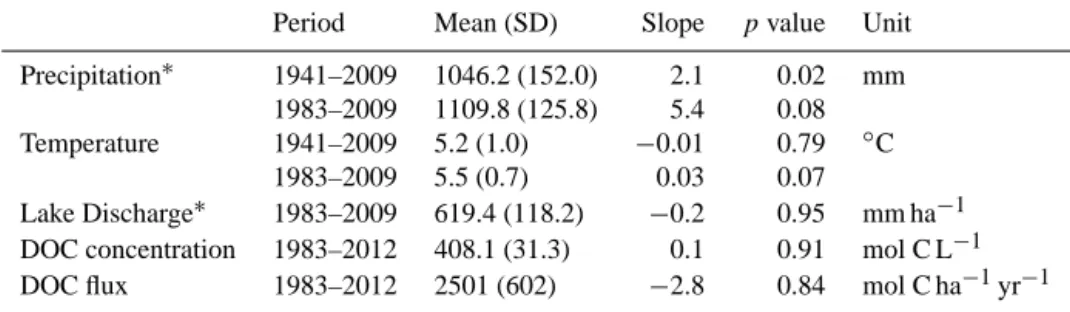
Precipitation increased significantly from 1941 to 2009 (Ta-ble 1). However, there was no significant change in precipita-tion (p = 0.08) or temperature (p = 0.07) from 1983 to 2009 during the period of DOC and DON investigation (Table 1). There was a significant relationship between precipitation and discharge during the same period (Table 1). An analysis of the Arbutus ALTM data set from 1983 to 2012 showed no significant change in DOC concentrations at the lake outlet (mean 408.1 ± 31.3 SD µmol C L−1; Table 1). Annual DOC influx for Arbutus Lake averaged 2501 (±602 SD) mol C ha−1yr−1.
3.2 Trends of DOC, DON, and DIN concentrations using SUNY-ESF data set
The DOC and DON concentrations at the inlet and outlet using weekly concentration data from SUNY-ESF are given in Fig. 2. The inlet DOC concentra-tions (mean 480 ± 202 SD µmol C L−1, n = 541) showed
Table 1. Means and linear regression results (slope and p value) of annual precipitation and atmospheric temperature at Adirondack
Eco-logical Center site since 1941 and 1983 (available at: http://www.esf.edu/aec/research/ALTEMP_projects.htm, 2016) and annual discharge, DOC concentration, and DOC flux at the Arbutus Lake outlet since 1983 using ALTM data set.
Period Mean (SD) Slope pvalue Unit
Precipitation∗ 1941–2009 1046.2 (152.0) 2.1 0.02 mm
1983–2009 1109.8 (125.8) 5.4 0.08
Temperature 1941–2009 5.2 (1.0) −0.01 0.79 ◦C
1983–2009 5.5 (0.7) 0.03 0.07
Lake Discharge∗ 1983–2009 619.4 (118.2) −0.2 0.95 mm ha−1
DOC concentration 1983–2012 408.1 (31.3) 0.1 0.91 mol C L−1
DOC flux 1983–2012 2501 (602) −2.8 0.84 mol C ha−1yr−1
∗Determination coefficient (r2) between precipitation and lake discharge from 1983 to 2009 is 0.51 (p<0.0001).
94 96 98 00 02 04 06 08 10 DON ( mo l L -1) 0 20 40 60 80 100 Inlet 00 02 04 06 08 10 DOC ( mol L -1) 0 400 800 1200 1600 2000 Outlet 00 02 04 06 08 10 DOC ( mo l L -1) 0 400 800 1200 1600 2000 94 96 98 00 02 04 06 08 10 DON ( mol L -1) 0 20 40 60 80 100 94 96 98 00 02 04 06 08 10 DIN ( mol L -1) 0 20 40 60 80 100 Year 94 96 98 00 02 04 06 08 10 DIN ( mol L -1) 0 20 40 60 80 100 Year Weekly Yearly n=541 n=544 n=727 n=728 n=751 n=753
Figure 2. Weekly and annual yearly variation of DOC
concentra-tions from 1999 to 2009 and DON and DIN concentraconcentra-tions from 1994 to 2009 at the inlet and outlet of Arbutus Lake. Annual values are discharged-weighted concentrations.
higher mean and greater monthly variation than the out-let (mean 402 ± 93 SD µmol C L−1, n = 545). In contrast, the DON concentrations showed similar values at the in-let (mean 10.1 ± 5.4 SD µmol N L−1, n = 751) and the out-let (mean 11.5 ± 5.0 SD µmol N L−1, n = 727). The Sea-sonal Kendall test did not show any significant changes over time in DOC or DON concentrations: inlet DOC (slope: 1.8 µmol C L−1yr−1, tau: 0.04, p = 0.68), inlet DON (slope:
−0.03 µmol N L−1yr−1, tau: −0.05, p = 0.53), outlet DOC (slope: 1.07 µmol C L−1yr−1, tau: 0.04, p = 0.81), and out-let DON (slope: −0.11 µmol N L−1yr−1, tau: −0.09, p = 0.22).
The monthly concentrations of DOC, DON, and DIN and the monthly discharge values are shown in Fig. 3. At the inlet there was a strong seasonality of DOC, DON, and DIN
con-centrations. DOC and DON concentrations enhanced during a growing season and reduced during winter while DIN con-centrations increased during winter and decreased from May to October. At the outlet the monthly DOC patterns that de-creased from April and reaching a minimum in the fall (i.e., October) were substantially different than the temporal pat-terns of inlet DOC concentrations. At the inlet, DON con-centrations showed a similar seasonal pattern to that of DOC concentrations; however, at the outlet the patterns were not similar, suggesting differences in the mechanisms regulating DOC and DON dynamics in the lake. Outlet DIN concentra-tions increased from January to April and decreased from May through November, indicative of DIN uptake and/or DIN reduction.
The statistical correlations among DOC, DON, DIN, monthly average temperature, and monthly total discharge for every month and for entire years are provided in Table 2. For the inlet, DOC was positively correlated with DON, tem-perature, and discharge, and DON showed a positive rela-tionship with temperature and discharge as also found for the inlet DOC. We observed a significantly negative relationship between DON and DIN concentrations. At the outlet, DOC was not correlated with DON, and the significantly negative relationships (May to December) between DON and DIN in the lake was found.
3.3 Fluxes and mass balances of DOC, DON, and DIN in Arbutus Lake
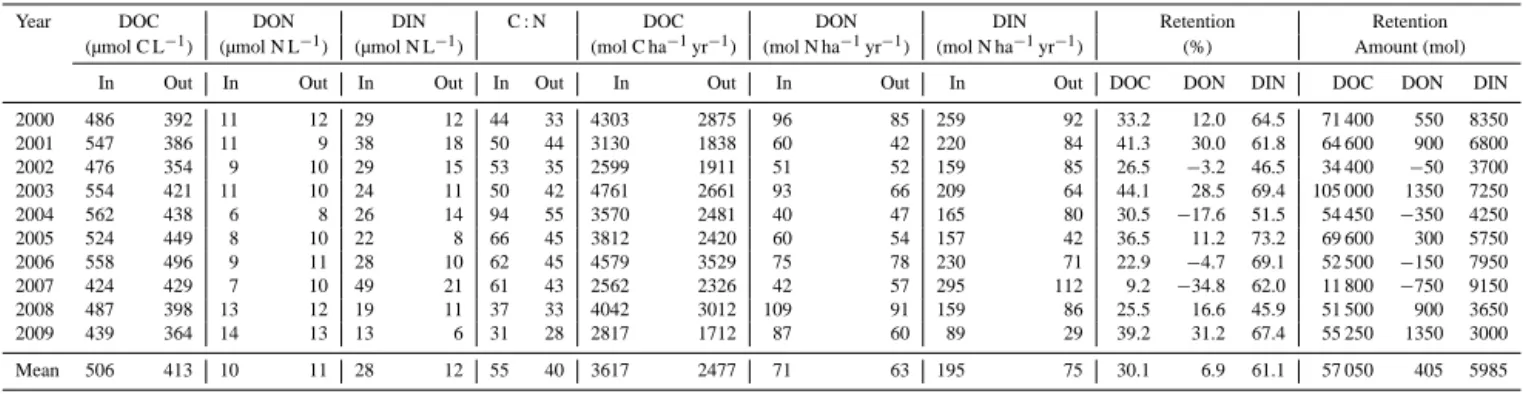
Based on weekly samples from 2000 to 2009, we calcu-lated the mass-balances of DOC, DON, and DIN at the in-let and the outin-let (Tables 3 and 4). Our calculation of av-erage residence time of 0.66 yr−1 was almost same as that value estimated to be 0.6 yr−1in a previous study of Driscoll and van Dreason (1993) (Table 3). ADWC of DOC and DIN decreased from the inlet to the outlet, while DON in-creased, resulting in a decrease in molar C : N ratios in the lake (Table 4). For Arbutus Lake the mean DOC outflux of 2477 mol C ha−1yr−1using weekly observations was similar (i.e., difference of 2 %) to the average flux calculated using
T able 2. Monthly and yearly Pearson correlation results (r ) among DOC, DON and DIN concentrations as well as climatic v ariables (Huntington F orest) at the inlet and outlet of Arb utus Lak e. Note that r v alues with 0.5 or greater in monthly analysis are sho wn to emphasize the most important correlations. A statistically significant correlation is indicated with asterisks (∗ p < 0 .01, ∗∗ p < 0 .001). Jan–Dec Jan Feb Mar Apr May Jun Jul Aug Sep Oct No v Dec DOC vs. DON Inlet 0.26 ∗∗ 0.55 ∗∗ Outlet DON vs. DIN Inlet − 0.28 ∗∗ − 0.68 ∗∗ − 0.41 ∗ Outlet − 0.29 ∗∗ − 0.50 ∗∗ − 0.61 ∗∗ − 0.57 ∗∗ − 0.66 ∗∗ − 0.53 ∗∗ − 0.54 ∗∗ DOC vs. DIN Inlet − 0.28 ∗∗ 0.57 ∗∗ 0.62 ∗∗ Outlet DOC vs. T emp Inlet 0.35 ∗∗ 0.56 ∗∗ Outlet − 0.24 ∗∗ DON vs. T emp Inlet 0.29 ∗∗ Outlet DIN vs. T emp Inlet − 0.55 ∗∗ Outlet − 0.34 ∗∗ DOC vs. Dischar ge Inlet 0.15 ∗ 0.61 ∗∗ 0.75 ∗∗ 0.64 ∗∗ 0.77 ∗∗ 0.66 ∗∗ 0.62 ∗∗ Outlet 0.11 ∗ 0.50 ∗∗ 0.57 ∗∗ DON vs. Dischar ge Inlet 0.11 ∗ 0.50 ∗∗ Outlet DIN vs. Dischar ge Inlet 0.38 ∗∗ 0.62 ∗∗ 0.71 ∗∗ Outlet 0.27 ∗∗∗
Inlet 1 2 3 4 5 6 7 8 9 10 11 12 DO C ( mo l l -1) 200 400 600 Outlet 1 2 3 4 5 6 7 8 9 10 11 12 200 400 600 1 2 3 4 5 6 7 8 9 10 11 12 DO N ( mo l l -1) 5 10 15 1 2 3 4 5 6 7 8 9 10 11 12 5 10 15 1 2 3 4 5 6 7 8 9 10 11 12 Discha rge (mm m o n th -1) 0 100 200 1 2 3 4 5 6 7 8 9 10 11 12 0 100 200 1 2 3 4 5 6 7 8 9 10 11 12 DI N ( mo l l -1) 0 25 50 1 2 3 4 5 6 7 8 9 10 11 12 0 25 50 D D D BCD ABC AB A ABC A A AB CD A A ABC D D CD CDABCD BCD CD AB AB CDE DE E BCDEABC AB A ABABCDAB BCDE E A A A A A A A A A A A A AB AB A B DE E E E E E D C CD BC AB A D E F F F F F EF 1 2 3 4 5 6 7 8 9 10 11 12 DO C f lux (m ol ha -1 ) 0 500 1000 0 20 40 1 2 3 4 5 6 7 8 9 10 11 12 0 500 1000 DO C f lux ( % ) 0 20 40 1 2 3 4 5 6 7 8 9 10 11 12 0 30 60 DO N f lux ( % ) 0 20 40 Month 1 2 3 4 5 6 7 8 9 10 11 12 DI N f lux (m ol ha -1 ) 0 30 60 0 20 40 Month 1 2 3 4 5 6 7 8 9 10 11 12 0 30 60 DI N f lux ( % ) 0 20 40 1 2 3 4 5 6 7 8 9 10 11 12 DO N f lux (m ol ha -1 ) 0 30 60 0 20 40 Dormant Snow period melt Vegetative/growing period Dormant Snow period melt Dormant period Vegetative/growing period Dormant period
Figure 3. Monthly average discharged-weighted concentrations (error bar: SE) of DOC, DON, and DIN and monthly average flux (circle,
left horizontal axis; error bars, SE) and share of the annual flux (bar, right horizontal axis) of DOC, DON, and DIN at the inlet and outlet of Arbutus Lake. Letters in upper panels indicate results of posthoc Tukey HSD test (α = 0.05) in one-way ANOVA and the same letter among months means no significant difference. Note that specific periods that were compared are provided on the top of the figure panels.
the monthly ALTM data (2501 (±602 SD) mol C ha−1yr−1) for the period from 1983 to 2012 (Tables 1 and 4).
The difference between the inlet and outlet of ADWC of DOC averaged 93 µmol C L−1, ranging from −5 (in 2007) to 161 (in 2001) µmol C L−1. The difference between inlet and outlet fluxes averaged 1140 mol C ha−1yr−1 with the range of 236 to 2100 mol C ha−1yr−1(Table 4), indicating that DOC was decomposed or retained in the lake. The reten-tion (%) of DOC ranged from 9.2 to 44.1 % (mean: 30.1 %). Hence, for all years there was a net decrease of DOC between the inlet and outlet.
For DON differences of ADWC and fluxes between the inlet and outlet ranged from −3.5 to 1.1 µmol N L−1(mean:
−1.0 µmol N L−1) and from −15 to 27 mol N ha−1yr−1 (mean: 8 mol N ha−1yr−1), respectively (Table 4). This anal-ysis suggests that within-lake processes sometimes
(particu-larly 2007) resulted in a net increase in DON through the lake in contrast to the routine net decrease in DOC. Net retention of DOC within the lake was smallest in 2007 and there was a net increase in DON during the same year (Table 4). The fraction of DON input concentrations and fluxes that changed in the lake based on fluvial DON exports ranged from −50.0 to 12.7 % (mean: −10.0 %) and from −35.7 to 31.0 % (mean: 11.2 %), respectively.
For DIN annual differences in concentrations and fluxes between inlet and outlet ranged from 7 to 28 µmol N L−1 (mean: 16 µmol N L−1) and from 60 to 183 mol N ha−1yr−1 (mean: 120 mol N ha−1yr−1), respectively (Table 4), indicat-ing the removal of DIN in the lake. The fraction of DIN con-centrations and fluxes from inlet values that were retained in the lake ranged from 42.1 to 64.3 % (mean: 57.1 %) and from 45.9 to 69.4 % (mean: 61.5 %), respectively. In brief, DOC,
Table 3. Annual precipitation, inlet and outlet discharge, residence time, and hydraulic retention from 2000 to 2009 in Arbutus Lake.
Year Precipitation Inlet discharge Outlet discharge Residence time Hydraulic retention
(mm yr−1) (mm yr−1) (mm yr−1) (year) ( %) 2000 1323 885 733 0.52 17.2 2001 901 572 476 0.80 16.9 2002 902 545 541 0.71 0.9 2003 1094 860 632 0.60 26.5 2004 972 635 567 0.67 10.8 2005 1296 728 539 0.71 26.0 2006 1174 820 712 0.54 13.2 2007 1199 604 542 0.70 10.2 2008 1395 830 756 0.51 8.9 2009 1153 641 471 0.81 26.5 Mean 1141 720 597 0.66 15.7
Table 4. Annual average of discharge-weighted concentrations, molar DOC:DON ratio, annual flux, and retention (% and amount) of DOC,
DON, and DIN at the inlet (In) and outlet (Out) of Arbutus Lake from 2000 to 2009 (I-O: Input-Output).
Year DOC DON DIN C : N DOC DON DIN Retention Retention
(µmol C L−1) (µmol N L−1) (µmol N L−1) (mol C ha−1yr−1) (mol N ha−1yr−1) (mol N ha−1yr−1) (%) Amount (mol)
In Out In Out In Out In Out In Out In Out In Out DOC DON DIN DOC DON DIN
2000 486 392 11 12 29 12 44 33 4303 2875 96 85 259 92 33.2 12.0 64.5 71 400 550 8350 2001 547 386 11 9 38 18 50 44 3130 1838 60 42 220 84 41.3 30.0 61.8 64 600 900 6800 2002 476 354 9 10 29 15 53 35 2599 1911 51 52 159 85 26.5 −3.2 46.5 34 400 −50 3700 2003 554 421 11 10 24 11 50 42 4761 2661 93 66 209 64 44.1 28.5 69.4 105 000 1350 7250 2004 562 438 6 8 26 14 94 55 3570 2481 40 47 165 80 30.5 −17.6 51.5 54 450 −350 4250 2005 524 449 8 10 22 8 66 45 3812 2420 60 54 157 42 36.5 11.2 73.2 69 600 300 5750 2006 558 496 9 11 28 10 62 45 4579 3529 75 78 230 71 22.9 −4.7 69.1 52 500 −150 7950 2007 424 429 7 10 49 21 61 43 2562 2326 42 57 295 112 9.2 −34.8 62.0 11 800 −750 9150 2008 487 398 13 12 19 11 37 33 4042 3012 109 91 159 86 25.5 16.6 45.9 51 500 900 3650 2009 439 364 14 13 13 6 31 28 2817 1712 87 60 89 29 39.2 31.2 67.4 55 250 1350 3000 Mean 506 413 10 11 28 12 55 40 3617 2477 71 63 195 75 30.1 6.9 61.1 57 050 405 5985
DON, and DIN decreased in the lake (mean: 57 050, 405 and 5985 mol, respectively; Table 4), but the retention amount of DON decreases in the lake was less than that of DIN (Ta-ble 4).
3.4 Factors affecting changing fluxes of DOC, DON, and DIN
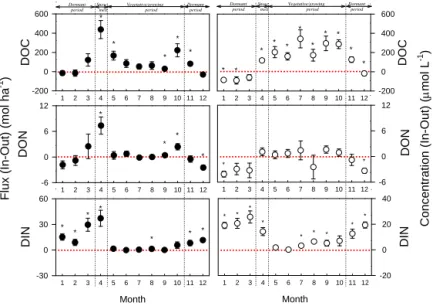
The patterns of DOC, DON, and DIN fluxes were similar for the inlet and outlet, although the concentration patterns of those solutes were different (Fig. 3), indicating that flux changes were largely caused by hydrological changes (Fig. 3, Table 5). The monthly variation of the differences in DOC, DON, and DIN concentrations and fluxes between inlet and outlet is shown in Fig. 4. The net retention of DOC flux through the lake was caused by both a decrease in discharge, particularly during snowmelt, and a decrease in DOC con-centrations. In contrast DON concentrations showed no sig-nificant difference between the inlet and outlet in months except in January and December which exhibited increases in DON concentration. For the calendar year the differences of DIN concentration between the inlet and outlet increased
through April after which concentrations were markedly re-duced within the lake.
Results of Pearson correlation comparing percent reten-tion of lake water and fluxes and concentrareten-tions of DOC, DON, and DIN are shown in Table 5. The percent retention of DOC was significantly related to hydraulic retention (%), but not for DON, indicating that the decrease of DOC in the lake was related to the hydraulic changes, whereas DON retention was less affected, indicating that other factors including bi-otic processes were likely important. Although a significant relationship between percent retention of DOC and DON was shown, the range of DON retention ranged from negative to positive while the percent retention of DOC was always pos-itive. Box-plots of the yearly retention of DOC, DON, and DIN in fluxes are shown in Fig. 5a, and potential sources and sinks for solutes are described in Fig. 5b.
4 Discussion
Our study suggests that annual DOC and DON mass balances were strikingly uncoupled as we hypothesized, and Arbutus Lake generally acted as a sink for DOC but a periodic source
1 2 3 4 5 6 7 8 9 10 11 12 DON -6 0 6 12 Month 1 2 3 4 5 6 7 8 9 10 11 12 DIN -30 0 30 60 1 2 3 4 5 6 7 8 9 10 11 12 DOC -200 0 200 400 600 1 2 3 4 5 6 7 8 9 10 11 12 DO C -200 0 200 400 600 1 2 3 4 5 6 7 8 9 10 11 12 DON -6 0 6 12 Month 1 2 3 4 5 6 7 8 9 10 11 12 DIN -20 0 20 40 * * * * * * * * * * * * * * * * * * * * * * * * * * * * * * * * * * * * * * Flux ( In-Out) ( m o l ha -1 ) Co nce n tra tion (In-Out) ( mo l L -1 ) Dormant Snow period melt Vegetative/growing period Dormant period Dormant Snow period melt Vegetative/growing period Dormant period
Figure 4. Monthly differences (error bars: SD) of DOC, DON, and DIN in fluxes and discharge-weighted concentrations between inlet and
outlet of Arbutus Lake from 2000 to 2009. Asterisk indicates significant difference from the zero (paired t test between inlet and outlet at
α =0.05). Note that specific periods that were compared are provided on the top of the figure panels.
DOC DON DIN
-60 -40 -20 0 20 40 60 80 Re ten ti o n ( % ) Sink Source DOC DIC Biotic uptake Assimilation Microbial decomposition & Photolysis Atmospheric deposition Release from POC & PON
Adsorption/ sedimentation DON DIN Microbial decomposition & Photolysis Import from catchment Export to downstream catchment Source Sink (a) (b)
Figure 5. (a) A box plot showing annual retention ((influx-outflux)/influx)) of DOC, DON, and DIN at Arbutus Lake from 2000 to 2009.
Whisker caps indicated 10th and 90th percentiles and a box showed the 25th, 50th (median), and 75th percentiles from the bottom to the top.
(b) a diagram indicating sources and sinks in DOC and DON in Arbutus Lake.
for DON (Table 4, Fig. 5). For DON, internal recycling be-tween DIN and DON might be important in affecting DON concentrations in the lake. Few studies have compared simul-taneously the long-term DOC and DON dynamics in lakes. Our work indicated that the sink strength of DOC in Arbutus Lake, an oligo-mesotrophic lake, was a function of hydraulic residence (Table 5).
4.1 Long-term change of DOC export from the lake Our results indicated that DOC concentrations and mass balances in Arbutus Lake varied among years but did not show significant long-term trend. These results are similar to Driscoll et al. (2007) who also found no significant trend in DOC concentrations for Arbutus Lake. However, Driscoll et al. (2007) did report that 10 of the original 16 ALTM
lakes showed increased concentrations of DOC from 1982 to 2004 with a mean increase of 4.5 ± 3.8 µmol C L−1yr−1. The actual mechanisms causing changes of DOC concentration are not specifically known but could include biological and chemical processes (e.g., a decrease in soil DOC partition-ing) and factors associated with climatic change (e.g., the hy-drological change and the dry and rewetting cycle) (Driscoll et al., 2007; Fellman et al., 2011; Singh et al., 2014; von Schiller et al., 2015). Monteith et al. (2007) suggested that increases in surface water DOC are linked to decreases in sul-fur deposition due to decreases in the partitioning of organic matter by soil associated with the change in pH, aluminum and ionic strength (Ekstrom et al., 2011; Erlandsson et al., 2011; Evans et al., 2012; Mulder et al., 2001). Most of the Adirondack lakes including Arbutus Lake have shown sig-nificant decreases in sulfate concentration (Park et al., 2003;
Table 5. Pearson correlation results (r) among percent retention of lake water and fluxes and concentrations (conc.) in DOC, DON, and DIN
of Arbutus Lake. A statistically significant correlation is indicated with asterisks (∗∗∗p<0.001,∗∗p<0.01,∗p<0.05). Percent retention of
concentrations was calculated using the same equation for flux retention described in Methods.
Percent retention Lake water DOC flux DOC conc. DON flux DON conc. DIN flux
DOC flux 0.68∗ – DOC conc. 0.75∗ – DON flux 0.86∗∗∗ – DON conc. 0.70∗ 0.69∗∗ 0.92∗∗∗ – DIN flux 0.83∗∗∗ – DIN conc. 0.87∗∗∗
Driscoll et al., 2007). The effects of changes of acidic depo-sition on surface water, including trends in DOC concentra-tions, have been documented in North America (Driscoll et al., 2007) and Europe (Erlandsson et al., 2011; Evans et al., 2007; Kalbitz et al., 2000; Monteith et al., 2007, 2015; Mul-der et al., 2001). However, for Arbutus Lake the effects of changes in acidic deposition may be less evident due to its relatively high pH (∼ 6.7) and ANC (∼ 77 µeq L−1) values and base status (Foster et al., 1992; Johnson and Lindberg, 1992; Mitchell et al., 2001; Chen et al., 2004; NYSERDA, 2011).
4.2 Temporal patterns of DOC and DON concentrations in forested catchments
Our study suggests the importance of biotic processes in af-fecting the seasonality of DOC and DON concentrations in forested watersheds. We observed the seasonal variation of DOC and DON concentrations such as the increase in inlet DOC and DON concentrations of the lake during the grow-ing season with notable decreases in the dormant season (i.e., December to March) (Fig. 3). The seasonality of dissolved organic matter dynamics in forested watersheds has been shown in various studies (e.g., Aitkenhead-Peterson et al., 2003; Levia et al., 2011; Park et al., 2003). In addition, our study indicated that at the lake outlet increases in DON con-centration coincided with decreases in DIN, suggesting that some DIN was converted to DON (Table 2). The monthly concentrations of DIN increased during winter and decreased from May to October, likely indicating the uptake of nitrogen as a nutrient by the biota during warmer periods of the year (Bischoff et al., 2001). Our observation of the negative rela-tionship of DIN with DON at the inlet was consistent with the study of McHale et al. (2000) (Fig. 3, Table 2). Regard-ing a quality of DOC and DON from the inlet, Kang and Mitchell (2013) in this catchment showed the production of refractory and HMW DOC and DON in upland regions of the catchment, which was followed by a large increase of DOC concentrations as water was transported through downstream wetland areas. Hence, the import of the high concentrations of aromatic, refractory and HMW DOM from the inlet would likely be an important source of DOC and DON for lakes
(Kang and Mitchell, 2013; Piatek et al., 2009; Reddy and DeLaune, 2008).
Annual DOC fluxes and concentrations from the inlet (Ta-ble 4) were similar to ranges reported from other studies of Adirondack lakes (Canham et al., 2004) and across United States (580 to 6200 mol C ha−1yr−1 and 41 to 2567 µmol C L−1) (Aitkenhead and McDowell, 2000; Tate and Meyer, 1983; Webster et al., 2006). We observed marked increases of DOC and DON influxes during snow melt (April to May) that accounted for 35.8 and 36.7 % of the annual inputs, respec-tively (Fig. 3). The importance of the snowmelt period has been shown in other studies of forested catchments (Horn-berger et al., 1994; Boyer et al., 1997; Goodman et al., 2011; Park et al., 2005). These studies also suggest that as ground-water table rises during snow melt, high concentration of DOC and DON from pore water in upper soil horizons in-cluding the forest floor are flushed into adjacent surface wa-ters. The export of DOM during snowmelt provides a sub-stantial contribution to the yearly DOM mass fluxes. The ex-port of DOC from soils to surrounding waters is controlled by many factors including hillslope connectivity (McGlynn and McDonnell, 2003), wetland area (Piatek et al., 2009), topography and the snow melt pattern (Boyer et al., 1997; Hornberger et al., 1994). At the inlet of Arbutus Lake, the in-creased discharge associated with snowmelt begins in early spring (e.g., March and April) resulting in increased DOC and DON concentrations that continue to increase to maxi-mum mid-summer concentrations (Fig. 3).
Our study also showed positive relationships between dis-charge and the concentrations of DOC and DON during the growing season from the inlet catchment (Table 2). Previ-ous analyses of the resultant influx of DOC and DON in the Archer Creek watershed during the growing season have shown close linkages with watershed wetness with notable increases in DOC during storms after dry antecedent peri-ods (Inamdar et al., 2008; von Schiller et al., 2015). Studies of other lake/watersheds have found lower DOC concentra-tions under dry condiconcentra-tions (Schindler et al., 1997) with ele-vated DOC concentrations under wetter conditions (Hinton et al., 1997; Inamdar et al., 2011; Singh et al., 2014; Tran-vik and Jansson, 2002). The increase in DOC concentrations
in surface waters with increases in wetness of catchments has been attributed to the generation of flow paths through organic rich soil, including the forest floor (Inamdar et al., 2008), and Park et al. (2003) also showed seasonal increases of DON due to soil microbial production from December 1996 to May 1996 in the lake inlet.
4.3 Importance of within-lake processes
Our observations of decreasing DOC fluxes from March to November in the lake support the role of the lake as a sink of DOC (Fig. 4). Similarly subalpine lakes have been found to be a DOC sink during spring snowmelt (Goodman et al., 2011). During the warm summer, autochthonous generation of DOC might contribute to slight increases in lake DOC (Figs. 3 and 4). Nevertheless, our observations support the role of the lake as a net sink for DOC. The retention and loss of DOC within lakes may occur by microbial decomposi-tion (Kang and Mitchell, 2013), sedimentadecomposi-tion (Owen et al., 1999) and photolysis (Bertilsson and Tranvik, 2000; Molot and Dillon, 1997).
Our observation of the increase of DON compared to DOC within the lake indicated the importance of the DON gen-eration processes in the N mass balance of this lake. When DON is mineralized to ammonium, some of the ammonium may be nitrified. This nitrate can then be utilized in assim-ilatory and dissimassim-ilatory reduction. Some of the organic N formed by assimilatory nitrate reduction can be found as DON (Fig. 5b). Regarding the differences in DON formation versus DOC formation in the lake, it is important to ascertain whether the rate of DON decomposition was substantially less than that of DOC or the DON generation from DIN was the major factor in maintaining relatively high concentrations of DON in the lake. From the one-year study of Kang and Mitchell (2013) in the Arbutus Lake, approximately 10 % (39.9 µmol C L−1) of the total DOC was microbially decom-posed, whereas 20 % (2.2 µmol N L−1) of the total DON was estimated to be bioavailable.
The removal of seston due to sedimentation can contribute to losses of DOC and DON within lake waters. Owen et al. (1999) studied seston sedimentation using traps in Arbu-tus Lake from September 1992 to November 1993, excluding the period from December to April. They reported on aver-age sedimentation rate of 1.4 g dry mass m−2d−1and seston C and N concentrations of 16.8 mmol C g−1 and 1.4 mmol N g−1with sedimentation fluxes of 85 848 mol C ha−1yr−1 and 7154 mol N ha−1yr−1. These relatively high sedimen-tation fluxes can easily account for the fluxes of DOC and DON retained in the lake observed in our study (1140 mol C ha−1yr−1 and 8 mol N ha−1yr−1, respectively; Table 4) and support the mechanism of removal of DOC and DON through the sedimentation of seston within the lake. Further understanding including the contribution of PON to DON in-creases is needed.
Since terrestrial DOM consists of HMW aromatic, chro-mophoric compounds (Kang and Mitchell, 2013), DOM en-tering the lake could also be oxidized by photolysis (Sins-abaugh and Findlay, 2003). Photochemical reactions upon exposure to ultraviolet (UV) radiation due to increased resi-dence time in the lake can result in a considerable decrease of chromophoric DOM and the resultant modification of chem-ical properties of DOM (Bertilsson and Tranvik, 2000; Molot and Dillon, 1997). Kang and Mitchell (2013) observed a decrease in aromatic compounds observed from ultra vio-let absorbance and HMW DOC concentration in the lake suggesting the possibility of the importance of photolysis. We observed that during the ice-covered period (December to March), a net increase of DOC and DON in the outlet compared to the inlet. The exception to this occurred during March when increased discharge resulted in a large increase in DOC and DON flux into the lake (Fig. 4). Our results sup-port the hypothesis of Pace and Cole (2002) that a decrease of photolysis during ice-cover can result in a buildup of DOC in lakes.
Like DOC the greatest difference in monthly DON fluxes between inlet and outlet occurred during the spring snowmelt. However, the magnitude of the differences in monthly fluxes between the inlet and outlet was rel-atively small for DON (−1.0 µmol N L−1 and 8 mol N ha−1yr−1) compared to DOC (93.0 µmol C L−1 and 1,140 mol C ha−1yr−1) likely indicating a contribution by autotrophs to the generation of DON in the lake over the an-nual cycle compared to DOC (Table 2, Fig. 4). Our observa-tion of the decrease of DIN in the lake may support biological uptake and assimilation of DIN by algae (e.g., assimilatory nitrate reduction). The assimilation of DIN is also supported by our analysis showing the negative relationship between DIN and DON especially during the growing season (May to September) in the lake (Table 2). Our results concurred with a one year (June 1995 to May 1996) study of McHale et al. (2000) who also found a net loss of DIN and net in-crease of DON between the inlet and outlet of Arbutus Lake. McHale et al. (2000) also showed that changes in NO−3 con-centrations and fluxes were greater than for DON during the growing season (June to September).
The pattern of decreasing C : N ratios in our study with an inlet value of 55 and an outlet value of 40 is consistent with previous studies of Adirondack Lakes (including Ar-butus Lake) (Ito et al., 2005, 2007) and lakes in other re-gions of the world (Kopáˇcek et al., 2003; Schindler et al., 1992; Wetzel, 2001). Autochthonous DOM (with a C : N ra-tio of ∼ 12; Wetzel, 2001) has been known to contribute to a pattern of decreasing the C : N ratios from the inlet to the outlet of lakes. For Arbutus Lake, Owen et al. (1999) sug-gested that autochthonous production was the major contrib-utor to seston with C : N ratios varying from 11.6 to 11.9 and hence has values substantially lower than C : N ratios of DOM from terrestrial sources such as leaf litter (53 to 62) and B horizon soil organic matter (22 to 29). Similarly, in
a forested mid-Atlantic watershed, a decrease of C : N ra-tios from litter to groundwater were observed largely due to a loss of DOC compared to DON (Inamdar et al., 2011). Goodman et al. (2011) also observed high temporal vari-ability of C : N ratios and a decrease of the C : N ratios be-tween inlet and outlet in five out of seven lakes studied. Other studies have suggested that changes in DON concen-trations can be attributed to hydrological factors (Kaiser and Zech, 2000; Kaushal and Lewis, 2003), internal N cycles (Caraco and Cole, 2003; Kaushal and Lewis, 2005), and high DON uptake in N-limited systems (Kaushal and Lewis, 2005; Stepanauskas et al., 2000a). The increase of DON in Arbu-tus Lake might also be due to the production of DON from macrophyte stands (Stepanauskas et al., 2000b) which are abundant (Heady, 1942).
In the current study, one of the major findings is the obser-vation of different retention amounts of DOC versus DON within the lake (Table 4, Fig. 5a). The lowest retention, we observed, for both DOC and DON in 2007 could likely be attributed to the biotic contributions. Although we would re-quire measurements of primary productivity to quantify the contribution of internal biological production within the lake, the large amounts of DIN removal in the lake suggests the importance of DIN uptake and DON production in regulat-ing TDN in the lake (Fig. 5b). In 2003, the year with highest hydraulic retention in the lake, we observed the highest reten-tion of DOC and a high level of retenreten-tion of DON (Table 4). In comparing results among years, there was a positive rela-tionship between hydraulic retention and DOC retention, but not for DON retention (Table 5).
4.4 Limitation and further study
Bioavailable DON was greater than the difference between the inlet and outlet, indicating that DON was likely pro-duced within the lake (Kang and Mitchell, 2013). In con-trast, larger amounts of DOC were retained in the lake than values of biodegradable DOC, indicating that DOC might be more readily decomposed due to different processes with DON changes in the lake. Therefore, we suggest that DON generated from internal production from DIN is important. Further study is needed to understand the primary productiv-ity for estimating DOC and DON, the microbial uptake rate of DOC (i.e., glucose) and DON (i.e., dissolved free amino acid) and the quantification of DON decomposition and re-tention.
Wet DIN deposition was estimated to account for 21.3 % (range: 14.3 to 29.2 %) of the DIN input to Arbu-tus Lake from 2000 to 2009 (for example, in 2009 al-lochthonous DIN input from the inlet catchment, 26 878 mol N yr−1=89 mol N ha−1yr−1 (inlet DIN flux in 2009; Ta-ble 3) × 302 ha (entire watershed area – lake area) and wet deposition input of DIN, 11 071 mol N yr−1=221 mol N ha−1yr−1 (http://nadp.sws.uiuc.edu/nadpdata/annualReq. asp?site=NY20) × 50 ha (lake area)). If the direct
deposi-tion of DIN in the lake is included in the N budget, N mass balances in the retention of DIN in Arbutus Lake is even greater (mean of DIN retention including wet DIN deposition: 64.3 %). Arbutus Lake is considered P-limited based on its molar N : P ratio of 25 (more than 7 of Redfield’s ratio: calculated from TP concentration data (0.44 µmol P L−1) from Kelting and Laxson (2014) and av-erage TDN data (23 µmol N L−1) in this study). Whereas in N-limited lakes, lake productivity is dependent on at-mospheric DIN inputs that contribute to algal productivity and DON concentrations. In those N-limited lakes, the re-cycling of DON might play an important role in N avail-ability. Additionally, in lentic systems, since DOM bioavail-ability may regulate secondary production in the micro-bial loop (DOM → bacteria → protozoa → zooplankton), we should reconsider the importance of DON recycling.
DIC is the end product of DOC due to reten-tion/decomposition with other fates of DOC including sedi-mentation, photolysis and direct uptake for biotic production. The DIC of Arbutus Lake has a mean of ∼ 115 µmol C L−1 and DIC ranges from ∼ 50 to 250 µmol C L−1(NYSERDA, 2011) and DIC constitutes about 25 % of total dissolved car-bon. Fakhraei and Driscoll (2015) summarized across the ALTM lakes which included Arbutus Lake that DIC is uni-formly oversaturated with respect to the solubility of atmo-spheric CO2. The importance of DIC as a DOC sink needs to be studied further. Also in spite of the potential for photolysis as a mechanism removing DOC and producing DIC in lakes (e.g., Wetzel, 2003), the quantitative determination of the rel-ative importance of this process has been difficult. Therefore, future research should consider the effect of allochthonous DOM entering lakes during the growing season on the net in-crease of DOC and DON in lakes during ice-cover and quan-tify the photolysis of DOM (e.g., approximately 10 % of total respiration based on the study of Granéli et al., 1996).
5 Conclusions
Our study found no significant long-term changes in annual mean concentrations of DOC and DON. However, mass-balances for DOC and DON between the lake inlet and outlet revealed that the lake was generally a sink for DOC (range: 11 800 to 105 000 mol) and DIN (range: 3000 to 9150 mol), but functioned as a sink or source for DON (range: −750 to 1350 mol). Annual concentrations and fluxes showed strong variation as a function of the hydraulic retention time of the lake.
Our study suggests a complex interplay of both hydrolog-ical and biologhydrolog-ical factors in affecting DOC dynamics of a lake (Goodman et al., 2011), and that newly formed DON from DIN within a lake plays an important role in lake N dy-namics (Stepanauska et al., 2000b). The enrichment of N in DOM could be a source of nutrient N for downstream aquatic ecosystems. This DON may also serve as a link in the
sup-ply of a limiting N nutrient and subsequently contribute to productivity of N limited systems. Our study provides new information that DOC and DON may display substantially different biogeochemical relationships in oligo/mesotrophic lakes nested in forested watersheds, and therefore different roles for a sink behavior for DOC (which has received more attention) and a producer of DON.
Acknowledgements. We thank David Lyon (SUNY-ESF) for sampling and analytical assistance. This research was supported by US National Science Foundation (Ecosystem Studies, LTER, Hubbard Brook) and the New York State Energy Research and Development Authority (NYSERDA).
Edited by: B. A. Pellerin
References
Aitkenhead, J. A. and McDowell, W. H.: Soil C : N ratio as a predic-tor of annual riverine DOC flux at local and global scales, Global Biogeochem. Cy., 14, 127–138, 2000.
Aitkenhead-Peterson, J. A., McDowell, W. H., and Neff, J. C.: Sources, production, and regulation of allochthonous dissolved organic matter inputs to surface waters, in: Aquatic ecosystems: interactivity of dissolved organic matter, edited by: Findlay, S. E. G. and Sinsabaugh, R. L., Academic Press San Diego, 26–70, 2003.
Bertilsson, S. and Jones, J. B.: Supply of dissolved organic matter to aquatic ecosystems: autochthonous sources, in: Aquatic ecosys-tems: interactivity of dissolved organic matter, edited by: Find-lay, S. E. G. and Sinsabaugh, R. L., Academic Press San Diego, 3–24, 2003.
Bertilsson, S. and Tranvik, L.: Photochemical transformation of dis-solved organic matter in lakes, Limnol. Oceanogr., 45, 753–762, 2000.
Bischoff, J. M., Bukaveckas, P., Mitchell, M. J., and Hurd, T.: N storage and cycling in vegetation of a forested wetland: impli-cations for watershed N processing, Water Air Soil Poll., 128, 97–114, 2001.
Boyer, E. W., Hornberger, G. M., Bencala, K. E., and McKnight, D. M.: Response characteristics of DOC flushing in an alpine catchment, Hydrol. Process., 11, 1635–1647, 1997.
Campbell, J. L., Hornbeck, J. W., McDowell, W. H., Buso, D. C., Shanley, J. B., and Likens, G. E.: Dissolved organic nitrogen bud-gets for upland, forested ecosystems in New England, Biogeo-chemistry, 49, 123–142, 2000.
Canham, C. D., Pace, M. L., Papaik, M. J., Primack, A. G. B., Roy, K. M., Maranger, R. J., Curran, R. P., and Spada, D. M.: A spa-tially explicit watershed-scale analysis of dissolved organic car-bon in Adirondack lakes, Ecol. Appl., 14, 839–854, 2004. Caraco, N. F. and Cole, J. J.: The importance of organic
nitro-gen production in aquatic systems: A landscape perspective, in: Aquatic ecosystems: interactivity of dissolved organic matter, edited by: Findlay, S. E. G. and Sinsabaugh, R. L., Academic Press San Diego, 263–279, 2003.
Chen, L., Driscoll, C. T., Gbondo-Tugbawa, S. S., Mitchell, M. J., and Murdoch, P. S.: The application of an integrated
biogeo-chemical model (PnET-BGC) to five forested watersheds in the Adirondack and Catskill regions of New York, Hydrol. Process., 18, 2631–2650, 2004.
Driscoll, C. T. and van Dreason, R.: Seasonal and long-term tempo-ral patterns in the chemistry of Adirondack lakes, Water Air Soil Poll., 67, 319–344, 1993.
Driscoll, C. T., Fuller, R. D., and Simone, D. M.: Longitudinal vari-ations in trace metal concentrvari-ations in a northern forested ecosys-tem, J. Environ. Qual., 17, 101–107, 1988.
Driscoll, C. T., Driscoll, K. M., Roy, K. M., and Mitchell, M. J.: Chemical response of lakes in the Adirondack region to de-clines in acidic deposition, Environ. Sci. Technol., 37, 2036– 2042, 2003.
Driscoll, C. T., Driscoll, K. M., Roy, K. M., and Dukett, J.: Changes in the chemistry of lakes in the Adirondack region of New York following declines in acidic deposition, Appl. Geochem., 22, 1181–1188, 2007.
Ekstrom, S. M., Kritzberg, E. S., Kleja, D. B., Larsson, N., Nilsson, P. A., Graneli, W., and Bergkvist, B.: Effect of acid deposition on quantity and quality of dissolved organic matter in soil-water, Environ. Sci. Technol., 45, 4733–4739, 2011.
Erlandsson, M., Cory, N., Fölster, J., Köhler, S., Laudon, H., Wey-henmeyer, G. A., and Bishop, K.: Increasing dissolved organic carbon redefines the extent of surface water acidification and helps resolve a classic controversy, Bioscience, 61, 614–618, 2011.
Evans, C. D., Monteith, D. T., Reynolds, B., and Clark, J. M.: Buffering of recovery from acidification by organic acids, Sci. Total Environ., 404, 316–325, 2007.
Evans, C. D., Jones, T. G., Burden, A., Ostle, N., Zieli´nski, P., Cooper, M. D. A., Peacock, M., Clark, J. M., Oulehle, F., Cooper, D., and Freeman, C.: Acidity controls on dissolved organic car-bon mobility in organic soils, Glob. Change Biol., 18, 3317– 3331, 2012.
Fakhraei, H. and Driscoll, C. T.: Proton and aluminum binding properties of organic acids in surface waters of the Northeastern US, Environ. Sci. Technol., 49, 2939–2947, 2015.
Fellman, J. B., Dogramaci, S., Skrzypek, G., Dodson, W., and Grier-son, P. F.: Hydrologic control of dissolved organic matter biogeo-chemistry in pools of a subtropical dryland river, Water Resour. Res., 47, W06501, doi:10.1029/2010WR010275, 2011. Findlay, S. E. G. and Sinsabaugh, R. L. (Eds.): Aquatic
ecosys-tems: interactivity of dissolved organic matter, Academic Press San Diego, 2003.
Foster, N. W., Mitchell, M. J., Morrison, I. K., and Shepard, J. P.: Nutrient cycling in Huntington Forest and Turkey Lakes decidu-ous stands: acid and base cations, Can. J. Forest Res., 22, 167– 174, 1992.
Freeman, C., Evans, C. D., Monteith, D. T., Reynolds, B., and Fen-ner, N.: Export of organic carbon from peat soils, Nature, 412, 785, 2001.
Freeman, C., Fenner, N., Ostle, N. J., Kang, H., Dowrick, D. J., Reynolds, B., Lock, M. A., Sleep, D., Hughes, S., and Hudson, J.: Export of dissolved organic carbon from peatlands under ele-vated carbon dioxide levels, Nature, 430, 195–198, 2004. Goodman, K. J., Baker, M. A., and Wurtsbaugh, W. A.: Lakes
as buffers of stream dissolved organic matter (DOM) vari-ability: Temporal patterns of DOM characteristics in
moun-tain stream-lake systems, J. Geophys. Res., 116, G00N02, doi:10.1029/2011JG001709, 2011.
Granéli, W., Lindell, M., and Tranvik, L.: Photo-oxidative produc-tion of dissolved inorganic carbon in lakes of different humic content, Limnol. Oceanogr., 41, 698–706, 1996.
Gregorich, E. G., Beare, M. H., Stoklas, U., and St-Georges, P.: Biodegradability of soluble organic matter in maize-cropped soils, Geoderma, 113, 237–252, 2003.
Heady, H. F.: Littoral vegetation of the lakes on the Huntington For-est, Roosevelt Wildlife Bulletin, 8, 1–37, 1942.
Hedin, L. O., Armesto, J. J., and Johnson, A. H.: Patterns of nutrient loss from unpolluted, old-growth temperate forests: evaluation of biogeochemical theory, Ecology, 76, 493–509, 1995.
Helsel, D. R., Mueller, D. K., and Slack, J. R.: Computer program for the Kendall family of trend tests, US Geological Survey Sci-entific Investigations Report, 4, 2005–5275, 2006.
Hinton, M. J., Schiff, S. L., and English, M. C.: The significance of storms for the concentration and export of dissolved organic car-bon from two Precambrian Shield catchments, Biogeochemistry, 36, 67–88, 1997.
Hornberger, G. M., Bencala, K. E., and McKnight, D. M.: Hydro-logical controls on dissolved organic carbon during snowmelt in the Snake River near Montezuma, Colorado, Biogeochemistry, 25, 147–165, 1994.
Inamdar, S. P. and Mitchell, M. J.: Storm event exports of dis-solved organic nitrogen (DON) across multiple catchments in a glaciated forest watershed, J. Geophys. Res., 112, G02014, doi:10.1029/2006JG000309, 2007.
Inamdar, S. P., Rupp, J., and Mitchell, M. J.: Differences in dis-solved organic carbon (DOC) and nitrogen (DON) responses to storm-event and groundwater conditions in a forested western New York, J. Am. Water Resour. As., 44, 1458–1473, 2008. Inamdar, S., Singh, S., Dutta, S., Levia, D., Mitchell, M., Scott,
D., Bais, H., and McHale, P.: Fluorescence characteristics and sources of dissolved organic matter for stream water during storm events in a forested mid-Atlantic watershed, J. Geophys. Res., 116, G03043, doi:10.1029/2011JG001735, 2011.
Ito, M., Mitchell, M. J., Driscoll, C. T., and Roy, K. M.: Nitrogen input-output budgets for lake-watersheds in the Adirondack re-gion of New York, Biogeochemistry, 72, 283–314, 2005. Ito, M., Mitchell, M. J., Driscoll, C. T., Newton, R. M., Johnson, C.
E., and Roy, K. M.: Controls on surface water chemistry in two lake-watersheds in the Adirondack region of New York: differ-ences in nitrogen solute sources and sinks, Hydrol. Process., 21, 1249–1264, 2007.
Johnson, D. W. and Lindberg, S. E.: Atmospheric Deposition and Forest Nutrient Cycling, Springer-Verlag New York, 1992. Kaiser, K. and Zech, W.: Sorption of dissolved organic nitrogen by
acid subsoil horizons and individual mineral phases, Eur. J. Soil Sci., 51, 403–411, 2000.
Kalbitz, K., Solinger, D., Park, J. H., and Matzner, E.: Controls on the dynamics of dissolved organic matter: A review, Soil Sci., 165, 277–304, 2000.
Kang, P. and Mitchell, M. J.: Bioavailability and size-fraction of dis-solved organic carbon, nitrogen, and sulfur at the Arbutus Lake watershed, Adirondack Mountains, NY, Biogeochemistry, 115, 213–234, 2013.
Kaushal, S. S. and Lewis, W. M.: Patterns in the chemical fractiona-tion of organic nitrogen in Rocky Mountain streams, Ecosystems, 6, 483–492, 2003.
Kaushal, S. S. and Lewis, W. M.: Fate and transport of organic nitro-gen in minimally disturbed montane streams of Colorado, USA, Biogeochemistry, 74, 303–321, 2005.
Kelting, D. L. and Laxson, C. L.: Adirondack Lake Assessment Program: 2013 Report, Arbutus Lake, Adirondack Watershed In-stitute of Paul Smith’s College, Report No. PSCAWI 2014-56, 2014.
Kirchman, D. L.: The contribution of monomers and other low-molecular weight compounds to the flux of dissolved organic material in aquatic ecosystems, in: Aquatic ecosystems: interac-tivity of dissolved organic matter, edited by: Findlay, S. E. G. and Sinsabaugh, R. L., Academic Press San Diego, 217–241, 2003. Kopáˇcek, J., Hejzlar, J., Kana, J., Porcal, P., and Klementová, S.:
Photochemical and biological degradation of dissolved organic carbon and its impact on alkalinity production in acidified lakes, Limnol. Oceanogr., 43, 106–117, 2003.
Levia, D. F., Carlyle-Moses, D., and Tanaka, T. (Eds.): Forest hy-drology and biogeochemistry: synthesis of past research and fu-ture directions, Springer Netherlands, 2011.
Likens, G. E., Edgerton, E. S., and Galloway, J. N.: The composition and deposition of organic carbon in precipitation, Tellus B, 35, 16–24, 1983.
McGlynn, B. L. and McDonnell, J. J.: Role of discrete landscape units in controlling catchment dissolved organic carbon dynam-ics, Water Resour. Res., 39, 1090, doi:10.1029/2002WR001525, 2003.
McHale, M. R., Mitchell, M. J., McDonnell, J. J., and Cirmo, C.: Nitrogen solutes in an Adirondack forested watershed: impor-tance of dissolved organic nitrogen, Biogeochemistry, 48, 165– 184, 2000.
Mitchell, M. J., Driscoll, C. T., and Raynal, D. J.: Temporal changes and Solute Mass Balances in an Adirondack Forested watershed, Water Air Soil Poll., 88, 355–369, 1996.
Mitchell, M. J., McHale, P. J., Inamdar, S. P., and Raynal, D. R.: Role of within-lake processes and hydrobiogeochemical changes over 16 years in a watershed in the Adirondack Mountains of New York State, USA, Hydrol. Process., 15, 1951–1965, 2001. Mitchell, M. J., Piatek, K. B., Christopher, S., Mayer, B., Kendall,
C., and McHale, P.: Solute sources in stream water during con-secutive fall storms in a northern hardwood forest watershed: a combined hydrological, chemical and isotopic approach, Biogeo-chemistry, 78, 217–246, 2006.
Molot, L. A. and Dillon, P. J.: Photolytic regulation of dissolved organic carbon in northern lakes, Global Biogeochem. Cy., 11, 357–365, 1997.
Monteith, D. T., Stoddard, J. L., Evans, C. D., de Wit, H. A., Forsius, M., Høgåsen, T., Wilander, A., Skjelkvåle, B. L., Jeffries, D. S., Vuorenmaa, J., Keller, B., Kopácek, J., and Vesely, J.: Dissolved organic carbon trends resulting from changes in atmospheric de-position chemistry, Nature, 450, 537–540, 2007.
Monteith, D. T., Henrys, P. A., Evans, C. D., Malcolm, I., Shilland, E. M., and Pereira, M. G.: Spatial controls on dissolved organic carbon in upland waters inferred from a simple statistical model, Biogeochemistry, 123, 363–377, 2015.
Mulder, J., De Wit, H. A., Boonen, H. W. J., and Bakken, L. R.: Increased levels of aluminum in forest soils: effects on the stores of soil organic carbon, Water Air Soil Poll., 130, 989–994, 2001. Neff, J. C., Chapin III, F. S., and Vitousek, P. M.: Breaks in the cycle: dissolved organic nitrogen in terrestrial ecosystems, Front. Ecol. Environ., 1, 205–211, 2003.
Newton, R. M. and Driscoll, C. T.: Classification of ALSC Lakes, in: Adirondack Lakes Survey: An Interpretive Analysis of Fish Communities and Water Chemistry, 1984–87, Adirondack Lakes Survey Corporation, Ray Brook pp. 2-70-2-91, 1990.
NYSERDA: The Adirondack Long-Term Monitoring Lakes: A Compendium of Site Descriptions, Recent Chemistry and Se-lected Research Information, New York State Energy Research and Development Authority Report No. 11-12, 251–252, 2011. NYSERDA: Importance of Acidic and Mercury Deposition in
Re-lation to Climate Change in the Adirondack Mountains: Biogeo-chemical Responses, New York State Energy Research and De-velopment Authority Report. No. 15-04s, 2015.
OECD: Eutrophication of waters: Monitoring, assessment and con-trol, Organisation for Economic Co-operation and Development, Paris, 1982.
Owen, J. S., Mitchell, M. J., and Michener, R. H.: Stable nitro-gen and carbon isotopic composition of seston and sediment in two Adirondack lakes, Can. J. Fish. Aquat. Sci., 56, 2186–2192, 1999.
Pace, M. L. and Cole, J. J.: Synchronous variation of dissolved or-ganic carbon and color in lakes, Limnol. Oceanogr., 47, 333–342, 2002.
Park, J. H., Mitchell, M. J., McHale, P. J., Christopher, S. F., and Myers, T. P.: Interactive effects of changing climate and atmo-spheric deposition on N and S biogeochemistry in a forested watershed of the Adirondack Mountains, New York State, Glob. Change Biol., 9, 1602–1619, 2003.
Park, J. H., Mitchell, M. J., and Driscoll, C. T.: Winter-time cli-matic control on dissolved organic carbon export and surface wa-ter chemistry in an Adirondack forested wawa-tershed, Environ. Sci. Technol., 39, 6993–6998, 2005.
Petrone, K. C., Richards, J. S., and Grierson, P. F.: Bioavailability and composition of dissolved organic carbon and nitrogen in a near coastal catchment of south-western Australia, Biogeochem-istry, 92, 27–40, 2009.
Piatek, K. B., Christopher, S. F., and Mitchell, M. J.: Spatial and temporal dynamics of stream chemistry in a forested watershed, Hydrol. Earth Syst. Sci., 13, 423–439, doi:10.5194/hess-13-423-2009, 2009.
Reddy, K. R. and DeLaune, R. D. (Eds.): Biogeochemistry of wet-lands: Science and applications, CRC Press, 2008.
Sarkkola, S., Nieminen, M., Koivusalo, H., Laurén, A., Kortelainen, P., Mattsson, T., Palviainen, M., Piirainen, S., Starr, M., and Finér, L.: Trends in concentrations and export of nitrogen in bo-real forest streams, Bobo-real Env. Res., 17, 85–101, 2012. Schindler, D. W., Stainton, M. P., Kelly, C. A., Bayley, S. E., Curtis,
P. J., and Parker, B. R.: Natural and man-caused factors affect-ing the abundance and cyclaffect-ing of dissolved organic substances in Precambrian Shield lakes, Hydrobiologia, 229, 1–21, 1992. Schindler, D. W., Curtis, P. J., Bayley, S. E., Parker, B. R., Beaty, K.
G., and Stainton, M. P.: Climate-induced changes in the dissolved organic carbon budgets of boreal lakes, Biogeochemistry, 36, 9– 28, 1997.
Siddiqui, M. S., Amy, G. L., and Murphy, B. D.: Ozone enhanced removal of natural organic matter from drinking water sources, Water Res., 31, 3098–3106, 1997.
Singh, S., Inamdar, S., Mitchell, M., and McHale, P.: Seasonal pat-tern of dissolved organic matter (DOM) in watershed sources: influence of hydrologic flow paths and autumn leaf fall, Biogeo-chemistry, 118, 321–333, 2014.
Sinsabaugh, R. L. and Findlay, S.: Dissolved organic matter: Out of the black box into the mainstream, in: Aquatic ecosystems: interactivity of dissolved organic matter, edited by: Findlay, S. E. G. and Sinsabaugh, R. L., Academic Press San Diego, 479–498, 2003.
Stepanauskas, R., Laudon, H., and Jorgensen, N. O. G.: High DON bioavailability in boreal streams during a spring flood, Limnol. Oceanogr., 45, 1298–1307, 2000a.
Stepanauskas, R., Farjalla, V. F., Tranvik, L. J., Svensson, J. M., Esteves, F. A., and Granéli, W.: Bioavailability and sources of DOC and DON in macrophyte stands of a tropical coastal lake, Hydrobiologia, 436, 241–248, 2000b.
Tate, C. M. and Meyer, J. L.: The influence of hydrologic conditions and successional state on dissolved organic-carbon export from forested watersheds, Ecology, 64, 25–32, 1983.
Thurman, E. M.: Organic geochemistry of natural waters, Martinus Nijhoff/Dr W. Junk Publishers, Dordrecht, p. 51, 1985.
Tranvik, L. J. and Jansson, M.: Climate change-terrestrial export of organic carbon, Nature, 415, 861–862, 2002.
von Schiller, D., Graeber, D., Ribot, M., Timoner, X., Acuña, V., Martí, E., Sabater, S., and Tockner, K.: Hydrological transitions drive dissolved organic matter quantity and composition in a tem-porary Mediterranean stream, Biogeochemistry, 123, 429–446, 2015.
Webster, J. R., Wallace, J. B., and Benfield, E. F.: Chapter 6. Or-ganic processes in streams of the eastern United States, in: River and stream ecosystems of the world, edited by: Cushing, C. E., Cummins, K. W., and Minshall, G. W., University of California Press, 117–187, 2006.
Wetzel, R. G.: Limnology: Lake and River Ecosystems, 3rd Edn., Academic Press New York, 2001.
Wetzel, R. G.: Dissolved organic carbon: Detrital energetics, metabolic regulators, and drivers of ecosystem stability of aquatic ecosystems, in: Aquatic ecosystems: interactivity of dis-solved organic matter, edited by: Findlay, S. E. G. and Sins-abaugh, R. L., Academic Press San Diego, 455–478, 2003. Williamson, C. E.: What role does UV-B radiation play in
freshwa-ter ecosystems?, Limnol. Oceanogr., 40, 386–392, 1995. Worrall, F. and Burt, T.: Predicting the future DOC flux from upland
peat catchments, J. Hydrol., 300, 126–39, 2005.
Worrall, F., Burt, T., and Adamson, J.: Can climate change explain increases in DOC flux from upland peat catchments?, Sci. Total Environ., 326, 95–112, 2004.