J Korean Acad Community Health Nurs (지역사회간호학회지) https://doi.org/10.12799/jkachn.2019.30.2.226
Influence of Emotional Intelligence, Communication, and
Organizational Commitment on Nursing Productivity among
Korean Nurses
Geun, Hyo Geun
1· Park, Eunok
21Assistant Professor, Department of Nursing, Chodang University, Muan 2Professor, College of Nursing, Jeju National University, Jeju, Korea
Purpose: Improving productivity in nursing practice is an important issue. This study investigated factors affecting nursing productivity of Korean clinical nurses. Methods: A structured survey tool was used in a cross-sectional design with a convenience sample of 239 nurses working in university hospitals. Stepwise multiple regressions were done to identify influential factors. Results: The level of nursing productivity was at a moderate level (3.3 out of 5). Those nurses who were over 36, married, over master-graduated, regularly employed, on day duty, and with experiences as a charge or head nurse reported better achievements in nursing productivity than the other groups of nurses. All three independent variables, age, and employment status explained 55.4% of the variance in nursing productivity. Conclusion: The leaders and managers of nursing organizations should develop educational programs aimed at in-creasing nurses’ competencies in relation to emotion controls and communication skills, which consequently should improve nursing productivity.
Key Words: Nurses; Communication; Emotional intelligence
Corresponding author: Park, Eunok
College of Nursing, Jeju National University, 102 Jejudaehak-ro, Jeju 69352, Korea. Tel: +82-64-754-3882, Fax: +82-64-702-2686, E-mail: [email protected]
Received: Dec 29, 2018 / Revised: Apr 27, 2019 / Accepted: May 9, 2019
This is an open access article distributed under the terms of the Creative Commons Attribution Non-Commercial License (http://creativecommons.org/licenses/ by-nc/3.0), which permits unrestricted non-commercial use, distribution, and reproduction in any medium, provided the original work is properly cited.
INTRODUCTION
I. Introduction
It is widely recognized that the nursing profession has made significant contributions to increase productivity in health care services. During the last fifteen years, nursing productivity has been increased by about 45 times world-wide [1].
The productivity of nurses generally is explained to be achieved in terms of economic labor trends and costs to an organization [2]. Productivity has been commonly asso-ciated with efficiency in terms of services provided, costs, material resources, output per input of labor, nurse ratio at the department level and so on and accordingly, has been presented using quantitative measures [2,3]. In addi-tion, productivity produced by nurses or nursing depart-ments overlap and has not clearly been differentiated, making it difficult to develop a coherent understanding of
‘productive’ nursing practice. We use nursing
produc-tivity in the current study.
A nursing productivity model showed that human-re-lated factors including a significant number of nurses with adequate knowledge, skill, and experiences were impor-tant components of productivity for 360 Iranian clinical nurses [4]. Similarly, organizational trusts such as loyalty, competency, honesty and stability were multiply corre-lated with nurse administrators’ productivity [5]. In the case of primary care nurse practitioners in ambulatory settings, nursing productivity was associated with some modifiable practice characteristics such as autonomy [6]. In addition, nursing productivity has been examined in relation to nurses’ demographic and organization charac-teristics in the literature. McNeese-Smith and Van Servel-len [3] found that older nurses with many nursing
experi-ences and/or a highjob satisfaction showed greater
pro-ductivity. Farhadi et al.[1] reported that nurse produc-tivity was significantly high in nurses who were male,
married, and attained a bachelor’s degree from the nurses’ perspective, while the priority factors affecting nursing productivity were clear role perception, knowledge and skills, motivation, performance feedback coaching, organ-izational support, and environmental adjustment from the head nurses’ perspective. As mentioned in above studies, although the variables related to nurses or nursing pro-ductivity are different depending on the study purpose or even the perspectives, it is believed that nursing produc-tivity is affected by the overall work environment as well as the characteristics of individual nurses.
In a similar trend, according to the results of studies in Korea, the level of productivity in Korean clinical nurses differed by their individual characteristics such as age, marital status, shift, position, salary, nursing experiences, and educational level [7,8] as well as organizational char-acteristics such as commitment or internal marketing ac-tivities [9-11].
In additions, there have been studies exploring which factors have an impact on the role of nurses in delivering patient care from an organizational perspective such as nurses’ level of emotional intelligence, communication skills in practice, and commitment to their organizations [7,11-14]. These variables have contributed to the produc-tivities of nurses by controlling their emotions, effectively communicating with other staff, and committing to the goals of the organizations. A couple of studies have inves-tigated the associations between emotional intelligence and communication and their roles in the accomplish-ments of the organizations [14,15] or the relatedness be-tween some other variables. However, very few studies have shown associations between these organization- related variables (i.e., emotional intelligence) and pro-ductivity in nursing practice. Similarly, little attention has been given to the role of individual characteristics (e.g., age) of Korean clinical nurses in the assessment of work productivity.
2. Purpose
Given this gap in the literature, this study was designed to identify the perceived levels of emotional intelligence, communication, organizational commitment, and nursing productivity, to explore the associations among the four measured variables, and to identify factors substantially predicting nursing productivity among the subjects.
3. Theoretical Background
To date, several models have been used to explain the
concept or components of nursing productivity. The ori-ginal study defining nursing productivity proposed four characteristics: human measures, material resources, pa-tient qualities, and service provided [16]. In this study, the authors concluded nursing productivity is the ratio of out-put to inout-put, and productivity was most commonly asso-ciated with efficiency. The perspectives of North and Hug-hes [2] are similar to the original definition to some extent. However, North and Hughes [2] took a system approach to nursing productivity, focusing on the importance of nurses and the working environment and proposed to rec-onceptualize nurses not as a capital asset but as an in-tellectual asset. Similarly, factors affecting nursing pro-ductivity were prioritized based on the ACHIEVE model (ability, clarity, help, incentive, evaluation, environment, and validity) from the perspectives of nurses and head nurses [1]. According to the results expressed by the two groups, nurses and head nurses, the strategies to improve nursing productivity are mainly associated with organiza-tional systems or programs such as orientation, retraining courses, supporting systems and so on. Although these ef-forts for the conceptual building of nursing productivity were attempted, nursing productivity mostly has been based on the individual needs of patients or a cost-effec-tive care system. It seems clear that factors related to or-ganizations as well as the enhancement of nurse-related resources received very little attention. Therefore, we in-cluded variables that would show significant relation-ships with nurse productivity from organization-based but non-cost-related variables such as nurses’ competency in controlling their emotions, communication, and per-ceived level of their commitments to their organizations in daily nursing practice. It is assumed that the variables se-lected for this study (i.e., emotional intelligence, commu-nication, and organizational commitment) are appropriate to explain the correlates of nursing productivity in this study, considering this is the first time these variables have been investigated.
METHODS
1. Study Design, Sample, and Setting
An exploratory cross-sectional design was used with a convenience sample of 239 Korean nurses working in three different university hospitals (size, 500~1300 beds). The subjects were registered nurses working in hospitals lo-cated in three different areas of Korea. The hospitals were selected based on the author’s convenience and university hospitals, which included a variety of clinical
depart-ments. Eligibility criteria for study inclusion were Korean nurses who have been currently working for more than 6 months at their current organizations. Nurses employed in emergency and specialty areas were excluded.
This survey was reviewed and approved by the
Institu-tional Review Board ofJeju National University (IRB No.:
JJNU_IRB 20140512-HR-004-01). Data were collected from
October 2014 toJune 2015. Before administrating the
sur-vey, the researcher contacted three hospitals to encourage survey participation and explained to the supervisors at each nursing organization the purpose of the study and the potential benefits for participating. All organizations participated voluntarily in the survey. The subjects were asked to respond to a paper survey which was in an enve-lope containing the following: a cover letter, question-naire, consent form, and instructions for completing the survey. Confidentiality and anonymity of the participants were assured by not using real names but rather a partic-ipant code. Particpartic-ipants were informed that they were able to drop out of the study at any time.
During the survey period, 246 participants completed the survey with a response rate of 82 percent. Of the 246 re-sponses, 7 cases were excluded due to incomplete respon-ses. Therefore, a total of 239 responses were identified as participants in this study. After completing the survey, all the participants received a small gift (measuring tape). The total numbers included in the data analysis, that was deemed appropriate to ensure statistical significance for the stepwise multiple regressions, was estimated by G* Power 3.0 for Windows (power=80%, ⍺=.05, and effect size=.25).
2. Measures
1) General Characteristics
The general characteristics consisted of two parts: the demographic characteristics of the nurses (gender, age, marital status, and education), and questions related to work experiences and conditions (nursing experiences, employment, shift, position, and working hours).
2) Emotional Intelligence
In the present study, emotional intelligence was assess-ed using the Wong and Law Emotional Intelligence Scale (WLEIS), an extensively used instrument which measures nurses’ intelligence in terms of emotions [17]. In this study, we used the Korean version of the tool [18]. This instru-ment is composed of 16 items measuring the level of emo-tional intelligence in four components: self-emoemo-tional ap-praisal (4 items), other’s emotional apap-praisal (4 items),
regulation of emotions (4 items), and use of emotions (4 items). To measure a subject’s emotional intelligence, a 5-point Likert scale was used ranging from 1 (strongly dis-agree) and 5 (strongly dis-agree). Higher scores indicated an increased level of emotional intelligence. Cronbach’s ⍺ was .76~89 [17], and .93 in this study.
3) Communication
The ability to deliver and understand the thinking and emotions of people was measured using Hur [19]’s commu-nication scale (Global Interpersonal Commucommu-nication Com-petence Scale, GICC-15). This instrument is composed of 15 items with a 5-point Likert scale ranging from 1 (strongly disagree) to 5 (strongly agree). A higher score indicated that nurses were very good at communicating with nurses and other people in their organizations. Its psychometric proper-ties such as content validity, concurrent validity, and con-vergent validity were assured in the original study [19]. Cronbach’s ⍺ was .72 [19], and .90 in this study.
4) Organizational Commitment
The Organizational Commitment Questionnaire (OCQ), developed by Mowday et al.[20] and revised by Kim [21], was used to measure the perceived level of Korean nurses’ organizational commitment. This instrument is composed of 15 items and uses a 5-point Likert scale format ranging from 1 (strongly disagree) to 5 (strongly agree). A higher score indicated a higher level of nurses’ commitment to their current organizations. Cronbach’s ⍺ was .91 for the current sample.
5) Nursing Productivity
Nursing productivity was measured using an instru-ment that was originally developed by McNeese-Smith and Van Servellen [3] and translated by Lee [22]. This in-strument consists of 15 items and measures nurses’ self-as-sessment of success in meeting productivity indicators, in-cluding level of nurses’ commitment to the achievement of
the goal, reduce costs, labor savings, problem solving,job
accuracy, use of sick leave, and resources used. All items were measured by a 5-point Likert scale ranging from 1 (strongly disagree) to 5 (strongly agree). Internal con-sistency was verified by Cronbach’s ⍺(=.91) in this study, which was .91 in the original study [3]. A higher score in-dicated that the nurses’ degree of perception on nursing productivity is high.
6) Statistical Analysis
The data were analyzed with the Statistical Package for the Social Science software version 18.0.3 (Chicago,
Illi-Table 1. Comparison of Nursing Productivity by Participants Characteristics (N=239)
Factors Characteristics Categories n (%) Nursing productivity
M±SD t or F p
Demographics Gender Male
Female 2 (0.8) 237 (99.2) 3.26±0.47 3.31±0.46 -0.16 .872 Age (year) ≤25 26~30 31~35 ≥36 89 (7.2) 77 (32.2) 47 (19.7) 26 (10.9) 3.08±0.38c 3.37±0.45b 3.43±0.39b 3.78±0.34a 23.33 <.001
Marital status Not married
Married 166 (69.5) 73 (30.5) 3.22±0.44 3.55±0.42 -5.45 <.001 Education Diploma BSN RN-BSN ≥Master's 69 (28.9) 103 (43.1) 38 (15.9) 29 (12.1) 3.16±0.35a 3.28±0.48ac 3.41±0.43bc 3.69±0.41b 11.25 <.001
Work-related Total nursing experiences (years, except <6 months)
≤2 3~5 6~10 ≥11 51 (21.3) 67 (28.0) 66 (27.6) 55 (23.0) 3.08±0.42 3.25±0.48 3.36±0.36 3.56±0.44 11.68 <.001
Employment status Irregular Regular 12 (5.0) 227 (95.0) 2.88±0.29 3.34±0.45 -3.45 .001
Work shift Daytime
Rotation 14 (5.9) 225 (94.1) 3.96±0.25 3.28±0.44 5.83 <.001
Current position Staff
Charge Head 195 (81.6) 33 (13.8) 11 (4.6) 3.23±0.44a 3.60±0.29b 3.99±0.46c 26.86 <.001
Working hours (per week) 40~44 45~49 50~54 ≥55 69 (28.9) 87 (36.4) 61 (25.5) 22 (9.2) 3.34±0.42ab 3.35±0.46a 3.34±0.48ab 3.04±0.39b 3.12 .027
Post-hoc test: a<b<c; BSN=bachelor in science of nursing; RN-BSN=registered nurse-baccalaureate student nurse. nois). p-values of <.05 were considered to be statistically
significant. Descriptive statistics were used to understand the general characteristics of the sample and the levels of the measured variables. t-tests and analysis of variance were employed to compare nurse productivity according to the selected demographic and work-related character-istics. The associations among the four measured variables were estimated with Person’s Correlations. The normality of each variable and the summated mean scale of the mea-surements were assessed by normal Q-Q plots and Kolmo-gorov-Smirnov. Stepwise multiple regressions were done to identify factors associated with nursing productivity. Before performing the regression analysis, multicollinea-rity was confirmed by reviewing the values for the toler-ance and the varitoler-ance inflation factor (VIF=1/tolertoler-ance).
RESULTS
1. Descriptive Statistics of the Participants and
the Four Variables
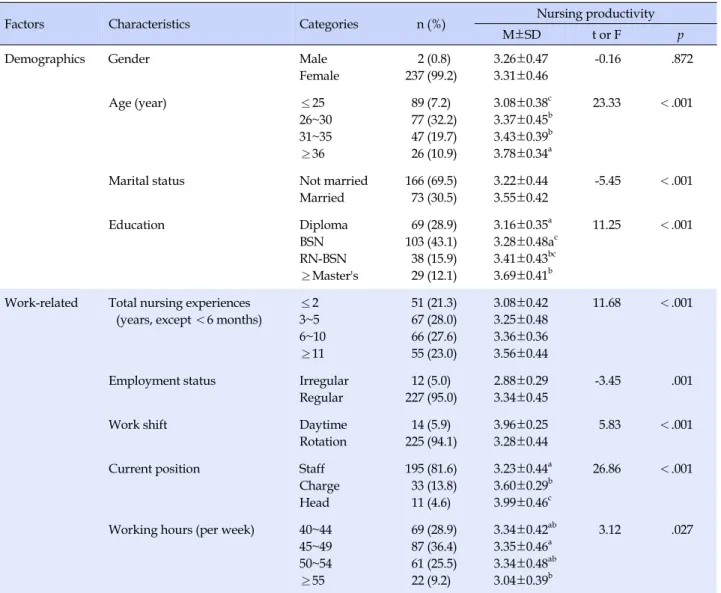
Table 1 presents the general characteristics of the sam-ple. Of the 239 subjects, the overwhelming majority were females (99.2%), aged less than 30 years old (39.4%), and unmarried (69.5%). Forty-three percent of nurses attained BSN degrees. Of the 239 subjects, 21.3% had less than 2 years of nursing experience. Many of them worked on a regular basis (95.0%), as rotation duty (94.1%), and as staff (81.6%). About one third of the sample (34.7%) worked more than 50 hours per week.
Table 2 presents the mean scores of the four measure-ments used. Of them, the highest mean scores were
emo-Table 3. Associations among Emotional Intelligence, Communication, Organizational Commitment, and Nursing Productivity Variables Emotional intelligence Communication Organizational commitment Nursing productivity r (p) r (p) r (p) r (p) Emotional intelligence 1 Communication .81 (<.001) 1 Organizational commitment .36 (<.001) .32 (<.001) 1 Nursing productivity .65 (<.001) .58 (<.001) .34 (<.001) 1
Table 2. Levels of Emotional Intelligence, Communication, Organizational Commitment, and Nursing Productivity
Variables Min Max M±SD
Emotional intelligence 2.06 4.75 3.39±0.44
Communication 2.13 5.00 3.39±0.47
Organizational commitment 2.07 3.73 2.92±0.22 Nursing productivity 2.00 4.67 3.31±0.46 tional intelligence (3.39±0.44) and communication (3.39± 0.47), followed by nursing productivity (3.31±0.46), and organizational commitment (2.92±0.22).
2. Comparison of Nurse Productivity according to
General Characteristics
As shown in Table 1, differences in the subjects’ nurse productivity were measured according to demographic and work-related characteristics. Overall, nursing pro-ductivity was significantly different in the subjects’ gen-eral characteristics except for gender. Those Korean nurses, who were over 36 years of age (p<.001), married (p<.001), and over master-graduated (p<.001), were more likely to show higher productivity in nursing practice compared to the other groups of nurses. In relation to work-related conditions, nurses who had more than 11 years of nursing experiences (p<.001), were regularly em-ployed (p=.001) in a hospital, worked in the day time (p< .001), was a charge or head nurse (p<.001), worked for less than 50 hours per week (p=.027) and were more likely to report higher nurse productivity than the nurses in the other groups. There were no specific significant differ-ences between the groups by gender.
3. Correlations among the Measured Variables
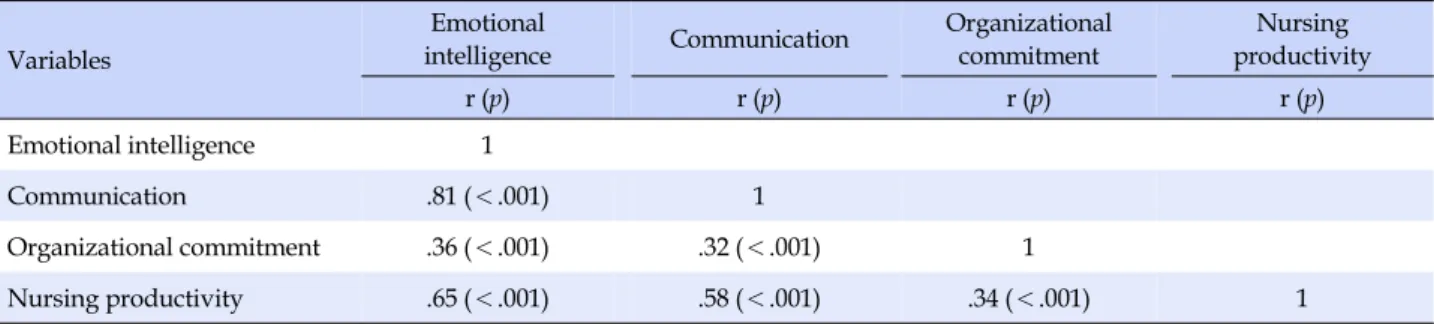
Pearson correlation coefficients were calculated to de-termine the relationships among the four variables (Table3). Nurse productivity was moderately positively corre-lated with emotional intelligence (r=.65, p<.001), follow-ed by the associations with communication (r=.58, p<.001) and organizational commitment (r=.34, p<.001). In addi-tion, the other three variables were significantly positively correlated with each other (p<.001).
4. Predictive Factors for Nurse Productivity
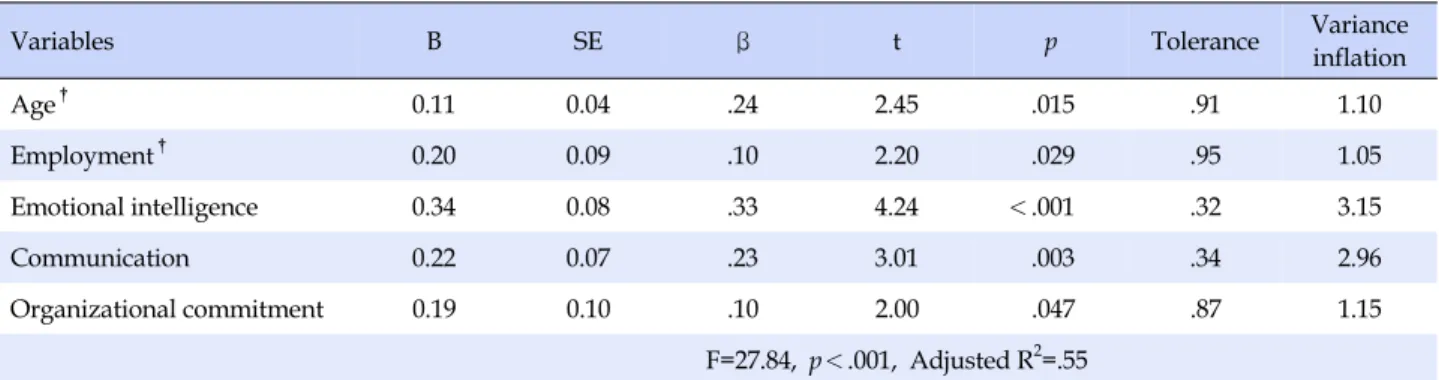
Stepwise Multiple regressions (enter method) were done to determine the effects of the selected variables in-cluded in this study which could have a significant influ-ence on the nurse productivity of the subjects. The final model showed that the five variables (age, employment, emotional intelligence, communication, and organiza-tional commitment) significantly predicted nursing pro-ductivity among the sample surveyed (F=27.84, p<.001). The model explains 55.4% of the variance in nurse pro-ductivity, with most of the variation explained by emo-tional intelligence (Table 4).DISCUSSION
Based on the empirical evidence, it seems that pre-vious studies have not yet identified what factors, except-ing economic values (i.e., staff ratio and cost), improve practices in nursing which consequently enhance nurs-ing productivity. This current study investigated factors affecting the productivity of Korean clinical nurses and their implications for enhancing nursing practice. Emotio-nal intelligence was the strongest predictor of productivi-ty in Korean nurse, and nursing productiviproductivi-ty was asso-ciated with nurses’ individual characteristics and other or-ganization-related factors in this study.
Factors affecting nursing productivity have been docu-mented in the literature. The factors that have been de-fined are inconsistent throughout these studies, and dif-ferent depending on the subjects’ specialties such as clin-ical nurses [4], nurse administrators [5], and nurse
practi-Table 4. Stepwise Multiple Regression for Factors Affecting Nursing Productivity of Participants (N=239)
Variables B SE β t p Tolerance Varianceinflation
Age† 0.11 0.04 .24 2.45 .015 .91 1.10 Employment† 0.20 0.09 .10 2.20 .029 .95 1.05 Emotional intelligence 0.34 0.08 .33 4.24 <.001 .32 3.15 Communication 0.22 0.07 .23 3.01 .003 .34 2.96 Organizational commitment 0.19 0.10 .10 2.00 .047 .87 1.15 F=27.84, p<.001, Adjusted R2=.55 SE=standard error; †
Dummy coded variables; "≥36" is equal to 1 otherwise "0" for age, and regular is equal to "1" otherwise "0" for employment status.
tioners [6], on nurses’ negative experiences such as work-place bullying [23], on nurse’s quality of work life [24], and organizational characteristics such as organizational trust [5] as well as on the supporting theoretical model for pro-ductivity [1,2,4].
The research trends for Korean nurses are similar to those of previous studies. For instance, customer orienta-tion was found to be the most important factor in explain-ing the variance in the productivity of Korean nurses working at a university hospital (35.3%), providing evi-dence that a high orientation toward customer (i.e., pa-tient) service was related to the delivery of a high level of healthcare services [8]. Park et al. [25] reported that sleep quality was a significant predictor of nursing produc-tivity, suggesting poor sleep quality may lead to lower nurse productivity. Similarly, experiences of workplace bullying and burnout affected organizational behaviors and nursing productivity [11], which is consistent with the result of Berry et al.[23].
In this study, nursing productivity was moderately sig-nificantly correlated with emotional intelligence, followed by communication and organizational commitment (p< .001 for all), confirming the results of previous studies: nursing productivity was positively correlated with emo-tional intelligence [7], and commitment [11]. Especially, a significant relationship between emotional intelligence and communication appeared to be the most significant finding (r=.81, p<.001) in this study, a finding which is al-so supported by the literature [14]. From these findings, it is assumed that nurses who are good at controlling their emotions, adequately communicating with other mem-bers, which are necessary for the delivery of patient care, and committing to their current organizations will be able to improve their productivity in their nursing practices. Consequently, the high level of those variables may con-tribute to increasing the level of nursing productivity
In addition, nursing productivity was significantly dif-ferent according to the demographics and career charac-teristics in the current study. Regarding the age of nurses, it was observed that the productivity of a nurse was sig-nificantly lower in younger nurses in this study as well as in previous studies with similarly aged populations [7, 11]. Similarly, Wei and Richardson [26] showed that older workers are not less productive than the other groups, suggesting that older workers are good substitutes for younger workers. A stronger relationship was observed between age group and nursing productivity; older nurses and a higher commitment to the organization [3]. Howev-er, there is a study that showed older nurses had a higher health-related productivity loss than that of younger nur-ses [27]. Based on these evidences, it is assumed that, be-yond the age differences between groups, there might be some other factors affecting nursing productivity such as the nurses’ roles (e.g., bedside patient care vs admin-istrative) or type of institution employed at (e.g., nursing home vs hospital) although the age groups were the same [26]. These inconsistent results may suggest the need for further studies investigating other additional underlying factors.
There were a number of limitations associated with this study. First, the target population in this study was limited to nurses from three university hospitals in Korea, result-ing in lack of generalizability of the findresult-ings. Various sized- samples with multi-institutional backgrounds are needed in future studies. Second, because of the nature of the cross-sectional design used in this study, we were not able to establish causal relationships among the four variables. Additionally, this study did not clearly reveal whether each variable directly affects nurse productivity or wheth-er one of them acts as a mediator which affects the othwheth-er re-maining variables. Future studies using longitudinal de-signs are strongly recommended.
One of the practical implications of this study is that or-ganization-related but non-cost variables such as emo-tional intelligence could affect the productivity of Korean nurses in daily practice. Generally, emotional intelligence has only been considered on an individual basis in terms of a nurse’s competency in controlling emotions. However, it is also affected by interactions with other staff members or patients, indicating that its development is also associated with the organizational environment as well as the nurse’s characteristics. Therefore, the importance of the hospital workplace environment to improve nurses’ competencies such as emotional intelligence and communication skills, which in turn, provides quality care, ultimately increases the productive outputs of nurses, needs to be emphasized. Another implication is that this is the first study to inves-tigate the associations between communication and ing productivity, not between communication and nurs-ing performance [14], which is a variable used often as a similar concept of productivity in studies [9,22]. A pre-vious study reported that the majority of medical errors involves faulty communication [28] and emotionally in-telligent nurse leaders influence patient care and out-comes [29]. The continuous education program of enhanc-ing emotional intelligence and communication skill for nurse managers as well as nurses can be a way to improve nurse productivity. Making the organizational climate in-fluence on emotional intelligence and communication competency in a positive way can be another strategy [30]. Given these results, further studies need to be conducted to investigate the predictive powers of the variables; more-over, the various elements of the factors need to be ex-plored because their influence on nursing productivity has yet to be elucidated.
CONCLUSION
This study provides insights into the importance of emotional intelligence and communication skills in that these variables affect nursing productivity. First, identi-fication of emotional intelligence as well as nurses’ general characteristics provides an opportunity for occupational health managers and nurse leaders to recognize how they are related to nursing productivity. In addition, consider-ing that the productivity of individual nurses in nursconsider-ing practice is dependent basically on their competency such as communication skills, these findings suggest the neces-sity to design nurse-centered staff development programs.
Most importantly, beyond cost-related value, reframing nursing productivity based on improvable and control-lable variables in nurses along with the supporting
man-agement of organizations is strongly recommended for better quality of patient care and nurse outcomes.
REFERENCES
1. Farhadi P, Ravangard R, Sajjadnia Z,Jafari A, Ghasemi H, Rahgoshay I. Study of factors affecting the productivity of nurses based on the ACHIEVE model and prioritizing them using analytic hierarchy process technique, 2012. Archives of Pharmacy Practice. 2013;4(2):63-70.
https://doi.org/10.4103/2045-080x.112986
2. North N, Hughes F. A systems perspective on nursing pro-ductivity.Journal of Health Organization and Management. 2012;26(2):192-214.
https://doi.org/10.1108/14777261211230772
3. McNeese-Smith DK, Van Servellen G. Age, developmental, andjob stage influences on nurse outcome. Outcomes Manage-ment for Nursing Practice. 2000;4(2):97-104.
4. Nayeri ND, Bahabadi AH, Kazemnejad A. Investigating the productivity model for clinical nurses. Acta Medica Iranica. 2014;52(10):757-763.
5. Bahrami S, Hasanpour M, Rajaeepour S, Aghahosseni T, Hodhodineghad N. The relationship between organizational trust and nurse administrators' productivity in hospitals. Irani-an Journal of Nursing and Midwifery Research. 2012;17(6): 51-455.
6. Xue Y, Tuttle J. Clinical productivity of primary care nurse practitioners in ambulatory settings. Nursing Outlook. 2017; 65(2):162-171.
https://doi.org/10.1016/j.outlook.2016.09.005
7. Cho HK, Choi YJ,Jeon MK,Jung GH. Factors affecting nursing productivity of clinical nurses: Focused on emotional intel-ligence and burnout. TheJournal of the Korea Contents Asso-ciation. 2015;15(9):307-316.
https://doi.org/10.5392/jkca.2015.15.09.307
8. Yeo AR, Lee HJ,Jin HK. Factors associated with customer orientation and nursing productivity.Journal of Korean Acad-emy Nursing Administration. 2014;20(2):167-175.
https://doi.org/10.11111/jkana.2014.20.2.167
9. Doo EY, LimJY, Seomun GA, Kim IA. An analysis of nurse's perception of internal marketing activities affecting on nurse's turnover intention, nursing task performance and nursing productivity. Journal of Korean Academy Nursing Admin-istration. 2005;11(1):1-12.
10. Kim SY, Kim EK, Lim HM, Lee MY, Park KO, Lee KA. Struc-tural equation modeling on nursing productivity of nurses in Korea.Journal of Korean Academy of Nursing. 2013;43(1):20- 29. https://doi.org/10.4040/jkan.2013.43.1.20
11. Park KO, Kim SY, KimJK. Hospital nurses' experience of bul-lying in the workplace and burnout, organizational
commit-ment, turnover intention and nursing productivity.Journal of Korean Clinical Nursing Research. 2013;19(2):169-180. 12. ChoiJH. Relationship between nurse's emotional intelligence,
communication competency, and organizational commitment [master's thesis]. [Suwon]: Ajou University; 2010. 66 p. 13. Joo YS, Han SS. The effects of leader's emotional intelligence
and nurse's own emotional intelligence on organizational com-mitment and organizational citizenship behavior. TheJournal of Korean Academic Society of Nursing Education. 2013;19(2): 194-202. https://doi.org/10.5977/jkasne.2013.19.2.194 14. Lee YB, Koh MS. The effect of clinical nurses' communication
competency and emotional intelligence on organizational per-formance.Journal of Korean Clinical Nursing Research. 2015; 21(3):347-354.
15. Petrovici A, Dobrescu T. The role of emotional intelligence in building interpersonal communication skills. Procedia - Social and Behavioral Sciences. 2014;116:1405-1410.
https://doi.org/10.1016/j.sbspro.2014.01.406
16. Holcomb BR, Hoffart N, Fox MH. Defining and measuring nursing productivity: A concept analysis and pilot study. Jour-nal of Advanced Nursing. 2002;38(4):378-386.
https://doi.org/10.1046/j.1365-2648.2002.02200.x
17. Wong CS, Law KS. The effects of leader and follower emotional intelligence on performance and attitude: An exploratory study. The Leadership Quarterly. 2002;13(3):243-274.
https://doi.org/10.4324/9781315250601-10
18. Fukuda E, Saklofske DH, Tamaoka K, Lim H. Factor structure of the Korean version of Wong and Law's emotional intelli-gence scale. Assessment. 2012;19(1):3-7.
https://doi.org/10.1177/1073191111428863
19. Hur GH. Construction and validation of a global interpersonal communication competence scale. KoreanJournal of Journal-ism and Communication Studies. 2003;47(6):380-426. 20. Mowday RT, Steers RM, Porter LW. The measurement of
or-ganizational commitment.Journal of Vocational Behavior. 979; 14(2):224-247.
21. Kim KJ. An empirical study on the turnover decision process
[master's thesis]. [Seoul]: Korea University; 1986. 100 p. 22. Lee HJ. Predictors ofjob performance, work satisfaction, and
productivity among Korean hospital nurses.Journal of Kore-an Academy of Nursing Administration. 2001;31(4):571-583. https://doi.org/10.4040/jkan.2001.31.4.571
23. Berry PA, Gillespie GL, Gates D, SchaferJ. Novice nurse pro-ductivity following workplace bullying. Journal of Nursing Scholarship. 2012;44(1):80-87.
https://doi.org/10.1111/j.1547-5069.2011.01436.x
24. Borhani F, Arbabisarjou A, Kianian T, Saber S. Assessment of predictable productivity of nurses working in Kerman Univer-sity of medical sciences' teaching hospitals via the dimensions of quality of work life. GlobalJournal of Health Sciences. 2016; 8(10):65-72.
25. Park E, Lee HY, Park CS. Association between sleep quality and nurse productivity among Korean clinical nurses.Journal of Nursing Management. 2018;26(8):1051-1058.
https://doi.org/10.1111/jonm.12634
26. Wei Z, Richardson S. Are older workers less productive? A case study of aged care workers in Australia. The Economic Record. 2010;86(s1):115-123.
https://doi.org/10.1111/j.1475-4932.2010.00665.x
27. Letvak S, Ruhm C, Gupta S. Differences in health, productivity and quality of care in younger and older nurses.Journal of Nursing Management. 2013;21(7):914-921.
https://doi.org/10.1111/jonm.12181
28. Codier E, Codier D. Could emotional intelligence make pa-tients safer? AmericanJournal of Nursing. 2017;117(7):58-62. https://doi.org/10.1097/01.NAJ.0000520946.39224.db 29. Smith KB, Profetto-McGrath J, Cummings GG. Emotional
intelligence and nursing: An integrative literature review. Inter-nationalJournal of Nursing Studies. 2009;46(12):1624-1636. https://doi.org/10.1016/j.ijnurstu.2009.05.024
30. Vasudevan H, Mahadi N. Emotional intelligence, commit-ment and climate in organizations: Bridging contribution and practical implication. Review of Integrative Business and Eco-nomics Research. 2017;6(supp 1):202-216.