36-3 / Hwi Kim
IMID 2009 DIGEST •
Abstract
In this paper, an accurate ray-tracing based visual analysis method of lenticular 3D liquid liquid crystal display (LCDs) and some analysis results are presented. In the developed method, the geometric optics analysis is performed on the single 3D unit pixel of 3D lenticular LCD. It is shown that the display characteristics of 3D lenticular LCD panels of arbitrary size can be evaluated through the 3D unit pixel analysis. The analysis results of a few representative structures of 3D lenticular LCDs are compared.
1. Introduction
Three-dimensional (3D) display is one of next-generation display technology having huge application potential and has been intensively researched [1] in industry as well as academia. In the R&D activities associated with the development of autostereoscopic 3D displays, simulation based design and analysis is considered as a key fundamental technology, which enables several R&D tasks such as optimal design, novel idea extraction and evaluations to be efficiently performed without expensive experimental trials.
In this paper, a ray-tracing based three-dimensional visual simulation tool and analysis method of autostereoscopic lenticular 3D LCDs are developed. The developed 3D ray-tracing simulator provides real graphic images of lenticular 3D LCDs that are same as what can be seen by observers at any observation positions. In principle, the lenticular 3D LCDs of arbitrary size with arbitrary composition of lens array and LCD panel can be analyzed with the 3D unit pixel characterization. In this paper, the 3D unit pixel characterization method is addressed with the developed 3D pixel simulator and the extended analysis of the whole panel characterization with respect to crosstalk and moiré based on the raw data obtained by the 3D pixel simulator is presented.
2. Geometric model of 3D displays
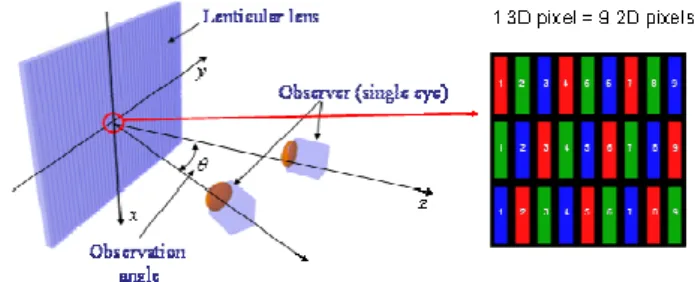
In Fig. 1, the conceptual schematic of the developed 3D pixel simulator is illustrated. A lenticular 3D LCD is placed on the x-y plane (z=0) and it is assumed that an observer with single eye sees the single pixel located on the origin (x,y)=(0,0). The observation angle θ is defined by the angle between the z-axis and the line connecting the origin and the observer. For the lenticular 3D displays with horizontal 9 views, one 3D pixel is composed of nine 2D pixels as indicated in Fig. 1.
Fig. 1. Concept of the 3D pixel simulator
The developed 3D pixel simulator visualizes the images seen by the observer’s eye through the lenticular lens. The raw data calculated by the 3D pixel simulator is the images of the center 3D unit pixel observed for several observation angles. Figures 2(a) and 3(a) show the pixel patterns of 2D LCD panels of two conventional 3D lenticular LCDs; stripe mosaic panel with vertical lenticular lens array and z-cell mosaic panel with lenticular lens array, respectively. In Figs. 2(b) and 2(c), the simulated images of the 3D unit pixel of the stripe mosaic panel with vertical lens array seen at the observation directions of 16.25(deg.) and 41(deg.) are shown, respectively. Similarly, in Fig. 3(b) and 3(c), those of the z-cell mosaic panel with vertical lens array observed at the same directions are presented. From
Analysis of lenticular 3D liquid crystal displays using 3D
pixel simulator
Hwi Kim, Kyoungho Jung, Haeyoung Yun, Seunghoon Lee, Heesub Kim,
and Sungtae Shin
Fundamental Technology Group, LCD research center, Samsung Electronics, Yongin-City, Gyeonggi-Do 446-711, Korea
Tel.:82-31-209-7800, E-mail: [email protected]
Keywords: lenticular 3D display, liquid crystal display, crosstalk, moiré, pixel simulator
36-3 / Hwi Kim
• IMID 2009 DIGEST
the 3D pixel images, we can extract several characteristic data on the investigated 3D display structure such as crosstalk and moiré characteristics.
(a)
(b)
(c)
Fig. 2. (a) Stripe mosaic 2D pixel pattern for the 9-multiview 3D unit pixel with vertical lenticular lens array and 3D unit pixel images captured at the observation directions of (b) 16.25(deg.) and (c) 41(deg.), respectively.
3. 3D unit pixel characterization
Using the raw data obtained by the 3D pixel simulator, we can do the post-analysis on several imaging characteristics of examined lenticular 3D LCD. The raw data information obtained by the analysis of single 3D unit pixel is directly interpreted to the total display characteristics of whole panel such as Moiré and cross-talk.
Let us design the pixel characteristic function indicating the radiant power distribution, which is actually the 2D image distribution shown in Figs. 2 and 3. We can define nine pixel characteristic functions as the total power of the white image of
nth view for a specific observation angle θ denoted by In( )θ , where In( )θ is the normalized power
function satisfying
(a)
(b)
(c)
Fig. 3. (a) Z-cell mosaic 2D pixel pattern for the 9-multiview 3D unit pixel with vertical lenticular lens array and 3D unit pixel images captured at the observation directions of (b) 16.25(deg.) and (c) 41(deg.), respectively. ( ) 9 1 1 n n I θ = =
∑
. (1)These power functions, In( )θ , can be directly
calculated from the raw data of 3D unit pixel images shown in section 2. With the nine power functions,
( )
n
I θ , the characteristic functions indicating crosstalk and moiré can be defined. In this paper, the crosstalk is defined as the normalized standard deviation of the nine power functions as
36-3 / Hwi Kim IMID 2009 DIGEST • ( )
(
( ))
( ) ( )(
)
9 2 1 2 2 1 9 1 8 1/ 9 8 / 9 9 n n I θ m σ θ = − = +∑
, (2) where ( ) 9 1 1 9n n m I θ ==
∑
. If the total power ( )9 1 n n I θ =
∑
issmaller than a threshold value Ic, the status of the
pixel is black. In this case, the crosstalk σ θ( ) is given by the value of 1.
-600 -40 -20 0 20 40 60 0.2 0.4 0.6 0.8 1 Observation angle(deg.) Rel a tiv e vie w r a ti o Cr o s s ta lk -600 -40 -20 0 20 40 60 0.2 0.4 0.6 0.8 1 Observation angle(deg.) Rel a tiv e vie w r a ti o Rel a tiv e vie w r a ti o Cr o s s ta lk (a) -600 -40 -20 0 20 40 60 0.2 0.4 0.6 0.8 1 R e la tive v iew ra ti o -600 -40 -20 0 20 40 60 0.2 0.4 0.6 0.8 1 R e la tive v iew ra ti o R e la tive v iew ra ti o (b)
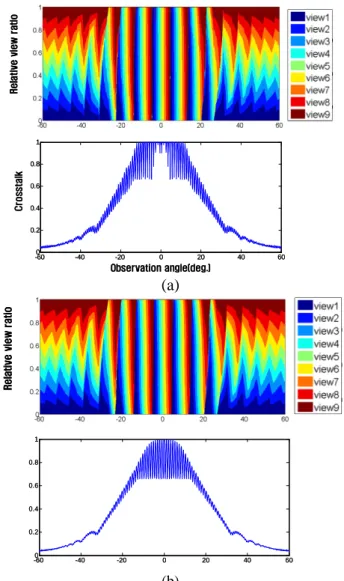
Fig. 4. Crosstalk analysis of 3D unit pixels of (a) stripe mosaic panel and (b) z-cell mosaic panel for vertical lenticular lens array.
Figures 4(a) and 4(b) show the crosstalk analysis results of the stripe mosaic panel and z-cell mosaic panel, respectively. Comparing the result, the level of crosstalk of two types of 3D display is very similar. The allowable viewing angle is measured as about -20(deg.)~+20(deg.) for both types.
The critical difference between two types appears in the moiré property. The moiré pattern indicates the gray periodic pattern appearing on the 3D display. That can be effectively defined as the function
( ) 9 ( ) 1 n n F θ θ = Μ =
∑
. (3)The moiré characteristic function is visualized for several observation distances and lateral shifts in Fig. 5. As clearly compared in Fig. 5, the moiré property of the z-cell mosaic panel is superior to that of the simple stripe mosaic pane. The optimal observation distance of the panel is assumed to be 3.5m in this simulation.
-0.6 -0.4 -0.2 0 0.2 0.4 0.6 5 10 15 20 25 30 0.2 0.3 0.4 0.5 0.6 0.7 0.8 0.9 1 Obs e rv a ti on di s ta nce -0.6 -0.4 -0.2 0 0.2 0.4 0.6 5 10 15 20 25 30 0.2 0.3 0.4 0.5 0.6 0.7 0.8 0.9 1 Obs e rv a ti on di s ta nce (a) -0.6 -0.4 -0.2 0 0.2 0.4 0.6 5 10 15 20 25 30 0 0.2 0.4 0.6 0.8 1 Ob s e rv a tio n di st ance -0.6 -0.4 -0.2 0 0.2 0.4 0.6 5 10 15 20 25 30 0 0.2 0.4 0.6 0.8 1 Ob s e rv a tio n di st ance (b)
Fig. 5. Moire characteristics of (a) stripe mosaic panel and (b) z-cell mosaic panel with vertical lenticular lens array (designed observation distance is 3.5m).
The most interesting feature of the developed simulator is the 3D ray-tracing observation images of whole 3D LCD panels. As stated in the introduction, the panel observation images can be synthesized from the pixel characteristic function. Let us assume that an observer’s position is at (x y zs, s, s). To this observer, a
pixel on the 3D display at
(
xp,yp,0)
is seen with theradiant power of In
( )
θp , where θp is approximatelygiven by
(
)
1 tan / p ys yp zs θ = − − . (4)The crosstalk data of all 3D pixels on the 3D panel for a fixed position observer can be evaluated with the
36-3 / Hwi Kim
• IMID 2009 DIGEST
pixel characteristic function, In( )θ . As a result, we
can synthesize the observation image of whole panel with finite size for any observation direction. Figures 6 and 7 present the panel observation simulation results of the 52inch 9-multiview lenticular 3D displays with stripe mosaic and z-cell mosaic patterns, respectively. In Figs. 6(a) and 6(b), the panel images observed by a single eye at the observation directions of 16.25(deg.) and 41(deg.) are shown, respectively. In Figs. 7(a) and 7(b), the panel images observed by the single eye at the observation directions of the same positions are presented, respectively. The image blurs induced by the crosstalk are vividly perceived in the observed images of 41(deg.). It is noted that a wide dark stripe pattern is perceivable in Fig. 6(a). As confirmed in Fig. 5, the zig-zag pixel pattern of the z-cell structure is superior to the stripe pixel pattern regarding the moiré pattern. In the conference presentation, the movie displaying the observed scenes varied with the observation angle from 0(deg.) to 80(deg.) will be reported.
(a)
(b)
Fig. 6. Observation simulations of stripe mosaic panel at the observation directions of (a) 16.25(deg.) and (b) 41(deg.)
(a)
(b)
Fig. 7. Observation simulations of z-cell mosaic panel at the observation directions of (a) 16.25(deg.) and (b) 41(deg.)
4. Conclusion
The 3D unit pixel characterization method for the analysis and design of 3D lenticular LCDs has been proposed. In the proposed method, the lens aberration and details of LCD pixel patterns are accurately considered through geometric ray-tracing method. The simulation evaluation of the imaging quality measures such as moiré and cross-talks of the panel of arbitrary size can be performed accurately and efficiently. The developed 3D pixel characterization method would be extensively applied to design and analysis of general class of 3D displays.
References
1. B. Lee, J.-H. Park, and S.-W. Min, Chapter 12 in Digital Holography and Three-Dimensional Display, Springer, New York, USA, 2006, p. 393. 2. H. Kim, J. Hahn, and B. Lee,“The use of a negative
index planoconcave lens array for wide-viewing angle integral imaging,“ Opt. Express 16[26], p. 21865 (2008).
3. M. Salmimaa and T. Järvenpää,“Objective evaluation of multi-view autostereoscopic 3D displays,“ SID’08 Technical Digest, p. 267 (2008).