INTRODUCTION
Hydrogels are three dimensional, hydrophilic, polymeric networks, which can absorb large amounts of water or a biological fluid without dissolution due to the presence of chemical crosslinks, or physical crosslinks (Peppas et al. 1976; Risbud et al. 2000). The networks are composed of a homopolymer or copolymer, and are insoluble due to the presence of chemical crosslinks (tie-points, junctions), or physical crosslinks such as entanglements or crystallites (Peppas et al. 1976). The hydrogels resemble natural living tissue more than any other classes of synthetic biomaterials due to their high water contents and soft consistency which is similar to natural tissue. Hydrogels used as wound burn dressings were invented by Rosiak et al. (1994) and they have many interesting properties: immediate pain control; easy replacement; transparency to allow healing follow up;
absorbance and prevention of loss of body fluids; barrier against bacteria; good adhesion; good handling; oxygen per-meability; control of drug dosage and so on. They usually show a good biocompatibility in contact with blood, body fluids and tissues (Rosiak 1994). Hence, they are often used for contact lens, burn wound dressings, artificial cartilages or membranes as well as the coating materials being applied in the contact with living organism, e.g., coating of the sur-face of catheters, electrodes, vascular prostheses etc. Because of their ability to swell as well as to release the trapped par-ticles into the surrounding medium, hydrogels are often used as drug delivery systems.
PVA hydrogels have been developed for repair of wounds and promotion of wound healing (Winter 1962; Burczak et al. 1994). The PVA hydrogels have received increasing atten-tion in biomedical and biochemical applicaatten-tions, because of their permeability, biocompatibility and biodegradability (Muhlebach et al. 1996; Yeom et al. 1996; Matsuyama et al. 1997).
Glycerol is a sweet colorless, transparent, and odorless
Journal of Radiation Industry 3 (3) : 201~204 (2009)
─ ─ 201 ──
Study on Specific Water Contents and Thermal
Properties of Poly(vinyl alcohol) Hydrogels Prepared
by γ-Irradiation
Woo-Jin Kim, Hui-Jeong Gwon, Youn-Mook Lim, Yong-Soo Kim, Bo-Ram Choi, Sun-Young Jo and Young-Chang Nho*
Advanced Radiation Technology Institute, Korea Atomic Energy Research Institute, Jeongeup 580-185, Korea
Abstract -- The specific water contents and thermal behavior of poly(vinyl alcohol) (PVA) hydrogel were examined as a function of gamma-irradiation dose and PVA content to develop an advanced wound dressing. A simple crosslinking method was introduced to prepare the PVA hydrogels with the use of gamma-irradiation. The specific water contents decreased with increasing glycerol con-tent and the melting temperature of PVA slightly decreased with increasing the dose rate of gamma-ray and amount of glycerol.
Key words : Poly(vinyl alcohol), Glycerol, Gamma-irradiation, Hydrogels
* Corresponding authors: Young-Chang Nho, Tel. +82-63-570-3060, Fax. +82-63-570-3069, E-mail. [email protected]
syrupy liquid. It is a humectant, i.e. “draws moisture”. It is used in creams, lotions, facial treatments, masks, and other bodycare products (Huang and Yang 2008).
In order to prepare hydrogels, γ-ray irradiation has been recognized as a very suitable method for the formation of hydrogels. Its main advantages, compared to the other meth-ods, are no necessity to add any initiators and cross-linkers to start the process, hence the final product contains only polymer in its structure and the final product does not require further purification (Zhao et al. 2004). Moreover, γ-ray irra-diation usually allows for the combination of a synthesis and sterilization of polymeric materials in one technological step, thus reducing the costs and production time (Rosiak et al. 1999). These make a γ-ray irradiation a very suitable tool for preparation of hydrogels.
In this study, the poly (vinyl alcohol) (PVA) based hydro-gel was prepared by using γ-ray irradiation to simplify the cross-linking process, and the glycerol was used as a moi-sturizer to improve the hygroscopic nature. The effects of the irradiation dose, the contents of glycerol on the absorption ratio and thermal properties were investigated to create the desired hydrogels for an advanced wound dressing.
MATERIALS AND METHODS
1. Materials
Poly (vinyl alcohol) (PVA) (Mw==8.5×10⁴~1.46×10⁵) with a 98% of hydrolysis was supplied by the Aldrich Che-mical Company (WI, USA). Glycerol was supplied by the Showa Company (Japan). These polymers were used without further purification. Distilled water was used as a solvent in all the experiments.
2. Preparation of hydrogels
PVA/Glycerol (PVA/Gly) was dissolved in distilled water at 120�C for 20 min by using an autoclave. The PVA content varied from 18 wt% to 22 wt%. To remove bubbles and pre-vent the hardening of the homogeneous solutions, the solu-tions were placed in a water bath at 70�C for 30 min. These solutions were then poured into Petri dishes to make the hydrogels. The irradiation was performed by 60Co γ-ray to doses of 20, 30 and 40 kGy, respectively, at a dose rate of 10 kGy h-1.
3. Specific water content
To measure the specific water content, the hydrogels were immersed in distilled water for different times at room tem-perature until an equilibrium state of absorption was achiev-ed. The procedure was repeated until there was no further weight increase. The swollen gels were then dried at 60�C for 48 h to a constant weight. The specific water content of the hydrogels was given by W (%)==[(Ws-Wd)/Wi]×100. Where Wsis the weight of the swollen hydrogels, Wdis the oven-dried gel weight after washing, and Wiis the initial weight of the dried hydrogels.
4. Thermal analysis
The physical blended hydrogel samples were dried at 60�C for 48 h before using a differential scanning calorimetry (DSC, DSCQ100 TA Instrument Company). During the measurement, the dried hydrogels were heated from 30 to 240�C under N2 atmosphere with a heating rate of 10�C min-1.
RESULTS AND DISCUSSION
The PVA/Gly hydrogels were successfully prepared by using gamma-irradiation. Crosslinking by irradiation trans-forms a linear polymer into a three-dimensional molecule, resulting in a significant increase in the molecular mass, lower solubility in organic solvents, and improve mechanical properties. Degradation results in a decrease in the molecular mass, and has the opposite effect on the physical properties of the polymer. Crosslinking and degradation occur simul-taneously. However, the ratio of their rates depends on the chemical structure of the polymer, its physical state, and the irradiation state. Polymers are generally divided into those that predominantly crosslink and those that predominantly degrade. In this study, the PVA is easily crosslinked in their homogeneous mixture with water.
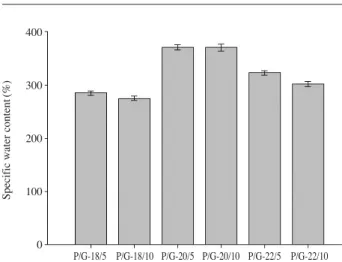
The specific water content of hydrogel is an important parameter in its practical uses. Particularly, hydrogels used as wound dressing should have large water absorption capa-city in order to absorb the wound exudates. Fig. 1 shows the specific water content of the hydrogels as a function of the PVA and glycerol contents after the equilibrium state had been reached. As shown in Fig. 1, the 20/5 wt%
concentra-Woo-Jin Kim, Hui-Jeong Gwon, Youn-Mook Lim, Yong-Soo Kim, Bo-Ram Choi, Sun-Young Jo and Young-Chang Nho 202
tion of PVA/Gly showed an excellent specific water content with 362%. The specific water content increased with in-creasing the contents of PVA due to their high hydrophilici-ty, but decreased when the glycerol content. The thermal properties of the hydrogels were studied by DSC measure-ments. The pure PVA exhibits an endothermic peak at about 228.3�C. According to Table 1 and Fig. 2, as compare to
pure PVA, the melting temperature is reduced for PVA/Gly hydrogel and it decreases with a decreasing PVA content. This indicates that the ordered associations of PVA mole-cules are decreases by the presence of glycerol. Also, the increases in the irradiation dose results in a reduction in the melting temperature. The chemical changes formed by irra-diation often involve the cross-linking and degradation and these changes often decrease the degree of crystallinity with increasing irradiation dose. Thus, the chemical changes form-ed by irradiation rform-educe the melting temperature. Hydrogels with more content of PVA exhibit increased melting tem-perature, a similar phenomenon to that of the physical blends. Thus, it can be seen that irradiation influenced the thermal behavior of PVA.
CONCLUSION
The hydrogel based on PVA and glycerol was developed by γ-irradiation. The effects of the irradiation doses and the contents of PVA and glycerol on the specific water content and thermal properties were investigated. Hydrogels with increased contents of PVA and glycerol show decreased the specific water content. The increase in irradiation dose leads to an increase in chemical crosslinking density. The ordered association of PVA is significantly altered by chemical cross-linking and by the presence of glycerol. The most efficient crosslinking conditions were obtained for the PVA/Gly con-tents of 20/5 wt% at 25 kGy and these hydrogels which can provide an excellent specific water content (¤360%) for biomedical applications.
ACKNOWLEDGMENT
This work was supported by a grant from the Korea Sci-ence and Engineering Foundation in the Ministry of Educa-tion, Science and Technology, Republic of Korea.
REFERENCES
Burczak K, Fujisato T, Hatada M and Ikada Y. 1994. Protein per-meation through poly(vinyl alcohol) hydrogel membranes. Biomaterials 15(3):231-238.
Huang MH and Yang MC. 2008. Evaluation of glucan/poly
Water Contents and Thermal Properties of γ-irradiated PVA gels 203
Fig. 1. The specific water content (%) as a function of the contents of PVA/Gly after the equilibrium state had been reached.
Table 1. The melting temperatures (�C) for PVA/Gly hydrogels at
different compositions
Irradiation PVA/Gly content (wt%)
dose (kGy) 18/5 18/10 20/5 20/10 22/5 22/10
20 188.9 188.1 194.2 193.9 199.1 198.7
30 187.7 187.1 193.9 192.5 198.1 197.6
40 186.8 186.3 192.6 191.7 196.9 196.1
Fig. 2. The melting temperatures (�C) as a function of the contents
of PVA. 400 300 200 100 0 P/G-18/5 P/G-18/10 P/G-20/5 P/G-20/10 P/G-22/5 P/G-22/10
Specific water content
(%) 200 150 100 50 0
PVA 18 wt% PVA 20 wt% PVA 22 wt%
20 30 40
Irradiation dose (kGy)
Melting temperature
(�
(vinyl alcohol) blend wound dressing using rat models. Int. J. Pharm. 346:38-46.
Matsuyama H, Teramoto M and Urano H. 1997. Analysis of solute diffusion in poly(vinyl alcohol) hydrogel membrane. J. Membrane Sci. 126:151-160.
Muhlebach A, Muller B, Pharisa C, Hofmann M, Seiferling B and Guerry D. 1996. New water-soluble photo-cross-linka-ble polymers based on modified poly(vinyl alcohol). J. Polym. Sci. Pol. Chem. 35(16):3603-3611.
Peppas NA and Merrill EW. 1976. Differential scanning calori-metry of crystallized PVA hydrogels. J. Appl. Polym. Sci. 20(6):1457-1465.
Rosiak JM. 1994. Radiation formation of hydrogels. J. Control. Release 31:9.
Rosiak JM and Ulanski P. 1999. Synthesis of hydrogels by irra-diation of polymers in aqueous solution. Radiat. Phys. Chem. 55:139-151.
Risbud MV, Hardikar AA, Bhat SV and Bhonde RR. 2000.
pH-Sensitive freeze-dried chitosan-polyvinyl pyrrolidone hydro-gels as controlled release system for antibiotic delivery. J. Control. Release 68:23-30.
Winter GD. 1962. Formation of the scab and the rate of epithe-lialization of superficial wounds in the skin of the young domestic pig. Nature 193:293.
Yeom CK and Lee KH. 1996. Pervaporation separation of water-acetic acid mixtures through poly(vinyl alcohol) membranes crosslinked with glutaraldehyde. J. Membrane Sci. 109: 257-265.
Zhao L, Mitomo H, Yoshii F and Kume T. 2004. Preparation of crosslinked carboxymethylated chitin derivatives by irra-diation and their sorption behavior for copper (II) ions. J. Appl. Polym. Sci. 91:556-562.
Manuscript Received: September 17, 2009 Revision Accepted: September 24 2009
Woo-Jin Kim, Hui-Jeong Gwon, Youn-Mook Lim, Yong-Soo Kim, Bo-Ram Choi, Sun-Young Jo and Young-Chang Nho 204