Performance Test for Developing the Acoustic Leak Detection System of the LMR Steam
Generator
Tae-Joon Kim, Ji-Young Jeong, Seop Hur
Korea Atomic Energy Research Institute, 150 Dukjin-dong, Yuseong-gu Daejeon 305-353, Korea [email protected]
1. Introduction
The successful detection of a water/steam into a sodium leak in the LMR SG (steam generator) at an early phase of a leak origin depends on the fast response and sensitivity of a leak detection system. It is considered [1], that the acoustic system is intended for a fast detecting of a water/steam into a sodium leak of an intermediate flow rate, 1~10 g/s, during several seconds. This intention of an acoustic leak detection system is stipulated by a key impossibility of a fast detecting of an intermediate leak by the present nominal systems such as the hydrogen meter.
Subject of this study is to introduce the detection performance of the acoustic leak detection system discriminated by a back-propagation neural network with a preprocessing of the FFT power spectrum analysis and the Octave band analysis, and to introduce the status of the development of the acoustic leak detection in KAERI. It was used with the acoustic signals from the injected Argon gas into water experiments in KAERI, the acoustic signals injected from the water into the sodium obtained in IPPE, and the background noise of the PFR superheater.
2. Experiments
Measurements of the micro-leak noises in circulating
sodium at a sodium temperature of 350~500oC were
executed in the IPPE facility and have confirmed the prospects of a passive acoustic method for a micro-leak detection in an industrial steam generator in the KAERI facility. The experimental works of the Argon gas injection were in a water mock-up facility of KAERI. The container in the KAERI facility was constructed with stainless steel 304, and its sizes are height 2000mm, diameter 500mm and thickness of the wall 10mm. The Argon gas injection system consists of a micro nozzle, diameter 0.006~ 0.16 mm and a
high-pressure outflow system supplied up to 100kg/cm2.
Here we tested the discrimination of acoustic leak detection by the back-propagation neural network. The signals to test the system are prepared by mixing the signal to amplify and to attenuate the leak signals based on the amplitude of the background noise, the leak signal, and the background noises.
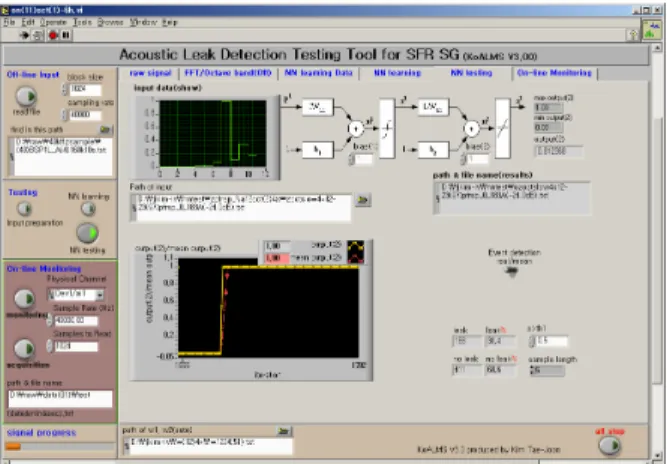
This acoustic leak detection system as shown in Fig. 1, constructed with LabVIEW consists of the unit for preprocessing the signals and the neural network having the input of its feature vector by a pre-processing.
Figure 1. LabVIEW panel of the acoustic leak detection system developed in KAERI.
3. Results and Discussion
3.1 Analysis of the signals obtained by water into sodium leak and by the Argon gas injection
The typical analysis of the noise spectra resulting at a leak stage is presented in Fig. 1; it is its FFT analysis results. The main peak of the frequency in these FFT spectra is around 1171 Hz in Fig. 2(upper) in the case of the sodium-water reaction at a leak rate increase from 0.005 g/s to 0.183 g/s, an increase in the amplitude of the raw signal, and the frequency relative to the spectrum maximum was approximately observed at more than three times, and around 1421 Hz in Fig. 2(Lower) in the case of the Argon gas injection into water. These frequencies are similar with the calculations [2]. In the Argon gas injection to compare the bubbling frequency regime, the frequency by a bubbling was also around 1~2 kHz followed with the
Argon gas flow rates, 0.26~210cm3/sec, according to
the diameter of the micro nozzle under 100kg/cm2. The
presence of smaller sized and larger hydrogen bubbles was insignificant.
Transactions of the Korean Nuclear Society Autumn Meeting Busan, Korea, October 27-28, 2005
Figure 2. Typical FFT analysis results of the experiment for water into sodium leak: sodium-water reaction (upper), Argon gas injection into water (Lower).
3.2 Detection logic for sodium-water reaction system
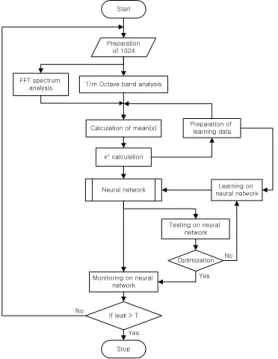
As described previously the acoustic leak detection system consists of the neural network and the preprocessing unit of the signals as shown in Fig. 3. The preprocessing unit is also used for the FFT power spectrum analysis and the 1/m Octave band analysis function, and its sampling rate of the input data of a preprocessing is 1024, and the selected frequency band is 0.47~1.6 kHz. After its preprocessing, it is again calculated for the input data of the feature vector for learning about and testing the neural network, and then after an optimizing by learning of the weight values of the neural network and we monitor the raw leak signals using the optimized neural network to detect the leak state or no leak state based on the threshold condition to define the leak.
Figure 3. Preliminary acoustic leak detection system logic diagram for the sodium-water reaction system
3.3 Performance of the acoustic leak detection system using test signals
The performance of the developed acoustic leak detection methodology using the sodium-water reaction noises controlled with the attenuation of the leak signal against the background noise of the PFR superheater was shown to detect a leak up to -22dB ~ -27dB according to the learning conditions of the neural network as shown in Fig. 4. One of the learning conditions was the background noise and the mixed noise with the background signal and controlled attenuation signal of the leak signal, another was only the background noise and the signal of the sodium-water reaction noise.
Figure 4. Leak probability tested by the developed acoustic leak detection system.
3. Conclusion
To protect the LMR SG from a damage of a tube bundle owing to the origin of secondary leaks it is necessary to detect a leak during its self-wastage up to the moment of the outflow diameter, with the performance results by the developed acoustic leak detection methodology it was possible to detect the leak up to 22dB, in some cases to detect the leak up to -27dB according to the learning conditions. At present the system has no errors for detecting a leak, but in the future it must be absolutely assured that it has no error for detecting a leak.
ACNOWLEDGEMENT
This study was performed under the Mid and Long-term Nuclear R&D Program sponsored by the Ministry of Science and Technology (MOST) of Korea.
REFERENCES
[1] Kim Tae-Joon, Advantages of Acoustic Leak Detection System Development for LMR Steam Generators, Journal of the Korean Nuclear Society. Vol. 33, No. 4, pp. 423-440, 2001.
[2] Kim Tae-Joon, Simulation of Water/Steam into Sodium Leak Behavior for an Acoustic Noise Generation Mechanism Study, Journal of the Korean Nuclear Society, Vol. 33, No. 2, pp. 145-155, 2001.
Start
1/m Octave band analysis
Calculation of mean(x) Preparation of 1024 xn calculation Neural network Monitoring on neural network If leak > T Stop Yes No FFT spectrum analysis Preparation of learning data Learning on neural network Optimization Testing on neural network No Yes -30 -20 -10 0 10 20 0 50 100 S/N=Na-H2O Rx / PFR S/H BG xn method PFR S/H BG, Mixed(-19.9~-25dB) PFR S/H BG, Na-H2O Rx L ea k p ro b ab ility (% ) S/N (dB)