The effect of interscalene block on ipsilateral
shoulder pain and pulmonary function
in patients undergoing lung lobectomy
A randomized controlled trial
Jae Hee Woo, MD, PhD
a, Youn Jin Kim, MD, PhD
a,∗, Kwan Chang Kim, MD, PhD
b,
Chi Hyo Kim, MD, PhD
a, Jeeyoung Jun, MD
aAbstract
Background:Postoperative ipsilateral shoulder pain occurs in 37% to 68% of patients undergoing a thoracotomy. We examined whether interscalene brachial plexus block using a lower concentration of local anesthetic would reduce the incidence of post-thoracotomy ipsilateral shoulder pain with assessment of pulmonary function in patients who underwent a lung lobectomy.
Methods:Forty-four patients who underwent a lung lobectomy were randomly assigned to either the control or the interscalene block group. Single-shot interscalene block on the surgical site side was performed using ropivacaine 0.25% 10 mL including dexamethasone 5 mg under ultrasound guidance in the interscalene block group. Lobectomy and continuous paravertebral block were performed under general anesthesia. The presence of ipsilateral shoulder pain and postoperative adverse events were assessed. Pulmonary function tests were performed preoperatively, the day after surgery, and the day after removing the chest tube.
Results:The incidence of ipsilateral shoulder pain was significantly lower in the interscalene block group than in the control group (54.5% vs 14.3%, P=.006) with an overall incidence of 34.9%. Postoperative adverse events were similar between the groups, with no patients presenting symptoms of respiratory difficulty. Significant reductions in pulmonary function were observed in all patients after lobectomy; however, no significant difference in any of the pulmonary function test variables was observed postoperatively between the groups.
Conclusions:Interscalene block using 10 mL of 0.25% ropivacaine including dexamethasone 5 mg reduced the incidence of post-thoracotomy ipsilateral shoulder pain and did not result in additional impairment of pulmonary function.
Abbreviations: FEV1= forced expiratory volume in 1 second, FVC = forced vital capacity, IQR = interquartile ranges, ISB =
interscalene block, ISP= ipsilateral shoulder pain, MV = mechanical ventilation, NSAIDs = nonsteroidal anti-inflammatory drugs, PEFR= peak expiratory flow rate, PFTs = pulmonary function tests, US = ultrasound, VATS = video-assisted thoracoscopic surgery.
Keywords:interscalene block, local anesthetic, pain management, pulmonary function
1. Introduction
The incidence of postoperative ipsilateral shoulder pain (ISP) varies from 37% to 85% in patients undergoing thoracotomy.[1–4]It is often
unresponsiveto epiduralorparavertebralanalgesia,whichiseffective for alleviating surgical site pain after a thoracotomy.[1] Several methods have been investigated to treat ISP, including nonsteroidal anti-inflammatory drugs (NSAIDs),[5]suprascapular nerve block,[2]
intrapleural local anesthetic,[6]and phrenic nerve block.[7]Two case
reports described that interscalene block (ISB) relieved post-thoracotomy ISP immediately for 6 to 10 hours.[8,9]ISB using a high concentration of local anesthetic (0.5% 10 mL bupivacaine) showed superior efficacy for post-thoracotomyshoulderpain compared with NSAIDs in a prospective non-randomized study.[3]However, that
study did not evaluate pulmonary function and used a high concentration of local anesthetic.
The etiology for the considerable decrease in pulmonary function after a lung lobectomy is multifactorial, including the lobectomy itself, post-thoracotomy surgical site pain, and the presence of chest drainage. Additional diaphragmatic paresis due to motor blockade of the phrenic nerve by ISB may harm patients undergoing lobectomy, although diaphragmatic paresis itself is not usually associated with adverse clinical symptoms in healthy patients.[10]
In this prospective randomized study, we examined whether ISB using a lower concentration of local anesthetic would reduce the incidence of post-thoracotomy ISP. We also performed pulmonary function test in patients who underwent a lung lobectomy.
Editor: Hiroyuki Kinoshita.
Presentation: Preliminary data of this study were presented at the annual meeting of the European Society of Anaesthesiology, May 2017, Geneva.
JHW has received grants from the Ewha Womans University Research Grant of 2015.
The authors report no conflicts of interest.
a
Department of Anesthesiology and Pain Medicine,bDepartment of Thoracic and Cardiovascular Surgery, College of Medicine, Ewha Womans University, Seoul, Republic of Korea.
∗
Correspondence: Youn Jin Kim, Department of Anesthesiology and Pain Medicine, College of Medicine, Ewha Womans University, 1071 Anyangcheon-ro, Yangcheon-gu, 07985, Seoul, Republic of Korea (e-mail: [email protected]). Copyright© 2018 the Author(s). Published by Wolters Kluwer Health, Inc. This is an open access article distributed under the terms of the Creative Commons Attribution-Non Commercial License 4.0 (CCBY-NC), where it is permissible to download, share, remix, transform, and buildup the work provided it is properly cited. The work cannot be used commercially without permission from the journal.
Medicine (2018) 97:24(e11034)
Received: 9 January 2018 / Accepted: 16 May 2018 http://dx.doi.org/10.1097/MD.0000000000011034
Clinical Trial/Experimental Study
Medicine
2. Materials and methods
After approval by the ethics committee of Ewha Womans University Mokdong Hospital (EUMC 2015-03-007), this trial was registered with the Clinical Trial Registry of Korea (KCT0001726), and written informed consent was obtained from all patients. Patients with ASA physical status I to III lung cancer scheduled for lung lobectomy and continuous para-vertebral block for postoperative analgesia were enrolled from December 2015 to February 2017. Exclusion criteria were age <19 years, respiratory difficulty at rest, pre-existing contralateral diaphragmatic paralysis, ISP and chronic pain, coagulopathy, severe chronic obstructive pulmonary disease, neurological deficit, infection at the site of ISB, drug or alcohol abuse, peptic ulcer disease, uncontrolled diabetes mellitus, known allergy to local anesthetic, any physical or mental illness rendering the patient unable to perform spirometry, previous thoracic surgery, and patient refusal.
Routine monitors were applied and midazolam 1 to 3 mg was given intravenously for sedation upon arrival in the operating room. Patients were assigned randomly to either the control or the ISB group using a computer-generated randomization table. Patients assigned to the ISB group received single-shot ISB under ultrasound (US) guidance on the surgical site side before inducing anesthesia by one experienced anesthesiologist. Using a 5- to 12-MHz linear probe, the point where the C5, C6, and C7 roots were most visible was selected in the short-axis view. After sterile skin preparation, the tip of a 50-mm, 22-gauge insulated needle (UniPlex NanoLine, PAJUNKGmbH Medizintechnologie, Gei-singen, Germany) was advanced towards the target point using the in-plane method. A total volume of 10 mL of 0.25% ropivacaine (2.5 mg) including dexamethasone 5 mg was admin-istered immediately posterior to or between the C5 and the C6 nerve roots.
General anesthesia was induced using glycopyrrolate 0.2 mg, propofol 1.5 to 2 mg/kg, fentanyl 1 to 2mg/kg, and rocuronium 0.6 mg/kg. The patients were intubated with a left-sided 35 or 37 Fr double-lumen tube, as appropriate, and positioned in the lateral decubitus position for surgery. Lobectomies were performed by video-assisted thoracoscopic surgery (VATS) and posterolateral thoracotomy at the surgeon’s discretion. Intraop-erative conversion from VATS to open thoracotomy was classified as open surgery for analysis. In patients with multiple tumors, metastasectomy of coexistent lesions was performed by wedge resection or lobectomy. Mediastinal lymph node dissec-tion was performed in all patients. At the end of the lung resecdissec-tion and before closing the chest, a paravertebral catheter (On-Q SilverSoaker, Halyard Health, GA) was inserted using an introducer needle percutaneously by a surgeon, checking the parietal pleura under direct vision or using a camera. It was advanced beneath the parietal pleura longitudinally along the paravertebral space, and a tip of a catheter was placed at the level of the surgical incision (T5, T6, or T7). A bolus of 5 mL of 0.5% ropivacaine was injected followed by continuous infusion of 0.5% ropivacaine at a rate of 5 mL/h using an elastomeric pump (ON-Q Pain Relief System, Halyard Health, GA).[11,12] All surgeries and paravertebral blocks were performed by the same team of thoracic surgeons. At the end of each operation, a single chest tube was placed apically or with the tip positioned mid-posteriorly on waterseal. Patients were extubated in the operating room after reversing residual muscle relaxation, if possible.
Postoperative analgesia consisted of a paravertebral infusion of analgesia for 3 days and ketorolac 30 mg intravenously every 8
hours for thefirst 24hours and after then oral ketorolac10mg every 8 hour. The patients were treated with tramadol 50 mg (up to 300 mg/d) intravenously when they requested an additional analgesic. If ISP or any complication existed after 48 hours, the patient was followed up at discharge.
Sensory blockade by paravertebral block in all patients and ISB in the ISB group was assessed by the attending anesthesiologist in the post-anesthesia care unit. The loss of cold sensation was regarded as a successful block. The adverse events such as respiratory difficulties and Horner syndrome were assessed. A doctor blinded to the groups assessed the presence and degree of pain using a numerical rating scale (0=no pain, 10=the worst imaginable pain) at the surgical site and the ipsilateral shoulder up for 48 hours postoperatively. Patients were asked if they had any ISP, and they were asked to be able to differentiate ISP from surgical site pain. A plain chest radiograph was taken to assess possible complications and the position of the tip of the chest tube within 1 hour postoperatively.
Pulmonary function tests (PFTs) were performed preopera-tively, the day after surgery and the day after removing the chest tube using a spirometer (Cosmed, Pony Fx; Cosmed Srl, Rome, Italy). Chest tubes can cause pain and impair mobility, and removing the chest tube improves forced expiratory volume in 1 second (FEV1).[13]The chest tubes were removed when no air
leakage was present and drainage was<200mL and not chylous or bloody. FEV1, forced vital capacity (FVC), and peak expiratory flow rate (PEFR) were measured three times with the patient in a 45° upright position, and the best value was chosen. Based on the American Thoracic Society/European Respiratory Society guidelines,[14] obstructive disease was
defined when FEV1/FVC was<0.7 and a restrictive spirometric
pattern was considered in nonobstructive patients if FVC was <80% of the predicted value.
2.1. Statistical analysis
SPSS software (ver. 18.0; SPSS Inc., Chicago, IL) was used for the statistical analysis. The primary endpoint was the incidence of ISP during thefirst 48hours postoperatively. The results of a previous study evaluating the effect of phrenic nerve infiltration with lidocaine on post-thoracotomy ISP were used to calculate sample size because no study has reported the incidence of ISP when using ISB. A sample size of 20 patients (2-taileda=0.05, power = 90%) per group was calculated to detect a reduction in the incidence of ISP from 0.85 to 0.33 after accepting two-taileda error.[4]The correction for dropout would require 44 patients per
group. Discrete variables were analyzed using the chi-square or Fisher exact tests. Continuous variables were analyzed by Student t test or the Mann–Whitney U test after the assessment for normality and are presented as the mean±standard deviation or as medians with interquartile ranges (IQR) as appropriate. The spirometry results were analyzed by repeated-measures analysis of variance followed by Bonferroni correction. A 2-sidedP<.05 was considered significant.
3. Results
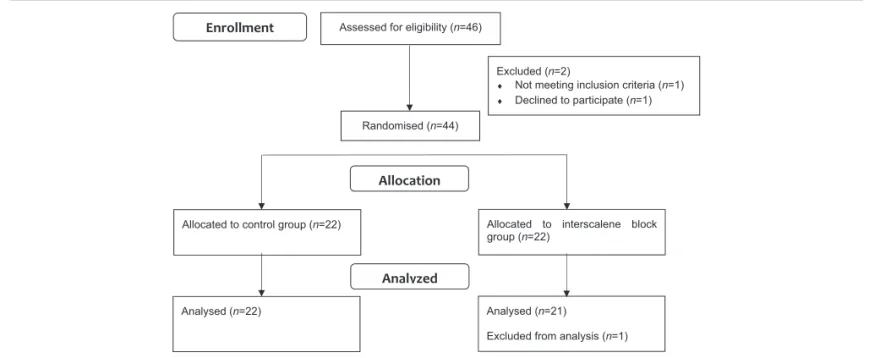
Forty-six patients were assessed for eligibility, but 2 patients were ineligible because of the exclusion criteria or patient refusal; as such, 44 patients in total were included. One patient in the ISB group was excluded from the analysis because of a change in the operative plan to wedge resection (Fig. 1). The patient demographics and baseline characteristics were well balanced
between the randomized groups (Table 1). Perioperative clinical details, such as the type and extent and method of surgery were also similar between the groups (Table 2).
The incidence of ISP was significantly lower in the ISB group than that in the control group (54.5% vs 14.3%,P=.006) with an overall incidence of 34.9% (Fig. 2). All patients who experienced ISP could distinguish shoulder pain from the surgical site pain. Fifteen patients (12 patients in the control group, 3 patients in the ISB group) experienced ISP during the study period with a median duration of 23 hours (IQR 6–48hours). Three patients in the ISB group complained of ISP beginning 6, 7, or 12 hours after surgery, whereas patients in the control group had ISP from a median time of 1 hour (IQR 0.25–4.75hours) after surgery. The use of rescue analgesic for thefirst 24hours was higher in the control group compared with the ISB group (P=.038) (Table 2).
Satisfactory paravertebral blockade was achieved in all patients, and there was no patient who had sensory blockade above T3 dermatome. Satisfactory ISB was also observed in the ISB group. Figure 3 shows that the degree of surgical site pain was similar between the groups. Two patients in the ISB group did not complain of surgical site pain (4.7%), and the others presented with surgical site pain with various characteristics, such as dull
(37.2%), sharp (44.2%), or burning (14%) pain. On the other hand, all patients experiencing ISP expressed the pain as a dull ache, not a sharp pain.
Postoperative adverse events were similar between the groups (Table 3). There was no patient who had a symptom of respiratory difficulties and Horner syndrome. One patient in the control group received postoperative mechanical ventilation
Enrollment Assessed for eligibility (n=46)
Excluded (n=2)
♦ Not meeting inclusion criteria (n=1)
♦ Declined to participate (n=1) Randomised (n=44)
Allocated to control group (n=22) Allocated to interscalene block group (n=22)
Allocation
Analysed (n=22) Analysed (n=21)
Excluded from analysis (n=1)
Analyzed
Figure 1. Flowchart of this study. ISB =interscalene brachial plexus block.
Table 1
Demographic data. Values are number (%) or mean±SD.
Characteristics Control (n=22) ISB (n=21)
Gender; men 11 8
Age; yr 65.41±8.69 63.48±13.73
Height; cm 160.23±7.84 159.95±8.03
Weight; kg 61.57±10.72 58.35±11.16
ASA physical status; I/II 1/21 2/19
smoking 10 (45.5%) 9 (40.9%)
Pulmonary function test:
Normal 14 (63.6%) 14 (66.7%)
Restrictive 0 1 (4.8%)
Obstructive 5 (22.7%) 4 (19%)
Mixed 3 (13.6%) 2 (9.5%)
ISB=interscalene brachial plexus block.
Table 2
Perioperative data. Values are number (%), mean±SD or median (interquartile ranges).
Characteristics Control (n=22) ISB (n=21)
Extent of operation:
Lobectomy 15 (68.2%) 17 (81.0%)
Lobectomy + wedge resection 5 (22.7%) 4 (19.0%)
Bilobectomy 2 (9.1%) 0 (0%)
Method of surgery:
VATS 9 (40.9%) 7 (33.3%)
Open thoracotomy 13 (59.1%) 14 (66.3%)
Resected lobe (double checked for bilobectomy):
RUL 11 6
RML 2 1
RLL 3 8
LUL 5 2
LLL 3 4
The location of paravertebral catheter tip
5th intercostal space 6 2
6th intercostal space 14 19
7th intercostal space 2 0
Chest tube location:
Apex 11 (50%) 11 (52.4%)
Dependent 11 (50%) 10 (47.6%)
Duration of surgery; min 214.09±67.18 204.76±49.91 Duration of anesthesia; min 274.32±70.31 277.38±54.92 Estimated blood loss; mL 631.67±633.10 558.33±813.46
Duration of chest tube; d 8.70±3.68 7.40±1.88
Rescue analgesic, 0–24hours∗ 1 (0–1) 0 (0–1)
Rescue analgesic, 24–48h 0 (0–0.25) 0 (0–0)
ISB=interscalene brachial plexus block, LLL=left lower lobe, LUL=left upper lobe, RLL=right lower lobe, RML=right middle lobe, RUL=right upper lobe, VATS =video-assisted thoracoscopic surgery.
∗
(MV) to minimize any adverse effects of increased work-of-breathing in the immediate postoperative period because he had a 7-hour-long surgery due to severe adhesions and intraoperative difficulties, but was weaned from MV only 3hours later. One patient in the ISB group received MV postoperatively due to 2400-mL blood loss and hemodynamic instability during the operation and was also weaned from MV only 3 hours later. Significant reductions in FEV1, FVC, and PEFR were observed in
all patients after the lobectomy (Table 4). However, no significant differences were observed between the 2 groups in any of the PFT variables measured postoperatively. The reduction in FEV1 0.00 0.10 0.20 0.30 0.40 0.50 0.60 0.70 0.80 0.90 1.00 PACU 6h 12h 24h 48h Total
Control
ISB
* * * * *Figure 2. Proportion of patients who experienced ipsilateral shoulder pain. The incidence of ISP was significantly lower in the ISB group than that in the control group. ISB=interscalene brachial plexus block, PACU =post-anesthesia care unit.
0 1 2 3 4 5 6 7 8 9 10 PACU 6h 12h 24h 48h
Control-rest
ISB-rest
Control-cough
ISB-cough
Figure 3. Numerical rating scale (0–10) for the surgical site pain. The degree of surgical site pain was similar between the groups. ISB =interscalene brachial plexus block.
Table 3
Adverse events in the postoperative period.
Control (n=22) ISB (n=21)
Mechanical ventilation 1 1
Nausea and vomiting 3 2
Horner syndrome 0 0
Dyspnea 0 0
measured on postoperative day 1 was 54.12±16.04% in the control group versus 55.66±13.04% in the ISB group. The reduction in FVC was 43.66±51.30% in the control group versus 48.28±16.79% in the ISB group.
4. Discussion
To our knowledge, this is the first randomized study to demonstrate the effect of single shot ISB using low concentration and volume of ropivacaine to prevent post-thoracotomy ISP and describes pulmonary functions and the character of ISP in the immediate postoperative period. We have shown that ISB using ropivacaine 0.25% 10 mL significantly reduced the incidence of post-thoracotomy ISP and no significant differences in FEV1,
FVC, or PEFR between the control and ISB groups postopera-tively.
The characteristics of the pain at the surgical site and shoulder were different, suggesting a different mechanism. Suggested etiologies for ISP include referred phrenic nerve pain by the diaphragm and pleural irritation caused by the surgical process and the chest drain, and causes directly related to the shoulder region, such as an upward retracted scapula and distraction of the acromioclavicular and coracoclavicular joints due to inadequate lateral decubitus positioning.[4,15]Theoretically, ISB is supposed to prevent these 2 possible mechanisms because it causes a phrenic nerve block due to nerve proximity with anatomical brachial plexus analgesia of the shoulder region. Local anesthetic in a patient who received ISB can spread to the cervical sympathetic nerve chain,[16] which can also play a role in reducing ISP as visceral pain, as a sympathetic block is one of the methods to treat sympathetic-mediated pain of the upper limbs.[17]Despite this theoretical background, ISB has generally
not been used because of the drawback of diaphragmatic paresis. ISB is often associated with blockade of the phrenic nerve, which supplies motorfibers to the diaphragm, causing diaphragmatic paresis and sensoryfibers to the fibrous pericardium, mediastinal pleura and diaphragmatic peritoneum.[18]In our study, we used a
low concentration of ropivacaine, which preferentially blocks sensory nervefibers while sparing motor nerve fibers compared with bupivacaine.[19] To avoid motor blockade of the phrenic nerve leading to diaphragmatic paresis, previous investigations used various combinations of reduced volume, concentration, and dose of local anesthetic in non-thoracic surgical popula-tions.[3,20] Riazi et al[21] assessed diaphragmatic excursion by
real-time United States in patients who received an ISB, followed by general anesthesia for shoulder surgery. They found a 33% incidence of paralyzed diaphragm 60 minutes after surgery when using ropivacaine 0.5% 5 mL (2.5 mg) for ISB. Another study by al-Kaisy et al[20]used bupivacaine 0.25% 10 mL (2.5 mg) for an
ISB, which induced no significant change in diaphragm excursion. On the other hand, bupivacaine 0.5% 10 mL (5 mg) abolished normal diaphragm movement completely 30 and 60 minutes after ISB. In another study, diaphragm movement was reduced by 54% compared with that at baseline by continuous ISB (5–9mL/h of 0.125% bupivacaine).[22]
Diaphragmatic dysfunction can be assessed during the postoperative period by several methods such as chest radio-graphs, fluoroscopy, US and PFT by spirometry.[23] We
performed PFT to assess the effects on respiration. In all patients, significant reductions in the value of FEV1, FVC, and PEFR were
observed postoperatively, which were consistent with previous study.[24]However, there was no difference between the 2 groups in PFT variables measured the day after surgery and after the chest tube had been removed.
ISP generally disappears within 1 to 2 days,[3,25] and our
previous study showed that 5 mg of perineural dexamethasone prolonged the median time of sensory blockade by ISB using 0.5% ropivacaine from 11.0 to 24.2 hours.[26]Thus, in this study
we used dexamethasone as an adjuvant to the ISB. It can be criticized that perineural dexamethasone might have its own systemic effect and contribute to our results. It has been described that perineural dexamethasone acts via a direct effect of the glucocorticoid on nerve conduction or a direct blockade of transmission in nociceptive C fibers, besides its systemic anti-inflammatory action.[27,28] We cannot determine how much
perineural dexamethasone acts systemically, however, evidence that systemic dexamethasone relieves pain is limited to surgical site pain, which is related to the postoperative inflammatory response and pain related to bone metastasis, bone surgery, and local edema.[29–31]Referred pain, which has been suggested to be the main mechanism for ISP, does not mainly originate from either an inflammatory reaction or edema. In addition, no difference in surgical site pain was observed between the 2 groups, and ISP was not related to the degree of surgical site pain (not shown here). Therefore, we consider that perineural dexamethasone itself probably did not have a considerable systemic effect on the occurrence of ISP.
Several limitations of the present study should be mentioned. First, this was a single-center study with a relatively small sample size. Second, we performed ISB before induction of general anesthesia according to our study design to evaluate the incidence of ISP. Although there was no adverse effect related to ISB in our patients, our sample sizes are too small to conclude the risks of ISB in the thoracic surgical populations. Third, we did not inject saline at the same volume for the control group. All patients were sedated with midazolam but patients were not blinded to the group randomization. Fourth, radionuclide lung scanning to estimate the predicted postoperative FEV1is not assessed in all
Table 4
Pulmonary function test. No significant difference between groups. Values are mean±SD.
Control (n=22) ISB (n=21)
Parameter Baseline
Postoperative day 1 (% change from baseline)
After chest tube removal
(% change from baseline) Baseline
Postoperative day 1 (% change from baseline)
After chest tube removal (% change from baseline) FEV1; L 2.45±0.67 1.11±0.46 ∗ ( 54.12±16.04) 1.36±0.57∗,†( 43.66±16.79) 2.42±0.71 1.05±0.39∗( 55.66±13.04) 1.22±0.49∗( 48.28±16.79) FVC; L 3.35±0.84 1.62±0.68∗( 51.30±15.18) 1.95±0.83∗,†( 42.61±17.25) 3.26±0.99 1.40±0.48∗( 56.56±10.57) 1.65±0.68∗,†( 49.17±15.29) PEFR; L/min 6.90±1.90 2.62±1.41∗( 62.33±18.05) 3.12±1.74∗( 54.65±24.15) 6.36±2.25 2.00±1.02∗( 64.33±20.29) 2.66±1.61∗( 54.47±23.95) FEV1/FVC 73.68±9.13 73.23±19.01 73.82±18.84 74.05±8.97 74.05±11.48 74.38±10.64
FEV1=forced expiratory volume in 1second, FVC=forced vital capacity, ISB=interscalene brachial plexus block, PEFR =peak expiratory flow rate. ∗
P<.05 from baseline value.
patients at our institution; therefore, we could not calculate the change in pulmonary function due to the lobectomy itself. However, no differences were observed in the distribution of resected lobe and any of the PFT variables between groups. Lastly, as the etiology of ISP remains not fully understood, we cannot completely rule out the effect of dexamethasone on the occurrence of ISP despite our earlier explanation. Further study without dexamethasone is warranted to clarify an effect of ISB itself on post-thoracotomy ISP.
5. Conclusions
ISB using ropivacaine 0.25% 10 mL including dexamethasone 5 mg was effective for reducing the incidence of post-thoracotomy ISP without additional impairment of pulmonary function in the postoperative period. Further study is needed to clarify the benefit and safety profiles of ISB in a larger population of patients undergoing lung lobectomy.
Author contributions
Conceptualization: Youn Jin Kim, Chi Hyo Kim.
Data curation: Jae Hee Woo, Kwan Chang Kim, Jeeyoung Jun. Formal analysis: Jae Hee Woo.
Funding acquisition: Jae Hee Woo. Investigation: Kwan Chang Kim. Resources: Jae Hee Woo. Software: Jae Hee Woo. Supervision: Chi Hyo Kim.
Writing– original draft: Jae Hee Woo.
References
[1] Barak M, Ziser A, Katz Y. Thoracic epidural local anesthetics are ineffective in alleviating post-thoracotomy ipsilateral shoulder pain. J Cardiothorac Vasc Anesth 2004;18:458–60.
[2] Tan N, Agnew NM, Scawn ND, et al. Suprascapular nerve block for ipsilateral shoulder pain after thoracotomy with thoracic epidural analgesia: a double-blind comparison of 0.5% bupivacaine and 0.9% saline. Anesth Analg 2002;94:199–202. table of contents.
[3] Barak M, Iaroshevski D, Poppa E, et al. Low-volume interscalene brachial plexus block for post-thoracotomy shoulder pain. J Cardio-thorac Vasc Anesth 2007;21:554–7.
[4] Scawn ND, Pennefather SH, Soorae A, et al. Ipsilateral shoulder pain after thoracotomy with epidural analgesia: the influence of phrenic nerve infiltration with lidocaine. Anesth Analg 2001;93:260–4. 1st contents page.
[5] Burgess FW, Anderson DM, Colonna D, et al. Ipsilateral shoulder pain following thoracic surgery. Anesthesiology 1993;78:365–8.
[6] Pennefather SH, Akrofi ME, Kendall JB, et al. Double-blind comparison of intrapleural saline and 0.25% bupivacaine for ipsilateral shoulder pain after thoracotomy in patients receiving thoracic epidural analgesia. Br J Anaesth 2005;94:234–8.
[7] Danelli G, Berti M, Casati A, et al. Ipsilateral shoulder pain after thoracotomy surgery: a prospective, randomized, double-blind, placebo-controlled evaluation of the efficacy of infiltrating the phrenic nerve with 0.2%wt/vol ropivacaine. Eur J Anaesthesiol 2007;24:596–601. [8] Keith C, Arora H, Kumar PA. Ultrasound-guided interscalene block
for postthoracotomy ipsilateral shoulder pain. J Clin Anesth 2008;20:546–8.
[9] Ng KP, Chow YF. Brachial plexus block for ipsilateral shoulder pain after thoracotomy. Anaesth Intensive Care 1997;25:74–6.
[10] Robaux S, Bouaziz H, Boisseau N, et al. Service SOSRHLPersistent phrenic nerve paralysis following interscalene brachial plexus block. Anesthesiology 2001;95:1519–21.
[11] Marret E, Bazelly B, Taylor G, et al. Paravertebral block with ropivacaine 0.5% versus systemic analgesia for pain relief after thoracotomy. Ann Thorac Surg 2005;79:2109–13.
[12] Yoshida T, Fujiwara T, Furutani K, et al. Effects of ropivacaine concentration on the spread of sensory block produced by continuous thoracic paravertebral block: a prospective, randomised, controlled, double-blind study. Anaesthesia 2014;69:231–9.
[13] Refai M, Brunelli A, Salati M, et al. The impact of chest tube removal on pain and pulmonary function after pulmonary resection. Eur J Cardiothorac Surg 2012;41:820–2. discussion 3.
[14] Pellegrino R, Viegi G, Brusasco V, et al. Interpretative strategies for lung function tests. Eur Respir J 2005;26:948–68.
[15] Bamgbade OA, Dorje P, Adhikary GS. The dual etiology of ipsilateral shoulder pain after thoracic surgery. J Clin Anesth 2007;19:296–8. [16] Lehtipalo S, Winso O, Koskinen LO, et al. Cutaneous sympathetic
vasoconstrictor reflexes for the evaluation of interscalene brachial plexus block. Acta Anaesthesiol Scand 2000;44:946–52.
[17] Woo JH, Park HS. Successful treatment of severe sympathetically maintained pain following anterior spine surgery. J Korean Neurosurg Soc 2014;56:66–70.
[18] Urmey WF, Talts KH, Sharrock NE. One hundred percent incidence of hemidiaphragmatic paresis associated with interscalene brachial plexus anesthesia as diagnosed by ultrasonography. Anesth Analg 1991;72:498–503.
[19] Bader AM, Datta S, Flanagan H, et al. Comparison of bupivacaine- and ropivacaine-induced conduction blockade in the isolated rabbit vagus nerve. Anesth Analg 1989;68:724–7.
[20] al-Kaisy AA, Chan VW, Perlas A. Respiratory effects of low-dose bupivacaine interscalene block. Br J Anaesth 1999;82:217–20. [21] Riazi S, Carmichael N, Awad I, et al. Effect of local anaesthetic volume (20
vs 5 ml) on the efficacy and respiratory consequences of ultrasound-guided interscalene brachial plexus block. Br J Anaesth 2008;101:549–56. [22] Pere P. The effect of continuous interscalene brachial plexus block with
0.125% bupivacaine plus fentanyl on diaphragmatic motility and ventilatory function. Reg Anesth 1993;18:93–7.
[23] Gerscovich EO, Cronan M, McGahan JP, et al. Ultrasonographic evaluation of diaphragmatic motion. J Ultrasound Med 2001;20:597– 604.
[24] Varela G, Brunelli A, Rocco G, et al. Predicted versus observed FEV1 in the immediate postoperative period after pulmonary lobectomy. Eur J Cardiothorac Surg 2006;30:644–8.
[25] Mac TB, Girard F, Chouinard P, et al. Acetaminophen decreases early post-thoracotomy ipsilateral shoulder pain in patients with thoracic epidural analgesia: a double-blind placebo-controlled study. J Cardio-thorac Vasc Anesth 2005;19:475–8.
[26] Woo JH, Kim YJ, Kim DY, et al. Dose-dependency of dexamethasone on the analgesic effect of interscalene block for arthroscopic shoulder surgery using ropivacaine 0.5%: a randomised controlled trial. Eur J Anaesthesiol 2015;32:650–5.
[27] Choi S, Rodseth R, McCartney CJ. Effects of dexamethasone as a local anaesthetic adjuvant for brachial plexus block: a systematic review and meta-analysis of randomized trials. Br J Anaesth 2014;112:427–39. [28] Kim YJ, Lee GY, Kim DY, et al. Dexamathasone added to
levobupivacaine improves postoperative analgesia in ultrasound guided interscalene brachial plexus blockade for arthroscopic shoulder surgery. Korean J Anesthesiol 2012;62:130–4.
[29] Chow E, Meyer RM, Ding K, et al. Dexamethasone in the prophylaxis of radiation-induced pain flare after palliative radiotherapy for bone metastases: a double-blind, randomised placebo-controlled, phase 3 trial. Lancet Oncol 2015;16:1463–72.
[30] Hur K, Zhou S, Kysh L. Adjunct steroids in the treatment of peritonsillar abscess: a systematic review. Laryngoscope 2017;128:1463–72. [31] Abukawa H, Ogawa T, Kono M, et al. Intravenous dexamethasone
administration before orthognathic surgery reduces the postoperative edema of the masseter muscle: a randomized controlled trial. J Oral Maxillofac Surg 2017;75:1257–62.