pISSN 2233-8233 · eISSN 2233-8241 Clin Exp Reprod Med 2020;47(3):155-160
Effect of L-carnitine on the expression of the
apoptotic genes Bcl-2 and Bax
Reyhane Vardiyan1,*, Daniyal Ezati1,*, Morteza Anvari2, Nasrin Ghasemi1,2, Alireza Talebi1,2
1Department of Biology and Anatomy and 2Research and Clinical Center for Infertility, Shahid Sadoughi University of Medical Sciences, Yazd, Iran
Objective: The genes Bcl-2 and Bax play important roles in apoptosis. Many studies have shown that formalin has a strong deleterious effect on male fertility and can induce apoptosis. L-carnitine has been reported to potentially reverse the negative effects of formalin, leading to im-proved spermatogenesis. In this study, we examined the levels of expression of Bcl-2 and Bax in mice treated with formalin and L-carnitine.
Methods: Thirty adult BALB/c mice were categorized into three groups. The mice in the control group (n=10) were not injected with any sub-stance. The mice in the second group (n=10) received 10 mg/kg of formalin daily via an intraperitoneal injection, while those in the final group (n=10) were intraperitoneally injected daily with a dose of 10 mg/kg of formalin and 100 mg/kg of L-carnitine. All mice were kept in isolated cages for 31 days.
Results: The expression of Bax was significantly higher in the formalin-treated mice than in the mice of the control group, while the expression of Bcl-2 was significantly lower in the formaltreated mice than in the control mice. Additionally, relative to control mice, Bcl-2 expression in-creased and Bax expression dein-creased in the mice administered both formalin and L-carnitine.
Conclusion: In this study, L-carnitine was shown to augment Bcl-2 expression and to reduce Bax expression, indicating that this compound may inhibit apoptosis. Due to its positive effects, L-carnitine can be used as a prophylactic treatment for people who routinely come into direct contact with formalin as an occupational hazard.
Keywords: Apoptosis; Bax; Bcl-2; Formalin; L-carnitine
Introduction
Infertility and the personal and social problems that it may cause are extremely important issues in modern life [1,2]. Studies have dem-onstrated the destructive role of environmental pollutants on human fertility [3,4]. Formalin (an aqueous solution of formaldehyde) is a pol-lutant that is widely used in the manufacture of disinfectants and de-tergents as well as in hospitals and factories [5]. Formalin has been shown to affect reproduction in mammals [6]. The deleterious effects
of formaldehyde on fertility in both human and laboratory animal models have been documented; these effects include alterations in spermatogenesis, apoptotic changes in the testes, and decreased testosterone secretion, all of which may decrease fertility [7-9]. The adverse impact of formalin on the male reproductive system may re-sult from hormonal changes in the hypothalamic-pituitary-gonadal axis [10]. Formalin also causes cellular and oxidative damage in many tissues by increasing the production of reactive oxygen species (ROS) [6]. Studies have indicated that 25%–40% of infertile men exhibit in-creased levels of ROS. In addition, ROS generated through DNA dam-age are important intracellular signals in the induction of apoptosis [11-13].
L-carnitine plays a crucial role in the β-oxidation of long-chain fatty acids in the mitochondria and ultimately in the energy production of the cell [14]. L-carnitine also protects DNA and cell membranes from damage caused by oxygen free radicals [15]. Previous studies have shown that L-carnitine may act as an antioxidant to prevent H2O2 -in-Received: November 24, 2019 ∙ Revised: March 3, 2020 ∙ Accepted: April 3, 2020
Corresponding author: Alireza Talebi
Department of Biology and Anatomy, Research and Clinical Center for Infertility, Shahid Sadoughi University of Medical Sciences, Bou-Ali Avenue, Safayeh, Yazd, Iran Tel: +98-351-8247085 Fax: +98-351-8247087 E-mail: [email protected]
*These authors contributed equally to this article.
This is an Open Access article distributed under the terms of the Creative Commons Attribution Non-Commercial License (http://creativecommons.org/licenses/by-nc/4.0/) which permits unrestricted non-commercial use, distribution, and reproduction in any medium, provided the original work is properly cited.
duced oxidative stress in SH-SY5Y neuroblastoma cells [16]. L-carni-tine also enhances the cell’s capacity to prevent both apoptosis and the H2O2-induced accumulation of ROS in the cell. Researchers have found that L-carnitine is a therapeutic option in patients with azo-ospermia, as it can increase sperm count both in those patients and in those exhibiting abnormal sperm maturation [17,18]. L-carnitine has also been demonstrated to increase cytochrome oxidase activity, resulting in the increased production of adenosine triphosphate [19]. In addition, flow cytometry and caspase activity experiments have shown that L-carnitine prevents alkaline phosphatase-induced apoptosis in cardiomyocytes [20]. L-carnitine protects against cyclo-phosphamide-induced testicular damage by inhibiting cell apoptosis and autophagic modulation [21].
Apoptosis is a physiological and biological process that is important for normal development and the maintenance of homeostasis. How-ever, apoptosis also occurs when cells are exposed to cytotoxic agents [22]. Additionally, severe damage to the genetic material of the cell can trigger multiple pathways that lead to apoptosis [23]. The key characteristics of apoptosis include cell wrinkling, membrane destruc-tion, chromatin compacdestruc-tion, and DNA damage [24]. The control of apoptosis is very intricate and involves multiple proteins. Members of the Bcl-2 protein family, which includes apoptosis inhibitor pro-teins, are key regulators of this process [22]. The protein Bcl-2 acts as a suppressor of apoptosis, whereas the protein Bax promotes apop-tosis. Bcl-2 helps to maintain the integrity of the mitochondrial mem-brane by binding to receptors on the outer mitochondrial memmem-brane [25]. If the cell is exposed to apoptosis-inducing agents, Bax is moved from the cytoplasm to the mitochondrial membrane and acts to alter the permeability of the outer membrane [26]. These changes release cytochrome c and other apoptosis-inducing factors from the mito-chondria and eventually lead to DNA fragmentation [27]. Given the positive effects of L-carnitine and the deleterious effects of formalin on male fertility, the present study was planned to examine the ef-fect of L-carnitine on apoptotic gene expression in formalin-treated BALB/c mice.
Methods
1. Animal care
Thirty adult BALB/c mice were categorized into three groups. The mice in the control group (n=10) were not injected with any substance. The mice in the second group (n=10) received 10 mg/kg of formalin daily via intraperitoneal injection, while those in the final group were intraperitoneally injected (n=10) daily with a dose of 10 mg/kg of formalin and 100 mg/kg of L-carnitine. The mice were kept in isolated cages for 31 days under proper temperature and light conditions. At the end of that period, the animals were killed via neck dislocation,
and one testis from each mouse was removed and kept in a freezer at –80°C until RNA extraction.
2. RNA isolation and complementary DNA synthesis
For RNA extraction, the frozen testis tissues were homogenized, and the total RNA was then isolated using a miRNeasy Micro Kit (Qiagen, Hilden, Germany) in accordance with the manufacturer’s protocol. Then, on-column deoxyribonuclease (DNase) digestion and in-solu-tion DNase digesin-solu-tion were performed to avoid DNA contaminain-solu-tion. The purity and concentration of the RNA were determined via spec-trophotometry (NanoDrop; Thermo Fisher Scientific, Waltham, MA, USA) and optical density analysis at wavelengths of 260 and 280 nm. The complementary DNA (cDNA) of Bcl-2 and Bax were synthesized using a RevertAid First Strand cDNA Synthesis Kit (Thermo Fisher Sci-entific) in accordance with the manufacturer’s protocol.
3. Real-time quantitative polymerase chain reaction
Quantitative polymerase chain reaction was accomplished on a StepOnePlus real-time polymerase chain reaction System (Applied Biosystems, Foster City, CA, USA) with 1.5 μL of produced cDNA, 9.5 μL of SYBR Green Master Mix (Applied Biosystems), 1.5 μL of each prim-er, and 6.0 μL of DNase-/RNase-free water for the gene expression profile. β-actin was used as the reference gene and Bcl-2 and Bax as
the target genes, with designed primers listed in Table 1. The reactions consisted of an initial period of denaturation at 95°C for 12 minutes; 40 cycles of denaturation at 95°C for 12 seconds, annealing at 60°C for 32 seconds, and extension at 72°C for 32 seconds; and a final peri-od of extension at 72°C for 12 minutes. Relative gene expression was calculated using the 2−∆∆Ct quantitative method.
4. Data analysis
Statistical analysis of Bcl-2 and Bax gene expression in the formalin-treated and L-carnitine–formalin-treated mice was conducted using the un-paired t-test, and p<0.05 was considered to indicate statistical sig-nificance. All analyses were performed using GraphPad Prism 6 soft-ware (GraphPad Softsoft-ware, San Diego, CA, USA).
Table 1. Real-time reverse transcription-polymerase chain reaction
primers applied in the experiment
Gene Primers (5′→3′) Product size (bp) TM (°C)
Bax F: TGGAGATGAACTGGACAGCA 201 60 R: GATCAGCTCGGGCACTTTAG Bcl-2 F: CTGGCATCTTCTCCTTCCAG 202 60 R: ACATCTCTGCGAAGTCACGA β-actin F: CGACGAGGCCCAGGCAAGAGAGG 180 60 R: TCAGGCAGCTCATGCTCTTCTCCAGG
Results
1. Relative expression of Bcl-2 and Bax in the formalin-treated group
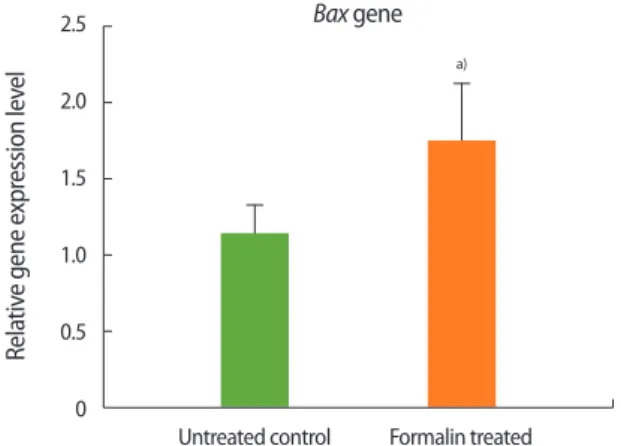
As shown in Figures 1 and 2, the expression of Bax increased in the formalin-treated group relative to the control, whereas the expres-sion of Bcl-2 decreased. These results indicate that exposure to for-malin led to the increased expression of pre-apoptotic genes and the decreased expression of anti-apoptotic genes.
2. Relative expression of Bcl-2 and Bax in the formalin- and L-carnitine–treated group
As shown in Figures 3 and 4, the expression of Bax decreased in the formalin- and L-carnitine–treated group relative to the control, where-as the expression of Bcl-2 increwhere-ased. These results indicate that L-car-nitine attenuated the negative effects of formalin, leading to the de-creased expression of pre-apoptotic genes and the inde-creased expres-sion of anti-apoptotic genes.
Discussion
Reports published in the last 2 decades have emphasized that vari-ous chemicals can affect the structure and function of the genitouri-nary system. Formalin is one such chemical. Formalin has a profound adverse impact on sperm characteristics, chromatin stability, and apop-tosis. Formalin intake leads to impaired testicular function, reduces the efficiency of antioxidant enzymes, and exacerbates oxidative stress. Formalin also causes increased DNA damage and augments the tran-scription of Hsp70, p53, and genes involved in apoptosis, such as Bax [28]. Research has shown that L-carnitine can counteract the negative effects of formalin [29]. Previous studies have provided strong sup-port for the imsup-portance of L-carnitine in improving sperm parame-ters, reducing oxidative stress and apoptosis, and enhancing the effi-ciency of adenosine triphosphate production [30,31]. Since the early 1990s, numerous studies have been conducted on the effect of L-car-nitine on idiopathic infertility in men. Increased sperm motility has been observed in some studies of patients treated with L-carnitine
Figure 1. Relative expression of Bax in the formalin-treated group
compared to the control group. a)p<0.01. a) 2.5 2.0 1.5 1.0 0.5 0 Rela tiv e gene e xpr ession lev el
Untreated control Formalin treated Bax gene
Figure 2. Relative expression of Bcl-2 in the formalin-treated group
compared to the control group. a)p<0.001. a) 2.0 1.5 1.0 0.5 0 Rela tiv e gene e xpr ession lev el
Untreated control Formalin treated Bcl-2 gene
Figure 3. Relative expression of Bax in the group treated with
forma-lin and L-carnitine compared to the control group. a)p<0.01. a) 2.0 1.5 1.0 0.5 0 Rela tiv e gene e xpr ession lev el
Untreated control Formalin+L-carnitine treated Bax gene
Figure 4. Relative expression of Bcl-2 in the group treated with
for-malin and L-carnitine compared to the control group. a)p<0.001. a) 3 2 1 0 Rela tiv e gene e xpr ession lev el
Untreated control Formalin+L-carnitine treated Bcl-2 gene
[32,33]. The highest concentration of carnitine in the human body is in the epididymis, where the concentration is 2,000 times that found in the blood. Several studies have shown lower carnitine levels in the semen of infertile men than in the semen of fertile men [34,35]. In 2019, Micic et al. [36] revealed the beneficial impacts of carnitine de-rivatives on progressive motility, vitality, and sperm DNA fragmenta-tion.
Two genes known to participate in apoptosis are Bcl-2 and Bax. Ex-perimental results have shown that the dysfunction of these genes leads to defects in spermatogenesis and infertility in mice [37]. Accord-ing to a review of the literature, the present study was the first to eval-uate the impacts of formalin and L-carnitine on the expression of
Bcl-2 and Bax. The outcomes of this experiment showed that the
expres-sion of Bax in the formalin-treated mice was significantly increased compared to the control group, while the expression of Bcl-2 in the formalin-treated mice was significantly decreased compared to the control mice. These results confirm that in the testis, formalin enhanc-es the exprenhanc-ession of apoptotic genenhanc-es and acceleratenhanc-es the procenhanc-ess of apoptosis, eventually leading to impaired spermatogenesis and ste-rility.
Bhatia [38] stated that formalin induces potent cytotoxicity due to the increased activity of caspase-9 (an initiator of apoptosis), the in-duction of oxidative stress, mitochondrial dysfunction, and ultimately apoptosis itself. Hegazy et al. [39] observed the destruction of the genetic content of germ cells in formalin-treated mice. Similar to the results of the present experiment, Yang et al. [40] reported that in mice administered formalin, apoptosis and testicular injury were ag-gravated, Bax expression was increased, and Bcl-2 expression was de-creased. Cell line studies have shown that Bcl-2 protein can prevent the transfer of Bax from the cytosol to the mitochondria, thereby in-hibiting apoptosis [41]. Although the lack of Bax seems to decrease apoptosis in the testis and thus to improve spermatogenesis, male
Bax−/− mice exhibited defective spermatogenesis as well as infertility [42]. These results indicate that the balance between the levels of ex-pression of genes involved in apoptosis is essential for proper sper-matogenesis.
Another finding of this study was an increase in Bcl-2 expression and a decrease in Bax expression in mice administered both formalin and L-carnitine. This result suggests that L-carnitine can minimize the negative effects of formalin and reduce the expression of pro-apop-totic genes, such as Bax. In a mouse study, Cankorkmaz et al. [43] sug-gested that L-carnitine could facilitate the repair of testicular injury in mice by reducing apoptosis. Altun et al. [44] investigated the anti-apoptotic effect of L-carnitine on the testicular tissue of mice receiv-ing gamma radiation and reported that L-carnitine inhibited the apop-tosis of germ cells during radiation therapy. In addition, several human studies have shown that L-carnitine has a positive effect on sperm
parameters.
Overall, the present study showed that exposure to formalin increased
Bax expression, decreased Bcl-2 expression, and could lead to increased
apoptosis. L-carnitine can counteract the effects of formalin, and the results revealed that L-carnitine augmented Bcl-2 expression and re-duced Bax expression, indicating that it may inhibit apoptosis. Due to the positive effects of L-carnitine, it can be used as a prophylactic treat-ment for people who routinely come into direct contact with forma-lin as an occupational hazard. Further research is needed to confirm the results of this study and to use its findings in treatment.
Conflict of interest
No potential conflict of interest relevant to this article was reported.
Acknowledgments
The authors would like to thank Dr. S. Javadi, Dr. Mehravar, and Mr. Babakhanzadeh for their valuable support.
Author contributions
Conceptualization, Data curation, Formal analysis, Writing–original draft, review & editing: all authors.
References
1. Babakhanzadeh E, Khodadadian A, Rostami S, Alipourfard I, Aghaei M, Nazari M, et al. Testicular expression of TDRD1, TDRD5, TDRD9 and TDRD12 in azoospermia. BMC Med Genet 2020;21:33. 2. Babakhanzadeh E, Nazari M, Ghasemifar S, Khodadadian A. Some
of the factors involved in male infertility: a prospective review. Int J Gen Med 2020;13:29-41.
3. Henriques MC, Loureiro S, Fardilha M, Herdeiro MT. Exposure to mercury and human reproductive health: a systematic review. Reprod Toxicol 2019;85:93-103.
4. Schatten H, Rawe VY, Sun QY. Cytoskeletal architecture of human oocytes with a focus on centrosomes and their significant role in fertilization. In Vitro Fertilization. Berlin: Springer; 2019.
5. Gnanadeepam JC, Rajavel AT, Eswaran SE, Thiagarajan PR. Histo-logical changes in testis of wistar albino rats following formalde-hyde exposure by inhalation. J Clin Diagno Res 2018;12.
6. Tajaddini S, Ebrahimi S, Behnam B, Bakhtiyari M, Joghataei MT, Abbasi M, et al. Antioxidant effect of manganese on the testis structure and sperm parameters of formalin-treated mice. An-drologia 2014;46:246-53.
fertility of albino rats treated with formaldehyde vapours. Egyp-tian J Zoology 2017:221-38.
8. Klocke S, Bundgen N, Koster F, Eichenlaub-Ritter U, Griesinger G. Slow-freezing versus vitrification for human ovarian tissue cryo-preservation. Arch Gynecol Obstet 2015;291:419-26.
9. Naghdi M, Maghbool M, Seifalah-Zade M, Mahaldashtian M, Ma-koolati Z, Kouhpayeh SA, et al. Effects of common fig (Ficus carica) leaf extracts on sperm parameters and testis of mice intoxicated with formaldehyde. Evid Based Complement Alternat Med 2016; 2016:2539127.
10. Vosoughi S, Khavanin A, Salehnia M, Asilian Mahabadi H, Shah-verdi A, Esmaeili V. Adverse effects of formaldehyde vapor on mouse sperm parameters and testicular tissue. Int J Fertil Steril 2013;6:250-67.
11. Agarwal A, Saleh RA. Role of oxidants in male infertility: rationale, significance, and treatment. Urol Clin North Am 2002;29:817-27. 12. Agarwal A, Sharma RK, Nallella KP, Thomas AJ Jr, Alvarez JG, Sikka SC. Reactive oxygen species as an independent marker of male factor infertility. Fertil Steril 2006;86:878-85.
13. Makker K, Agarwal A, Sharma R. Oxidative stress & male infertility. Indian J Med Res 2009;129:357-67.
14. Zhou X, Liu F, Zhai S. Effect of L-carnitine and/or L-acetyl-carnitine in nutrition treatment for male infertility: a systematic review. Asia Pac J Clin Nutr 2007;16 Suppl 1:383-90.
15. Cavallini G, Ferraretti AP, Gianaroli L, Biagiotti G, Vitali G. Cinnoxi-cam and L-carnitine/acetyl-L-carnitine treatment for idiopathic and varicocele-associated oligoasthenospermia. J Androl 2004; 25:761-70.
16. Yu J, Ye J, Liu X, Han Y, Wang C. Protective effect of L-carnitine against H(2)O(2)-induced neurotoxicity in neuroblastoma (SH-SY5Y) cells. Neurol Res 2011;33:708-16.
17. Chang B, Nishikawa M, Nishiguchi S, Inoue M. L-carnitine inhib-itshepatocarcinogenesis via protection of mitochondria. Int J Cancer 2005;113:719-29.
18. Ye J, Li J, Yu Y, Wei Q, Deng W, Yu L. L-carnitine attenuates oxidant injury in HK-2 cells via ROS-mitochondria pathway. Regul Pept 2010;161:58-66.
19. Wachter S, Vogt M, Kreis R, Boesch C, Bigler P, Hoppeler H, et al. Long-term administration of L-carnitine to humans: effect on skeletal muscle carnitine content and physical performance. Clin Chim Acta 2002;318:51-61.
20. Baghaei A, Solgi R, Jafari A, Abdolghaffari AH, Golaghaei A, As-ghari MH, et al. Molecular and biochemical evidence on the pro-tection of cardiomyocytes from phosphine-induced oxidative stress, mitochondrial dysfunction and apoptosis by acetyl-L-car-nitine. Environ Toxicol Pharmacol 2016;42:30-7.
21. Dokmeci D, Inan M, Basaran UN, Yalcin O, Aydogdu N, Turan FN,
et al. Protective effect of L-carnitine on testicular ischaemia–re-perfusion injury in rats: cell biochemistry and function: cellular biochemistry and its modulation by active agents or disease. Cell Biochem Funct 2007;25:611-8.
22. Singh R, Letai A, Sarosiek K. Regulation of apoptosis in health and disease: the balancing act of BCL-2 family proteins. Nature Re-views Mol Cell Bio 2019;20:175-93.
23. Abotaleb M, Samuel SM, Varghese E, Varghese S, Kubatka P, Lis-kova A, et al. Flavonoids in cancer and apoptosis. Cancers (Basel) 2018;11:28.
24. Esmailpoor A, Ghasemian A, Dehnavi E, Peidayesh H, Teimouri M. Physalis alkekengi hydroalcoholic extract enhances the apopto-sis in mouse model of breast cancer cells. Gene Rep 2019;15: 100366.
25. Yamaguchi R, Lartigue L, Perkins G. Targeting Mcl-1 and other Bcl-2 family member proteins in cancer therapy. Pharmacol Ther 2019;195:13-20.
26. Warren CF, Wong-Brown MW, Bowden NA. BCL-2 family isoforms in apoptosis and cancer. Cell Death Dis 2019;10:177.
27. Knight T, Luedtke D, Edwards H, Taub JW, Ge Y. A delicate balance: the BCL-2 family and its role in apoptosis, oncogenesis, and can-cer therapeutics. Biochem Pharmacol 2019;162:250-61. 28. Silva AG, Lopes CF, Carvalho Junior CG, Thome RG, Dos Santos HB,
Reis R, et al. WIN55,212-2 induces caspase-independent apop-tosis on human glioblastoma cells by regulating HSP70, p53 and Cathepsin D. Toxicol In Vitro 2019;57:233-43.
29. Moretti S, Famularo G, Marcellini S, Boschini A, Santini G, Trinch-ieri V, et al. L-carnitine reduces lymphocyte apoptosis and oxidant stress in HIV-1-infected subjects treated with zidovudine and di-danosine. Antioxid Redox Signal 2002;4:391-403.
30. Hosseinzadeh Colagar A, Karimi F, Jorsaraei SG. Correlation of sperm parameters with semen lipid peroxidation and total anti-oxidants levels in astheno- and oligoasheno- teratospermic men. Iran Red Crescent Med J 2013;15:780-5.
31. Morovvati H, Khaksar Z, Sheibani MT, Anbara H, Kafiabad MA, Moradi HR. Effect of aspartame on histological and histometrical structure of prostate gland in adult mice. Qom Univ Med Sci J 2019;12:14-27.
32. Costa M, Canale D, Filicori M, D’lddio S, Lenzi A. L-carnitine in idio-pathic asthenozoospermia: a multicenter study. Italian Study Group on Carnitine and Male Infertility. Andrologia 1994;26:155-9. 33. Vitali G, Parente R, Melotti C. Carnitine supplementation in
hu-man idiopathic asthenospermia: clinical results. Drugs Exp Clin Res 1995;21:157-9.
34. Hinton BT, Snoswell AM, Setchell BP. The concentration of carni-tine in the luminal fluid of the testis and epididymis of the rat and some other mammals. J Reprod Fertil 1979;56:105-11.
35. Sigman M, Glass S, Campagnone J, Pryor JL. Carnitine for the treatment of idiopathic asthenospermia: a randomized, double-blind, placebo-controlled trial. Fertil Steril 2006;85:1409-14. 36. Micic S, Lalic N, Djordjevic D, Bojanic N, Bogavac-Stanojevic N,
Busetto GM, et al. Double-blind, randomised, placebo-controlled trial on the effect of L-carnitine and L-acetylcarnitine on sperm parameters in men with idiopathic oligoasthenozoospermia. Andrologia 2019;51:e13267.
37. Ranger AM, Malynn BA, Korsmeyer SJ. Mouse models of cell death. Nat Genet 2001;28:113-8.
38. Bhatia M. Understanding toxicology: mechanisms and applica-tions. Berlin: Springer; 2017.
39. Hegazy AA, Elsayed N, Ahmad M, Omar N. Effect of Formaldehyde on Rat Testis Structure. Acad Anat Int 2017;3:15-23.
40. Yang SB, LI CY, Zhang YB. Effects of formaldehyde and benzene on the apoptosis, expression of Bcl-2 and Bax in testicle of mouse.
Pract Prev Med 2008;4.
41. Kang MH, Reynolds CP. Bcl-2 inhibitors: targeting mitochondrial apoptotic pathways in cancer therapy. Clin Cancer Res 2009;15: 1126-32.
42. Rucker EB 3rd, Dierisseau P, Wagner KU, Garrett L, Wynshaw-Boris A, Flaws JA, et al. Bcl-x and Bax regulate mouse primordial germ cell survival and apoptosis during embryogenesis. Mol Endocri-nol 2000;14:1038-52.
43. Cankorkmaz L, Koyluoglu G, Ozer H, Yildiz E, Sumer Z, Ozdemir O. The role of apoptosis and protective effect of carnitine in contra-lateral testicular injury in experimental unicontra-lateral testicular tor-sion. Ulus Travma Acil Cerrahi Derg 2009;15:529-34.
44. Altun Z, Olgun Y, Ercetin P, Aktas S, Kirkim G, Serbetcioglu B, et al. Protective effect of acetyl-l-carnitine against cisplatin ototoxici-ty: role of apoptosis-related genes and pro-inflammatory cyto-kines. Cell Prolif 2014;47:72-80.