펨토초 레이저와 SLM을 이용한 광소자 제작 및
광특성 평가
Optical Testing and Fabrication of Optical Elements
by Using Femtosecond Laser and Spatial Light
Modulator (SLM)
Jin-Tae Kim
Dept. of Photonic Eng. Chosun Univ. [email protected]
Diffraction gratings with spatial periods of 2 μm and 5 μm have been fabricatedin fused silica by using femtosecond laser micromachining technology before fabricating a FZP and the hologram of a word (Chosun). We fabricated diffraction grating with homogeneous depth and width. The grating with line widthof 800~1000 nm, the depth of 400 nm, and grating period of 5 μm is fabricated. Femtosecond laser beam with 785 nm wavelength, 184 fs pulse width, 1 kHz repletion rate, and maximum 1 W power has been used to fabricate the patterns. The laser beam with several micro Joule depending on the patterns is focused by using an object lens (x50 magnification and NA=0.42, etc.). A linear stage with speed of 0.1 mm/s, moving range of 300 mm*300 mm, and precision of 20 nm is used. A typical size of the fabricated pattern is 3 mm*3 mm. Since our micro-machining system can generate precise matrix dots using pulse synchronization, the wanted pattering can be fabricated easily. After fabrications of the basic gratings, we fabricate FZPs with focal lengths of 25 mm and 50 mm at the wavelength of 632.8 nm. In order to test the optical properties of the fabricated FZPs, we measured the beam waist of the He-Ne laser beam passed through the fabricated FZP using a beam profiler.
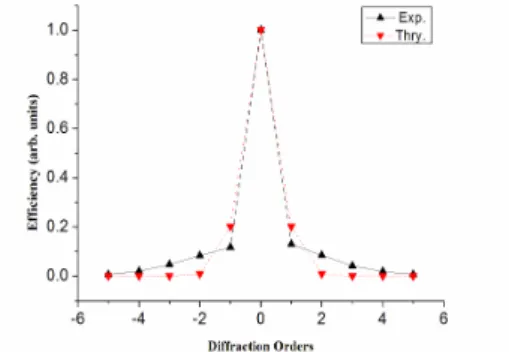
The efficiency and angular separation of the diffraction grating depend on the change of the refractive index and profile of surface relief. Disregarding the change of the refractive index, those depend mainly on surface relief pattern which can be described by Fourier series of spatial periodic function. Thus, the efficiency can be calculated from phase change due to the surface relief pattern. By using these parameters from the fabricated profile, the efficiency of the grating is calculated and compared with the measured ones as shown in Fig. 1. Also calculated angular
separation of the diffraction pattern by using simple diffraction equation is compared with
Fig. 1 Comparison of the diffraction efficiency between the experimental result and the calculated one.
measured one. Measured diffraction angles and diffraction efficiencies of those gratings normalized to one, match well with the calculated results. We measured the beam waist of the He-Ne laser beam passed through the fabricated FZP using a beam profiler. The measured focal length of the FZP matches well with the designed focal length of FZP.
Fig. 2(a) and (b) show the profile of the fabricated hologram of a word (Chosun) and the reconstructed image of the hologram in which the hologram is reconstructed by illumination of a 543 nm laser beam. In Fig. 2(b), we can observe only the real image of the reconstructed hologram the far field location. We also observe a small point shown in the Fig. 2(b) caused by the defects of the hologram. Fig. 2(b) shows that the fabricated hologram reconstructs the two dimensional image successfully at the far field location. For future research, we will fabricate the hologram of characters with different depth locations. This volumetric hologram will reconstruct the characters with different depth locations. Method for correcting phase error to improve reconstructed image from binary hologram implemented by SLM will be introduced.
Fig. 2 (a) Fabricated hologram (x500 optical microscope view (b) Far field pattern of the hologram (real image only).
This work has been done in cooperation with Jin-Chang Ryu, Ik-Bu Sohn, and Taegeun Kim.