2018). 이 같은 이유로 고기구이에서 발생하는 유기
성분 분석과 더불어, 관련된 대기 정량적 기여율 분
석 및 산화 잠재력과 관련된 독성 연구가 최근 전 세 계적으로 활발히 진행되고 있다(Li et al., 2014; Mohr et al., 2012; Robinson et al., 2006). 홍콩 음식 연소 성 분 중 formaldehyde, acetaldehyde, benzene과 같은 휘 발성 유기화합물이 다량 발생하는 것으로 보고되었 고(Huang et al., 2011), 멕시코 음식조리 배출 성분 중 벤젠 화합물을 포함하는 비메탄 휘발성 유기화합물 이 다량 발생하며(Mugica et al., 2001), 미국에서는 formaldehyde, acetaldehyde 등이 고기구이 중 발생하
1. 배 경
대기 중 초미세먼지(PM2.5)의 원인으로는 크게 식 생연소, 자동차 배출, 중국발 장거리 물질, 2차 성분으로 이루어져 있다(Oh et al., 2018b, 2017; Park et al., 2016). 최근 연구에 의하면, PM2.5 내 음식 조리, 특히
고기구이에서 배출되는 미세먼지가 증가하고 있다 (Zhao et al., 2015; Sun et al., 2011; Allan et al., 2010; Schauer et al., 2002). 2014년 미국 내 식당에서 배출 되는 초미세먼지 총량은 약 9톤에 달하며, 2023년에 는 10톤을 넘어간다는 보고가 있다(Gysel et al., p-ISSN 1598-7132, e-ISSN 2383-5346 논 문
고기구이 초미세먼지 내 콜레스테롤 및 산화 잠재력과의 관계
Relationship between Cholesterol and Oxidative Potential from
Meat Cooking
이용민, 김은영, 류춘호, 오세호, 주흥수1), 배민석*
목포대학교 환경공학과, 1)안양대학교 환경에너지공학과
Yongmin Lee, Eunyoung Kim, Chunho Ryu, Sea-Ho Oh, Hungsoo Joo1), Min-Suk Bae*
Department of Environmental Engineering, Mokpo National University
1)Department of Environmental Engineering, Anyang University
Abstract Identification of the major sources contributing to PM is of importance in order to understand their quantitative
contributions to atmosphere. In the viewpoint of the meat cooking in Korea, only a few analyses of organic molecular markers have been conducted due to analytical difficulties. In this study, ten different parts of meat (i.e., blade shoulder, belly, and arm shoulder of pork; ribeye roll, top blade muscle, and short plate of beef; leg quarter, breast, and wing of chicken; duck; mackerel) were pyrolyzed to generate the cooked PM using an electronic heating plate. Generated PM were collected by the pyrolysis sampling system to identify total carbon (TC) using a carbon analyzer and cholesterol using a Liquid chromatography tandem-mass spectrometry (LC-MSMS) based on fragmentor voltage (FV), precursor ion, collision energy, product ion. In addition, oxydative potential (OP) analysis using dithiothreitol (DTT) method were discussed to investigate the toxicity relates. Highly correlated pairwise scatterplots between the cholesterol and TC indicate that oxydative potential was highly associated with different parts of meat. This study provides insight into the meat cooking components of PM, which could be drivers of the oxidative potential relates.
Key words: DTT, ROS, Meat cooking, Cholesterol
접수일 2018년 10월 5일 수정일 2018년 10월 10일 채택일 2018년 10월 10일 Received 5 October 2018 Revised 10 October 2018 Accepted 10 October 2018 *Corresponding author Tel : +82-(0)61-450-2485 E-mail : [email protected]
는 것으로 보고되었다. 특히 cholesterol(CAS num-ber: 57-88-5, C27H46O,(3β)-cholest-5-en-3-ol)은 고기
구이에서 발생하는 대표적인 유기지표 성분으로 알 려져 있다(McDonald et al., 2003; Schauer et al., 2002; Schauer et al., 1999). 고기구이가 우리나라 주식단 중의 하나임을 고려 할 때, 이와 관련된 초미세먼지의 대기 기여율은 무 시할 수 없으며, 관련 연구 또한 매우 미비하다. 미국 등에서 연구된 고기구이에 대한 원인분류표는 조리 방법 및 고기 종류 및 부위가 상이함을 감안할 때, 대 기 중 고기구이에 따른 기여율 계산을 위해, 미국 등 에서 발표한 동일 원인분류표(source profile)를 이용 하기에는 한계가 크다. 이에, 고기구이 등에 따른 국 내 대기 기여율을 계산하기 위해서, 우리나라 특성에 맞는 cholesterol과 같은 유기지표 성분 분석 및 더 나 아가 독성과 관련된 산화 잠재력 분석은 필수 불가결 하다. 본 연구에서는 연소 체임버를 이용하여, 부위별 돼 지고기, 소고기, 닭고기 및 고등어 등 총 10종의 고기 를 전기구이하여 발생된 초미세먼지를 석영여과지를 이용하여 포집하였다. 포집된 여과지는 열광학 탄소 분석기를 이용하여 총탄소(total carbon, TC) 분석 및 Liquid chromatography tandem-mass spectrometry (LC-MSMS)를 이용하여 cholesterol를 분석하였다. 또한, dithiothreitol(DTT) 분석법을 이용한 고기구이 분진 내 산화 잠재력을 분석하였다. 이에, 1) 고기구 이 종류에 따른 TC에 대한 cholesterol 비율 및 2) DTT 분석에 따른 산화 스트레스 잠재력과의 상관성 분석을 통해, 고기 종류에 따른 독성 잠재력을 분석 함으로써, 인체 유해성과의 관련성을 분석하였다.
2. 연구 방법
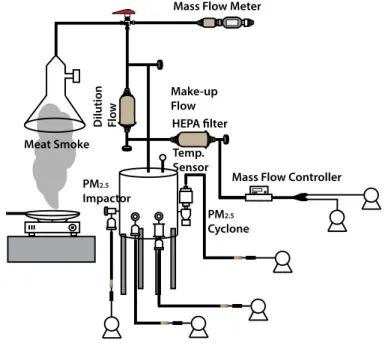
2.1 고기구이 연소 체임버 본 연구에서는 고기구이 분진 내 존재하는 PM2.5 cholesterol 및 TC 분석을 위해, 연소 체임버를 설계 제작하였다(그림 1). 본 연구에 사용된 연소 체임버 는 크게,(1) 질량 유량계에 의한 HEPA 필터 유동 1차 희석기,(2) 내부 팬이 장착된 직경 30cm 혼합 체임 HEPA filter Mass Flow MeterMass Flow Controller PM2.5 Impactor PM2.5 Cyclone Meat Smoke D ilution Fl ow Make-up Flow Temp. Sensor
버, 그리고 (3) 8채널 연소 분진 포집관으로 구성되어 있다. 모든 관은 직경 0.5인치 내열 스테인리스 관으 로 구성되어 있으며, 시료 포집 전후로 질량 유량 측 정기에 의해, 각 채널 유량 및 총유량을 측정하여, 유 량 유실 및 압력 저하를 확인하였다. 본 연구에서는 연소 체임버 내 희석기를 사용하지 않고, 석영필터가 장착된 2개 채널을 이용하였다. 오리피스에 의해 고 정 유량 16.7lpm하에, PM2.5 고기 열분해 분진을 직경
47mm로 절단된 석영필터(Pallflex, 2500QATUP, Pall Corp., USA)에 의해 포집하였다. 석영필터는 포집 전 450℃에서 최소 12시간 가열된 후, 알루미늄 호일로 내부 포장된 페트리디쉬에 담아 테프론 테이프로 밀 봉하여 추출 및 성분 분석 전까지 냉동실(-20℃)에 보관하였다. 1개 채널에 의해 포집된 석영 여과지 포집 시료는 총탄소 분석 후, 잔여 여과지 부분과 다른 채널에 의 해 포집된 석영 시료와 혼합하여, cholesterol 농도 측 정을 위해 15mL의 메탄올(HPLC grade, >99.9%, sigma-aldrich, USA)을 이용하여 추출하였다. 추출은 4℃로 설정된 유체 순환기(CA-111, Eyela, Japen)와 초음파기(8800, Branson, USA)를 이용해 120분 동안
추출하였다. 추출액은 시린지 여과지(PTFE 0.45μm,
Pall, USA)를 사용하여 불용성 분진을 제거한 후, 최
종 시료를 LC-MSMS를 이용하여 시료 내 cholesterol
를 분석하였다. 본 연구에 사용된 고기는 무양념 돼 지고기(목살(blade shoulder), 삼겹살(belly), 앞다리 살(arm shoulder)), 소고기(꽃등심(rib eye roll), 부채 살(top blade muscle), 업진살(short plate)), 닭고기 (다리(leg quarter), 가슴살(breast), 날개(wing)), 오리 고기(duck)의 10종류 고기류 및 고등어(mackerel)를
무연료 전기 후라이팬을 이용하여 연속 3분 간격으
로 총 9분간 포집하였다.
2.2 Cholesterol 분석
본 연구에서는 LC-MSMS(LC; 1200, tandem-MS; 6100, Agilent Technologies, USA)를 이용하여 열분해 한 고기구이 분진 내 존재하는 PM2.5 cholesterol을 분
석하였다(Bae et al., 2017). LC-MSMS는 주입 시료를 atmospheric-pressure chemical ionization(APCI) source(Nagy et al., 2006)를 이용하여, cholesterol 성 분을 이온화하고, 고진공 하에 두 직렬 질량 분석기
에 의해 질량 파편(m/z)을 선택적 분리하여, 이온 증
폭 검출기에 의해 증폭된 질량 이온을 최종 분석한 다. 표 1에 cholesterol 분석을 위한 LC-MSMS 분석 조 건을 나타냈다. 간략히, 컬럼 온도 21℃ 하에 Poro-shell 컬럼(Agilent Poroshell 120 EC-C18, Capillary 2.1×150mm 4.0-Micron)을 이용하여, 용리액 aceto-nitrile(ACN) 및 methanol을 4:1의 비율로, 유량 0.6 mL/min 하에 분석하였다. 이후, 주입온도 325℃에서 60 PSI 압력 하에, 50μL 주입 시료와 함께 질량 분석 기로 주입된다. 표 2 및 그림 2에 cholesterol 최종 검출 질량 이온 및 에너지를 나타냈다. LC-MSMS는 단일 질량 분석 기와 다르게 두 번의 연속 질량 파편 분석에 의해, 분 석 방해 질량 이온 물질을 제거함으로써 목적 성분만
Table 1. Operational conditions of LC-MSMS system.
Type Condition
Column Agilent Poroshell 120 EC-C18 (2.1×150 mm, 4.0-Micron) Column temp. 21°C
Gas temp. 325°C Gas flow 4L/min Nebulizer 60PSI Capillary 4000V Ion source APCI Time segments scan type MRM Time segments polarity Positive
Eluent 80(Acetonitrile):20(Methanol) Solvents flow 0.6mL/min
Injection volume 50μL
Table 2. Mass fragment ions (m/z) for cholesterol using LC-MSMS.
Compound Molecular weight Fragmentor voltage(FV) Precursor ion(m/z) Collision energy(CE) Product ion(m/z)
이 갖는 고유한 생성이온에 대해서 선택적 검출이 가
능하다. 각각의 성분마다 높은 감도를 나타내는 (1)
Fragmentor Voltage(FV),(2) 전구이온(m/z) (Precur-sor Ion),(3) 충돌 에너지(Collision Energy, CE), 그리 고 (4) 생성이온(m/z)(Product Ion)에 대한 최적 조 건을 찾는 것은 대기 시료와 같이 저농도 샘플을 분 석하는 데 매우 중요하다. 본 연구에서는 119 FV에 의해 발생한 전구이온 369m/z를 이용하여, 15 CE에 의한 생성이온 160.9m/z를 cholesterol(retention time; 7.50분) 정량 분석에 최종 이용하였다. 2.3 DTT 분석 열분해 고기구이 분진의 독성 정도를 분석하고자, 산화 잠재력을 분석하는 방법 중 하나인 디티오트레 이톨(dithiothreitol, DTT)을 이용하여 독성 관련성을 시료 간 정량적으로 분석하였다. DTT 법은 비세포 화학 발생 반응 실험으로 시료처리량과 경제적 측면 에서 장점이 뛰어나고(Ayres et al., 2008), 세포 내 산 화스트레스(Li et al., 2002), 병리학적 관련성(Strak et al., 2017; Bates et al., 2015)이 보고되고 있다. 간략히,
100 80 60 40 20 0 C ou nt s (% ) 350 300 250 200 150 100 50 m/z 80.9 95.1 134.9160.9 109.2 369.0 100 80 60 40 20 0 C ou nt s (% ) 800 700 600 500 400 300 200 m/z 369.0 3 2 1 10 9 8 7 6 5 0
Retention time (min) 7.50 min. 160.9 m/z standard = 6.44ppm 3 x10 1 0.6 0.2 Responses 10 9 8 7 6 5 0
Retention time (min) 160.9 m/z sample = chicken smoke
3
x10
Responses
Cholesterol Precursor Ion Cholesterol Product Ion
Fig. 2. Mass fragment ions (m/z) of precursor ion (369) and product ion (160.9) for cholesterol using LC-MSMS.
O H O H S H S H O H O H S H S H O H O H S H S O H O H S S PM + PM
· -
+ + PM·
-2 PM 2 H+ H+DTNB reaction from residual DTT 2 PM
·
-PM O2 O2 H2O2·
-2 O2·
-2 O2 2 O2·
-2 O2 + + + + + + + + O H O H S S O H O H S S N+ N+ O OH O OH O– O O– O S S N+ O O– O– O S– TNB 2- ion (Yellow) DTNB absorbance at 412 nmFig. 3. Chemical loss basis of the dithiothreitol (DTT) assay
followed by its reaction with 5,5-dethiobis-(2-nitrobenzoic acid) (DTNB), which is converted to
5-mercapto-2-nitroben-zoic acid for the absorption at 412nm(Sameenoi et al.,
그림 3에 나타낸 바와 같이 산화환원반응인 DTT법 은 크게 두 반응으로 구성된다. 첫 번째, PM2.5 내 활 성산소 관련 성분과 DTT와의 반응, 두 번째, 잔류 DTT의 발색반응이다. 본 반응은 시료 내 활성산소 농도 및 반응 DTT 농도 사이에서, 시간에 따른 반응 속도와 깊은 관련성이 있다. 즉, 시간에 따른 잔류 DTT와 5,5-dethiobis-(2-nitrobenzoic acid)(DTNB) 의 반응 생성물인 5-mercapto-2-nitrobenzoic acid (thionitrobenzoate, TNB)를 412 nm 흡광도에서 분석 함으로써 시료 내 활성산소의 농도를 간접적으로 분 석하는 방법이다. 즉, DTT 흡광도의 빠른 감소율은 포집 시료 내 산화 잠재력 성분이 높게 존재한다는 것을 의미한다. 본 연구에 사용된 반응 시약 명을 표 3에 나타냈다. 간략히, 반응에 필요한 두 용액(potassium phosphate dibasic & potassium phosphate monobasic(100mM), trichloroacetic acid solution(1%))과 2mM DTT, 2 mM DTNB를 이용했으며, DTT 반응종결 시약인 0.08 M tris(hydroxymethyl)amino-methane이 사용되 었다. 전체 9.5mL DTT 분석 혼합액이 반응 시작 후 40분 내에서, 37℃ 등온 교반 하에, 총 5회 동안 412 nm 흡광도에서 DTT 감소율과 관련된 최종 산물인 TNB를 분석하였다. 최종 DTT 소비 감소율(DTT
consumption rate(nmol/min))은 다음 식에 의해 산 출되었다. σDTT(nmol/min)= -σABS×(No/ABSo) (1) 여기서 σABS는 40분 내 5회(5분, 10분, 20분, 30분, 40 분) 분석된 흡광도의 감소 기울기를 나타내며, No는 초기 DTT 농도 및 ABSo는 초기 흡광도 값을 나타낸 다. 본 연구에서는 열분해 고기구이 분진 농도와 비 교를 위해 포집 부피 농도로 정규화해서 다음 식에 의해 dithiothreitol-oxidative potential(DTT-OP)를
최종 분석하였다.
DTT-OP activity(nmol/min)
=(σDTTsample-σDTTblank) (2) 위 식(2)를 다시 포집 부피 DTT-OPV(nmol/min/m3) 및 TC 농도 DTT-OPT(nmol/min/μgTC)로 정규화하 여 식(3)과 (4)를 나타냈다. DTT-OPV(nmol/min/m3) =(σDTTsample-σDTTblank)/m3 (3) DTT-OPT (nmol/min/μgTC) =(σDTTsample-σDTTblank)/μgTC (4) 여기서 σDTTblank는 같은 조건에서의 바탕 시료의 흡광도 감소 기울기를 나타낸다. 본 연구에서 σDTTblank는 81.93nmol/min로 나타났으며, 시료 흡광 감소 기울기의 상관관계 결정계수의 평균은 0.98로 매우 높게 나타났다. 2.4 TC 분석 TC 분석을 위하여 실험실 탄소분석기(Lab based
OCEC Carbon Aerosol Analyzer, Sunset laboratory-Inc., USA)를 이용하였다. 탄소분석기는 National Institute of Occupational Safety & Health(NIOSH
5040) 프로토콜(protocol)을 기초로 한 열광학적 투 과도 법을 이용한 분석법이다. 포집한 석영 여과지로 부터 0.4418cm2 크기로 절단하여 분석하였으며, 외부 표준시료 및 시료 중 10%를 재차 분석한 결과, 정확 도 및 정밀도 모두 5% 오차 내에서 분석되었다. 선행 연구에서, 서로 다른 세 개 프로토콜(NIOSH5040,
Interagency Monitoring of Protected Visual Environ-ments_A(IMPROVE_A), European Supersites for Atmospheric Aerosol Research(EUSAAR))을 이용한 TC는 서로 일치하는 것으로 나타났다(Oh et al.,
Table 3. Analytical dithiothreitol (DTT) compounds for
meat smoke.
Compound Concentration Potassium phosphate dibasic & Potassium
phosphate monobasic 100mM dithiothreitol (DTT) 2mM Trichloroacetic acid solution 1% 5,5-Dithiobis(2-nitrobenzoic acid) (DTNB) 2mM Tris(hydroxymethyl)amino-methane 0.08M
2018a). 간략히, 승온과정을 거쳐 총탄소를 여과지로
부터 증기화 한 후, 산화, 환원과정을 거쳐 메탄의 양
을 불꽃이온화 검출기(flame ionization detector, FID)로 분석한다. 매 분석 종료 시마다 내부 표준물
질(internal standard)인 메탄가스를 이용하여 최종
분석 농도를 자동으로 보정하였다. 선행 연구 결과에
서 고기구이 TC 중 원소탄소(elemetal carbon, EC)는 매우 낮고, 유기탄소(organic carbon, OC)가 대부분 을 차지하는 것으로 보고되었다(Heo et al., 2016; Kang et al., 2014; Seo et al., 2014, 2010; Schauer et al., 1999). 그림 4에 탄소분석기에 의해 분석된 돼지고기 (앞다리살), 소고기(부채살), 닭고기(다리) 구이의 열 광학 분포를 나타낸 것이다. 분석 중 산소 주입조건 에서 EC의 FID 면적은 거의 분석되지 않았다. 이에, 본 연구에서는 OC 및 EC를 분리하지 않고, TC 분석 농도를 cholesterol 및 DTT와 함께 비교 분석하였다.
3. 결 과
서로 다른 3 부위별 돼지고기, 소고기, 닭고기와 오 리고기 및 고등어를 무연료 전기 후라이팬에서 열분 1000 900 800 700 600 500 400 300 200 100 0 Ta rg et & A ct ua l te m pe ra tu re (C el si us ) 840 780 720 660 600 540 480 420 360 300 240 180 120 60 0Analytical lapse time (sec.) 20x103 15 10 5 0 C H4 pp m b y C ar bo n A na ly ze r
target temp. actual temp.
Pork (arm shoulder) Beef (top blade muscle) Chicken (leg quarter)
Internal Standard
Fig. 4. Carbonaceous thermal distribution for pork (arm shoulder), beef (top blade muscle), and chicken (leg quarter).
Table 4. Analytical results of TC, cholesterol, and ratio of cholesterol from the pyrolysis sampling system from meat smoke.
Type Part Abbreviation TC (μg/m3) Cholesterol (μg/m3) Cholesterol/TC
Pork
Blade shoulder Pork BS 54,917 1,015 0.018
Belly Pork BY 50,901 854 0.017
Arm shoulder Pork AS 14,859 94 0.006
Beef Ribeye rollTop blade muscle Beef RRBeef TB 42,241 30,795 702 616 0.017 0.020 Short plate Beef SP 62,438 916 0.015
Chicken Leg quarterBreast Chicken LQChicken BT 19,260 8,595 273 23 0.014 0.003
Wing Chicken WG 17,130 388 0.023
Overall average of port, beef, and chicken 33,460 542 0.015
Duck - - 31,098 504 0.016
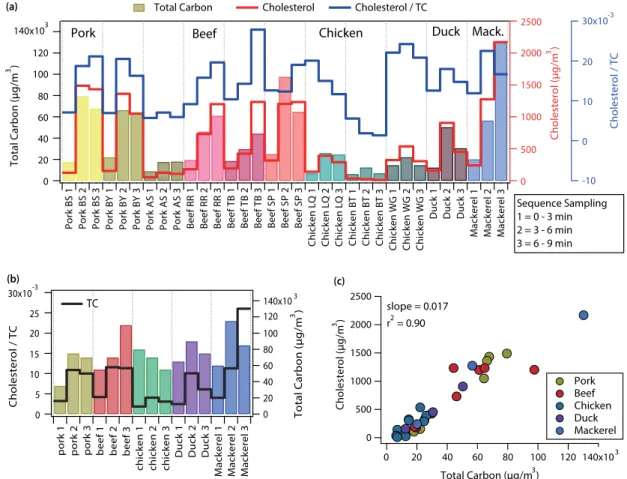
해하여 발생된 분진을 연소 체임버를 이용하여, 3분 간격 총 9분간 포집하여, 총 33개 시료에 대해 TC 및 cholesterol 분석 결과를 표 4에 요약하였다. 본 연구 에서 나타낸 데이터는 모두 최저 저한계 이상 값을 나타냈으며, 재차 및 표준시료에 대해서 5% 이내 정 확 정밀도를 나타냈다. 본 연구에서 고기구이 시 발 생하는 모든 분진이 체임버 후드로 포집되지 않음을 가정할 때, 부피농도 환산 값을 고기구이 분진 배출 절대량으로 판정할 수 없지만, 같은 조건에서 실험이 진행되었음을 볼 때 상대 농도 값은 의미가 있다. 돼지고기 중 목살의 TC는 54,917μg/m3 및 choles-terol 1,015μg/m3로 분석되어 다른 돼지고기 부위보 다 가장 높은 값을 나타냈으며. 다음으로 삼겹살 및 앞다리살로 나타났다. 전체 돼지고기 TC 및 choles-terol 평균값은 40,226μg/m3 및 654μg/m3로 분석되었 다. 앞서 설명한 바와 같이 고기구이 시 유실 분진이 있으므로, 고기별 구이 분진 발생 특성을 분석하고자 cholesterol와 TC의 비율을 계산하였다. 돼지고기의 경우 앞다리살이 가장 작은 비율 값(0.006)을 나타냈 으며, 목살과 삼겹살은 비슷하게 분석되었다. 이는 돼 지고기 구이 시 목살 및 삼겹살에서 상대적으로 많은 TC 발생과 함께, 높은 cholesterol이 발생하였다. 소고 기의 경우 꽃등심, 부채살, 업진살 중에서 업진살이 가장 높은 TC(62,438μg/m3) 및 cholesterol(916μg/ m3)으로 분석되었다. 하지만, 부채살의 경우 가장 높 은 cholesterol과 TC의 비율(0.020)을 나타내, 단위 140x103 120 100 80 60 40 20 0 To ta l C ar bo n (μ g/ m 3 ) Po rk B S 1 Po rk B S 2 Po rk B S 3 Po rk B Y 1 Po rk B Y 2 Po rk B Y 3 Po rk A S 1 Po rk A S 2 Po rk A S 3 Be ef R R 1 Be ef R R 2 Be ef R R 3 Be ef T B 1 Be ef T B 2 Be ef T B 3 Be ef S P 1 Be ef S P 2 Be ef S P 3 C hi ck en L Q 1 C hi ck en L Q 2 C hi ck en L Q 3 C hi ck en B T 1 C hi ck en B T 2 C hi ck en B T 3 C hi ck en W G 1 C hi ck en W G 2 C hi ck en W G 3 D uc k 1 D uc k 2 D uc k 3 M ac ke re l 1 M ac ke re l 2 M ac ke re l 3 2500 2000 1500 1000 500 0 Ch ol es te ro l ( μg /m 3 ) 30x10-3 20 10 0 -10 Ch ol es te ro l / T C
Total Carbon Cholesterol Cholesterol / TC
Pork Beef Chicken Duck Mack.
Sequence Sampling 1 = 0 - 3 min 2 = 3 - 6 min 3 = 6 - 9 min 30x10-3 25 20 15 10 5 0 C h o le st er o l / T C p o rk 1 p o rk 2 p o rk 3 b ee f 1 b ee f 2 b ee f 3 ch ic ke n 1 ch ic ke n 2 ch ic ke n 3 D u ck 1 D u ck 2 D u ck 3 M ac ke re l 1 M ac ke re l 2 M ac ke re l 3 140x103 120 100 80 60 40 20 0 Tota l C ar b o n (μ g /m 3 ) TC 2500 2000 1500 1000 500 0 Ch ol es te ro l ( μg /m 3 ) 120 80 40 0 Total Carbon (μg/m3) slope = 0.017 r2 = 0.90 Pork Beef Chicken Duck Mackerel 100 60 20 140x103 (a) (b) (c)
Fig. 5. Results of TC, cholesterol, and ratio of cholesterol concentrations in the sequence sampling time(1=0~3 min,
2=3~6 min, 3=6~9 min) and pairwise scatterplot between cholesterol & TC from the pyrolysis sampling system from meat
TC 당 높은 cholesterol을 발생하였다. 닭고기는 닭다 리 구이에서 가장 높은 TC(19,260μg/m3), 닭날개 구 이에서 가장 높은 cholesterol(388μg/m3)을 나타냈으 며, 특히 전체 고기구이에서 가장 높은 cholesterol과 TC 비율(0.023)을 나타냈다. 전체 돼지고기, 소고기, 닭고기의 평균 TC 및 cholesterol은 33,460μg/m3 및 542μg/m3, cholesterol와 TC 비율 0.015로 분석되었 다. 이는 오리고기의 TC(31,098μg/m3) 및 cholesterol (504μg/m3)와 비슷한 값으로 분석되었다. 특이한 점 은 고등어 구이의 경우 TC(68,945μg/m3) 및 choles-terol(1,227μg/m3)이 고기구이보다 약 2배 이상 높은 값을 나타내었다. 이는 생선 비늘이 상대적으로 열분 해가 잘 되어, 다량의 유기 성분이 배출될 가능성이 크다. 좀 더 자세히, 본 연구에서 각 3분 간격 구이 시간 별 TC, cholesterol 농도 및 cholesterol과 TC 비율을 그림 5에 나타냈다. 모든 돼지고기 목살, 삼겹살, 앞다 리살 구이에서 3분에서 6분 구이 시간 동안 가장 높 은 TC(54,467μg/m3) 및 cholesterol(991μg/m3)이 분 석되었다. 이는 구이 초반, 돼지고기 내 수분 등이 선 증발되고, 이후 고기가 열분해되어 cholesterol을 포 함하는 유기 성분이 발생하며, 6분 이후 발생량이 서 서히 감소하는 것으로 판단한다. 닭고기, 오리고기 구 이에서 3분에서 6분 사이에 가장 높은 TC 및 choles-terol 농도가 나타났다. 하지만, 소고기의 경우 꽃등 심, 부채살의 경우 6분에서 9분 구이 시간 동안 가장 높은 TC 및 cholesterol가 분석되었다. 이는 고기를 구성하고 있는 단백질 성분 등의 열분해 특성이 다른 고기류에 비해 느리게 나타남을 알 수 있다. Cholesterol과 TC 평균 비율을 살펴보면, 돼지고기 의 경우 3분에서 6분 구이 시간 동안 가장 높은 비율 을 나타낸 반면, 소고기의 경우 6분에서 9분 구이 시 간에 가장 높은 값(0.022)을 나타내, 앞서 설명한 느 린 열분해에 따른 cholesterol 배출량 특성을 나타냈 다. 닭고기의 경우, 소고기와는 반대로 처음 구이 시 작에서 3분 동안 가장 높은 비율(0.016)을 나타내, 다 른 고기류에 비해 짧은 열분해 유기성분 발생이 일어 남을 알 수 있다. 오리고기 및 고등어의 경우 돼지고 기와 동일하게 3분에서 6분 구이 시간 동안 가장 높 은 비율을 나타냈다. 전체적인 cholesterol과 TC의 상관관계를 살펴보 면, 높은 상관관계 결정계수(r2=0.90) 기울기 0.017 로 나타났다. 본 연구 결과를 바탕으로 다음과 같은 식(5)를 산출하였다. TCmeat cooking
TCmeat cooking=---×Cholesterol (5)
Cholesterolmeat cooking
위 식(5)를 통해 TC 내 고기구이에 의해 대기 중
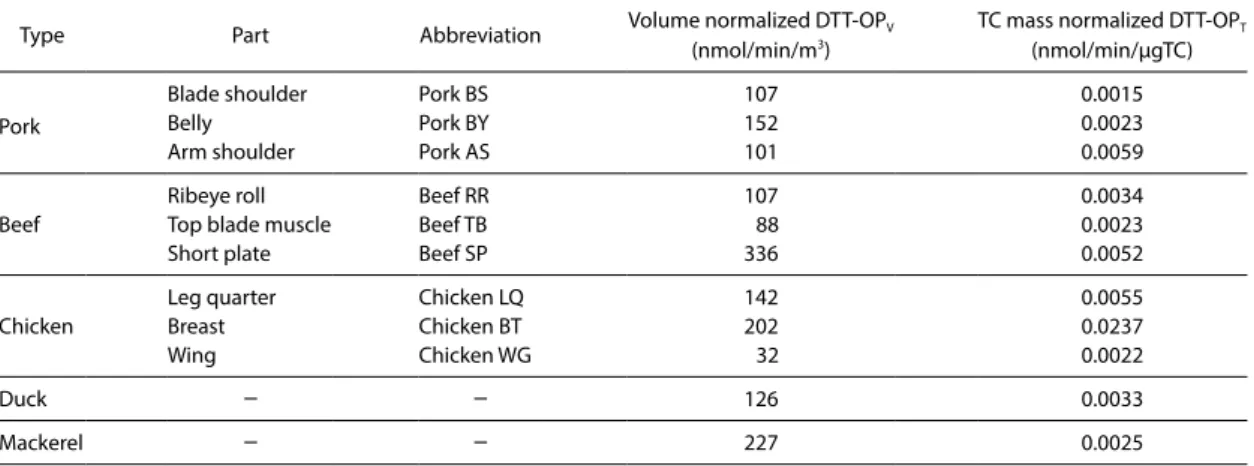
Table 5. Analytical results of volume normalized DTT-OP and TC mass normalized DTT-OP from the pyrolysis sampling
sys-tem from meat smoke.
Type Part Abbreviation Volume normalized DTT-OPV (nmol/min/m3)
TC mass normalized DTT-OPT (nmol/min/μgTC)
Pork
Blade shoulder Pork BS 107 0.0015
Belly Pork BY 152 0.0023
Arm shoulder Pork AS 101 0.0059
Beef
Ribeye roll Beef RR 107 0.0034
Top blade muscle Beef TB 88 0.0023
Short plate Beef SP 336 0.0052
Chicken Leg quarterBreast Chicken LQChicken BT 142 202 0.00550.0237
Wing Chicken WG 32 0.0022
Duck - - 126 0.0033
기여량(TCmeat cooking)을 계산할 수 있다. TCmeat cooking /
Cholesterolmeat cooking는 본 구이 실험에서 연구 결과의
cholesterol과 TC의 기울기는 0.017의 역수 값인 58.8 이다. TCNMC=TCT-TCmeat cooking (6) 식(5)로부터 산출된 TCmeat cooking와 대기 중 전체 TCT의 차이로 식(6)에 나타낸 비고기구이 TC (TCNMC) 기여량을 최종 산출할 수 있다. 이는, 대기 TC 내, 2차 생성물 및 다른 1차 원인에 대한 정량적 기여량 등을 연구하는 데 매우 유용하다. 고기구이 분진의 산화 잠채력을 DTT 실험을 통해 분석한 DTT-OP 결과를 표 5에 나타냈다. 본 DTT 분 석에서 바탕 시료를 측정 값에서 식(2)를 통해서 보 정했으며, 바탕 값보다 낮은 값은, 본 결과에서 모두 제외하였다. DTT-OP는 크게 포집 부피로 정규화한 값(volume normalized DTT-OPV(nmol/min/m3))과
분석 TC로 정규화한 값(TC mass normalized DTT-OPT(nmol/min/μgTC))으로 계산하였다. 그 결과, 돼지고기 DTT-OPT는 앞다리살의 경우 단 위 TC 배출량에서 가장 높은 값(0.0059)을 나타냈다. 이는 다른 목살(0.0015) 및 삼겹살(0.0023) 구이에서 보다 높은 산화 잠재력을 지닌 성분이 앞다리살 구이 분진 내 존재할 가능성이 크며, 이에 따른 인체 유해 400 300 200 100 0 D TT -O Pv (n m ol /m in /m 3 ) Po rk B S 1 Po rk B S 2 Po rk B S 3 Po rk B Y 1 Po rk B Y 2 Po rk B Y 3 Po rk A S 1 Po rk A S 2 Po rk A S 3 Be ef R R 1 Be ef R R 2 Be ef R R 3 Be ef T B 1 Be ef T B 2 Be ef T B 3 Be ef S P 1 Be ef S P 2 Be ef S P 3 Ch ic ke n LQ 1 Ch ic ke n LQ 2 Ch ic ke n LQ 3 Ch ic ke n BT 1 Ch ic ke n BT 2 Ch ic ke n BT 3 Ch ic ke n W G 1 Ch ic ke n W G 2 Ch ic ke n W G 3 D uc k 1 D uc k 2 D uc k 3 M ac ke re l 1 M ac ke re l 2 M ac ke re l 3 2500 2000 1500 1000 500 0 Ch ol es te ro l ( μg /m 3 ) 140x103 120 100 80 60 40 20 0 TC (μ g/ m 3 ) DTT-OPv Cholesterol TC
Pork Beef Chicken Duck Mack.
Sequence Sampling 1 = 0 - 3 min 2 = 3 - 6 min 3 = 6 - 9 min 300 250 200 150 100 50 0 D TT -O Pv (n m ol /m in /m 3 ) po rk 1 po rk 2 po rk 3 be ef 1 be ef 2 be ef 3 ch ic ke n 1 ch ic ke n 2 ch ic ke n 3 D uc k 1 D uc k 2 D uc k 3 M ac ke re l 1 M ac ke re l 2 M ac ke re l 3 40x10-3 30 20 10 0 D TT -O PT (n m ol /m in /μ gT C) 40x10-3 30 20 10 0 D TT -O P T (n m ol /m in /μ gT C) 30x10-3 25 20 15 10 5 0 Cholesterol / TC Pork Beef Chicken Duck Mackerel (a) (b) (c)
Fig. 6. Results of DTT-OP in the sequence sampling time (1=0~3 min, 2=3~6 min, 3=6~9 min) and pairwise scatterplot
성도 상대적으로 높게 나타날 수 있다. 소고기의 경 우 업진살에서 가장 높은 DTT-OPT(0.0052)가 분석 되었으며, 꽃등심보다 1.5배, 부채살보다 2.3배 높게 나타났다. 닭고기의 경우 닭가슴살의 DTT-OPT가 0.0237로 닭날개 구이보다 약 10배 이상 매우 높게 나타났다. 오리 구이 DTT-OPT의 경우 0.0033으로 나 타났으며, 고등어 DTT-OPT는 0.0025로 돼지고기, 소 고기, 닭고기 전체 평균 값보다 낮게 나타났다. 이는 발생 TC가 다른 고기구이 분진보다는 높게 나타났지 만, 분진 내 산화 잠재력을 지닌 성분은 상대적으로 적게 존재함을 의미하며, 이에 따른 인체 유해성도 낮게 평가될 수 있다. 본 연구 결과로 최근 이슈화가 된, 국내 고등어구이 미세먼지 발생량에 따른 유해성 평가의 재고가 반드시 필요하다고 판단한다. 마지막으로, 본 연구에서 각 3분 간격 구이 시간별 DTT-OPv 및 DTT-OPT를 그림 6에 나타냈다. 돼지고 기(목살, 삼겹살, 앞다리살) 모든 구이에서 6분에서 9 분 구이 시간 동안 가장 높은 DTT-OPT(0.0053)가 나 타났다. 이는 앞서 설명한 처음 구이 시 돼지고기 내 수분 등 선 증발, 이후 cholesterol을 포함하는 유기 성 분이 발생하며, 6분 이후 BC 및 활성산소를 포함하는 불완전 연소 성분 등에 의한 산화 잠재력 증가에 따 른 결과라 판단한다. 이는 닭가슴살 구이의 경우 같 은 경향으로 분명하게 나타났다. 소고기의 경우 돼지 고기와는 다르게 처음 시작에서 3분까지, 6분에서 9 분 사이에 높은 DTT-OPT가 나타났다. 위 고기구이의 배출 성분 특성과 DTT-OPT의 특이한 점은 TC와 cholesterol의 비율이 낮을수록 높은 DTT-OPT가 분 석되었다. 이를 그림 6(c)에 DTT-OPT와 cholesterol/ TC의 상관관계를 나타냈다. 이는 TC로 정규화한 성 분 중, cholesterol이 상대적으로 많이 존재하면, 활성 산소를 포함하는 산화 잠재력이 상대적으로 낮으며, 반대로 cholesterol이 상대적으로 적게 존재하면, 높 은 DTT-OPT가 분석되어 산화 잠재력이 상대적으로 크게 나타났다. 이는, 고기구이 시간별 열분해에 따른 연소 성분이 다르게 나타나며, 산화 잠재력과 깊은 관련성이 있음을 의미한다.
4. 결 론
연소 체임버를 이용하여, 부위별 소고기, 돼지고기, 닭고기 및 고등어 등 10종의 고기를 열분해 발생 분 진을 TC, cholesterol, 그리고 DTT 분석법을 이용하 여 산화 잠재력을 통해, 고기구이 종류에 따른 TC에 대한 cholesterol 비율 및 독성 잠재력을 분석하였다. 그 결과, 전체적인 cholesterol과 TC의 높은 상관관계 결정계수(r2=0.90)와 함께 기울기 0.017로부터 비고 기구이 TC(TCNMC) 기여량을 최종 산출할 수 있다. 또한, 닭가슴살의 DTT-OPT 가 0.0237로 매우 높게 나 타났으며, 고등어 DTT-OPT는 0.0025로 돼지고기, 소 고기, 닭고기 전체 평균값보다 낮게 나타났다. 마지막 으로, TC 내 cholesterol의 비율이 낮을수록 높은 DTT-OPT가 분석되어, 고기구이 시간별 열분해에 따 른 불완전 연소 성분이 산화 잠재력과 관련성이 있 다.감사의 글
본 논문은 정부의 재원으로 한국연구재단 (NRF-2017R1D1A1B03029517 및 NRF-2017M3D8A109222 2)의 지원을 받아 수행된 연구 결과입니다.References
Allan, J.D., Williams, P.I., Morgan, W.T., Martin, C.L., Flynn, M.J., Lee, J., Nemitz, E., Phillips, G.J., Gallagher, M.W., Coe, H. (2010) Contributions from transport, solid fuel burning and cooking to primary organic aerosols in two UK cities, Atmospheric Chemistry and Physics, 10(2), 647-668.
Ayres, J.G., Borm, P., Cassee, F.R., Castranova, V., Donaldson, K., Ghio, A., Harrison, R.M., Hider, R., Kelly, F., Kooter, I.M., Marano, F., Maynard, R.L., Mudway, I., Nel, A., Sioutas, C., Smith, S., Baeza-Squiban, A., Cho, A., Duggan, S., Froines, J. (2008) Evaluating the Toxicity of Airborne Particulate Matter and Nanoparticles by
Measuring Oxidative Stress Potential-A Workshop Report and Consensus Statement, Inhalation Toxi-cology, 20(1), 75-99.
Bae, M.-S., Park, D.-J., Lee, K.-H., Cho, S.-S., Lee, K.-Y., Park, K. (2017) Determination of Analytical Approach for Ambient PM2.5 Free Amino Acids using LC-MSMS, Journal of Korean Society for Atmospheric Environ-ment, 33(1), 54-63. (in Korean with English abstract) Bates, J.T., Weber, R.J., Abrams, J., Verma, V., Fang, T., Klein, M.,
Strickland, M.J., Sarnat, S.E., Chang, H.H., Mulhol-land, J.A., Tolbert, P.E., Russell, A.G. (2015) Reactive Oxygen Species Generation Linked to Sources of Atmospheric Particulate Matter and Cardiorespira-tory Effects, Environmental Science & Technology, 49(22), 13605-13612.
Cho, A.K., Sioutas, C., Miguel, A.H., Kumagai, Y., Schmitz, D.A., Singh, M., Eiguren-Fernandez, A., Froines, J.R. (2005) Redox activity of airborne particulate matter at dif-ferent sites in the Los Angeles Basin, Environmental Research, 99(1), 40-47.
Gysel, N., Welch, W.A., Chen, C.-L., Dixit, P., Cocker, D.R., Karaval-akis, G. (2018) Particulate matter emissions and gas-eous air toxic pollutants from commercial meat cooking operations, Journal of Environmental Sci-ences, 65, 162-170.
Heo, S.-H., Kim, J.-H., Jo, M.-R., Hong, J.-H., Kang, D.-I. (2016) A Study on the Emission Characterisrics of Hazardous Air Pollutants (HAPs) and Particulate Matters from Under-Fired Briquette (Yeontan) Broiling, Journal of the Korean Society of Urban Environment, 16(2), 169-178. (in Korean with English abstract)
Huang, Y., Ho, S.S.H., Ho, K.F., Lee, S.C., Yu, J.Z., Louie, P.K.K. (2011) Characteristics and health impacts of VOCs and carbonyls associated with residential cooking activities in Hong Kong, Journal of Hazardous Mate-rials, 186(1), 344-351.
Kang, B.-W., Jeon, J.-M., Lee, H.S. (2014) A Study on the Source Profile Development for Fine Particles (PM2.5) Emit-ted from Meat Cooking, Journal of Korean Society for Atmospheric Environment, 30(1), 18-25. (in Korean with English abstract)
Li, N., Bhattacharya, P., Karavalakis, G., Williams, K., Gysel, N., Rivera-Rios, N. (2014) Emissions from commercial-grade charbroiling meat operations induce oxida-tive stress and inflammatory responses in human bronchial epithelial cells, Toxicology Reports, 1, 802-811.
Li, N., Sioutas, C., Cho, A., Schmitz, D., Misra, C., Sempf, J., Wang, M., Oberley, T., Froines, J., Nel, A. (2002) Ultrafine
Particulate Pollutants Induce Oxidative Stress and Mitochondrial Damage, Environmental Health Per-spectives, 111(4), 455-460.
McDonald, J.D., Zielinska, B., Fujita, E.M., Sagebiel, J.C., Chow, J.C., Watson, J.G. (2003) Emissions from Charbroiling and Grilling of Chicken and Beef, Journal of the Air & Waste Management Association, 53(2), 185-194. Mohr, C., DeCarlo, P.F., Heringa, M.F., Chirico, R., Slowik, J.G.,
Richter, R., Reche, C., Alastuey, A., Querol, X., Seco, R., Peñuelas, J., Jiménez, J.L., Crippa, M., Zimmer-mann, R., Baltensperger, U., Prévôt, A.S.H. (2012) Identification and quantification of organic aerosol from cooking and other sources in Barcelona using aerosol mass spectrometer data, Atmospheric Chemistry and Physics, 12(4), 1649-1665.
Mugica, V., Vega, E., Chow, J., Reyes, E., Sánchez, G., Arriaga, J., Egami, R., Watson, J. (2001) Speciated non-methane organic compounds emissions from food cooking in Mexico, Atmospheric Environment, 35(10), 1729-1734.
Nagy, K., Jakab, A., Pollreisz, F., Bongiorno, D., Ceraulo, L., Aver-na, M.R., Noto, D., Vékey, K. (2006) Analysis of sterols by high-performance liquid chromatography/mass spectrometry combined with chemometrics, Rapid Communications in Mass Spectrometry, 20(16), 2433-2440.
Oh, S.-H., Park, D., Cho, J-H., Han, Y.-J., Bae, M.-S. (2018a) Inter-comparison of Carbonaceous Analytical Results using NIOSH5040, IMPROVE_A, EUSAAR2 Protocols, Journal of Korean Society for Atmospheric Environ-ment, 34(3), 447-456. (in Korean with English abstract)
Oh, S.-H., Park, E.-H., Yi, S.-M., Shon, Z.-H., Park, K., Bae, M.-S. (2018b) Contribution of Biomass Burning and Sec-ondary Organic Carbon to Water Soluble Organic Carbon at a Suburban Site, Journal of Korean Soci-ety for Atmospheric Environment, 34(2), 259-268. (in Korean with English abstract)
Oh, S.-H., Kim, J., Shon, Z.-H., Bae, M.-S. (2017) Assessing the Altitudinal Potential Source Contribution Function of Aerosol Optical Depth in the West Coast of Kore-an Peninsula during the DRAGON-KORUS-AQ Cam-paign, Journal of Korean Society for Atmospheric Environment, 33(1), 19-30. (in Korean with English abstract)
Park, D.-J., Cho, I.-H., Lee, K.-Y., Park, K., Lee, Y.-J., Ahn, J.-Y., Bae, M.-S. (2016) Analysis of Poly Aromatic Hydrocarbon (PAH) Pollutants Originated from Local Road Dust by Spacial Measurements, Journal of Korean Society
for Atmospheric Environment, 32(3), 272-279. (in Korean with English abstract)
Robinson, A.L., Subramanian, R., Donahue, N.M., Bernardo-Bricker, A., Rogge, W.F. (2006) Source Apportion-ment of Molecular Markers and Organic Aerosol. 3. Food Cooking Emissions, Environmental Science & Technology, 40(24), 7820-7827.
Sameenoi, Y., Koehler, K., Shapiro, J., Boonsong, K., Sun, Y., Col-lett, J., Volckens, J., Henry, C.S. (2012) Microfluidic Electrochemical Sensor for On-Line Monitoring of Aerosol Oxidative Activity, Journal of the American Chemical Society, 134(25), 10562-10568.
Schauer, J.J., Kleeman, M.J., Cass, G.R., Simoneit, B.R.T. (2002) Measurement of Emissions from Air Pollution Sources. 4. C1-C27 Organic Compounds from Cook-ing with Seed Oils, Environmental Science & Tech-nology, 36(4), 567-575.
Schauer, J.J., Kleeman, M.J., Cass, G.R., Simoneit, B.R.T. (1999) Measurement of Emissions from Air Pollution Sources. 1. C1 through C29 Organic Compounds from Meat Charbroiling, Environmental Science & Technology, 33(10), 1566-1577.
Seo, Y.-H., Jang, Y.-K. (2014) CMB Source profile of PM10 emitted upon meat and pork charbroiling, Journal of Korean Society of Environmental Administration, 20(2), 49-55. (in Korean with English abstract)
Seo, Y.-H., Ko, K.-Y., Jang, Y.-K. (2010) Determination of Choles-terol, Fatty Acids and Polyaromatic Hydrocarbons in PM10 Particles Collected from Meat Charbroiling, Journal of Korean Society of Environmental Engi-neers, 32(2), 155-164. (in Korean with English
abstract)
Strak, M., Janssen, N., Beelen, R., Schmitz, O., Vaartjes, I., Kars-senberg, D., van den Brink, C., Bots, M.L., Dijst, M., Brunekreef, B., Hoek, G. (2017) Long-term exposure to particulate matter, NO2 and the oxidative poten-tial of particulates and diabetes prevalence in a large national health survey, Environment Interna-tional, 108, 228-236.
Sun, Y.-L., Zhang, Q., Schwab, J.J., Demerjian, K.L., Chen, W.-N., Bae, M.-S., Hung, H.-M., Hogrefe, O., Frank, B., Ratti-gan, O.V., Lin, Y.-C. (2011) Characterization of the sources and processes of organic and inorganic aerosols in New York city with a high-resolution time-of-flight aerosol mass apectrometer, Atmo-spheric Chemistry and Physics, 11(4), 1581-1602. Zhao, X., Hu, Q., Wang, X., Ding, X., He, Q., Zhang, Z., Shen, R.,
Lü, S., Liu, T., Fu, X., Chen, L. (2015) Composition pro-files of organic aerosols from Chinese residential cooking: case study in urban Guangzhou, south China, Journal of Atmospheric Chemistry, 72(1), 1-18.