www.kwss.or.kr
204
-1
Division of Crop Science, Gyeongsangbuk-do Agricultural Research & Extension Services, Daegu 702-708, Korea. 2
Division of Environmental Science & Engineering, Keimyung University, Daegu 704-701, Korea. 3
Department of Clinical Pathology, Jeju Halla University, Jeju Special Self-Governing Province, Jeju 690-708, Korea. * 연락저자(Corresponding author):Phone) +82-64-741-7403, Fax) +82-64-747-3989, E-mail) [email protected]
(Received July 5, 2012; Examined August 15, 2012; Accepted September 13, 2012)
Ⓒ 2012 Korean Society of Weed Science
Physicochemical Properties of Starch in Water Chestnut
(Eleocharis kuroguwai Ohwi)
Sang-Kuk Kim1, Jong-Hee Shin1, Su-Yong Kim1, Hak-Yoon Kim2 and Shin-Young Park3*
올방개 괴경 전분의 이화학적 특성
김상국1, 신종희1, 김수용1, 김학윤2, 박신영3*ABSTRACT The physicochemical properties of tuber starch in water chestnut have been studied. Peak viscosity, hot paste viscosity and cooling peak viscosity were 5679, 3146 and 4262 RVU, respectively. In three transition parameters, onset temperature (To), peak temperature (Tp), and conclusion temperature
(Tc) were 64.1, 68.5 and 72.3oC, respectively. Gelatinization enthalpy (
Δ
H gel) was 4.48 J/g. A-type starchhas a smaller proportion (11.4%) of short chains (DP≥12) and a larger proportion (57.2%) of short chains (13≤DP≥24). The tuber starch of water chestnut displayed an A-type X-ray diffraction pattern showing a strong diffraction peak at 2θ values of 15.18°, 17.13°, and 23.1°, and a weak peak at 2θ values of 18.1°, 20.06°, and 26.69°. Their crystallinity was 28.6% and the mean starch granule size was 21.5 µm.
Key words: amylose; Eleocharis kuroguwai; starch; waterchestnut.
INTRODUCTION
Water chestnut (Eleocharis kuroguwai Ohwi) was reported to be one of the most important perennial weed species in temperate regions including Korea (Kim 1983) and Japan (Takabayashi 1988). Water chestnut is not easy to be controlled by the use of herbicides. It is also one of the most important weed species in machine-transplanted rice fields (Chae and Guh 1999) and direct water-sown rice fields (Kim and
Pyon 1998) in Korea. Water chestnut is an erect, tuber- forming perennial.
Plant height, number of tillers and top fresh weight per m2 are 50~90 cm, 500~875 and 175~750 g, respectively. This weed forms tubers deep in the soil. These propagules die when the soil temperature falls below -5 to -7°C and cannot survive under dry condi- tions (Auld et al. 1996). Vegetative propagules with a water content of about 70% die when their water content decreases to 30% (Auld et al. 1996). It is
mainly found in temperate countries, such as China, Korea and Japan in irrigated rice areas.
Apart from these ecological and physiological cha- racteristics, tuber starch of this weed has been some- times used as food. Less is known about the physico- chemical properties of main component, starch in water chestnut. Since the water chestnut is potential new starch resource, its physicochemical properties were investigated in this study.
MATERIALS AND METHODS
The alkaline steeping procedure to isolate tuber starch of water chestnut was followed by the method of Wang et al. (2001). The two or three years grown tubers of water chestnut were collected at experimental fields of Gyeongsangbuk-do Provincial Agricultural Research & Extension Services, Daegu, Republic of Korea.
Water chestnut flour (20 g) was steeped in 40 mL of 0.1% NaOH for 18hr. The slurry was blended with a Waring blender at a high speed for 2 min, passed through 100 mesh sifter and centrifuged at 1,300×g for 10 min. The top layer was carefully removed and bottom layer was reslurried and washed three times with 0.1% NaOH. The top layer was removed and then the starch layer was washed with deionized water and centrifuged. The combined starch was then reslurried and neutralized with 0.1 N HCl to pH 6.5, and washed with deionized water four times, centrifuged, dried in an oven at 45°C for 48 hr.
The absorption curves of starch and iodine complexes were measured by a UV/VIS spectrophotometer (Model Evolution 300, Thermo Electron Corporation, USA) at 700 to 500 nm. A solution containing 2 mg iodine and 20 mg potassium iodate was added to 1 mg NaOH- gelatinized and HCl-neutralized starch, and made up to 25 mL. The wavelength at maximum absorption (λmax)
and blue value (BV), absorbance at 680 nm, were determined. According to the method of Kainuma (1977),
amperometric iodinetitration of defatted starch was carried out at 1A and 50 mV.
The pasting properties of the rice flours (3 g, 14% moisture basis) in water (25 mL) were determined using the Rapid Visco Analyzer (RVA, Newport Scientific Pty. Ltd., Narrabeen, Australia). DSC was performed on a Differential Scanning Calorimeter (DSC-SP, Rheometric Scientific, New Castle, DE, USA) and the instrument was calibrated with indium. Starch samples and distilled water (1:3, w/w) were hermetically sealed in aluminum pans, held overnight, and heated from 30 to 120°C with 10°C/min heating speed. An empty aluminum pan was used as reference. Rice starches were then suspended in 5 mL of meth- anol, boiled for 10 min, and the homogenate was centrifuged at 2,500 g for 10 min. The precipitated polyglucan fraction was washed twice with 1 mL of 90% (v/v) methanol, suspended in 5 mL of distilled water, and then boiled for 60 min. The gelatinized polyglucan sample was added to 50 μl of 600 mm sodium acetate buffer (pH 4.4) and 10 μl of 2% (w/v) NaN3, and hydrolyzed by adding 10 μl of Pseudomonas amyloderamosa isoamylase (1,400 units, Seikagaku,
Tokyo) at 37°C for 24 h. The hydroxyl groups of the debranched glucans were reduced with 25 mg of sodium borohydride under alkaline pH conditions for 20 h by the method of Nagamine and Komae (1996). The precipitate was dried in vacuum at room tem- perature. The reduced isoamylolysate sample was dis- solved in 30 μl of 1m NaOH for 60 min and diluted with 270 μl of distilled water. A 50 μL aliquot of the preparation was injected into a BioLC (model DX-500, Dionex, Sunnyvale, CA) equipped with a pulsed ampero- metric detector and a CarboPac PA-1 column (4 mm × 25 cm). Size fractionation of α-1,4-glucans was per- formed with a linear gradient of sodium acetate (50~ 500 mm) in 0.1 m NaOH at a flow rate of 1 mL min-1. Purified starch granules were sputter coated with gold and examined with scanning electron microscope (Model JSM-56000LV, JEOL) at 10 or 20 kV. DSC of starches was measured as described by Fujita et al. (2003).
Table 1. Wavelength at maximum absorption (λmax), absor- bance at 680 nm (blue value), starch and amylose content in water chestnut.
λmax (nm) Blue value (at 680 nm) Starch content (%) Amylose content (%) 595 0.267 85.6±0.1 19.3±0.2
Values are means ± standard deviations. Starch and amylose content were calculated by dry weight basis.
Table 2. Pasting properties of tuber flours of water chestnut.
Pasting time (min.) Pasting temp. (oC) Viscosity (RVU) PKV HPV CPV Breakdown Setback 2.67 69.8 5,679 3,146 4,262 2,533 -1,417 †
PKV, Peak viscosity; HPV, Hot paste viscosity; CPV, Cooling peak viscosity. X-ray diffraction pattern of starches was obtained with
copper, nickel foil-filtered, Kα-radiation using a diff- ractometer RINT 2000 at 50 kV and 27 mA. The collected data for tuber yield were analyzed by using SAS package for Duncan’s multiple range tests.
RESULTS AND DISCUSSION
Wavelength at maximum absorption, absorbance at 680 nm, starch and amylose contents for the tuber of water chestnut are presented in Table 1. Blue value was 0.267 at 680 nm. The starch and amylose contents in tuber flours of water chestnut were 85.6% and 19.3%, respectively.
Table 2 presents pasting properties of tuber flour in water chestnut determined by Rapid Visco Analyser (RVU). Pasting time and temperature in tuber flours of water chestnut were 2.67 min. and 69.8°C, respecti- vely. Peak viscosity (PKV), hot paste viscosity (HPV) and cooling peak viscosity (CPV) were 5,679, 3,146 and 4,262 RVU, respectively. Among these parameters, hot paste viscosity is influenced by the rate of amylose
exudation, amylose-lipid complex formation, granule swelling, and completion between exudated amylose and remaining granules for free water, while the cold paste viscosity is largely determined by the retrogra- dation tendency of the soluble amylose upon cooling (Olkku and Rha 1978).
Pasting properties are dependent on the rigidity of starch granules, which in turn affect the granule swelling potential (Sandhya et al. 1989) and the amount of amylose leaching out in the solution (Morris 1990). Parades-Lopez (1994) reported that low peak viscosity is due to short chain length and to irreversible damage treated with alkaline media. Setback values in non- glutinous proso millet starches were higher than the waxy proso millet starches. It is generally recognized that if viscosity of setback is high, the retrogradation of starch paste would progress rapidly (Leeiarathi et al. 1987).
The transition temperatures (To, Tp, and Tc), range (R, Tc-To), enthalpies of gelatinization (ΔH gel), and
peak height indices (PHI) of tuber starch from water chestnut were determined by differential scanning calo- rimeter (Table 3). In three transition parameters, onset temperature (To), peak temperature (Tp), and conclu- sion temperature (Tc) were 64.1, 68.5 and 72.3, res- pectively. Gelatinization enthalpy (ΔH gel) was 4.48
J/g. Gelatinization temperature may be attributed to the differences in amylose content, size, shape, and distri- bution of starch granules, and to the internal arrange- ment of starch fractions within the granules (Grelda et
al. 1997).
Transition temperatures are influenced by the mole- cular architecture of the crystalline region, which cor-
Table 3. Thermal properties of tuber starch determined by differential scanning calorimeter (DSC) in water chestnut.
Gelatinization parameters
To (oC) Tp (oC) Tc (oC) ΔH gel (J/g) PHI R
64.1±0.2 68.5±0.1 72.3±0.2 4.48 1.02 8.2
All values shown are means ± standard deviations. To, onset temperature; Tp, peak temperature; Tc, conclusion temperature; R, gelatinization range (Tc-To); ΔH, enthalpy of gelatinization (based on starch dry weight); PHI, peak height index ΔH gel/ (Tp-To). 5 10 15 20 25 30 35 40 45 50 55 60 Degree of polymerization 70 60 50 40 30 20 10 0
Fig. 1. Distribution of amylopectin branch chain-length of
water chestnut determined by using a high-perfor- mance anion-exchange chromatography coupled with a pulsed amperometric detector (HPAEC-PAD).
Table 4. X-ray diffraction data of tuber starch from water
chestnut.
Diffraction peaks at 2θ values
Strong peak Weak peak
15.18°, 17.13°, 23.1° 18.1°, 20.06°, 26.69° respond to the amylose and amylopectin ration (Noda
et al. 1998). The ΔH gel of starch suggested that the
double helices (formed by the outer branches of adja- cent amylopectin chains) that unravel and melt during gelatinization are strongly associated within the native granule. The gelatinization enthalpy reflects the overall measure of crystallinity (quality and quantity of cry- stallites) of amylopectin and is an indicator of the loss of molecular order within the granules (Tester and Morrison 1990). PHI is the ratio of ΔH gel for gela- tinization to the gelatinization temperatures range and is a measure of uniformity in gelatinization. Tuber starch in PHI was 1.02, indicating that the high PHI value of starch may be attributed to the presence of large-size granules (Aggarwal et al. 2004).
Chain length distribution represents the structural feature of polyglucans such as amylopectin and gly- cogen. Analysis by HPAEC-PAD was performed to examine the fine structures of polyglucans in tuber starch of water chestnut (Fig. 1).
In general, A-type starch has peaks at shorter chain- lengths (first peak at dp 12~14, second peak at dp 1 2~14, second peak at dp 41~51) than B-type starch (first peak at dp 14~16, second peak at 48~53). A-type starch has a smaller proportion (11.4%) of short chains (dp≥12) and larger proportions (57.2%) of short chains (13≤DP≥24). All cereal starches display very short chains of dp 6 and a gradual increase in chains dp 7~ 9. Some tuber, root and mung bean starch also displays a higher proportion of dp 6 than dp 6 and 8 (Jane et
al. 1999).
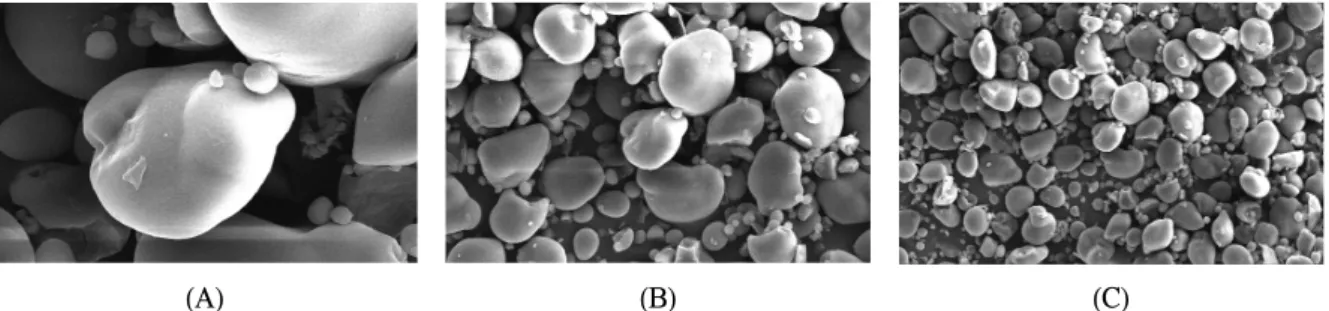
X-ray diffraction study was performed to obtain qualitative evidence for crystalline starch. X-ray diff- raction angles, crystallinity and scanning electron pho- tographs of water chestnut starches are presented in Table 4, Table 5, Figure 2, and Figure 3, respectively. The profile for water chestnut starch has distinctive feature of A-type starch such as cereal crops, corn and rice starches. Furthermore, its feature of water chestnut was the same with that of Eleocharis dulcis starch (Yu
et al. 1999).
The tuber starch of water chestnut displayed an A-type X-ray diffraction pattern showing the strong diffraction peak at 2θ values of 15.18°, 17.13°, and 23.1°, and a small peak at 2θ values of 18.1°, 20.06°,
Table 5. Crystalpatternanddegreeofcrystallinityof tuber starch from water chestnut. Starch granule size (µm) Degree of Crystallinity (%)
Crystal pattern % Distribution
DP≥12 13≤DP≥24 25≤DP≥36 37≤DP
28.6±2.1 21.5±0.3 A 11.4 57.2 24.1 8.7
Degree of crystallinity was determined following equation as Xc=Ac/(Ac+Aa); Ac:the crystallized area; Aa:the amorphous area on the X-ray diffractogram.
5 10 15 20 25 30 35 40 Diffraction angle (2θ) 12000 10000 8000 6000 4000 2000 0
Fig. 2. X-ray diffraction diagram of tuber starch in water
chestnut.
(A) (B) (C)
Fig. 3. Scanning electron micrograph of tuber starch in water chestnut. From the left, magnification (A)×3000, (B)×1000, and
(C)×500.
and 26.69° (Table 4, Table 5, and Fig. 2). Their cry- stallinity was 28.6%. The degree of crystalline in starch is strongly dependent on amylose content (Cheetham et
al. 1998). It is generally reported that A-type and
B-type starches reflect the presence of parallel stranded double helices. Parallel stranded double helices, which are packed quite closely in A-type structures but are more loosely associated for B-type starches (Ratnayake
et al. 2001).
Scanning electron microscopy revealed that the mean starch granule size was 21.5 µm in diameter (Fig. 3). Starch granules of water chestnut showed mostly polygonal-round, oval, spherical in shape. In brief, the variation in size and shape off starch granules may be due to the biological origin (Svegmark and Hermansson 1993). The morphology of starch granules depends on the biochemistry of the chloroplast or amyloplast, as well as physiology of the plant (Badenhuizen 1969). In conclusion, it is supposed that new natural starches are essential for their best use and also to increase the utilization of starchy flours including utilization as an additive in food industry.
요 약
본 연구는 다년생 잡초인 올방개 괴경의 전분에 관 한 이화학적 특성을 알아보기 위하여 수행되었다. 올 방개 괴경 분말의 호화 점도 특성은 최고점도 5,679, 강하점도 426이었고, 괴경 전분의 호화 개시온도는 64.1oC로 낮았으며 최종온도는 72.3oC이었다. 전분입자의 X-ray 회절각은 15.18°, 17.13°, 23.1°에서 강한 피크를 보였으며, 18.1°, 20.06°, 26.69°에서 약한 피크 를 보였다. 올방개 괴경 전분의 결정화율은 28.6%이고 괴경 전분 입자의 모양은 둥글면서 부분적으로 눌린 형태였으며 평균 입자 크기는 21.5µm이었다.
REFERENCES
Aggarwal, V., N. Singh, S. S. Kamboj and P. S. Brar, 2004. Some properties of seeds and starches separated from different Indian pea cultivars. Food Chem. 85:585-590.
Auld, B. A., and K. U. Kim. 1996. Weed management in rice. FAO plant production and protection paper. FAO of the United Nations. 17-18. Badenhuizen, N. P. 1969. The biogenesis of starch
granules in higher plants. New York, Appleton Crofts.
Chae, J. C., and J. O. Guh. 1999. Occurrence and control of weeds in direct-seeded rice paddy in Korean J. Weed Sci. Tech. 44(4):391-404. Cheetham, N. W. H, and L. Norman. 1998. Variation
in crystalline type with amylose content in maize starch granules: an X-ray powder diffraction study. Carbohydrate Polymers. 36(4):277-284.
Fujita, N., A. Kubo, D. S. Suh, K. S. Wong, J. L. Jane, K. Ozawa, F. Takaiwa, Y. Inaba and Y. Nakamura. 2003. Antisense inhibition of isoamylase alters the structure of amylopectin and the physicochemical properties of starch in rice endosperm. Plant Cell Physiol. 44: 607-618.
Grelda, A., G. A. Yañez-Farias, J. G. Moreno-Valencia, M. R. Falcón-Villa and J. M. Barrón-Hoyos. 1997. Isolation and partial characterization of starches from dry beans (Phaseolus vulgaris) and Chickpeas (Cicer arietinum), Grown in Sonora, Mexico. Starch 49(9):341-345.
Jane, J., Y. Y. Chen, L. F. Lee, A. E. McPherson, K. S. Wong, M. Radosavljevic and T. Kasemsuwan. 1999. Effects of amylopectin branch chain length
and amylose content on the gelatinization and pating properties of starch. Cereal Chem. 76(5): 629-637.
Kainuma, K. 1977. Handbook of Starch Science. In : Nikuni J. et al. (eds.). Asakara Shoten, Japan. pp. 202.
Kim, H. H., and J. Y. Pyon. 1998. Weed occurrence and yield loss due to weeds in different direct seeded rice paddy fields. Korean J. Weed Sci.18: 12-19.
Kim, K. U. 1983. Control of perennial weeds in rice in temperate zones. In:Weed control in rice. IRRI, Los Banos, Philippines, 243-253.
Leeiarathi, K., D. Indrani and J. S. Sidhu. 1987. Amylograph pasting behavior of cereal and tuber starches. Starch 39:378-381.
Morris, V. J. 1990. Starch gelation and retrogradation. Trends Food Sci. Technol. 1:2-6.
Nagamine, T. and K. Komae. 1996. Improvement of method for chain-length distribution analysis of wheat amylopectin. J. Chromatogr. 732:255-259. Noda, T., Y. Takahata, T. Sato, I. Suda, T. Morishitta
and K. Ishiguro. 1998. Relationships between chain length distribution of amylopectin and gelatini- zation properties within the same botanical origin for sweet potato and buckwheat. Carbohydrate Polymers 37:153-158.
Olkku, J. and C. Rha. 1978. Gelatinization of starch and wheat flour starch - A review. Food Chem. 3: 293-317.
Parades-Lopez, O. 1994. Amaranth carbohydrate, in amaranth biology, chemistry and technology, O Parades-Lopez, ed, CRC Press, Boca Raton, USA. Ratnayake, W. S., R. Hoover, F. Shahidi, C. Perera and
J. Jane. 2001. Composition, molecular structure, and physicochemical properties of starches from four field pea (Pisum sativum L.) cultivars. Food Chem. 74(2):189-202.
Sandhya S., M.R. Rani and K. R. Bhattacharya. 1989. Rheology of rice flour pastes: effect of variety, concentration, and temperature and time of cook-
ing. J. Texture Stud. 20:127-137.
Svegmark, K. and K. A. Hermansson. 1993. Micro- structure and rheological properties of composites of potato starches granules and amylose. a com- parison of observed and predicted structure. Food Struct. 12:181-193.
Takabayashi, M. 1988. Weed management practices for rice farming in Japan. In:Proceedings of the National Seminar and Workshop on Rice Field Weed Management, 25-31.
Tester, R. F. and W. R. Morrison. 1990. Swelling and
gelatinization of cereal starches. I. Effect of am- ylopectin, amylose and lipids. Cereal Chemistry 67:551-557.
Wang, L. and Y. J. Wang. 2001. Comparison of pro- tease digestion at neutral pH with alkaline steep- ing method for rice starch isolation. Cereal Chem. 78:690-692.
Yu, B., S. Fujii and K. Kobe. 1999. Physicochemical properties of Huaishan (Rhizoma dioscorea) and Matai (Eleocharis dulis) starches. Starch 5-10.