O-II-3
46
-Magnetic field and temperature control over
CoFeB/Ta/CoFeB logic device
A.D. Talantsev1,2*, R.B. Morgunov2, Y. Lu3, S. Mangin3, C.G. Kim1
1Department of Emerging Materials Science, DGIST, 42988, Daegu, Republic of Korea 2Institute of problems of chemical physics, 142432, Chernogolovka, Moscow, Russia
3Institut Jean Lamour, UMR 7198 CNRS, Université de Lorraine, France
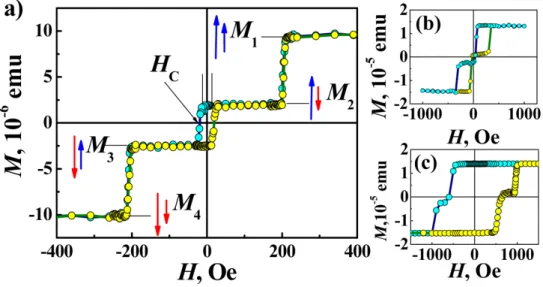
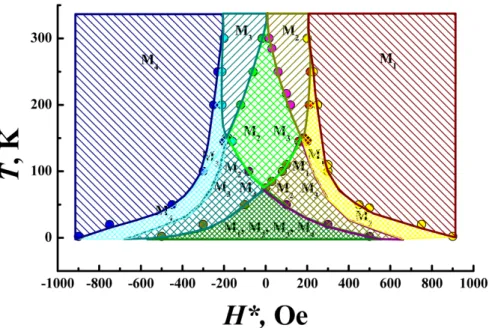
Our work is focused to the study of magnetization reversal processes in synthetic antiferromagnets based on two perpendicularly magnetized CoFeB layers of different widths separated by non-magnetic Ta interlayer. Magnetic hysteresis loops at three temperatures corresponding to three different modes of magnetization switching are presented in the fig.1. The full map (T-H phase diagram) of the different states and switching between them for studied system is shown in the fig.2. The sequence of magnetization reversals of the magnetic layers in this trilayer structure is temperature dependent. In high-temperature mode (150 – 300 K) magnetization reversals are governed by dipole-dipole interaction magnetic layers [1]. Three transitions were resolved: magnetization flop of thin layer magnetization (M1 → M2 transition) at H = 200 Oe, flip-flop transition of thick and thin layers, both,
at H = ± HC (M2 → M3 transition), and flop transition of thin layer at H = - 200 Oe (M3 → M4 transition).
Fig. 1. Magnetic hysteresis loops at 300 K (a), 100 K (b) and 2 K (c). Long and short arrows correspond to thick and thin layers magnetizations, respectively.
In low temperature mode (2 – 80 K) exchange interlayer coupling dominates dipole-dipole interaction between magnetic [2] layers and the sequence of magnetization switching is governed by magnetic anisotropy of the layers. The sequence contains only two transitions correspondent to independent flop transitions of the thin and thick layers. At the intermediate (80 – 150 K) temperature range the hysteresis loop is most complicated. Competition between dipole-dipole interaction, interlayer exchange coupling and anisotropy of the layers results in the shift of magnetization states M2 and M3 and results in a butterfly shape of the hysteresis loop.
47
-Fig. 2. Phase diagram of different magnetization states existence in the CoFeB/Ta/CoFeB trilayer in H-T space. Denotations M1, M2 etc correspond to areas of existence of a single possible state independently
on thermal and magnetic prehistory, the denotations M1 or M2; M2, M3, M4 etc correspondent to possibility to
observe several different states dependently on thermal and magnetic prehistory.
This work was supported by the DGIST R&D Program of the Ministry of Science, ICT and Future Planning (17-BT-02) and Ministry of Education and Science of the Russian Federation (grant 3.1992.2017/PCh).
References
[1] T. Hauet and O. Hellwig. J. Appl. Phys. 115, 123911 (2014).
[2] N. Vernier, J.-P. Adam, S. Eimer, G. Agnus, T. Devolder, T. Hauet, B. Ocker, F. Garcia, and D. Ravelosona. Appl. Phys. Lett. 104, 122404 (2014);