• 검색 결과가 없습니다.

Prosodic Boundary Effects on the V-to-V Lingual Movement in Korean

N/A
N/A
Protected

Academic year: 2021

Share "Prosodic Boundary Effects on the V-to-V Lingual Movement in Korean"

Copied!
13
0
0

로드 중.... (전체 텍스트 보기)

전체 글

(1)

말소리와 음성과학 제2권 제3호 (2010) pp. 101~113

Prosodic Boundary Effects on the V-to-V Lingual Movement in Korean

Cho, Taehong 1) ․Yoon, Yeomin 2) ․ Kim, Sahyang 3)

ABSTRACT

The present study investigated how the kinematics of the /a/-to-/i/ tongue movement in Korean would be influenced by prosodic boundary. The /a/-to-/i/ sequence was used as ‘transboundary' test materials which occurred across a prosodic boundary as in /ilnjəntʃʰa/ # /minsakwae/ (‘일년차#민사과에’ ‘the first year worker’ # ‘dept. of civil affairs'). It also tested whether the V-to-V tongue movement would be further influenced by its syllable structure with /m/ which was placed either in the coda condition (/am#i/) or in the onset condition (/a#mi). Results of an EMA (Electromagnetic Articulagraphy) study showed that kinematical parameters such as the movement distance (displacement), the movement duration, and the movement velocity (speed) all varied as a function of the boundary strength, showing an articulatory strengthening pattern of a “larger, longer and faster” movement. Interestingly, however, the larger, longer and faster pattern associated with boundary marking in Korean has often been observed with stress (prominence) marking in English. It was proposed that language-specific prosodic systems induce different ways in which phonetics and prosody interact: Korean, as a language without lexical stress and pitch accent, has more degree of freedom to express prosodic strengthening, while languages such as English have constraints, so that some strengthening patterns are reserved for lexical stress. The V-to-V tongue movement was also found to be influenced by the intervening consonant /m/’s syllable affiliation, showing a more preboundary lengthening of the tongue movement when /m/ was part of the preboundary syllable (/am#i/). The results, together, show that the fine-grained phonetic details do not simply arise as low-level physical phenomena, but reflect higher-level linguistic structures, such as syllable and prosodic structures. It was also discussed how the boundary-induced kinematic patterns could be accounted for in terms of the task dynamic model and the theory of the prosodic gesture (π-gesture).

Keywords: V-to-V lingual movement, prosodic boundary effect, π-gesture, syllable affiliation

1. Introduction

One of the fundamental properties of speech is that it is variably produced due to various factors coming from both linguistic structures (e.g., syntactic, semantic or prosodic structure) and non-linguistic structures (e.g., gender, age or vocal tract physiology).

Among those factors is the prosodic structure that has been central to a large body of recent experimental phonetic studies under the rubric of the phonetics-prosody interface. As Beckman (1996:16)

1) Hanyang University [email protected](corresponding author) 2) Hanyang University [email protected]

3) Hongik University [email protected]

Received: August 13, 2010 Revision: September 11, 2010 Accepted: September 11, 2010

puts it, prosodic structure can be defined as “a hierarchically organized structure of phonologically defined constituents and heads”

reflecting how speech units are grouped together forming different sizes of prosodic constituents or domains (e.g., syllables, prosodic words, phrases) and how prominent the prosodic domains are relative to each other (e.g., stressed versus unstressed or focused versus unfocused). Prosodic structure is thus known to serve dual functions in speech production—i.e., prosodic boundary marking by which hierarchical grouping of prosodic constituents is determined, and prominence marking by which relative prominence (e.g., stress/accent) among prosodic constituents is determined (e.g., Cho

& Keating, 2009). Prosodic structure has therefore been taken to be

an important grammatical entity in its own right (Beckman, 1996),

and a general consensus is that a complete picture of speech

production and comprehension cannot be obtained without

understanding the interplay between phonetics and prosody at various

(2)

levels of production and comprehension process. The primary purpose of the present study is to explore the phonetics-prosody interplay at the fine-grained articulatory level by examining how boundary marking of prosodic structure influences the vowel-to-vowel (/a/ to /i/) tongue movement in Korean, using an Electromagnetic Articulography (EMA).

1.1. Background

In generally accepted models of prosodic organization (e.g., Beckman & Pierrehumbert, 1986; Nespor & Vogel, 1985; Selkirk, 1984), prosodic structure is hierarchically organized, such that smaller prosodic domains are grouped into a higher prosodic domain in a strictly layered way. The Intonational Phrase (henceforth IP), often taken to be the largest prosodic domain, consists of smaller prosodic domains, such as the Intermediate Phrase as in English or the Accentual Phrase (henceforth AP) as in Korean, which is again composed of even smaller prosodic domains, called the Prosodic Word (henceforth Word) (see Shattuck-Hufnagel & Turk, 1996 for a general review on prosody, and Jun, 1995, 2000, for the prosodic system in Korean). In such a hierarchical prosodic structure, the Word boundary occurs inside an AP (in the case of Korean), and the AP boundary occurs inside an IP with the boundary strength progressively increasing from the Word to the IP boundaries.

Some aspects of the phonetics-prosody interplay can be understood in terms of ‘prosodic strengthening.’ The term ‘prosodic strengthening’ has been used as a cover term for articulatory strengthening in spatial and/or temporal dimension that arises with boundary and prominence markings (e.g., Cho, 2005, 2008; Cho &

McQueen 2005; Cho & Keating, 2009). The prosodic strengthening patterns associated with the boundary marking are observed at edges of prosodic domains—i.e., in preboundary position at the right edge of prosodic domain and in postboundary position at the left edge of prosodic domain.

Preboundary (domain-final) segments are generally produced with temporal expansion (also know as domain-final lengthening), such that, for example, the first word ‘bus’ in the two word sequence ‘bus

# tickets’ in English (where ‘#’ refers to a prosodic boundary) is produced with longer duration when it occurs phrase-finally (as in

‘When you get on the bus, # tickets should be shown to the driver’

where ‘#’ is an IP boundary) than phrase-medially (as in ‘John forgot to buy bus#tickets for his family’ where ‘#’ is an Word boundary inside an IP) (Cho, McQueen & Cox, 2007). The domain-final lengthening, however, has often been observed without accompanying spatial expansion, which has led some researchers (e.g., Beckman, et al., 1992; Edwards, et al., 1991) to believe that

the preboundary articulation is differentiated from the articulation for prominence marking (i.e., the stress/accent-induced articulation), in that the former is characterized by temporal expansion alone while the latter is characterized by both temporal and spatial expansion.

Postboundary (domain-initial) segments, on the other hand, are generally produced with both temporal and spatial expansion. In a cross-linguistic Electropalatography (EPG) study (with Korean, English, French and Taiwanese), Keating, Cho, Fougeron & Hsu (2003) showed that domain-initial lingual (alveolar) consonants are produced with a greater amount of linguopalatal contact (the contact between the palate and the tongue) in the spatial dimension as well as a longer stop closure duration in the temporal dimension (see also Cho & Keating, 2001, for an extended study on Korean). The domain-initial strengthening phenomenon, however, has been observed primarily with domain-initial consonants, and its effect on the following vowel has, if it exists, only sporadically observed in English (Cho, 2005, 2008). Barnes (2001, 2002) suggested that at least in English the vowel in CV syllables is not subject to domain-initial acoustic lengthening because vowel duration is a major cue for lexical stress in English.

The boundary-induced prosodic strengthening in English has also been examined kinematically in terms of how the tongue movement spanning a prosodic boundary is influenced by the boundary strength (Byrd 2000; Cho, 2008). (The term kinematics generally refers to the study of the motion of bodies, but here it is specifically concerned with the motion of articulators, which are characterized by movement duration, velocity and distance.) In a V1#CV2 sequence, V2 articulation starts before the intervening consonant (and therefore before the prosodic boundary), and its target is reached after the consonant (and therefore after the prosodic boundary). Given that the articulatory gesture for V2 is reflected in the V1-to-V2 lingual movement across the prosodic boundary, the prosodic boundary effect on the vocalic gesture has been examined as a “transboundary”

effect (Byrd, 2000; Cho, 2008). The results of an articulatory study by Cho (2008) showed that the transboundary V-to-V tongue movement in English is characterized by both spatial and temporal expansion--i.e., with the longer duration and the larger displacement (the movement distance) at a higher than a lower prosodic boundary, suggesting that the boundary-induced prosodic strengthening is not strictly limited to the consonantal articulation, but it may be reflected in the vocalic articulation as well. Similarly, Byrd (2000) also showed a larger, longer and slower V-to-V articulation across a larger prosodic boundary than across a smaller prosodic boundary in English. (See Tabain, 2003, for similar results in French data.)

These studies have suggested that the prosodic boundary effects

(3)

on the vocalic articulation are better understood by examining the dynamic kinematic characteristics of the articulation. The prosodically-conditioned kinematic patterns, however, have been sparsely documented in the literature only with a few Indo-European languages, especially on English, and therefore our knowledge on the prosodic strengthening effects on the vocalic articulation in non-Indo-European languages including Korean is extremely limited.

In the present study, we explore the effects of prosodic boundary on the V-to-V tongue movement in Korean whose kinematic patterns arising with prosodic structure have never been investigated.

Expanding our knowledge of prosodic strengthening effects in Korean will not only allow us to explore, for the first time, how the prosodic structure in Korean is kinematically manifested, but it will also allow us to compare Korean data with already-existing data in English for a more balanced insight into the kinematic characteristics of prosodic strengthening across languages.

1.2. Research questions

A fundamental question of the present study is about how the effects of prosodic boundary on the transboundary V-to-V tongue movement in Korean are kinematically characterized—i.e., how the kinematic parameters such as the movement duration, velocity and displacement (or distance) of the /a/-to-/i/ tongue movement change as a function of prosodic boundary strength. As now understood, the transboundary /a/-to-/i/ upward tongue movement in English is characterized by a longer, larger but slower articulation (i.e., by an increase in both duration and displacement but a decrease in movement velocity). Keating et al. (2003) showed that domain-initial articulatory strengthening as evident in the linguo-palatal contact pattern for a coronal aspirated stop is more robust in Korean than in English, and suggested that the Korean prosodic structure is more boundary-marking driven than the English prosodic structure is. This leaves a question open as to the extent to which the boundary effects on transboundary V-to-V movement in Korean are similar to and different from those in English. Given that the Korean prosodic structure is not constrained by the lexical stress system, and given that the Korean prosodic structure is marked primarily by boundaries, the boundary effects in Korean may well be different from those in English. In the present study, we will compare the results in Korean with the English data to test in what aspects the transboundary V-to-V tongue movement can be generalizable across languages, and in what aspects different languages with different prosodic systems employ language-specific ways of marking prosodic structure.

A related question we endeavor to answer in the present study is how the kinematic patterns that arise with prosodic boundary can

be understood in terms of movement dynamics as in the task dynamic model (Saltzman & Munhall, 1989). The basic idea of the task dynamic model is to model articulators with a 'mass', a 'spring' and a 'damper'. An articulatory movement is modeled as an abstract movement of the 'mass' which is connected to a 'spring' and a 'damper' in the critically damped mass-spring system (see Hawkins, 1992, for an overview for non-specialists). In the system, articulatory movements are specified by a set of dynamical parameter values.

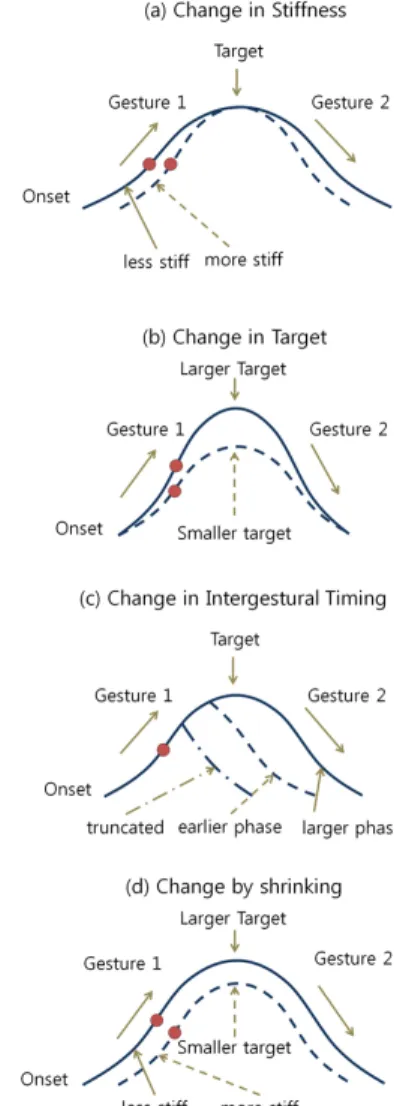
Relevant dynamical parameters include stiffness, target, and intergestural timing, as shown in Figure 1.

Figure 1. Hypothetical movement trajectories that correspond to a change in each dynamical parameter that has been discussed in the literature (cf. Cho, 2007). Note that the filled dot is the time

point of the peak velocity.

The stiffness parameter influences the speed of the movement

—the greater the stiffness, the faster the movement. As shown in

Figure 1a, the stiffness change is observed in the durational

dimension—i.e., “being less stiff” means that the movement speed

(velocity) slows down, and therefore its duration becomes longer

(4)

for reaching the same target. The target parameter (Figure 1b) determines the distance (displacement) that the mass travels.

Kinematically, an increase in the target value is observed in a larger displacement along with an increase in velocity. Because the target change does not modify the temporal dimension, the increased distance for the mass (the articulator) to travel requires a faster movement, resulting in an increase in movement velocity.

The intergestural timing or truncation parameter (Figure 1c) determines the relative timing between two adjacent gestures: how early the following gesture (Gesture 2 in the figure) is phased with the preceding gesture (Gesture 1). When the following gesture initiates early, the preceding gesture may be truncated—

i.e., an early activation of the following gesture prevents the preceding gesture from reaching its assumed target. The resulting kinematic pattern is decreased displacement and duration without a change in velocity. In addition to these parameters, the gestural shrinking (Figure 1d) has been considered as another possible factor that determines kinematic patterns. As the term ‘shrinking’

indicates, both the spatial and the temporal dimensions are modified proportionally, so that a more shrunk gesture is kinematically realized with a proportional decrease in displacement and duration without change in velocity.

Since Articulatory Phonology, which was based on a mass- spring task dynamic model, was first introduced in late 1980s (e.g., Browman & Goldstein, 1990, 1992), researchers have attempted to account for prosodically-conditioned speech variation in terms of gestural dynamics (e.g., Beckman, et al., 1992; Byrd, 2000; Byrd, et al., 2000; Byrd & Saltzman, 1998, 2003; Byrd, et al., 2006; Cho, 2006, 2008; Edwards, et al., 1991; Harrington, et al., 1995; de Jong, 1991; Saltzman, 1995), and suggested that prosodically-conditioned articulatory variation may be controlled by dynamical parameter settings. For example, some researchers (e.g., Beckman, et al., 1992; Edwards, et al., 1991) suggested that accent-induced (prominence marking) kinematic variations are best accounted for by a change in intergestural timing, but others suggested that multiple dynamical parameters are needed to account for the accent-induced kinematic patterns (e.g., Cho, 2006, 2008). Regarding the boundary-induced strengthening, a change in the stiffness parameter has been considered as a possible explanation (e.g., Beckman, et al., 1992; Byrd &

Saltzman, 1998). The stiffness account assumes that a strong prosodic boundary brings about a decreased stiffness value, which kinematically results in slower and therefore longer movement with no spatial change. But the stiffness account cannot be a complete story as it fails to explain boundary-induced spatial

expansion that has often been observed (e.g., Cho, 2008). (Recall that a change in stiffness alone does not modify the spatial target.)

In an attempt to better understand the dynamical aspects underlying the boundary-adjacent articulation, Byrd and her colleagues (Byrd, 2000; 2006; Byrd, et al., 2000; Byrd, et al., 2006; Byrd & Saltzman, 2003; Saltzman, 1995) have proposed the ‘π-gesture’ account, arguing that boundary-induced articulation should be understood as a result of the influence of prosodic gesture or ‘π-gesture.’ The π-gesture is an abstract and non-tract variable ‘prosodic’ gesture which is assumed to be governed by prosodic constituency in the task dynamics model. (Here

‘non-tract variable’ means that the gesture is not actually realized in terms of vocal tract constrictions.) It determines the speed of the articulatory movement, by modulating the rate of the clock that controls articulatory activation of gestures. The clock is assumed to be slowed down at a prosodic juncture, which in turn slows down the articulatory movement at the juncture. The π- gesture is anchored at a prosodic boundary, and its clock-slowing effect is stronger at the juncture—its effect waxes as it gets closer to the boundary and wanes as gets farther from the boundary. Under the π- gesture account, some recent kinematic studies have shown that the boundary-induced lengthening is most robustly manifested in the ‘transboundary’ articulatory movements in English (i.e., the movement that starts domain-finally and ends domain-initially spanning the intervening juncture as in /i/-to-/a/

movement in /i#Ca/ context), which are assumed to be under the strongest influence of the π-gesture (see also Byrd, et al., 2006 and Cho, 2006, 2008, for English data, and Tabain, 2003 and Tabain & Perrier, 2005, for French data).

Although the π-gesture is hypothesized to work at prosodic

boundaries across languages, the model has been tested

extensively with English. It is therefore still unclear whether the

theory can be extended to other languages. In the present study,

we address this issue, examining whether the transboundary

V-to-V movement characteristics in Korean can be accounted for

by a specific dynamical parameter setting or by the π-gesture

model. If the stiffness is a responsible dynamical parameter for

boundary-induced articulation, as some previous studies suggested,

only the temporal modification is expected to occur, showing a

change in movement duration and velocity. The π-gesture model

predicts the similar temporal pattern, but it also can allow for

spatial expansion, as the clock slowing may prevent the following

gesture from truncating (or overlapping with) the preceding

gesture.

(5)

Finally, we test whether the syllable affiliation of the intervening consonant /m/ in the /ami/ sequence influences the transboundary /a/-to-/i/ tongue movement. The syllable affiliation conditions were /a#mi/ versus /am#i/, so that /m/ was either the onset of the postboundary syllable or the coda of the preboundary syllable. In the framework of Articulatory Phonology (Browman

& Goldstein, 1992), the consonantal and vocalic gestures are defined on different tiers, and it is generally assumed that the consonantal gesture is superimposed on the vocalic gesture (cf.

Öhman, 1966, 1967). One can therefore hypothesize that the vocalic gesture such as the /a/-to-/i/ tongue movement gesture may be kinematically independent from the intervening consonantal gesture. This is in line with Fowler (1983) who suggested that in the sequence of evenly stressed monosyllables in English, V-to-V coarticulation is independent of the intervening superimposed consonant. If this were the case, the /a/-to-/i/

movement to be examined in the present study would show no substantial kinematic change as a function of the intervening /m/’s syllable affiliation. On the other hand, a recent study by Löfqvist (2009) showed that the V1-to-V2 tongue movement is modified according to the phonological length of the intervening consonant /m/ (one moraic /m/ versus two moraic /mm/): the V2 target comes relatively later for the two moraic /mm/ than for the single /m/, which was arguably to insure for the V2 target to be attained after the consonantal release. This result opens up an alternative possibility that the V-to-V tongue movement is modulated by the syllable affiliation of the intervening consonant.

In the present study, we test these two possibilities.

2. Method

For the investigation of the effects of the prosodic boundary and the syllable affiliation of the consonant on the kinematics of V-to-V lingual gestures, the /a/-to-/i/ tongue movement data in Korean were collected together with other movement data which were needed for other studies. The data were acquired by using Electromagnetic Midsagittal Articulography (EMA, Carstens Articulograph AG 200).

2.1 Participants

Four male and one female Seoul Korean speakers in their early or mid 20s (average 24.2 years old) participated in this experiment. They were not aware of the purpose of the experiment. They were paid for participation after the experimental session.

2.2 Speech material

The /a/-to-/i/ target segment sequences were created with /a#mi/ and /am#i/, which occurred in sentences as in Table 1.

Target Target-bearding Sentences

IP a#mi

[jəŋmani ilnjənʧʰa]

IP

# [minsakwae aʧik ankani]

[영만이 일년차]

IP

# [민사과에 아직 안가니?]

‘First year, Young-man, didn't you go to the dept.

of civil affairs yet?’

am#i

[jəŋmani waŋkoʧʰam]

IP

# [insakwae aʧik ankani]

[영만이 왕고참]

IP

# [인사과에 아직 안가니?]

‘Top senior, Young-man, didn't you go to the dept.

of personnel affairs yet?’

Wd a#mi

[jəŋmani ilnjənʧʰa # minsamunʧe]

IP

iʧe k*ɨtʰnas*ə [영만이 일년차# 민사문제]

IP

이제 끝났어.

‘The civil litigation matter of the first year worker, Young-man, has now been settled.’

am#i

[jəŋmani waŋkoʧʰam # insamunʧe]

IP

iʧe k*ɨtʰnas*ə [영만이 왕고참# 인사문제]

IP

이제 끝났어.

‘The personnel matter of the top senior, Young-man, has now been settled.’

Table 1. Test speech materials

The consonant /m/ was chosen for the intervening consonant because it minimally interferes with the vocalic lingual articulation. The intervening consonant in the target sequence V1CV2 was either in the onset (e.g., [ilnjənʃʰa] # [minsakwae], 일년차#민사과에, ‘the first year words’ # ‘dept. of civil affairs’) or in the coda position (e.g., [waŋkotʃʰam] # [insakwae] 왕고참#

인사과에, ‘the top senior’ # ‘dept. of personnel affairs’), which allowed for examination of the effect of the consonant’s syllable affiliation on the kinematics of the V1-to-V2 tongue movement.

The prosodic boundary inside the sequence was either the Word boundary (Wd boundary) or the Intonational Phrase boundary (IP boundary).

2.3 Procedure

The EMA data acquisition took place at the Hanyang Phonetics and Psycholinguistics Laboratory (HPPL). Both articulatory and acoustic data were recorded simultaneously in the speech production booth. Acoustic data were recorded with a condenser headset microphone (SHURE WH-30) at a sampling rate of 44 kHz. The 2D Electromagnetic Midsagittal Articulography (Carstens AG200) was used to track articulatory data (see Hoole, 1996;

Schoenle, 1988; Schoenle et al., 1989; Tuller et al., 1990, for

more technical information on the Carstens system). As shown in

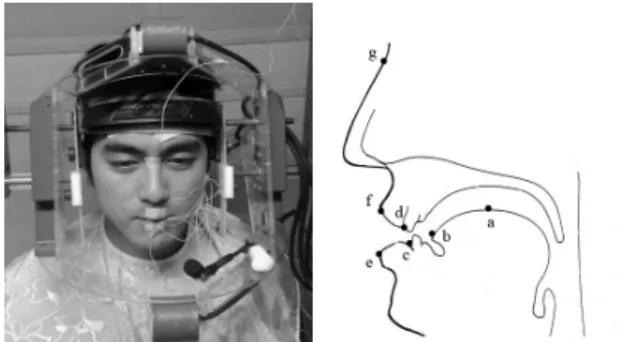
Figure 2, seven pellets (sensors) were used with five sensors

attached on the articulators: the tongue body (a), the tongue tip

(6)

(b), the upper and lower lips at the vermilion borders (e-f) and one at the lower gumline of the mandibular incisor for monitoring the jaw movement (c). Additional two pellets were used as reference points, attached on the upper gum line (d) and the nose bridge (g) to correct for the head movement inside the helmet.

The exact location of the pellet on the tongue body varied from speaker to speaker, depending on the size of the tongue, but it was placed on the rearmost point when the tongue was pulled out, which was about 5-5.5 cm from the tongue tip. In addition, a bite plate with two extra sensors was used to rotate the obtained data, so that the occlusal plane obtained by the two coordinate points created on the bite plate became the horizontal (x) axis of the data, and the y axis became perpendicular to the occlusal plane. Entire articulatory movement data were sampled at 200Hz and low-pass filtered at a cut-off frequency of 20Hz. All the filtering and rotation processes were performed by the TAILOR program (Carsten’s data processing program).

Figure 2. Seven locations of transducer coils. Five articulatory points were (a) the tongue body, (b) the tongue tip, (c) the jaw,

(e) the lower lip, (f) the upper lip. In addition, two reference points were used: (d) upper front gum line, (g) the nose bridge

which were used to correct for any head movement during the experiment.

Target-bearing sentences in Table 1 were repeated 15 to 20 times per speaker in a pseudo-randomized order. The prosodic boundary information of each utterance was examined by having two Korean ToBI transcribers check the prosodic boundary (IP versus Wd boundaries) after the recording session. All the utterances were also visually inspected (i.e., with displays of the spectrograms and acoustic waveforms). When there was disagreement between two transcribers, a third transcriber was involved. In this case, all three transcribers discussed on the validity of choosing a particular token as having a particular prosodic boundary, which resulted in abandoning some tokens.

Furthermore, some of the velocity trajectories in the movement data showed irregular patterns, which would pose measurement

problems, and those tokens were excluded. In order to have a comparable number of tokens across speakers, we decided to choose just 10 repetitions (out of 20 repetitions for 4 speakers and 15 repetitions for 1 speaker) which were randomly selected to be analyzed in the present study.

2.4 Measurements

To examine the /a/-to-/i/ upward tongue movement characteristics, the articulatory landmarks in the present study were obtained from the vertical dimension of the articulators.

Since the /a/-to-/i/ lingual movement was of interest, the movement data were extracted from the sensor coil (pellet) attached at the tongue body. A Matlab-based kinematics analysis software, MVIEW (under development by Mark Tiede at Haskins Laboratory) was used to define kinematical points such as the gesture onset, the gesture target attainment, and the peak velocity point, as shown in Figure 3.

Figure 3. Schema of the /a/-to-/i/ tongue movement in the y dimension (top panel) and the y velocity dimension (bottom panel) with an indication of the measured kinematic variables

Of these points, the gesture onset and the target attainment points were identified from a threshold-crossing point in the velocity profile. Ideally, these landmarks should correspond to the zero-crossing points in the velocity profile, but because of the inherent noise, we needed to set up a 10% of threshold window of the range between the maximum and the minimum local velocity.

Various dependent variables were calculated based on

timepoints of movement onset, target, and peak velocity, generally

following Byrd (2000) and Cho (2008). The measured variables

(7)

that were examined are schematized in Figure 3. As can be seen in the figure, five different measures were made. The measured variables include:

(a) displacement (mm): the amount of spatial difference between the onset and the target (Figure 3a);

(b) total movement duration: the interval from the onset to the target (Figure 3b);

(c) time-to-peak-velocity (acceleration duration): the interval from the onset to the timepoint of peak velocity, which is sometime referred to as acceleration duration (Figure 3c);

(d) deceleration duration: the interval from the timepoint of peak velocity to V target (Figure 3d);

(e) peak velocity: the actual peak velocity value during the V-to-V lingual movement (Figure 3e).

Among the five dependent variables, three dependent variables are related to the temporal dimension (i.e., total movement, time-to-peak, deceleration duration). The total movement duration is the time that takes for the tongue to move from the onset to the target attainment point. Note that the total movement duration begins before the intervening prosodic boundary and ends after it.

Its first component, the acceleration duration, and the second component, the deceleration durations, can therefore be considered as pre and postboundary components (Byrd, 2000; Cho 2008).

The lengthened time-to-peak velocity (acceleration duration) may then be interpreted to be more attributable to a preboundary effect and the lengthening of the second component to a postboundary effect.

2.5 Statistical analyses

The effects of the prosodic boundary and the consonant’s syllable affiliation on various kinematic measures were statistically analyzed by conducting a series of repeated measures Analyses of Variance (RM ANOVAs), using SPSS 17.0 for Windows. There were two within-subject factors: Boundary (IP versus Wd) and Syllable Affiliation (Onset versus Coda). Following Max and Onghena (1999), we adopted a conservative statistical approach, so that RM ANOVAs were conducted with each speaker contributing one averaged score (out of 10 repetitions) per condition, in order to avoid possible type I (alpha) errors. That is, if all the values from 10 repeated tokens were used in statistical analyses, the effect size would be unduly inflated, often giving rise to unviable significance results (type 1 error).

3. Results

In this section, results regarding the effects of Boundary and Syllable Affiliation on the /a/-to-/i/ upward movement sequence are reported.

3.1 The effects of Boundary

Figure 4 summarizes the main effects of Boundary on all five kinematic measures, displacement, peak velocity, total movement duration, time-to-peak velocity (acceleration duration) and deceleration duration.

Displacement. RM ANOVAs generated a significant main effect of Boundary on the /a/-to-/i/ displacement (F[1,4]=32.53, p<0.01), showing a greater spatial expansion across the IP boundary than across the Wd boundary (987.24 ms vs. 527.10 ms) (Figure 4a).

Peak velocity. There was a significant main effect of Boundary on peak velocity (F[1,4]=15.50, p<0.05), showing a faster /a/-to-/i/

tongue movement across IP than Wd boundaries (12.77 mm/ms vs. 9.35 mm/ms) (Figure 4b).

Temporal measures, Total movement duration, Time-to-peak velocity, and Deceleration duration. As shown in Figure 4c, all three temporal measures were significantly affected by Boundary, showing that the transboundary /a/-to-/i/ tongue movement is longer across IP than Wd boundaries (F[1,4]=24.638, p=0.008 for total movement duration; F[1,4]=9.443, p=0.037 for acceleration duration; F[1,4]=8.821, p=0.041 for deceleration duration). The significant main effects of all three durational measures suggest that the elongated total movement duration was attributable to both the time-to-peak velocity (acceleration duration) and the deceleration duration measures. However, as can be inferred from Figure 4c, the effect size was greater for acceleration duration (mean diff., 32.44 ms, eta

2

=0.702) than for deceleration duration (mean diff. 14.16 ms, eta

2

=0.688), suggesting that the acceleration duration contributed more to the boundary-induced lengthening of the movement duration than did the deceleration duration.

In sum, the results of ANOVAs showed that the /a/-to-/i/

upward tongue movement was significantly influenced by the

strength of prosodic boundary (IP versus Word), showing a

longer, larger and faster movement.

(8)

Figure 4. Effect of Boundary on /a/-to-/i/ tongue movement

3.2 The effects of the intervening consonant’s syllable affiliation

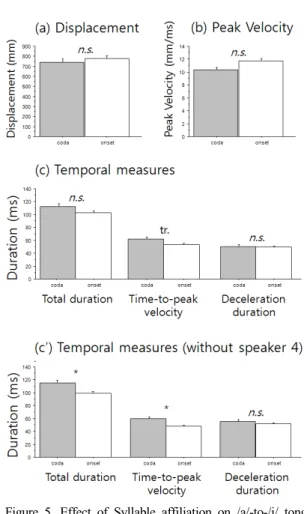
As shown in Figure 5a-c, none of the five kinematic measures showed significant main effects of Syllable Affiliation, showing that the /a/-to-/i/ tongue rising movement is not influenced by whether the consonant was the coda of the preceding syllable or the onset of the following syllable (displacement: F[1,4]=2.92;

peak velocity: F[1,4]=2.28; total movement duration: F[1,4]=2.3;

time-to-peak velocity: F[1,4]=5.43; deceleration duration: F[1,4]<1, all at p>0.07).

Among the five kinematic measures, however, the acceleration duration (Time-to-peak velocity) showed a trend effect of Syllable Affiliation (F[1,4]=5.43, p<0.08) with longer time-to-peak velocity in the coda condition (/am#i/) than in the onset condition (/a#mi/). Inspection of individual speakers’ mean differences between the onset and the coda conditions revealed that the trend effect was due to the fact that one speaker (S4) behaved differently from the other four speakers: all four speakers showed an increase in time-to-peak velocity in the coda condition while S4 showed the opposite pattern. We therefore re-ran ANOVAs without this deviant speaker. As shown in Figure 5c’, when the deviant speaker was excluded, the effect of Syllable Affiliation on time-to-peak velocity reached significance, confirming longer time-to-peak velocity in the coda condition. The Syllable Affiliation effect on total movement duration also became significant without this deviant speaker. The results therefore suggested that the /a/-to-/i/ tongue rising movement is elongated when the intervening consonant /m/ was affiliated with the preceding syllable (/am#i/), and it was almost entirely attributable

to the lengthening of the acceleration duration (time-to-peak velocity), which can also be considered as preboundary lengthening.

Figure 5. Effect of Syllable affiliation on /a/-to-/i/ tongue movement

In sum, the consonant’s syllable affiliation exercised no influence on the /a/-to-/i/ displacement and its peak movement velocity, showing no effect in the spatial dimension. In the temporal dimension, however, the coda condition (/am#i/) induced an increase in the acceleration duration (time-to-peak velocity) and in the total movement duration for four out of five speakers.

Finally, the Syllable Affiliation factor did not interact with the Boundary factor in both the results with five speakers and those with four speakers. This indicates that the effect of syllable affiliation found in the current study is independent of the effect of prosodic boundary.

4. Summary and Discussion

In the present study, we examined how various kinematic

measures (i.e., displacement, peak velocity, total movement

duration, acceleration duration and deceleration duration) for the

(9)

/a/-to-/i/ lingual rising gesture in Korean are influenced by the prosodic boundary strength (IP boundary versus Word boundary), and whether they are further constrained by the syllable affiliation of the intervening consonant /m/ (onset in /a#mi/ versus coda in /am#i/). In this section, we will summarize the results and discuss important findings in light of research questions that were discussed in the introduction.

4.1 Cross-linguistic versus language-specific phonetics -prosody interplay

One of the research questions that the present study has endeavored to answer is to what extent the boundary effects on the V-to-V transboundary movement can be generalizable across languages, comparing the obtained Korean data with the already existing English data, and to what extent the effects differ, reflecting the language specificity of prosodic systems. One of the basic findings of the present study is that all kinematic measures are influenced by prosodic boundary, showing that the /a/-to-/i/

tongue rising movement is bigger in all directions: it is larger in displacement, faster in peak velocity and longer in movement duration (including acceleration and deceleration durations). The fact that the transboundary V-to-V articulation in Korean is modified as a function of prosodic boundary, as found in English, could be seen as the cross-linguistic similarities or perhaps more broadly universal aspects in the phonetics-prosody interplay: the prosodic structure is phonetically expressed in the fine-grained kinematic details of articulation at prosodic junctures. In particular, as was the case with English (Byrd, 2000; Cho, 2008), the transboundary /a/-to-/i/ movement in Korean was expanded in both spatial and temporal dimensions, with larger displacement and longer movement duration. This suggests that as far as the V-to-V lingual movement is concerned, the boundary induces spatio-temporal articulatory strengthening as a universally applicable pattern of ‘prosodic strengthening.’

The transboundary V-to-V movement in Korean was, however, found to be categorically different from that in English in terms of the speed of movement. It has been consistently found in English that articulation at prosodic boundary is slower, not only in preboundary position, but also across the prosodic boundary for the transboundary V-to-V movement (Byrd, 2000, Cho, 2008).

Crucially, the Korean data showed the opposite: the V-to-V movement was faster in Korean (as reflected in higher peak velocity). This opens up the possibility that the articulatory slowing down at the prosodic juncture may not be a universal characteristic of boundary-induced articulation, but it is

language-specifically determined. We propose that the language-specificity is attributed to language-specific prosodic systems.

In English, lexical stress and pitch accent are important aspects of prosodic structure, especially in terms of prominence marking, so that its phonetic manifestation has often been found to be differentiated from that of boundary marking (e.g., Barnes, 2002;

Beckman & Edwards, 1992; Cho, 2005, 2008; Cho & Keating, 2009; Edwards, et al., 1991). For example, Edwards, et al. (1991) suggested that boundary-induced domain-final lengthening is not accompanied by spatial expansion, because the spatial expansion is used for marking stressed syllables. Korean, on the other hand, does not employ lexical stress and pitch accent in its prosodic system. Given that there is no articulatory constraint coming from stress marking in Korean, Korean appears to have more degree of freedom to express the prosodic boundary marking, yielding the robust prosodic strengtheing pattern: the longer, larger and faster transboundary V-to-V movement, which is comparable to the stress-induced articulatory pattern in English.

4.2 Dynamical accounts of the transboundary V-to-V tongue movement

Another question that the present study has aimed to address is how the kinematically-defined prosodic strengthening pattern can be accounted for in terms of the task dynamic model (Saltzman

& Munhall, 1989). The larger, longer and faster V-to-V movement pattern that we have observed in the present study, however, cannot be easily understood in terms of dynamical parameter settings (see Figure 1 in the introduction). According to the model, a larger displacement can stem from an increase in the target value (Figure 1b), less shrinking (Figure 1d) or no truncation (delayed timing of the following gesture, Figure 1c).

None of these parameter settings appear to account for the larger, longer and faster movement pattern: An increase in the target value alone cannot explain why the movement duration is longer (as the change in target does not affect the temporal dimension);

shrinking and truncation do not account for why the movement is faster--i.e., the change in shrinking modifies the temporal and spatical dimensions proportionally, resulting in no change in the movement speed, and truncation or an earlier phasing of the following gesture does not influence the speed of the preceding gesture.

The larger, longer and faster movement characteristics in

Korean may not be then accounted for by a single dynamical

parameter setting. As was discussed with English data (Cho,

(10)

2006), the prosodically-conditioned articulatory strengthening pattern in Korean may be due to complex interaction of multiple dynamical parameters, which must be taken into account in the task dynamical model. This also has important theoretical implications for the theory of π-gesture (Byrd 2000; Byrd &

Saltzman, 2003). As we discussed in the introduction, the π -gesture model has been proposed in order to explain the kinematic patterns in the framework of the task dynamics, especially for slowing down of the articulatory movement in the vicinity of prosodic boundary. As we have just discussed, however, the Korean data have failed to show the evidence for slowing-down articulatory movement at the prosodic juncture.

Although the theory of the π-gesture has been developed based on English data (e.g., Byrd, 2000; Byrd et al., 2000; Byrd, et al., 2006; Byrd & Saltzman, 2003), it has been considered to be universally applicable, because the boundary-induced lengthening has been observed across languages, and the lengthening can easily be thought to have come from the clock slowing that governs the articulatory movement. The Korean data, however, suggest that the boundary-induced lengthened articulation is not due to the clock slowing, but it simply implies the global articulatory effort (e.g., Fowler, 1995) which strengthens the articulation in all directions, arguably in order to increase the perceptual salience of the relevant articulation. The theory of π -gesture must therefore be re-visited to see the extent to which it can be universally applicable, and how different prosodic systems of different languages can be modeled in the theory. As we have discussed, the phonetic manifestation of phonetics-prosody interplay is modulated by language-specific prosody systems, and so is the cross-linguistic applicability of the theory of π-gesture.

4.3 The effect of the intervening consonant /m/’s syllable affiliation

In addition to testing the prosodic effects on the transboundary V-to-V movement in Korean, we have also asked whether the syllable affiliation of the intervening consonant /m/ (/a#mi/ in the onset condition versus /am#i/ in the coda condition) would influence the transboundary /a/-to-/i/ tongue movement. Results showed that the consonant /m/’s syllable affiliation did not affect the displacement and the speed of the V-to-V movement.

However, four out of five speakers showed temporal modification of the V-to-V movement: the /a/-to-/i/ tongue rising movement was longer in the coda condition (/am#i/) than in the onset condition (/a#mi/), and the effect was almost entirely attributable to the lengthening of the acceleration duration (time-to-peak

velocity) independent of the prosodic boundary strength. Given that the acceleration duration has been considered to be

‘preboundary’ duration, it appears that speakers delay the tongue movement duration in the preboundary domain during which /m/

is co-produced as part of the preboundary syllable in the coda position.

The results support the view that the consonantal and vocalic gestures influence each other (Öhman, 1967). Our finding is also compatible with Löfqvist (2009)’s finding in Japanese: As the V-to-V vocalic movement in Japanese is affected by the phonological length of the intervening consonant /m/ (one moraic /m/ versus two moraic /mm/), so is it influenced by /m/’s syllable affiliation. The consonantal and vocalic gestures have often been considered independent from each other (e.g., Fowler, 1983) as they occur hypothetically on separate tiers. The intervening consonant /m/ between vowels may also be assumed to be neutralized under the traditional view of re-syllabification. Our results, however, imply that the underlying syllable structure does surface in the fine-grained kinematic dimension.

5. Conclusion

Over the past several decades, we have seen ample evidence for the interplay between phonetics and higher-order linguistic structure: fine-grained phonetic (subphonemic) patterns do not simply arise as low-level physical phenomena, but they often reflect higher level linguistic structures. We have now obtained better insights into the nature of sound systems in which phonetics and prosody are intertwined in a linguistically systematic way. However, our knowledge has been somewhat biased as theories of the phonetics-prosody interplay have often been grounded with a few Indo-European languages, including English. In the present study, we have chosen a non-Indo-European language, Korean, as the test language, in order to broaden our knowledge of the phonetics-prosody interplay.

We have focused on how the prosodic boundary influences the

transboundary (i.e., across the boundary) V-to-V movement in

Korean, whose kinematic aspects have never been explored in the

literature. From the results of the EMA (Electromagnetic

Articulography) study, we can draw several important points. The

transboundary V-to-V tongue movement in Korean is significantly

and systematically modified by prosodic boundary, similar to

previous findings in English. However, Korean was different from

English, in that Korean showed a longer, larger and faster

(11)

movement across a higher prosodic boundary, while a longer, larger and slower movement has often been found in English.

This cross-linguistic difference appears to arise with different prosodic systems (e.g., the presence or absence of lexical stress and pitch accent), which in turn gives rise to language-specific ways that phonetics interplays with prosody. We proposed that Korean, as a language without constraints from the lexical stress system, has more freedom to strengthen articulation at the prosodic juncture, creating the strengthening pattern of “all is big in every direction,” which is often encountered with prominence (stress) marking in English. We have also observed that the underlying syllable structure of the /ami/ sequence (/m/ as the coda versus the onset) is reflected in the fine-grained kinematic pattern in the temporal dimension, which constitutes another type of evidence for the role of phonetic (subphonemic) detail in expressing higher-order linguistic structure, this time, the syllable structure.

Finally, we failed to account for the transboundary V-to-V tongue movement both in terms of dynamical parameter settings and in terms of the theory of π-gesture, which are important elements in the model of task dynamics. Understanding the phonetics-prosody interplay is an essential prerequisite for understanding the whole linguistic system of a given language.

The model of the task dynamics, based on which the theory of Articulatory Phonology has founded, needs to be further developed to capture the complex interplay of phonetics and prosody in both descriptively and explanatorily adequate ways.

This is indeed a new challenge for any linguistic models that attempt to integrate linguistic functions of speech prosody in the architecture of grammar.

Acknowledgement

We thank five speakers for volunteering to participate in the study. Special thanks goes to Yoonjeong Lee for her assistance in conducting the EMA experiments.

References

Barnes, J. A. (2001). "Domain-initial strengthening and the phonetics and phonology of positional neutralization", Proceedings of the Northeast Linguistic Society (NELS) 32, pp.1-20.

Barnes, J. A. (2002). "Positional neutralization: A phonologization approach to typological patterns", Unpublished Ph.D. dissertation, University of California, Berkeley.

Beckman, M. E. (1996). "The parsing of prosody", Language and Cognitive Processes, 11, pp.17-67.

Beckman, M. E., Edwards, J. & Fletcher, J. (1992). "Prosodic structure and tempo in a sonority model of articulatory dynamics", in G. Docherty & B. Ladd (eds.), Laboratory Phonology, Vol. II: Gesture, Segment, Prosody (pp.68-86).

Cambridge, U.K.: Cambridge University Press.

Beckman, M. E. & Pierrehumbert, J. (1986). "Intonational structure in Japanese and English", Phonology Yearbook, Vol. 3, pp.

255-309.

Browman, C. & Goldstein L. (1990). "Tiers in articulatory phonology, with some implications for casual speech", in J.

Kingston & M. E. Beckman (eds.), Laboratory Phonology, Vol.

I: Between the Grammar and the Physics of Speech (pp.341-376). Cambridge, U.K.: Cambridge University Press.

Browman, C. & Goldstein, L. (1992). "Articulatory phonology: An overview", Phonetica, Vol. 49, pp. 155-180.

Byrd, D. (2000). "Articulatory vowel lengthening and coordination at phrasal junctures", Phonetica, Vol. 57, pp3-16.

Byrd, D. (2006). "Relating prosody and dynamic events:

Commentary on the papers by Cho, Navas, and Smiljanić", in L.

Goldstein, D. Whalen & C. Best (eds.), Laboratory Phonology Vol.IIV: Varieties of Phonological Competence (pp. 549-561).

Berlin/New York: Mouton de Gruyter.

Byrd, D., Kaun, A., Narayanan, S. & Saltzman, E. (2000). "Phrasal signatures in articulation", in M. Broe & J. Pierrehumbert (eds.), Laboratory Phonology Vol. V: Acquisition and the Lexicon (pp.70-88). Cambridge, U.K.: Cambridge University Press.

Byrd, D., Krivokapić, J & Lee, S. (2006). "How far, how long: On the temporal scope of prosodic boundary effects", Journal of the Acoustical Society of America, Vol. 120, pp.1589-1599.

Byrd, D.,& Saltzman, E. (1998). "Intragestural dynamics of multiple prosodic boundaries", Journal of Phonetics, Vol. 26, pp.

173-199.

Byrd, D. & Saltzman, E. (2003). "The elastic phrase: Modeling the dynamics of boundary-adjacent lengthening", Journal of Phonetics, Vol. 31, pp.149-180.

Cho, T. (2005). "Prosodic strengthening and featural enhancement:

Evidence from acoustic and articulatory realizations of /a,i/ in English", Journal of the Acoustical Society of America, Vol. 117, pp. 3867-3878.

Cho, T. (2006). "Manifestation of prosodic structure in articulation:

(12)

Evidence from lip kinematics in English", in L. M. Goldstein, D.

H. Whalen & C. T. Best (eds.), Laboratory Phonology Vol.IIV:

Varieties of Phonological Competence. (pp. 519-548). Berlin/New York: Mouton de Gruyter.

Cho, T. (2007). "Prosodic strengthening in speech production and perception", Speech Science, Vol. 14, pp. 7-24.

Cho, T. (2008). "Prosodic strengthening in transboundary V-to-V lingual movement in American English", Phonetica, Vol. 65, pp.

45-61.

Cho, T. & Keating, P. (2001). "Articulatory and acoustic studies of domain-initial strengthening in Korean", Journal of Phonetics, Vol. 29, pp. 155-190.

Cho, T. & Keating, P. (2009). "Effects of initial position versus prominence in English", Journal of Phonetics, Vol. 37, pp.

466-485.

Cho, T. & McQueen, J. M. (2005). "Prosodic influences on consonant production in Dutch: Effects of prosodic boundaries, phrasal accent and lexical stress", Journal of Phonetics, Vol. 33, pp. 121-157.

Cho, T., McQueen, J. & Cox, E. (2007). "Prosodically driven phonetic detail in speech processing: The case of domain-initial strengthening in English", Journal of Phonetics, Vol. 35, pp.

210-243.

de Jong, K. (1991). "The oral articulation of English stress accent", Ph.D. dissertation, Ohio State University.

Edwards, J. E., Beckman, M. E. & Fletcher, J. (1991). "The articulatory kinematics of final lengthening", Journal of the Acoustical Society of America, Vol. 89, pp.369-382.

Fowler, C. A. (1983). "Converging sources of evidence on spoken and perceived rhythms of speech: cyclic production of vowels in monosyllabic stress feet", Journal of Experimental Psychology, Vol. 112, pp.386-412.

Fowler, C. A. (1995). "Acoustic and kinematic correlates of contrastive stress accent in spoken English", in F. Bell-Berti &

L. Raphael (eds.), Producing Speech: Contemporary Issues: For Katherine Safford Harris, pp. 355-373. Melville, Long Island, New York: AIP Publishing.

Harrington, J., Fletcher, J. & Roberts, C. (1995). "Coarticulation and the accented/unaccented distinction: Evidence from jaw movement data", Journal of Phonetics, Vol. 23, pp. 305-322.

Hawkins, S. (1992). "An introduction to task dynamics", in G.

Docherty & B. Ladd (eds.), Laboratory Phonology Vol. II:

Gesture, Segment, Prosody (pp. 9-25). Cambridge, U.K.:

Cambridge University Press.

Hoole, P. (1996). Issues in the acquisition, processing, reduction and

parameterization of articulographic data. Forschungsber. Inst.

Phonet. sprachl. Kommun., München, 34, pp.158-173

Jun, S.-A. (1995). "Asymmetrical prosodic effects on the laryngeal gesture in Korean", in B. Connell & A. Arvaniti (eds.), Laboratory Phonology Vol. IV: Phonology and Phonetic Evidence (pp.235-253). Cambridge, U.K.: Cambridge University Press.

Jun, S.-A. (2000). "Korean ToBI , version 3", UCLA Working Papers in Phonetics. 99.

Keating, P. A., Cho, T., Fougeron, C. & Hsu, C. (2003).

"Domain-initial strengthening in four languages", in J. Local, R.

Ogden & R. Temple (eds.), Laboratory Phonology Vol. VI:

Phonetic Interpretation (pp.145-163). Cambridge, U.K.:

Cambridge University Press.

Löfqvist, A. (2009). "Vowel-to-vowel coarticulation in Japanese:

The effect of consonant duration", Journal of Acoustic Society of America, Vol. 125, pp. 636-663

Max, L. & Onghena, P. (1999). "Some issues in the statistical analysis of completely randomized and repeated measures designs for speech, language, and hearing research", Journal of Speech, Language, and Hearing Research, Vol. 42, pp. 261-270.

Nespor, M. & Vogel, I. (1986). Prosodic phonology. Dordrecht:

Foris Publications.

Öhman, S. E. G. (1966). "Coarticulation in VCV utterances:

spectrographic measurements", Journal of the Acoustical Society of America, Vol. 39, pp. 151-168.

Öhman, S. E. G. (1967). "Numerical model of coarticulatio", Journal of the Acoustical Society of America, Vol. 41, pp.

310-320.

Saltzman, E. (1995). "Intergestural timing in speech production:

Data and modeling", in Proceedings of the XIII International Congress of Phonetic Sciences, Vol. 2, pp. 84-91.

Saltzman, E. & Munhall, K. G. (1989). "A dynamical approach to gestural patterning in speech production", Ecological Psychology, Vol. 1, pp.333-82.

Schoenle, P. W. (1988). Elektromagnetische artikulographie. Berlin:

Springer.

Schoenle, P. W., Mueller, C. & Wenig, P. (1989). Echtzeitanalyse von orofacialen Bewegungen mit Hilfe der elektromagnetischen Artikulographie. Biomedizinische Technik, Vol. 34, pp. 126-130.

Selkirk, E. (1984). Phonology and syntax: The relation between sound and structure. Cambridge, MA: MIT Press.

Shattuck-Hufnagel,S. & Turk, A. E. (1996). "A prosody tutorial for investigators of auditory sentence processing", Journal of Psycholinguistic Research, Vol. 25, pp. 193-247.

Tabain, M. (2003). "Effects of prosodic boundary on /aC/

(13)

sequences: articulatory results", Journal of the Acoustical Society of America, Vol. 113, pp. 2834-2849.

Tabain, M. & Perrier, P. (2005). "Articulation and acoustics of /i/

in preboundary position in French", Journal of Phonetics, Vol.

33, pp. 77-100.

Tuller, B., Shao, S. & Kelso, J. A. S. (1990). "An evaluation of an alternating magnetic field device for monitoring tongue movements", Journal of Acoustic Society of America, Vol. 88, pp. 674-679.

∙Cho, Taehong

Department of English Language and Literature Hanyang University,

Haengdang-dong 17, Seongdong-gu, Seoul (133-791), Korea Email: [email protected]

∙Yoon, Yeomin

Department of English Language and Literature Hanyang University,

Haengdang-dong 17, Seongdong-gu, Seoul (133-791), Korea Email: [email protected]

∙Kim, Sahyang

Department of English Education Hongik University,

Sangsu-dong 72-1, Mapo-gu, Seoul (121-791), Korea

Email: [email protected]

수치

Figure 1. Hypothetical movement trajectories that correspond to a  change in each dynamical parameter that has been discussed in  the literature (cf
Table 1. Test speech materials
Figure 3. Schema of the /a/-to-/i/ tongue movement in the y  dimension (top panel) and the y velocity dimension (bottom  panel) with an indication of the measured kinematic variables
Figure 5. Effect of Syllable affiliation on /a/-to-/i/ tongue  movement

참조

관련 문서

The “Asset Allocation” portfolio assumes the following weights: 25% in the S&amp;P 500, 10% in the Russell 2000, 15% in the MSCI EAFE, 5% in the MSCI EME, 25% in the

1 John Owen, Justification by Faith Alone, in The Works of John Owen, ed. John Bolt, trans. Scott Clark, &#34;Do This and Live: Christ's Active Obedience as the

Objective : The purpose of this study is to explore the effects of mental health (stress perception, sufficiency of sleep, depression, suicidal ideation) on alcohol drinking

- the difference between the energy required to charge a secondary battery and the energy delivered by the battery in use (q wh = q Ah x V discharge /V charge ).

We study the relationship between Independent variables such as the V/T(Vibration Time), V/T movement, expansion height, curing time, placing temperature, Rising and C/S ratio

Bactericidal effect of photocatalytic reactor depending on the UV-A illumination time and flow rate of V.. Bactericidal effect of photocatalytic reactor

The Korean Voluntary Effort to Increase Their Airpower During the Korean War - With Special Reference to the National Fundraising Movement for Aircraft in

Altwork Station - Physically Conforming to the Needs of Humans in the Workplace