• 검색 결과가 없습니다.

A Study on the Relationship among Skin Care Situations, Skin Care Recognition, and Skin Care Satisfaction by Gender in Medical Skin Care Center Patients: - Focused on Females and Males in Hainan Province, China-

N/A
N/A
Protected

Academic year: 2021

Share "A Study on the Relationship among Skin Care Situations, Skin Care Recognition, and Skin Care Satisfaction by Gender in Medical Skin Care Center Patients: - Focused on Females and Males in Hainan Province, China-"

Copied!
9
0
0

로드 중.... (전체 텍스트 보기)

전체 글

(1)

JKSCI

A Study on the Relationship among Skin Care Situations, Skin Care Recognition, and Skin Care Satisfaction by Gender in Medical Skin

Care Center Patients: - Focused on Females and Males in Hainan Province, China-

1)

Yue Jia*, Kyeong-Ran Kim*

*Graduate School, Dept. of Beauty Science, Kwangju Women's University, Gwangju, Korea

*Professor, Dept. of Beauty Science, Kwangju Women's University, Gwangju, Korea

[Abstract]

Chinese people have increasingly high interests in skin care and trust and prefer medical institution products and equipment to treat skin problems. The purpose of this study is to examine skin types and skin care situations, skin care recognition, and skin care satisfaction by gender in medical skin care center patients from in their 10s to 50s in Hainan Province, China. The questionnaire survey consisted of general characteristics(n=8), skin care situations(n=6), skin care recognition(n=11), and skin care satisfaction(n=21). A total of 328 questionnaires were researched from December 21, 2020 to January 9, 2021 using WeChat and Wenjuanxing program. Data were analyzed by SPSSWIN 21.0. Frequency analysis was applied for general characteristics, skin care situations, skin care recognition, and skin care satisfaction and Cronbach’s α was used for the reliability of skin care recognition and satisfaction. The relationship among skin care situations, skin care recognition, and skin care satisfaction was analyzed by χ 2 test and t-test. As a result, the common skin types by gender was dry skin in females and oily skin in males. The highest skin trouble was melasma and pigments in females and pimple in males.

The most common way to manage troubled skin was homecare in both females and males, followed by the dermatology department in females and pharmacy in males, suggesting a significant difference. The common period of skin trouble was from one year to three years and the most effective way to improve skin was good life habit, followed by laser treatment in both females and males. The most important consideration to choose a hospital was a famous franchise hospital and the most important matters in management was doctor or skin care professionalism. Skin care and treatment recognition was high in external effects for females and internal effects for males. Skin care satisfaction was high in service for females and effect for males. Skin care satisfaction was significantly higher in males than in females. In conclusion, there was a difference in skin types, skin troubles, skin problems, skin care ways, and skin care satisfaction by gender in Chinese medical skin care center patients. Therefore, this study suggests the development of various products and the need of systematic management programs.

▸Key words: China, Medical skin care, Gender, Skin types, Recognition, Skin care situations, Satisfaction

First Author: Yue Jia, Corresponding Author: Kyeong-Ran Kim

*

Yue Jia ([email protected]), Dept. of Beauty Science, Kwangju Women's University

*Kyeong-Ran Kim ([email protected]), Dept. of Beauty Science, Kwangju Women's University

∙Received: 2021. 05. 14, Revised: 2021. 06. 13, Accepted: 2021. 06. 13.

Copyright ⓒ 2021 The Korea Society of Computer and Information http://www.ksci.re.kr pISSN:1598-849X | eISSN:2383-9945
(2)

[요 약]

본 연구에서는 중국 하이난성 지역 10대~50대 남녀를 대상으로 메디컬스킨케어센터를 내원한 환자 들을 중심으로 성별에 따른 피부유형 및 피부관리실태 , 피부관리 인지도, 만족도를 검증하고자 한다.

이에 피부관리 실태, 피부관리 인지도, 피부관리 만족도 등을 2020년 12월 21일에서 2021년 1월 9일까 지 위쳇 (WeChat), 왠쥬엔씽 프로그램(wenjuanxing program)을 이용하여 총 328부를 조사하여 SPSSWIN 21.0 프로그램을 사용하여 분석하였다. 피부유형 및 피부관리실태, 피부관리 인지도 및 만족도는 빈도 분석(Frequency Analysis)을 실시하였고, 피부관리 인지도와 만족도 신뢰도는 Cronbach‘s α의 계수를 구하였다. 성별에 따른 피부유형 및 피부관리실태, 인지도, 만족도의 관련성은 카이스케어 검정( 

)과 t-test를 실시하였다. 분석결과 성별에 따른 피부타입은 여성은 건성피부, 남성은 지성피부이고, 피부고 민은 여성은 기미색소, 남성은 여드름피부로 성별에 따라 차이가 나타났다. 이러한 문제성피부관리는 남녀모두 홈케어가 높았고, 다음으로 여성은 피부과, 남성은 약국으로 유의미한 차이를 나타내었다.

진행기간은 남녀모두 1∼3년 미만이고, 효과적인 피부 개선 방법으로는 남녀모두 좋은 생활습관, 레이 저 순이었다. 병원 선택 시 고려 사항으로는 유명한 체인병원이고, 관리 시 중요 사항은 의사나 피부관 리의 전문성을 고려한 것으로 응답하였다. 피부관리 및 치료 인지도는 여성은 외적, 남성은 내적이 높았고, 피부관리 만족도의 차이는 여성은 서비스, 남성은 효과로 나타났으며, 관리만족도는 남성이 여성보다 유의미하게 더 높은 것으로 나타났다. 결론은 중국 메디컬스킨케어센터를 내원한 환자들이 성별에 따라 피부유형 및 피부고민, 피부문제, 피부관리 방법, 피부관리 만족도에 차이가 있는 것으로 분석되어 다양한 제품 개발 및 체계적인 관리프로그램의 필요성을 제시하였다.

▸주제어: 중국, 메디컬스킨케어, 성별, 피부유형, 인지도, 관리실태, 만족도

Ⅰ. Introduction

세계 최대의 14억 인구를 가진 중국은 개혁, 개방정책 을 실시한 이래 국민의 소득 증대 및 생활수준 향상에 따 라 문화적으로 많은 변화를 가지고 왔다[1]. 중국 경제의 급속한 발전은 현대 의학 미용기술을 사용하여 이미지 변 화를 원하는 사람이 증가함에 따라 미용 시장에서 중요한 소비군이 증가하고 있다[2]. 중국의 피부관리실은 산업별 로 크게 일반 피부관리실, 메디컬스킨케어, SPA 센터로 구분하고 있다. 피부관리 방법은 천연물질과 화장품, 미용 기기, 아로마오일, 스톤, 보석, 약물과 레이져, 물리적박피, 화학적박피(AHA, BHA등), 주사요법 등을 병행하여 피부 상태에 따라 다르게 적용하고 있다[3][4].

1990년대부터 레이저산업의 발달과 화학필링 및 여러 미용시술 등이 활발해지면서 의료적인 처치와 스킨케어를 동시에 병행하는 메디컬 스킨케어(madical skin care)가 피부관리의 한 분야로 발전하기 시작하였다. 메디컬스킨케 어는 산업화와 각종 스트레스로 인한 피부과적 치료를 원 하는 사람이나 색소침착 환자, 심각한 여드름 환자나 아토 피환자 등 전문적인 피부관리가 필요한 사람 뿐만 아니라 정상피부 사람에게도 건강한 피부를 유지하는데 도움을

주고 있다[5][6]. 피부관리(esthetic)란 내적, 외적 요인으 로 인한 미용상의 문제를 물리적, 화학적, 주사방법을 이 용하여 예방하고 피부의 생리기능을 자각함으로써 아름답 고 건강한 피부를 유지하고 관리하는 미용기술을 말한다 [5][7][8]. 현대에 들어와 의료미용 대중화되면서 피부관리 와 문제성 피부관리를 함께하는 피부관리실(esthetic salon)이 발전하기 시작하였다. 메디컬스킨케어센터에서 는 동·서양의 수기요법과 레이저, 피부미용기기를 이용한 관리를 하고 있다.

피부는 각 개인마다 다른 사람과 다른 특유의 상태를 가지 고 있지만 그 유형을 분류하면, 피부의 유분량과, 수분량에 따라 중성피부, 건성피부, 지성피부, 복합성피부,민감성피 부의 5가지 유형로 크게 분류한다[9][10][11]. 또한 문제성 피부 유형으로 색소침착 피부, 여드름피부, 노화피부, 넓은 모공과 흉터, 모세혈관 확장 피부등으로 나눌 수 있다[12].

이러한 피부 유형은 가변적으로 연령, 기후, 계절, 수면상태,

생활습관, 화장품 사용, 스트레스 등의 요인에 따라 항상 변

화할 수 있다, 피부 유형들의 특성을 파악하고 이에 따른 올

바른 관리법을 이 해하여 피부관리시 적용한다[13][14][15].

(3)

한국문헌에 보고된 성별에 따른 피부관리 인지도 및 피 부관리 만족도 관련된 연구결과는 메디컬스킨케어센터를 방문한 남녀 환자들의 피부유형, 피부상태, 피부문제, 피 부관리/치료 방법 [16][17]등이 있고, 피부관리 및 치료 만 족도[18] 등이 있다. 성별에 따른 피부문제의 비교에서는 여자가 남자에 비해 색소침착이 높게 나타났으며, 여드름 (뾰루지)은 남자가 여자보다 높다는 보고가 있다. 피부상 태에 영향을 미치는 요인으로 생리적, 영양학적, 내과적, 심리적, 생활습관 및 환경적, 잘못된 화장품 사용 등 여러 가지가 있다[1][19][20].

중국문헌에 보고된 성별에 따른 메디컬스킨케어센터를 방문한 남녀 환자들의 피부유형 비교 연구 결과를 살펴보 면 남자는 지성, 여자는 건성, 복합성이 많은 것으로 나타 났다[21]. 사람의 피부구조는 모두 동일하나 성별, 나이, 인종 등에 따라 다른 피부유형을 가지고 있다. 기본적인 피부유형은 중성, 건성, 지성, 복합성, 민감성 등으로 분류 되고 있다[22]. 대부분의 경우 자기 피부유형을 정확하게 알고 있다고 하지만 실제로는 잘 알지 못할 경우가 많다.

메디컬스킨케어실로 옮긴 주된 이유는 피부가 개선되지 않고 재발되는 경우 옮겼으며, 관리 및 치료과정에서 효과 가 가장 높았던 곳은 병원내 피부 관리실로 90.2%로 나타 났다[23][24]. 또한 메디컬스킨케어의 가장 큰 장점은 피부 문제점을 치료하기 위해 의료기기를 사용한다는 점과 의 사의 전문성과 병원의 신뢰성으로 인식하였다[25].

이에 본 연구 결과를 통해 중국 메디컬스킨케어센터를 내원한 남녀 환자들의 성별에 따른 피부유형과 피부문제, 피부관리 실태, 피부관리/치료 인지도와 만족도의 차이를 파악하고자 한다. 따라서 향 후 중국의 남녀 성별에 따른 문제성피부 관리 및 치료 프로그램의 중요성과 필요성을 제시하고, 피부 건강을 유지하고 향상 시킬 수 있는 메디 컬스킨케어센터의 성장발전에 기여할 수 있는 기초자료로 제공하고자 한다.

II. Study Methodology

1. Participants and the period of study

본 연구는 중국 하이난성 지역에 거주하는 10대에서 50 대까지 중국 메디컬스킨케어센터를 내원한 환자들을 대상 으로 2020년 12월 21일에서 2021년 1월 9일까지 위쳇 (WeChat), 왠쥬엔씽 프로그램(wenjuanxing program)을 이용하여 335에게 무기명으로 설문조사를 실시하였으며, 불성실한 응답자 7부를 제외한 328명을 최종 대상자로 선택

하였다. 연구 대상자들은 연구목적을 읽고, 동의한 후 전자 설문지에 설문하여 엑셀프로그램(Excel 2013 program)으 로 자동 코딩된 자료를 연구에 사용하였다. 이때 설문 참여 자들은 설명문과 동의서를 신중하게 검토한 후 동의하고, 언 제든지 설문을 중단하여도 불이익이 없음을 알렸다.

2. Survey Tools

본 연구는 선행연구[15][16][17][18]를 바탕으로 본 연구 에 맞게 수정보완하여 총 47문항으로 재구성 하였다. 일반 적 특성 8문항, 피부관리 실태 7문항은 명목척도로 설문하 였고, 피부관리 및 치료 인지도(이하, 피부관리 인지도) 11 문항과 피부관리 및 치료 만족도(이하, 피부관리 인지도) 21문항은 5점 리컷트 척도는 [(매우그렇다(5점), 그렇다(4 점), 보통이다(3점), 그렇지 않다(2점), 매우그렇지 않다(1 점)]로 구성되었다. 척도의 점수가 높을수록 측정변수의 성향이 높음을 의미한다. 설문방법은 설문지를 중국어로 번역하여 중국 위쳇에서 자기기입식 방법으로 조사하였다.

3. Data analysis

본 연구를 수행하는데 있어서 자료는 SPSSWIN 21.0프 로그램 이용하여 통계처리하였다. 메디컬스킨케어센터를 방문한 남녀 환자들의 일반적 특성, 피부관리 실태를 알아 보기 위하여 빈도분석(Frequency Analysis)을 실시하였 다. 피부관리 인지도와 피부관리 만족도에 대한 신뢰도는 Cronbach‘s α의 계수로 판단하였다. 성별에 따른 피부관 리 실태의 차이를 알아보기 위하여 카이스케어 검정( 

) 을 실시하였다. 성별에 따른 피부관리 인지도, 피부관리 만족도의 차이를 알아보기 위하여 t-test를 실시하였다.

본 연구의 실증분석은 모두 유의수준 5%에서 검증하였다.

III. Results and Discussion

1. General characteristics of subjects

연구대상자의 일반적 특성을 살펴본 결과는 다음과 같다.

성별은 여성이 59.1%, 남성이 40.9%이었고, 연령은 10∼

20세가 27.4%, 41세 이상이 25.6%, 21∼30세가 24.4%, 31

∼40세가 22.6% 순이었다. 결혼상태 미혼이 50.6%, 기혼이

49.4%이었으며, 학력은 대학교 졸업이 32.9%, 전문대학 졸

업이 29.9%, 대학원 졸업’이 14.0%, 고등학교 졸업이

12.5%, 중학교 졸업 이하가 10.6% 순이었다. 직업은 학생

31.4%, 사무직 25.6%, 전문직15.2%, 서비스직 13.4% 순이

었고, 음주는 음주함이 53.0%, 음주안함이 47.0%, 식사는

(4)

불규칙적이 57.0%, 규칙적이 43.0%이었고, 흡연은 흡연이 49.7%, 비흡연이 50.3%로 조사되었다.

김나연의 선행연구[26]에서 피부건강 관리인식이 피부 건강관리 실천행위에 미치는 영향을 분석 한 결과 유해요 인은 음주, 식사에 영향을 미치고, 생활습관은 관리전문성 과 영양 및 피부상태에서도 영향을 미치는 것으로 나타났 다. 최정연의 연구[27]에서도 균형잡힌 식습관을 유지한다 는 것은 피부의 젊음과 탄력을 오래 유지하는데 가장 중요 한 미용행위에 속한다고 하여 식생활 실천의 중요성에 대 하여 같은 견해를 보였다.

2. Verification of reliability of skin care recognition and satisfaction

1) Verification of reliability

본 연구에 사용된 측정도구인 피부관리 및 치료 인지도와 피부관리 및 치료 만족도 신뢰성은 Cronbach‘s α계수를 사용하였으며 구체적인 결과는 Table 1과 같다. 피부관리 인지도 11문항의 전체 신뢰도 Cronbach's α는 .696, 피부 관리 만족도 21문항은 .682으로 높은 값으로 나타냈다.

Details Item

No.

Cronbach's

Skin care treatment

and recognition

Recognition of medical

skin care items 4 .647

External effects of

medical skin care 4 .560 Internal effects of

medical skin care 3 .608 Skin care and treatment recognition 11 .696

Skin care and treatment satisfaction

Satisfaction at facilities

and environment 4 .538

Satisfaction at effects 5 .649 Satisfaction at service 4 .522 Satisfaction at economic

expenses 4 .535

Satisfaction at products 4 .541 Skin care and treatment satisfaction 21 .682 Table 1. Verification of reliability of skin care recognition and satisfaction

2) Skin types and management situations

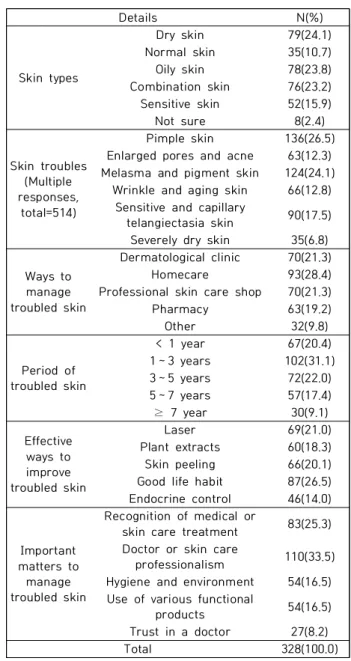
피부유형 및 피부관리 실태를 살펴본 결과는 Table 2와 같다. 피부타입은 건성피부가 24.1%, 지성피부가 23.8%, 복합성피부가 23.2%, 민감성피부가 15.9%, 중성피부가 10.7% 순이었고, 피부고민은 여드름 피부가 26.5%, 기미 색소침착 피부가 24.1%, 민감성, 모세혈관 확장 피부가

17.5%, 주름 및 노화피부가 12.8%, 넓은 모공과 흉터가 12.3%, 악건성이 6.8% 순이었다. 문제성피부 관리방법으 로는 피부과 병원이 28.4%, 전문 피부 관리실과 약국이 각 각 21.3%, 일반 피부관리실이 19.2%이었으며, 문제성피부 진행기간은 1-3년 미만이 31.1%, 3-5년 미만이 22.0%, 1 년 미만이 20.4%, 5-7년 미만이 17.4%, 7년 이상이 9.1%

순으로 나타났다. 효과적인 문제성피부 개선방법으로는 좋 은 생활습관이 26.5%, 레이저가 21.0%, 박피술이 20.1%, 식물 추출물이 18.3%, 몸의 내분비를 조절한다가 14.0%

순이었고, 문제성피부 관리 및 치료 시술 시 중요하게 생각 에서는 의사나 피부관리의 전문성이 33.5%, 메디컬이나 피 부관리 및 치료의 인지도’가 25.3%, 위생 및 환경과 다양한 기능성 제품 사이 각각 16.5%, 의사에 대한 신뢰도가 8.2%

Details N(%)

Skin types

Dry skin 79(24.1)

Normal skin 35(10.7)

Oily skin 78(23.8)

Combination skin 76(23.2) Sensitive skin 52(15.9)

Not sure 8(2.4)

Skin troubles (Multiple responses,

total=514)

Pimple skin 136(26.5)

Enlarged pores and acne 63(12.3) Melasma and pigment skin 124(24.1)

Wrinkle and aging skin 66(12.8) Sensitive and capillary

telangiectasia skin 90(17.5) Severely dry skin 35(6.8)

Ways to manage troubled skin

Dermatological clinic 70(21.3)

Homecare 93(28.4)

Professional skin care shop 70(21.3)

Pharmacy 63(19.2)

Other 32(9.8)

Period of troubled skin

< 1 year 67(20.4)

1~3 years 102(31.1)

3~5 years 72(22.0)

5~7 years 57(17.4)

≥ 7 year 30(9.1)

Effective ways to improve troubled skin

Laser 69(21.0)

Plant extracts 60(18.3) Skin peeling 66(20.1) Good life habit 87(26.5) Endocrine control 46(14.0)

Important matters to

manage troubled skin

Recognition of medical or

skin care treatment 83(25.3) Doctor or skin care

professionalism 110(33.5) Hygiene and environment 54(16.5) Use of various functional

products 54(16.5)

Trust in a doctor 27(8.2)

Total 328(100.0)

Table 2. Skin types and management situations

(5)

순이었다. 항으로는 의사나 피부관리의 전문성이 33.5%, 메디컬이나 피부관리 및 치료의 인지도가 25.3%, 위생 및 환경과 다양한 기능성 제품 사용이 각각 16.5%, 의사에 대한 신뢰도가 8.2% 순이었다. 성별에 따른 자각하는 피 부유형, 교에서는 남자는 지성, 여자는 건성, 복합성이 많 은 것으로 나타났다 성별에 따른 피부문제의 비교에서는 여자가 남자에 비해 넓은 모공과 흉터, 기미 색소침착이 높게 나타났으며, 여드름(뾰루지)는 전체 26.5%로 높게 나 타났다. 이상에서 발생하였으며, 주름 및 노화피부, 민감 성, 모세혈관확장 피부, 악건성 피부는 남자가 여자보다 높게 나타났으나 유의한 차이가 유의미하게 나타났다.

3) Skin care and treatment recognition

피부관리 인지도를 살펴본 결과는 Table 3과 같다. 피 부관리 인지도 전체의 평균은 3.67로, 메디컬스킨케어의 외적 효능(M=3.71), 메디컬스킨케어의 내재적 효능 (M=3.69), 메디컬스킨케어 항목의 인(M=3.61) 순으로 평 균이 높았다.

Details M±SD

Skin care treatment

and recognition

Recognition of medical skin

care items 3.61±.86

External effects of medical

skin care 3.71±.73

Internal effects of medical

skin care 3.69±.83

Skin care and treatment recognition 3.67±.57 Table 3. Skin care and treatment recognition

4) Skin care and treatment satisfaction

피부관리 만족도를 살펴본 결과는 Table 4와 같다. 피 부관리 만족도 전체의 평균은 3.76으로, 서비스 만족도 (M=3.80), 시설 및 환경 만족도’(M=3.76), 제품 만족도 (M=3.76), 효과 만족도(M=3.73), 경제적 비용 만족 도’(M=3.73) 순으로 평균이 높았다.

Details M±SD

Skin care and treatment satisfaction

Satisfaction at facilities and

environment 3.76±.59

Satisfaction at effects 3.73±.62 Satisfaction at service 3.80±.61 Satisfaction at economic

expenses 3.73±.64

Satisfaction at products 3.76±.61 Skin care and treatment satisfaction 3.76±.35 Table 4. Skin care and treatment satisfaction

3. Relationship among skin care situations, recognition, and satisfaction by gender

1) Difference in skin care situations by gender 성별에 따른 피부관리 실태의 차이를 살펴본 결과는 Table 5와 같다. 분석결과 성별에 따른 문제성피부 관리 방법의 차이는 유의미하였으나, 피부타입, 문제성피부 진 행기간, 효과적인 문제성피부 개선방법, 병원 선택 시 고 려사항, 문제성피부 관리 시 중요사항의 차이는 유의미한 차이를 보였다. 피부고민은 여성은 기미 색소침착 피부가 31.8%, 여드름 피부가 21.4% 순으로 높았고, 남성은 여드 름 피부가 34.0%, 민감성, 모세혈관 확장 피부가 23.8%

순으로 높았다. 문제성피부 관리방법은 여성은 피부과 병 원이 24.7%, 집에서 혼자관리 25.8%, 전문 피부 관리실이 23.7%, 약국이 14.4%로 고르게 나타났으나, 남성은 피부 과 병원이 16.2%, 전문 피부 관리실 17.9%, 집에서 혼자 관리 32.1%로 높게 나타났다( =11.795, p<.05). 선행연 구에서 신진영은[28] 피부유형이 남자가 여자보다 지성피 부가 많았고, 여자는 남자보다 건성피부가 많은것으로 성 별에 따라 유의미한 차이를 나타난 결과와 본 연구와 일치 하였다. 이는 남성이 여성보다 피지선이 커서 피지량이 많 이 분비되기 때문에 일반적으로 여성에 비하여 남성이 지 성피부가 많은 것으로 사료된다. 피부의 문제점은 여드름 은 남자가 여자보다 많고, 색소 침착은 여자가 남자보다 많다고 인식하였다. 남자의 경우는 남성호르몬의 영향으로 여드름의 발생이 많아 문제성 피부로 인식하는 경우가 많 고 여자는 임신이나 경구피임약, 자외선 등으로 인한 기 미, 주근깨, 잡티 등의 색소침착으로 인한 문제점을 인식 하는 것으로 사료된다[26].

문제성 피부관리에서 남자는 과거에 집에서 혼자 관리

하고, 여자는 피부과 병원, 전문 피부관리실을 이용한 것

으로 성별에 따라 유의미한 차이를 보였다( =11.795,

p<.05). 선행연구에서 문제성 피부 질환 치료를 위해 과거

에는 주로 집에서 관리하였으나, 현재는 더 좋은 환경과

신뢰도가 높은 메디컬스킨케어센터에서 받는 것으로 사료

된다[16][17]. 메디컬스킨케어를 받기 위해 병원 선택 시

남녀모두 유명한 체인병원과 의사의 명성이 높은 곳을 선

택하였고, 중요사항으로 의사나 피부관리의 전문성을 고려

한 것으로 나타났다.

(6)

Details Female Male Total

(p)

N(%) N(%) N(%)

Skin types

Dry skin 50(25.8) 29(21.6) 79(24.1)

7.902 (.162)

Normal skin 18(9.3) 17(12.7) 35(10.7)

Oily skin 39(20.1) 39(29.1) 78(23.8)

Combination skin 50(25.8) 26(19.4) 76(23.2)

Sensitive skin 34(17.5) 18(13.4) 52(15.9)

Not sure 3(1.5) 5(3.7) 8(2.4)

Skin troubles (Multiple responses,

total=514)

Pimple skin 66(21.4) 70(34.0) 136(26.5)

- Enlarged pores and acne 51(16.6) 12(5.8) 63(12.3)

Melasma and pigment skin 98(31.8) 26(12.6) 124(24.1) Wrinkle and aging skin 36(11.7) 30(14.6) 66(12.8) Sensitive and capillary telangiectasia skin 41(13.3) 49(23.8) 90(17.5)

Severely dry skin 16(5.2) 19(9.2) 35(6.8)

Ways to manage troubled skin

Dermatological clinic 48(24.7) 22(16.4) 70(21.3)

11.795*

(.019)

Homecare 50(25.8) 43(32.1) 93(28.4)

Professional skin care shop 46(23.7) 24(17.9) 70(21.3)

Pharmacy 28(14.4) 35(26.1) 63(19.2)

Other 22(11.3) 10(7.5) 32(9.8)

Period of troubled skin

< 1 year 42(21.6) 25(18.7) 67(20.4)

4.464 (.347)

1~3 years 59(30.4) 43(32.1) 102(31.1)

3~5 years 36(18.6) 36(26.9) 72(22.0)

5~7 years 38(19.6) 19(14.2) 57(17.4)

≥ 7 year 19(9.8) 11(8.2) 30(9.1)

Effective ways to improve troubled

skin

Laser 39(20.1) 30(22.4) 69(21.0)

1.619 (.805)

Plant extracts 34(17.5) 26(19.4) 60(18.3)

Skin peeling 37(19.1) 29(21.6) 66(20.1)

Good life habit 54(27.8) 33(24.6) 87(26.5)

Endocrine control 30(15.5) 16(11.9) 46(14.0)

Considerations to choose a

hospital

Accessibility 20(10.3) 22(16.4) 42(12.8)

8.518 (.203) Convenient transportation and parking 23(11.9) 16(11.9) 39(11.9)

Friends’ recommendation 30(15.5) 22(16.4) 52(15.9)

Famous franchise hospital 47(24.2) 40(29.9) 87(26.5)

Advertisement 15(7.7) 5(3.7) 20(6.1)

Newest medical equipment and facilities 18(9.3) 6(4.5) 24(7.3)

Doctor’s reputation 41(21.1) 23(17.2) 64(19.5)

Important matters to manage troubled

skin

Recognition of medical or skin care treatment 46(23.7) 37(27.6) 83(25.3)

1.323 (.857) Doctor or skin care professionalism 64(33.0) 46(34.3) 110(33.5)

Hygiene and environment 35(18.0) 19(14.2) 54(16.5)

Use of varous functional products 33(17.0) 21(15.7) 54(16.5)

Trust in a doctor 16(8.2) 11(8.2) 27(8.2)

Total 194(100.0) 134(100.0) 328(100.0)

* p<.05

Table 5. Difference in skin conditions and skin care situations by gender

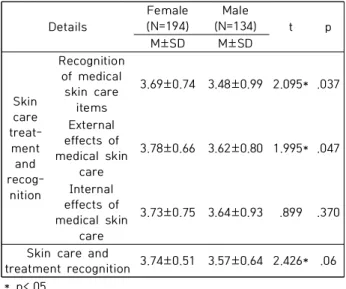
2) Difference in skin care recognition by gender 성별에 따른 피부관리 및 치료 인지도의 차이를 살펴본 결과는 Table 6과 같다. 피부관리 및 치료 인지도의 메디 컬스킨케어 항목의 인지와 메디컬스킨케어의 외적 효능은 성별에 따른 차이가 유의미하였으나, 메디컬스킨케어의 내 재적 효능은 성별에 따른 차이가 없었다[29].

피부관리 및 치료 인지도 전체는 여성(M=3.74)이 남성 (M=3.57)보다 피부관리 및 치료 인지도가 더 높았다 (F=2.426, p<.05). 특히, 메디컬스킨케어 항목의 인지

(F=2.095, p<.05)와 메디컬스킨케어의 외적 효능(F=1.995,

p<.05)에서 여성의 인지도가 더 높은 것으로 나타났다.

(7)

Details

Female (N=194)

Male

(N=134) t p

M±SD M±SD

Skin care treat- ment and recog-

nition

Recognition of medical

skin care items

3.69±0.74 3.48±0.99 2.095* .037

External effects of medical skin

care

3.78±0.66 3.62±0.80 1.995* .047

Internal effects of medical skin

care

3.73±0.75 3.64±0.93 .899 .370

Skin care and

treatment recognition 3.74±0.51 3.57±0.64 2.426* .06

* p<.05

Table 6. Difference in skin care and treatment recognition by gender

3) Difference in skin care and treatment satisfaction by gender

성별에 따른 피부관리 및 치료 만족도의 차이를 살펴본 결과는 Table 7과 같다. 피부관리 및 치료 만족도의 효과 만족도와 경제적 비용 만족도는 성별에 따른 차이가 유의 미하였으나, 시설 및 환경 만족도, 서비스 만족도, 제품 만 족도는 성별에 따른 차이가 유의수준 5%에서 유의미하지 않았다. 피부관리 및 치료 만족도 전체는 여성(M=3.72)보 다 남성(M=3.81)의 피부관리 및 치료 만족도가 더 높았다 (F=-2.175, p<.05). 특히, 효과 만족도(F=-2.320, p<.05) 와 경제적 비용 만족도(F=-2.288, p<.05)에서 남성의 만 족도가 더 높은 것으로 나타났다. 성별로는 남자가 여자보 다 효과, 서비스, 경제적 비용, 제품 만족도에 하였으며, 여자는 남자보다 시설 및 환경 만족도 하였고, 성별에 따 라 유의미한 차이를 보였다[30].

Details

Female

(N=194) Male

(N=134) t p

M±SD M±SD

Skin care and treat-

ment satis- faction

Facilities and

environment 3.77±0.55 3.75±0.66 .207 .836 Effects 3.66±0.61 3.82±0.62 -2.320* .021 Service 3.79±0.60 3.82±0.63 -.486 .628 Economic

expenses 3.66±0.67 3.82±0.58 -2.288* .023 Products 3.73±0.61 3.80±0.61 -1.017 .310 Skin care and

treatment

satisfaction 3.72±0.35 3.81±0.35 -2.175* .030

* p<.05

Table 7. Difference in skin care satisfaction by gender

IV. Conclusions

본 연구는 중국 하이난성 지역 거주하는 10대에서 50대 까지 중국 메디컬스킨케어센터를 내원한 남녀 환자들을 대상으로 2020년 12월 21일에서 2021년 1월 9일까지 성 별에 따른 피부유형 및 피부관리 방법, 피부관리 만족도에 차이가 조사분석한 결과 다음과 같은 결론을 얻었다.

분석결과 성별에 따른 피부타입은 여성은 건성피부이 고, 복합성피부순, 남성은 지성피부, 건성피부순으로 나타 났고, 피부고민은 여성은 기미색소, 여드름순이고, 남성은 여드름, 민감 및 모세혈관확장순으로 성별에 따라 차이가 나타났다. 이러한 문제성피부관리는 여성은 홈케어 및 피 부과, 남성은 홈케어와 약국으로 유의미한 차이를 나타내 었다. 진행기간은 여성은 1∼3년 미만, 1년 미만이었고, 남성은 1∼3년 미만, 3∼5년 미만으로 나타나 남성이 피 부고민이 더 높은 것으로 나타났다. 효과적인 피부 개선 방법으로는 남녀모두 좋은 생활 습관, 레이저 순으로 나타 났다. 병원 선택 시 고려 사항으로는 유명한 체인병원, 의 사의 명성이 높은 곳을 선택한 것으로 나타났다. 관리 시 중요 사항은 의사나 피부관리의 전문성, 피부관리 인지도 를 고려한 것으로 응답하였다. 피부관리 인지도는 여성은 외적, 내적인 효능 다음으로 항목의 인지순이고, 남성은 내적, 외적, 항목의 인지순으로 나타났으나, 여성이 남성 보다 높게 나타났다. 피부관리 만족도의 차이는 여성은 서 비스, 시설 및 환경, 제품순이고, 남성은 효과, 서비스, 경 제적 비용으로 남녀의 차이가 나타나. 관리만족도는 남성 이 여성보다 유의미하게 더 높은것으로 나타났다.

본 연구의 중국 하얼빈은 사계절이 뚜렷하지만 사계절의 기후변화가 커서 피부는 쉽게 건조해지고 민감하며 모세혈 관 확장 등 피부문제가 많이 나타나는 영하의 온도시점에서 대상자 선정은 연구 제한점을 일반화하는데 다소무리가 있 다. 추후 기후변화에 따른 피부 상태를 관찰할 필요성을 제 언하고자 한다, 이상과 같은 결과로 중국 메디컬스킨케어센 터를 내원한 남녀 환자들이 피부에 대한 정확한 정보와 피부 관리 인지도/만족도 정보를 통해 향후 중국인들에게 문제성 피부 피부관리 행동을 이끌기 위해서는 성별에 따라 관리치 료 방법과 다양한 제품 개발 및 체계적인 피부관리 프로그램 개발이 이루어져야 할 것으로 사료된다.

REFERENCES

[1] S. M. Park. An effect of preference for Korean wave of Chinese

in their 20s-30s on beauty salon using behavior and loyalty on

(8)

Korean beauty. Seokyeong University School of Beauty Arts.

Master's thesis. Feb. 2012

[2] M. Zhao. A Study on Consumer Behavior of Medical Skin Care Service by Medical Skin Care Behavior of Chinese Women.

Kwangju Women's University School of Beauty Science. Doctoral dissertation. Aug. 2019

[3] H. Zheng., and S. H. Wang. Dermatology and Venerology Branch of Chinese Medical Association. Expert Consensus on Clinical Application of Hydroxy Acid Chemical Stripping. Chinese Journal of Dermatology, Vol.25, No.4, pp.213-214, Apr. 2015, No:

1004-2814(2015), 04–212-02

[4] X. B. WU. Comparison of Skin Condition, Skin Care Perception, and Skin Care Behaviors between Korean and Chinese Female College Students. Kwangju Women's University School of Beauty Science. Master's thesis. Aug. 2014

[5] E. J. Choi. A Study on the Status of the Utilization of the Medical Skin Care -Focused on the Women in Daejeon City-. Hannam University School of Socio Culture Cosmetic Beauty. Master's thesis. Aug. 2005

[6] Q. Zheng., and S. Y. Lee. The basic concept and mechanism of laser therapy. Chinese Medical Cosmetology, Jun. 2016. DOI:

10.39769/j.issn.1001 -1703.2016.06.005

[7] S. M. Lee. An Analysis on Jobs for Growing Medical Skin Care Personnel and Their Importance. Sungkyul University School of Cosmetic Education. Master's thesis. Jun. 2020

[8] Y. H. Lee. A Study on the Use of Medical Esthetics and Satisfaction Level. Sookmyung Women's University School of Distance Learning. Master's thesis. Jun 2015

[9] M. H. Shin. A Study on the Use of Cleansing Products and the Relationship between Skin Care and Skin Type. Hansung University School of Beauty Art & Design Art. Master's thesis.

Jun. 2017.

[10] M. Han. Chinese Women’s Skin Type and Cosmetics Purchase Behavior. Kwangju Women's University School of Beauty Science. Master's thesis, Aug. 2015

[11] H. Lee, and S. Y. Lin. Clinical Sensitive Skin Management Strategies. International Journal of Dermatology and Venereology, No.24, pp.140-162. Jun. 2014

[12] Y. J. Jang. Pigmentology Group of Dermatology and Venereal Diseases Committee of Chinese Association of Integrated Traditional and Western Medicine. Journal of Dermatology, No.4, pp.40-55. Dec. 2007. DOI: 10.3969/j.issn.1050-4275.2007.12. 018 [13] K. E. Kim., and D. Qiao. Air Pollution and Skin Diseases Adverse

Effects of Airborne Particulate Matter on Various Skin Diseases.

Journal of Life Sciences, Vol.52, No.16, pp.126-134, Jul. 2017 [14] M. Han. Chinese Women’s Skin Type and Cosmetics Purchase Behavior. Kwangju Women's University School of Beauty Science. Master's thesis. Aug. 2015

[15] N. JIN. A Comparison of Acne Recognition and Actual

Conditions in University Students in Shandong Area of China.

Kwangju Women's University School of Beauty Science.

Master's thesis. Feb. 2014

[16] S. Y. Kim. An Analysis on Moderating Effect of Customer's Trust to Medical Skin Care Therapists on the Relation Between Customer's Awareness and Satisfaction. Seoul Venture University school of Beauty Health. Master's thesis. Jan. 2013

[17] S. E. Kim. A Study of the Knowledge and the Management of Skin Health Among the Male Adults in Korean Society Skin Care and Obesity Management. Sungshin Women’s University School of Cultural Industry. Master's thesis. May. 2006.

[18] S. Zheng. Research on the Influence of Hospital Medical Service Quality on Customer Satisfaction and Behavioral Intention. Wusong University School of Business. Master's thesis. May. 2011 [19] Kim. J. H. The influence of the appearance interest of the 20-30

age group on the perception of skin health care and practice behavior. Hansung University School of Beauty Art & Design Art. Master's thesis. Dec. 2018

[20] Y. Jin. A Study on Awareness of Medical Skincare and Satisfaction.

Major in Cosmetic & Beauty, Sookmyung Women's University School of Distance Learning. Master's thesis. Jul. 2008 [21] J. X. Chen. Comparisons Between China Guangdong Female

Twenties and Thirties in Korean Makeup Usage and Buying Action. Kwangju Women's University School of Beauty Science.

Master's thesis. Feb. 2019

[22] Y. Gao. The Effects Skin Care Behavior On the Skin Knowledge and Attitude of Some Female College Students in China.

Dongshin University School of Beauty and Cosmetics. Master's thesis. Jun. 2012

[23] J. E. Lee. A Study on the State of Medical Skin Care and Satisfaction Level. Sookmyung Women's University School of Distance Learning Cosmetic and Beauty. Master's thesis. Dec. 2014 [24] S. E. Rho. Customer Satisfaction and the Intent of Reutilization

for the Facility of General Skin Care and Medical Skin Care.

Daegu Haany University School of Public Health. Master's thesis.

Feb. 2011

[25] E. J. Lee. A Study on Factors in Selecting Hospital for Medical Skin Care Treatment in 20s-40s. Konkuk University School of Cosmetology Engineering. Master's thesis. Dec. 2018 [26] N. Y. Kim. Skin Conditions by Gender of Chinese Students in

Korea. Honam University School of Industry and Business Administration Art and Design. Master's thesis. Aug. 2015 [27] J. Y. Choi. Study on Adult Males' Knowledge of Skin and

Individual Skin Care Practice. Sungshin Women's University School of Cultural Industry Skin Care and Obesity Management.

Master's thesis. Nov. 2011

[28] J. Y. Shin. A Study on Awareness of Medical Skin Care and

Satisfaction. Sookmyung Women's University School of Distance

Learning Cosmetic & Beauty. Master's thesis. Jun. 2009

(9)

[29] H. L. Song. Influence of Counseling Service Quality of Cosmetic Dermatology Hospital on Use of Cosmetic Medical Procedure and Purchase of Cosmetics. Konkuk University School of Engineering Cosmetology. Master's thesis. Aug. 2017 [30] E. J. Jeong. A Study on the Medical Esthetic Conditioning

Customer Satisfaction and Reformation Plan. Chung-Ang University School of Food and Drug Administration Cosmetic

& Beauty. Master's thesis. Jun. 2016

Authors

Yue Jia. Ph. D. course in the Department of Beauty Science, Kwangju Women's University. Yijia Medical Cosmetic Surgery Hospital, Haikou City, Position: Medical and Beauty Consultant

Kyeong-Ran Kim Ph. D. in skin cosmetology, Wonkwang University in 2010.

Professor in the Department of Beauty Science, Kwangju Women's University.

Policy adviser of the Grwangju Future

Industry Promotion Committee and the TFT Committee of

Gwangju Metropolitan City in 2004. Interested in the

wellness beauty industry.

수치

Table  2.  Skin  types  and  management  situations
Table  5.  Difference  in  skin  conditions  and  skin  care  situations  by  gender
Table  6.  Difference  in  skin  care  and  treatment  recognition  by  gender

참조

관련 문서

The results of the study on how Boswellia affects the hair cycle of the inflammatory skin(? scalp) caused by DNCB in mice are as follows, Experimental method : 5 week-old

Actinic keratoses showed a trend towards increased expression in the basal layer compared with normal skin.. In actinic keratoses, Keratoacanthomas and seborrheic

Mean Value and Skin Improvement Effect that Prepare of 50 year-old Korean by Black Soybean Powder E xtract Applied to the Human Skin ……… 32 Fig.. Correlation

Comparison of the acyclovir fluxes across hairless mouse skin and artificial membranes (polyether block amide (PBA) membrane, polyurethane (PU) membrane,

tricuspidata on the production of proinflammatory cytokines in TNFα+IFNγ-stimulated HaCaT cells ...15 Fig.5: The cell viability of sub-fractions from 70% EtOH

Objective: The purpose of this study was to investigate the expression of syndecan-1, E-cadherin, and beta-catenin in tissue sections of normal sun-damaged skin,

Herb Extract which exhibit several bene ficial effects including acne(pimple) and skin diseases was tested for antimicrobial activity and antiinflammation

This study aims to suggest a basic data for the activation of aromatherapy pimple treatment program with the pimple skin care and treatment by testing the actual