• 검색 결과가 없습니다.

Effect Analysis of Worldview-3 SWIR Bands for Wetland Classification in Suncheon Bay, South Korea

N/A
N/A
Protected

Academic year: 2021

Share "Effect Analysis of Worldview-3 SWIR Bands for Wetland Classification in Suncheon Bay, South Korea"

Copied!
9
0
0

로드 중.... (전체 텍스트 보기)

전체 글

(1)

https://doi.org/10.7848/ksgpc.2018.36.5.371

Effect Analysis of Worldview-3 SWIR Bands for Wetland Classification in Suncheon Bay, South Korea

Han, Youkyung

1)

· Jung, Sejung

2)

· Park, Honglyun

3)

· Choi, Jaewan

4)

Abstract

Unlike general VHR (Very-High-Resolution) satellite sensors that are mainly for panchromatic and MS (Multispectral) imaging, Worldview-3 sensor additionally provides eight SWIR (Short Wavelength Infrared) bands in wavelength range from 1198 nm to 2365 nm. This study investigates the effect of informative Worldview-3 SWIR bands for wetland classification performance. Worldview-3 imagery acquired over Sunchon Bay, which is a coastal wetland located in South Korea, is used to implement the classification. Land-cover classes for the scene are determined by referring to national land-cover maps, which are provided by the Ministry of Environment, overlapped with the scene. After that, training data for each determined class are collected. In order to analyze the effect of SWIR bands, classifications with and without SWIR bands are carried out and the results are then compared. In this regard, a SVM (Support Vector Machine) is utilized as their classifier. As a result of the accuracy assessments performed by test data that are independently extracted from training data, it was confirmed that classification performance was improved when the SWIR bands are included as input features for SVM-based classification.

Keywords : Wetland Classification, Shortwave Infrared, Worldview-3, Suncheon Bay

Original article

Received 2018. 09. 21, Revised 2018. 10. 08, Accepted 2018. 10. 28

1) Member, School of Convergence & Fusion System Engineering, Kyungpook National University (E-mail: [email protected]) 2) School of Convergence & Fusion System Engineering, Kyungpook National University (E-mail: [email protected])) 3) Member, School of Civil Engineering Chungbuk National University (E-mail: [email protected])

4) Corresponding Author, Member, School of Civil Engineering Chungbuk National University (E-mail: [email protected])

1. Introduction

Recently, in addition to KOMPSAT series operated by Korea, there are many worldwide global observation satellites that are equipped with VHR (Very-High-Resolution) sensors such as GeoEye-1, Worldview-3, TerraSAR-X, and so on.

Among them, the Worldview-3 satellite launched on August 13, 2014 is capable of obtaining high spatial resolution and high spectral resolution images at the same time. Specifically, it provides a panchromatic image with a spatial resolution of approximately 0.31m and 8 bands of a MS (Multispectral) image with a spatial resolution of approximately 1.24m.

Unlike other high-resolution satellites, the Worldview-3 satellite also offers 8 SWIR (Short Wavelength Infrared) bands with a spatial resolution of 3.7m and 12 CAVIS (Clouds,

Aerosols, Vapor, Ice, Snow) bands with a spatial resolution of 30m.

The SWIR typically means light emitted from a wavelength range of 1.05 to 2.5 μm . The SWIR has a wide infrared spectrum that allows researchers and experts in the remote sensing field to obtain important information. For example, it is possible to find man-made/natural materials on the Earth’s surface (Kruse and Perry, 2013), to discriminate crop (Panigrahy et al ., 2009), to classify mangrove species (Wang et al ., 2015), and so on. In particular, the SWIR bands in Worldview-3 provide 8 times as much the spatial information content as SWIR data provided by Landsat-8 (i.e., 30 m), thereby providing a high degree of reliability in interpreting and making decisions with high-resolution images. Therefore, this sensor is a significant tool for a wide range of remote

This is an Open Access article distributed under the terms of the Creative Commons Attribution Non-Commercial License (http://

(2)

sensing applications.

Satellite images are the most economical solution for the land-cover classification with respect to water bodies.

However, classifying water-related regions such as wetlands, coastal areas, and the transition zone between land and water is probably the most challenging part of the land-cover classification. Most of all, the content of wetland is more diverse than other regions, making the classification difficult.

In addition, the weather also has a huge impact on wetland classification since wetlands tend to have a local characteristic of heavy fog.

The aforementioned difficulties on wetland classification can be solved by using SWIR bands. In contrast to land, water strongly absorbs light from SWIR range. Due to this high absorption rate, water looks mostly opaque or black in images acquired from those wavelengths. On the other hand, algae and other moss at the surface of the water have a higher reflectivity of NIR (Near-Infrared) and SWIR bands than other wavelengths so that those bands make them easier to distinguish from the surrounding system (Hu, 2009).

However, the coastal areas have difficulty in sorting with the NIR band images because of suspended solids and aerosol that are highly affected on those images (Lee et al ., 2001).

Therefore, rather than NIR bands, SWIR bands can be an alternative to classify wetlands (Ye et al ., 2016).

There are studies that exploit SWIR band images to extract water-related information. Waterline was extracted from SWIR bands of Landsat TM data (Ryu et al ., 2002). Becker et al . (2007) tried to find the optimal spectral and spatial resolutions for coastal wetland classification. Wolski et al . (2017) demonstrated that the SWIR band makes clear the distinction between dry and flooded areas in wetlands. An ocean color index to detect floating algae in the global oceans was also introduced (Hu, 2009).

This study investigates the effect of the informative Worldview-3 SWIR bands for wetland classification performance. To this end, Worldview-3 imagery acquired over Sunchon Bay, which is a coastal wetland located in South Korea, is used to implement the classification. To analyze the effect of SWIR bands, a SVM (Support Vector Machine)- based classification with and without SWIR bands is carried

2. Dataset Construction

2.1. Worldview-3

The Worldview-3 satellite was launched in August 13, 2014.

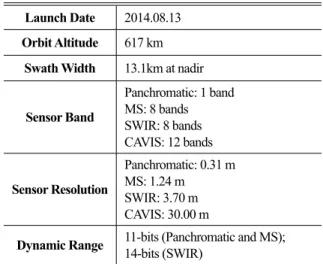
It provides panchromatic, MS, SWIR, and CAVIS bands with 0.31 m, 1.24 m, 3.70 m, and 30.00 m spatial resolutions, respectively. Focusing on spectral resolution, it provides 8 MS bands, 8 SWIR bands, and 12 CAVIS bands. The MS bands are composed of coastal (400 - 450 nm), blue (450 - 510 nm), green (510 - 580 nm), yellow (585 - 625 nm), red (630 - 690 nm), red edge (705 - 745 nm), NIR1 (770 - 895 nm), and NIR2 (860 - 1040 nm). In the case of 8 SWIR bands, their main wavelengths are 1195 - 1225 nm, 1550 - 1590 nm, 1640 - 1680 nm, 1710 - 1750 nm, 2145 - 2185 nm, 2185 - 2225 nm, 2235 - 2285 nm, and 2295 - 2365 nm. Additionally, the worldview-3 provides 12 CAVIS bands that have an advantage of monitoring the atmosphere with relatively lower spatial resolution of 30 m. The detailed specification of the Woldview-3 satellite is summarized in Table 1.

Table 1. Specification of Worldview-3 Launch Date 2014.08.13

Orbit Altitude 617 km Swath Width 13.1km at nadir

Sensor Band

Panchromatic: 1 band MS: 8 bands SWIR: 8 bands CAVIS: 12 bands

Sensor Resolution

Panchromatic: 0.31 m MS: 1.24 m

SWIR: 3.70 m CAVIS: 30.00 m

Dynamic Range 11-bits (Panchromatic and MS); 14-bits (SWIR)

2.2. Study site

The Worldview-3 imagery acquired from Suncheon Bay

in July 26, 2015 is used for experiments regarding wetland

classification. Suncheon Bay, a coastal wetland located in

Suncheon, South Korea, has a vast mudflats formed by the

tidal action of the sea that cause soil and organic matter to flow

along the river. The total area of the mudflats reaches 22.6㎢,

(3)

and the area of the mudflats that is revealed at low tide is 12㎢.

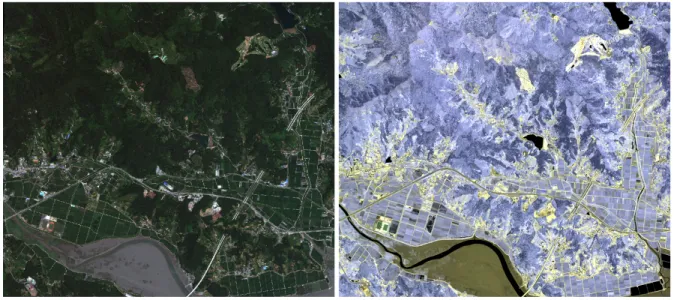
In addition, a large reed colony covers 5.4㎢ of land, and the mudflats and reed beds are abundant. Those characteristics of the Suncheon Bay allow for conducting experiments that can investigate the effect of Worldview-3 SWIR bands for the wetland classification. The study site displayed with a true- color is presented in Fig. 1(a). The site displayed with false- color composition of the SWIR bands (i.e., RGB channel =

SWIR 4, SWIR 2, and SWIR 1 bands, respectively) is also shown in Fig. 1(b). Compared to the true-color image, water- related regions are visually emphasized with high-contrast colors in the false-color image, meaning that those SWIR bands are effective to discriminate such regions.

Land-cover classes for the scene are determined by visual inspection referring to the Worldview-3 imagery and national land-cover maps provided by the Ministry of Environment

(a) (b)

Fig. 1. Study Site displayed with (a) RGB = MS 5, MS 3, MS 2 (true-color composition) (b) RGB = SWIR 4, SWIR 2, SWIR 1 (false-color composition)

Table 2. Reference data for classification

Class Reference Data Class Reference Data

Urban Area Lake

Road Water

Paddy Field Wetland1

Bare Soil Wetland2

Farm Wetland3

Forest

(4)

overlapped with the scene. According to the visual analysis, a number of 11 classes has been selected for the classification of the scene: urban, road, paddy field, bare soil, farm, forest, lake, water, wetland1, wetland2, and wetland3. It should be noted that there are 5 water body classes (i.e., lake, water and three kinds of wetlands). Depending on the presence of algae or moisture content, the wetlands have a large variation in their spectral characteristics. Therefore, wetlands have been classified into three categories. Accordingly, training and test data have been discriminated by visual analysis of the Worldview-3 imagery and other VHR aerial and satellite images that are able to figure out the water’s properties (Table 2). The selected classes and extracted number of pixels according to each class are listed in Table 3.

3. Methodology

For an effective analysis of the Worldview-3 SWIR bands for wetland classification performance, a geometric preprocessing is conducted. First, a SRTM (Shuttle Radar Topography Mission)-based DEM (Digital Elevation Model) is employed to generate an ortho-rectified Worldview-3 imagery. After that, the SWIR bands are resampled to the same spatial resolution of MS bands. Even though the ortho-

geometric misalignments between multi-sensor bands (i.e., MS and SWIR bands) due to different spatial resolutions and sensor properties. Therefore, a co-registration process between MS and SWIR bands is carried out based on phase correlation approach (Han and Choi, 2015). Since the classification-based comparison is carried out, a specific radiometric correction is not necessary.

As mentioned, Land-cover classes for the scene are determined by visual inspection referring to the Worldview-3 imagery and national land-cover maps, after which the training data for each determined class are collected.

Especially, we selected 5 water-related classes (i.e., water, lake, wetland1, wetland2, and wetland3) more in detail compared to other classes defined in the national land-cover map since the aim of the paper is to classify those classes specifically. In order to analyze the effect of SWIR bands, classifications are carried out with various combinations of input features. Among the SWIR bands, the wavelength of SWIR-3 (1640 - 1680 nm) and SWIR-4 bands (1710 - 1750 nm) is known to be capable of utilizing for extraction of water- related properties (Shi and Wang, 2009). Therefore, the SWIR- 3 (1640 - 1680 nm) and SWIR-4 (1710 - 1750 nm) bands are used as representative SWIR bands for the classification.

Totally 4 cases of different input feature combinations for the Table 3. Determined land-cover classes and number of the training and test data for each class

Class Color Number of Training Pixels Number of Test Pixels

Urban Area 362 355

Road 135 122

Paddy Field 1003 1008

Bare Soil 163 152

Farm 888 871

Forest 904 915

Lake 534 334

Water 645 651

Wetland1 286 271

Wetland2 389 356

Wetland3 873 865

(5)

1) 8 MS bands: All the 8 MS bands that Worldview-3 sensor provides are selected for a base comparison to analyze the effect of the SWIR bands for wetland classification. We call it 8MS hereafter.

2) 8 SWIR bands: All the SWIR bands are used as input features to investigate the effect of the SWIR bands for wetland classification. We call it 8SWIR hereafter.

3) 8 MS bands with SWIR-3 (1640 - 1680 nm) and SWIR-4 (1710 - 1750 nm) bands: The SWIR-3 (1640 - 1680 nm) and SWIR-4 (1710 - 1750 nm) bands known as suitable wavelengths to discriminate water-related regions are combined with MS bands as input features to investigate the case when MS and representative SWIR bands are used together for wetland classification. We call it 8MS+2SWIR hereafter.

4) 8 MS bands and 8 SWIR bands: All the 8 MS and 8 SWIR bands are combined as input features for wetland classification. We call it 8MS+8SWIR hereafter.

To implement the classification, a SVM, which is a statistical learning theory developed by Cortes and Vapnik (1995) for binary grouping and regression analysis, is used as a classifier. The SVM technique is effective in the classification of land cover because it enables a nonlinear separation among classes using a kernel function (Choi et al ., 2006). For a qualitative analysis, we estimate the classification accuracies

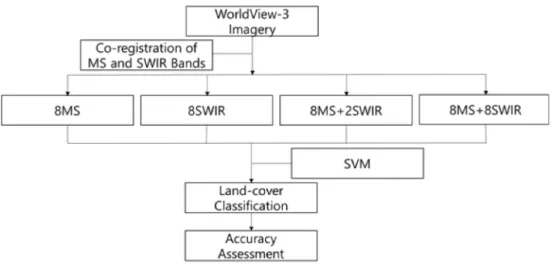
of all the cases by using the test data independently extracted from the training data (Table 3). The flowchart of the proposed approach is presented in Fig. 2.

4. Experimental Results

The SVM-based classification is carried out with 4 different input features, and their results are presented in Fig. 3. As one can see from the visual inspection on classification acquired by 8 MS bands (Fig. 3(a)), land-related classes such as urban and road tended to be misclassified as water-related classes (e.g., watland1, wetland2, wetland3, etc.). When only 8 SWIR bands were used, it showed large amount of misclassified pixels both on land and water classes. Moreover, the classification result of large wetland areas located in lower part of the scene showed different patterns with other classification results. These results may due to the following reasons that wavelength of SWIR bands cannot effectively describe diverse land and water classes. Moreover, the SWIR bands have relatively poor spatial resolution than the MS bands. In the case of the classification applied by combining MS and SWIR bands (i.e., Figs. 3(c) and 3(d)), better classification results were presented both in land-related and water-related classes in general.

A part of the classification results related to water classes is magnified to clearly visualize the performance according to different band combinations (Fig. 4). It can be seen that

Fig. 2. Flowchart of the classification by different combination of MS and SWIR bands

(6)

the classification conducted by combining MS and SWIR bands (Fig. 4(d) and (e)) is more effective to discriminate the wetland areas than only using MS (Fig. 4(b)) or SWIR bands (Fig. 4(c)). In the classification result by only using the MS bands, some wetlands were misclassified to urban areas. In the case of the classification result by only using the SWIR

bands, a large amount of errors occurred between water and farm classes. Those errors were significantly minimized by implementing the classification using the MS and SWIR bands simultaneously.

For qualitative analysis, we estimated the classification accuracies for the 4 cases by extracted test data for each

Class Color

Urban Area Road Paddy Field

Bare Soil

Class Color

Farm Forest

Lake Water

Class Color

Wetland1 Wetland2 Wetland3 (a)

(c)

(b)

(d)

(7)

Class Color Urban Area

Road Paddy Field

Bare Soil Farm Forest

Class Color

Lake Water Wetland1 Wetland2 Wetland3 (a)

(c)

(e)

(b)

(d)

Fig. 4. Comparison of classification results focusing on wetland area: (a) RGB, (b) 8MS, (c) 8SWIR

(d) 8MS+2SWIR (e) 8MS+8SWIR

(8)

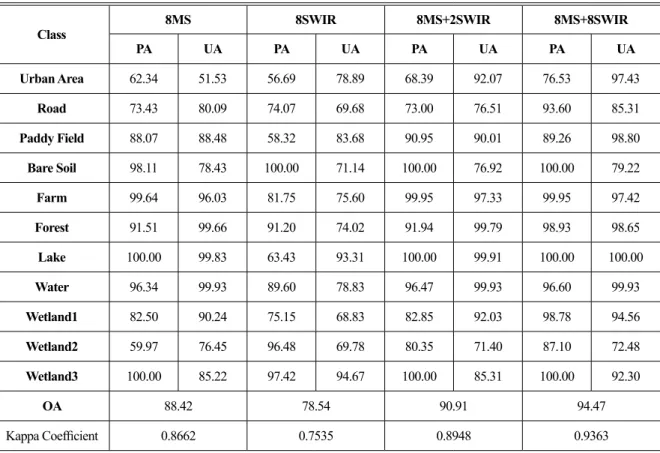
class (Table 4). The result only using the MS bands showed the overall accuracy around 88.42%. Compared to that, the classification result conducted with only SWIR bands had lower accuracy of 78.54%. It was revealed that the effective way to classify the wetland scene is to use the MS and SWIR bands simultaneously. It was demonstrated by the classification accuracy acquired from MS bands with SWIR- 3 and SWIR-4 bands over 90%. When all the MS and SWIR bands are used, the accuracy improved up to 94.47%.

5. Conclusions

This study investigated the effect of the informative Worldview-3 SWIR bands for wetland classification performance. Worldview-3 imagery acquired over Sunchon Bay, a coastal wetland located in South Korea, is used to

by SVM classifier with 4 different input features were compared: 1) 8 MS bands, 2) 8 SWIR bands, 3) 8 MS bands with 2 SWIR bands (1640 - 1680 nm and 1710 - 1750 nm), and 4) 8 MS bands with 8 SWIR bands. As a result of the accuracy assessments, it was confirmed that classification performance was improved when SWIR bands are used together with MS bands as input features for wetland classification. The classification accuracies conducted by using 8 MS bands with 2 SWIR and 8 SWIR bands were 90.91% and 94.47%, respectively. As a future work, an object-based approach will be applied to the VHR classification. Moreover, water-related indices such as normalized difference water index (NDWI) generated from MS and SWIR bands will be investigated and combined as input features to improve the wetland classification performance.

Table 4. Comparison of classification accuracy according to features’ combination (unit: %)

Class 8MS 8SWIR 8MS+2SWIR 8MS+8SWIR

PA UA PA UA PA UA PA UA

Urban Area 62.34 51.53 56.69 78.89 68.39 92.07 76.53 97.43

Road 73.43 80.09 74.07 69.68 73.00 76.51 93.60 85.31

Paddy Field 88.07 88.48 58.32 83.68 90.95 90.01 89.26 98.80

Bare Soil 98.11 78.43 100.00 71.14 100.00 76.92 100.00 79.22

Farm 99.64 96.03 81.75 75.60 99.95 97.33 99.95 97.42

Forest 91.51 99.66 91.20 74.02 91.94 99.79 98.93 98.65

Lake 100.00 99.83 63.43 93.31 100.00 99.91 100.00 100.00

Water 96.34 99.93 89.60 78.83 96.47 99.93 96.60 99.93

Wetland1 82.50 90.24 75.15 68.83 82.85 92.03 98.78 94.56

Wetland2 59.97 76.45 96.48 69.78 80.35 71.40 87.10 72.48

Wetland3 100.00 85.22 97.42 94.67 100.00 85.31 100.00 92.30

OA 88.42 78.54 90.91 94.47

Kappa Coefficient 0.8662 0.7535 0.8948 0.9363

(PA: Producer’s Accuracy, UA: User’s Accuracy, OA: Overall Accuracy)

(9)

Acknowledgment

This research was supported by Basic Science Research Program through the National Research Foundation of Korea (NRF), which is funded by the Ministry of Education (NRF- 2017R1D1A3B03034602).

References

Choi, J.W., Byun, Y.G., Kim, Y.I., and Yu, K.Y. (2006), Support vector machine classification of hyperspectral image using spectral similarity kernel, Journal of the Korean Association of Geographic Information Studies , Vol. 14, No. 4, pp. 71-77. (in Korean with English abstract) Cortes, C. and Vapnik, V. (1995), Support-vector networks,

Machine learning, Vol. 20, No. 3, pp. 273-297.

Feng, L., Hu, C., Chen, X., Cai, X., Tian, L., and Gan, W.

(2012), Assessment of inundation changes of Poyang Lake using MODIS observations between 2000 and 2010, Remote Sensing of Environment , Vol. 121, pp. 80-92.

Han, Y.K. and Choi, J.W. (2015), Matching points extraction between optical and TIR images by using SURF and local phase correlation, Journal of Korean Society for Geospatial Information System , Vol. 23, No. 1, pp. 81-88.

(in Korean with English abstract)

Hu, C. (2009), A novel ocean color index to detect floating algae in the global oceans, Remote Sensing of Environment , Vol. 113, No. 10, pp. 2118-2129.

Kruse, F.A. and Perry, S.L. (2013), Mineral mapping using simulated Worldview-3 short-wave-infrared imagery, Remote Sensing , Vol. 5, No. 6, pp. 2688-2703.

Lee, K.S., Kim, T.H., Yun, Y.S., and Shin, S.M. (2001), Spectral characteristics of shallow turbid water near the shoreline on inter-tidal flat, Korean Journal of Remote Sensing , Vol. 17, No. 2, pp. 131-139.

Panigrahy, R.K., Ray, S.S., and Panigrahy, S. (2009), Study on the utility of IRS-P6 AWIFS SWIR band for crop discrimination and classification, Journal of the Indian Society of Remote Sensin g, Vol. 37, No. 2, pp. 325-333.

Ryu, J.H., Won, J.S., and Min, K.D. (2002), Waterline extraction from Landsat TM data in a tidal flat: a case study in Gomso Bay, Korea, Remote Sensing of

Environment , Vol. 83, No. 3, pp. 442-456.

Shi, W. and Wang, M. (2009), An assessment of the black ocean pixel assumption for MODIS SWIR bands, Remote Sensing of Environment , Vol. 113, No. 8, pp. 1587-1597.

Wang, T., Zhang, H., Lin, H., and Fang, C. (2015), Textural–

spectral feature-based species classification of mangroves in Mai Po Nature Reserve from Worldview-3 imagery, Remote Sensing , Vol. 8, No. 1, pp. 24-38.

Wolski, P., Murray-Hudson, M., Thito, K., and Cassidy, L.

(2017), Keeping it simple: Monitoring flood extent in large data-poor wetlands using MODIS SWIR data, International Journal of Applied Earth Observation and Geoinformation , Vol. 57, pp. 224-234.

Ye, H., Li, J., Li, T., Shen, Q., Zhu, J., Wang, X., and Zhang,

B. (2016), Spectral classification of the Yellow Sea and

implications for coastal ocean color remote sensing,

Remote Sensing , Vol. 8, No. 4, pp. 321-343.

수치

Table 1. Specification of Worldview-3 Launch Date 2014.08.13
Fig. 1. Study Site displayed with (a) RGB = MS 5, MS 3, MS 2 (true-color composition)   (b) RGB = SWIR 4, SWIR 2, SWIR 1 (false-color composition)
Fig. 2. Flowchart of the classification by different combination of MS and SWIR bands
Fig. 4. Comparison of classification results focusing on wetland area: (a) RGB, (b) 8MS, (c) 8SWIR  (d) 8MS+2SWIR (e) 8MS+8SWIR
+2

참조

관련 문서

A Systematics and Ecological Notes on Marine Polychaetes (Annelida, Polychaeta) from Korea, with the Secondary Production of Hediste japonica Population in Suncheon

Learning Korean is essential to understand Korean culture and live in Korea with fewer obstacles. Fortunately, there are many institutions in Korea offering Korean language

Sources: metal plating, rechargeable batteries, smelting (제련), refining, mine drainage, industrial wastewater, corrosion of galvanized pipe in the water distribution

This is because compared with the free-year English classes, the general semester English classes consisted of teacher oriented grammar class and reading

First, uniformity in the form of cooperative classes recommended by the Korea Culture, Arts and Education Promotion Agency, the main body of the support

So, the result of the comparative analysis in the social studies object, curriculums and textbooks of South and North Korea indicate that the differences

In this study, water flow system of Danghang Bay, which has the narrow and long topographical characteristics with the narrow bay mouth and its flow

 Dilute water means separating water molecules and make it more difficult for them to