http://dx.doi.org/10.12925/jkocs.2020.37.6.1489
Characterization of soil, vegetation, and soil fungal community in Cheongsu Gotjawal Forest
Jong-Shik Kim
1,✝ ․ Dae-Shin Kim
2Marine Industry Research Institute for East sea rim, Uljin 36315, Republic of Korea World Heritage Office, Jeju Special Self-Governing Provincial Government,
Jeju 63341, Republic of Korea
(Received October 13, 2020; Revised December 15, 2020; Accepted December 17, 2020)
Abstract : Gotjawal, Jeju Island, Korea is a lava-formed forest with low soil content that is unique in the world. Around 6 percent of the Jeju Iand is classified as a lava-based specific forest.
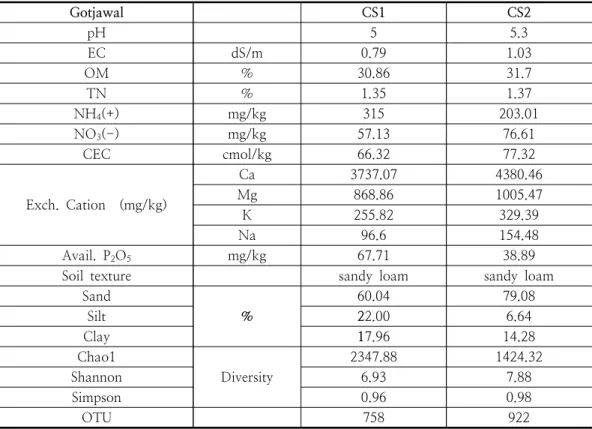
The forest has been gradually disappearing during the last several decades, with approximately one half having been destroyed. Our study undertakes a detailed analysis of the landscape of the lava subsidence, and describes the fungi, vegetation, and soils of Cheongsu Gotjawal. Soil samples from the Gotjawal were collected, and soil analyses as well as pyrosequencing of the internal transcribed spacer gene for fungal communities were performed. Soil fungal communities are represented by Discisedars , Fusarium , Pleochaeta, and Fuscoporia genera. Endemic vegetation of the Gotjawal includes the plants Pleris critical , Machilus japonica, Quercus glauca, Arachniodes aristata, and Neocheiropteris ensata. Results of soil analysis indicate sandy loam with 31.70% organic matter, and 1.36 mg/kg of total nitrogen. This fundamental information can help understand the invaluable and unique nature of Cheongsu Gotjawal, and the necessity for more studies on Gotjawal.
Keywords : Soil, Fungi, Vegetation, Gotjawal, Cheongsu Gotjawal forest
1. Introduction
Gotjawal is a low-soil forest that is unique in the world [1, 2, 3]. Representative Gotjawal microbial diversity was analyzed; in addition to analyzing soil microbial diversity, soil characterization was elucidated for the first time [4]. The study showed high values for organic matter (OM), NO
3, iron, and Al concentrations.
✝